Word of God in Bulk

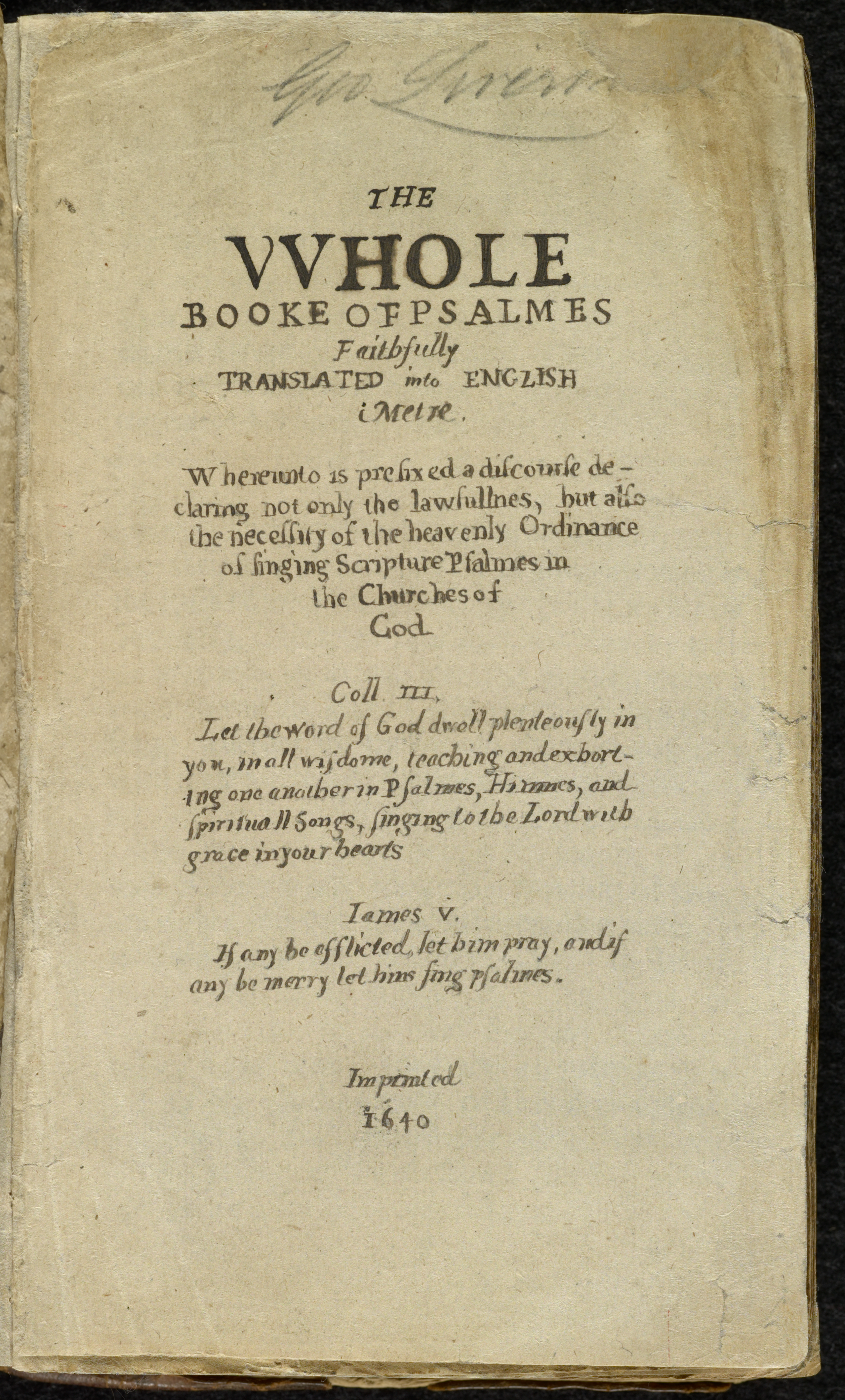
Bay_Psalm_Book_LoCThe Salem witch trials were still half a century in the future. The Puritans, hoping for religious freedom, had come to Massachusetts. Despite prevailing attitudes toward the religious, the Puritans were keen on learning and began printing books. The first book printed in English in North America was the Bay Psalm Book. You see, the Psalms have a particularly important place in Christian (and Jewish) worship. In fact, much of what would later develop into the daily offices in the Church of England, adapted from the breviaries of the Roman Catholic Church, were services that started essentially as vehicles for reciting the Psalms. It is fair to say that Christian worship might have never taken on the elaborate forms that it has without the underlying recitation of the Psalter. The Bay Psalm Book, printed in 1640, is now the most expensive book ever sold at auction. According to the New York Times, one of the eleven known Bay Psalm Books has just sold for over 14 million dollars. The Bible has a way of continuing to surprise us.

As someone who has more Bibles than your average layperson, I find it isn’t difficult to think that Bibles are fairly common. They are. I actually switched to The Green Bible in my classes out of the ecological concern that there have been over six billion Bibles printed. The Gideons give them away, and even the Christian heavy metal band Stryper used to throw handfuls of Bibles into the crowds. Chances are, in the United States, you are not physically far from a Bible at any given moment. So why would someone pay 14 million dollars for one? The answer goes deeper than the suggestion that the Psalms contain timeless truths—you can get those free on the internet anytime—but that it is part of our heritage. We are who we are, in part, because of the “Bible believing” founders of our culture. Survival was not taken for granted in the mid-seventeenth century. The Bible was a pillar of certainty in dangerous times.

Yes, interpretations of the Bible have led to horrendous results. There is no point in denying the guilt. Hermeneutics, however, is a human activity. The Bible gives as well as takes away. Some of us may never have a million dollars to spend. Many people don’t have enough to eat. Specialists tell us that some 45 million Bibles are printed each year. Bibles are big business. In the words of Big Dan from O Brother, Where Art Thou? “Sales, Mr. McGill, sales! And what do I sell? The Truth! Ever’ blessed word of it, from Genesee on down to Revelations! That’s right, the word of God, which let me add there is damn good money in during these days of woe and want! Folks’re lookin’ for answers and Big Dan Teague sells the only book that’s got ‘em!” David M. Rubenstein, the buyer of the book, intends to send it around to libraries to display. Although I’ve spent over forty years studying the Bible, it takes the skills of a man from an investment firm to earn enough money to buy one. And I wonder if that’s Big Dan I hear laughing, or perhaps it’s just the sound of Puritans singing in the wilderness.


Bleak Friday

Among the high holy days of capitalism, Black Friday stands as a beacon for those in the service of Mammon. It seems that we’ve taken the basic process of fair trade and constructed from it an über-religion based on getting more for less. Certainly in my little world of academic publishing I’ve encountered those who believe marketing a book is far more important than what it actually says. Ironically, my last two publishing jobs were located through LinkedIn. LinkedIn allows you to put your professional life online and those who shop for souls are free to “find” you, read about your accomplishments, and even occasionally contact you with employment options. It may not work for everyone, but it has for me. LinkedIn will also email you with opportunities, and this Black Friday as I opened my email I discovered that the top article they’d selected for me was entitled, “How Neuroscience Is Key to Successful Marketing Strategies.” Welcome to the temple of Mammon.

Screen Shot 2013-11-29 at 4.25.20 AM

Neuroscience has been as fascinating to me as it can be to a layperson. Since we all encounter the world through the gateway of our brains, we stand to learn a lot through its study. Of course, my mind always goes to the deeper questions: what can we learn about religious belief through neuroscience? What can the study of the brain reveal to us about reality? Will this science eventually reveal to us that more than brains are involved in the pure, raw experience of the ultimate? Of course, you can also use this study to figure out how to make a buck. We are so eager to make money that we’ll open stores on the prototypical family holiday itself, before the turkey is even digested. Try to corral the stampedes in a day early, and the great god Mammon smiles. We consume, therefore we are.

If you want to shop, someone has to be on duty. The worker might be enticed from her or his family by the prospect of “time and a half” pay. It might sound tempting, but I ask what the baseline cost really is. We’ve known since at least the days of the Charlie Brown Christmas and the original Grinch that happiness does not accompany owning more stuff. As a society we’ve promoted materialism so heavily that we are left feeling empty without the urge to buy making us feel like we’re accomplishing something important. I still find learning new things more satisfying than buying new things. Ironically, just below the neuroscience article, LinkedIn suggests I read “The End of the Public University?” It seems to me that Black Friday might have more than a single connotation. Of course, I’ll have to check in with Mammon on that; the smart money’s on the most demanding god.


Unusual Thanksgiving

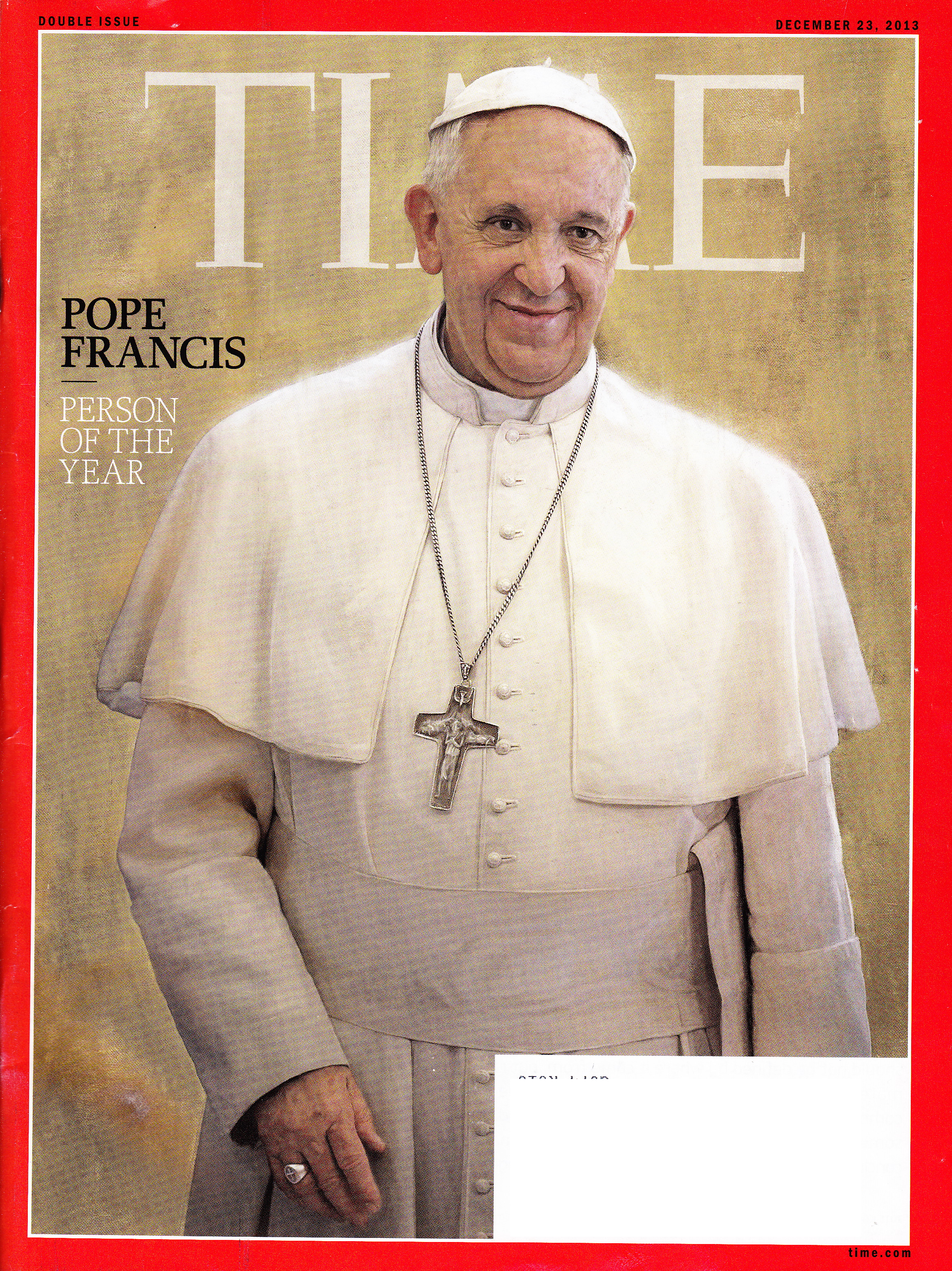
Believe it or not, preaching was once part of my job description. At Nashotah House all faculty were called to the pulpit, ordained or not. Falling into the latter camp, my obligations were generally held down to once a semester. My first homily, focused on the lectionary readings for the day, was about the problems of social inequality. Afterward the senior faculty member came to me in the vestry and said, “It has been a long time since I’ve heard the social gospel preached from that pulpit.” This little incident came to mind as I was reading a CNN Belief Blog story my wife pointed out to me. The article highlights some of the provocative comments by Pope Francis in his recent document Evangelii Gaudium. Francis, in a startlingly refreshing vein, suggests that the church must get back to basics. Human basics. I agree with those who say the church has not gone far enough on gender equality, but the idea that the cut of your surplice demands more divine attention than the homeless and starving has got to go.

At Nashotah House many students who wanted to be Catholic priests but also wanted to be married (the flesh is willing, but the spirit is weak) had Pope cards, rather like baseball cards, in their chapel stalls. This was in the era of the great conservative John Paul II, affectionally known as J2P2 in the theological ‘hood, when men ruled and a congregation might split over the use of a maniple. The gnat-strainers were clogged in those years. Camels fled for their lives. I wonder what these priests now make of the very head of their favorite chauvinistic church stating that even the papacy itself must change. I keep wondering when Pope Francis will have his accident, or unexpected heart attack or stroke. As the Belief Blog makes clear, not all appreciate the challenge to the status quo. There is too much power at stake.

This Thanksgiving, this old Protestant finds himself unaccountably thankful for a Pope that is willing to start turning things in the right direction. It will take decades, if not centuries, before the church can possibly catch up with the realities faced by the vast majority of the powerless, disenfranchised, and the needy. These are uncomfortable realities. When I saw a picture of Pope Francis laying his hands on a badly deformed man during a service in Rome a few weeks back, I could almost believe that someone was taking the message of Jesus to heart. That message was, and is, a radical one. We only have all-male disciples because we can only count to twelve. And we tend to forget that just about all of those guys were working-class slobs. Maybe if we could really be thankful for the gift of people all of this might just come to mean something significant after all.

Photo credit: Tomaz Silva/ABr

Photo credit: Tomaz Silva/ABr


Fateful Dreams

Popular historians love a good coincidence. I suppose it is a way of reading order into a chaotic world where many events, in the final analysis, just don’t make sense. Perhaps academic historians shy away from coincidental events—after all, they contain a whiff of the improbable about them, and academics can admit no greater force driving our efforts toward a civil existence. The rest of us, however, like to note them. This week contains the anniversaries of a couple of significant landmarks of United States history, and they may somehow be related. November 19 marked the 150th anniversary of the Gettysburg Address while November 22 is the 50th anniversary of John F. Kennedy’s assassination. The events, a century and three days apart, stand for transitions in American society, and the implications of both still linger on as unfairness and fear continue to haunt our hopes for a future where all might indeed be considered created equal—and not just all men, but all people—and where optimism might edge out cynicism in the political world.

486px-Abraham_Lincoln_November_1863Of course, both Lincoln and Kennedy died at the hands of assassins. America has never been terribly comfortable with dreamers. The century that separated the Gettysburg Address from Kennedy’s tragic death was not enough time to swing the ship of state around to bring about a world of dreams. Unfortunately, war also defined both presidencies. The dream of a world at peace has been more difficult to attain than a human desire for such a world would seem to merit. If we all (or most) want a world at peace, why can’t we bring it about? Unfortunately, it seems that a basic sense of justice is lacking.

500px-John_F._Kennedy,_White_House_color_photo_portraitPerhaps it is a coincidence that many of the world’s religions stress the concept of a just society. By far the majority of the world population associates itself with one form of religious belief or another. Not all religions get along, however. Many of the conflicts that have erupted into wars have had a basis in differing religions. Power is easily seized from dreamers, religious or not. Watching modern elections is a terribly sobering event. We don’t advertise what we might accomplish, but rather what is so wrong with the other guy so that we win by a paltry default. Victory for whom? And why consider it a victory? A friend once suggested that Christians should start out as bishops and eventually be promoted to the level of laity. I thought it was a brilliant idea that could be applied to politics as well. Think of it: elected officials as servants of the people. Of course, by coincidence, I am a hopeless dreamer.


I See Only Nothing

Once considered to be bad omens, comets are becoming a fad for those who can take their eyes off the screen for a few moments to look at the sky. Comet ISON (C/2012 S1), apart from falling trippingly from the tongue, is apparently now visible with the naked eye. I’ve been looking forward to this comet since at least January, although living just to the west of New York City complicates viewing possibilities quite a bit. You see, although I am now an urbanite, I’m really a rural rube at heart. I grew up in a town of less than 1000, and was born in a town of less than 15000. I attended college in a small town and my first teaching job was in a rural setting in Wisconsin. Apart from the fact that I’m now convinced people have very little control over their own destinies, I have preferred to live in places where I can see the night-time sky. Perhaps it was my love of science fiction as a child, but for whatever reason, space has always captured my imagination. I used to drag my brother out on frigid nights to look at the stars, and even tried to teach myself the azimuth coordinate system to document precisely where I’d seen something. I took astronomy classes in high school and in college. In middle school I did an intensive report on comets that saved my science grade that year.

Hyakutake, 1996.  My first comet.

Hyakutake, 1996. My first comet.

Comet ISON, however, has been refusing to behave as it was projected that it might. Although it could still turn into a very bright sky-show, so far it has been difficult to spot, and, at least for my location, at inconvenient hours of the day. Much to the chagrin of creationists, ISON is 4.6 billion years old, although it is just getting out for it’s first tour of the solar system. Part of the Oort cloud region, Comet ISON is probably a piece of a never-formed planet out past Neptune that decided to take its first cosmic stroll about a million years ago. It’s had a date with the sun since that time. The scientific jury’s still out as to whether ISON will go out with a blaze of glory after its close encounter with our sun and if it will come back around again to wow generations of our distant progeny (presuming we survive that long). For me it will be a matter of seeing if the clouds ever break in the east at 4 a.m. so that I can actually get a glimpse of the sky.

Hale-Bopp, 1997; a little over-exposed--one of the hazards of amateur photography with film.

Hale-Bopp, 1997; a little over-exposed–one of the hazards of amateur photography with film.

Comets were once thought to be heralds of the gods. Like other variable objects in an otherwise pretty predictable night-time sky, they can be either very bright or very dim (even invisible, for all practical purposes). When Halley’s Comet came around in 1986 I was living in Boston and couldn’t see the heavenly visitor. In 1996 Hyakutake buzzed earth, I stood in wonder in the woods of Wisconsin, photographing my first comet. A year later when Hale-Bopp blazed through the sky, I was out with my camera trying to capture it on film (a medium, I understand, that is about as old as Comet ISON). Were these visitors bad omens? One comet may have been decidedly devastating for our dinosaur friends, while some speculate that life on earth was seeded by a comet (making it a kind of secular god, I suppose). I’m only convinced that we have no control over our fate as I stand outside at 4 a.m. yet again, only to find clouds in the east and a comet in my heart.


The Problem with Apocalypses

Over on The Daily Beast, Joe McLean points out “How the Tea Party’s Apocalyptic Politics Are Destroying the Republican Party.” I say good riddance. Let me explain. It’s not that I have a problem with apocalypses. (Zombie apocalypses are especially fun.) My problem is that the mythology of one religion endangers us all. This is not some leftist-leaning rant, or at least not a leftist-leaning rant that’s uninformed. I grew up in a very conservative, apocalyptic Christianity. I was looking for the end of the world before I considered a college major. Even my (limited) choice of classes in high school were determined by a kind of eschatological laissez faire: the world’s going to end any day now, so why plan for a career? I was a true believer. In my Christian college I majored in religion. If the end is near, it pays to be ready for it. I know this doctrine inside-out. If Christ is returning any day now (can’t you hear the hoof-beats?) then we should pillage this poor old earth for all its worth. That’s what it’s here for. Do we want him coming back and saying we’re poor stewards? Besides, if we can ramp up the crisis in the Middle East far enough, Jesus will have to return. Won’t he? And these are “rational” adults thinking this way.

There was likely a naive cynicism on the part of the Republican Party when it realized that aligning itself with what was considered the religious fringe would boost their numbers. After all, the fringe surrounds the whole of the cloth. Apocalyptic Christianity is very popular because it appeals directly to the emotions. Although our society believes the study of religion is pointless, those of us who’ve persisted have noticed a few things. The religions that are really taking off are the ones that appeal to the emotions. Many Spock-like scientists intone their message of materialism only in the face of massive crowds of true believers. Who do you think is likely to win out? We have had presidents in the Oval Office who believed that triggering the apocalypse was a presidential prerogative. When society finally shook off its goofy grin and slowly pressed the electoral brakes, the Tea Party took off. Guess what? Apocalypses are all about destruction. If you invite apocalypticists to your party, the results are pretty predictable.

In the article McLean uses the word “zealot.” Rationalists might find the use of their dictionaries helpful here. Zealots do not respond to logic. Zealots are driven by emotion. Have you ever tried to argue with one? I have had years of experience teaching religion in a variety of classroom settings. Long ago I learned to lay down the sword when a zealot spoke up. Logic is not spoken here. The media, the scientific, the academic, they scratch their heads. How can any rational person believe this? The answer doesn’t require much effort to find. It might mean consulting someone who understands a bit about religion, though. Otherwise, the smart money is on stocking up on canned goods, gas masks, and a good supply of water. This could take a while.

Mary in the sky with circles, or the apocalypse?

Mary in the sky with circles, or the apocalypse?


Beliefism

A question never adequately resolved revolves around the status of atheism. What exactly is it? Well, I suppose it is many things, actually. One thing that seems indisputable is that religion has been part of human culture from the beginning. It would seem likely that not all believers carried the same level of conviction, and there may have been “atheists” shortly after theism evolved. The difficulty is that both belief in god/s, and/or the lack thereof, are matters of personal conviction. That somewhat blurred line has been crossed, according to some, by the recent growth of “atheist churches.” In several web stories my friends have pointed out to me, a growing movement of atheist “mega-churches” has been noticed. These are groups of atheists who meet for many of the same reasons religious folk do, sans salvation. It is a social occasion, and a chance to fellowship with like-minded non-believers, and to support their lack of faith. Some atheists bristle at this (as do some religious), claiming that it cheapens the atheistic enterprise (or that religions somehow hold a copyright on belief-based gatherings).

Herein lies the rub. Atheists are no more cut from the same cloth (or lack of cloth) as religious believers are. There are varieties of unbelief. Some obviously see that the weekly gathering has benefits. There’s no question that atheists can be every bit as humanitarian as religious believers are. Besides, who doesn’t like to meet with people who think like them? “Minister” might not be the leader’s title of choice, although it has a long pedigree in politics as a secular title (as, for example, in the Ministry of Defense). The slow decline in mainstream Christian services, however, might suggest that atheist services would be inclined to grow. Weekends were originally created for religious reasons and still generally remain the religious meeting days of choice. Some religious groups do not insist on doctrine to be members—Unitarians are a prime example of this—but the value of meeting together is human, all too human.

Clearly the purpose of an atheist gathering is not primarily worship. I should imagine, however, that wonder is still part of the non-religious vocabulary. God is not necessary for feelings of awe and joy. And sometimes it is fun to get together for some structured activity that isn’t work (for those who have jobs). An Associated Press story, however, points out the irony of the gathering of “people bound by their belief in non-belief.” There is, however, believing going on here. There can be no escaping it. Despite all the problems associated with omnipotence, the idea of a deity where the buck indeed stopped was an ebenezer for grounding belief. Even the most outspoken of atheists share this with the literalist and the moderate—they all believe. And as long as people believe, they will seek groups of those who share similar views. Why not? Even the truth requires belief.

What does it  mean?

What does it mean?


Ancient History

Every great once in a while somebody in the popular media seems to remember suddenly that the ancient world existed. I suppose that it is the fate of forward-looking species to forget the past, at least until it looks trendy. An editor for Sunday’s paper, for example, ran an article by Tom Standage, “Facebook, Twitter: That’s all so 1st century B.C.,” written originally for the Los Angeles Times. Tom Standage has written popular histories that go back to the Sumerians; I really enjoyed his A History of the World in Six Glasses. He’s got a great grasp of antiquity. In this short article, Standage points out similarities between modern, electronic social media and the distribution of gossip in ancient times. Indeed, he is basically right about writing: as soon as people learned to do it, it proliferated. Communication at a distance is such a wonder that we seldom pause to consider just how revolutionary it is. Social media has just made it that much easier. Instant thoughts, at the speed of light. Anywhere in the wired world. And yet…

SolomonFakeNot having been trained properly in journalism, I don’t know how newspaper articles are designed. People, I know, don’t like huge blocks of text without some visual candy. To illustrate Standage’s article is a close-up photo of some funky paleo-Hebrew letters with this caption: “Were ancient stone tablets, like this one detailing repair plans for the Jewish Temple of King Solomon, part of early social media networks?” I may be obsolete in the scholarly world, but I instantly recognized this inscription. It was “discovered” and rapidly disseminated in 2003. Almost immediately it was clearly demonstrated to have been a forgery. Scholars nowhere accept this as an authentic artifact. Even those of us who last saw this a decade ago know that it’s fake. Social media, indeed? Somebody in the design department needs to read their ancient history.

What is so striking about this faux pas is that most well-meaning readers have no way of assessing or ascertaining the validity of such an image. Oh, the script is cool, no doubt about that—but the artifact is fake. To answer the question posed by the caption: no, this is not ancient social media. It is a modern hoax. People are susceptible to hoaxes because of two factors: TMI and P. T. Barnum. Too Much Information exists for anyone to stay on top of it all. For progress to occur we need to rely on experts on the past to clear the way for us. Phineas Taylor Barnum knew how to turn any cheap scam into instant cash. It is no surprise that Solomon’s inscription first appeared on the antiquities market, certainly with an eye for cashing in on the success of the recently promoted James Ossuary, the one where someone much later added the phrase, “the brother of Jesus.” I’m sure that Tom Standage was in no way involved in the choice of image for the reprint of his article in our local paper. It does, however, suggest an old message that will even fit on your Twitter character limit: “There’s a sucker born every minute.”


Alien Bears

“And if there’s life on other planets, I’m sure that he must know, and has been there once already, and died to save their souls.” Larry Norman, one of the original Jesus Freaks, may not have been the deepest theologian, but his words come to mind as I see scientists reluctantly admitting that maybe life on earth is not so unique after all. It’s been in the news that Kepler Space Telescope’s data have been indicating that other planets like earth may be quite common. It has always amazed me that people have been so reluctant to let go of the notion that we are the only spark of intelligence in this vast, vast, cold, and dark universe. We seem to need to think we’re special. Religions generally indicate that the gods made us for some purpose or another, some love us, some are indifferent, others may be hostile. But generally, we’re unique. The Mormons have for years taught that there is life out there, but mainstream Christianity has generally been agin it, mainly owing to the crucifixion. Larry Norman, the original Christian rock artist, speculated that cosmic history repeated itself: if Jesus died for us, well then, he must’ve done the favor for them too.

Once Edwin Hubble stepped away from the telescope, stuck his famous pipe in his mouth, and said “huh,” I would’ve thought other scientists might’ve considered, like H. G. Wells, that “they” were out there looking back at us. Why this reluctance to suppose that we’re not alone? The story in the Washington Post cites the typical reason: the Goldilocks effect. Scientists, perhaps unwittingly influenced by the anthropic principle, have supposed other planets, if they existed, were either too hot or too cold to support life. We, like Goldilocks, happened to inhabit the only planet among the billions of galaxies of billions of stars, that got it just right. More like God-ilocks. The idea derives from Genesis where, it is strongly implied, we are the only ones. Religion influences culture, whether materialists want to admit it or not. The earth-only bias is inherently religious.

Who's looking back at Hubble?

Who’s looking back at Hubble?

Astronomers will gradually come around to the idea that there are other planets like ours. It will likely take decades, perhaps centuries, before they will commonly admit that life forms like ours are out there walking around. Eventually they may decide that there’s something to UFOs after all. Meanwhile, various New Religious Movements have already hitched rides on those flying saucers and they will be laughing once the rest of us catch up. We tend, under the influence of those who claim religion is always Bronze Age drivel, to forget that religion often leads the way to new territory. When the little green men and women land, we’ll find that many religions have beat science to the punchline. I’m not so sure, however, that the aliens will know who Jesus is. After all, this chair’s too hard, and this one’s too soft.


A Theistic Nation

That’s a dill-pickillial of a peccadillo, if you’ll pardon my Ned Flanderism. I’m referring to the issue of the Supreme Court dealing with public prayer. Again. In a recent Chicago Tribune story, prayer before town board meetings in Greece, New York have led to accusations of violation of citizens’ rights. In a similar, but unrelated, situation, a friend asked me what I thought about religious symbols on public property. He asked the basic question that if atheism relies on no symbols, isn’t the absence of symbolism tacit approval of atheism. These issues are very difficult to resolve for a number of reasons. The first non-partisan elephant in the room is the fact that we do not have an acceptable definition of religion. Universities shy away from hiring specialists in religion and we, as a society, and, more restrictively, as an academy, can’t agree on what religion is. Is atheism a religious belief system? Some would argue that it is, and that it shouldn’t be the default stance—that would favor one religion. From what neuroscience seems to tell us, atheists aren’t born, they’re made. Religion, of some description, is normal human thinking.

A further issue involves both symbols and prayers. A symbol means nothing without interpretation. As I told my friend, unintentional crosses are ubiquitous. You might have to look a bit harder to find unintentional stars of David or yin-yangs, but I’m certain they exist. Without the Christian eye, however, those unintentional crosses are just architectural features or natural spaces between corners. The same applies to prayer. If I decide to speak, it is a matter of interpretation whether my words are prayers, a guy talking to himself, or, increasingly, somebody chatting on their blue tooth phone as they walk past a church. Intention, a specific aspect of interpretation, certainly plays into the sometimes coercive power of a symbol or a prayer. Do those Ten Commandments on the courthouse lawn just represent a nice piece of art, or do they bear an intended message? Do intended messages not attempt to persuade others that they are true?

Smart folk like Supreme Court justices have difficulty with this issue every time. I’m not surprised. We don’t know how to quantify religion, even though most of us are pretty sure of it when we see it. Some would argue that many eastern religions are in fact philosophies. Some would claim that atheism is the opposite of religion. Atheism is not so very far from some strains of Buddhism, however. And like it or not, people are all subject to belief. We seem to like forging ahead in the darkness on this issue. State universities hide their religious studies programs like embarrassing warts. What rational person would want to waste time studying such superstition? The Supreme Court of the United States, I might point out, just for one.

Religion or not?

Religion or not?


Voting Vicissitudes

“Remember, remember, the fifth of November, the Gunpowder Treason and plot. I know of no reason, why the Gunpowder Treason, should ever be forgot.” Election day fell on November fifth, and as I watched V for Vendetta again, I was reminded how true it rings. Religious leadership takes over government, the common person becomes an enemy of the state, and criticism is treason. Tea, anyone? I’ve always had a soft spot for dystopias, but the world of V is entirely too plausible at times. I have watched rational people transformed by fear and the certainty of religious dogma into those who will do what they are told without question. The movie always gives me a profound hope that the human spirit is larger than the powers that be. V can also stand for Vote.

I cast my ballot knowing that a vote against a governor who enjoys the bully image was indeed close to a lost cause. People are enamored of power. In my deepest Jedi dreams, however, I know that the most powerful moment in Star Wars is when Obi Wan turns off his light saber to allow himself to be struck down. There is a power, one upon which entire religions are premised, in the self-sacrificial act. It’s not that I have anything against Parliament; I saw it just this past year and enjoyed the experience in a way that Guy Fawkes could perhaps not have appreciated. As Evey says, “this country needs more than a building right now. It needs hope.” I guess we can hold on another four years. V can also stand for five.

“He’s a deeply religious man and a member of the conservative party. He has completely single-minded convictions and has no regard for the political process. Eventually, his party launches a special project in the name of ‘national security’.” So V tells Finch concerning a dictator who could be wearing any number of political masks in our world. We hand power over to those who encourage our fears rather than those who inspire our imagination. Camelot died in 1963. It is not so difficult to imagine a world so much better than the one we’ve constructed, but plutocracy does prevail when people do not take the implications of their religion seriously. When we only glance at the surface, the deeper message gets lost in the mythology of it all. November fifth is a myth that still has the potential to change the world. If we would allow it.

VoteV


Sacred Fear

Last week’s Time magazine ran a story about fear. I’m no stranger to this emotion, so long ago I decided to engage it creatively rather than run away. The article, “Monsters Inc., Inside the weird word of professional haunting,” by Lily Rothman, contains the laments of those who operate seasonal haunted houses. People are just getting too hard to scare. Some blame violence in the media and computer games, a large-scale desensitization to the suffering people might cause to others. CGI has made the most hellish nightmare realistic in the theater or on the small screen. If you can imagine it, it can be brought to life. Yesterday was Halloween, the day we’re allowed to be afraid. Of course, those who fear the influence of negative emotions on children have cute-ified the frights: bulbous air-filled creatures lit up from within billow harmlessly in front lawns, monsters of various sorts sport silly grins, and humor is liberally sprinkled in with the horror. One haunted house owner wanted patrons to walk through naked, so they could feel vulnerable. Today most people will wake up to just another day of work, while others will roll out of bed ready for All Saints’ Day and a rousing chorus of Vaughn Williams. Some of us will still be scared.

DSCN0216

Thrice I’ve had to face the highly secretive severance agreement offered by employers who know that people over forty have a difficult time rebuilding a career. I know that in this I’m not alone. If it hasn’t happened to you, here’s how it goes: you show up to work one day and begin doing whatever it is someone pays you to do. Depending on the size of the organization, either Human Resources or some level of supervisor will innocently invite you to the office. They will have solemn smiles on their faces. The door will be closed. You will be told that, for whatever reason they wish to give, your services are no longer required. In return for your silence you’ll be offered some kind of adult care package. You’ll leave shattered and stunned and willing to sign anything slipped under your nose.

The secrecy’s the thing. I’ve never revealed to anyone, under pain of prosecution, what any of those agreements said. What I have noticed, however, is the fear. The lawyer-instilled fear of bad press. Organizations want to be thought of as caring and concerned. They do not want any clandestine information released. Truth seems to be the greatest engine of fear in the corporate world. A few years back, before the Bush-whacking of the economy, I read about optimistic companies practicing “naked business.” Revealing vulnerability. I immediately admired the idea. Like walking through a haunted house in the nude, businesses could demonstrate that they have nothing to hide. But there’s real fear here. Like a ghost, truth can pass through walls. Like Godzilla, truth is indestructible. Like the invisible man, naked truth just can’t be seen.


World War 1.2

75 years ago today Orson Welles presented a radio drama version of The War of the Worlds. Perhaps it was the looming fear of the Second World War in a society that hadn’t yet overcome the trauma of the First, or perhaps too few people had read H. G. Wells’ novel, but the result was surprisingly catastrophic. Panic arose as listeners supposed that the invasion was real—the broadcast, although announced as a radio drama, followed a news bulletin format that overrode the rational faculties of many. This episode would influence government decisions about what to reveal to the public for years. And, naturally, it all began in New Jersey. Unlike the novel, the radio broadcast set the invasion, initially, in Grover’s Mill, New Jersey. This tiny town is difficult to locate even today, falling as it does between the busy north-south roadways that run through the central part of the state.

DSCN4241

The Hindenburg disaster had taken place the previous year in Lakehurst, New Jersey. Welles, impressed by the radio coverage of that celestial fear, used those broadcasts as models for his play. A few weeks ago I ventured to Grover’s Mill to let my imagination roam free for a while. A great deal of history may have been determined by that broadcast and the public reaction. We are ready to believe that danger lurks above. The First World War began to make early use of the airplane as a weapon. The sky, previously, had been obtainable only with the slowly moving balloon. Only eleven years earlier Charles Lindbergh had crossed the Atlantic by plane for the first time. The Second World War would see air combat as a major component of victory, also for the first time. My mother grew up in New Jersey, watching planes searching for German U-boats off the shore. The skies were not so friendly then.

DSCN4239

As I stood in Grover’s Mill, I recollected an unpublished book I once wrote about the weather in the book of Psalms. The thesis, somewhat loosely, suggested that for the average person the sky reflects the mood of the divine. Dramatic clouds still look angry, even when God is removed from the equation. The Reagan era gave us all new things to fear raining down on us from the skies. September 11, 2001, brought the skies crashing to the earth again. Invasion from above is an apt way to add a chill to Halloween, for it takes the prerogative of the deity and makes it either human or alien. At least most people who believe in God think he’s on their side. When the Wright brothers took their heavier-than-air craft briefly to the skies in 1903, The War of the Worlds had only been on the market for five years. The coming decades would drive God from the skies and we would come to learn that what falls from above would no longer have our best interests at heart.


Human Resources

I’m thinking about how we blithely accept cruelty and christen it “just business.” It’s legal, and even encouraged. Was a time when you wouldn’t dare trade with a stranger because he might cheat you. To make a deal implied a relationship. To get away with something unseemly you had to be able to look someone in the eye and take advantage of her or him anyway. Oh, we’ve sanitized it alright. Most workers never meet the CEO. His hand doesn’t even deign to sign the paycheck. The workers are forced to trust nevertheless. Don’t worry, it’s just business. Or is it?

Wired GeniusThe system, of course, favors those with the loudest voices, and those voices speak the language of Mammon. We don’t dare upset the order, believing we will get ours some day. Delusion is so sweet. On the cover of Wired magazine is a little girl. The caption reads, “Genius is everywhere—but we’re wasting it… Seventh grader Paloma Noyola Bueno lives next to a garbage dump in Mexico. Last year she had the top math score in the country.” Careful, Wired, you’re beginning to sound socialist. Bueno was on the cover of a major magazine because she was discovered. Those who remain hidden far outnumber those who claim far more than their share of capital. You don’t make it to the top unless you crawl over the other caterpillars. When you reach the top, as Trina Paulus sagely warned, you find there’s nothing there. Just human detritus beneath your feet.

Business has come to mean “cold and impersonal.” Keep the human element out of it. In fact, the term “just business” is a very effective shield against all kinds of unethical behavior. And it is the model on which we shape our society. Is it any wonder that the economy takes such precipitous tumbles? Funnily enough, those who support “business ethics” such as these most vehemently also claim the title “conservative Christian.” Unless Christianity has thrown its moral compass into the sea, there’s no legitimate way to claim the latter half of that moniker. We praise and wonder at our Einsteins. How many of them died in the gas chambers and ovens of the Nazi regime? How many of them have starved in Africa? How many never rose above the crippling poverty of Mexico? Perhaps it is time we as a society demanded a stop to the wastage. “Waste not, want not,” should be our mantra. And if those at the top can’t show what they’ve done to help their fellow human resources, perhaps they should live next to the garbage dump. Don’t take it personally, one percenters, it’s just good business.


Lost Supper

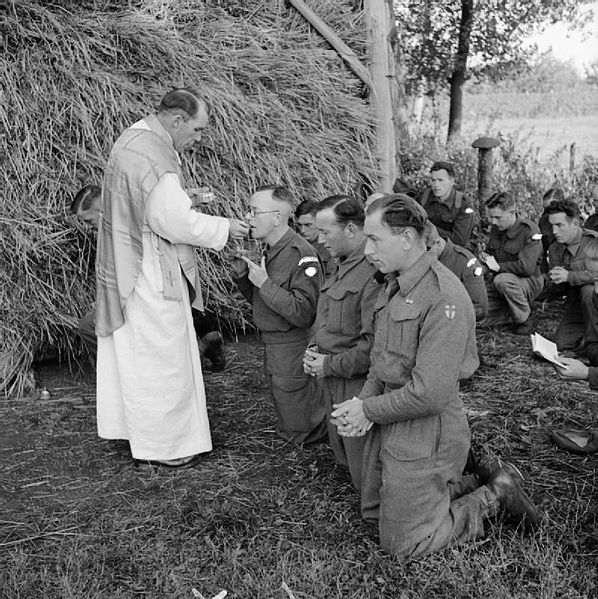
Culture, for better or worse, involves a deep connection to religion. No matter how secular we suppose the world to be, profound connections to belief surface in the most unlikely places. Time magazine’s culture section this past week has a brief blurb on “Burger Blunders.” Having been a vegetarian for a decade-and-a-half, this short story might not have caught my interest had my wife not pointed out “the Ghost,” a burger offered by Kuma’s Corner, a heavy-metal band-themed bar in Chicago. “The Ghost” comes with an unconsecrated communion wafer on top, and this has raised some spirits, according to Time’s culture team. Even Protestants recognize the power of the symbol of the wafer, even if they can’t accept transubstantiation. In Catholic belief, however, prior to consecration the sliver of bread is just that—a bit of pressed wheat product. The wafer came to be preferred because it was more easily contained than the crumbs of a regular piece of consecrated bread.

Communion, or the Eucharist, is a ritual meal based on the Jewish Passover. According to the Gospels, it was during the “last supper,” a Passover seder, that Jesus instituted the ritual. Early Christians ate together, and, recalling the symbolism, gave special prominence to the bread and wine. Bread, however, produces crumbs. When theology got ahold of bread it became a sacred object, after it was properly consecrated. It was believed (is still believed by some) to be very powerful in that state since it had become the actual body of Christ during the ritual. Wafers, technically unleavened bread, had many advantages to the emerging theological sensitivities. Portion control, symmetry, and virtually no crumbs. I’ve attended many masses, and the extreme care for particle control is everywhere from ciborium to patten to sacred linens that cover the altar like a liturgical table cloth. They are all accessories to the containment of broken bread.

Última_Cena_-_Da_Vinci_5

Communion wafers, however, when unconsecrated are just bread (if even that). They are not made palatable as snacks, but are more easily available online than basic gears or recordings of your favorite musical. Heavy metal has always enjoyed its blasphemous image as one of the most in-your-face counter-cultures possible. It is also profoundly religious. (Note, I am not saying that heavy metal is Christian or even Judeo-Christian, but it does participate deeply in religious symbolism.) If robbed of its shock-value, it is just loud noise. By association, however, many people mistake the wafer itself for what it represents. Without the added ingredient of consecrations, however, the liturgical churches tend to say it’s just bread. If you’ve ever eaten it, you’ll know that that assertion requires faith sufficient to move a Big Mac.