The Computer of Dr. Caligari

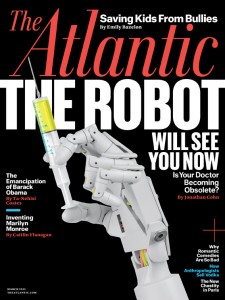
TheAtlanticTo be human is to be ethical. Not always in the best way, unfortunately. Nevertheless, our moral sensors are pretty much constantly running as we try our best to make the right moral decisions. This thought occurred to me while reading Jonathan Cohn’s article, “The Robot Will See You Now,” in this month’s The Atlantic. Having been a sideline watcher of FIRST Robotics for about four years now, I have heard countless stories of how robots perform some surgeries more efficiently than clumsy humans can. Cohn’s article starts off with the impressive potential of IBM’s Watson to sort through millions and millions of bits of data—far beyond any human capacity—and make more informed recommendations about medical treatments. After all, Watson won on Jeopardy!, so we know “he”’s smart. But he isn’t really a he at all. Still, in our reductionist world where humans are just “soft machines” computers and robots should be quite capable of helping us heal. To survive longer.

I am a veteran of Saturday afternoon science fiction movies and weekday episodes of Star Trek and Battlestar Galactica (original series, both). The present is starting to feel like that impossible future I watched as a starry-eyed child. But what of Dr. McCoy? I remember literally cheering (something I haven’t done much in recent decades) when DeForest Kelley’s name appeared on the opening credits of Star Trek when season three began. Bones was always one of my favorite characters—the doctor who didn’t trust the machines upon which he relied so heavily. He was a down-to-earth country doctor, who seemed to feel out of touch with the human (and occasional alien) element with machines interposed between them. Medicine is, after all, a very personal thing. Our bodies are our souls. I know; scientists tell us we have no souls. Embodiment studies, however, suggest otherwise. That robot coming at me with needles and scalpels may know how to heal me, but does it have my best interests at heart? Where is its heart? Its soul?

Better health care is certainly much to be desired. But in a country where our lawmakers continually debate whether the poorest should have access to Watson and his ilk, I wonder where ethics has gone. Robot doctors, I’m sure, will not accept patients with no insurance. Does not compute. Having gone without health insurance myself for several years, despite holding advanced degrees, I know that if I’d had a health crisis I’d have been rightly ranked down there with the blue collar folk that I consider kin. You see, to be human is to be ethical. That doesn’t mean we’ll always make the right decisions. It’s a safe bet that Watson can play the odds mighty finely. And the soulless machine may be making the decisions about who lives and who does not. Now that I have insurance again, when I’m on that cold slab I may have a shot at seeing a robot doctor. If that ever happens, I’m going to hope that Dr. McCoy is at least standing in the corner, and that those waiting outside the comfortable walls of affluence will somehow enter Watson’s scientific calculations with me.


Persistent Idealism

Few spans of human life are so idealistic as our college years. There we meet many people from beyond our hometown, and we learn the treasures of diversity and different ways of doing things. Ideas mix and blend, and with professors who’ve learned so much telling us all the places we can go, the possibilities seem endless. I find the idealism of college kids refreshing. That’s one reason, I suppose, that I enjoyed teaching them so much. At work you’re far more often told why things won’t work and how they can’t be done. And I find myself thinking back to college and wondering when people lost their sense of vision. When did idealism die?

Yesterday I spent on the campus of the University of Texas at Austin. Between appointments I was crossing a quad area and noticed a bunch of blue and white balloons. We’re all still kids inside when we see balloons. I stopped to look. Then I noticed, across the street (in which sat a very obvious police car) a small group of students waving a Palestinian flag. Several police, frankly looking bored, stood between the two peaceful groups.

IMG_0581IMG_0580

Looking back to the balloons, there were a series of tents set up and a sign read “Israel Block Party.” Obviously this had been a carefully planned event, and we all know the heinous story of the constant persecution of the Jews throughout much of “civilized” history. The simple table across the street bore the sign “Free Palestine.” Less than ten students stood around, handing out literature, peaceful, yet literally flying their flag. Yes, the Palestinians have also been oppressed for much of their history. If only adults could live so peacefully as these students. My heart went out to them.

The issue of Israel and Palestine is one of the deepest scars in our collective human psyche. Indirectly, that conflict is responsible for many tragic terrorist acts, including the attacks of 9/11. And it is so frustrating because both sides (and there are actually more than two) are victims. We like our good guys in white and our bad guys in black. I’m still an idealist, after all. Yet in Israel/Palestine we have two historically oppressed groups vying for the very same land. And in the middle of this maelstrom, the Bible. The very book that can be read as an eternal promise by God that the people of Israel should own this land. By 1947, however, we’d stopped relying on God and began relying on guns. And atomic bombs. And life has never been the same since.

Images of the wall going up between Israelis and Palestinians just after the wall went down in Berlin reminded me of Bush’s proposed wall between Texas and Mexico. Here in Texas just about everyone in the lower paying jobs I’ve met is hispanic. And friendly. Grateful in a way that many of us wouldn’t emulate in such low stations. We are all people. We all experience the same feelings, needs, and desires. Why not tear down the walls and let us look at one another? Take a good, long look. And my idealistic self says, if we face another human being with love everything will be all right.


Continental Drift

So this is the way epiphany works. (I know it’s Lent, but I’ve got bigger fish to fry.) I sat down to check my personal email after a horrid day at work, and since I have a Verizon account, I can’t help but see the news headline that’s on the page when I open it. When the headline said something about a new continent discovered by scientists under the ocean, I’ll have to admit that Atlantis sounded better than anything I’d heard in the office. So it was worth a click.

Athanasius_Kircher's_Atlantis

Turns out that this isn’t Atlantis at all—I have this habit of making naive assumptions—but a continent just north of Madagascar that sunk some nine million years ago. No happy lemurs or Homo sapiens around then. So when this Atlantis sank, there was nobody around to see it. At least not Plato.

The story was broadcast by Newsy and it made mention of Science World Report. Here’s where the epiphany piphed. I’d never heard of Science World Report. When I went to their site, the wonders of the universe spread out before me. “Dying Stars Reveal the Clue to Extraterrestrial Life: Earth-like Planets Unmasked” read one headline. “How Dinosaurs Evolved the World’s Longest Necks While Giraffes Fell Short.” These are the things I need to brighten me after a rotten day. A world with wonder in it. A world where money is not the sole, or even the highest good. A world where an intellect need not go to waste.

“Human Language May Have Evolved from Birdsong: New Meaning for Communication.” This website is like my eternal monologue in headline format. I’m not naive enough to suppose this website will be the nepenthe for all my workaday woes. But it does serve to remind me that science and religion are not always foes. A religion only becomes belligerent when it takes its truisms too seriously. We evolved in a world of wonder, but we’ve taken great care to remove the wonder from it. As if joy and delight were puerile phantasms with no place in the serious adult world of finance and industry.

I became an educator because I’ve always been in love with ideas. I lost my job in education because I was an idealist. Yes, continents do indeed sink. And while it may not be Atlantis down there, a simple click led me to a world of wonder. And that is, if anything can be, cause for hope.


Near Earth Objects

Even before the Chelyabinsk meteor, Time magazine had committed to the printers with a story on asteroid 2012 DA14. From our terribly parochial viewpoint, such cosmic invaders are in our airspace (or at least in our satellite zone), as if we owned the very heavens above us. They are somehow an affront to our religious sensibilities. Many religions revolve around a celestial orientation. We all know that God is “up there” and the Devil is “down there.” What we’re discovering “up there,” however, is scarier than the Devil for many people. Space rocks are just part of the debris from the messy business of universe creating. Although space may be mostly empty (but dark matter has us reevaluating even that), it is far from tidy. Rocks rain down on us every day, and our user-friendly atmosphere that we’ve polluted so badly still begrudgingly incinerates those that enter at the wrong angle, brightening many a night with spectacular meteors. I’ve even seen some bright ones while driving in traffic in New Jersey. Wondrous indeed.

adoration-of-the-magi-1306

Back in seventh grade I did a science report on comets. This was a fascination that led me to take astronomy in my Sputnik-era high school—complete with planetarium—and in my older, more conservative college—sans planetarium. Comets were, until fairly recent times, religious harbingers. The Time story even has a detail of Giotto’s Adoration of the Magi from the early fourteenth century, complete with Halley’s Comet hovering overhead as the ersatz Star of Bethlehem. In a pre-Copernican universe signs in the sky had to be divine. There was no other logical way to explain them. Of course, in science class I stuck to the facts. As a religious kid, however, I knew there was something more to it.

Our skies are not our own. The universe isn’t here for us. These scientific revelations are frightening on a religious scale. We haven’t quite gotten to the point where we’re ready to let go of the Heaven above that no telescope can see. We don’t even have any way to spot hunks of rock the size of Chelyabinsk’s unbidden visitor with any kind of accuracy. We don’t even know how many there are. Before the second Russian explosion, Time prophetically noted that about a million stones of a hundred feet or more are near our planet and that one 150-footer could be 180 times more powerful than the bomb dropped on Hiroshima. Our recent brush with God’s dropped stone was only about 30 times the size of the terrors unleashed on Japan. According to ABC a Father Dimitri of Chelyabinsk said, “This event happened the day of the big Orthodox holiday that means meeting with God and this has to make people think.” I know I’m thinking. I sure hope his aim is good.


Tunguska 2.0

The explosion of a meteor above Chelyabinsk on Friday immediately took me back to Tunguska five-score and five years ago. The Siberian Explosion, as we called it as kids, had captured my early imagination. An explosion that big, so long before nuclear weapons had been developed, and so long after the dinosaurs felt the wrath of an asteroid, fired my sense of wonder. The pictures of all those felled trees. Of course, the mystery helped as well. Some decades later, The X-Files revisited Tunguska, and the mania of my youth was back. There’s nothing like something incredibly massive to ignite the chariots of fire. The Chelyabinsk meteor is the largest object to strike the earth since the Tunguska event, and although at 500 kilotons of explosive power, it was about 60 times less potent than the earlier event, it does have many pondering the fragility of life on our little planet.

tunguska2

For those less familiar with astronomy, the event was confused with the much hyped passage of asteroid 2012 DA14 which buzzed close enough to have had some fingers hovering above the retaliation button. The two unrelated events stand to underscore just how small we are in our tiny ripple of the Milky Way. Watching the many videos of the Chelyabinsk meteor, I ponder what might have happened had this been during the Reagan years and the delirious high point of Cold War paranoia—would any of us have been left here to read about it at all? Although ants, we think ourselves giants. Some speculate that if the dinosaurs hadn’t been wiped out by an asteroid or comet they may have evolved to intelligent beings. Perhaps they would have had a reptilian god. Based on body-mass ratios, that’d have been one huge deity!

So we’ve had a couple of near misses this week past. Chances are some day we’ll get hit. There will be those who call it an apocalypse, and others who will suggest it is some kind of cosmic justice. In reality, it is just what happens in a universe where we are but minuscule demigods in our own imaginations. Tunguska was a huge event, but it didn’t kill on the scale of the Haiti Earthquake or the Indian Ocean Tsunami. Such natural disasters make the insurance industry cry foul as they describe them as “Acts of God.” “Act of God” is legalese for anything outside human control. Giant rocks falling from the sky clearly fit into that category. Goliath, the biblical giant, was slain by a single smooth stone from a brook, according to the book of Samuel. We think we’re pretty big with our towers and our weapons and our internet. If God unleashes a big stone our way, as Friday’s events demonstrate, Goliath might have the last laugh.


Portrait of God as a Young Man

Famed swing state Ohio is back in the news with Jesus in the front lines. It was an unlikely setting to notice such a thing. I was sitting in a conference room at work, awaiting the start of a meeting. A laptop was set up with a projector, and the homepage cast upon the screen was msn.com. There, on the wall at work was Jesus’ name.

The story has to do with a public school in Jackson City. A student group had donated a portrait of Jesus to the school in 1947, but in a multicultural world the constitution sometimes has to take on the Prince of Peace.

CompositeJesus

While the legal issues are thorny, I have an even more probing question to ask. What makes a portrait a religious object? There is a fair bit of dispute about the historical Jesus—who he really was, where he was from. Despite the sangfroid of the New Atheists, there is little reason to doubt that there was a historical person Jesus. If that is the case, what makes his picture any different than that of Woodrow Wilson or Ronald Reagan? Or Churchill, with his religious-sounding name? One could argue that we don’t know what Jesus looked like—and this is true—but neither could we really identify many historical figures before the advent of photography.

The making of a picture into a religious object comes down to intent. Intent on the part of those who hung it, and on the part of those who view it. The 1940s were a different era. The Second World War was just ended, America was proudly Christian after fighting for the cause of truth, justice, and, well, the American way. Could the school group have donated Jesus in that era as the portrait of a great man? Without supernatural implications? I suspect we all know the answer to that.

Fast forward a few decades. The world has changed drastically. We are multicultural. The internet entertains us with such stories as this. If not for the internet, and a casually chosen homepage, I would never have even heard of Jackson City, Ohio. Is it possible that we could look at a picture of Jesus in our day without religious adoration? Quite possibly. But the furor raised by the religious right every time a perceived slight stirs up the dust would seem to make such an association impossible. Any prominently displayed picture of Jesus in a government location, no matter how local, is perceived as a religious act. It seems that we’ve lost our ability to appreciate the wider realm of possibilities. And that is sad. Who was Jesus, really? Historians and theologians come to no consensus on the issue. One thing is for certain, he’s sure to set people against one another wherever he appears.


Implausible Deniability

Sandy gave us a little taste of dampness under the gunnel. You see, people live by the water because it beckons to us. That was actually Rachel Carson’s idea, but nevertheless, we do find ourselves drawn to the sea around us. Historically our great cities grew in the littoral because communication across the big water was, prior to jet travel and trans-oceanic cables, the best way to stay in touch. Have a business meeting in London, but live in New York? No problem. We can get you there in two-to-three weeks. And the ship sets sail. Since that day we’ve become more electronic. Those of us who experienced Sandy near New York City know that one of the biggest problems was that salt water and electrified trains don’t mix. Of course, conservative lobbies have insisted that Congress and the White House keep their eyes firmly shut about the possibility that a more unstoppable flood is coming. We may not need an ark, but we’re going to have to take some steps back.

A story on the Weather Channel shows the “smoking gun” of global warming. Oh wait, that’s just a myth. Industrialists tell us so. But what a devastating myth! The Gulf Stream waters of yore have kept the climate mild in northern latitudes. While in Scotland we spent a wonderful weekend with some friends on the Island of Arran in the Hebrides. Palm trees growing in Scotland? Yes! The warm Gulf Stream means that much of the British Isles remains relatively temperate despite their latitude. The Gulf Stream, due to climate change, is slowing. In less than a century, climatologists now predict, the oceans will rise three feet. Looks like I’ll need to wear my gaiters to work. We’ve known for about half of my life that we’ve been changing our environment. And not for the better. Those who are too wealthy stand to lose a little so we do what we can to protect them, the poor dears. The rest of us had better learn to swim.

We don’t worry when the people of some Indonesian island point out that their entire world may submerge. Put a little ocean water in the subway and, well, that’s an entirely other story. How are the peons to get to work? Let them wear hip-boots. Word from the top one percent is that there is no global warming. If the Gulf Stream is slowing down it’s because it’s lazy. What a moocher! Suppose it will be wanting a health plan next. That’s the problem with the weather—it changes like, uh, the weather. Unlike the minds of some people that are already made up and never change, no matter what the facts. When the one-percenters start speaking, I’m glad I’m wearing my hip-boots after all.

Where can I get me one of those?

Where can I get me one of those?


Popeless

414px-Benedykt_XVI_(2010-10-17)_4 Pope Benedict XVI managed to catch many of us off-guard with his early retirement option. Not within living memory, or even very dusty, antiquated memory has a pope resigned. Such is the draw of power. Of course the founder and putative CEO of the organization stepped down at 33, or so the story goes, but after that the urge to stay on only grew. The papacy, some traditions claim, is as old as Christianity. Others suggest that the stresses and strains that eventually led to the primacy of Rome in the western church were much more intricate than that. Modern research has also indicated that one-size-fits-all Christianity really didn’t even exist from the beginning. Different groups claimed to be Christian but were labeled heretical by other groups. The Roman Catholic Church is still the single largest Christian denomination in the world, however, and that translates to quite a lot of weight.

According to the book of Acts, the first Christians were a communal lot, holding everything in common. Although we can’t call them communists, in a sense they were. It didn’t take long for that structure to break down, however. Before long it was obvious that leaders would emerge in the movement. At first they wouldn’t have been priests, but eventually that age-old designation came to describe what the clergy did. Worship became ceremony, and ritual requires expert leadership. Various religions have tried to break down the hierarchical structure of having one person over the others, but in this masculine world of CEOs and prestige, well, there’s only so much you can share.

What’s really striking is that no pope in 600 years has stepped down. There could’ve been many occasions. Presiding over about a sixth of the world’s population must be a heady experience, especially for a religious person. Already the speculation is thick on who the next pontiff might be. The fact that the faithful are already chomping at the bit shows something of the nature of the creature (one can’t very well say “beast” in such a context). The papacy has become a symbol in its own right, and even megachurches can’t hope to top their numbers. The Pentecostals, however, are racing to catch up. The two types of Christianity are about as far apart as possible while remaining under the same Lord. I suspect by the time the next pope vacates the office the religious landscape will be very different. Perhaps Benedict XVI is wise to call the game on his own terms.


Maltese Faction

The Crusades remain one of the most celebrated episodes of religious violence in the history of the church. I am certain that many would put forward other instances of official violence to rival the piecemeal warfare of the Middle Ages, however, the Crusades still jolt many Muslims for their unflappable conviction that God gave the Holy Land to them. Ironically a bit of good emerged from the carnage in the form of sometimes secret orders of knights whose charge was originally to care for injured and sick Christians. Thanks to Dan Brown everyone knows of the Knights Templar. There were, however, several of these orders spanning the eleventh to the sixteenth centuries, and some of them survive today. In Sunday’s New Jersey Star-Ledger a story appeared of the 900th birthday of the Knights of Malta. I don’t recall having heard of them before, but then, it has been many years since my last class in Medieval Christianity. And no wonder—they don’t even appear in Wikipedia under that name.

What is so interesting about the Knights of Malta is that, like the Vatican, they have the authority to act like a country. According to the Associated Press, the knights can issue their own passports, stamps, and money, and have diplomatic relations with real countries and even have observer status in the United Nations. The blurring of the lines between religion and politics, as any student of history knows, has deep roots indeed. The Knights of Malta, however, own no territory (no, their eponymous island isn’t theirs). A nation with no territory. At least the Vatican has its own city. The Knights still exist for their charitable works and, it is to be hoped, not for the conquest of lands legitimately owned by others.

The Sovereign Military Order of Malta (“sovereign” and “military” were omitted in the press), is a sub-branch of the Knights Hospitaller, the oldest surviving chivalric order in the world. It is nice to think that the church might still have a few knights up its sleeves. The concept of chivalry has largely been absorbed into chauvinism, however, and even now the Knights of Malta are men. Along with the Vatican, that makes two entities run completely by males that assert their own sovereignty. In the twenty-first century it would be nice to think that we wouldn’t need monied men in robes in order to help out those in need. But then I’ve always been prone to believe in myths. And knights tend to follow after daze. Crusades, however, have far outlived their putative usefulness.

Good knight?

Good knight?


God’s Country Club?

Heaven is a sparsely populated place. Considering its vast celestial real estate, vis-a-vis the earth, it must be downright lonely. Maybe that’s the way the elect like it.

Official teaching, as it is often called, for many churches is downright brutal for those who dare explore. This past week the sin of Rob Morris, a Lutheran Pastor (Missouri Synod) who had the audacity to pray for the children slaughtered in Newtown, Connecticut in the same room as—gasp—Jews and Muslims, has been in the news. You see, Missouri Synod pastors aren’t allowed to worship with those outside their brand, and the president of the Synod, Matthew Harrison, insisted on an apology from Morris. Never mind the twenty-six coffins in the room. This is about doctrine!

Exclusion is part of what gives religion a bad name. Yes, there are some people who appear evil—I’m glad I’m not often put in the place of judging that. For some Christian sects, however, the gate is very narrow indeed, and the path exceptionally difficult. More than one Christian denomination, presumably those not so good with arithmetic, officially teaches that only 144,000 will be saved. A thousand gross, and not one more. These poor sinners keep hoping they’ll get in without adding up the hundreds of generations standing in line before them. I get the sense that their heaven wouldn’t exactly be paradise for any of the rest of us who happened to slip in. If the world were full of people like me, I think I’d be on the first space shuttle off to parts unknown.

Overlooking the gross insensitivity to the fact that Morris was trying to heal his community after a tragedy where children—children! To whom most religions give a free pass into heaven—were being mourned, we must wonder what the paradise of Missouri Synod Lutherans looks like. A heaven without diversity. Smiles must be rare indeed. And long, long, long naps very common.

For those of us committed to the common good, heaven on those terms is no ideal place. In fact, I doubt that God would be tempted to spend much time there. I think that God was present at the interfaith prayer vigil, and that Rev. Harrison has yet to receive an apology postmarked “Heaven.”

Rules is rules.

Rules is rules.


Scouting for Boys

I guess losing a bid for a presidential nomination sanctions a guy to speak for God. Of course, that goes for just about any Republican these days. I’m frankly amazed that Moses managed to write the Ten Commandments without them. So Rick aptly-named Santorum has gone after the Boy Scouts. To remove the duplicitous ban on gay scouts, according to Santorum, is to remove God. Obviously Mr. Santorum was paid no attention in Boy Scouts himself. I spent many hours at Scout camp and I can attest that God was already the last thing on most boys’ minds. Maybe our former presidential hopeful ought to look back a little further, for Webelos and Cub Scouts may imply the love that dare not mewl its name. I predict this: if the ban is lifted, as it should be, no one will notice the difference. Santorum will continue beating his dead horse and the rest of America may achieve just a hint of maturity.

“Scouting may not survive this transformation of American society, but for the sake of the average boy in America, I hope the board of the Scouts doesn’t have its fingerprints on the murder weapon,” Santorum declared, according to CNN. I have to wonder what he knows about the average boy in America. Or the average girl. Santorum would have a difficult time finding the word “gay” in his Bible, for it is not there. But apparently God is not God without someone to hate, without the “Right” to show him the way. And God favors straight, white men, as the last presidential election clearly shows.

Any religion that makes someone feel better by repressing others is not worthy of propagation or emulation. Look at any oppressed group. What’s the backing always cited by the oppressor? Is it not narrow religious belief? Anyone can say “God says.” There—I just wrote it. And I could distort the Bible to make God dance to my prejudices as well. The problem is that I recognize how cheap and tawdry such eisegesis is. Of course, hot air expands. The Texas governor that God told to run for president, but then changed his divine, omniscient mind, and who never thought closely about the implications of that—aka Rick Perry—also had to weigh in on the issue. CNN quotes him as stating, “Scouting is about teaching a substantial amount of life lessons… Sexuality is not one of them. It never has been; it doesn’t need to be.” Mr. Perry needs to spend a weekend at camp with his eyes and ears open and his mouth shut. In the best of all possible political worlds, his bosom buddy Rick Santorum will be right there beside him. Maybe it will take a little child to lead them after all. And that actually is biblical.

From WikiCommons, AgnosticPreachersKid--worth a thousand words

From WikiCommons, AgnosticPreachersKid–worth a thousand words


Real World Ethics

Do yourself a favor. Spend five minutes watching this video:

(note: the video has been removed and a “family friendly” version is here: Kai)

Although it has a whiff of the apocryphal about it, I choose to believe that Kai is really who he claims to be. I don’t know what actually happened here, but this is ethics divorced from armchair pundits and congressional committees. Sometimes you see something and know it’s just wrong. Most of us wring our hands and await some authority figure to sort it out. When Kai met someone claiming to be Jesus, he was willing to be “the Antichrist” to save innocent people with no regard for himself. I am very impressed.

No, vigilantism is wrong. In fact, I wouldn’t trust a who coven of Republicans to ever arrive at so parsimonious a solution as Kai. He saw evil, he confronted it. I don’t know the backstory here, but I know that I feel a lot less threatened by the street people I see nearly every day than I do by those hiding away in limousines. Ethics is all about figuring out what is right. Kai has his head on straight here. If he could go back in time to stop “Jesus” reincarnated from harming an innocent bystander, he would. No regrets, no questions.

I have watched, and personally experienced, religious leaders intricately plotting how to ruin the life of their neighbors to maximum effect. I have read about politicians who shamelessly increase their earnings while knowing that some of their constituency live in poverty and persistent hunger. I have seen a president declare a war to fulfill a personal vendetta. And I have seen Kai lifting a hatchet to save a person he didn’t know.

There will certainly be those who would condemn such quick thinking and right action as immoral. For those who object from a Christian outlook I would remind them of Dietrich Bonhoeffer, one of the darlings of the Evangelical world. Bonhoeffer was hanged by the Nazis because he did what he knew to be right. Even though his bomb plot failed to kill Hitler, Bonhoeffer knew what Kai knows—those who sit around and watch evil happen as just as guilty as those who perpetrate it. And that’s like trying to surf when the ocean’s at a dead calm.


Secular Oaths

“I do solemnly swear that I will faithfully execute the Office of President of the United States,” so begins the story. With President Obama’s second inauguration so fresh in the public mind, an article in the Sunday New Jersey Star-Ledger raised the question of using Bibles for taking this secular oath. As A. James Rudin points out, not every president has laid a hand on the Bible to take the oath—John Quincy Adams preferred a law book to do the job. Rudin points out that commentators have started to question the practice of using any religious book for taking a vow for a government position. As I read this article I had to pause for a thought. It was the particular turn of phrase “the Bible, and by implication all other religious writings,” that stopped me at this brain crossing.

Washington's_Inauguration

Anyone who has taken time to study the phenomenon of religion seriously (admittedly not a large cohort) has stumbled upon the blue whale in the room: what exactly is religion? We all know, but nobody really knows. Many scientists equate religion with superstition and claim that we are evolving out of it, but we still seem preternaturally powerfully attached to it, if that’s the case. While religious writings have been around for ages, the idea of a sacred book seems to have its origins in the societal reception of the Bible. There are older religious books, but the Bible seems to have defined the category. What’s running rampant in my mind is where the line is drawn between a religious and a secular book. For some, it would seem, Fifty Shades of Grey, or Twilight would fall into that category. Some thinner, more glossy and heavily illustrated literature favored by teenaged boys might also qualify. What makes a book religious?

In current understanding, religion is a matter of belief. Not all religions insist on belief, but in the United States, in any case, it’s not properly religion without it. In our secular society belief is atomized into millions of varieties, even within the same religious family. Step outside the church, synagogue, or mosque, and the sheer varieties of religious experience would make even William James blush. “All other religious writings.” Those might include just about every pen stroke on paper (or electron on whatever it is that I’m typing this into). Those of us who venture to write know that at some level it is a sacred activity. I would swear it with my hand on my dissertation. (At graduation at Nashotah House students are hit on the head with a Bible. Perhaps this might be more appropriate to swearings in?) We lay our hands on that which is sacred, otherwise there’s no vow involved. Whether it be Bible, law book, or saucy literature, we pledge on it because all books are religious, regardless of definition.


Ad Lib

Somewhere in the back of my mind I’ve had a notion to research and write a book on the history of “bad words.” Being raised Evangelical, I had a preternatural fear of saying something that might damn me to Hell, and even today working in Manhattan, I still flinch when I hear f-bombs falling all around me. Still, the concept of “bad words,” although almost universal, is very odd. We all know the tired jokes of a particularly offensive word in one language being common in another, with an entirely different denotation leading to embarrassing situations. No set of sounds, inherently, means anything bad. Surely it is the intention behind such outbursts that lead to accusations of profanity or blasphemy. I wonder how it got started. The Bible says nothing about bad words—in fact it contains a few—but it does warn against thoughtless curses. That’s because ancient people believed curses really worked.

As I stepped out in the dark to pick up the paper this morning I was curious, then, when a front page story announced, “At school, cursing’s out—for girls only.” The school in question turns out to be Queen of Peach High School in North Arlington, New Jersey. According to Leslie Brody the girls at the school were asked to take a no cursing pledge yesterday, while the boys weren’t. The real story here, however, is not my curiosity about “bad words,” but an insidious sexism. One of the teachers is quoted as saying “We want ladies to act like ladies.” And, of course, what lady would ever have anything to cuss about? Being paid lower wages than a man for the same work? Being blocked out of clergy positions in some churches? Being regularly maligned as “the weaker sex” who, like Eve, bear the guilt of bringing sin into the world? If anything, it seems to me, women have more cause to swear than men.

Just when I’ve been lulled into thinking we’re making strides toward equality, such stories dash the ice water of reality into my face. Who decided that it is appropriate for gentlemen to cuss? Can they just not help it? Are the same words any more offensive for slipping past feminine lips than masculine ones? I’m still not convinced about the entire bad word concept. As someone who smiths words every day, indeed, whose living depends on words, I find all words have their uses. It’s really a matter of context. And if I were a girl being told not to say what boys can say, I think I might have some choice words to add to that conversation.

Good, bad, and ugly.

Good, bad, and ugly.


On My Honor

Some old fashioned institutions fear new learning. Although I was a Boy Scout for only a couple of years, I grew up in Cub Scouts and Webelos and had a pretty good idea what boys talked about when they were together. It would’ve shocked me at the time to learn that some Scouts were gay, but then, I was young and most new things shocked me. I later came to learn that not only some Scouts, but also many of the guys I knew from conference-wide church groups were gay. It wasn’t so much that they were in the closet as the rest of the world was. Society wasn’t ready to admit anything that challenged male patriarchy (this was the 60s and that was beginning to shift), and homosexuality did challenge that hierarchy. The Bible could be used to back a husband’s superiority over his wife, but if two men formed a couple—as B-movie computers used to say—”that does not compute.” A society that declared sex had one purpose only—procreation—was already deep in denial about the symbolic power that sexual relations inherently possess, something even the ancient Greeks knew about. How could a culture that out of sync with nature come to embrace true equality?

In the socially conservative icebox of the fin de siècle nouveau (pardon my French), evangelical forces began to declare the Bible as the basis for defining marriage. The problem is that the Bible doesn’t do such a good job of it. Marriage is far from a sacrament, and its main purpose seems to have been to make sure men were kept accountable for the children they sired. After all, they could have as many wives as they could afford, eh, Solomon? The Boy Scouts, so loyal to God and country, preferred not to admit what was already part of their culture. You isolate a bunch of boys together in a cabin in the woods, and what happens? The old myth of Platonic hero-and-sidekick pairs with nary a thought of the pounding chorus of hormones surging through the atmosphere held up remarkably well, considering.

We like to think we live in a more enlightened age. Sexologists tell us that mating is hardly just for reproduction—the natural world belies that. The Bible says little about its purpose, not being of a scientific bent. And yet the Boy Scouts hold up three fingers and go beyond don’t ask, don’t tell. I’m glad to see that they are again considering a look at the obvious. In the Bible that cotton-poly blend you’re wearing is mentioned as evil just a few verses away from one of the few passages that says the same thing about homosexuality (and even that is an overstatement). The Bible was a product of its time, just as the Boy Scouts were a product of theirs. If they want to honor their pledge about keeping morally straight, the Boy Scouts need to consider morality in the light of what we know and open the closet doors to what society has been keeping hidden all along.

Read the green words.

Read the green words.