The Triumph of Lovecraft

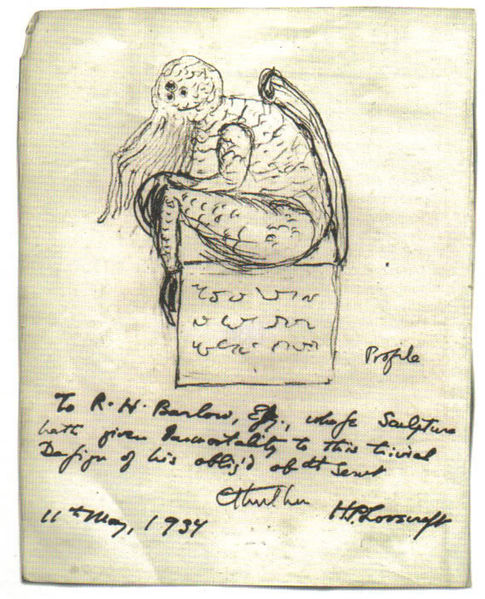
The deeper you peer into the mouth of nature, the more Lovecraftian the world becomes. Just days after I had posted a little meditation on Cthulhu, the great old god of H. P. Lovecraft’s unholy pantheon broke into the mainstream news. No less a source than NBC ran the headline “Tiny Cthulhu ‘monsters’ discovered in termite guts” only a few days ago. The microbe with the scientific name Cthulhu macrofasciculumque lives in the digestive system of termites, helping them in their destructive work. True, Lovecraft described Cthulhu as a bit bigger than that, but the first appearance of the microbes, according to Megan Gannon, reminded the discoverers of the eponymous terror of the Cthulhu mythos.

From microbes to the major football leagues such as the Baltimore Ravens, writers of the macabre have left their mark on our culture. The darkness they describe so richly is something we all feel at some level, but that we sublimate most of the time so that we can get on with our lives. Cthulhu macrofasciculumque may be very, very small, but the super-viruses and bacteria that we are encountering have the ability to destroy us just as surely as the chimerical colossus of Lovecraft’s nightmares. When we look for a way to describe these terrors, we have brave literary heroes from whom we might draw. We would be lost without them. They make it safe for us to venture into that darkened room, for they have been there before us. Lovecraft gave the world its first scientific description of Cthulhu, and although that description defies adequate reconstruction, we recognize it when we see it.

As Lovecraft saw him.

As Lovecraft saw him.

Science has brought us so very far. We can now see to almost the brink of an infinite universe and delve into the guts of termites. We have the ability to prolong life and increase physical comfort for those who can afford it, and we can annihilate entire nations at the press of a button. Drones can fly overhead and do the dirty work, and we don’t even have to step outdoors. Yet when we meet something that shivers our scientific spines, we turn back to the old gods to name it. Yes, religion may be the bête noire of science, but the dark night of the soul is not illuminated by LED’s or lasers. To see in this dark you need to have the night vision of literary perception. And those lenses, according to Lovecraft, reveal that the old gods are dead but still dreaming.


Fearful Christianity

So some North Carolina Republicans want to declare themselves a state religion. I wonder which one it will be? Hmmm, let me think… Whatever that religion will be it will be one that is afraid. Only religions that are uncomfortable with challenges have to back themselves with militaristic force. Seems to me some North Carolina politicians have never read a book on Medieval history. Ironically, the religion they wish to select was probably itself the result of the Reformation, the original challenge to state religion in the history of Christianity. It is also clear that these misguided lawmakers have not fully acquainted themselves with the vast diversity of forms of Christianity. The Christianity they want is televangelist, conservative, Protestant Christianity. Even that, however, is no longer a uniform religion. Why would there be more than one channel?

Those who spend long hours gazing at religion, both from inside and outside, realize that religious belief is not, cannot be, a static entity. Should a genuine apostle walk into an evangelistic Christian service today, chances are great that said apostle would leave wondering what religion this was. According to the Bible itself (ironically, taken only partially seriously by those who promote it) the first Christians were communists. Those who refused to sell everything and give it to the common good were struck dead, or so the book of Acts tells us. My guess is that free market economics has trumped the Holy Spirit here. What legislators really, really want is a religion to back up their secular plans.

Which Christianity would they choose? Who would be welcome in New North Carolina? Mormons? Mennonites? Methodists? Catholics? Well, at least Catholics vote the right way on key issues. Or some of them do. What we are talking about is actual state support of religious ideology. In a country where some of the finest state universities do not even have departments of religious studies, the University of North Carolina, Chapel Hill, has one of the finest in the country. And not all the faculty fill North Carolina’s preferred demographic.

IMG_0019

Religions do not take such rear-guard actions unless they are afraid. What does Christianity fear? It depends on which Christianity you mean. Studies have shown that over 41,000 Christian denominations exist. Think about that a minute. If one flavor-of-the-month Christianity becomes official state religion, what becomes of the other 40,999? I’m no math whiz, but it just doesn’t add up. Seems to me that before states start declaring their religions publicly funded, legislators should go back to school. They should be required to take Religion 101. Might I suggest they enroll at UNC Chapel Hill?


Flood Warning

If you’re like any number of others in North America, you may be wondering when spring will arrive. Not meteorological spring—that has flown past already—but the warm, salubrious air that bears no wind chill factor. You might, like many, turn to the Weather Channel website. While you’re there you might see a story about extreme weather and Noah’s Flood. (You might need to scroll down the page to find it; the link seems to have been cursed.) The flood myth is a pervasive story. It appears in countless novels, movies (even Titanic and The Poseidon Adventure, for those who are willing to believe), and many baby’s nurseries. The weather this year has many wondering about global warming, although, honestly, we’ve known about it for years. Some are speculating that floods will become more common, and that’s almost certain. The Weather Channel, however, uses the myth to point out that people have experienced extreme weather from “the beginning.”

The trouble with this reasoning is that the story of Noah’s flood is not original to the Bible. It seems virtually certain that the writers of the biblical stories (there are two) knew the Babylonian version embedded in the tale of Gilgamesh. The writer of the Gilgamesh Epic knew the Sumerian version of the story, already centuries old by that point. And the story never really happened. At least not in historical time. Floods, yes. World-wide flood, no. The stories were told to make points, as most stories are. The point here seems to be that gods can be pretty petty if you neglect to offer them their due. Even minor sins can set you treading water for weeks at a time. Still, the Weather Channel considers the possibility that this could reveal ancient meteorology. Ancient morality is closer to the truth.

Every year around Easter the media peppers its workaday headlines with biblical tropes. It is the time to catch the quasi-religious thinking pious thoughts and click-throughs are more likely. Never mind that biblical scholars have known for many decades that this fetching tale is based more on a primitive Schadenfreude than modern science. Not that the Bible is devoid of ancient weather. I once wrote an ill-fated book about the topic. The people of ancient times knew that God has a special place in his sacred heart for the weather. It is one of the most awesome demonstrations of divine power. So it is in the story of Noah. For those of us in the twenty-first century it may still be a morality tale. This time, however, the flood is caused by human greed and lack of control. And this, when all is measured in the scales, may be among the worst sins humanity has ever committed.

Martin,_John_-_The_Deluge_-_1834


Good, Friday

Riding public transit sometimes turns into a religious experience. Various bus drivers will wish passengers a “blessed day” as they pull into the Port Authority Bus Terminal—not that I can blame them, after the traffic they face daily, for taking a spiritual breather. Lately, though, I have been wished a happy Easter by the driver. Ironically, I must note, because people of many faith traditions ride the bus. Not all are Easter riders. Just yesterday a Rastafari stood before me in line. I’m regularly joined by Hindus, Jews, and maybe even a Mormon or two (who can tell?). Holy Week in New York is a surreal experience. I chatted with some co-workers where the topic changed effortlessly from their experiences of Passover to others’ experiences of Easter. Religion is alive and well in the Big Apple, but it is mostly an afterthought to the real business of making money. That’s what we’re all here for, after all.

Money, according to the good book, is inimical to the lifestyle of faith. I must have a little too much faith, I guess, since I have so precious little money. Nothing throws that into such sharp relief as looming tuition bills. You see, I tried “to fight the good fight” only to learn that there’s no way to win it without playing by the entrepreneur’s rules. Filling out the FAFSA over the smoldering ruins of my “earning years” was a distinctly sobering experience. I went into higher education because I believed in it—there’s that pesky faith again. The things you believe in, however, have a way of turning on you. I suppose that’s an appropriate reflection for Good Friday.

It’s hard to be an idealist in a world where people say, “you just need someone to give you a chance,” and then turn their backs on you. So as I’m walking across town, thinking about my blessed day, I notice that we’re all in this together. Except some of us. In the idealist world, those who want it the most sometimes win it. Those who play by the rules. I had no Harvard aspirations, just a reasonable job in a little college would suit me fine. A place to think that doesn’t have wheels and aluminum sides and seat forty-nine other lost souls. But for those who have less, even the little they have will be taken from them. That’s biblical too. Higher education is one of the greatest gifts we can give our children, but it easily joins hands with Judas Iscariot. It is Good Friday, according to some. Others just call it a blessed day.

Mathis_Gothart_Grünewald_007


Infinite and Expanding

Show me the birth certificate. Whoa! It seems the universe padded the figures by about 80 million years. To you and me that’s 80 million years. To old universe, it’s merely the blink of a cosmic eye. The news has been humming with the results of the European Space Agency’s Planck Space Telescope picture of the microwave background radiation of the universe. From what I can see, the universe forgot to say cheese. Unless, of course, it’s swiss cheese. Further and further science confirms our big bang of a beginning, and, quite literally, it has been downhill from there.

PLANCK

Cosmology is the most theological of the sciences. I’m sure many cosmologists would demand to differ on that point, but the inexorable draw to find out how it all began had its humble origins in religious thought. The mythologies of the Sumerians, Babylonians, Egyptians, Israelites, among many, many others, explored options for how the universe (as they knew it) might have begun. The curiosity is deeply embedded in the human psyche—we want to know our origins. Physicists, of course, play by the rules. Astrophysicists use incredibly complex formulas that all point to a big bang that nobody has ever heard. The inevitable question is, however, what happened before that? Could it be there was no before? A time before time? It seems to me a religious question.

The Planck telescope tells us that our middle-aged universe also has more girth than it admitted previously. No surprises there, after all the theory of the universe’s growth is called “inflation.” I sympathize. All of this information is wonderful news on an intergalactic scale, but it hasn’t solved many of our problems out here in this corner of the cosmos. Reading the rest of the news headlines, after I wipe away the tears, I see that our universe really is showing its age. We are older than we thought, but are we wiser? Scientists are examining fossilized light with glee, but we still can’t figure out that if a guy loves another guy (or girl another girl) that it’s just another instance of what happens after the big bang. We can’t accept that our industrial greed has messed up the weather—has anybody been outside lately? We know that one percent control almost all the wealth and yet we buy lottery tickets and hope for the best. And these are only a few in a long series of echoes that can’t seem to allow some people to think clearly in this girth-challenged, more-than-ancient universe. It must be a religious issue after all.


Palming the Truth

For some today is Palm Sunday. For others it is not. And I’m not referring to those outside the Christian camp. For many Eastern Orthodox Christians, Lent is just beginning as others prepare to celebrate Easter. Such divisions in the priesthood of all believers. The message was brought home to me when a friend emailed me an article from Archon News headlined “For the first time since the Great Schism, Ecumenical Patriarch to attend Pope’s inaugural mass.” For those of you outside the thrill-a-millennium Catholic-Orthodox drama, it might help to know that about the middle of the eleventh century, Christianity experienced its first major schism. The issues were insignificant to all but those who had far too much time on their hands, but the list of grievances grew and festered for centuries until a clean-shaven Pope and heavily bearded Patriarch stopped inviting each other to one another’s parties. It seems that Pope Francis may be seeing the beginning of the end of that particular tiff.

Christianity is one of the most fragmented faiths in the world. Tens of thousands, yea, myriads of denominations exist. And if some of them got together and compared notes, I suspect they’d be shocked to learn that they are just the same as some of the others. Religious belief is deeply personal and highly individualistic. Belonging to a religious body is more a matter of commitment than it is a full agreement on every point—rather like a marriage, I suppose. The funny thing is people join religions that they like, suspecting that these copacetic beliefs will somehow save them from Hell. You can literally write your own ticket to Heaven, based on this system. No religion is right because all religions are right. And we wonder why people are eager to kill one another over matters of belief.

So, is it Palm Sunday or not? It depends entirely on your point of view. Roman Catholicism, followed by many Protestant groups, considers the first Sunday after the first full moon after the Vernal Equinox to be Easter. Never mind that all this equinox stuff smacks of its Pagan forebears—even Easter is named after the Germanic goddess Ostara. I can’t pretend to know how various Orthodox groups calculate their Easter, but the fact is that both dates can’t be right. Unless, of course, one of them is really a celebration of Ostara. Or maybe both are. And if it comes to a matter of debate, it will mean the birth of even more denominations.

Ostara laughs to see such sport

Ostara laughs to see such sport


Free Think Ing

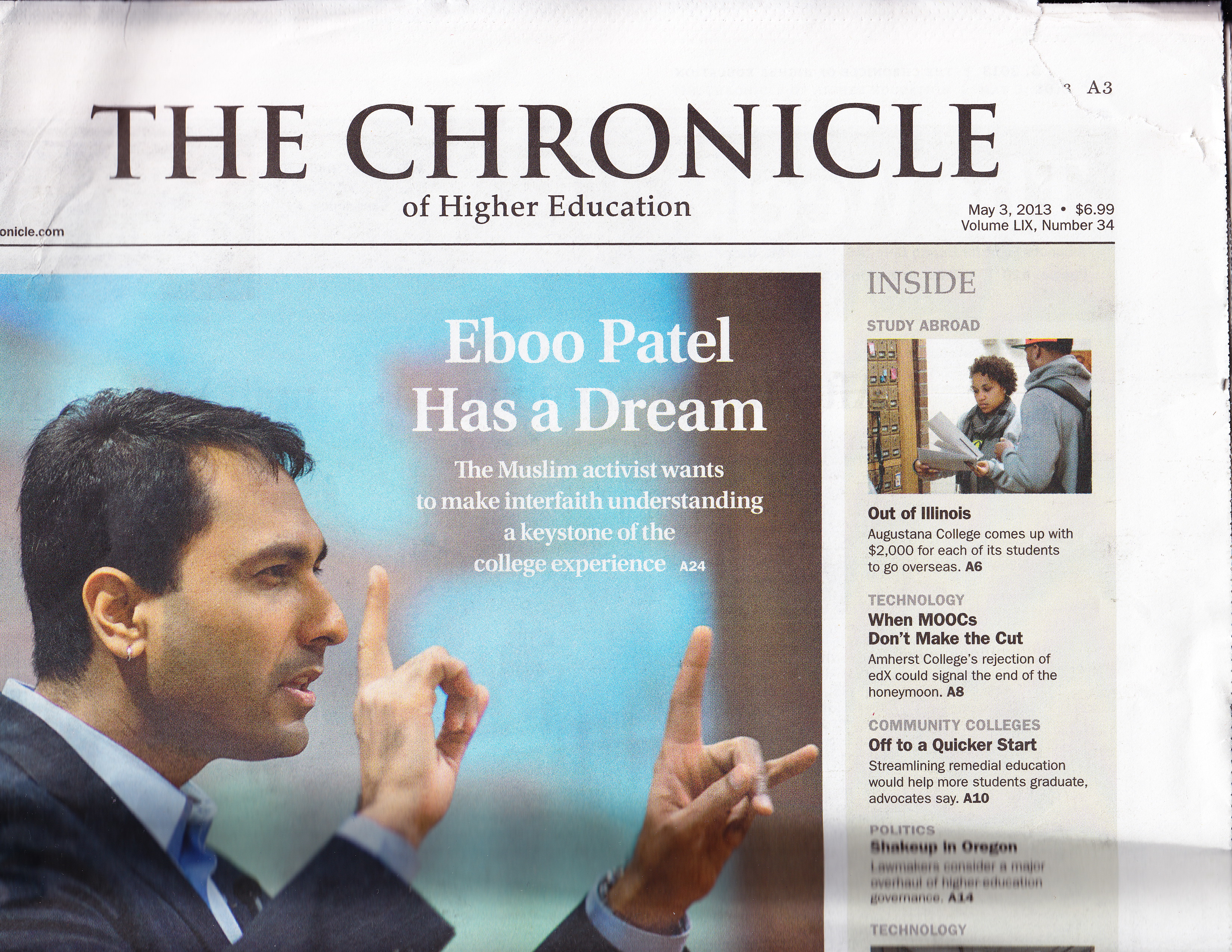
It is not exactly pride that I feel when I see my undergraduate college featured in a Chronicle article entitled “Group Aims to Help Conservative Parents Counter ‘PC Indoctrination’ at Colleges.” I almost feared to scroll down the page. Yes, good old Grove City College has to thrust its manly credentials into the face of reason once again. The problem is that what such conservative groups decry as “indoctrination” is, in reality, critical thinking. It took me a long time to learn this distinction. I grew up in a conservative family, but I didn’t choose Grove City because of its flaming commitment to sixteenth-century values. I chose Grove City because it was a selective, intellectually honest school close to home. Being a first generation college student, I had no family tradition on which to draw. Guidance counselors didn’t know what to do with a religious kid who seemed to have some smarts. Other colleges seemed so far away. I didn’t even know what I wanted to study. You see, being raised in humble circumstances you learn to react to the many unpleasantries that life throws at you and there really isn’t time to plan out a future. It never works out that way in any case. I felt driven, but I didn’t know where I was going. Some day I hope to find out.

In the meanwhile, Grove City College has grown even more reactionary than when I was there in the 1980s. The Chronicle article states that “Conservatives have long complained about a perceived liberal bias in higher education,” and that Jim Van Eerden, an “entrepreneur in residence,” (shudder!) at Grove City has started the ironically named “FreeThinkU” to counter the liberalities students receive in school. Talk about your mixed messages! I wonder if Van Eerden has ever considered that Free Thinking has a long association with the very progress he abhors. Free thinkers gave us the gifts of evolution, rational thought, and for a while anyway, free love. Free thought gave us Kate Chopin, J. D. Salinger, and Margaret Atwood. They literally gave us the moon and have landed our probes on Mars. Somewhere lost in space a metal plaque is spinning in infinity with a naked couple and directions to planet Earth. I think the mis-named FreeThinkU might be better rechristened as Don’tUThink.

Higher education has a long, long history with religious thinking. Early universities were often outgrowths of theological colleges. Over the centuries, as our thinking matured, the ways of the past were recognized for what they were—outdated, short-sighted, unchanging for the sake of being unchanging. The reality that meets our eyes through the lenses of logic sometimes claims beehive hairdos and horn-rimmed glasses and greased back business haircuts as its victims. The earth is warming up. We did share a common ancestor with the apes. Our universe is even larger than we ever thought. And yet “FreeThinkU” suggests that we need to set the clock back a little. Maybe just a couple of centuries, but enough to hold our kids in the twilight of misperception. Progress has to be more than raping the earth and getting rich. Free thinking has to be a willingness to use the minds we have. I wonder what the aliens will say when they land here, our Pioneer 10 plaque in hand. If they land in Grove City, I suspect, they might feel they were sold a false bill of goods.

From the alumni mag; think about it...

From the alumni mag; think about it…


Blob Blog

Those who actually know something about movies occasionally complain that Hollywood seems to provide us with diminishing returns. How many movies have been remade? Can anyone even count all the sequels, prequels, and just plan quels? A similar trend is evident in publishing. A teen-vampire novel takes off and every publisher faces a twilight of the profits if it doesn’t spin off its own version. Sometimes I end up becoming familiar with a movie through its remake before ever viewing the original. The Blob is one example of this. I’ve seen the thirty-year remake 1988 version a few times. Just this weekend I saw the original 1958 version for the first time. It seems to me that teen movies of the late fifties and early sixties tried a little too hard to get the snappy, sassing dialogue of teens on the brink of the incredible cultural changes that were about to take effect after the extreme conservatism of the McCarthy Era. At times it is so hip that I can hardly stand it.

The_Blob_posterThe Blob falls into that category. A young Steve McQueen trades ripostes with his chums who think a drag race and a Bela Lugosi movie with your gal are pretty daring behaviors. Buried in all that innocence, however, I found a hidden warning tone. When I watch scary movies, I always keep an eye out for religious themes. Sometimes they fail to materialize. The Blob is about as secular as they come. I didn’t even spot a church or a priest (unlike the 1988 remake) in the typical American town. Just a bunch of kids that, Archie-like, try to convince the adults that they’re serious. A blob from space really is loose in town, and nobody has an idea how to stop it. All the adult men wear ties and the ladies all wear dresses. It is a world that follows the rules.

What of this warning tone I mentioned? Well, the blob itself is, apart from its disruptive raison-d’être, hardly more threatening than the stifling culture it attacks. It can’t be shot or burned, and nobody has any other ideas. It is unstoppable. Except for cold. And here’s the chilling part. As the carbon-dioxide drenched blob is airlifted to the Arctic by the military, Lieutenant Dave declares the world safe once more. Steve (Andrews, i.e., McQueen) chimes in with, “Yeah, as long as the Arctic stays cold.” The film ends with a trademark horror question-mark (this one literal) as the blob is parachuted onto a snow-covered landscape. Global warming was a future monster in 1958. The optimistic world could see nowhere but forward. Now, over 50 years later, our future looks a lot less cold. With politicians and some religious leaders decrying global warming as just another liberal myth, we might do well to remember The Blob. Something up there on our melting ice caps is waiting for us to return to the 1950s to begin its sequel of terror.


Next to Godliness

Catholics, secularists, and even a Pharaoh or two. Loud, pounding music. Dancing teenagers. It must be FIRST Robotics season again. Although I’m ambivalent about the implications of a world filled with robots, I can’t help but be impressed by what high school students can do when they are mentored so closely by adults eager to share the tricks of the trade. If you’re not familiar with FIRST Robotics, here are the basics: each January a new game objective is released. Participating high schools throughout the world have six weeks to plan, design, construct, and program a robot to perform the tasks spelled out. Since this is a busy time of year for many schools, dedicating extra hours to building a robot leads to complaints and loss of sleep—maybe a skipped supper or two. When they come together on the playing field, however, all that is forgotten and the wonder is that kids, who are often disparaged in our society, have managed to construct a working, complex machine capable of tasks impossible for many adults (for example, doing chin-ups).

Every year I can’t help but think how like a religious service these events are. The robots are like deities to be served and the technology flits about like mechanized angels. There is an increasingly complex hierarchy of officials telling you what you can’t do (now this is beginning to feel like work!). At the end of the day, however, the kids get to be the stars in a competition that puts brains over brawn. And the robots are treated with extreme deference, because we know that we wouldn’t stand a chance if they had a will anything like the deities of yore.

The religious imagery, however, is never absent. Technology represents humans doing things without divine intervention. These are empirically devised devices, performing according to the laws of physics. And yet, teams from Catholic high schools, bearing mythologically-laden names, join in the world where no gods need apply. Robots, as initially named by Karel Čapek, were human servants, the ultimate in godliness—making images in our likeness to do our bidding. And yet we can’t escape the language of religion when thinking about our own creations. The fascination applies to non-parochial schools as well, with some teams claiming names echoing themes from holy writ. Creating autonomous beings is next to godliness. We make our own future, and, god-like, we hope that nothing goes wrong.

Humans and machines

Humans and machines


Evolving Leadership

Simple answers are seldom correct. Unfortunately many people will accept a simple answer rather than try to sort through the complexities that life in the universe provides in such abundance. I was given cause for hope by an interview that I saw on The Upworthiest. Zack Kopplin, a student only nineteen years old, is taking on the creationists in the south. It’s not an easy thing to do. As Bill Moyers points out in this interview, 46% of Americans believe in creationism. In a land where everything is a matter of choice, it seems, science is just one of many options. Also, Fundamentalist clergy are among the most gifted spin-doctors ever to have evolved. By pairing evolution and atheism and values that are dangerous to their beloved lifestyle, the message goes out from thousands of pulpits that evolution is a lie and that the Bible is a science book after all. And people, easily led, will follow. For many decades scientists and religionists alike refused to even address creationism, supposing illogical thought would eventually die out. What they were actually witnessing was a match thrown into a kindle-dry forest after decades of drought.

Even the case of Zack is a demonstration of this. When a law passed in his native Louisiana making it easier to teach creationism in the public schools, those who knew better did nothing. It took a nineteen-year-old to try to change the law. One could argue that full-grown scientists and other professionals have too much to do to waste their time on such foolishness. The problem is, as Zack is keenly aware, the creationists are well funded, strategic, and insidious. Fueled by self-righteousness, and supported by at least 16 years of presidential administrations that approved of creationism as a form of science, this movement is as much a threat as the NRA is to a peaceable kingdom. Maybe more of a threat because nobody takes them seriously. There is a plenty of history documenting the growth and development of the creationist movement, and, as Zack knows, it is not a fad. Most serious scholars just don’t bother to read it.

Creationism thrives by its own sense of victimization. Science offers us no cuddly deity who will make everything right at the end of a life of toil and turmoil. That is fine for science, but we must never forget that people are people. We need something to hold onto. It is this that creationists understand. Instead of calling it delusional, perhaps scientists need to step back and realize that it is a profoundly human need. That doesn’t make creationism right—not by a long stretch—but it might help to understand why it just doesn’t seem to go away. Instead of ignoring, science must address creationism. And so must those with serious training in religion. Creationism doesn’t survive close scrutiny by either scientists or religious specialists, but it sure does offer a feel-good ending. Until we admit that they’ve done their homework, those who oppose creationism are going to find themselves being led by nineteen-year-olds with a sense of what’s really at stake. And that’s complicated.

Yes, they will attack the prophet

Yes, they will attack the prophet


Pope Springs Eternal

All channels lead to Rome. In a world where Christians lament their public influence, we can’t seem to get enough of the pageantry, the mystery, and the stylish drama of electing a pope. The secrecy is key. If cardinal debates were held in an open forum, by cardinals in business suits, the media would have trouble covering its yawns. In a conclave deep within the classical architecture of Rome, privileged men in expensive gowns meet and whisper in hushed tones until a puff of smoke rises though a sacred chimney and the world either hitches its collective breath or sighs in deep contentment. No wonder the election of a pope is such a big deal for Protestant and Catholic alike.

We would be mistaken, however, to limit such docu-drama to Rome. Religions, from the earliest institutionalization of their practices, used drama and showmanship to add to the draw of the sacred. Ancient Mesopotamians and Egyptians kept statues of deities hidden away in the deepest recesses of temples, and brought them out periodically to great public fanfare. The laity would watch in astonishment as an actual god was paraded among them—the popemobile had yet to be invented—and lapse back into ordinary time as the sacred statue was swallowed once again in the darkness of its great house. Even the aniconic Israelites maintained ceremony and mystery, for they had an invisible god who raised all kinds of questions in the naturally curious human mind.

The papacy is, after all, a recognized authority structure. Some nations recognize the Vatican as a sovereign state, a little bit of the City of God among the Rome of Humanity. For the time being at least, the Roman Catholics outnumber any other branch of Christianity. It is the most successful trader in the marketplace of religious commodities among Christian consumers. Its draw has always been tied closely to a sense of mystery and awe. There is a magic to the mass that the televangelist sermon splashed on the big screen somehow lacks. It is old and arcane. Few believe in its literal transubstantiation, and yet it stands as the outward and visible sign of a deeply occluded reality that takes place behind closed doors. Men in red, debating on the virtues of a new CEO for the vicar of Christ. No wonder all channels are tuned to Rome.

From presidencia.gov.ar, via Wikimedia Commons

From presidencia.gov.ar, via Wikimedia Commons


HRH vs C of E

An article from the Sunday Daily Mail, the UK newspaper, opens with the headline “Queen fights for gay rights.” I was pleased, as most even-minded individuals would be, that discrimination is being addressed by Her Royal Highness. Then the implications began to kick in. Having domiciled many years among the Episcopalians, I couldn’t help but smile knowing that the monarch is the head of the Church of England. Figurehead maybe, but on the books, the buck stops in Buckingham, not Lambeth. For decades I’ve seen the Anglican communion fracturing over what is a non-starter, theologically speaking. The only reason to protest homosexuality is the loss of potential life. For anyone who believes that sex is for procreation only, I would advise trying to counsel all the spermatozoa who just didn’t make it to the egg in time. Procreation is filled with an extravagant exuberance of over-production. Walk under any oak tree or stand among the wondrous helicopters of a maple tree in early summer and ponder what’s falling at your feet.

It seems to me that what’s lacking in the religious world is love. Loving, committed couples are ostracized for being just what God made them, while self-righteous critics wag their parsimonious fingers. And this is done in the name of God. I have friends of all gender orientations, and never have they given me cause for moral concern. In fact, I have trouble categorizing them together as a group; they are individuals to me, not pigeonholes. Some churches have trouble because prejudice has become dogma. Even the Roman Catholic Church allows for sex between couples when conception is virtually impossible, as when a woman is pregnant yet doesn’t yet know it. Just try not to enjoy it too much. The life potential ends the same way. Millions must lose for every winner. Consider the ethical implications of a deity who didn’t design a one-shot, sure-fire sperm for each act. Surely it would’ve been possible to engineer for an omnipotent divinity.

Instead many mainstream churches are assiduously drawing lines in the sand, claiming that one gender, one orientation, one race, only is welcome on the side of the 144,000. The rest can, quite literally, go to Hell. Is this what religion has become? Imagine what good might be done if all that energy were poured into addressing poverty, starvation, or inadequate water supplies. Imagine those who represent the winners in the reproductive race receiving care and attention rather than those who will, by a massive margin, stand no chance of survival whatsoever. We could make this a better world instead of prolonging the suffering of those who’ve done no wrong. Those holding the balls are trying to make up the rules of the game. The Queen of the Realm seems to be saying it’s time to start playing fair. Long live the Queen!

The first queen of the Church (of England)

The first queen of the Church (of England)


A Tale of Two Bees

We’re nearing the competition season for FIRST Robotics. The animated, mechanical creatures created from scratch since early January are now set to compete for a kind of ultimate, ultimate frisbee. Only you can’t call it “frisbee,” for copyright reasons. Ironically drone bombers have been in the headlines this past week. Drones are robotic planes that fly their missions with human pilots sitting safely hundreds, or even thousands of miles away from the action. People are beginning to wonder—is this ethical? I pull out the Scientific American I purchased at Bush International in Houston last week. There’s an article about robo-bees. In a scare that seems like it could have come straight from the X-Files, I’ve been reading about the disappearance of bees. There are people seriously worried about this. It does seem that we failed to learn the lesson of Rachel Carson, and a land of milk and honey just doesn’t appeal without the honey.

The robo-bees are the size and roughly the shape of biological bees. They can be programmed to behave like bees and pollinate plants that our missing bees have been, well, missing. There may be hope for the flowers after all. But I wonder about the honey. No doubt, technology will come to the rescue. Those labs that gave us sucralose, aspartame, and stevia can surely invent a golden, viscous liquid sweetener that drips from a pipette. No cause for worry here. We can recreate the natural world in the laboratory. Honey has been reputed to have medicinal effects, but we can synthesize medicines in the lab as well. You might not want to dribble those on your biscuits, however.

Honey is made from nectar, the mythological food of the gods. Hinduism, Buddhism, and Judaism all recognize the religious significance of honey. Those of us who’ve been stung realize that a price has to be paid for such divine sweetness. The gods are like that. Roses have thorns for a reason. Not that I’m not impressed with the technology behind robo-bees. I am astounded that tiny robots can be built to fly and perform as we understand nature to dictate the Apis genus. They don’t, however, have the minds of bees. Mind is not the same as brain, as we’re beginning to learn. And minds are not limited to Homo sapiens. I recall when in our arrogance we thought we could improve the productivity of bees (capitalist bees) by breeding them with their Africanized cousins, biologically separated by an ocean. Many nightmares haunted me of the resulting killer bees. Yes, I had been stung as a child. Just by regular, garden-variety bees. From those painful events I learned a valuable lesson. We tinker with nature at our own cost. I, for one, am willing to deal with real-life stingers to taste the very food of the gods.

True bee or not true bee?

True bee or not true bee?


Real Life Zombies

In recent months Binghamton University has been on my mind. Binghamton has a number of videos available on YouTube which I find to be entertaining and even, sometimes, very funny. I like Bing’s style. Even though I catch myself laughing once in a while, I know that Binghamton takes higher education seriously. I watched a recent, 17 minute talk on a vital topic. It is located here, and I would recommend that you watch it too. Don’t worry, I’ll wait.

Back? Okay. The situation raised here is one that makes me shudder. Few things are as debilitating and vulnerable as an uneducated populace. Both religious and political forces have made great efforts to prevent certain orthodoxies from being challenged by what they term, as an obvious swear-word, “higher education.” The fact is, folks, higher education is nothing more than an attempt to get people—often young people—to learn how to think critically. That last word is a stumbling block sometimes. Any number of people will suppose that critical thinking is the same as criticism. It isn’t. Critical thought is the ability to approach a problem—any problem—rationally. To respond with the best that our minds have taught us to do, rather than with knee-jerk reactions. Yes, emotion and jerking knees have important places in the world, but they only work well if they are accompanied by the ability to think critically.

The video makes it pretty clear that the ability to think is rapidly eroding in our culture. Perhaps not quite zombie apocalypse, but not comfortably far from it. The death of Borders was blamed on its inability to get into the electronics markets by various pundits. I disagree. Borders fell victim to a culture that has lost the joy of challenging reading. We like spoon-feeding (otherwise much of the internet is difficult to explain). In order to exercise our brains, we have to use them to read hard things. Like my high school coach used to say, if you don’t use your muscles they’ll atrophy. Looking at my mid-section, I can see that his words were true. What Coach didn’t warn us about, though, is that the same holds true for the mind. The unchallenged intellect is a dull one. This is a threat far more insidious than any Communism, or liberalism ever was. It is the dummification of America. We are a nation that loves zombies. We are also a nation in danger of becoming them as well. Fight the zombie apocalypse—read a book. And like that baseball bat you use to swing at the undead, the harder it is, the better.

They don't write them like that anymore

They don’t write them like that anymore


International Women’s Day

So it’s International Women’s Day, and I’m thinking about what various religions might do to celebrate it. How about equality? True equality. With rare exceptions religions have been spawned and gestated in masculine wombs. Increasing the asperity, monotheism had to, by definition, introduce a single-gendered god to match at least half of the human race’s expectations. No surprise he is a deity with a Y chromosome. For whatever reason, religions nearly always promote male experience as normative and female experience as supportive. If you disagree, well, talk to the man upstairs.

In those few precious moments when I’m allowed the luxury of a daydream, I wonder how differently the world would’ve developed without the mythology of the alpha male god. If god had been conceived as feminine in the beginning, would it have made a difference? Would the rules be more or less stringent? More humane?

Lange-MigrantMother02

Polarities are a funny way to view the world. As evolved, gender-differentiated animals, we easily slip woman and man into that category of natural polarities. Over time, however, it has become clear that reality is more complex than X or O (or I and O, or X and Y—where the male is missing something the female secretly possesses). What if the overall category were simply “human?” As we’ve evolved, we’ve learned to keep many animalistic tendencies in check. Our vast and complex societies, unique only in degree, have demonstrated that it is possible. To judge half of the human race as less able to provide spiritual leadership is an exploitation well past due for extinction. With all eyes on the Vatican over the past couple of weeks, the largest Christian denomination in the world doesn’t seem ready to shift even a nanometer on this one. Mother Mary, pray for us.

In a world where conception was a mystery (which it still is, to a point), women were the sole life givers. Men had the role of sustainers, the help-meets who brought home the meats. Somewhere along the sociological lines the order somehow switched. Might it have been religion itself that led to the subordination of the god-like ability to give life that only women possessed? By attributing the origin of life to a being, generally male, outside the realm of normal reality, religion bestowed a foreign primacy upon the human race. We became the victims of our own longing for transcendence. So celebrate International Women’s Day. If it weren’t for a woman, a goddess in her own right, you wouldn’t be reading this right now.