Artificial Ugarit

Yesterday a friend pointed me to an article in the MIT News entitled “Computer automatically deciphers ancient language.” The language in question is Ugaritic. The article, by Larry Hardesty, narrates how three computer scientists have developed a program that may potentially decipher as yet non-readable languages. Ugaritic was chosen as a test-case because it has already been decoded and since it meets the specific criteria needed for the program to work. Results from the program could be measured against the standard translations already produced by specialists. Perhaps Ugarit will have another day in the sun.

The larger issue, of course, is technology and its role in understanding the human endeavor. Written texts are an extension of the human mind and those of us who practice it copiously know that the written piece is a piece of the author. Ancient texts may not suffer the same burden of individuality – some undoubtedly were rote pieces set to clay only after a lengthy oral life – nevertheless they participate in the constant paronomasia that is the human psyche. We invent the myths that Ilimilku and his colleagues inscribed so carefully over three millennia ago. Computers may indeed aid us in unlocking their often obtuse forms of expression, but how close will they put us to laughing at Ilimilku’s jokes or wondering deeply at his profundities?

Having been involved in a research project involving computerization and the Ugaritic texts (I was an editor in the now defunct Ugaritic Tablets Digital Edition) I am very aware of the benefits that technology brings to the table. As a sometime writer, I am also aware of the ironies involved. Our ancient predecessors, humans like ourselves, wrote texts that they considered worthy of preservation. Their civilization collapsed. Their language died. We rediscovered it and eagerly wanted to know what they had to say. We, however, have lost the ability to understand. Computers have taken on a dominant role in disseminating the written word. They daily participate in the human experience. Perhaps some day it will be AI that is scrutinizing our whimsical words and trying to decipher what in the world we meant. When they succeed they will find we are not that far from where Ilimilku began.


Under God

As one of the more flamboyant of national holidays in the United States nears, there is a whiff of discontent in the air. The North Carolina Secular Association has been sponsoring billboards that provocatively read, “One Nation Indivisible.” Those who, since 1954, have grown accustomed to reciting the “pledge of allegiance” with the words “under God” inserted after the “one nation” bit, grumble that one more icon of civil religion has come under fire. I first became aware of civil religion as a student in a self-identified Evangelical Christian college. I was astonished that the religion faculty, all believers, suggested that civil religion was not true religion at all. True religion was an inner commitment, not social bravado – often in the service of political aims. I was pointed to the writings of Richard Niebuhr and Dietrich Bonhoeffer and told to think for myself.

Since that time, I have kept a wary eye on civil religion. It is a dangerous force in society since few people think deeply or seriously about their religion. It fosters knee-jerk mob mentality. Civil religion is a slurry of a variety of religious outlooks, mostly Christian, predominantly Protestant, but now gaining a dose of conservative Catholicism. No one denomination would accept all its tenets as true faith, but weighed against the “godless alternatives” most conservative believers would much prefer the shallow public display of religiosity to “one nation indivisible.”

The Pledge of Allegiance was first composed in 1892. It read, “I pledge allegiance to my flag and the republic for which it stands: one nation indivisible with liberty and justice for all.” (That flag didn’t have 50 stars.) The North Carolina Secular Association has, arguably, simply reverted to the original formulation. In 1954, with Cold War concerns heating up and decent Americans associating themselves with Evangelical Protestant values, the phrase “under God” was added – take that you godless Communists! That other great icon of civil religion, the United States motto, “In God we trust,” was placed on currency during the battle-torn era of the Civil War. Once again, the Cold War brought it into prominence. In 1956 the Congressional Record noted that “In God we trust” should be designated as the United States motto. With the collapse of many of the Cold War threats, the fully charged civil religion front had to find a new outlet for its excessive energy. One needs only a casual glance at the American political scene to see where this insipid, lukewarm version of civil religion has resurfaced. One nation indivisible?

Does it really stand for freedom of religion?


Misappropriated Prophets

There seems to be a can of worms lying open on my desk, released by the comments yesterday’s post engendered. I thank all my readers and commentators. The issue most pointedly thrust among the worms appears to be that of prophecy. Teaching about prophecy constitutes a large part of my meager income. And since prophecy plays a large role in many Evangelical associations not only with the Deepwater Horizon disaster, but also Hurricane Katrina, 9/11 and just about any other major catastrophe, it is worth exposing. In the Bible prophecy is not about predicting the future.

Prophecy was a widespread phenomenon long before Israel appeared on the scene. One of the roles prophets shared in ancient times was the declaration of outcomes to momentous events. Unfortunately that aspect of their duty easily became equated with predicting the future. Its actual milieu, however, was that ancient people believed prophets to be “effective speakers.” When a prediction came true it was not because a prophet could “see the future,” but because the spoken word of the prophet participated in the reality of the world. The belief was that the effective word came from God/a god, and therefore would be true by definition.

Apocalyptic, the familiar literary form of Daniel and Revelation, is not prophecy. Zoroastrianism, the religion of ancient Persia, had influenced many ancient religions, including Judaism. Apocalyptic, like prophecy, has a predictive element. Like prophecy, however, apocalyptic has a different purpose. The books most heavily farmed for future predictions by Evangelicals, Daniel and Revelation, are both thinly veiled accounts of contemporary events of the authors’ own days. Daniel consoles Jews persecuted by Antiochus IV Epiphanes and Revelation consoles Christians persecuted by one of the early Roman emperors (the jury is still out on precisely which one). Neither book predicts the end of the world. Both, however, declare the comeuppance of the arrogant oppressor. It is here, perhaps, that the true relevance of the Bible speaks to the scars human beings inflict on their own planet and on each other.

sic semper tyrannis


Oil’s Well that Ends

Greed has been on my mind quite a bit lately. I like to think it isn’t petty personal greed, but the insatiable corporate variety of greed. Friends send me links to sad commentaries on the Gulf Oil Spill, an event that severely amplifies the cruelty already inherent in nature, but an event that would have been preventable were it not for greed. My friend James from Idle Musings sent me a compelling story from the UK Guardian that poignantly demonstrates how a shift of worldviews has bestowed divine approval on the rape of our planet. The very religion that began as animism, the belief in the ubiquitous divine in nature, has evolved into a Neo-con Christianity that supports free markets as surely as it believes in resurrection. If a few million animals have to die, well, their invisible, loving God sees far more than our limited sight.

Nowhere is this more evident than in the video link my wife pointed out to me last night. Here an advocate for biblical “prophecy” points out that it can not be coincidence that the day after the United States withdrew unilateral support for Israel in the United Nations Security Council was the very day that Deepwater Horizon exploded. No, the pundit declares, do not be fooled. God is punishing the United States for withdrawing support from Israel. This idea, unfortunately, draws on a morass of sloppy theology that can be historically traced to an evangelical death-wish for the planet. Barbara Tuchman, one of the most respected historians of the last century, objectively traces the story in her classic Bible and Sword. Political support for Israel was perceived as a means of forcing God’s hand into releasing the second coming. So much for human sympathy.

Coincidences continually occur. April 19 is the day that Cardinal Ratzinger was elected Pope just five years ago. It is the day Grace Kelly married Prince Rainier of Monaco. It is the Feast of Saint Aelfheah of Canterbury. It is Patriot’s Day in New England. It is the day The Simpsons premiered. Whether to see God’s hand in any or all of this is a matter of perspective. As is the motivation behind supporting Israel, big oil, or the second coming. If there is any name other than greed for offering political support for a nation of sacrificial lambs and spilling oil in order to hasten the apocalypse, I simply do not know what it might be.

And this was only April


Wasting our Breath

The internet is alive with the sounds of musings about the appropriateness of various types of scholars doing biblical research. The discussion revolves around a recent article by Ronald Hendel in Biblical Archaeological Review, a useful, if sometimes overeager, magazine. In it Hendel laments the policy of the Society of Biblical Literature, a professional group to which I have belonged for nearly two decades, of accepting overtures from evangelical groups in return for money they are able to bring in. The Society’s web page has a rebuttal and has invited discussion. I prefer to give my views on my blog – a place that I consider neutral territory.

I am not privy to the inner workings of the SBL. I have served as a chair of one of the program units in the annual meeting for several years, but I do not pretend to know the politics behind the scenes. I joined the society, like most young scholars, to find a job. Since that has never happened I have not become more deeply involved since I have no institutional base. It is clear, however, that over the past years conservatively motivated groups have felt an assonance with the Society, given that it is the gateway to academic respectability. The problem is that conservative/evangelical groups approach the Bible with doctrinal shackles firmly locked in place. Fearful of angering their image of God, there are questions they simply can’t ask. Secular or unaffiliated scholars are free to go wherever they believe the evidence leads. In the job market, the evangelicals are better placed to find work. In the wider academic world, however, their work is suspect.

Little did I realize as I laboriously worked away on my dissertation that many evangelical scholars flock to the field of ancient Near Eastern studies, providing, as it does, a way to avoid critical interaction with the Bible. They may thus become “Bible scholars” while leaving the confessional virgin Holy Writ intact. I entered ancient Near Eastern studies to get to the bottom of it all – to explore the origins of the Bible itself. All of us end up interviewing for the same jobs.

At the end of the day what it comes down to is an issue I’ve addressed before: who has the right to interpret the Bible? The answer often distresses scholars. It does not require a Ph.D. to read and interpret the Bible. Most times an advanced degree is a decided liability. A friend has recently pointed out that scholars write for scholars, intent on demonstrating their erudition while losing all public credibility. I’m not sure where the debate will end, but when it’s over not a ripple will be felt among the general public. The Bible will continue its reign in American society unchallenged.


Life in the Laboratory

Nancy Gibbs’ essay “Creation Myths” appears in this week’s Time. Leaping off from Craig Venter’s “creation of life” in the laboratory, Gibbs asks who the final arbiter might be in this world we’re creating in our own image. The more I ponder the question, the more I realize that no person really decides how far we will go and the implications will only grow more and more unanswerable. We all attempt to construct the world according to our idea of how it should look; it is not a question of if we create the world in our image as much as it is whose image will prevail. As I noted in a recent post, no one person has all the answers. What each of us does impacts all the others just as a wave influences everyone in the sea. We fear science taking the prerogative of creating life because we are fully capable of imagining where it might go, but we just don’t know.

As an individual who has often been on the receiving end of other people’s visions of how this or that institution or company should look, it is my humble assessment that we have already lost control. We never really had control in the first place. At the end of the day, who will really be able to prevent another Gulf oil spill from occurring? Make what laws we will, other creators will find ways around them. And as in Gibbs’ article, the rest of us will simply have to react. No one is really in control.

Perhaps this is the real reason that religion is so appealing. It is terribly, terribly convenient to have an omnipotent divine entity on whose anthropomorphic shoulders we might cast our worries and burdens. Whether we believe in predestination or not, it is comforting to suppose that when it is all over God will somehow sponge up all that oil (preferably squeezing that sponge back out into BP’s great, sturdy tankards of crude), or stop that evil clone we’ve engineered, or stomp out that hyper-aggressive virus we’ve unleashed. We may make laws against creating life or human clones in the laboratory, but it will happen nevertheless. Gibbs wonders if scientists are about to cross some moral Rubicon. My answer is simple: we crossed that Rubicon long before the river itself flowed, when we first put our webbed feet out onto dry ground and began our still uncertain journey to the future.

God exits, stage left


Sol Invictus

Perhaps for abject fear of paganism, western civilization has avoided holidays associated with the summer solstice. Being the lightest day of the year in a frequently dark northern hemisphere, it was naturally a time to celebrate the victory of light over darkness. While the winter solstice insinuated itself into the complex of Christmas holidays and Easter became intricately intertwined with the vernal equinox, the summer and autumn holidays were rejected.

This neglect of the powers of light coincides to some extent with the orthodox Christian rejection of Gnosticism. The Gnostics, able dualists like their Zoroastrian predecessors, celebrated the victory of light over darkness. Remnants of their theological outlook survived in the canonical Gospel of John and the always questionable Revelation. Ancient societies throughout the world recognized the summer solstice because, regardless of its name, the sun was acknowledged as a powerful deity. On this day the sun is at its height of strength, banishing darkness for longer than any other day of the year. It is a day not to waste.

Christianity has preserved some minor holidays for the summer season, but with the advent of a leisure-based society where summer is a time to take it easy, if not cease work altogether, the solstice lost its grip. Perhaps because light is so abundant already in the longer days as winter wends its way into spring and summer and lingers pleasantly until the vernal equinox, summer itself is simply holiday enough. Those adhering to the ancient religions nevertheless gather at sites like Stonehenge and Maeshowe, or even Egypt’s famous pyramids to consider the unending influence that our special star holds for its most imaginative planet.

The stones of summer


Casting the First Stone

I’m not overly nostalgic for a guy interested in ancient history. I tend to look at the more recent past as a via negativa for the young who might make a difference today. Very occasionally, however, aspects of society were handled better back in the 1960s and early 70s. One of the most obvious instances of a more sane society was the segregation of politics and religion. Prior to the rise of the “Religious Right” as a political machine the religious convictions, or lack thereof, of politicians played little role in their campaigns and American culture itself was much more open. A story from today’s MCT News Service illustrates this all too well.

In an article entitled “In S.C., religion colors gubernatorial race,” Gina Smith reports on the various religious slurs that now pass for political campaigning in that state. “Raghead” (for a former Sikh), Buddhist, Catholic, and “anti-Christian Jewish Democrats” are among the aspersions freely cast by those without the sin of a non-evangelical upbringing. As if only Fundamentalists are capable of making the right political decisions. As if Fundamentalists ever make the right political decisions. Fundamentalism is a blinding force on the human psyche, and those who are misled by religious leaders who claim unique access to the truth are to be seriously pitied. Conviction that those most like you are to be trusted most may be natural, but dogged belief that pristine morals accompany any religion is glaringly naïve.

The American capacity for belief in fantasy worlds is in the ascendant. No matter how many times Fundamentalists or Evangelical politicians are arrested or forced from office for the very sins they rant against, their overly forgiving constituencies come flocking back to them. Commit the sin of being born Sikh, Hindu, Buddhist, Muslim, Jewish, or Catholic and no quarter will ever be offered. No, I have no desire to go back to the 1960s, but I sure wish politics would.


The Power of Christ Beheads Thee

Yesterday’s news carried the story of Gary Brooks Faulkner, self-appointed Osama bin Laden hunter. Faulkner, on his third trip to Afghanistan, is described as “extremely religious” and “highly intelligent” by his sister. Equipped with night-vision goggles, a pistol, sword, and “Christian texts,” according to the New York Daily News, he plans to behead bin Laden by the power of his (Faulkner’s) faith. Faulkner is fighting kidney failure, a disability he apparently shares with bin Laden, and although he appears to be dying Faulkner said, “God is with me, and I am confident I will be successful in killing him.”

It is hard not to admire a person so driven by conviction. On the other hand, it is difficult to imagine Jesus instructing his followers to lop off somebody’s head. The incongruity between the insistence of forgiving and loving one’s enemies and the more direct approach of beheading is a wide gulf indeed. At what point does religion become revenge? Is doing unto others as they have done unto you the corollary of its better known anastrophic sibling? Beheading is one of the most degrading forms of execution – although all forms of capital punishment raise serious questions in classical Christianity. What happened to turning the other cheek (neck)?

The image of a lone-ranger mercenary wearing night-vision goggles while toting a 40-inch sword is painfully ironic if not downright reminiscent of Attack of the Killer Tomatoes. Flying planes into buildings out of hatred for theological differences is even more ridiculous. If people could keep their religious hands to themselves the world might become a much more humane place and the daily news might become just a tad less colorful.


Joltin’ Jesus

Jesus has been having a hard time lately. Just last month he was hit by a car, and on Monday night lightning struck a second time. Literal lightning. A touchdown-style Jesus in Monroe, Ohio, formerly six stories tall, received the paragon of divine punishments in a Midwest thunderstorm. Struck by lightning, the fiberglass and plastic foam savior melted leaving only an eerie, Lovecraftian idol of a steel frame behind. The statue had adorned the Solid Rock Church in Monroe since 2004. According to MSNBC many motorists said that America needs more symbols like this; God apparently disagrees.

Former Touchdown/Quicksand Jesus

Obtrusive religious symbols dot many high hills and adorn many quotidian highways as signs of the donors’ faith. Lawrence Bishop, horse-trader-cum-pastor, and his wife Darlene made a substantial investment in this eviscerated Touchdown Jesus sculpture. As a camp counselor in my youth, I slept in the shadow of the great steel cross of Jumonville in southwestern Pennsylvania. The 60-foot tall cross is lit at night and is visible in three states. The monolithic cross always seemed incongruous with the blackened roasted weenies and gooey banana-boats we managed to choke down. Staring at its gleaming whiteness by night was an epiphany to many.

With the rainbow seal of approval

When my wife and I lived in Scotland some years ago, a terrific wind-storm blew through. In itself that was nothing uncommon, as any Scot will tell you. Wind gusts in this storm reached about 140 knots (160 mph), causing widespread damage. In an interview on the BBC, the sexton at one of Scotland’s cathedrals (time has robbed me of the details) recorded seeing the wind topple a statue of Jesus atop the building. He quipped, “I looked up, saw Jesus coming down, and ran for my life!” Although the exact location escapes me, the words have taken on an unexpected significance as icons crash down all around me. The demise of “Quicksand Jesus” is simply one further reason to avoid trusting in anything less than solid rock.


Tut-tut

King Tutankhamen is on tour in New York City at the Discovery Times Square Exposition. It is difficult to assess how he feels about this tour, but I am certain the young king would have been astounded at Manhattan. The Egyptians were impressed by monumental architecture, and whatever one’s personal likes or dislikes may be, New York is full of monumental architecture. Tut’s famous golden death-mask will, however, be absent. That never leaves Cairo anymore.

As a sometime lecturer on the Ancient Near East, I can always count on students knowing King Tut. Many can’t name his father, Akhenaton, or even say what he was famous for (a rudimentary monotheism), but all know Tut. The reasons are transparent – all that gold! It is difficult not to be impressed with that shiny yellow metal we all would like to have in abundance. Apparently Tut did. His accomplishments as king were severely circumscribed and lackluster, yet he lives on as the most famous Egyptian pharaoh because we have his gold.

Our appreciation of the superficial in the ancient world is a condemnation of our own society. We continue to be impressed by wealth at the expense of substance. Seldom do we find anything resembling true wisdom surviving from the enormous estates of CEOs. Their wealth assures their place in society, regardless of their accomplishments in moving society forward (or, more likely, not). They are living King Tuts. When ancient historians of the future turn their gaze back to our era it is most certain that the modern day Tuts are the ones who will dazzle them with their worthless gold.


Dissing Mother T.

I pity the fool who challenges a powerful religion. Compelling religion. Tall towers. Tears of regret. The Empire State Building has a famous tower light show. Depending on the occasion, diverse wavelengths of light splash off the iconic skyscraper, and those who have the scorecard can see what’s important. In a city like New York there are countless occasions – holidays, Yankees and Mets games, significant birthdays. New York also houses a significant Catholic population. So it was not a popular decision on the part of the owner of the building to turn down a request to light up the town in honor of Mother Teresa’s centenary. I’m sure it was uttered with the purest of intentions, but the words of Bill Donohue, the president of the Catholic League, made me shiver just a little: “His [the owner’s] decision to double down at this juncture – in the face of massive support for our request – is something he will regret for the rest of his life” (according to the New York Daily News).

Mother Teresa, to many, is the epitome of Christian charity and selflessness. Devoted to helping the poorest members of a cruel world, she lived a life that many religious leaders could stand to emulate. On the front page of the same newspaper carrying this human interest story was the headline of how Seton Hall’s finalist for university president withdrew from the search after requesting a $300 K salary for the job. He is a priest, after all. Beg pardon, a Monsignor. And a professor of Christian ethics. I pity the fool who takes ethics seriously.

Somewhere between a 300,000 dollar salary and abject poverty, many religious believers are boggled by the mixed messages broadcast by their leaders. Most people in western religions are trying hard to avoid hell, complying with the traditions and new demands made by the spiritual CEOs. In a seminary setting someone once said to me that if Mother Teresa had advocated for responsible parenting (that great lumbering demon of birth control) perhaps the roots of the great poverty she daily redressed in Calcutta might have begun to dissipate. But the word from on high had been uttered and was immutable. She would not live to see her name up in lights. From what I’ve read about her, I have a strong feeling that Mother T. is just as happy to stay out of the limelight. I pity the fool who doesn’t understand.

A picture is worth $300,000


Long, Dark Tea Party of the Soul

I remember a time when it was considered bad taste for politicians to utilize their religion to garner votes. Crass and vulgar, it was considered an impropriety not unlike bribery – offering power in exchange for support. Two for tea, and tea for two. Elect me and I’ll make America a Christian nation again, i.e., in my own image. What perhaps bothers me the most about this culture is its deep-rooted arrogance in co-opting history, decorum, even the very imago dei itself. The lie in the service of the truth is a very powerful weapon. When a case is erected on a house of cards, architects must be careful indeed.

A very ancient image for the king was that of the shepherd. This is not surprising since the early kings were not afraid to confess to being gods, and characters like Dumuzi, originally a man, later became divine. And Dumuzi was a shepherd. Sheep are seldom classed among the most intelligent of mammals, being natural followers rather than leaders. When a sheep with the right stuff led the flock, he reserved the right to claim divinity.

The same dynamic is at work in Tea Party mentality. Although the leaders would be swift to deny – the truth is in the denials – that they are anything but humble servants, old ideas die hard. Civilization was built around the idea that leaders got their mojo from on high. Kings were only gods in disguise. Modern politicians are Joe the Plumber in aspect, but Belial under the skin.

Dumuzi leading a follower to a Tea Party?


Zombies, Golems, and Robots – Oh My!

A truly great metaphor is hard to kill. Despite detractors and naysayers, the zombie has clawed its way into the modern psyche as a denizen of the living death of a world we’ve created for ourselves. Joblessness, environmental disasters, tea parties – just when you thought it couldn’t get any worse, the dead refuse to stay dead. Elsewhere on this blog I’ve written about the origin of zombies in Voodoo, and I mentioned in passing the connection with the golem. The golem is a mythical Jewish creature that serves the role of protector of the oppressed (one can’t help but think of the Democratic Party). It is strong, dedicated to its task, brainless and soulless (one can’t help but think of the Religious Right). Like the zombie, the golem has no inherent ability to think for itself, and it must be animated by a magical word written on its forehead.

Golem around the corner

One of the most famous golem stories involves the Golem of Prague, defender of the oppressed Jews in that city in the Middle Ages. The Prague connection also forever ties the golem together with robots in Karel Capek’s 1921 play, R.U.R. (Rossum’s Universal Robots), the very origin of the word “robot.” Like the golem the robot putatively has no soul. It too is controlled by a code written precisely for it. Unfortunately on my one trip to Prague back in 1991, I didn’t know to look for the golem – I did find the statue of Jan Hus, however. Right around the corner the golem lurked, standing guard over the oppressed. It is a powerful image when the world is in such a state.

We need a hero

With the recent release of George Romero’s Survival of the Dead, the zombie has been given renewed life. Watching the Republican Party gearing up for a major thrust at the very soul of America, lining up the local BP station to support big oil, spouting false rhetoric about what the Bible says, I think I’d rather take my chances with the zombies. Does anyone out there happen to have a golem for sale, just in case?


Go Fish

You are what you eat. That trite truism has been kicking around for a few decades now, and although it has been an aphorism to encourage healthy eating it does convey a deeper truth. Scientists working in Africa have determined that the hominid diet of roughly two million years ago led to rapid brain expansion (rapid on an evolutionary scale, of course), according the New Jersey Star-Ledger. Remains found in Kenya, featuring a Rutgers University archaeologist, have indicated a widely varied diet of fish, turtles, and crocodiles among ancient hominids. Apparently these animals provide valuable nutrients for brain development, a somewhat disturbing piece of information for us vegetarians.

The more I have pondered this information, the more it has become evident that the concept of God has undergone considerable evolution. As I have noted several times in the past, religious behavior emerges at the very least in the Paleolithic Era of human development. What those non-literate ancestors thought or believed about “God” is long lost, but it seems to have persisted into modern conceptions of divinity. Belief in supernatural beings is attested world-wide, and therefore is a true human universal. (There are, of course, non-theistic religions and individuals, but all cultures show some measure of belief in the supernatural.)

In those moments when I am free to ponder what this might mean, I wonder about the earliest conceptions of the divine. It seems likely that this being was like a hominid, able to respond in kind to placating gestures on the part of early humans. An abstraction simply doesn’t fit easily into minds focused on the practical aspects of survival without the guidance of professional theologians. That early God was able to, but not obligated to assist our fearful ancestors with the struggles of daily life. That aspect of the divine being has not changed in many millennia. Even today many religious individuals still consume fish, a food approved even for meat-free days, by God himself.

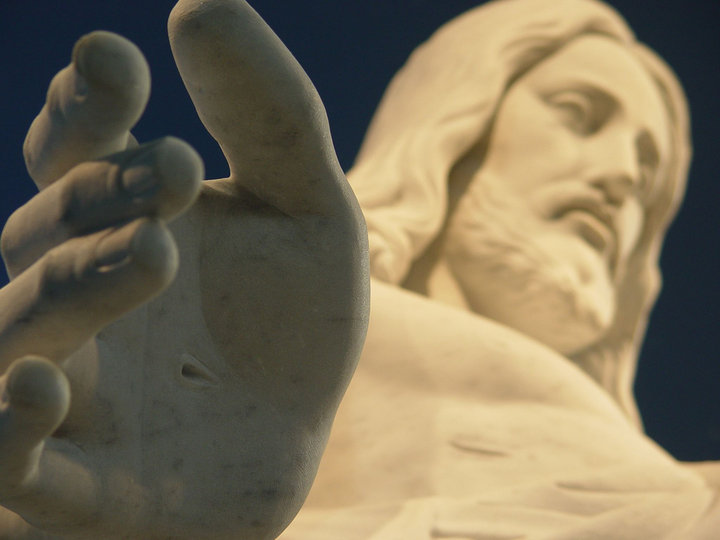
Early images of God?