All You Sea

Speaking of large ships, in honor of World Ocean Day, which was June 8, I had planned to watch Seaspiracy.  A Netflix original documentary, this really is a must-see film.  Not to pass the buck, but I’ve long believed it will be the younger generation that will take the initiative to improve conditions on our planet.   I’ve seen my own insanely selfish and aging generation (with even more aged and selfish senators) continue to exploit this planet like there’s no tomorrow.  If you watch Seaspiracy you may see that it’s closer to true than you might think.  There may be no tomorrow if we don’t change our ways right now.  Borrowing its title from Cowspiracy, another important documentary, Seaspiracy looks at the fishing industry and its devastating effects on our oceans.
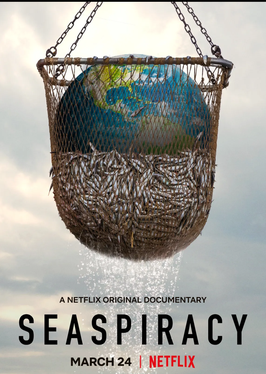
There’s a lot of sobering stuff here.  It begins with plastics.  Single use plastics, and even recyclable plastics, are everywhere.  They kill sea animals, they break down into micro-particles and infiltrate everything.  Chances are you have lots of plastic in your body just from living in an environment where it’s everywhere.  Ali and Lucy Tabrizi take you on a very disturbing journey where governments keep secrets about their roles in depleting the oceans and where large corporations kill observers at sea where there’s no chance of the truth being discovered.  They take you to the claims behind “dolphin safe” tuna and other fish.  They take you to where the market price on illegally caught blue fins can bring in three million dollars per fish.  And they’re caught in great numbers.

The oceans, according to current projections, could be empty in 27 years.  If current practices don’t change, there could be basically nothing left by 2048.  Why?  Because humans are hooked on consuming.  Some critics complain the date should be 2072, as if that isn’t just kicking the can down the road.  I became a vegetarian many years ago, after leaning that way many years before that.  It took Cowspiracy to make me go vegan. We eat without thinking about where our food comes from.  Our industrial food practices are literally destroying our planet.  Having given up fish along with other meat, I didn’t think much about fishing.  Seaspiracy shows why fishing is everyone’s concern.  It’s largely unregulated, unenforceable laws apply, and companies try to make consumers feel better in their acceptance that some fish is safe for endangered species.  This documentary shows once again how the price of eating animals, and doing so on an industrial scale, is simply not sustainable.  My generation is perhaps too lazy to change its ways.  Our only hope is that the younger generation takes the state of this mess far more seriously than we do. And perhaps thinks before putting things in their mouths.


No, uh, It Won’t

Irony comes in all shapes and sizes.  Over the past several decades various fundamentalist groups have built replicas of what they believe to be life-size versions of Noah’s ark.  All of these are approximations because the cubit was never an exact measure.  Nobody knows what gopher wood was.  Most of them ignore the fact that the story of Noah clearly borrows from the more ancient Mesopotamian flood story where the measurements of the ark differ.  In any case, these arks—some containing dinosaurs and others not—are made for convincing people that Genesis is to be taken as history.  While there is some irony in that itself, the larger irony comes in the various proofs that are given that such things really would work to preserve all species since evolution could not have happened.  To work such models have to be seaworthy.

One such ark, according to the BBC, has been detained in Ipswich because it is unseaworthy.  An ark may be useful on dry land for drawing tourists, but would such a large boat work on the open ocean?  All of this brought to mind a Sun Pictures documentary from my younger days.  Giving the ark a makeover, various literalists re conceived the classic design from children’s Bibles to a more boxy, sturdy shape.  This was based on alleged encounters with the ark on Mt. Ararat.  To test this new design, the producers made a scale model and tested it in a pool of water and declared it eminently seaworthy.  Of course, there’s no way to make water molecules shrink to scale to test whether a full-sized ark could actually handle the stresses and strains of a world-wide flood.

Ship building is an ancient art.  Peoples such as the Phoenicians, the neighbors of ancient Israel, achieved some remarkable feats in ocean travel without the benefits of modern technology.  They didn’t have boats large enough to hold every species of animal that exists today, but they sure knew how to get around.  The real issue with literalism is the failure to recognize ancient stories for what they were—stories.  Such tales were told to make a point and the point was often obvious.  The obsession with history is a modern one—indeed, the ancients had no concept of history that matches what our current view is.  Borrowing and adapting a story was standard practice in those days.  Unaware that centuries later some religions would take their words as divine, they told stories that, in the round, just wouldn’t float.


Conflicting Kingdoms

There is reason to be afraid.  Yes, I watch horror but the reason I suggest being afraid is because of a documentary titled ’Til Kingdom Come.  Directed by Maya Zinshtein, the film examines Christian evangelical support for Israel.  Primarily set in Binghamton, Kentucky, the interviews indicate a number of frightening implications.  One, that support for Jews is based on a “convert or die” model.  These evangelicals have the end times mapped out and believe the Bible is a fortune-telling book par excellence.  This doesn’t surprise me since I grew up with some of those very same charts and timelines.  It doesn’t surprise, but it scares.  These true believers never reflect or question their beliefs and this leads them to an emotional coldness that is antithetical to the sympathy Jesus preached.

A second fear factor here is just how organized and just how good at raising money the various Israeli lobbies are.  When evangelicals are elected to congress, these groups have open doors in Washington.  Those shown in the documentary are unfailing in their flattery of Trump.  The Jewish groups are clearly using the Christians to push and anti-Palestinian agenda while the evangelicals, for their part, are using the Jews to force God’s hand in sending Jesus back to end the world.  Under the Trump administration we were nearly pushed to the brink by elected officials who fervently pray for the end of the world.  This should keep any sane person up at night.

The beliefs of these evangelical groups have evolved to the point of not being recognizable as anything Jesus taught.  The conservative social agenda has been mistaken for the Gospel and these groups despise anyone who approaches the Bible to learn what it actually says.  Again, having grown up with this viewpoint none of it comes as a surprise.  I know it’s possible for people to grow out of it.  Watching overweight televangelists stirring up massive crowds to donate to a gospel of hate is nevertheless troubling.  Early on one of the pastors admits that they indoctrinate their children.  He sees no problem with that, although he seems embarrassed to have been caught saying it on film.  One lone mainline pastor, a Palestinian resident of Bethlehem, speaks out against this distortion of the Christian message.  One of the evangelicals walks away from a conversation with him and his heartfelt sympathy for his fellow Palestinians only to say the pastor’s theology is anti-Semitic.  ’Til Kingdom Come is a disturbing documentary.  I think I’ll watch a horror film to calm down.


Bible, or Not?

Chosenness comes with a price.  Everyone, it seems, wants to feel special.  One way to ensure that feeling is to believe that you were specially chosen by God to fill a pre-ordained mission on earth.  Since such views are always human views there will be inevitable conflict when another group thinks itself the truly chosen one.  The process goes on and on with history laying waste one claim after another, but belief continues on just the same.  America is a young country, at least compared to much of the world.  Those who “govern” it (originally invaders) felt they were on a mission from God.  Believing themselves the “new Israel” they felt a Calvinistic faith was the only true one.  The people who put the government together were largely deists who’d left that thinking behind.

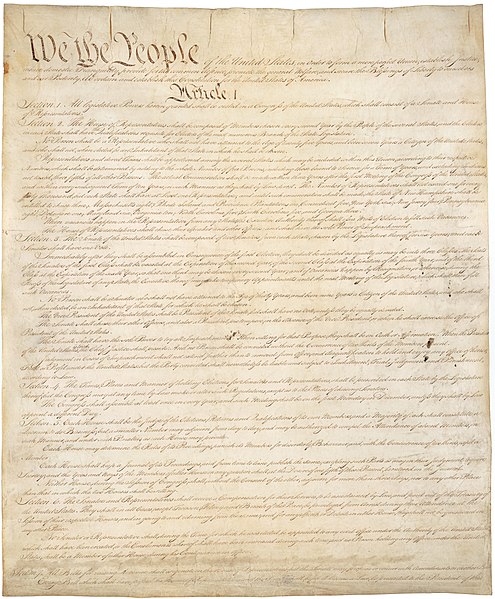
A recent story in the Washington Post cites such concerns with the God Bless the USA Bible, on sale in September.  This particular Bible is bound together with the US Constitution.  The reason people are concerned is a valid one—whenever something is bound with the Bible a significant number of people can’t tell the Bible from the other content.  Believing the Bible to be magically revealed by God, the entire content between the covers becomes sacred revelation.  Putting a secular document like the Constitution in there suggests to some (perhaps many) that said Constitution belongs to the canon of Scripture.  It’s a real enough concern, as easily attested by any who teach the Bible.  Even college-level students don’t know what’s Bible and what’s commentary.

Photo credit: U.S. National Archives and Records Administration, via Wikimedia Commons

Both the Good Book and the Constitution are documents in the public domain.  You can do with them what you please.  You could bind the King James Bible together with Moby-Dick if you wanted to, and if you wanted to make a long book even longer.  The price is confusion among those who can’t really tell the difference.  Many of the more evangelical stripe say “I don’t interpret the Bible, I just read it.”   Putting aside that reading is interpretation, the problem becomes clear.  That which is bound together in one book is one book.  After all, The Book of Mormon mentions Jesus in America.  The hazy view that many readers have of what’s actually in the Bible makes it dangerous to put other documents together with it.  The problem becomes clear when a nation believes itself chosen.  Chosen for dominion, it look to a specific book in support of that idea.  Even if it doesn’t know much about what that book actually says.


Ocean Day

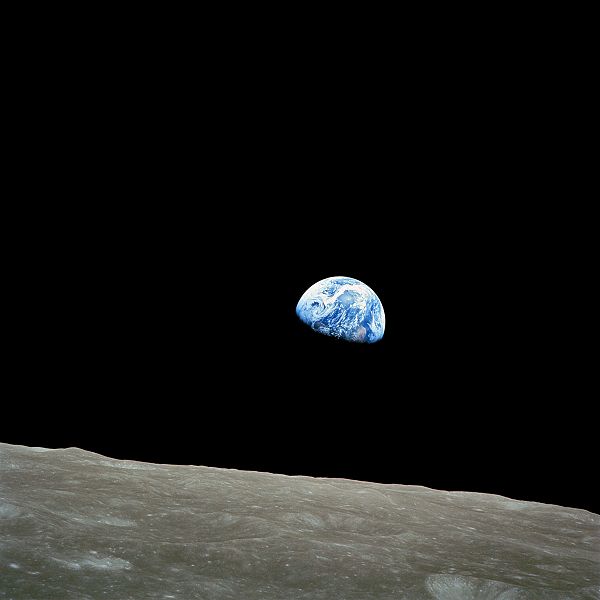
Yesterday was World Oceans Day.  It’s probably a measure of how busy I’ve been that I missed it until well into the work day.  Environmental care is one of my major concerns—something that the majority of Americans share but which Republicans block at every chance they get.  The oceans are the largest part of our planet .  Viewed from certain angles, the globe has barely any land on it at all.  And yet, since we live on the dry part, we use the wet part as our dumping ground.  There is an entire island in the Pacific made of plastic refuse.  Big petroleum doesn’t want any alternatives offered even though plastic is one of the most toxic products we produce for other life on this planet.  Shouldn’t governments share the values of their people?

Born in the landlocked western part of Pennsylvania, I first saw the ocean when I moved to Boston.  It was almost so distracting that I couldn’t study.  Here was this seemingly endless expanse of water that we so poorly understand, the symbol of eternity and life itself, right before me.  It was while living on the coast that I came to read Moby-Dick.  I could spend hours on the rocky shoreline, gazing out toward the seas in wonder.  I’m not a sea-farer myself.  I have inner-ear problems and being on a ship for any length of time would likely lead to extreme discomfort.  I can imagine, however.  Eventually I would read Coleridge and Hemingway and understand that I was not the only one who felt this way about the seemingly endless water.

Some of my earliest literary memories involve Rachel Carson’s The Sea Around Us.  It’s another book that opened young, landlocked eyes to what our world really is.  The image of water eternally crashing onto the shore is a comforting one.  As Carson knew, we came from the water and we yearn for it still.  Life as we know it isn’t possible without our oceans.  Yet, having petty human needs for extreme wealth and a sense of power over others, we pollute these seas with oil and plastics and chemicals and figure it’ll be somebody else’s problem.  In reality, the problem belongs to all of us.  Plastic Island, as it’s now being called, is nearly three times the size of France.  It’s composed of 100 percent pollution.  The Great Pacific Garbage Patch is being considered by some the eighth continent.  World Oceans Day should never slip away unnoticed.


Post-Literate?

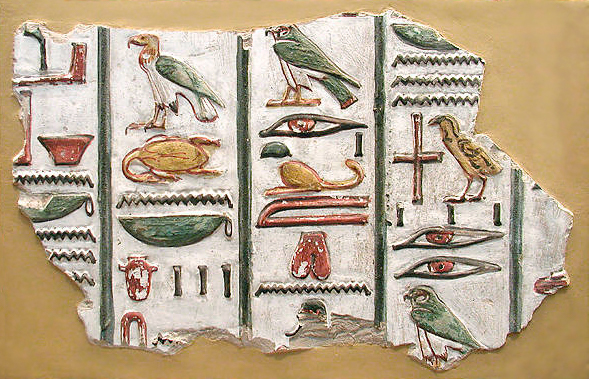
Who would’ve thought that publishing could be a scary industry in which to work?  Apart from the constant changes, that is.  Or maybe the changes are the reason it’s scary.  Our society has never been through a revolution quite like the tech revolution.  Yes, writing was pretty radical when it was invented, but it took millennia before literacy got to the point where it created widespread change.  Tech changes everything, and it does so very quickly.  Writing changes everything, but does so over the longue durée.  It began in a pretty humble way.  Crude drawings, called pictographs, came to represent things that mattered to pre-capitalists.  Take an ox head, for example.  It could represent the entire animal.  While some pictographs can be discerned in cuneiform (just as they can in some Chinese characters), the best example is perhaps Egyptian hieroglyphs.

Photo credit:: Jon Bodsworth, via Wikimedia Commons

Whether wedge-headed oxen or beautifully stylized hieroglyphs, both writing styles came to be representative for phonemes.  Egyptian and Mesopotamian writing tended to be syllabic rather than strictly alphabetic, and indeed, the invention of the alphabet made learning to write simpler.  Even after this innovation, however, it still took over a millennium before its practice became widespread.  Writing meant that ideas could be preserved beyond a lifetime.  Instructions and history could be recorded.  When a mistake was known and noted, remaking that error could be avoided.  (This seems to be a feature that has been lost to history, judging by recent fascist political parties.)  One of the great advantages to writing is the precision with which ideas could be expressed and preserved.

So how does this make publishing scary?  Some analysts are now claiming we are in a “post-literary” society.  Reading is no longer necessary.  We download visual content to gain the information we need.  When ideas need to be expressed in writing, we have emojis.  What happens, however, to synonyms when emojis take over?  Our humble ox head that eventually morphed into the capital A may now be represented by a stylized cow.  Or is it a bovine?  What does that cow image convey?  Books—novelties at the moment—are being written with emojis.  Learning to read is difficult.  It takes years and changes our brains.  Technology is encouraging us to become post-literate.  Even blogs are now becoming outdated.  Yet, looking at those emojis we see the history of writing moving in reverse.  From the precision of clear and accurate description to vague notions that look cool but leave us guessing otherwise.  Perhaps those ancient scribes scratching sketches into clay had it right to begin with.


The Heart of Memorial Day

The Memorial Day will be a somber one for the many people who’ve lost someone due to Covid-19.  Even as those who know that science can help to bring a pandemic under control have been vaccinated,  it is too late for millions who didn’t make it.  Memorial Day weekend, for many of us in northern climes, has been unseasonably cold.  Around here it’s been rainy too.  The official kick-off to summer seems to be a memorial to the long winter of 2020 and ’21.  It’s also hopeful, because things are starting to get better.  Having an organized national response helps, even as the Fascist Party is gaining strength.  “Memorial” means looking back.  Remembering the past.  I’m saddened, shocked, and distraught that one political party has refused to look at how insidious fascism is, and how it always starts under the guise of righteousness.  Remember this.

We tend to think of Memorial Day as a play day.  Indeed, the number of boats being towed as I’ve been out driving attests to the plans of many.  We’re ready for life to return to normal, but even that involves memory.  Remembering what was normal.  We have never been a fascist nation.  That’s not a memory but a sick future dream.  Those who attempt insurrection and then block any investigation into it can’t have the good of the nation at heart.  It should be a play day.  It should be frolicking in the sun.  Instead I’m wondering how we’ll ever stop this apparently inevitable evil that has taken over a country formed as a democracy.  Has it stopped raining yet?

Although I wasn’t close to him, my father was a veteran.  He fought for the cause of liberty, at least as it was understood before Trump’s America.  He was, according to his family, never the same after seeing war.  Bureaucrats, fat from the monies they pocket from special interest groups and lobbies, seem to have forgotten.  They’ve forgotten the frighteningly large national cemetery at Arlington.  They’ve forgotten that we fought to stop the very thing they are now promoting in their own country.  I’m sorry, Mr. Lincoln, these dead may have died in vain after all.  I had hopes of warm days and leisurely outdoor activities as the end of May rolled along.  Either that, or at least being able to get out and take care of all the yard work that’s been piling up over the past several weeks.  I wonder, will it stop raining today?


Come Together

When’s the last time a commercial made you cry?  Well, made you cry for joy?   A colleague sent me this commercial for chewing gum that left me nearly blubbering.  Go ahead and give it a watch, I’ll wait.  You see, I’m in the waiting period after my second vaccination (even scheduling that, it turned out, was difficult) and we’re waiting for everyone we know to reach that state where being together with strangers, unmasked, will become safe and normal again.  We’ve all been under enormous pressure for the past 14 months.  The absolutely directionless response of the Trump administration prolonged the agony in this particular country, and some places in the world are still having a difficult time of it, but there is a light.  There is a light.

Even we introverts are social creatures.  Like cats, we suffer in prolonged, enforced isolation.  We’ve been through difficult times.  It’s been the deepest hope of mine that we would come out of this pandemic better than we went into it.  The commercial, although clearly shot with humor, shows a more inclusive, completely accepting society.  As the couples separated for months reunite the only concern is that they have fresh breath.  It’s not what some other couple is doing.  It’s not who makes up that couple.  It’s simply that we are all ready to be back together instead of divided.  It’s about love, not hate.

Photo by Jamie Street on Unsplash

The most deadly poison of the Trump years was the normalization and acceptance of hatred.  We are already, and we have been from the beginning, a diverse people.  Like some mythological tower, we were divided because of fear.  There was nothing really to be afraid of down here.  Those at the top of the power structures (many of them sociopaths) want to protect their privilege.  It’s far easier to do that when the rest of the people are at one another’s throats.  Is English God’s own language?   Can people not be taught to pound swords into plowshares?  Perhaps when the time comes we’ll burst from these doors ready to accept those who are different as fully human.  Perhaps we’ll not judge them for who they love or how.  I don’t know why this commercial hit me so hard.  Perhaps it’s the Jim Steinman power ballad, perhaps it’s the quality of the acting, perhaps it’s the welling emotion that’s been suppressed alone in shadowy corners for over a year, but this particular commercial hit a chord.  And I don’t even chew gum, if that’s what it’s advertising.


Is This Contact?

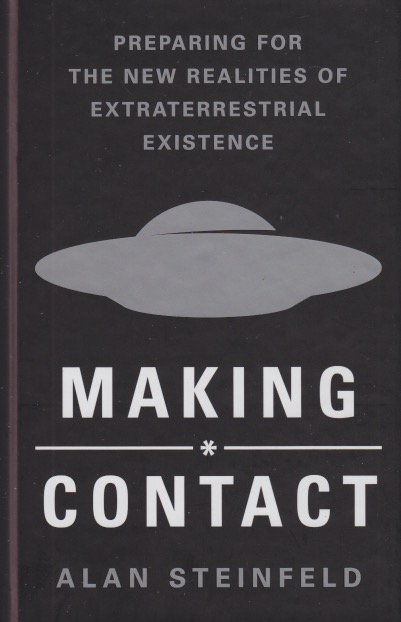
And speaking of the X-Files—but ah, I shouldn’t jest!  In fact, I strongly advocate avoiding the ridicule response when a claim seems outlandish.  A few weeks ago I posted on a review of Alan Steinfeld’s Making Contact: Preparing for the New Realities of Extraterrestrial Existence, a book just out.  The review I’d seen made reference to the aspects of religion and paranormal in the book, and given the mainstream media’s treatment of the topic of UFOs lately, I thought I should see what was being said.  As you might expect for a collection of essays, the tome is a mixed bag.  While ridicule is excluded, a healthy skepticism is necessary.  Amid the contributors with known credentials are those who make claims that are difficult to verify.  Much like the rest of life, you’re left making choices.

Amid all of this, where does religion come in?  Books like this often reveal the deep biblical literalism of our society.  Amid the authors who haven’t held government (although that’s hardly a situation where critical thinking is necessary) or university posts, there is clearly the assumption that the Bible is literally true.  Cherry-picked verses are “explained” by the presence of UFOs or aliens, with the supposition that if it’s in the Good Book it must be true.  This kind of simple credulity is quite common, but it does make you wonder if all the homework’s been done.  I know, I know, biblical scholars spoil all the fun!  If one piece of the puzzle doesn’t fit, however, perhaps the picture hasn’t been put together correctly.

That’s not the extent of the religious—or better, spiritual side of the topic.  Many of the essays are written from a somewhat “New Age” perspective with vibrations, and energy, and universal guidance of spiritual beings.  Other essays deal with government whistle-blowers who seem to tell a coherent story of secrecy and deception on the part of those in power.  No matter how you slice it, reading this book without ridicule is a perception-bending experience.  It may not be the one book everyone needs to read to get up-to-date information on where things stand in public perception, but it will make you think.  Given how much the topic has been in the media lately, and how it has at last been treated without snide asides, may be cause for hope.  “No go” topics may be vanishing, if only because our military admits to taking this one seriously.  And there seem to be, as always, religious implications.


Just Justice

Like many people raised to believe in democracy, I’m distressed to see that the right wing, worldwide, has taken to a full-on attack against it in an effort to keep power.  In the United States Republicans that stood up against the cult of Trump (who was no architect, but a figurehead only) are now being run out of Dodge by their own party.  Meanwhile a friend in Britain sent me an article about the open and obvious corruption of Boris Johnson and how the Tories are completely overlooking it in an effort to keep “democratic authority.”  It wouldn’t be so bad if the right wing came right out and said “we want to run things, no matter what it takes,” but instead they appeal to religious ideas and try to make it seem like their side alone appeals to “justice” while doing the exact opposite.  Paging Mr. Orwell…

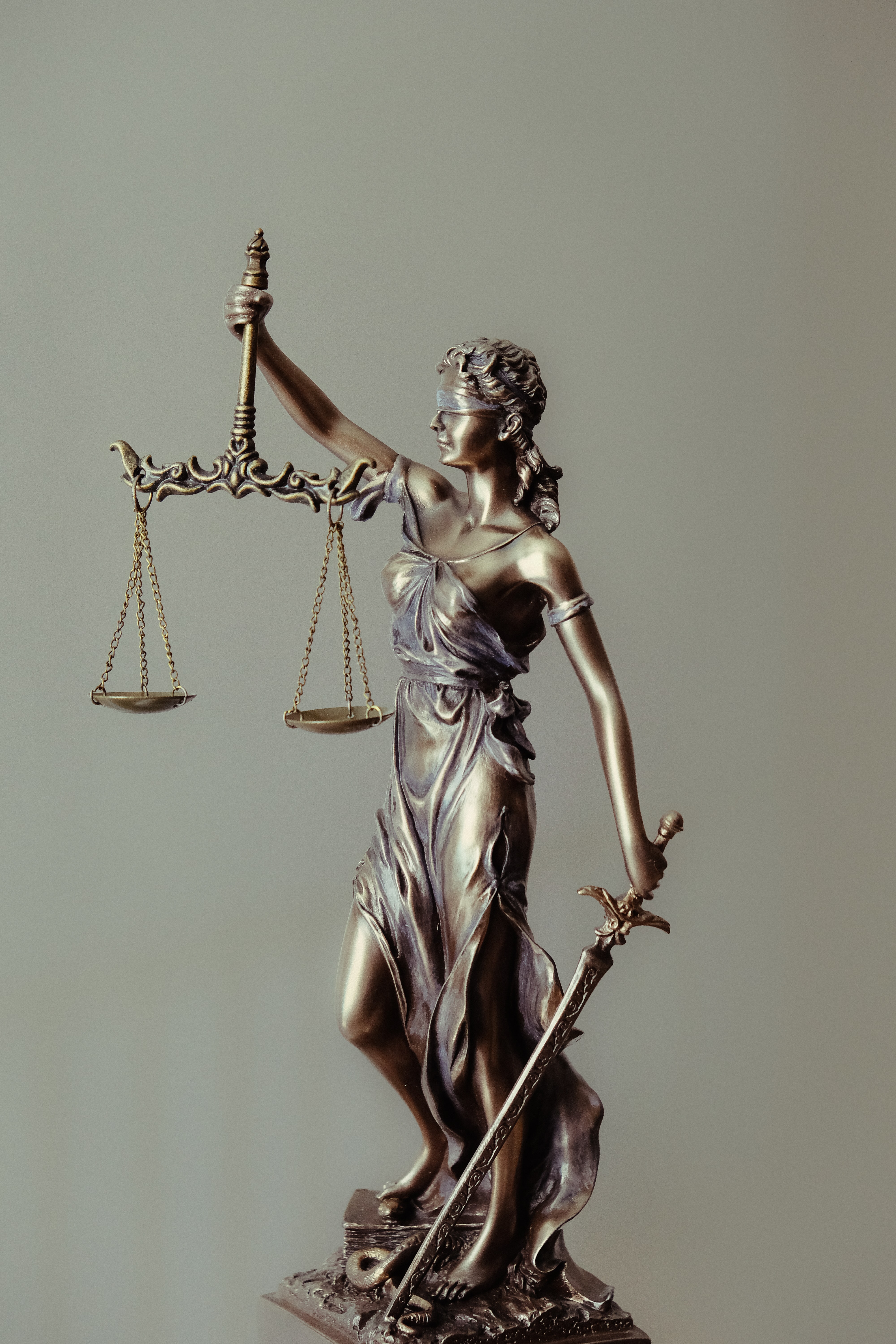
The best test case is Jesus.  Have you noticed how Jesus has fallen out of right-wing Christianity?  Apart from occasionally taking his name in vain, the principles they stand for generally go against the core teachings of the Gospels.  The fascism of the right wing has taken what good there was in Christianity and jettisoned the kernel to keep the shell.  It’s like a bag of pistachios where all the nuts have been discarded, leaving only the hard casings behind.  The really sad thing is that both in the US and in Britain, these power-mongers are in the minority.  They use political loop-holes to make their strong-arm tactics look like the will of the people.  Things like restricting voting access, made possible by courtroom politics.  Isn’t Justice supposed to be blindfolded?

We know for a fact that many of these same people are fully cognizant that fascism led to World War II.  They know Hitler used the same tactics to gain power.  They know that millions and millions of people died.  And now they trumpet the one thing that brought this nation together—the recognition that fascism was evil—as the way of true Christianity.  I’m sometimes asked if I believe in demons, having written a book on the subject.  Demons are, if you look closely, are considered the source of evil in the world.  Quite often stories about them have them possessing good people by pretending to be something that they’re not.  Can demons take over entire political causes?  Did we not see naked evil in the Nazi regime?  How do we not recognize it now that it has taken root in one political party that has claimed the name of “Christian” while simultaneously discarding the teachings of Christ?


As Nature Directs

The news about the “stampede” in Israel last week is tragic.  People like to gather in large crowds once in a while.  Religious events are sometimes such occasions (although not so much the case among mainstream religions anymore).  In this case the celebration, largely among the Ultra-Orthodox, was Lag BaOmer, a festival with unknown origins.  It has to do with counting the omer, a measure, in a biblically based instruction regarding grain offerings.  Since it’s based on the lunar Jewish calendar, it doesn’t fall on the same date of the solar year every time.  To be honest, I’d not heard of this celebration before the tragedy that occurred last week.  Having been confined for over a year, many religious groups are anxious to be back together in numbers.  Nothing reinforces belief better than having the size to be taken seriously.

A few years back, if I recall correctly, it was Muslim faithful at Mecca who experienced a tragic uncontrolled panic.  Religious ideas bring people together, but they can’t always control the results.  I’m reminded of what a Protestant clergyman told me many years ago: after a Billy Graham crusade came to town, the regular ministers were ill-equipped to handle the large numbers of emotionally charged members who normally sat still in the pews.  Religion stirs people, but its psychological nature shows when it leads to tragedy.  No particular group is immune since we are all emotional animals.  One slip on the stairs, one panicked individual, and those nearby can be infected.  Already emotional from the event itself, nature takes its course.

Stampedes are an evolved flight response.  Herd animals, when perceiving a threat, begin to run.  Others, not even directly aware of the threat, join in.  Other animals, not aware of their “herd mentality,” seem to handle this more naturally than do people.  Indeed, our religions often instruct us not to think of ourselves as animals at all.  Our religious events are often removed from our familiar surroundings.  I suspect that may be one reason people don’t find “Zoom church” very satisfying.  The emotion of religion is more easily spread in person.  In a place specifically designed as being outside the norm.  You take your hat off in church.  You sit quietly, reverently, in church.  You do not use coarse language in church.  In a pandemic you try to join in while physically in the environment where the rest of everyday life occurs.  When we gather again, we must do it while being aware of our nature.  Being part of nature itself can often be, if well thought out, cause for celebration.  We mourn those who fall victim to it.


You Are Data

The dark web.  The very idea conjures up images of extremely seedy technophiles with ambitions that run from illegal to just plain inhumane.  It’s a place I never want to go.  Still, it was brought to mind by a recent article in Threat Post.  (If you ever want an excuse to unplug and curl up with your head under the blanket, Threat Post might be a good place to start.)  The particular story was about the theft of millions of users’ data from LinkedIn.  This followed shortly after major data theft from Facebook.  In the world of the web-addicted the hacker is king.  Data are used for who knows what nefarious purposes, but primarily, I suspect, to try to sell you stuff.  Anyone who’s produced something (such as, say, a book) knows how difficult it is to get that product noticed.  Forcing it into someone’s inbox is one potential way.

What bothered me the most about this story was a line from an official in cyber-protection research (not a choice of major when I was in college).  It was noted there that although the data contained no financial information, it does contain information of value, “which is why it’s not published it for free.”  Those last two words: “for free.”  Data are, apparently, available for sale.  The computer people I know (all of whom are younger than me) tell me data mining is common on everything from social media to web browsers.  When you choose to go online you’re offering information about yourself to others.  Some of them dwell in the dark web.

Personally, I don’t know what they’d want from me beyond the scary thought of getting ahold of the digits that define me.  I’m not a fan of shopping and tend to buy only what I need.  (Yes, books are a necessity.)  I have probably succumbed to purchasing something seen in an online ad once or twice, but it is generally only if a holiday’s approaching or if it’s something I’d already thought I needed.  The fact is we can get along with a lot less.  If only we knew how to grow our own food.  Which is something, I suspect, that we could look up online.  But beware, your agricultural interest will be noted, and likely sold.  There’s money to be made on the web.  And before long you’ll end up with John Deere ads tailor made to suit your interests, and liquid assets.


Lessons from Mars

It’s a parable.  This week, on a planet weeks away, earthlings achieved heavier than air flight.  Considering that we flew for the first time on our own planet only 118 years ago (within feasible limits of a very successful human lifetime), the achievement is remarkable.  What I found most fascinating about the live stream provided by NASA, however, was the human element in the control room.  Not only did all the engineers look young enough to have been my children, I was cheered almost to tears to see several women among them.  We’ve come a long way.  And I don’t mean just to get to Mars.  There’s a lot of work yet to be done on the planet on which we evolved, but it does me good to see scientists recognizing the contributions women make to progress.

While many cultures worldwide still consider women the property of men, that scene showed that with women in leadership roles we can achieve remarkable things.  Only with the priorities of diversifying the workplace could we realize a dream that began long before Kitty Hawk.  People of all genders and all ethnicities have much to offer our growing sense of accomplishment.  Mars is millions of miles away.  Perseverance and Ingenuity are being controlled across this godlike distance by a group of humans that consists not just of angry white men who want to rule this world.  Although the palpable  excitement in the room was for what was happening far away, my spirits were buoyed by what was happening here.

Our biology defines us, but it becomes a sin when it confines us.  We are capable of more.  We’ve flown on another planet, and yet we still need to learn that on this planet all people deserve fair and equitable treatment.  It boggles my mind that on that reddish speck I can see on a clear night, a speck so small that my pinkie held at arm’s length can obliterate it, we have landed a car-sized rover and a helicopter.  The math involved staggers this old mind, but the imagination inspires it.  We come to moments like these when women and men of various backgrounds come together and dream.  Double-masked and socially distant, young people have shown us a world far beyond what angry white men could even imagine.  Watching the video of a helicopter taking off, hovering, and landing on another planet, looking at the people in the room, I realize there is a parable here.


Well Grounded

Earth Day feels like it’s actually Earth Day for the first time in four years.  Many of those with more common sense than gullibility know that we have only one planet.  Even as we have achieved flight on Mars, any hope of going elsewhere (and some of us would rather not) is many years away.  Earth is our home and we can live on our planet without destroying it.  Other animals also change the environment, of course.  The problem arises when one species becomes unchecked and begins changing things for their benefit only.  Or what they perceive as their benefit only.  Life evolved on this planet deeply integrated.  The more we study nature the more we see how interconnected it is.  Thinking ourselves special, we’ve placed a wall between humankind and everything else.  It’s an artificial wall.

If you read about nature you’ll be amazed.  Trees, perhaps the true heroes of this planet, make our life possible.  They couldn’t exist without the fungi that partner with their roots in a symbiotic relationship.  If there had been no trees our ancestors would’ve been easy prey to larger predators and would likely not have survived.  Large industrial corporations destroy trees as if they’re a nuisance.  They are our life.  Even as governments with “strong men” leaders destroy the forests in “their” countries, we are losing the very biodiversity that makes life possible on this planet.  There’s room for humans to get along here without destroying the environment that supports our very life.

One of the hidden motives in this scenario is a strange development within Christianity.  A literalism that would’ve shocked even old Augustine developed around the turn of the last century.  That literalism was used by corporations that saw the earth as a resource to be exploited and claimed that we, unlike animals, owned the planet.  If you own a home would you destroy it just because you could?  What good would it do?  No, this Earth Day let’s take the time to consider our religion and its implications sensibly.  The Bible does not advocate destroying what God created.  It may have been written too early to comprehend evolution, but that was never a problem for early theologians.  When fused with capitalism, however, this religion provided everything greedy businesses needed to exploit the planet for its own purposes—the god Mammon.  Just this week we flew our first flight on an inhospitable planet far away.  Today let’s think of how we might protect the only home we have under our feet. 


He’s Dead, Jim

So there’s this thing called Spotify.  Like most modern contraptions, I approach it warily.  I’m not sure how it works.  Do the artists get paid?  What’s the catch?  Is it only having to listen to a commercial for Amazon every three or four songs, like the radio?  I don’t have a lot of time to listen to music, but when I do have time I like to discover something new.  Then there’s the oldies.  And I can’t help but feel a deep sense of loss at the death of Jim Steinman.  I discovered Steinman earlier than I realized it when “Total Eclipse of the Heart” came out the year my first romantic relationship ended.  That song can still reduce me to a quivering lump of emotion.  All I knew at the time was that it was a Bonnie Tyler song.

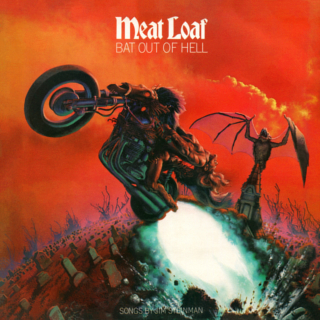
Growing up fundamentalist, even album titles like Bat out of Hell, Meatloaf’s Steinman breakthrough, were enough to scare said toponym right out of me.  I never knowingly listened to any of the songs on that album until after earning my doctorate.  When I did I was hooked.  My research skills had grown by that time to include finding out who the writer of a song was.  I discovered that “Wagnerian rock” really spoke to me.  And the only guy who seemed to know how to write it was Jim Steinman.  Most kids, I suppose, settle into their music tastes much younger, but in my thirties and forties I found Steinman a most compelling artist.  I listened to his older stuff, and his newer stuff.  I found out some surprising things, such as that even Air Supply’s “Making Love out of Nothing at All” was a Steinman song.

I seem to be hopeless at playing musical instruments.  I’ve studied piano and taken guitar lessons, leaving bewildered teachers in my wake.  My wife tried to teach me the recorder.  Despite my failure as a player, music means a lot to me.  I don’t listen to it unless I can pay attention to it.  For me it’s not background noise.  When I learned to identify operatic rock, I soon came to realize that it was the work of a singular genius who was covered by a wide variety of artists.  No one else, it seems, could capture the feeling of being young like Steinman could.  Now he’s gone.  In my noodling around with this thing called Spotify, I wonder if I can discover any more of his songs.  Meanwhile, I’m thankful that I found him when I did.