Bad Seeds

Strange things happen.  I doubt anyone would deny that, even the most skeptical.  Sometimes the strange has an edge to it, though.  A recent story on WTVR reports that residents of Virginia are receiving packets of unidentified seeds from China.  Perhaps a nation naive enough to elect 45 believes in magic beans?  If I recall correctly the beanstalk incident didn’t really end well, although Jack may have survived when it was all over.  WTVR is compelled to say what should be obvious: if you receive unexpected seeds in the mail, don’t plant them.  Not so many years ago I would’ve supposed most Americans were smart enough to know that.  Four years later I’m left wondering.  America’s critical thinking levels appear to be at an all-time low.

Upon first seeing this story my immediate reaction was to question it.  Was it a hoax or a scam?  The kind of thing Trump Enterprises might do to drive business?  If it did happen haven’t scientists (if there are any anymore) been able to figure out what kinds of seeds these are?  Isn’t there an app for that?  Increasingly, it seems, people rely on Facebook rumors for their fact checking.  Of course, that’s the beauty of this kind of plot, if it indeed is one.  A simple thing such as sending a packet of seeds can start a panic.  And with a Gross Domestic Product like China’s I’m sure the postage isn’t even all that expensive.

I also wonder if this isn’t in return for something that the US has done.  We currently have no foreign policy to speak of, but I wonder if people in China have been receiving tariff-free shipments from us.  But do we even have a functioning Post Office anymore?  What if the seeds are from the US and were made to look as though they came from China?  My suspicion goes deep, I guess.  Several years ago I got dressed down at an academic conference for being too skeptical.  My notebook has nullius in verba written inside the front cover.  I tend to think that I just like to ask questions.  Nobody sends you anything for free—being raised in capitalist heaven taught me that.  WTVR says these seeds may be invasive species.  Waging a continuing war against trees of heaven (also an invasive species) I know how much time can be wasted on the task.  Just when you think you’ve got them all, another one pops up.  Strange things indeed.

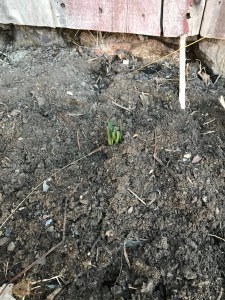
Wonder what’s growing?


Narrow Passage

While on a rare family visit (it’s scary to get out too much) we visited Watkins Glen State Park in upstate New York.  My mother’s family has roots in this area, and we’ve visited it several times in the past.  There are always people there, but in manageable numbers.  The website declared it was mandatory to wear a mask (“New York tough”!) and to keep social distancing.  It perhaps didn’t help that we went during a heat wave when a walk along a waterfall-laced path seemed like a refreshing idea.  I guess I had in my head the modest crowds we’d encountered in our many past visits.  We were, however, not the only tourists (although somewhat local) with that particular plan.  Not by any metric I can conceive.

If you’ve never been to Watkins Glen, the park has a Civilian Conservation Corp-built stairway and trail (approximately 600 stairs) through a glacial and water-cut gorge.  The sedimentary layers are fascinating for anyone with an interest in geology and for those who like to ponder the millions of years required for the laying down and lifting up of multiple bedding planes.  The gorge itself has a curvilinear appeal that is almost mystical.  Waterfalls produce negative ions which, everyone knows, tend to make people happy.  I was, however, more on the terrified side of the spectrum.  It became clear even before we reached the gorge that there were hundreds of people already in the park.  Most of them unmasked.  Large crowds gathered around the more picturesque waterfalls, blocking the narrow walkways.  Tourists have no idea what “six feet” might possibly mean.  Stair-climbing is an aerobic exercise, and wearing a mask in such circumstances is the only smart thing to do.

While on the considerably less crowded trails of the Pennsylvania outdoors venues we more commonly frequent, I’m nervous when someone walks even more than six feet away in the opposite direction.  This felt like a nightmare to me.  Too many people paying too little heed to the mandated caution.  I’ll be quarantining myself for two weeks for sure.  Maybe more.  I don’t get out much in any case, but even though we were obstructing our view through cloudy glasses and trying to get adequate oxygen through made-to-specification cloth masks, there’s only so much that prophylactics can do.  I jog at first light to avoid other health nuts on the local trails.  I go to stores only for necessities.  Being in a canyon with the careless invincibles inspired less than confidence in this petrified pilgrim.  Knowing human nature, it seems closing popular state parks until people get smart may be the best way out of a tight squeeze.


No So Innocent

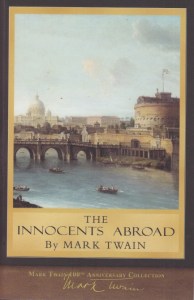
Mark Twain’s best-selling book in his own lifetime was his first commercially produced one: The Innocents Abroad.  Originally a set of letters sent during an excursion to parts of the Mediterranean basin with stops in Europe and the Levant, it’s difficult to read today.  Although satirical with much of it clearly for fun, Twain’s humor about those other than Americans embodies an attitude that would fit into Trump’s America a little too comfortably.  Other religions are strange and therefore wrong, for example.  People in the regions visited did not bathe frequently enough and were often singled out for their looks.  There’s something rascally about the behavior of the American visitors, chipping away at monuments so that they might take a piece of history home with them, yet never failing to feel superior.

I had to remind myself constantly that this is a period piece.  It contains much of the gritty humor for which Twain became justly famous.  Travel broadened him also.  A southern abolitionist, Twain nevertheless never overcame some of the racism into which he was born.  My wife and I were reading the book because of its early description of western visits to Palestine (there was no Israel at the time).  Keeping in mind that travel to much of that part of the world was expensive (his trip was sponsored by the newspaper for which he worked) and difficult, his account is actually one of the early modern travelogues on what would eventually become a fairly common pilgrimage.  Twain, like all of us, was a product of his time.

Twain’s diary famously reveals what he came to believe about religion.  There are inklings of it here.  Although he refers to the manner of dress of the ship’s passengers as “Christian,” and although he casts aspersions on Islam frequently, he reserves his most biting humor for his own brand.  During their visit to Smyrna (one of the seven cities of the book of Revelation), for example,  he writes, “Thick-headed commentators upon the Bible, and stupid preachers and teachers, work more damage to religion than sensible, cool-brained clergymen can fight away again, toil as they may” (page 327 from the 2018 SeaWolf Press edition).  Still, the assumption of the rightness of Christianity is something that he would eventually come to question.  His humor does often fall flat in an era of government support of racist, sexist tropes.  And the impressions made on those they met was summed up in his contractually-obligated note to the paper: “Many and many a simple community in the Eastern hemisphere will remember for years the incursion of that strange horde in the year of our Lord 1867, that called themselves Americans, and seemed to imagine in some unaccountable way that they had a right to be proud of it” (page 526).  Some things, it seems, haven’t changed despite the time elapsed.


November Dreaming

I recently took part in a non-partisan postcard-writing effort sponsored by Moms Rising.  The idea is simple enough: encourage people to get out and vote.  Such is the state of our country that some people see this as a liberal agenda.  An anti-patriotic act.  Who would object to people voting (apart from the Republican Party, that is)?  Apparently we’re now simply supposed to accept what the present administration hands down, including its desire to retain power legally or illegally.  Those who suggest that people should be given their constitutional voices are considered radicals.  This would be ironic were it not so dangerous.  The only reason the powers that be are in office is because of an election, and one that was “won” by that gaming of the system known as the electoral college.  Now that Covid-19 is ravaging our country, those who refuse to do anything about it want to strengthen their grip.  And their followers blindly say “Amen.”

Postcard writing does not involve telling the potential electorate whom to choose.  The message we’re instructed to write is simply encouraging others to vote.  Gerrymandering and making people stand in Covid-laced long lines have been “tactics” used by current supporters of the modern-day plague to keep their hold on power.  When trying to get people to vote is considered an act of sedition we need to stop and think what democracy has become.  If you don’t believe everyone should vote then you have no right to object—your voice is your vote.  I stand with Moms Rising to test the room.  Let’s see if what’s happening here is really the will of the people.  And I don’t mean that house of lower education, the so-called electoral college.

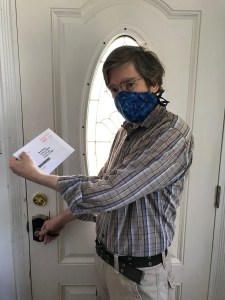
If you’re inclined to help with the effort, all it costs is a little time.  Check out Moms Rising’s website.  They’ll send you a packet of postcards for free with a postage-paid envelope to mail them back.  All you need to do is write a sentence or two in the blank space on the back, put the cards in the envelope, and drop it in a mailbox.  It costs so little and so much is at stake.  Time is a commodity, I know.  Given that our time is running out, however, it seems that sparing a bit of it to keep democracy breathing is important.  No— vital.  My regular readers know how I often express my wish/need for just a little more time to accomplish what I’d like to squeeze into a day.  I’ll gladly sacrifice ten minutes for the good of the country I call home.


Everybody Knows

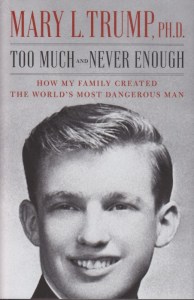
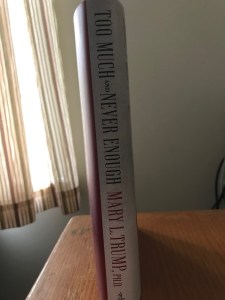
One of my favorite Leonard Cohen songs is “Everybody Knows.”  On a related note, the best-selling book in America last week was Mary Trump’s Too Much and Never Enough: How My Family Created the World’s Most Dangerous Man.  With the publisher citing 900,000 copies sold upon release, it produced numbers that most publishing houses only dream of.  I’d preordered it on Amazon but for the first time ever I did not have a copy on the day of release.  There were a lot of people ahead of me in this line.  That’s even more remarkable than it sounds because we all pretty much know what the book says.  We also know that its subtitle is true: we have a very dangerous man (daily rising Covid deaths show this to be true) given free rein by Republican senators.  Even adults without high school educations that I talk to know there is something seriously wrong.  Indeed, anyone who knows how to fact-check can see it.

A very popular way to deal with inconvenient truths is to posit a conspiracy theory.  Evangelicals (now defined as Trump supporters) have long used conspiracies as ways of explaining how facts simply don’t support their views.  From the moment “alternative facts” left the lips of the administration in January 2017 I knew we were in deep, deep trouble.  Funny thing is, many Evangelicals had to read Orwell in school, like the rest of us.  How they could support anyone that had such a long, long track record of criminal cases against him before placing his hand on the Bible and swearing to uphold a constitution he’s been daily dismantling since is anybody’s guess.  Daily life, it seems, is now a conspiracy.  

One of my favorite Leonard Cohen songs is “Everybody Knows.”  The lyrics suggest that whatever it is we want to keep secret everybody, well, knows.  That’s what’s so distressing about America’s current decline.  Everybody knows that being president is a very difficult position and that it’s only handled adequately by well-trained and smart people who, despite their faults, put country above self.  With the election of 2016 it was clear from even before day one that ego was the driving factor behind 45.  Americans love their outrageous television personalities and somehow think that appeal on the small screen somehow translates to leadership ability.  We’ve learned before that this isn’t true.  I haven’t read Mary Trump’s book yet—it just arrived in the mail—but when I do I’m sure I’ll find out what everybody knows.


Missing Markers

Something truly remarkable happened this week.  The Society of Biblical Literature, which, along with the American Academy of Religion, meets annually in November, has canceled its in-person meeting.  I’ve been attending this conference since 1991 (with a few years off for good behavior).  It always meets the weekend before Thanksgiving, stretching to the Tuesday prior.  Some academics use the meeting to have an exotic Thanksgiving break with their families, particularly when it congregates someplace warm.  (It was scheduled for Boston this year.)  So I’m ruminating what this will mean for a year of missing markers.  Some of you may recall I missed two years ago, electing to stay in Newark Airport instead, but this is different.  We’re all being changed by this virus.

Missing markers.  That’s what my wife calls it.  March 12 was the day that Covid-19 became a crisis.  In my extended family that’s in the middle of birthday season.  Travel plans had to be altered.  Trips to see loved ones had to be delayed.  Then cancelled.  Memorial Day came and went.  It was a long weekend, but for most of us it was a long weekend at home.  Our usual summer trip to the lake was also a victim.  A remote lake may be the safest place to be, but you have to get there.  Flying doesn’t seem safe and we don’t have enough vacation days to drive all the way out and back.  Here we are halfway through the summer and each day feels pretty much like the one before, even if it’s a day off work.  Time seems out of whack.  Back in April it was hard to believe it was still 2020, now it’s difficult to comprehend that the year’s more than half over and there will be no AAR/SBL in November.

Growing tired of the phrase “unprecedented times,” I prefer “missing markers.”  Yes, the weather’s still doing its time-keeping job.  This summer has been quite hot around here, for the most part.  I remember shivering in my study sometime not so long ago, bundled up in layers and thinking that when summer rolled around this coronavirus would be a bad memory.  If only there were something governments could do to keep people safe.  If only there were people in the White House who cared.  I had visions of professors, hundreds and hundreds of them, wearing masks with their tweed.  It was a vision of wonder.  They’d walk up to you, extending an elbow to bump, but you’d back off.  That’s actually too close.  And lecturing spreads germs very effectively.  Over time 2020 itself will become a marker.  I’m not sure anyone will miss it, however.


Like an Egyptian

“And Pharaoh’s servants said unto him, How long shall this man be a snare unto us? let the men go, that they may serve the Lord their God: knowest thou not yet that Egypt is destroyed?”  The words are from the Good Book.  Specifically Exodus 10.7.  They’ve been on my mind as the coronavirus is beginning to yield in all developed nations but our own.  Let me set the scene: the Israelites have become slaves in Egypt.  Moses was sent to set them free, but a Trumpian Pharaoh stood in the way.  Plague after plague was sent, but the president, er, I mean Pharaoh, refused to acknowledge what the evidence indicated.  Moses would appear before the senate and declare the coming disaster.  In the mythical world of the Bible, though, the senate actually saw reason.

“Knows thou not yet that Egypt is destroyed?”  Instead of addressing the Covid-19 crisis the White House has decided to turn a blind eye.  Nearly one-fourth of the worldwide cases of the disease are recorded in the United States.  In the past week several record-setting days of new case numbers were set even as the administration was insisting that schools be opened without any plans, or even ideas about how to help.  “Have them make bricks without straw,” you could almost hear echoing around the Oval Office.  Ah, indeed, this is the most biblical of administrations.  Our economy has been tanked for years to come.  The environment has been degraded to the point of disaster.  And yet Moses is ignored.  The real plague was the Pharaoh.

“This is the finger of science!”

Exodus is a story of liberation.  What’s more, according to the Good Book, God himself wanted Israel to be set free.  The Pharaoh, it seems, was not personally afflicted with the plagues until the darkness fell.  Prior to that, if it didn’t affect him personally he simply didn’t care.  Too many self-aggrandizing monuments to be built to his own name.  Ancient Egypt was like that.  Meanwhile plagues brought the mightiest nation of the time to its knees.  Beyond that.  It brought them prone.  Most of us, I expect, are ready to get on with life.  We’ve been self-isolating for over three months and yet the number of cases continues to increase.  We could use a word or two of guidance from a sympathetic leader.  Instead we’re entering hurricane season.  I can’t speak for anyone else, but I’ve got my Bible all ready.  And right now it’s open to Exodus.  


Skywalker Arises

Maybe, if you’re like me, you find the Star Wars franchise a little hard to keep straight.  Ever since the end of Episode VI the number of characters with strange and oddly short names jumped.  The rate of light saber duals skyrocketed, and the story grew more complex (and not always with any payoff).  I suspect that like many I kept watching the second trilogy of episodes I through III out of a sense of duty, longing for that pathos that stayed with me after leaving the theater (remember theaters?) following episodes IV through VI.  Hope awakened along with the Force in Episode VII under the able hand of J. J. Abrams.  Then the stinker of Episode VIII, which my wife and I watched in a cold theater in Bernardsville, New Jersey, dropped us back into the realm of I through III.  I didn’t even notice when Episode IX, The Rise of Skywalker came out last year.  DisneyPlus, to which many people subscribed just to watch Hamilton, made it possible for us to round out the trilogy of trilogies on the small screen.

While better than The Last Jedi, the story ran into the standard sequel problems of probing relationships between characters that a crisp story tends to leave ambiguous.  But there were, to my religious eye, many themes that seemed quite Christian.  There was buzz when Kylo Ren’s cruciform light saber appeared in The Force Awakens, but the Christian tropes were more obvious as the series wound down.  Rey, for example, finds out about the wayfinder from the first physical book of the series.  It’s old and leather-bound and iconic.  This is a kind of Bible.  Jedis are shown to be increasingly messianic, and I thought having a female messiah was a nice touch.  I was going to write “as the series closed,” but with the money made there’s little doubt that more will come from a galaxy far, far away.

Rey’s impressive Jedi feats look like miracles and her ability to raise the dead (or dying) and to heal in a time of an evil empire (for ancient Christians, Rome) rings familiar to those with Bible radar.  The name Skywalker should’ve been a clue from the beginning (as it was for those of us who crowded the theaters in 1977), and the final shot of Rey on Tatooine where the setting of the binary stars make a halo around her head should eliminate any doubt.  There are many throwbacks to the original trilogy in this final installment, and although the plot was more complex than necessary, it leaves the armchair theologian in a nice place.  But some of us will always think of the holy grail as that found back when the evil in our own empire seemed, if briefly, to be waning.


Nightmares with Nightmares

Although some staff members are furloughed, Nightmares with the Bible is still going to press.  Unlike many authors, I realize that Covid-19 has had a stifling effect on publishing, starting with bottlenecking books at printing houses.  Printers (along with publishers) were non-essential businesses and since you have to be physically present to run a printing press, the virus literally, well, stopped the presses.  Many publishers could work remotely, so the projects began piling up before printing houses reopened.  All of this is preamble to saying I am gratified that work with Nightmares is continuing.  Yesterday, however, it led to a nightmare of its own.

One of the reasons I don’t fight awaking early is that it is uninterrupted writing time.  Most of the rest of your time zone is asleep at three a.m., so I can write in peace.  Yesterday, however, I had to divide my manuscript into chapter files and resend it to the publisher.  No problem, right?  Technology, however, has made this once simple task a burden.  I use a Mac, and so my word processor is Pages.  Not only that, but the constant systems upgrades require me to empty space on my hard drive—really, the only stuff I keep on here are my writings and those pictures I snap with my phone.  Still, I had to load my external drive to access the final file sent to the publisher two months back.  With Pages you can’t select material from page-to-page in the thumbnails.  No, you must “physically” go to the start of the chapter, click, scroll to the end of the chapter, and shift-click to highlight and then copy it.  Then you have to open a new file, select a template, and paste.  Save and export as a Word document.  The process took about two hours.


Now, I get up this early to write and do a little reading.  Yesterday I could do neither.  Instead I was cutting and pasting like a manic kindergartener, trying to get my manuscript printed before the second wave comes and shuts everything down again.  Talk about your nightmares!  Technology has made the industry much swifter, no doubt.  When I first began publishing articles you had to send physical printouts through the postal services and await either a rejection, or acceptance, through the mail.  Book manuscripts required large print jobs and keeping duplicates (at least we didn’t have to use carbon paper!).  All I lost was a morning of writing before the work bell rang.  Still, nightmares come in all sizes, some of them quite small.


Independence Day Wishing

It’s Independence Day and what we most need independence from is our own government.  History is full of ironies.  Federal holidays falling on a Saturday, for instance.  In any case, here we are on the Fourth of July and still stuck under a repressive government that a small portion of people like.  Republican groups supporting Biden are starting to arise, but we can only dream on Independence Day.  Many of us would like to be independent of the coronavirus, and not a few people are acting like we are.  Cases are spiking, so the rest of us are staying indoors.  Fireworks are okay, but I have trouble staying awake until dark these days and more often than not they just keep me awake as I’m starting to doze.

Maybe for Independence Day I’ll take leave of reality.  Maybe I’ll imagine a government that isn’t so utterly corrupt that some people might have some faith in it.  Maybe I’ll dream that black lives matter and that our leaders would believe it.  Maybe I’ll think what it would have been like if caring officials addressed the Covid-19 crisis directly instead of brushing it off, so that like all well-run nations cases would be going down here instead of back up.  There’s so many possibilities and the one thing they all have in common is that they point to independence from the Trump Administration, if that’s what it can be called.  Maybe it’s time to light a sparkler of hope.

Independence Day can be a day of looking forward instead of looking back.  If we can look ahead we might see a country where anyone will be allowed to exist and not be condemned by “Christianity.”  We can come to see that privileging any one “class” or “race” or “sexual orientation” is a form of bigotry from which we can and should be independent.  We can try to think what it must be like to experience life from somebody else’s skin.  We can try to understand instead of standing ready to condemn that which is “different.”  Fact is, everyone is different from everyone else, it’s only a matter of degree.  And difference can unite rather than divide.  The whole idea behind uniting different states was that those who were different could support one another and figure out how to make room for everyone to fit.  It won’t be easy to do, but we might use today to envision a country where we can work together, and figure out that leaders who bring people together are the only hope we have for the future.


X-Files Redux

So, after writing a post about The X-Files, I finished season three, forgetting up until then that the last episode was “Talitha Cumi.”  Apart from being part of the alien mythology arc, the biblically literate recognize the title as the words Jesus said to Jairus’ daughter as he raised her from the dead.  Appropriately enough, the episode features an alien-human hybrid that is able to raise the dead and to shape-shift.  This particular episode also has an intriguing dialogue between the Smoking Man and Jeremiah Smith (the hybrid) where they discuss whether the alien agenda for people, or that of the shadowy cabal, is better.  With a theology drawn from the Grand Inquisitor chapter of The Brothers Karamazov (according to Wikipedia, and which I have no reason to doubt), they argue from different perspectives.  The Smoking Man explains that they have given people science instead of God and miracles will only confuse the issue.

While not exactly Fyodor Dostoyevsky, this scene raises some very real questions.  Are people happier not believing?  Not only that, but the cynicism of the Smoking Man matches rather precisely the modus operandi of our government some two decades later.  There’s a reason we keep coming back to the classics.  The X-Files mythology is, like the Cthulhu Mythos, woven throughout a larger tapestry whose warp and weft both seem to be religion.  It ran far longer than Sleepy Hollow ever did, and it would take considerable effort to tease all of the Bible, let alone religion, out of it.  They make the story far more believable.

This particular episode also displays the staying power of the classics.  Long, ponderous books like The Brothers Karamazov require concerted effort to read in these soundbite days of internet hegemony.  That Grand Inquisitor chapter, however, has been enormously influential.  (I recall during my most recent rereading of the novel that I hit that wonderful chapter and then realized I still had hundreds of pages to go.)  We often have trouble telling God from the Devil.  Just look at today’s political scene and try to disagree.  In the X-Files diegesis there is a shadowy, high-powered group that got to the extraterrestrials first.  They keep the secrets to themselves while the masses play out their insignificant lives that enrich those in charge.  Democracy, it seems, used to be about elected representatives seeing to the will of the people.  It perhaps assumes a greater educational base than we’ve been able to retain.  But still, with chapters like “Talitha Cumi” we see that there may be some glimmer of hope after all.


Slimy Veggies

This wasn’t the work of ghosts, but it sure looked like it.  I snapped on the kitchen lights at 3:00 a.m. to find one of the counters dripping with slime.  It looked like the basement of the New York Public Library.  As I grabbed a damp rag and a roll of paper towels, I thought about Ghostbusters and fresh produce.  The slime, you see, came from a burst freezer pack.  During the pandemic we’ve been using Misfits, a service that delivers fresh fruits and vegetables to your door.  Early on, back in March and April, it looked like various shortages, apart from toilet paper, were here to stay.   Every couple of weeks we’d get a Misfits box, so we’d at least have that.

Since fruits and vegetables are perishable, and since there is a time lag involved, they are packed with freezer bags.  These cold-pack bags are reusable and we began sticking them in our ice-box.  We have no free-standing freezer, so the unit atop our fridge was getting full.  The last week’s pack had begun to leak in transit, and, being too busy, I’d set it aside until I could figure out how to dispose of it in the most environmentally friendly way.  We don’t generate a huge amount of trash.  We compost our food scraps, and being vegan we don’t have smelly animal byproducts to toss.  And we recycle all that we can.  I guess just “throwing it out” has become a kind of last resort.  In the dark, the freezer bag made the decision for me and so I found myself mopping in the middle of the night.

It’s a small price to pay, really, to try to help save the environment.  The past four years have contributed unconscionably to global warming.  We tend not to care because those who’ll bear the brunt of it in the short-term are the poor.  Industrialists can afford vacation homes in the mountains.  Our lifestyles have an impact everywhere.  We need to learn to think differently about things.  Of course, that leaky freezer pack did cause quite a mess.  The gooey slime was everywhere, but it was everywhere with a conscience.  I have to wonder what happens to the world when leaders lack conscience.  Unfortunately I don’t have to wonder long since I have the headlines to read.  No, this wasn’t the work of ghosts, but unless we change our ways it could well be.  And when those treating you like enemies are your leaders, who you gonna call?


Letterbox

It’s kind of scary.  I mean, I know that Google Maps has everything recorded.  Some family members recounted, a few years back, how they were shown raking the leaves in their yard on street level photographs.  I guess everything’s part of your permanent record now.  What was scary to me was receiving a letter with a picture of my house on the envelope.  Yes, it was from an insurance agency, and insurance thrives on the feeling of vague threat that rattles around our primate brains most of the time.  Is something  or someone out to get me?  Oh no!  They know where I live!  Maybe it was supposed to be friendly, like a good neighbor.  It just didn’t come across that way.  Smile, you’re on Candid Camera.

Not that being recorded doesn’t have its advantages.  We live in an older house, and like most older houses it has had some additions over the decades.  That means the roof is complex.  That complex roof turned out to be leaky also.  When the roofer was trying to explain why he couldn’t do just the one part where the water was getting in (we have been re-roofing on an installment plan), I had trouble imagining it.  You see, when you’ve got neighbors all around it’s pretty tough to get the right angle to examine your own roof.  I googled our address and shifted to satellite mode.  I zoomed in and found the layout of the roof.  Screenshot and save.  Otherwise I don’t think I’d ever have understood how complicated rain deterrence can really be.

But getting a letter in the mail with your own house on it—this seems to cross some kind of line.  Yes, I like our place.  I feel comfortable here.  It’s got space for lots of books.  It isn’t fancy, though.  It still needs quite a lot of work both inside and out.  And I like to spend my scant free time reading.  It’s cheaper than buying all the lumber and tools I need to do things the way they should be done.  Maybe if my job were driving around filming other peoples’ houses I’d make enough to have some contractor come in and fix things up.  But the insurance agent knows where I live now.  Covid-19 probably stops him from knocking at my door, but I do value my privacy.  Like most things, being recorded is a mixed bag.  Who couldn’t use a little extra anxiety once in a while?


Sticks and Stones

So much has been happening that I have trouble keeping up.  This past month a border skirmish erupted between the planet’s two most populous nations, China and India.  The skirmish took place in the Himalayas, around a disputed border line.  About twenty died in a scuffle that the New York Times reported as involving clubs and stones.  This image stuck with me.  As kids we used to chant “Sticks and stones may break my bones, but names will never harm me.”  Quite apart from the incorrect message in this saying, it struck me how childish border skirmishes are.  Like race, national boundaries are mere human constructs.  We’re obsessed with ownership.  Territoriality.  This land belongs to me, not you.  If you disagree we can club and stone each other to death to prove it.  

I mailed a package to someone in Canada recently.  Not only did I have to fill out a customs form, I also had to fork over quite a hefty sum, amounting to half the price of the item sent.  The reason for the high cost was that this was international mail.  Now, I can understand Canada wanting to distance itself from its southern neighbor, but why do we feel that we need to have strict borders?  We’ve been peaceful for centuries.  Being who I am, my thoughts tend toward the breaking down of religious ideals of unity.  Believe me, I know these are only ideals that we never realized in practice, but the concept haa been there from the beginning.  Religion tends to divide rather than to bring people together, no matter what the founders of various traditions taught.  Now even that is breaking down.

As the New York Times points out, both India and China are nuclear powers.  During this time of social distancing I had secretly hoped national aggressions might fade.  With some eight million people infected worldwide, you might think we could all work together, put down our sticks and stones, and see the human face before us.  We wear masks, I guess, for more than one reason.  The primitive nature of that skirmish bothers me.  People beating one another to death with rocks and clubs over a location difficult to reach just so both sides can lay claim to it.  In my mind’s eye I envision a gray-black monolith appearing in their midst.  A message of progress being beamed into their heads.  We’re two decades beyond that benchmark, and we still don’t get the message.

A better use for sticks and stones


Too Much Light?

The summer solstice comes whether we want it to or not.  Today is the longest day in the northern hemisphere although, as I write this the sun has not yet risen.  It was a sleepless night, making this day seem even longer than it already is.  Over on Horror Homeroom, where they understand sleepless nights, my piece on the movie Midsommar will appear.  I won’t say here what I say there, or you might not go and read it.  I will say that for a horror film Midsommar boldly sets itself in a sun-bathed atmosphere, making it all the more unsettling.  To see more you’ll need to visit the Homeroom.

There are implications for the longest day.  One of the most obvious is that from here on out days will be getting shorter.  That’s the thing about anticipation—we crave the light when it’s in such short supply in December and January.  This year of Covid, the spring blended into a long stretch of social distancing and isolation, even as the days were growing longer and the weather warmer.  It was like some spokes were missing from the wheel of the year.  Now that summer’s here many people are acting as if the need for caution is gone.  Midsommar may help with that, since it shows that the daylight sometimes shows us what we don’t really wish to see.

Ancient peoples kept an eye on the seasonal changes long before they learned to write.  Etched into the landscape markers like Stonehenge and Avebury and countless others were oriented toward celestial points on the solstices.  Equinoxes were also observed, as well as the half-way points between.  This altering of the earth to commemorate the progressing of the year took great effort, so we must assume it had great importance.  You don’t move boulders unless you feel strongly compelled to do so.  Such compulsion strikes us all as religious.

So it’s the longest day of the year.  What will we do with it?  When we look back at it, will we see what we wished we might have done with all that light on our side?  Will we treat it just like any other day?  The beauty of holidays (of which capitalism recognizes far too few) is that they teach us to stop and reflect for a few moments on the messages our planet sends us.  Our longest day is also a message.  What we do with that information is up to us.