Shades of Asherah

When my book on Asherah was first published in 1993, some reviewers criticized my humble effort to sort out the identity of this goddess without resorting to iconography. As I had anticipated this, in the text itself I provided what I thought was a reasonable rationale for my decision. It is a sad fact that ancient polytheists seldom captioned their imagery. Some images so clearly resemble the character of deities described in the myths that correlations are almost certain. Asherah, alas, lacks that privilege.

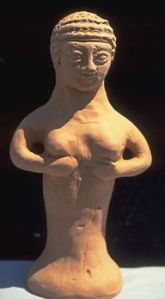
Could be anybody's mommy

Could be anybody's mommy

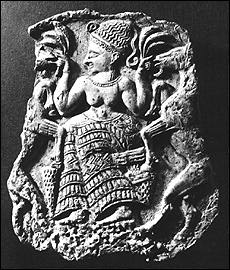
No item from ancient West Asia has yet been recovered that bears an inscription identifying the portrait as Asherah. We simply do not know what the ancients believed she looked like. This hasn’t prevented modern scholars from assigning an Aserah value to certain favored artifacts with a great deal of certainty. So much certainty, in fact, that we don’t know which certainties to trust. If iconic emblems for Asherah existed, that might provide a way of connecting images to the goddess. Unfortunately, snakes, lions, and “twigs” — the usual suspects — could fit just about any goddess with a little twisting. So we are forever left with iconic ambivalence.

May be Asherah, but what's with the goats?

May be Asherah, but what's with the goats?

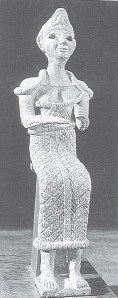
Of all the artifacts recovered from the Levant, where Asherah was actively worshipped, only one, it seems to me, is a potentially clear match. Not as alluring as the Asherahs of popular imagination, she is actually described as a matronly figure, the consort of patrician El. The El images that seem beyond question illustrated him comfortably seated on his throne of state, hand raised in a sign of blessing (or waving good-bye). One image found at Ugarit presents a feminine counterpart in posture and pose. This is likely the image of Asherah. Younger, sexier goddesses need not apply. This one instance reminds us of just how little we know of the immense divine world of Ugarit. If we are careful in our explorations, however, there is much to be learned.

Like hubby like wifie

Like hubby like wifie


For the Love of Aqhat

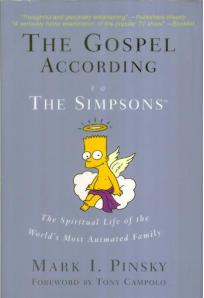
It seems that a new season of The Simpsons is upon us. With the release of season twelve on DVD last week, recession-ridden families everywhere are piling up on their couches to be entertained. Initially I had a hard time accepting The Simpsons; I had seen too many failed adult cartoons to give me much encouragement that this would be something worth wasting my time on. Surprisingly, it became clear after just a couple of seasons that The Simpsons was witty, smart, and surprisingly ethical. This final point was so pronounced that Mark Pinsky wrote a book focusing on it entitled The Gospel According to The Simpsons (Westminster John Knox, 2001). As to be expected in a book with a foreword by Tony Campolo, it was a little devious, but still retained a kind of sugar coating. Nevertheless, I found the book worth reading.

Bart after the birds?

Bart after the birds?

The Simpsons frequently pokes fun at all of us who take ourselves too seriously. Most of the time it is evident that the writers have done their homework as well, pulling in sometimes obscure references to classical or biblical literature. Recently while watching the episode entitled “Bart the Mother” I was struck by an ancient theme which was surely accidental. In the episode, Bart, trying to prove himself to the neighborhood bully, shoots a mother bird with a b-b gun. Guilt immediately sets in and Bart is haunted by his cold-blooded act. In a dream he sees a bird tribunal doling out the punishment for his crime — having his face pecked off. I’m sure this owes more to Hitchcock than to Ugarit, but I can’t help shaking the idea that the scene is somehow informed by the Epic of Aqhat. In one of Ugarit’s classic stories, Aqhat is given a divine bow that is coveted by the goddess Anat. When he won’t relinquish it, Anat has Aqhat pecked to death by raptors, “twice upon the noggin, thrice upon the ear!” Ugarit remains shrouded in cultural obscurity, so no easy cultural reference can point to it. Everyone has seen Hitchcock’s The Birds.

The story of Aqhat, although sadly broken, is a classic of ancient literature. So much more to pity is that it remains nearly as unknown today as it was while buried under the ground for three and a half thousand years. A colleague of mine approached Penguin a few years back trying to pitch the idea that they sell a translation of the Ugaritic texts in their classics series. They flatly turned him down on the basis of “no public interest.” If the publishers won’t put these world heritage classics out there, how will there ever be interest generated? Perhaps those of us bitten by the Ugaritic bug simply circulate in circles too small to have any impact on what the world thinks. Beyond a few souvenir-hawking vendors in Syria and a few crusty scholars sheltered away in dusty academic libraries, nobody knows the story. It seems that Aqhat’s fate is equally grim — pecked to death by birds and completely forgotten because the story just doesn’t possess sales potential.


Thy Will Bee Done

Today I had to do battle against the bees. That’s the way I must steel myself for the task of mass specieocide. Watching those little tiny creatures struggling, kicking their six legs and antennae into the air, trying to get the poison off is heartrending to me. They are, after all, only trying to do whatever it is that yellow-jackets do. But it is a heat wave right now, and without central air we need to open windows as much as possible, and today they tried to invade people air space. I had to do something. So standing over the carnage of an Ezekielian valley of damp exoskeletons, I recalled the bees of the Bible. (May their entomological souls rest in peace.)

Bees are one of the more innovative weapons in the divine arsenal. They are used to chase people away, like God’s little army of armored stinger missiles. And as in any arms race, it is numbers that count. Hundreds of them to the one human being holding a putrid can of chemicals trying to defend home against their incursions. In the book of Judges, the one prominent female judge is Deborah. Her name translates to “bee.” She is the bane of the Canaanites. So much so that general Barak (“lightning”) refuses to go to war without her. Bees were a potent curse in ancient times as well, strong enough to drive a family from their home.

Bee careful around this one, because love hurts!

Bee careful around this one, because love hurts!

A Sumerian cylinder seal depicts what appears to be a divine scene with a killer bee goddess (not an Africanized killer bee, but a slang killer bee). One wonders what the worshippers must be thinking. Perhaps they too had watched Phase IV when they were kids! Bees could also be benevolent. Honeybees provided a rare treat before sugarcane had been discovered, and even Israel’s “promised land” flowed with milk and honey. So like most of life, bees were ambiguous. They bore all the markings of the divine: a wonderful sweet residue, nice trendy color scheme, but a painful sting that could even be fatal. Gifts of the gods are like that. So no matter how humane my temporary solution may be, I still feel like I’m taking on the gods.


Sea Dagon

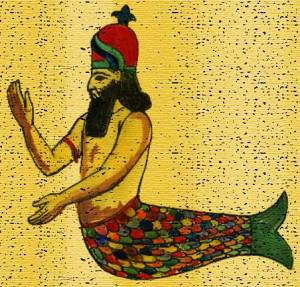
The Dagon of the Hebrew Bible is a fishy character. As I mentioned in my podcast on the subject (Puff the Magic Dagon), the biblical writers seem to have considered him a sort of merman (i.e., ugly mermaid), and since nobody really had an idea what lived in the depths of the ocean in those days that was a fairly safe bet. As we continue the deep-water exploration of our very wet planet, we constantly come across fantastic creatures. Keep an eye out for Jonah’s great fish, and we can explore this watery conundrum.

Not Dagon

Not Dagon

Water is the most divine natural substance. Life evolved in water and cannot exist without it. Ancient peoples were so fascinated by it that it was supposed to be the primordial element. In the beginning there was water. Genesis 1 does not narrate the creation of water; it is already present at the beginning. Water was perceived as chaotic, indeed, monstrous even. Some have suggested that the fierce waves breaking on the coast of the eastern Mediterranean spawned tales of water’s relentless battle against the land.

Tiamat, eh, ur, Yamm? Or is it Poseidon?

Tiamat, eh, ur, Yamm? Or is it Poseidon?

Whatever the reasons may have been, the ancient sea was divinized. The Sumerians may have perceived a deity named Kur as the god of the deeps, a role held more famously by Tiamat in the Enuma Elish. Enki and Apsu were also Mesopotamian deities with aqueous associations. When the Ugaritic myths were stylused, Yamm was a sea monster while Asherah was nick-named Lady Asherah of the Sea.

She's also a yellow submarine

She's also a yellow submarine

In all of this we find no Dagon in the water. When we add Rahab, Leviathan, and Poseidon into the mix maybe it is better that way; it would be a pity should there be more gods than fish in the seas.


Anat, Kali and the Violent Femmes

“Women and men,” runs the chorus of the They Might Be Giants song of that same title, “… everywhere they go love will grow.” Women and men. Thus it has always been. The Sumerians seem to have speculated, on a broken tablet concerning the creation of humanity, that some six varieties of gender had been ordained by the gods. This story reminds me of just how dicey gender definition can be. Despite the howls of protestation from man + woman = marriage crowd, the concept of gender is actually complex and diverse. The lowly slime mold of the genus Physarum has a combination of multiple sex-controling genes mixed with several different types of sex-cells, leading to a bewildering 500 different sexes. You’ve got to wonder what the Physarum bar-scene is like! So the whole women and men combination seems a little tame by comparison.

The ancients did, however, toy with standard gender role concepts. The Ugaritic goddess Anat, sometimes described as a “tomboy,” was perceived as a literal femme fatale, joining her in the company of Ishtar and Kali as warrior women-goddesses. She was a proto-Amazon (before they laid aside their male-bashing and set up a very lucrative web-site). Anat wears the severed heads and hands of slain warriors and stomps in blood-puddles, laughing all the while. Where did the ancients derive such violent feminine images as Anat and Kali? Some sociologists suggest that these myths were intended to solidify gender roles, although they seem to confuse the violent male with the shy and retiring female stereotypes. Perhaps the Ugaritians and other ancient folk knew deep down that gender is only a vague attempt to classify something that is really far more complex than it seems. Just when gender is nailed down you find yourself in a bloody mess as Anat swats at you again and again.

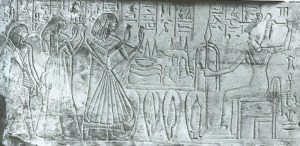
Anat ready to smite Egyptians who just don't understand the Violent Femmes

Anat ready to smite Egyptians who just don\’t understand the Violent Femmes

Nashotah is not far from Milwaukee where the folk-punk, genre-defining band the Violent Femmes started out. In college many of my overtly Christian radical friends told tales of how the Violent Femmes were a closet Christian rock group, based on some of the religious themes in Gordon Gano’s lyrics. When I listen to their CDs, however, I hear the same old angst that has plagued humankind for ages — what does a guy have to do to impress a girl (the same question may be reversed, turned upside-down, or dis-and-re-articulated, depending on whether you are female, male, or slime mold). At Ugarit they would have understood the Violent Femmes — listen to “to the kill” and tell me it’s not so! I would suggest that Gordon and the guys aren’t as much closet Christians as closet Ugaritians, struggling with the Anats and other violent femmes of their world and trying to make sense of it all.


Assyrian Dreams

All through my formal education I had learned about the Assyrians. My first introduction to them was as the evil empire that destroyed the chosen nation of Israel, inspiring countless myths of the ten lost tribes. Upon further study they appeared in a more positive light — they were one of the great, formative Mesopotamian peoples who had gone through considerable trouble inventing much of our culture for us. They also had a penchant for over-running smaller and weaker nations, but then, everyone has their foibles. When I saw their striking bas-reliefs in the Boston Museum of Fine Arts, and later in the British Museum, I was deeply impressed by their ability to project hostility. Bulging biceps, braided beards, dreadlocks and attitude enough to be the envy of any gangsta, these guys could subdue you with just a solemn nod in your direction.

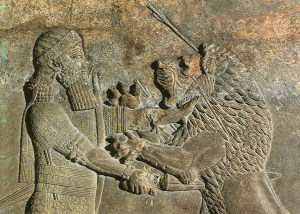
A good day for Assurbanipal, not so good for the lion.

A good day for Assurbanipal, not so good for the lion.

But the Assyrians over-extended themselves. Conquering further and further from the homeland, they couldn’t keep a stony eye from Egypt and Anatolia all the way to Persia. Media (not the paparazzi) eventually tumbled Nineveh and Babylonia stepped in to take on the burden of predominant empire. The United States hadn’t been invented yet, so somebody else had to dominate the Middle East. With the influx of Arameans and the machinations of the Persians, Mesopotamian culture became a cherubic mix of peoples. Assyria ceased to exist as a separate nation, and once the Arabian tribes launched into the region, all genetic bets were off. Racial purity was a dream of the past. So the Assyrians dissipated, joining their neighbors in a happy, amorphous Mesopotamian culture.

In Shamash we trust.

In Shamash we trust.

Then, after procuring a doctorate in Ancient Near Eastern studies, I took a job at Gorgias Press. Suddenly the Assyrians were back! That was one on the other end of the telephone! Visions of dreadlocks and skewered lions came to mind, and in my confusion I asked my colleagues if I’d slept through that lecture. No, it turns out, the Chaldo-Assyrians are a relatively new incarnation. Named Assyrians by nineteenth-century European missionaries, this predominantly Christian people has adopted and tried to assimilate the heritage of the ancient Assyrians. They still exist today, I’m told. Instead of swords and lion hunts, they wear camouflage and hunt with automatic rifles. But their flag hearkens back to their ancient, pre-Christian religion. That flag, their rallying point with high antiquity, bears the emblem of the eight-rayed Assyrian sun. Jesus, meet Shamash. Son versus sun. I guess it is time for me to go back to school again and see if I can get it straight this time.


Everlasting Cats

“The mystical divinity of unashamed felinity, round the cathedral rang ‘Vivat!’ Life to the Everlasting Cat!” I’m not sure if this is T. S. Eliot, Andrew Lloyd Webber, or a chimeric mix of the two, but it is an interesting bit of mythology. My daughter is the consummate Cats fan and has been asking me to write a post on Cats and religion. When I read (or hear) the above lines of poetry, I must confess, my mind wanders to Xenophanes who stated that if horses could draw they would draw their gods like horses. Ditto for cats.

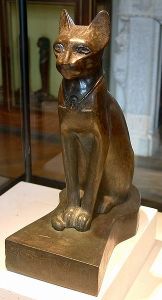
Everlasting cats, however, have their roots deep in religions of the ancient world. Although the word “cat” never occurs in the Bible (“dog” is there plenty of times, with even a “bitch” or two) cats are certainly within the biblical culture. Eternal Egypt knew of an everlasting cat — Bastet, the “cat goddess.”

Bast to see this as an everlasting cat

Bast to see this as an everlasting cat

Hailing from Bubastis, Bastet (I just can’t call her Bast, since it sounds like slathering meat with some kind of ambiguous liquid, something I can’t stomach as a vegetarian) seems likely to have some connection with the sun. Regarding yesterday’s post, the ancient Egyptians had a plethora, a veritable superabundance even, of solar deities. Bastet was called the Eye of Ra. She was also associated with war, appropriate enough to anyone who’s read Erin Hunter’s Warrior series. As a goddess, Bastet qualifies as an everlasting cat.
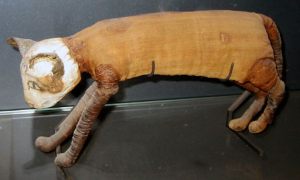
Little Bastie doesn't seem so playful any more

Little Bastie doesn't seem so playful any more


So do the numerous cat mummies from ancient Egypt. Preservation of the body was an aspect of realizing life beyond life for the Egyptians. It would also obviously help to keep the mice out of heaven. T. S. Eliot was C. of E. (Church of England, not Copt of Egypt) and had a savvy sense of wit. Ignoring the biblical snubbing of cats, he named the wisest and most respected of Old Possum’s Practical Cats with a biblical name — Old Deuteronomy. Although I am not a cat owner (is anybody really a cat owner?), I do have great respect for felines, mystical or not. And I am not alone as long as the ancient Egyptians kept a mummy or two around and an Eye of Ra to keep that solar barque on its course.


Here Comes the Sun, and Is She Ever Hot!

As I enjoy my Kellogg’s Raisin Bran at breakfast, a benevolent sun smiles down on me from the box. I know from social conditioning as a child (courtesy of television), that the smiling solar disc converted the healthful grapes into equally healthful raisins so that I could grow up to be big and strong. While there is no doubt some truth to this solar myth, it does demonstrate how pervasive solar personification is.

A persistent myth to minds conditioned by trinitarian concepts of early Christianity is that the ancients recognized three major goddesses. Although their names are distinct in the original languages, in English three of them begin with A and form a delightful Trinitiess: Asherah, Anat, and Astarte. So this feminine triune godhead is considered to represent the female power triangle of the ancient Ugaritic world. (Ugaritic, I know, is a far too limited term for what was a widespread idea. On the other hand, “Aramean” and “Canaanite” are inherently problematic!) It has been my contention for years that this construct is A) modern, and B) false.

Throughout the ancient world the sun was considered a major deity. And although deities frequently overlapped in their spheres of interest, the principle Ugaritic deity in charge of the sun is Shapash. (With apologies to Nicolas Wyatt, I simply can not find Asherah in her.) In the surviving Ugaritic mythology, which we know for sure is only a portion of a larger corpus, Shapash appears frequently to enlighten both gods and humans. She guides the dead to their repose in the underworld and provides them with some kind of light while the world sleeps unknowingly above. She even seems to have the ability to cure snake bites. Now in the heat of summer, there is no question of Shapash’s ability to turn our grapes into raisins. She even kept many indoors in India last week as the longest solar eclipse of the 21st century crossed that country (chalk one up for Yarikh). Let’s give the sun her due!


Drunken Moonshine

As I learn in wonder that several of my favorite public personalities are suddenly, in fact, younger than I am, Time sends an issue broadcasting that the first moon landing occurred 40 years ago. Ouch! I remember watching it on our snowy black-and-white television the size of a washing machine. There is some comfort, however, in knowing at least some people out there are as fond of outer space as I am. I have proudly told younger co-workers that I watched the original airings of the first real Star Trek, and I confess to having been a Lost in Space junkie.

Ancient peoples used a different set of lenses when they looked up into their pre-Galileoan skies. Those tiny dots of light in the sky at night actually move across the sky as any ancient insomniac knew. They had to be alive, that stood to reason — they must be gods. And that “big shiny one, right there,” as Donkey calls it, the moon, presided over them all. In many an ancient divine magisterium the moon reigned supreme. Its light wasn’t reflected, it was self-generated.

At Ugarit one of the deities associated with the moon was Yarikh. Unfortunately tablets relating his exploits are rare, but one such tablet (fancy title KTU 1.114) relates a frat party on Mount Saphon (an ersatz kind of heaven). As the gods are drinking themselves senseless (how else can the latest Bush administration be explained?) Yarikh, the moon-meister, begins crawling under the table like a dog and begging for a joint of meat. His advances are greeted with a divine stick-whacking to send him yowling back home. It is probably a good thing that the moon sobered up before we landed there. The imagination runs wild at what could have been so much worse than landing on a pile of green cheese!

Innocent nursery rhyme or Yarikh on another drunken exploit?

Innocent nursery rhyme or Yarikh on another drunken exploit?


Fallen Angels

When did angels become cute? This is one of the ranking mysteries of religious studies. In ages past, way back before monotheism, most people in western Asia believed in a plethora of deities, sub-deities, and heroic characters. A cosmic continuum of animal-to-human-to-superhuman-to-divine seems to have characterized their universe. They had little reason to suspect that anyone or anything more powerful than a human might be “cute!”

The first angels mentioned in the Bible, cherubim, are today often associated with Hallmark and Valentines: cute little nude boys with wings playing with their bows and arrows. In the world of the Bible, however, cherubim were not so tame. I tell my students to think of sphinxes when they read “cherubim” — scary hybrids of human and lion or ox and eagle. These creatures were intended to be guardians of the very throne of God; they had to be scary.

Your garden-variety angel was indistinguishable from a human being. They had no wings, halos, or — (gasp!) — harps. The reaction to angels by the people of the Bible was essentially that of a visit of a stranger, a stranger who sometimes said weird stuff about what the big guy wanted you to do.

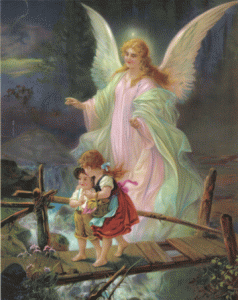
But somewhere along the line, angels had an extreme makeover. They became winged, effeminate people who could save your life or that of your puppy. They became guardians of human interests and loves. In so doing they lost the awe and majesty of being the Frankensteins of the supernatural world. Is this what a fallen angel really is?

A cheap copy of this popular image hung in my room as a child.

A cheap copy of this popular image hung in my room as a child.