
All through my formal education I had learned about the Assyrians. My first introduction to them was as the evil empire that destroyed the chosen nation of Israel, inspiring countless myths of the ten lost tribes. Upon further study they appeared in a more positive light — they were one of the great, formative Mesopotamian peoples who had gone through considerable trouble inventing much of our culture for us. They also had a penchant for over-running smaller and weaker nations, but then, everyone has their foibles. When I saw their striking bas-reliefs in the Boston Museum of Fine Arts, and later in the British Museum, I was deeply impressed by their ability to project hostility. Bulging biceps, braided beards, dreadlocks and attitude enough to be the envy of any gangsta, these guys could subdue you with just a solemn nod in your direction.
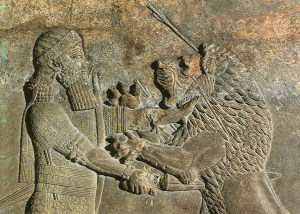
A good day for Assurbanipal, not so good for the lion.
But the Assyrians over-extended themselves. Conquering further and further from the homeland, they couldn’t keep a stony eye from Egypt and Anatolia all the way to Persia. Media (not the paparazzi) eventually tumbled Nineveh and Babylonia stepped in to take on the burden of predominant empire. The United States hadn’t been invented yet, so somebody else had to dominate the Middle East. With the influx of Arameans and the machinations of the Persians, Mesopotamian culture became a cherubic mix of peoples. Assyria ceased to exist as a separate nation, and once the Arabian tribes launched into the region, all genetic bets were off. Racial purity was a dream of the past. So the Assyrians dissipated, joining their neighbors in a happy, amorphous Mesopotamian culture.

In Shamash we trust.
Then, after procuring a doctorate in Ancient Near Eastern studies, I took a job at Gorgias Press. Suddenly the Assyrians were back! That was one on the other end of the telephone! Visions of dreadlocks and skewered lions came to mind, and in my confusion I asked my colleagues if I’d slept through that lecture. No, it turns out, the Chaldo-Assyrians are a relatively new incarnation. Named Assyrians by nineteenth-century European missionaries, this predominantly Christian people has adopted and tried to assimilate the heritage of the ancient Assyrians. They still exist today, I’m told. Instead of swords and lion hunts, they wear camouflage and hunt with automatic rifles. But their flag hearkens back to their ancient, pre-Christian religion. That flag, their rallying point with high antiquity, bears the emblem of the eight-rayed Assyrian sun. Jesus, meet Shamash. Son versus sun. I guess it is time for me to go back to school again and see if I can get it straight this time.


Pingback: A Decade of Augusts | Steve A. Wiggins