Milkweed and Honey

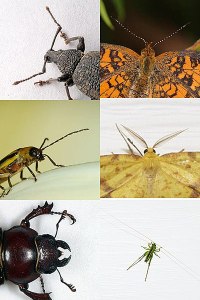
I’ve never thought of bugs as an ethical concern. Well, not directly anyway. I had some truly frightening encounters with insects and arachnids as a child, so I tended to avoid bugs when I could. At times, I hesitate to admit, I took advantage of my size and smooched them. I did, however, mature out of that. Many years ago I stopped killing bugs that got inside, choosing instead to favor capture and release. I’d trap them in one of a variety of empty peanut-butter jars we kept around the house expressly for that purpose. The imprisoned intruder is then escorted outside and released. It seemed the only fair way to handle the situation—I don’t believe in exploiting size, and hating things with too many legs is prejudicial. Then I heard that insects are dying out.

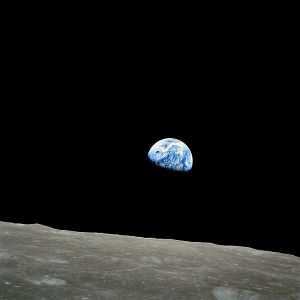
Public domain, from Wikimedia Commons

Instead of bringing glee, this instilled a kind of panic. According to a story in the Washington Post, scientists have noted a 75% drop in bug biomass over the past several years. Stop and think about that. Insects contribute so much to our lives that we barely pay them any mind. Everything from pollination to breaking down decomposing organic matter, bugs do it. We need our insects. As with most things these days, it seems that we humans are the likely culprits. We destroy habitat, we spread pesticides everywhere, we try to take all kinds of land and make it in our own image. And we’ve sacrificed our insects along the way. As the article states—driving around country lanes on a summer night doesn’t bring up the windshield splatter that it used to. I stopped to think about that. It seems to be true.

The tiny members of the animal kingdom do a tremendous amount of work. I know they’re not doing it for us, but the things they do we don’t have to—and oftentimes can’t—do. All fruits and vegetables are pollinated by insects. Honey has been the main place where some of this shortage has been felt most directly. Bees have been disappearing. So have monarch butterflies. The fact is, we can’t live in a world without bugs. This does make it an ethical issue. If we’re going to claim dominion over all things we have no right to overlook the smallest creatures. Sure, they can, well, bug you. They fly in your face or bite you while you’re sleeping. They’re only doing what they evolved to do. I don’t mean to bug you about it, but we need to look after the minuscule and vulnerable among us.


Healthy Hurricanes

Three major hurricanes into the season and our Republican government has nothing better to do than try to think up new ways to take away our healthcare. In an effort—no victory is too insignificant—to show that the swamp is being drained, the Grand Old Party wants its own constituents to sicken and die off just to prove a point. Meanwhile Thurston Howell can’t find a charted island even after being marooned on it. Puerto Rico is a territory of the United States. Perhaps the White House should use some of its tax money to purchase a map and a history book. Houston is still recovering from Harvey and 45 spends his time campaigning for the loser in Alabama. Not even Shakespeare could have come up with tragedies like this.

Morality, at least in the post-Reagan elephant wing, used to be in line with evangelical Christianity. When I grew up in that tradition I was taught it meant fair treatment for all, regardless of race or social location. Since my childhood that brand of Christianity has become more exclusive, it seems. God now, contrary to the Gospels, rewards the wealthy. He tends to favor gentiles, but only those of caucasian stripe. Those who are poor and suffering should learn to speak English and stay out of the sun. Act like proper suburbanites and hurricanes will never strike you. Oh yes, and you need not fear being stuck by the sun by day either. You don’t even need to read your Bible. In fact, you can ignore it as long as you know enough to proclaim to others you alone know what it means.

So far 2017 has been a year of natural disasters. Earthquakes, hurricanes, and further from home, multiple landslides and monsoons. And even volcanoes. It’s tempting to see some biblical correlations here, but that’s playing fast and easy with the great torment from which our fellow human beings are suffering. Far more important is to show that we can repeal healthcare in a nation that has been spared, to a great extent, the worst the world has had in store so far this year. Oh, except for Puerto Rico. Does anybody have a map app on their phone? And while you’re at it, check to see if maybe some developer has come up with software to help govern an affluent nation. Preferably one linked somehow with Twitter. We mustn’t forget our priorities.


Small Wonder

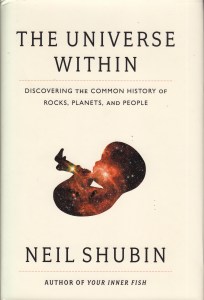
Nothing makes me feel small like thinking about the universe does. Never a large individual anyway, thinking how this apartment encompasses me and it is dwarfed by the small town in which I reside, it’s only a matter of moments before I become a mere microscope slide. And that’s before I even reach the level of just our planet. I’m sure Neil Shubin didn’t mean to make me feel bad when he wrote The Universe Within: Discovering the Common History of Rocks, Planets, and People. In fact, I’m pretty sure that he intended it to be a book that makes the reader feel connected to life, past and present, as well as to the stars that long ago spewed out the elements that have made such life possible. This is a big picture book. From the perspective of a paleontologist the very rocks that entomb the fossils live. The stream of particles is unbroken from the Big Bang to our little corner of the Orion Spur.

The great orthodoxies of science, however, require faith. No matter how the math works, it seems impossible to the rational mind the the entire universe could fit inside the space of the following period. Then, for some reason not yet known, bursts out to infinite but expanding size. Shubin brings many concepts together here—the effects of Jupiter on bringing earth into the Goldilocks Zone, the impact light and dark have on our bodies, whence the dinosaurs might’ve gone—and weaves a tether through it all that ends up in the hand of humanity. Evolved beings we are, but evolved from stardust as well as primordial soup. And then there’s the fact that the earth itself, as is inevitable, is slowing down. Days are growing longer yet we don’t get any more done. And we have maybe a billion years left before the sun goes Trump on us.

There is a strange comfort in being connected to all of this. And also a sense of shame as well. We are, as far as the fossil record reveals, the only species to initiate a mass extinction single-handedly. We have this whole planet and we want even more. It comes as no surprise that religious language crops up now and again in a treatment like this. After all, words divested of such concepts can take us only so far. The Universe Within is a book with a universal perspective, placing us squarely somewhere within a context that we simply can’t comprehend. And yet, reading it somehow leaves me feeling small.


Trees, Please

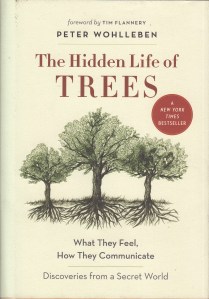
One thing we know about nature is that we don’t know much about nature. We can be a pretty self-absorbed species. Peter Wohllenben’s The Hidden Life of Trees is a good corrective for that. When we’re young we’re taught the difference between plants and animals. What Wohllenben shows is that such differences are more a matter of degree than we realize. Trees move, but slowly. Their timescale can be vast, compared to our brief, get-rich-quick outlook on life. It has been demonstrated pretty clearly that trees communicate with one another. They help one another, and they can, in their dendritic way, think. They cooperate with fungi to maintain connections between their root systems. Trees might even have what we would call personalities, were they fortunate enough to have been born human.

In a little like a medieval fantasy world, Wohllenben is a German forest keeper. He knows trees and their ways intimately. The trick, of course, is that we have a difficult time seeing things in timeframes that exceed our own. There are living trees that are 9,000 years old. That’s before the Sumerians ever showed up to invent writing. In human eyes, a lot has happened since then. And although we don’t know how to define consciousness, we’re sure that it’s limited to our species alone. Grudgingly we may admit some “higher” animals to the club, but our predilection for conquest of our world would be sorely diminished had we not other creatures to dominate. Looking at the world through a sympathetic lens, however, the fact that we’ve evolved these traits from the common ancestor we have with the animals should tell us something. As Wohllenben points out, animals diverged from plants at some stage, but we do ultimately come from the same stock.

Even on a practical level, we can’t live without plants. No matter how gourmet our foodies may be, our nutrition cycle begins with plants photosynthesizing food from pure light. There is perhaps a danger in recognizing our kinship with trees too closely. We depend upon them for food, shelter, warmth, and the oxygen we breathe. We might be inclined, as Wohllenben notes, not to use them at all. The key word here, however, is exploitation. We evolved along with plants and other animals and we all rely on each other. We are all connected. We should care for those with whom we share the planet. Trees have a much longer view than we do. When the desires of one species set the terms for all the others, we soon feel the pain of the trees.


Eating Earth

Some things are hidden in plain sight. That doesn’t make them any the less insidious. One such hidden truth is that the earth is of a finite size. Another is that, consequently, its resources are limited. Our species is easily led, as are most herd animals. Standing out can be embarrassing. Painful even. This is the recipe, along with a generous dash of greed, that has put us on the brink of worldwide catastrophe. We live in an unsustainable system, and some of the largest culprits are our appetites. As a fan of horror movies, I can honestly say Cowspiracy is the scariest movie I’ve seen in a long time. It’s a documentary, not genre fiction. Scientists had generally already thrown up their hands because we’ve passed the tipping point for global warming, and then we elected ourselves the stunning leadership of Donald Trump.

No one can predict exactly what form the collapse will take, but we’ve set the key factors in place. We’ve been warned for years. Cowspiracy demonstrates something we don’t want to admit—the agricultural lobby is extremely powerful and the least sustainable aspect of life on this planet is animal husbandry. In early civilization, where technology did not exist to support large-scale farming, meat was not a staple of the human diet. Families that could afford animals gained more value from their beasts alive than on the plate. And they had only a few. As mechanization increased in the last century, we made livestock valuable commodities. When I was a kid word on the street was you were even poorer than we were if you couldn’t eat meat every day. Humans were the absolute, if blind, masters of their own domain. Now agriculture is the single largest force of degradation of the environment on the planet. And nobody wants to listen.

Cowspiracy is not an easy movie to watch, even for a vegetarian of many years’ standing. So why watch it? Because our reliance on animal-based food is destroying our planet. Not slowly either. If this is true, why haven’t we heard of it? Kip Andersen and Keegan Kuhn spend an hour-and-a-half exploring that in this important film. While it can’t be fully summarized here, in a word it can be said: money. There’s huge money to be made in a business rightly called animal husbandry. Wedded to profits at the expense of the very soil that gives us life, we eat our way to the grave. And we do it even when technology has already offered viable alternatives. They are also hidden in plain sight.


Not Devil’s Tower

The Sourlands, apart from being the setting of Joyce Carol Oates stories, are one of New Jersey’s characteristic features. Although the Garden State brings visions of heavy industrialization to many imaginations, there are also lots of outdoor options for getting back to nature. One is the Sourland Mountain Preserve. No one’s sure of the origin of the name—was it named after a person, or was the land poor for farming? Could it have come from another language? No matter what the source might be, these areas are today criss-crossed with hiking trails—some of them quite rugged. On a sunny September weekend my wife and I decided to take a walk. The sunshine and cool temperatures made the opportunity beguiling. Although it’s not far from where we live, we’d never been there before. Time to look at a map.

The most distinctive point listed was the Devil’s Half-Acre Boulders. Geonyms, or place names, can be quite evocative. New Jersey and Pennsylvania along the Delaware both lay claim to some impressive boulder fields. The Devil’s Half-Acre was clearly a place for rock climbing, as chalk dust on the trail indicated. It’s not territory that you can get through quickly. But why devilish? Across the Delaware may lie the origins of the name. Near another boulder field, Ringing Rocks, is the site of a tavern along the Pennsylvania Canal. Said to have been the locale of lawlessness, haunted by the ghosts of dead canal workers, the location earned the same diabolical sobriquet in the early nineteenth century. What we found on the Jersey side, however, was an impressive jumble of massive stone and a rather popular hiking path.

“The map is not the territory” Alfred Korzybski once famously wrote. His expression was borrowed and adapted by religionist Jonathan Z. Smith in a book that’s still required reading for those starting out in the field. The point of the saying is that a map is an abstraction. The experience down here on the ground is very different from that projected from a bird’s eye-view. We can easily adjust to the concept however, using maps to tell us what lies ahead. The difficult work of digging a canal, or the unyielding nature of boulders, may symbolically point to the devil. At several points on the trail we had to pull out our map to make sure of our bearings. Trails are hard to follow over rocks. There was no literal devil there, but territory might just help to explain the name on a map.


Oil Heritage

I love optical illusions. Apart from the sheer fun of ambiguity, such illusions are really all about perspective. Shifting perspective can be one of the most powerful ways of changing a person’s life. One of my more stalwart perspectives is that those who originate something deserve recognition. If that something is important, they may even deserve acclaim. And sometimes that thing may turn bad, in which case the discoverer may end up being notorious. Originality, the subject of bestsellers and media gurus, is sometimes the result of thinking differently than other people do. It can be cultivated and grown. Sometimes it’s simply fortuitous.

Every time I visit my own place of origins in western Pennsylvania, I think of the oil industry. It’s pretty hard not to around here. “Pumping jacks” still operate in some back yards, and petroleum tanks suddenly appear along beautiful rustic roads. The presence of fossil fuels isn’t as evident as it was when I was a child, for all the big refineries have closed down. Many of them have been dismantled. Still, I can’t drive by the site where a refinery fire glowed beyond the next hill from my childhood home and not wonder about it. Seeing those huge oil tanks melted and crumpled as if they’d been made of wax is an image that doesn’t get easily erased. Today, that’s all gone. Still, the oil industry itself was originally from this region. The auto industry—although increasingly electric—would’ve never started without the obvious boost that petroleum production gave transportation.

In the light, or perhaps dark, of Hurricane Harvey we’re set to see increasing gas prices. They will impact the economy in other ways, and energy giants will continue to degrade the environment in the quest for cheap and abundant crude. I’m not sure if that makes the discovery of oil in this region worthy of acclaim or notoriety. It does seem, from my perspective, that since big oil is so lucrative, a lifeline ought to exist for the struggling communities in my childhood home. Empty storefronts were rare here in my youth. Now they are almost as common as shops that remain open. I know; if people can’t move on, then maybe there’s a reason the economy is sagging. There are ghost towns in this area, and there may be more in the future. I just wonder how all this will looks from another perspective. Will it all be an illusion once electricity makes the past superfluous?


Hurricane Warming

Image credit: NOAA, public domain via Wikimedia Commons

My heart goes out to those suffering from Hurricane Harvey in Texas and Louisiana. Natural disasters like this are often tied to the “wrath of God” model, and outdated though it is, it still captures how it feels. The sheer amount of rain dumped by this one storm is literally inconceivable. Trillions of gallons. Coupled with a completely ineffectual president, the disaster is even greater. Like many others, I’ve been watching since the weekend as the numbers and statistics of woe rise. Lives lost. Property washed away. Once more it reminds us just how small we are in the face of the weather. Some of this same awe was in my mind as I wrote Weathering the Psalms. Ancient Israel did not experience hurricanes—the bodies of water nearby aren’t large enough to generate them. A single thunderstorm, however, is enough to put the fear of God into a person. In ancient times, with an under-developed meteorology, all of this was the provenance of providence. How else could you begin to explain such tragedy?

One of the books that got me started on my meteorotheological quest was Erik Larson’s Isaac’s Storm, about the Galveston hurricane of 1900. Thousands died in that storm, and it remains the most deadly natural disaster in US history. Although Hurricane Harvey developed quickly, there was warning. The death toll is remarkably small (at least at the moment) compared to the fury of the storm. The natural tendency of human psychology is to look to supernatural explanations for such devastation. What have I done to deserve this? How could God do this? Are we being punished? Questions such as these come to mind, although we know that hurricanes are entirely normal features of this planet. Somewhere in the back of our minds, though, we probably are aware that global warming causes more radical weather.

Even as Trump continues to surround himself with climate change deniers, we see what global warming looks like. The weather is an intricate mechanism. Small things effect it. Large-scale changes throw it into chaos. Those who see climate change as a pain in the pocketbook will do anything they can to deny its reality. More powerful than a freight train or battleship, the weather can’t slam on the brakes and suddenly resume a more milder form. No, we’ve already started the process, no matter how many billionaires disagree. My heart goes out to those who continue to suffer from the hurricane. We need strong leadership and clear thinking at such times as this. We will need more of that in years to come. But we must also keep in mind this isn’t the anger of God. Unfortunately the wrath of human greed can be just as devastating as the wrath of the Almighty.


Planet A

Two of the classics of ecology, A Sand County Almanac, by Aldo Leopold, and The Sea Around Us, by Rachel Carson, were published by Oxford University Press. In its present-day iteration the press has a Green Committee, on which I’ve sat from very nearly the beginning of my time there. As a committee, we’re reading these classics to see what we might learn some half-century-plus after they were published. I’d never read A Sand County Almanac before. It’s a pity, since I lived in southeast Wisconsin, from which the book takes its genesis, for about a dozen years. The writing is poetical prose, but the ideas are solid science—the land on which we’ve evolved knows how to take care of itself. When one species becomes too greedy, all suffer. Leopold ends his book by suggesting a land ethic should be put in place. Now, a human lifespan later, has it?

Hardly. Watching the Trump Administration doing everything it can to commodify any aspect of the environment that might make a buck—or at least a buck for the wealthy—is alarming in the extreme. There is no soul in the land, to this way of thinking. They believe that because they themselves lack a functional soul. A soul cannot exist without ethics. What we do to this planet is one of the largest ethical issues imaginable. No species, rational or not, destroys its own habitat. Except our own. Arrogant to the point of supposing ourselves divine, we think we can take what we want and give nothing back. And everything will be just fine. I wonder that we’ve had this inexpensive, readable guidebook this last seven decades and have continued to ignore its sage advice. Maybe we’re too busy making money to read something that sounds suspiciously like poetry.

One of the observations I had about the Almanac was how attuned to the philosophy of nature it is. Philosophy has many enemies these days, from prominent scientists to Republicans. Nobody seems to value the capacity for deep and thorough thinking through of a problem that is unbeholden to any orthodoxy. The philosopher can ask “what if?” without regret. When it comes to the environment, humans aren’t the only philosophers. We’ve convinced ourselves so completely that we’re more advanced than other species that we suppose they can’t teach us anything. One thing they do, however, without our interference, is create balance in nature. It’s an ethic to which even our species might aspire. If only we would listen to the wisdom of those who pay attention to the world that has given them life.


Noah’s Parable

I write a lot about Noah. For those who didn’t know me before this blog, I was once invited to write a book on Noah for a series ironically published by Oxford University Press. I had been researching Noah for years, and I intended to write the book. Then, as the kids are saying these days, life happened. My interest in Noah has never waned, however. And part of the reason is that it is perhaps the most influential story in the entire Bible. I realize I’ll need to explain that, but stop and think about it—Evangelicals seldom talk about Jesus any more. Their concerns are with unborn babies, people making babies outside wedlock, and destroying our environment in the name of capitalism. It is the last of these that brings us back to Noah.

A friend recently sent me a story on Splinter by Brendan O’Connor titled “How Fossil Fuel Money Made Climate Change Denial the Word of God.” O’Connor is looking at the history of how a pro-environmentalism-inclined evangelical movement decided to shift its base to align with climate-change deniers. Behind the scenes are fundamentalist clergy. Oh, we like to laugh at them and their ways, but they are the power behind the throne and we should really not let them out of our sight. You see, as O’Connor points out, they believe that the God of Noah can protect the world from the worst that we can throw at it. It’s perfectly okay to try to destroy the planet because the magic man upstairs can fix everything right back up if he needs to before sending his son back to town on the final business meeting. Laugh if you will. These people are dead serious and many who hold power in Washington believe every lie they utter.

As a nation—perhaps as an entire western culture—we’ve laughed off religion. Secure that there’s no God up there to rain down, well, rain, we laugh and jeer at Noah. It’s a children’s story, after all, isn’t it? Okay, forget about the part where everyone in the entire world drowns, except eight people. And when he gets drunk and lays naked in his tent after it’s all over. Other than that, it’s a kid’s story, right? The story of the flood is one of the oldest myths in the world. It has been part of human story-telling for millennia. We now have very powerful people with smart phones in their pockets and access to vast hordes of money who believe it literally happened. And since God took care of his own once, he can do it again. The educated smirk. The smart start building arks.


On the Rocks

This universe is indeed a mysterious place. You don’t have to believe in the paranormal anymore to see it. A look at the headlines makes my point. There are those, however, who do look at the genuinely strange, and once in a while this realm crosses paths with that of religion. A friend pointed me to a story on Mysterious Universe about floating rocks. Apparently this story is going to be on the mainstream Travel Channel, so it’s not completely bonkers. It caught my attention because it’s about rocks. While of decidedly poor qualification to be a rock-hound, I have more than a passing interest in geology. Itinerates shouldn’t collect rocks, but I can’t help myself. Anyway, I’ve been known to go to publicly open mines and tap away with my rock hammer hoping to find some not-so-hidden treasure.

According to the story, there is such a publicly open mine in Arkansas. Crystals (I expect quartz) are available for surface excavation, for a fee. Then the owners, the Murphys, noticed the anomalous rocks. Since they are conservative Christians (this is Arkansas after all) they feared what powers might be behind rocks that don’t obey the laws of gravity. The mine didn’t get closed and hushed up because of an unusual source of inspiration. An article by Billy Graham on divine mysteries led them to keep the mine open and to allow for investigation. Once the Travel Channel comes out with its program Crystal Mine is sure to experience an influx of business. Mainstream scientists, one expects, will not be among them.

The universe is vast. We haven’t explored all of our own planet yet (we’re kind of busy destroying it at the moment, so if you don’t mind…) and yet we gleefully claim what’s impossible. I don’t know if there are levitating rocks in Arkansas, but I do think we’ve been a bit hasty about some of our conclusions. We may yet find things that will force the concepts—the laws—to change. Consider gravity, which seems particularly relevant in the case of floating rocks. Sir Isaac Newton (devout theist that he was) ending up having to relinquish the “correct” explanation to Albert Einstein. Some have been so bold as to suggest that maybe even Einstein might not have gotten the whole skinny on gravity. We continue to learn. Levitating rocks are indeed strange. Not so strange, however, as Billy Graham being the one to rescue an anomaly for the world to see.


Water Bears

Since we should all be busy planning on alternatives to planet earth, my mind has turned to tardigrades. Known as “water bears” these very simple animals are amazingly complex. Don’t go looking for them in your drinking water, however. They’re microscopic. So why am I thinking about tardigrades at a time like this? Because they’re one of the few organisms that scientists believe could actually survive the destruction of the planet. Who knows? They might even be able to survive in Washington, DC. Maybe that’s why they’re in The Washington Post.

You have to look closely to see one.

Able to cling to life at the cusp of absolute zero, in conditions with no oxygen, and at doses of radiation that would leave the human race—among most other species—fried, these micro-organisms are truly remarkable. No wonder scientists are playing with thought-experiments as to how to wipe them out. Hey, scientists are only human after all. Don’t worry—nobody’s really trying to kill these little guys off. The question behind Ben Guarino’s story seems to be what makes these tiny creatures so amazingly resilient. It raises an issue that I often ponder. The will to survive. Evolution is, according to standard theory, without purpose. Natural selection works in a “logical” way: the most successful organism survives long enough to breed and its traits become standard options in the next generation. Nobody needs to want anything (except to mate) and chance takes care of the rest. But that doesn’t explain the will to survive. The “eye of the tiger,” if you will. I’m sure this wasn’t what the Washington Post was intending to trigger, but doesn’t it seem strange that even “non-conscious” micro-organisms “want” to survive?

The desire to exist is dangerous territory. It has a whiff of the divine about it. One of the characteristics of life, if my high school biology isn’t completely outdated, is the ability to reproduce. What it didn’t address, for fear of teenage snickers, I’m sure, is the desire to reproduce. Why does life insist on its own continuation? Is it truly just an eons’ long succession of one-night stands that results in creatures capable of even asking that question? Or is there something more to it? Tardigrades have segmented bodies, legs, and claws. All at less than 40,000 cells per individual. They lack a neocortex (which doesn’t necessarily disqualify an individual from being president). They can’t answer the questions we put to them. As individuals they are remarkably easy to kill. As a species, however, their resilience carries the answers to some very deep questions. If only we had the will to ask them.


Brick in the Wall

Kids. You never know what’ll come out of their mouths. Not bounded by logic or the rules of physics, they come up with some of the most truly creative ideas that grace our species. The growing up process usually includes filters that separate the real from the imaginary. But not always. In a recent statement, Donald Trump said that his proposed wall between Mexico and the United States should be invisible. His concern, according to a Washington Post story by Christopher Ingraham, is that catapults could be used to launch drugs over the wall. Somebody could get hit in the head. (It sounds like somebody has been already.) So the wall should be see-through. This wall, which the majority of Americans don’t want, and which will have to be deconstructed at great expense after his presidency (such as it is), will be a technological marvel. It’ll even have solar panels, added by old king coal himself.

I can’t help but think of Star Trek IV: The Voyage Home. Earth is being destroyed—not by Trump in this scenario, but by aliens looking for whales that we’ve driven extinct (there’s the Trump part). The crew of the Enterprise, in a Klingon warship, have to transport humpback whales from the 1980s into the future. The problem is see-through aluminum does not yet exist. Scottie, posing as a professor from Edinburgh—back in the days when my alma mater bore some cachet—gives the formula to a San Francisco manufacturing firm in return for enough of the metal to make a holding tank for the aquatic mammals. They slingshot around the sun back to the future just in time to save earth from a catastrophe worthy of Trump Enterprises. Problem is, see through aluminum is fiction.

Photo credit: George Louis, Wikimedia Commons

In my daydreams I often picture this wall. My thoughts inevitably go to Berlin and shortsighted solutions. History (which most American presidents have made a point of studying) teaches that walls don’t work. The technology is ancient. As is the technology of how to get around, under, and over walls. In fact, basic career counseling will often use the wall as an exercise to get you thinking of ways to overcome obstacles in your path. Dealing with walls is one of the most time-honored of human pastimes. You see, walls were originally built to keep us safe especially from non-human threats. We didn’t want toothy big cats or cave bears wandering in during the night and making snacks of us. We built walls. Then we wondered what was going on over on the other side. Just now, it seems, that idea has begun to dawn on a man who might benefit from trying to understand The Voyage Home.


Berrying Perspective

Two people looking at the same thing see something different. Since we’re living with a government of distorted perspective this truth appears refreshed daily. I was reminded of this while picking huckleberries. Huckleberries, according to the local edible berry guide, are called many different things. In this part of the country you know them when you see them. And if you see them you pick them. They appeal to the frustrated hunter-gatherer left in us city-dwellers. As I was trying my best to fill my bucket, I kept thinking of those who only see nature’s bounty as a means of turning a profit. In my mind they’re meanies—those who take all the fun out of the few freedoms we have left—although I realize that it’s a matter of perspective. Consider the huckleberry.

I’m a mere seasonal visitor to these parts. Since not too many of my own species make this location their permanent domicile, that’s perfectly natural. Many of the berry pickers I’ve encountered have been seasonal guests as well. There are the more “industrial” pickers, though. In a good year huckleberries can command fifty dollars a gallon on the local market. Unless you know an unfrequented secret site, a gallon can take several hours to pick even in a promising location. Overall, you need to arrive before anyone else and get the most productive bushes so that you don’t have to wander around the mountainside in search of a more lucrative locale. Not to mention that, like most berries, they have a limited shelf life. Nature prefers sharers to hoarders.

While I’m picking I generally think of bears. Unlike my species they don’t have the grocery store option. These berries are their survival, I suppose. Nature does provide. That’s how evolution works—we form symbiotic relationships with our environment. The meanies, however, can’t see beyond the self. What nature provides must be accumulated for my own benefit and not that of others. There are never enough huckleberries to go around, the industrial mind thinks, and so I’d better control the availability and set my price. You don’t even have to like huckleberries to do it. Ironically we call this having a gift. Standing here on this isolated mountainside, bent over a bush offering nature’s abundance, I believe that I’ve found a gift. I have to remind myself, however, that this too is a matter of perspective. It is a perspective that tastes right to me.


Nature Watching

Whenever I travel in the northwest, I keep an eye open for what one colleague calls “charismatic megafauna.” You know, the big animals that are so rare to see that they develop a charming, if imaginary, persona. Not that I’ve ever seen much of it here. It’s rarity is part of the charm. My usual hope is to see a moose—something that happens every three or four years. Black bears are even rarer. Grizzly bears, which still inhabit this area, and mountain lions I’ve never seen. I know they’re there, but their agenda is not to be seen. My first full day here I was sitting outside working on an academic paper. My time off work is rare, and when I get a moment, even in the wilderness, I try hard not to waste it. I had the feeling of being watched. Not the creepy kind of feeling, but the kind where you think an animal might be keeping a wary eye on you.

I looked over the top of my book. Several yards distant I could see a head bobbing up and down. Then I noticed a black patch on a nearby lodgepole pine. It took a few seconds for the red head to register. A mated pair of pileated woodpeckers. Not exactly huge, but they are large birds. And since they are the personality behind Woody Woodpecker, well, I guess you can call that charismatic. Charismatic enough for me to put down my Ugaritic mythology and go inside to fetch a camera. Of course they were gone by the time I’d returned. I decided to take a walk down the track in a vain hope of finding them again. Once in a while charismatic megafauna cooperate. There they were, one going after ants on the ground, the other perched above pecking wood.

Most of our large fauna we’ve driven to near extinction. Humans can’t stand not to be the biggest thing around. The megafauna remain, however, hidden though they may be. An online site for this area posted a photo of a cougar snapped last summer. I’m not sure when the last time a grizzly might’ve wandered down from Canada, but since last November I’m not sure why they’d even bother. Even the moose seem coy. Animals don’t do what we want them to do. Those that we can’t domesticate follow their own agendas and calendars we can’t hope to comprehend. As they flap away I can swear these woodpeckers are laughing at me.