Science Marches On

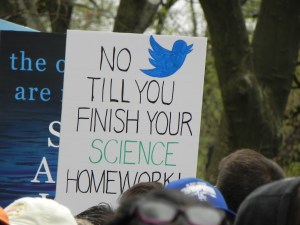
A few thoughts about the March for Science in Manhattan over the weekend seem to be in order. To get to the rally in time, from our little corner of New Jersey, we found ourselves on an early train. We arrived at 62nd Street and Central Park West to discover the march was beginning just outside of one of Trump’s unimpressive towers. The area for marchers was clearly marked off by barricades, but a woman walking her dogs, a resident of Trump’s tower, wandered in among the crowd. Like most Trump followers, she seemed clueless that there was an obvious way around the obstacles and had to be helped by the police. Seems to be a theme with 45—police are everywhere watching his assets. Meanwhile the hotel doormen from next door were asking for “Resist” paraphernalia and reminiscing about their shock when the boy next door received the nomination. The mood was jovial despite the spitting rain.

The speeches at the rally were mostly given by children ten and younger. The future teaching the past. As might be expected, the signs were clever, and some took considerable thought to figure out. A few, it seems, felt religion was to blame. Well, they’re probably right about that. One gets the sense that science and religion are like cats and dogs, and nobody has to guess which one’s identified with the cats. Still, the majority of the signs pointed out the benefits of science. Even scholars of religion use the scientific method, believe it or not. Like science, religion (as revealed by science) may be good for people. Who brings religion to a science rally?

I’ve always been a fan of science. Throughout school I learned a lot and did well in physics and chemistry, biology not so much (dissection was never my thing). I still read science and incorporate it into my thinking. Balance, however, suggests perhaps religion also be treated as not evil in and of itself. After all, it is evolved behavior. As the march progressed down Broadway, we passed a church that had a prominent banner reading “Prayer really does work,” or something along those lines. I’d seen enough clever signs already that morning to notice this contrarian voice. Then I wondered, why can’t science and religion seem to get along? Both can (but need not) make exclusive truth claims. What’s wrong with admitting that we just don’t know? Belief is involved in either case. No doubt science is important. I’ve always supported its study and always will. Is it, however, too much to believe that maybe religion can also enlighten, if understood for what it is—a human way of coping with an uncertain world? As science marches on, hopefully it will help us comprehend even the unmeasurable.


Earth vs. the GOP

They used to call her “Mother Earth.” Now she’s simply a commodity to be liquidated into cash at the country club where rich white men play. That’s why I’m spending Earth Day on my third protest march of the year. Of all the things the Republican Party has done to show its true colors the clearest has been to participate in the destruction of the world we all share. There’s only one word that answers the question “why,” and it used to be considered one of the seven deadly sins. Greed. These acts of planetary terrorism are carried out by men who believe lining their own pockets is the highest possible good. Even moderate Republicans have locked in their goose step to keep in the good graces of madmen who want to cram as much lucre into their coffers as they can before they die. When the planet’s a smoldering ruin their grandchildren will surely thank them.

Son, behold thy mother.

Don’t knock tree-hugging unless you’ve tried it. Trees tend to be much better company than Republicans anyway. Never have I had the feeling that I’ve had to celebrate Earth Day with such a blend of angst and anger. That one that your teacher always warned you about—the one who ruins it for everyone—now has control of the country. Immediately he insisted we start dumping coal waste into our streams and rivers. Burn more coal so he can play a few more holes with what passes for a clean conscience in a filthy soul. I march because I must. We can’t sit silently and let the darkness fall. If you can see through the coal dust you’ll understand that the planet weeps. It’s her that we celebrate today.

Matricide used to be considered a heinous crime. Now it’s just good business. If we were an honest species we’d admit it’s been bad business from the beginning. We’d never elect a businessman with inherently conflicting interests to the White House. The goods of the few outweighs the good of the many. The commodification of nature is the worst kind of unnatural selection. Here science and common sense agree—in order to survive we must preserve our planet. I confess that I’m unapologetic in this regard. So, although I’ll be spending this Earth Day in the artificial environment of Manhattan, marching in the cause of science, and if push comes to shove I’ll be the one hugging a tree.


Superstar Detective

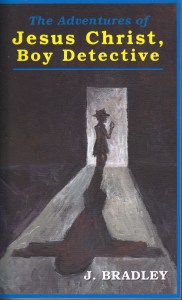
One of the reasons I accept reading challenges is that they take you places you otherwise wouldn’t go. Not all the books I read for the Modern Mrs. Darcy 2017 challenge make it onto this blog (to find the full list you need to see what I post on Goodreads.com), but some I can’t help but talk about. My wife had noticed a book that ended up in her Christmas stocking and for which I had admitted curiosity: J. Bradley’s Jesus Christ, Boy Detective. Now, Jesus is no stranger to fiction. In fact, he appears in lots of books as either the main character or as fulfilling some supporting role. In some books you have to really squint to find him. In others he’s obvious. In Bradley’s novel he’s a bit of both.

There’s a good bit of theology going on in the background of Jesus Christ, Boy Detective. As the title suggests, Jesus functions through a new incarnation in the body of a, well, boy detective. With some assistance from a criminal uncle and Saint Peter, he investigates bizarre murders and other crimes. There seems to be an ulterior motive, however, since he’s trying to get his father to own up for all the suffering he’s caused humanity. That’s right, this book is a modern theodicy.

Theodicy is a word for considering how a single deity can be both all powerful and all good. Since there’s plenty of suffering in the world we all experience, the question naturally arises: why doesn’t God do something about it? Theologians are fond of reminding us that we can’t see the bigger picture. It’s like global warming—it’s easy not to believe since we only live a few decades and the climate takes a lot longer than that to react to our pouring toxic stuff into the ecosystem. Maybe, theologians say, we have to suffer because we don’t see everything. Only God does. The boy detective disagrees. The deity in this story is truculent and culpable. A strong-willed divinity. If he doesn’t sound familiar, take another look at the Bible. I don’t know if J. Bradley has any theological training—I don’t even know his first name—but it’s clear that he’s down here with the rest of us wondering how all the pieces fit. And where there are clues it’s not a bad idea to call in a detective.


Seeing Thinks

Look, up in the sky! It’s a bird! It’s a dude! What what is it? It’s actually a cloud. I enjoy the entries on Mysterious Universe, but sometimes a cigar is just a cigar. It seems like decades since I laid down on the ground and looked at the clouds, seeking shapes. The sky is nature’s cerulean canvas and although they’re just water vapor, clouds take on endlessly fascinating shapes. Since religion has historically been projected onto the sky, many people take signs in the sky as somehow divine. The photo on Mysterious Universe is of a cloud that some thought was Jesus and others thought was Mary. Herein lies the rub of pareidolia. You see what you want to see.

There is, in traditional Christian thought, a world of difference between Jesus and Mary. You really don’t want to mix the two up. I mean one is divine and the other is only venerated. Don’t want to cross that line into worship because idolatry leads to all kinds of trouble. So who’s in the sky? Someone that we should perhaps think sacred: water. In a world quickly running out of fresh water (of course since now, officially, there is no global warming we’ll have to find another way of explaining our disappearing ice caps) we should all perhaps worship our clouds. The harbingers of fresh water. It won’t last forever.

I, for one, complain when it rains too much. I suppose that’s because I’ve lived most of my life in the rainy climates of the eastern United States and Scotland. Days can pass without a glimmer of sunshine. I get depressed and truculent. Yet the freshwater falls. Water tables are replenished. In much of the world—indeed, in much of the United States—it is not so. Water shortages are bad and are growing worse. We use far too much and when the ice caps are gone, the largest reserves of freshwater on the planet will be empty. Then again, capitalists have never been too keen on saving up for the future. Most of us alive today, at least in the rainy climes, will have our lifetime supply. The future, however, looks pretty hot and thirsty. So who is it in the sky? Could be either gender—wearing robes makes it hard to tell at this level of detail—but whoever it is, let’s hope they’ve brought plenty of friends with them.

Look like anybody you know?

Look like anybody you know?


We Are an Island

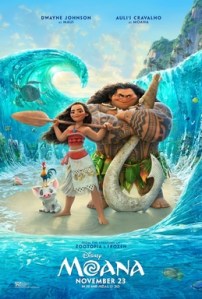
moana_teaser_posterApropos of both building your own deity and Disney, my family went to see Moana. Now, I have to admit up front to being a bit behind on my Polynesian mythology. Scholars of the history of religions feel terribly insecure if they don’t read the languages or haven’t spent time with the culture first-hand. I’ve seen the Pacific Ocean a few times, but never from the point-of-view of an islander. In fact, one of the areas of growing interest in biblical studies is the interpretation of Holy Writ by islanders. Their perspective, it seems clear, is different from others in more populated land masses. So Moana, which delves into Pacific islander mythology, was a brand new world for me. More than hearing about the demigod Maui, it was a chance to consider what destruction of our ecosystem looks like to those who have more limited resources at hand. Those who, when global warming really kicks in, will be the first to become homeless.

One of the strange things about living in the post-truth world (defined as the world after 11/9) is that many movies, novels, and other creative explorations I encounter seem to underscore the demon we’ve invited in. Moana is about a girl who saves her people, but she only does so by defying the man in power. Had she not journeyed beyond the reef, her people would’ve starved on their island. Meanwhile the big white man prepares to assault the White House and all that our founders held dear: an educated leadership. Progress. Fair treatment for all. Someone needs to remind these short-sighted individuals that every landmass is an island.

As we approach the end of 2016 it’s time to think of where we’ve been. At the theater, an ad by Google showed the newsworthy events of the year. There could not have been a better rendering of the high hopes with which we began and the sorrow with which we’ve come to an end. Our scorn of education has caught up with us and we’ve asked “the man” to please destroy our world and enslave our women and deport anyone who’s different. We need a lesson in how to build better deities. We need to be willing to admit that a girl might know more than her father. We need to learn the wisdom of the islanders.


My Stranger’s Keeper

img_3106

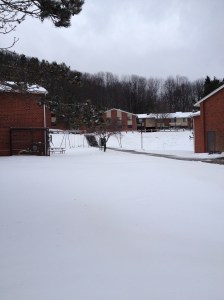
He was a bearded young man, maybe in his twenties. He kind of reminded me of my own youth, only cooler. I was at a stop sign on a snow-covered hill with tires honestly a little more worn than they should’ve been. Three times I tried to get some traction only to have to reverse and give it just a touch more gas. He walked by and called out “On the count of three, okay?” I shouted my thanks. It took him a couple of minutes to get me moving and as much as I wanted to stop and give him something for his efforts I knew that if I did I’d be right back where we’d started. Once I got moving, I had to keep going. I’ve driven in snow since I earned my Pennsylvania license in the snow belt of Lake Erie and I’ve helped drivers stuck in snow a time or two, but I was touched by this young man helping an older guy in a neighborhood he didn’t know get out of a jamb. That’s what I think of Americans as being like.

Seeing the utter selfishness of those “elected” officials posturing over the last few days I say to myself they didn’t grow up in the snow and cold. Nothing compels a young man with better things to do to help a frazzled older guy except for common human decency. Those who grow up with hardship know the value of their fellow human beings. We help each other because that’s what people do. Those born to wealth and power help themselves and only themselves. They need to learn the message of snow. Nature is our most natural teacher.

I don’t know his name. He didn’t have any idea that I had four hours to drive through snow, sleet, and freezing rain, but he helped me despite that. He didn’t ask for any money and I’m sure he expected nothing so coarse. I’m old enough to miss such kindheartedness and to cherish it deeply when I encounter it. Snow and hills and bald tires aren’t a winning combination, but the human capacity for goodness mixes well with any conditions. On a cold winter’s day I encountered the warmth of human concern for a guy in trouble. I need to listen to what the weather is saying more closely. More than that, I need to step out of my car more often and throw my shoulder against a stranger’s hatchback. It’s what makes us human.


Somewhere out There

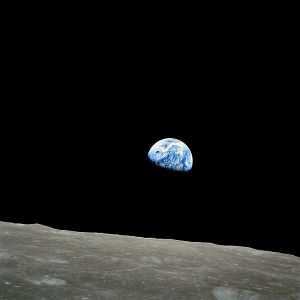
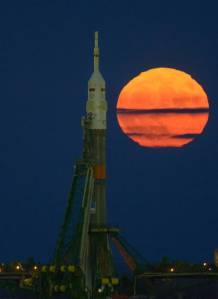
If last month’s election taught us anything it’s that nobody really knows anything. For many years now I’ve been saying that the sign of an educated person is s/he admits how little s/he knows. Socrates may have beat me to that idea, but there are still people whose intellect appears so great that we should pay attention. To my mind, such as it is, Stephen Hawking is one of those people. I don’t understand his formulas, but some of the concepts I can grasp. So when Prof. Hawking says we have approximately 1000 years before we make our planet unfit for human life, I think we should take notice. In just a decade we’ve gone from a Wall-e White House to a Dumb and Dumber one, and old mother earth is due to take a beating. Hawking, according to a story in The Washington Post, advises us to look for another planet to colonize.

 Photo Credit: (NASA/Bill Ingalls)

Photo Credit: (NASA/Bill Ingalls)

Colonization seldom ends well. I wonder how the rest of the universe feels about us moving into the neighborhood. We dump our waste into anything pristine enough to carry it away so that people can make some of their number wealthy so that they can feel better about themselves. We can’t go one year without a war somewhere in our world and we kill one another just because we look different. We can’t even elect a president who’s smarter than any random undergraduate. Not exactly the kind of invasive species you want living next door. Any system can be gamed—capitalism most of all—and if it were up to me I’d prefer to have thoughtful neighbors. Perhaps the universe is politely saying to Dr. Hawking, “not in my backyard.”

What I find truly amazing here is that religion gave us the entitlement. Believing that the gods are like us, or that one deity made us in his white, male image, we’ve figured out this world’s ours to destroy. Just like entitled kids with too many toys. Daddy can always buy you another. So now we’re in the market for a new planet. One that’s not too hostile, but easily exploitable. A capitalist planet, but one that doesn’t mind a bit of help from former communists. You see, once we’ve figured out how to exploit another planet, there’ll be no stopping us. I have great admiration for Stephen Hawking. It’s just this time I think that we need to set our own house in order before we start inviting ourselves to somebody else’s home.


Hollow Bible

Sleepy_Hollow_-_Title_Card

The proofs for my article on the Bible in Sleepy Hollow are now here. It will be appearing shortly in the Journal of Religion and Popular Culture. For those who know my previous academic work—hi, both of you!—this represents a departure from the familiar for me. Some years back, floundering for a teaching position like a fish that’d flipped out of the acadarium, I talked to a colleague who confirmed what I’d long suspected: study of the biblical text is dying. Face it, nobody cares about J, E, D, and P, or even Q, anymore. We’ve made our point. The Bible is a composite document with many sources that people can still tuck under their arms on the way to the polls. It’s so easy to forget that this text is the basis for so many lives and eternal plans. While we scholars have been arguing with one another, culture has moved on. That’s why I looked at the Bible in “Sleepy Hollow.”

If the Bible isn’t relevant, why bother studying it? If the main character—dare we call him protagonist?—of the New Testament says to turn the other cheek and his “followers” advocate for gun ownership it’s time to ask what went wrong. Scholars know the Bible, but do we know the Bible? Long ago meaning slipped away from academics. Consider science. We can question global warming because the science has become a topic of conversation among specialists that the rest of us can’t hope to understand. Instead of trusting that they know what they’re talking about, we politicize it. Scientific research, even in major universities, is funded by interested third parties. You know, some scholars don’t think there really was even an E after all.

The Bible no longer means what the specialists say it does. I may have spent years of my life and thousands of dollars to speak as an expert, but I soon learned nobody was listening. Meanwhile, culture marches on, somehow supposing if two Corinthians walk into a bar the rich man in his tower makes the best sense, according to the Good Book. Indeed, if you want to find out what the Bible says, all you need to do is head up the Hudson Valley for a season. Or listen to those who hand out tracts and purchase firearms. What could possibly go wrong there? My article will be out in a few weeks. If you’re one of the two who read it keep in mind that there’s more to it than meets the eye.


Frozen Over

The_Blob_poster

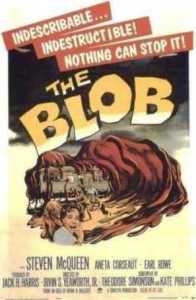
For reasons that may eventually become clear, I was watching The Blob. It seems that each generation’s fears are unique to its time—let the reader understand. For whatever reasons, star-appeal I expect, Steve McQueen was cast as the teenage Steve Andrews. A little unbelievable as a twenty-eight-year-old teen (Sissy Spacek was a more convincing teenage Carrie at twenty-six) Steve drives around his small town trying to find and stop the Blob. What is the Blob? Nobody really knows. Emerging from a meteorite, it seems to be an EBE (Extraterrestrial Biological Entity) that encompasses, dissolves, and assimilates animal life forms, getting bigger all the time. In a day when the Russians were actual enemies, this is hardly an intentional vision of capitalism but an apt description nevertheless. If it touches you, you’re dead. Since it can ooze through air vents, there aren’t too many places at hide. It forces itself upon you.

Steve’s love interest, Jane Martin, has a lisping little brother named Danny. While big sister is out on a date battling the jello-monster, Danny—a future NRA member—charges outside in his pajamas shooting at the thing with his cap gun. Can this be? One capitalist shooting at another? Don’t be fooled. This is the nature of the free market. Either the Blob ends up on a dinner plate, or Danny does. We know that prior to 1960s monsters seldom kill little children (but don’t get me started on Frankenstein), so it is the Blob that will succumb. As the town’s teens combat the goo with fire extinguishers, freezing it, Jane, Danny, and Steve escape to go hunting another day.

Those of you who’ve read my blog for any time know that subtext is often the point. I’m counting on you following along with me here—think of what day it is. The small town police chief, Dave, calls in the Feds. No wall will keep this alien out. It has to be deported. To some place that will never thaw. Like all good monsters, the Blob never really finally dies. It must be kept frozen to keep humanity safe. The final words Steve utters are indeed chilling, “As long as the Arctic stays cold.” Getting on sixty years later our “industriousness” has begun to melt the ice caps and the friends of the Blob deny global warming. I’ve seen The Thing from Outer Space too, and I know the last thing you want to do is thaw the Arctic. Remember what day it is, and do the right thing.


Giving Trees

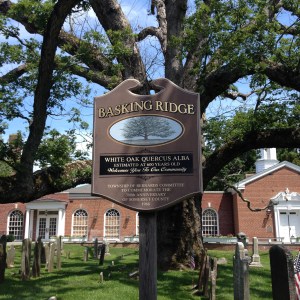
They’re not exactly worshipping the tree, but the Basking Ridge Presbyterian Church is holding a memorial service for the old oak tree. I’ve written about the Basking Ridge oak before. I learned about it only in January, and I visited it this summer. Some say it’s the oldest tree in the state, while others make that claim for the Great Swamp oak, which isn’t too far away. The climate change we’ve introduced, as well as natural aging, appear to have doomed the tree. It had leaves this summer, but not in the profusion that signals health to botanists. The decision has been made to take the tree down before any massive branches fall and cause injury or damage. In the light of these sad developments, holding a service seems perfectly natural. The tree is older than the church over which it presides, after all. It’s even older than John Calvin who started the Presbyterian tradition.

img_2878

My first book was on Asherah, the goddess often associated with trees by scholars. As those who’ve read my book will know, I’m a bit skeptical, on the basis of the actual evidence, that Asherah was a “tree goddess,” but it is also clear that trees are ancient objects of veneration. From the human perspective, they can live a very long time. There is a bristlecone pine in this country that dates back to before Noah’s flood (something the creationists conveniently ignore). With that much life-force, which, we’re told, is really a fiction, these trees deserve special respect. After all, they were in the neighborhood long before we got here. Still, the Basking Ridge oak has been artificially preserved before. It’s been on life support for years. Concrete was poured to support the massive trunk, and many ponderous branches are shored up by support rods. We respect our elders.

Maybe it’s not tree worship. Maybe it’s worship beside a tree instead of worship of a tree. Prepositions can make all of the difference. Nevertheless, it’s an occasion to stop and consider our place on the planet. The fear many of us feel regarding this week’s election is a mere second in arboreal memory. The independence of this country came after the oak had been here centuries already. It may not be tree worship, but we should respect the memories of such a tree. A country young and optimistic rather than old and jaded. Maybe this tree knows a secret that it’s willing to bequeath to those of us whose lives are but a few leafing seasons in length. Good-bye, Basking Ridge Oak. It was a pleasure to meet you.


Reveries of the Fall

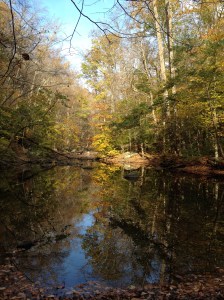
Just a quarter of an hour, studies show, of time in the woods can reduce stress. I suspect that if those fifteen minutes are spent running from a bear the opposite might result, but in general time in nature is an incredible solace. The weather hasn’t been particularly cooperative for October walks in the woods around here, but yesterday my wife and I managed to spend some time, along with many others, in Hacklebarney State Park, one of New Jersey’s gems. Living in the most densely populated state, to gather from the number of hikers we saw, encourages time in the woods. It was good to be reminded of the compelling scent of autumn leaves, the wonder of seeing their colors in the daylight when daily commutes begin and end in the dark. When work days are spent in the grayness of the city. Being out with nature, to borrow words from the Good Book, restoreth our souls.

img_2989

I suppose there’s nothing really logical about it. We’ve built civilization to protect ourselves from nature. Solid walls to keep predators out. Heat, running water, and electricity so that we can surf the internet without ever going outdoors. Permanent settlement always within reach of cell phone service and work email, we are the scions of civilization. Being unplugged just for an hour or two—even fifteen minutes—can feel like salvation. If that fifteen minutes is spent among rocks, trees, and the peculiar light that reflects off a lazy river. The internet will always wait, won’t it? Thoughts of work can be suspended until Monday, can’t they?

Hiking among the other expatriates of civilization in what used to be the Garden State contrasts so sharply with the image we project to the world. The Chris Christies and Donald Trumps who bluster that nature is there to be exploited. They may not say so with words, but lifestyles speak so much louder than syllables. Gaining wealth requires putting one’s own agenda first. We’re out here picking our way carefully over a rocky path. We have to stop frequently to let others go by the other way, or to let those faster than us pass by. But we’re all out here for the same reason. It’s a beautiful autumn day and spending it indoors feels wrong. I know that even getting online now feels like my time is being demanded by a million distractions. Unplugging, walking at a moderate pace, feeling the cool air and breathing the aroma of fall deeply into tired lungs, I can feel the stress draining away. If only for a day.


God’s Meteorologist

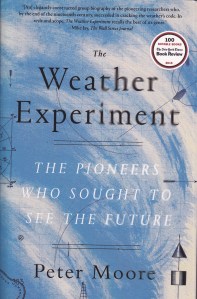
weatherexperiment“To understand the weather is somehow to glimpse the divine.“ I honestly don’t remember writing those words. A friend of my drew them out in a quote last year (perhaps the only time my book has every had such an honor) and they resonate with what a much better known writer has said. The Weather Experiment: The Pioneers Who Sought to See the Future was a book I bought upon first sight. Peter Moore’s story, like the science of the atmosphere, is only a small part of the whole. I glanced through the index for Increase Lapham while still in the bookstore, but despite his absence bought the tome anyway. I’m glad I did. Throughout this account of how meteorology developed in the nineteenth century religion and science are continually at play. As Moore points out, when faced with a violent storm, before any means of grasping the sheer enormity of the atmosphere existed, the only reasonable explanation was God. And it wasn’t just the clergy who believed this. Those we now recognize as scientists thought so too.

There are several key players in the drama of how we’ve come to our current understanding of the weather, but one that surprised me most was Robert FitzRoy. Everyone knows that FitzRoy was captain of the Beagle on Charles Darwin’s voyage that revolutionized science for ever. Some are even aware that FitzRoy, especially after his marriage, because a staunch evangelical Christian, parting ways with Darwin so far as to wave a Bible over his head at a public debate on evolution. I, for one, had no idea that FitzRoy almost singlehandedly invented the weather forecast. And that he did so as a government employee and doing so brought the ridicule of the scientific establishment because predicting was considered the purview of unscientific minds. It was as if the world I recognize had been whirled 180 degrees around by some unseen storm.

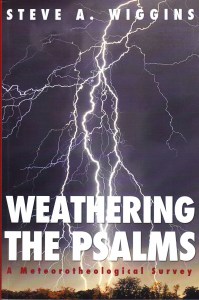
Any book on the weather, as I’ve learned, has to include a discussion of global warming. Climate change is real, and it is something we’ve done to our own planet. In a day when statistics can be produced showing that many scientific results are funded by companies with vested interests in the outcome of the experiments—even those at top universities—and we can see just how complex this web of financially motivated truth has become. Science is not pure rationality. It never has been, and it never can be as long as humans are the ones undertaking it. And we are beginning—just beginning—to see that there are some places where the wind blows freely through although those in white coats have assured us the room is sealed. This is a fascinating read and any book that makes me think I had the start of something profound to say is one I’ll buy on impulse any day.


Life As We Knew It

The government does funny things when your back is turned. Back in January, reading Scott W. Gustafson’s At the Altar of Wall Street, I learned that the government treats corporations as people. It assigns certain rights and privileges to these collectives so that business can thrive without interference. A recent article by Chip Colwell in The Conversation asks, “What if nature, like corporations, had the rights and protections of a person?” This isn’t merely an academic question. As Colwell points out, New Zealand has recently accorded a natural area personhood status to protect it from exploitation. Meanwhile we in the United States live in a country where companies—those nasty people—are chomping to get their teeth into the “natural resources” of our national parks and wilderness areas. Not because it’s best for the planet, but because their corporate person has one of humanity’s greatest evils—greed. Gluttony used to be a deadly sin. Now it’s called economy.

One thing this corporate person doesn’t understand: we have only one planet and it belongs to everyone. Or no one. Our capitalist outlook has given an undue sense of entitlement to those who have the means to take without asking. They can frack the ground under your feet and you’ll never know it. Until the earthquakes or sink holes come. Meanwhile natural areas—as Colwell indicates, considered sacred by many Native Americans—are unprotected from fictional persons that have immensely more power than any individual. We know what happens when the sacred is engaged in battle by the economic. It’s an unfair fight.

img_2476

When the crush of work stress gets to be too much, nature is our balm. Many times my wife and I will head to the woods on a weekend just to regain the balance that is stolen by what we call civilization. Manhattan has its wonders, to be sure, but they pale next to a simple stretch of “undeveloped” land and a path to walk through it. There’s a reason that corporate executives have their vacation houses far from the towers they build. It’s not a question of whether the sacred forests are valuable, but rather who gets to own them. With the legalization of fiction—corporations are not people, no matter how logic may be distorted—we have doomed fact. The earth is our fact, and, at this moment our only fact. As Colwell suggests, if it were treated like a person we’d have to show it some respect. And with respect true civility can thrive.


Finding Your Way

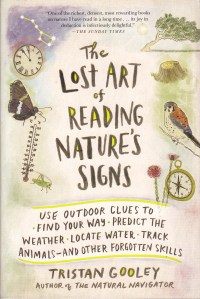
lost-artOnce while visiting the house of a friend, we took a walk in the woods. It was an area I didn’t know and after a few minutes it became clear that we were lost. There can be nearly no other feeling more frightening for a child. We wandered in the trees shouting for help for what seemed far longer than the maybe twenty minutes or so that my friend was disoriented. The message was clear: never go somewhere unless you know how to get where you’re going. I’ve been lost a few times since then and the gut-twisting fear is the same. Where am I? The Lost Art of Reading Nature’s Signs, by Tristan Gooley, is an amazing book for anyone who’s had that experience. We are residents of earth and we should know how to find our way around the place. Instead, most of us live in urban environments and never spend a lot of time outdoors learning that nature provides many, many clues to finding your way. You just have to know what to look for. I found myself wishing I could memorize large sections of this tome, assuring myself I’d never be lost again.

There is an irony about reading such a book during the commute to Manhattan. Apart from his small chapter on navigating in cities, Gooley spends most of his time offering advice on spotting hints in nature. I can’t believe the behavior of the mice, rats, pigeons, and cockroaches I’ve seen in the city is any less neurotic than that of the people. In nature trees, plants, land forms, weather, fungi, and the stars can all be used to guide a person home. There is a touch of quaint Britishness to the book, but the tips included quite often branch out to specifics in the United States, or even elsewhere. What all of this means is that in its own language the earth makes sense. We need to learn this language. Although Gooley doesn’t say it here, when we destroy our environment we’re increasing our ability to get lost.

One of the more interesting sections of the book used churches as a means of orienting oneself in unfamiliar country or a town. Church architecture, at least initially, followed a regular logic with an eastern orientation and opinions about the sacredness of the ground on the north-south axis as well. Knowing this holy geography, along with the ability to read lichens growing on the outside and finding the clues on tombstones, you can often find your way. There’s some poignancy here. There was a time when churches, synagogues, and mosques were natural means of showing people their cardinal points. We’ve come to rely on our devices to show us the way, and it’s a little early to know if that’s been a mistake. And if it weren’t for work today, I’d be outdoors, taking a walk and trying to learn to find my way through nature.


Lingering Memories

Visiting northwest Pennsylvania always makes me think of oil. I suppose the fact that I attended high school in Oil City has something to do with the fact. Many people suppose that the oil industry began in Texas, but Pennzoil and Quaker State have earlier roots back to the days when people flooded to Oil City and Titusville to get rich from the petroleum underground. I grew up in a refinery town that is becoming a ghost town, like Pithole City and Petroleum Centre before it. And when I returned home to New Jersey I wanted to find my Oil City book. Yes, there is a book. I first saw it in junior high school and I coveted it. Hardbound and large format, it was a book about my town. I had no idea where to get one, however. There were no bookstores in Oil City, or nearby Franklin. Any further afield than that and nobody cared.

I used to work as a janitor in my junior high school. It was my summer job for several years. One day our task was to haul out the garbage bins. I saw my opportunity. The library was discarding several copies of the book. They were in the trash. I dumpster-dived for the first (but not last) time in my life. I had the prized book. It had been locally printed. There is no publisher listed. It bears no ISBN. Nothing like a book to validate where you’re from. You see, I’ve always wanted to write a history of the area where I grew up. No major publisher would touch it—it can’t possibly sell enough books to cover its costs. It would be a labor of love.

Not that I’m a fan of Big Oil. Quite the opposite, in fact. I don’t appreciate their proprietary arrogance toward ownership of the planet. Of their pollution of the world to gain more money for themselves. I support alternate energy. But still. This is where I’m from. Not that anybody’s making much money off of oil there these days. The shallow wells ran dry long ago. The local oil companies were bought out by larger corporations but they kept the local names. Once in a while I pull out my old, salvaged Oil City book and scan the pages with wonder. Many of these towns wouldn’t be here if it weren’t for the prehistoric sludge that flowed under the rocks and stones. It’s easy to believe that the town would stay the same forever. Heading out of Oil City there is a church. A crude cross stands atop a truncated oil derrick. I stare at it and the irony is only half complete.

dscn6574