Desert Demons

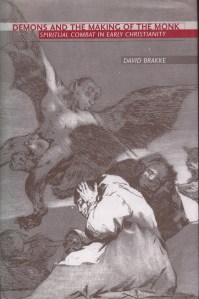
After reading many popular books, coming to a scholarly tome can be a shock to the system.  This is especially the case when said academic volume contains lots of information (not all do, believe me!).  David Brakke’s Demons and the Making of the Monk: Spiritual Combat in Early Christianity has been on my reading list for quite some time.  One of the perils of being a renegade academic is that you have no university library at hand and I’m not sure I want to reveal this side of myself to the local public librarian yet.  In any case, it would be difficult to summarize all that Brakke covers in this insightful treatment.  One of the elements that struck this reader, however, is the protean nature of the demons with which the eponymous monks wrestled.

Keep in mind that although demons appear throughout the Bible in various forms there is no single definition of what they are.  They appear to be spiritual monsters, in short.  Some passages seem to suggest they are fallen angels.  Others that they are foreign (primarily pre-Christian) gods.  Later ideas add the possibility that they are children of the Watchers, or even, as Brakke explains, evil thoughts.  The desert monks didn’t dwell on trying to discern their origin myth—they were out there to purify their souls, not to do academic research.  The Hebrew Bible does suggest that demons were creatures of the desert.  As monasticism began, appropriately in Egypt, one natural resource found in abundance was wilderness real estate.  The mortgage, however, was a constant struggle with demons.

Many of these demons developed into the seven deadly sins.  Not surprisingly, men living alone in the desert found themselves the victims of sexual temptation.  This led to, in some cases, the demonizing of women.  We’d call this classic blaming the victim, but this is theology, not common sense.  Anything that stood between a monk and his (sometimes her) direct experience of God could, in some sense, be considered demonic.  Brakke presents a description of several of these early desert-dwellers and their warfare with their demons.  Much of their characterization of evil would be considered racist and sexist today.  Brakke does make the point that during the Roman Empire—the period of the earliest monks—race wasn’t perceived the same way that it is in modern times.  Nevertheless, some of this book can make the reader uncomfortable, and not just because of demons.  Or, perhaps, that’s what they really are after all. 


Xenophobia’s Children

There are consequences, it seems, for not paying attention in school.  I have no way of knowing, of course, but I suspect most of us are taught that basic fairness is the social ideal.  Xenophobia is deeply embedded in the primate psyche, but to those who claim we haven’t evolved, there seems to be no way to convince them that “racial” differences are merely a matter of differing collectives separated by natural borders.  Over time traits favorable to the region predominate, and humans therefore have what seems to be a very wide array of potential appearances.  There should be nothing in all of this that suggests one group is superior to another.  Primate evolution, however, helps to explain but not to excuse.  Xenophobia is something from which we can evolve.

Fear is at the heart of any phobia.  In a society that measures the worth of individuals by their wealth, fear that another will take it is constant.  Perhaps, in a part of our souls we’d rather not acknowledge, we know it’s wrong to have too much while others don’t have enough.  It’s very cold this Martin Luther King Jr. Day.  In Manhattan on Saturday I saw many people on the street, those who’d met the wrong end of capitalism.  I’ve seen human beings shivering in Dickensian conditions in the twenty-first century.  I’ve known capable adults who couldn’t find work, even when they’ve tried.  We fear the street person.  We know that, but for slight shifts in capitalism, that could be us.

Xenophobia has come under threat with globalization.  We’ve made travel to remote locations affordable in order to spread capitalism to regions ready to be exploited.  And we see nothing wrong with taking from those who can’t prevent us from doing so.  Then we wonder why people just like us turn out to march in the cold.  Civil rights marches took place half a century ago.  Crowds thronged the nation’s capital seeking basic human treatment.  Fifty years later over a million women and supporters had to show up to make the same point again.  Fair treatment should not be a commodity.  Those who have fear the stranger.  Those who have don’t wish to share.  They claim the name of “Christian” and mock the very tenets upon which that belief system was founded.  It’s cold outside today.  As we huddle inside, we should have time to think.  It is a waste of a national holiday if we don’t at least ponder for a few moments what it is we celebrate.  And the real costs of xenophobia.


Truth Is Marching On

A funny thing happens to human minds when they’re in a crowd.  They begin thinking collectively.  We’ve all heard of “mob mentality” and dismiss it as so common that we don’t stop to think how remarkable it is.  Maybe we’re afraid to.  Yesterday I attended my third Women’s March, this time in New York City again.  Being an introvert, I find the prospect of putting myself into a large crowd daunting, and with a winter storm warning posted, worries  about getting home provided a convenient excuse.  My wife knows me well enough, however, to sense when my enochlophobia kicks in and tries to kick out that part of me that’s passionate about social justice.  You see, women are still not counted equal citizens in this “land of equality.”  The Equal Rights Amendment has never passed.  Pay is still based on gender rather than qualification.  And we have an unrepentant misogynist in the White House.

Once I’m in a likeminded crowd, supporting social justice, it’s clear that my thinking is influenced by the activity of all those brains around me.  Scientists know this happens in nature.  Ant colonies, for example, “know” more than a single individual does.  Recent studies have even suggested this “hive consciousness” can exist beyond a lifespan, creating an archive of learning that exceeds the lives of an entire generation.  If only we could teach Republicans to do that.  In any case, being in the crowd of bright, intelligent, hard-working women found me in a good head-space.  The men in DC are certainly doing nothing to make the male gender proud.

Although crowd estimation isn’t an exact science, the media has consistently underestimated the sheer numbers of these marches.  The National Park Service, on duty in Washington in 2017, estimated 1.3 million had shown up for the march.  It’s still not unusual to see the number cited as 500,000.  Regardless, with the sister marches it was the largest single-day protest event in U.S. history.  We have to keep marching as long as men continue to elect the most ignorant of their gender to high office.  There’s nothing controlled about the chaos in the White House.  Fake news, alternative facts, a revolving door of staff, and Fox News’ nose so brown you could grown corn on it is not the way to run a democracy.  I may have been part of a hive mind for a few hours yesterday, and it was a far better mind than those that abound in the federal government seeking only their own glory.  Let’s hope the collective mind outlives this generation.


Carrie On

Stephen King was still a fairly new writer when I first read “Lawnmower Man” for an English class in high school.  Carrie had been published by then, but I didn’t read any more Stephen King until after my academic job ended.  (There is, for those who are curious, a correlation between that traumatic change and my interest in horror.)  Like many, I suspect, I saw some of the movies before reading the King books behind them.  With a writer as prolific as King there’s always the issue of where to start, and I’m often subject to the selections independent bookstore owners make.  I seldom buy fiction through Amazon—I have to see the book for it to grab me (a kind of King thing to happen).

A used copy of Carrie recently came my way.  Now, I’ve seen the movie (both versions) many times; it is discussed at some length in Holy Horror.  I’d not read the novel until now.  Obviously there are differences between book and movie, but as this was Stephen King’s debut novel it struck me just how central religion was to the fearful scenario he paints.  That’s pretty clear in the film, I know, but it’s even more so in the novel.  Carrie is made into a monster by religion.  One could argue that she was born that way—telekinesis as a genetic marker is also a theme in the book, although absent from the films.  Still, it is Carrie’s rejection by others, largely because of her religion, that leads her to use her powers to destroy Chamberlain, Maine.

In a strange way, Carrie is a coming-of-age story from a girl’s perspective.  Strange because King is a man and some literary magazines won’t even accept stories written from the point-of-view of someone of the opposite gender.  Men can’t know what women go through.  Indeed, most of the male characters in the story are less than admirable, while some are downright wicked.  The real question is whether religion saves from wickedness or causes it.  There’s not much ambiguity here on the part of Mr. King.  Holy Horror, although it deals with movies and not novels,  makes the point that films based King don’t infrequently use religion as a source of horror.  Long-time readers of this blog know that I frequently make the point that this genre, more so than most, relies on religion as an engine to drive it.  And religion also has a role in repressing women.  Coincidence?  Ask Carrie.


Pleasant Dreams

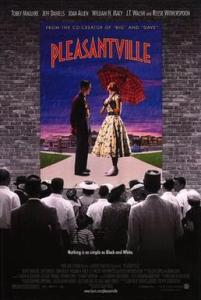
The last time I watched Pleasantville I didn’t have this blog running to discuss it.  It was also during the Obama administration where it felt more like nostalgia rather than a documentary.  In case you’re not familiar, Pleasantville is a movie about how a nerdy teen, David, and his cool sister Jennifer get sucked into a 1950’s sitcom, “Pleasantville.”  They find themselves in black-and-white and in a world as regimented as Stepford, but somewhat more humorously so.  As Jennifer is eager to get back home, she introduces this colorless world to sex, and as the two-dimensional characters begin to experience strong emotions colors start to appear.  The “picture perfect” Pleasantville begins to let the plastic facade of the 1950s slip to reveal a complex and messy world of true humanity beneath.

Watching the film in the age of Trump, as with most things, interjected a current of fear.  The townspeople feel threatened by those who are different, colorful.  They want everything just as it was—women serving their husbands, everyone the same hue, and pretending that sexuality doesn’t exist.  It may have been originally intended as an homage to the the 1960s, but what became clear in an age of MAGA is that crowds easily respond to suggestions of hatred.  Many of those in the group, individually, are “coloreds” themselves, but fear to let it show.  Conformity is much safer even if it means hating those who are different.  I wasn’t alive in the 1950s, but the superiority of the white man apparently was.  One of the characters is, tellingly, named Whitey.

Initially drawn to the film seeking biblical references (occupational hazard) I knew there was an Eden scene before I first watched it.  Margaret, on whom David has a crush, has discovered actual fruit at Lover’s Lane.  She brings him an apple which, the TV Repairman (if you’re lost, please watch the movie—it’s quite enjoyable) points out, is a form of sin in this world of simple answers and unspoken repression.  A mash-up of Jasper Fforde and American Graffiti, the film exposes the lie behind the idea that all were put on earth to serve the white man.  Jennifer discovers books and stays behind in colorized Pleasantville to go to college, something of a rarity in those days.  Although the movie bombed at the box office, it has a serious message to convey.  There was no perfect 1950s iconic America.  The process of becoming great is one of evolution, rather than that of a fabled Eden, available only in black-and-white.


Paying Troll

There was a time, should the media of my youth be believed, when a man insulted another man’s wife at his peril.  A barroom fight, or perhaps a sober brawl, would ensue.  Such chivalrous days are likely over and the internet makes nasty comments so easy to disseminate (how terribly masculine!) for all the world to see.  Hiding behind assumed names, avatars, or delusional fictions, you can feel like a big man by saying unkind things to a person you’ll never meet.  Such is the world of Trump’s America.  Although he may think himself divine, Trump didn’t invent Twitter or the internet.  Neither did Al Gore.  Still, the distasteful political rancor leading up to the midterm elections led to a man (I presume) trolling my wife behind a mask of Facebook anonymity.

It’s hard to tell how to react.  Feminism doesn’t always want a man to step in and defend, but we’re all raised with tales of princesses and those who honor them.  Having been raised by a woman with an absentee husband, I have nothing but admiration for strong women.  Although categorized as a “white man,” I can’t see my own brand as better than any other.  We are all human beings, and with some rare exceptions, we deserve respect.  Like all evolved creatures, however, I sometimes reach deeply back into my primate roots and the tropes of my childhood begin to simmer.  Who trolls another man’s wife over politics?  Who doesn’t stop to consider that every woman is a daughter and many are mothers and sisters?  If you want to pick on someone, well, you know how the saying goes.

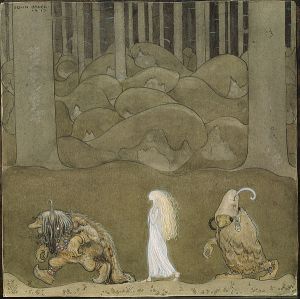
The midterm elections brought some much-needed balance to a government way off kilter.  There are still trolls under the bridges, however.  The storybooks tell how knights vanquish trolls and even the liberated male can’t help but imagine himself on that proud steed.  What kind of man takes a keyboarded cheap-shot at another man’s wife?  The quality of his discourse speaks volumes.  Those on the left believe in equality and can’t respond in kind.  It is, ironically, a far more biblical response than trolling on the right.

I’ve lost readers of this blog due to politics.  Some of my former readers have even told me so.  I appreciate their candor.  We can’t all agree, I know.  What we can do, however, is be civil.  Those who put themselves in elected office know that they are opening themselves to criticism.  It is very hard to slander a United States president, in the words of the Good Book, “how the mighty are fallen.”  Those with thin skin should think twice (or even once) before running for the most criticized office in the world.  Most, until now, knew that what they said would set the tone for the nation.  We’re all entitled to an opinion, and, for the time being, are free to express it.  Still, I’d think twice before insulting another man’s wife.  But then, I’ve always been a hopeless idealist.


Collinsport

Nothing is ever wasted.  That’s my economy of the soul.  I spent my tween years mooning about Maine.  I’d grown up watching Dark Shadows after school and I’d begun reading the pulp fiction based on the series by Marilyn Ross.  My mother wondered how I could waste my time on vampire nonsense when there was sun shining outside and other kids to play with.  Little did she know that I was learning valuable lessons for the future.  My fascination with Maine—still intact—led me to vacation there whenever possible and over my career I’d applied to more than one or two jobs there based primarily on the potential reward of living in the same state as Collinwood and its spooky mansion  atop the cliffs overlooking the stormy Atlantic.  Once some friends in Norwalk, Connecticut took us to see the  Lockwood–Mathews Mansion, used for Collinwood in the movie House of Dark Shadows.   Such is the draw of childhood imagination.

What were these lessons I’ve mentioned?  Well, Collinwood stands outside the quaint fishing village of Collinsport.  Both are named after the family that houses some very dark secrets, as well as shadows.  Barnabas Collins is a vampire.  He has run-ins with many supernatural creatures, including ghosts, witches, and a few Scooby-Doo kinds of cases where someone’s faking the paranormal.  But Barnabas isn’t the only monstrous Collins.  His cousin Quentin, whom I kind of remembered being his ally, was an unstable werewolf.   Of course, I’m not sure there is such  a thing as a stable werewolf, but still.  Those in the family stay loyal, despite the beasts that lurk within their walls.  Some of the early Collinses were involved in the slave trade.

The Collins family has a long association with the state of Maine.  During the groovy 1970s they seemed somewhat progressive while maintaining the aloofness of the aristocracy they’d become.  Despite Tim Burton’s spin on it, they were the undisputed lords of Collinsport.  You felt you could trust them.  Unelected though they were, they possessed an innate sense of social responsibility.  I also learned as a child that, as appealing and tortured as they might be, you could never really trust a Collins.  Barnabas was not evil, but he was a vampire.  He required blood to survive, and his victims, like those of the current Collins of Maine, Susan, were female.  Any girl who trusted a Collins was in danger, unless she was their willing servant.  I was not squandering my childhood afternoons.  I was learning lessons about trust and its costs.


Classic Education

A few months ago now, just after moving, our garage flooded.  Our books, unpacked, were stored there at the time, resulting in many casualties.  As I sorted through what was destroyed—a process still ongoing—I decided that if I replaced books I would re-read them as I did so.  Emily Brontë’s Wuthering Heights was the first replaced, and therefore re-read, volume.  For those who never had the opportunity to attend seminary, I would note that it is the ideal time for reading.  One of my professors, Harrell Beck, although he taught Old Testament, encouraged wide reading.  The Bible, he suggested, didn’t stop at the last verse of Revelation.  It was in seminary that I discovered the Brontë sisters and their remarkable literary achievements.

Wuthering Heights is fine autumnal literature and Heathcliff one of the greatest protagonist villains of literature.  An interloper among the privileged classes, Heathcliff finds delight in making others share in his suffering.  One of the more memorable characters is Joseph, the Bible-toting, Bible-quoting caretaker who sees nothing good in the younger generation.  Even Emily Brontë, the daughter of a clergyman herself, spies the hypocrisy so clear in the lives of literalists.  Joseph enjoys scolding as much as reading Scripture, and even the other servants find him tiresome.  Born in the year Frankenstein was published, Emily had Gothic sensibilities.  With the protracted death scenes and atmosphere  of loss and mourning, this classic can be a restorative in an era such as ours.  In more than one way.

Since Wuthering Heights is a classic, there’s no need to recount the story of lost love and damaged human beings.  What is important is to realize that we continue to support a social structure that repeats the sins of nineteenth-century England.  And like that setting, we do it firmly believing we are a “Christian” nation.  Joseph would surely nod in agreement.  Stripping the safety nets from the vulnerable so that the privileged classes might enjoy more of their ill-gotten gain, we live the hypocrisy of the self-righteous.  It the era of the Brontë sisters, women were not encouraged to write.  They, like the servants of the wealthy, were believed to exist for the comfort and pleasure of the master.  Not paying attention to the classics, we’ve come back to that era, claiming that wealthy white men are the true victims in all of this.  The denizens of the swamp will find their place in history next to Josef Stalin, Mao Zedong, and Benito Mussolini.  Wuthering Heights, like 1984, will, however, remain a classic that sees through hypocrisy.


IAGY?

Here’s how messed up “America first” is.  As we’re forced to try to protect ourselves from a drunken, sexually abusive Supreme Court nominee, Indonesia is trying to recover from an earthquake and tsunami that have killed at least 1,400 people.  Of course, it’s “America first.”  The powers that be want us to buy their narrative that we only are important, the chosen ones.  You don’t even have to be non-American to be excluded.  Just ask the people of Puerto Rico.  No, it is far more important to railroad through an anti-abortion judge so we can cause misery to countless numbers of people in America first.  Natural disasters strike even here (Florence), and we can only glance away a moment from the constant drama being roiled in that ever bubbling swamp.  I thought it was supposed to be drained by now.  They did find some slimy choices for high offices, in any case.

This new form of Manifest Destiny is as bad as the old one was.  People are suffering from a terrible tragedy and our lips are chapped from calling our senators to try to get them not to vote for someone a vast majority of normal citizens find highly objectionable.  The Republican abuse of power is only overshadowed by its abuse of women.  When even Kellyanne Conway speaks out stating that we need to listen to the victims, it’s clear something is amiss.  How slowly they awaken, these creatures of the swamp.  “America first” looked like a party game for a while, but now that its true and ugly agenda is being shown those who climbed aboard that bus aren’t quite sure how to signal that they want off.

What of Indonesia?  What of a president who can’t even point to it on a map?  It’s not here, so it’s not our problem.  Nice drunken frat boys who feel up women are the best we can offer for the highest court in the land.  Elsewhere in the world they’re trying to address the global warming that is causing more and more extreme weather.  We can charge tariffs and still call ourselves Republican.  If we can’t start actual wars we’ll start trade wars.  You can’t be great until others bow before you, even if they’re bowed in grief for a natural disaster that claimed hundreds of lives.  We’ll make America first even if we have to fall into last place to do it.


Come Salem Away

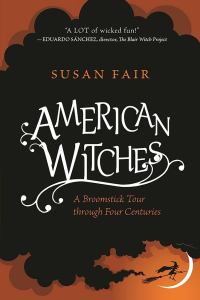
It’s the season.  Here in the fast waning days of September we can already taste October and thoughts turn toward ghosties and ghoulies and their kin.  Susan Fair’s American Witches: A Broomstick Tour through Four Centuries is, as any book in the nation of Salem, a mere skeleton crew of a long and feared tradition.  As is true of most things in the last two years, this book takes on a poignancy that was perhaps unintentional since it was written for fun.  It is a somewhat uncanny combination as it is—witch accusations often led to (and perhaps lead to, far from official eyes) someone dying.  We fear witches.  Fair reaches back pretty far, going even to the point of discussing those (generally women) hanged on ships on their way to America because their shipmates thought them witches.

Salem so dominates our witch consciousness that we sometimes forget these other episodes.  Fair explores, along with snarky asides, many early cases outside Salem.  In fact, the sad chapter in our history where hearsay became fact—one can’t help but think of “fake news”—the mass, “legal” murders carried out in Salem, is part of a larger pattern.  Not surprisingly women feature as the victims in this unholy web of fear and piety.  The combination is a dangerous one and otherwise rational people sanction evil rather than confront what is a mere perception of evil.  Fair moves on, however, to discuss other witchcraft scenarios—the witches (fortune tellers) of New York, the murder of a “witch” in Booger Hole, West Virginia (did I mention there was snark?), and the hex murder of York, Pennsylvania.  All of these represent an underlying fear that won’t go away.

This breezy tour ends near the author’s hometown outside Burkittsville, Maryland.  Although it is widely known that The Blair Witch Project was fiction from start to finish, this tiny town has been beset by those who refuse to accept that reality.  Such credulousness should stand as a warning to a country even capable of electing someone like Trump.  We are a suggestible nation with many people incapable of independent thought.  We are natural believers.  At the same time we’re a people that sees no value in studying religion even as it destroys us.  It’s like that embarrassing relative we never talk about.  But people still come to Burkittsville nevertheless.  Fair’s book was written before the election that showed who we really are.  Although the writing is charming, it’s hard to laugh about the subject these days.  We have forgotten Salem and all it taught us.


Riveting

The days of angry white men backlash are hopefully numbered.  One thing this strange phenomenon of privileged males feeling under threat has brought to the surface is the long struggle of women for the basic acknowledgment of human equality.  Ironically, it took a horrible war to move the cause forward.  Rosie the Riveter became a fixture during World War Two, blazing the message that women could do the tough jobs men had always done, now that males were off trying to kill one another overseas.  These images of Rosie have found new life in the era of Trumpism that has objectified women in the crudest possible ways, because it’s, well, monkey-see monkey-do in the world of politics.  Just consider Brett Kavanaugh and try to challenge the point.

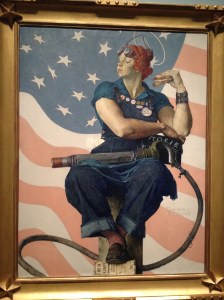
One of the more famous portraits of Rosie, back when Fascism was an evil thing, is that painted by Norman Rockwell.  A pugnacious Rosie eats her lunch with her feet on Main Kampf and her riveting gun in her lap.  (These days she would need to have her feet on an elephant rampant.)  Something about this painting always bothered me.  I could never put my finger on it.  It certainly wasn’t the confident look on Rosie’s face—she’d earned that and deserved it long before it became a reality.  Even the patriotism at that time was tasteful.  No, it was her posture.  There was something uncanny about it.  Then I learned that Rockwell had consciously copied Michelangelo’s Isaiah from the Sistine Chapel ceiling.

Isaiah, according to that famous rendition (Isaiah has never been a popular subject for paintings, for some reason), has his head turned at that peculiar angle because an angel is whispering in his ear.  Instead of a riveting gun, he’s packing a nascent Good Book, but he is receiving a direct message from on high.  I like to think it might be “The Spirit of the Lord is upon me, because he hath anointed me to preach the gospel to the poor; he hath sent me to heal the brokenhearted, to preach deliverance to the captives, and recovering of sight to the blind, to set at liberty them that are bruised, to preach the acceptable year of the Lord,” but then I’ve always been a dreamer.  Rosie, in Rockwell’s rendition, is prophetic.  She is proclaiming an equality which, inexplicably, coming up on a century later, is still unrealized.  Why?  The angry white man only recognizes God made in his own image.


Scriptural Slashers

Let me relish this a moment.

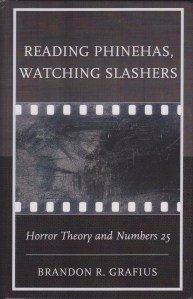
Thanks.  You still there?  It’s not too often, you see, that I get to feel like I’m near the front of the crowd.  I began writing Holy Horror when there were a small handful of books on the market concerning horror and the Bible.  I wasn’t aware of Brandon R. Grafius’ work at the time, but it sure is gratifying to see that others have noticed the connection.  Reading Phinehas, Watching Slashers: Horror Theory and Numbers 25 is pretty much what its title says.  I’ll be having more to say on it in a different venue—don’t worry, I’ll let you know—so I’ll keep to the basics here.  My spellcheck, and I’m sure not a few others, might have trouble identifying Phinehas.

In one of those weird, short, violent episodes for which the Good Book is justly famous, the story of Phinehas is clearly part of a larger, untold narrative.  Like the sons of the gods marrying the daughters of men in Genesis 6.  The grandson of Aaron, Phinehas was one of the hereditary priests of early Israel.  The Israelites wandering for their 40 years in the wilderness were nearly as xenophobic as the Trump Administration.  When one of the chosen people chose a foreign wife, Phinehas, full of zeal, grabbed a spear and skewered the couple.  Tradition says in flagrante delicto.  This act of violence stops a raging plague sent by the Almighty, so Phinehas looks like a hero in context.  If you want to read the story the subtitle tells you where to find it.  Or you could read Grafius’ excellent book.

Horror, which should be already obvious, enters the picture in the form of theory.  Yes, there is such a thing as horror theory.  Grafius uses it to analyze this story, along with other methods.  This is what I’m relishing.  I certainly wasn’t the first to notice the connection.  Many years ago Phyllis Trible wrote Texts of Terror, noting how the Bible seems less holy (my expression, not hers) when read from the perspective of a woman.  Indeed, many accounts that seem like standard issue narratives of God laying down the rules and humans disobeying tend to fall pretty heavily on females.  And the punishments used are fit for horror films.  Grafius focuses specifically on slashers, but one gets the sense that this book is just the start of something larger.  This reader, at least, hopes that is the case.


Pretty as a Prayerbook

Stolidity.  Canons all across this deck are known for it.  Visions of unchanging texts, however, tend to be false perceptions.  Even the canon of the Bible differs, depending on who you talk to.  So it is to be applauded, I suspect, that the Episcopal Church is planning to revise the Book of Common Prayer.  The last revision was 1979, and before that, 1928.  This schedule should be telling you something—the BCP, or simply “Prayerbook” as it’s commonly called, was never a changeless canon.  We mere mortals rely on experts to change the words by which the Almighty is approached, and although Episcopalians are thin on the ground in this country, world-wide they’re a formidable sect.  They’re united mainly by their commitment to the BCP.  And with good reason.

The days of the British Empire are long gone, but when it ruled the waves (and even before) this island state contributed a number of religious elements to the world.  The Prayerbook was born out of struggles with Rome for secular power disguised as sacred.  We try to live with a fiction of separation, but churches and states have always had mutual influence—just consider the way secular Trump has changed Christianity and you’ll see.  The BCP was to define English Christianity and in doing so became a Scripture in its own right (or rite).  Phrases from the Book of Common Prayer pepper the English language so as to rival the Good Book itself.  When church attendance was an expectation, you couldn’t help but internalize it.

A certain seminary, nameless here forevermore, will not be pleased with such change.  When I taught there many still clung to the 1928, claiming the church had erred (a strange position for someone in a voluntary organization and who vows to support its decisions) by adding “inclusive language” in the ’79.  This, they averred, was a man’s religion.  And they meant biological males.  Stolid.  Or perhaps stale.  Like the fiction of unchanging canons, the myth of the rational male hierarchy exists only to be exploded.  The two longest reigning British monarchs have been queens, after all.  World wars tend to be the legacy of male rulers.  So, although a tiny seminary in the woods of Wisconsin will likely rage, the BCP could use a bit of a makeover.  The world has changed substantially since the 1970s.  Mainline churches have been steadily shrinking and redefinition with a declining financial base makes good sense.  “This is another day, O Lord. I know not what it will bring forth, but make me ready, Lord, for whatever it may be.”  Even if it be changing canons.


Losing Ahab’s Head

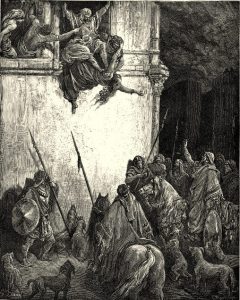
Call me Ishmael. There was a time when I heard about archaeological discoveries impacting the Bible soon after they were made. Now I have to wait until they appear in the paper, just like everybody else. When I saw a story asking if a recently found statue head might be that of Jezebel’s husband a number of things occurred to me. First of all, how cool is it that a king is referred to as the husband of a more famous wife? Well, I suppose Jezebel is infamous, but as the Washington Post article I read indicated, some biblical scholars are inclined to view her more sympathetically as a strong woman in a patriarchal morass. Seems like something we should be able to understand these days.

Another issue is that underlying bugbear of wanting to prove the Bible true. There is little doubt that Jezebel’s husband, a king by the name of Ahab, existed. Quite apart from the Bible he is historically attested—one of the earliest biblical characters to have received outside verification. If he actually struggled with a prophet named Elijah or not, we can’t know. In any case, the non-talking head of the statue looks like just any other pre-Roman guy with a crown. The article wistfully wishes the rest of the statue could be found, but one thing that we know from ancient iconography is that ancient figures, be they gods or heroes, are seldom inscribed. As I long ago argued about Asherah, without definitive iconic symbols to identify them, ancient images must remain ambiguous.

What would iconically identify good old Ahab? Certainly not a white whale—it’s far too early for that. He was represented in the book of Kings as the worst monarch Israel ever had. Politically, however, he seems to have been somewhat successful. Would he have been represented with the grapes of Naboth’s vineyard? Or, like a saint, holding the arrow that eventually slew him in his chariot? Ahab is a mystery to us. Unlike Melville’s version, he’s a man eclipsed by those in his life, notably the prophet Elijah and his wife Jezebel. Although the latter’s been baptized into the acceptable form Isabel, her name is synonymous with being a woman who knows what she wants. In the biblical world her main crime was being born into a family who worshipped Baal. The difference between her day and ours is that if a Republican president declared himself a Baal worshipper, evangelicals would cheer and joyfully follow along. Rachel, after all, cannot stop mourning her lost children.

The Republican National Convention?


What Lies Ahead

Things change. You’d think the fact that we all now carry the internet around in our pockets would’ve demonstrated that. What did President Nixon ever tweet? Conservatives, however, want it both ways. They want to pretend nothing has changed, but they still want to keep and reap the benefits of that change. This was shown most clearly by the ouster of Paige Patterson from his presidency of Southwestern Baptist Theological Seminary. Seminaries don’t make national news without a good scandal. (And some good scandals are never discovered.) This one involves demeaning statements made about women in Patterson’s long storm track through the Southern Baptist Convention, of which he was past president.

Journalists seem to only now be catching on to the fact that “conservative” is a codeword for misogyny. Thus it has always been. The fact that it would take nearly two millennia before women could take leadership roles in Christianity (and in some very large sects they still can’t) should’ve been a hint. It’s the old frog in the slowly heating kettle thing. Nobody notices until it’s too late. Since conservative Christianity has always downplayed the worth of women, it didn’t come to public notice until the #MeToo moment. Enough women had to speak up before society took notice of the obvious. Many men feel theologically entitled. Entitled to run things, and they live by the lie that things haven’t changed since Jesus strolled out of that garden tomb a couple thousand years ago. Well, apart from the fact that men no longer wear dresses and keep their hair short, in Roman style. But let’s not call it that, let’s say Evangelical style.

You see, the way you say things matters. Said a certain way, a misrepresentation of the truth is called a lie. It’s considered one of the greatest sins possible in the conservative lexicon. In another way, however, the same statement becomes doctrine, and that’s a whole different way of looking at things. Make it the fault of the Big Guy up there and the other big guys down here are off the hook. After all, the Almighty’s a bachelor. Such a theology has no possibility of treating women equally. Theologians say God is sexless. What’s that like? We have trouble imagining it. English has no neuter gender so we use the masculine pronoun and once we do thoughts go back to sexual features. It’s deeply ingrained. That doesn’t mean it’s the truth, however. After all, Mr. Patterson will still be kept on as theologian in residence. The more things change, the more they stay the same.