Christian Sister

Difficult to believe as it may be, some of the biggest superstars in America’s history have been clergy. The case has been firmly made that George Whitefield, the evangelist, was the first to hold “rock star” status in these United States. He drew stadium-sized crowds before there were stadiums and was, perhaps, the most famous man in the country. Fast forward a number of years and we find a name that may not ring so many bells today. Aimee Semple McPherson, however, was more famous than Hollywood actors and most political figures of her day. The founder of the Foursquare Gospel church was, in the roaring ‘20s, one of the most recognizable names in America. It may not count for much, but even in rural Pennsylvania we learned about her in American History class in high school four decades after her time.

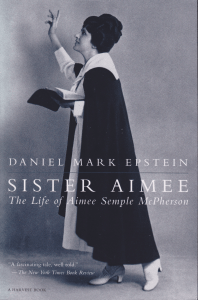
I read quite a lot about American religion, and Aimee Semple McPherson frequently comes up. I knew little about her, however, until reading Daniel Mark Epstein’s Sister Aimee: The Life of Aimee Semple McPherson. While it has its faults as a biography, it does convey a fair image of who this fascinating woman was. An evangelist when few women preachers existed, she was creative, crowd pleasing, and remarkably broad-minded for a Fundamentalist. Her personal life was full of drama—three marriages and at least one kidnapping episode—wealth, and want. She trusted Jesus implicitly and often suffered alone in silence. Secretly she befriended Charlie Chaplin, a man drawn to her stage presence but not her religion. It’s difficult not to like this woman who insisted on doing things her own way, and who ended up alienating her family (apart from her son) by doing so.

There can be no doubt that Aimee Semple McPherson believed what she said she did. Although she didn’t approve of theater she brought theatrics into church via her famous “illustrated sermons.” She pioneered radio evangelism, which subsequently grew into a hackneyed soapbox for lesser thinkers. She was a faith healer, a world traveler, and a woman who genuinely cared for the poor. Epstein’s book tells the story with heart and a touch of hagiography, but it is an entryway into one of the lives that shaped Jazz Age America, even if it is now largely forgotten behind flappers and Fitzgerald. It’s hard to believe that some of the most famous people in American history were religious leaders of their time, especially when we see what’s on offer in that arena today.


March On

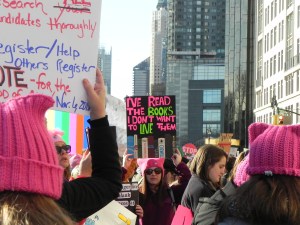
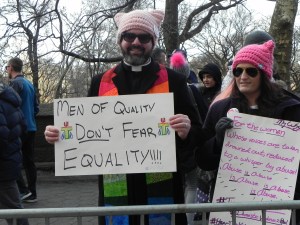
The day after the government shutdown, Women’s Marches were held across the country. Unlike the shutdown, these marches had been planned and anticipated in advance. They marked the anniversary of the Women’s March on Washington that spurred millions of people across the world into action just last year. I count it as a privilege to have been able to march with my sisters in DC last year, and yesterday again, in New York City. Religion gets a lot of bad press these days, but one of its truest aspects is that it invites you to participate in something greater than yourself. These marches are like that. They are all about social justice of the most basic kind. Not what divides us, but what brings us together. There may be historical reasons that women were kept from positions of leadership, but if we learn nothing from history’s mistakes we can call nothing we do progress.

It takes a lot to get me back to New York City when it’s not a work day. Nevertheless, the anticipation built along the way. Waiting for the train in Newark, we started to see pink hats at 8 a.m. on a Saturday. At Penn Station in New York they were everywhere. Strangers on the subway started conversations about the march, whether they were going or not. As usual, the program ran a little long and those who were near the stage grew impatient as they’d been on their feet for a couple of hours. Still, the messages were important to hear. Whoopi Goldberg was the star of the show this time, some might say, but all who stood up outside Central Park and gave voice to equality were stars.

The march itself lasted only a few blocks down Sixth Avenue, but the crowds were enormous. Although I held no clever sign, I knew that simply by being a body to march was significant. You see, the Women’s Movement isn’t about excluding anybody. It’s all about redressing institutionalized wrongs that insist “somebody else” is of less value than a white man who’s been able to exploit his way to the top. This system is corrupt and dehumanizing to all. Women see that. Woman say something about it. Women march. Yesterday thousands across the country marched for equal rights. Our government, controlled by one party—the white men’s party—couldn’t even figure out how to keep itself open. The differences between these two views of the world couldn’t be more obvious. I’m humbled and honored to be included on the women’s side.


All Is Calm

For those who prefer their solstice celebrations in Christian flavor, today’s Christmas Eve. As various denominations warn us to keep Christ in Christmas, secular NORAD provides a radar tracker to follow Santa through the skies. One hopes he’ll be cautious over North Korea this year. He may skip the White House altogether. And yet some will insist that there was no Christmas before Christ. But there was. Celebrations of the lengthening of the days began when humans reached temperate zones, at the very least. Prehistoric monuments throughout the British Isles were aligned with the sun’s position at solstices even before the Bible was scribbled on its first bit of parchment in warmer climes far away. We eagerly await the light.

Many religious traditions tell of that light within. Quakers, Unitarian Universalists, and some Asian religions focus on the divine spark, or secular light, within humankind. We are light-bearers, no matter what our religion. Back in my Nashotah House days, when Evening Prayer was a communal, daily expectation, the hymn Phos Hilaron, “gladsome light,” or, in the more liturgical mode, “O gracious light,” was the part that moved me most. We observe the coming of darkness with the hope that light might somehow continue. When days grow brief our hope grows fervent that the light will miraculously return. That it does so by the working of nature makes it no less of a wonder. We have been living in nighttime, and that light within us seems to flag at the persistent gloom. Then solstice. Christmas Eve captures that light in angelic voices.

Those who insist it’s all fake—the Tiny Tim crutch of feeble minds—need only look at NORAD today. The defense system built to keep the northern hemisphere safe from the endless winter of the nuclear species today shows a mythical object streaming across the stars with good will and cheer. Not just for Americans. Not just for Christians. Not just for true believers. No, Christmas Eve, the solstice, is for all people. Not just men. All people. Perhaps I’ve let my guard down just a little, and I’m letting my naiveté show just a bit much, but I do believe in that light. It may be that the tilt of the planet’s axis makes it inevitable, but a night when shepherds are startled and a woman brings hope to the entire world, we bask in what we deem a silent and holy night, knowing dawn will bring a longer day. And hopefully a world at peace.


Remembering Catherine

Literature has been on my mind lately. Although I’ve not read all of Charles Dickens’ oeuvre, he’s been in my consciousness what with the new movie and somewhat older book, The Man Who Invented Christmas. Those who analyze literature sometimes claim Dickens invented the modern novel. In my unprofessional opinion, however, the roots go back a bit further than Boz. Still, it’s an enviable position to hold, even if it’s just in the minds of admirers. Dickens came back to me yesterday in one of those apparently random emails from WikiTree. WikiTree is a genealogy website to which I’ve contributed from time to time. I have no famous ancestors, so WikiTree sometimes helps me borrow them. Turns out I’m 28-degrees separated from Charles Dickens.

Perhaps their algorithms are getting better, or perhaps one of their robots is reading my blog (goodness knows few actual people do!) but the connections are getting closer. I posted earlier that I’m 37-degrees separated from Bob Dylan and 43-degrees from J. R. R. Tolkien. I’m closer to Dickens than to either of these famous individuals. This is the beguiling aspect of genealogy—it shows how unexpected connections can be part of our unknown background. The maze back to Dickens is through my grandmother on the Tauberschmidt line. This is the one of the four grandparental lines for which I have the least information. Nobody in my family even knows my great-grandmother’s name. She died young and, as with women in that era, was known in census records only by her husband’s surname. I may never learn who she was.

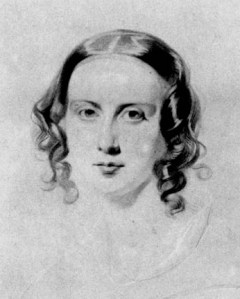
Although the reason for women changing surnames makes sense in its historical context, it is one of the great injustices of both gender equality and history. Signs are indicating that society is finally waking up on this point: women are half of the human story. As a dabbler in fiction writing, knowing that half the story is untold is a troubling phenomenon. Reading about Dickens I learned that he left the wife of his youth for a younger woman. Although such things are common, my reaction was to wonder who Catherine Thomson Hogarth might’ve become, had women had the opportunities they’re starting to have today. She was, after all, from Edinburgh. She has biographies, but not nearly as many as her feted husband. And if my math’s correct, I’m only 29-degrees separated from her. And this may well be the more important connection; the story untold.


Basic Catholic

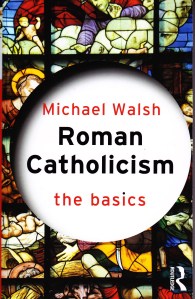
One thing upon which we all might agree is that we don’t have enough time. Publishers, eager to find an angle that will help them survive an age when we believe knowledge should be free, have shown a preference for short books. (An exception to this seems to be novels—consumers appear to like getting lost in a long story.) One result of this is the brief introduction format of book. That’s what Michael Walsh’s contribution to The Basics series is. Roman Catholicism is somewhat of a challenge to explain in less than 200 pages. You have to stick to, well, the basics. Having sojourned among the Episcopalians many a year, I felt that I had a fairly good grasp on Catholicism, but as I was reading it struck me that to really understand it, you have to be it.

One thing the Roman church has going for it is direct continuity. Making claims of having been there since the beginning, as an organization they have a leg up over other groups that boast more recent origins. We respect, or at least we tend to, organizations with such longevity. Tracing itself back to Saint Peter, the Catholics have continuity with spades. Or crosses. Of course, one of the things Walsh addresses is how change happens in such a long-lived group. Councils and synods, new scientific information and new Popes. Catholicism today isn’t the same as it was in Pete’s day. Walsh does a good job of guiding us through all that up to the time of Pope John Paul II, who, it turns out, raised global awareness of the papacy in the world as it existed then.

One thing we might agree upon is that Pope Francis has changed perceptions of what it means to be Catholic. The church remains mired in medieval thinking about matters such as gender and sexuality, but since this little book was published there have been steps forward. Even this popular pontiff, however, can’t change the decrees that went against the majority opinion regarding birth control, as Walsh somewhat guardedly notes. Or the ordination of women. He observes at the very beginning of his little book that Catholics know all about and deeply respect authority. This brief introduction helps to get a sense of how things ended up the way they are. We know that Pope Francis has started to speak out on such things, but men like to keep authority, as we all know. And even Popes have just so much time.


Wise Women

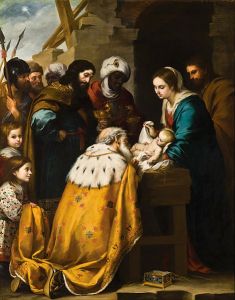
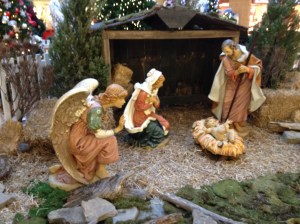
At a neighborhood holiday gathering the topic of a local living nativity came up. This year they need some wise men (don’t we all!) and some of the women mentioned that wise men should have beards. As the wearer of an old growth facial forest, I became the subject of a couple of queries—could you be a wise man? I replied that I wasn’t smart enough, but in the back of my mind I was attending the last church nativity play I’d been in. It was at the Church of the Advent, Boston’s high Episcopal establishment. I was cast as a centurion and was directed to deliver my lines woodenly. Being who I am, I did as I was told. I was invited to the cast party on Beacon Hill anyway. It was one of my few brushes with society folk in Boston.

Like many boys raised in church, I’d been cast in such plays before. One of three boys each born just one year apart, I was assigned the role of wise man along with my brothers. Far too young to grow a beard, I wore a costume made by my mother and carried a jar from a science experiment as a gift for baby Jesus. Being poor, we had no gold—or even frankincense or myrrh—lying around. In school we’d done this science project where a solution grew crystals up the inside of an ordinary coffee jar and out over the top. Stain it with food coloring and you have a gift fit for a king. So the illusion went.

The Christmas we celebrate today isn’t based too much on fact, but it is a prime occasion for plays. It’s a dramatic story, although the New Testament has to be bent and twisted to make it all fit into the comprehensive narrative of proselytizing playwrights. The king nobody recognizes being born in a barn. The creator of the universe being rejected by the very world for which he (the baby was always a boy) was responsible. The story is as timeless as Dickens’ Christmas Carol, and it’s enacted thousands of times each year in churches large and small across the country. Is there any reason that, as long as we’re straying into realms of imagination, the wise visitors shouldn’t be female? The ability to grow facial hair has little to do with any kind of intelligence. In fact, we’d be much better off right now with a woman in charge.


Astronomers and Pirates

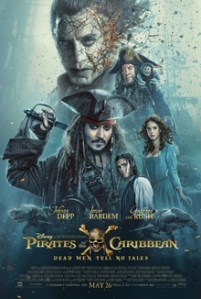
In an effort not to travel, the internet offers a great resource while it’s still free. If you don’t want to wander from home, it brings movies you might’ve missed right to your domicile. This year has been so busy that we’d missed completely Pirates of the Caribbean: Dead Men Tell No Tales. I know, as the Pirate movies spin on and on they become more special effects extravaganzas with insipid, if complex, plots. Still, we’ve been watching from the beginning, so last night we decided to see it through. The movies are fun, if less well written than they were at the beginning (and the movie began without a script). There are moments worth attention, however.

The story follows Carina Smyth as she attempts to discover her father through following his diary. This, of course, brings her path across that of Captain Jack Sparrow. Smyth is an astronomer and horologist. Because she’s female and this is the eighteenth century, she’s labeled a witch. Both the proximate and ultimate cause of the accusation is her gender. Although she proves to be the real hero of the film, the men can’t help thinking she’s a witch although she’s using science to find answers. In fact, if a male astronomer did the same things she did, there’d be no story here. This is a post-Galileo world. It’s also post-Salem. We don’t watch these films for history, of course, but it is true that although the witchcraft trials ended at the turn of that century, the accusations continued for some time after. The woman of science is a threat to the male establishment. She alone, however, discerns the truth.

Swashbuckler cinema was a male invention. Still, even in the twenty-first century too much of it comes at the expense of women. Jack Sparrow’s famous compass, for example, is passed on to him aboard a ship called the “Wicked Wench.” Surely this is meant to be funny, but at whose expense? The other women in the movie hardly come off better. Shansa actually is a witch, working for the establishment. Beatrice Kelly, in Jack Sparrow’s noose wedding, is portrayed as an undesirable bride, purely for laughs. Disney is famous for its princesses, but also for its wicked women. Even the strong female characters such as Mulan, Moana, and Anna find themselves being helped to success by male characters. Obviously the genders do interact in real life, and as recent history has shown us, men will demonize women if it helps them get ahead. You might think a movie of anti-heroes, however, would show the most intelligent character receiving a bit more respect. Especially since she’s a woman in a pirate’s world.


Autumnal Ashes

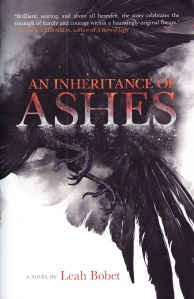
I once told someone that a book I was reading was a “good autumn book.” The friend looked at me quizzically and asked what I meant. Seasons have a feel to them, even as books do. When the days grow shorter and the chill seeps in through the storm windows, I start looking for a book that matches the mood of a year that’s dying beautifully. So it was I came upon An Inheritance of Ashes by Leah Bobet. While I like Amazon just fine, the magic of the brick-and-mortar bookstore is finding that book face out that you’d otherwise never have seen. I read a lot of fiction—more than I post about on this blog—and a great deal of it come from the unexpected find in the local indy.

The story’s difficult to classify. Set in a future that sounds quite a lot like post-Civil War days, two sisters, Marthe and Hallie, try to keep a living at Roadstead Farm. The last of the soldiers have made their way back from the war where the Wicked God was killed. We never see the Wicked God clearly. He’s from a parallel world and is championed by his prophet. The death of the Wicked God was largely thought to be the end of the war. The passage between worlds, however, isn’t as secure as they armies thought. Religion doesn’t play a strong role here, but it was the cause of the war that has devastated the nation.

Fictional worlds require believers. Stories need not be religious to include religion. Without it, many tales lack verisimilitude. People are religious creatures by nature. Belief drives us, whether secular or sacred. This novel about a family trying to pull together in the aftermath of an evil god’s death. There’s a purgatory here from which those who believe can be rescued. And Hallie, who believes, ends up saving her own entire world. Religious? Not really, but it is all about belief. We need books that encourage faith in dark times. Indeed, An Inheritance of Ashes is about a dark period of uncertainty. What used to be true is open to question in these days when one belief system is determined to wipe out all others for good. Not so much live and let live as it is give and not give back. Ashes, whether literal as in Bobet’s world, or figurative as in our own, are appropriate reflections as the year begins to die.


Christian Story

The problem with the Bible is anybody can “interpret” it. As a book of unrivaled status in the American imagination, it can be tapped for anything from advertising to justifying pedophilia. So when stories of Roy Moore’s sexual dalliances with minors emerged, Alabama’s state auditor, Jim Zeigler drew the comparison with Mary and Joseph from his half-hearted knowledge of the Bible. There is no auditor for Bible interpretations. It’s the ultimate free market. Many, including evangelical clergy, were quick to jump on the inappropriateness of the analogy. What they didn’t see is that the Bible can justify just about anything. Despite what it says. That’s the problem with worshipping a holy book.

What the Good Book says about Mary and Joseph is very, very little. We do not know their ages—they are never mentioned in the Bible. The tradition about Joseph being older seems to go back to having to explain his continence to preserve Mary’s perpetual virginity—also not in the Bible. The church, in the early days, had issues with ideas such as “original sin.” When Augustine suggested it passed, along with bodily fluids, during sex, it became clear that Mary could have none of that. Even if she was a virgin by misquoting Isaiah, then she still had original sin from her parents. So Mary had to have been immaculately conceived. The Bible, of course, knows of none of this. Anybody can interpret it. And what senator-to-be wants to be bothered with consulting a Bible scholar? They’re hard to find. And besides, they might not interpret it the way you want it.

GOPolitics have sunk so low as to pressgang the Bible into justifying pedophilia. What’s more, the faithful don’t seem to mind. The Bible’s big enough that you can find just about anything in there. Except morality, apparently. You’d think that anyone running for public office would examine his—and it’s usually a guy problem—life pretty closely for possible scandals. We’ve lived to see the radical right, diligently groomed and oh-so-righteous, go after anyone who can spout insanity and be counted on to vote against women’s rights. You can be sure Roy Moore will be forgiven—already has been by many—because the Bible swings that way. We’ve already seen what happens when people like Moore take public office. They make America grope again. For the Bible tells them so.


Imagine Devils

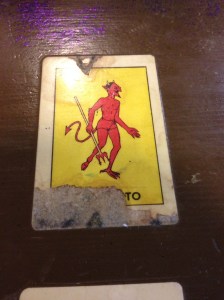
One of the more encouraging events of recent times took place on Tuesday. In elections across the country many public offices were won by women. After a year of official misogyny from the Comrade in Chief—it started long before the election, of course—I felt hope for the first time. You see, I’d been reading Carol F. Karlsen’s The Devil in the Shape of a Woman: Witchcraft in Colonial New England. I’ve been interested in witches as part of my general exploration of religious views of monstrosity, and in the Early Modern Period, witches were still lurking in the imagination of many. Karlsen’s book isn’t focused solely on Salem. There were other outbreaks of witchcraft accusations, and a general air of suspicion had hung over New England from its founding.

Why women? Karlsen’s question haunts much of human history. Why one gender, or gender construct, why one race, or racial construct, feels itself superior to others is an issue not easily resolved. It doesn’t come, necessarily, from being a “white” male, but it is a disease that primarily effects that demographic. It’s a myth of superiority. The Devil in the Shape of a Woman is not an easy book for a man to read. Centuries of bad behavior don’t exonerate those who, although their belief was sincere, found an outlet for their faith in the destruction of others. Karlsen demonstrates that quite often the background issues were those of inheritance—in a patriarchal society, land passed to male heirs. Women who owned property complicated a social picture that was already under stress. Consider: any family with two sons would halve (although the proportions were not equal) its land each generation. The only way to keep the wealthy wealthy was to snatch land wherever they could.

It wasn’t so simple as that, but the basic economics—which haven’t changed much—set colonial New England up for disaster. Birth control was considered evil. Men still had to be gratified, however, and population increased as land size remained the same. The system is untenable. Just a year ago the electoral college made love to an angry white man. A man who “owns” lots of “valuable” property. A man who demeans women and those of other “races.” When his own shady dealing come into the light he cries “witch hunt!” History is full of ironies. One of the greatest of them in the fact that women have been held back long after circumstances had advanced enough to allow equality in a stable society. There may still be witch hunts, but they flow in the direction they always have—toward those denied autonomy and civil rights. Maybe Tuesday was finally a sign of hope.


Digging Even Deeper

What does it mean to exist for someone else? Isn’t this the very definition of slavery? Yes, we may voluntarily give ourselves to someone for the sake of love, but woe to the person who thinks he owns his spouse. Human beings may be an acquisitive lot, but that doesn’t excuse it. To be civilized, after all, means to be more advanced than we are by nature. These thoughts follow on hearing one of my colleagues interviewed on Game Plan on Bloomberg. In the light of the Harvey Weinstein scandal, Francesca Levy and Rebecca Greenfield are interviewing people in different professions to see what inappropriate treatment women receive at the behest of men. Their job is, unfortunately, not one where it’s difficult to find examples. In this particular case, they interview Beth Alpert Nakhai of the University of Arizona. Dr. Nakhai is an archaeologist and she describes the perils faced by women in the field.

In 1987 I volunteered on the dig at Tel Dor in Israel. I had just graduated from seminary, didn’t have a job, and was pretty sure I’d be going on to graduate school. Tel Dor, like many digs, had different loci excavated by different university teams. I was on the Boston University area, B1, next to the section being worked by one of the universities in California. At one point one of the seasoned men—I can’t remember who—remarked to me that digs in Israel were great because of the three A’s: “alcohol, adultery, and archaeology; in that order.” It was intended as a joke, but it had that time-worn feel of a sentiment that’s been around for a while. At the time I thought little of it. I was there only for the last A, and, had circumstances been different, I might’ve made that my career choice.

Listening to Beth’s interview, however, showed me the darker side of careless remarks like this. Archaeologists often work in remote locations where local laws treat women differently than men. University professors have great power over graduate students and are able to make or break careers. Often married men leave their families in safe locations while they spend their summers directing teams that include female students and other volunteers. I’d never thought of the experience from that angle before. As a man I didn’t have to worry about anyone coercing me into an unwanted physical relationship far from prying eyes or legal systems which, at least in theory, protect women. The truly sad thing about all this is that forces are, especially now, at work to make women victims again even in this country. The point of archaeology is to try to understand civilization writ large. And yet, civilization in the advanced world is now moving backward. How long before we too are buried under a pile of shiftless dust waiting to be discovered by some future excavators whom we can only hope are more advanced than we are?


Justice for All

One of the perks of working for a publisher is author talks. I’ve worked for three publishers now, and the last two have made great efforts to bring authors to their New York offices to present their work, in a kind of dry run, to those in the industry. When an author (whose book will eventually feature on this blog, so I don’t want to provide any spoilers just yet) was to speak on misogyny this week, I quickly signed up for a seat. Perhaps it’s a lack of imagination, but I could never understand how one human being could ever feel superior to another. As a child with no father around, my experience suggested that women were the strong ones. Yet when out in society I saw men always stepping in to take charge. What was wrong here?

I realize that I view life through male lenses. I’m also aware that gender isn’t nearly as definitive as we tend to think it is. Biology fits us with bits and pieces, and some of those constructed somewhat like me assume this gives them the right to dominate others. And they say we’re better than animals. Better at what, I ask? No, this isn’t about chauvinism—a man stepping in to support weaker women. This is about justice, plain and simple. We’re all born human. Humanity is nothing without those of both genders as well as those somewhere between. What should separate humankind from the vicissitudes of nature is the inherent commitment to fairness. Life is harsh and not all receive fair treatment. Do not listen to the narrative coming out of Washington, DC! The father of lies dwells there. And yes, I mean “father.”

We used to take pride in having climbed above the mere animals. We have constructed something that used to be known as democracy. Lawmakers, while fighting against women’s rights in word, nevertheless tacitly supported them at home. Now our government has declared open war on women. Men who have no idea what it is like to be viewed as and treated like an object every single day of their lives are making laws to punish those who do. I feel as though the sky is about to crack open and that blind principle we call justice is about to shout “Enough!” That’s not, however, the way that nature works. It is only when women are treated equally with men that we’ll ever be able to call ourselves civilized. Or even human. Until that day we’ll hunker down in our caves and await lawmakers who have any inkling at all of what fairness, what justice, even means.


Gendered Lupines

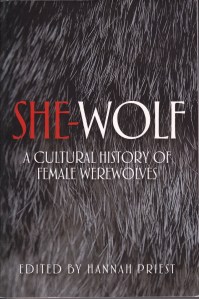
No doubt an excuse isn’t required for reading about werewolves this time of year. Something about October encourages that sort of thing. Hannah Priest edited a collection of essays from various scholars titled She-Wolf: A Cultural History of Female Werewolves. As is to be expected among academics, there are several interpretations wrapped together here and the book covers female werewolves from the Middle Ages—where they are sometimes associated with witches—up through modern cinema. A number of literary sources and a few television representations, and even an RPG, are also part of the mix. The problem with multi-contributor books is that it’s difficult to draw any overarching conclusions, but some observations do come up repeatedly here, and they are worth pondering.

The connection of the female with the animal nature of human beings is stressed for the female werewolf. As might be expected in a patriarchal culture that is becoming more so daily, this is considered an aspect of inferiority. The connection between lunar cycles and werewolves as an inherent feminization of the monster is also brought up more than once. The bodily transformations of puberty also play a role. What we can clearly see amid all of this is that although male werewolves outnumber females in literature and film, and, with a few exceptions, in folklore, the very nature of the werewolf is coded as feminine. This is something that isn’t obvious until a book like this points it out.

Given my own idiosyncratic interests, I was surprised how much religion came into the discussion. Among classic monsters, werewolves tend toward the secular end of the spectrum. There was, however, from the Medieval Period up through early modernity, an ecclesiastical fascination with werewolves. This fascination often came in the form of recriminations against women—attempts to subject them to the wills of men. The church often blamed werewolves on women out of the control of menfolk. And of course, you may kill a monster with no need to feel guilt. More modern views of female werewolves—particularly in movies—are more, well, humanizing. Recognizing that wildness is part of being an evolved animal means that we’re more sympathetic (or had been until November of last year) to the woman who is able to let go of convention and become truly liberated. Now that we experience the poignant lengthening of nights that stir our primal fears, werewolves come naturally to mind. If only we could learn what they have to teach, we might all howl at the harvest moon.


Zounds Like

Liberation from the confines of academia allows for the occasional indulgence in taboo subjects. I can’t remember when I first heard of stigmata. I didn’t grow up Catholic, and, like many Protestants, distrusted much of what came from Rome. Still, I was interested in the supernatural. When I learned that people in this modern day and age sometimes developed unexplained wounds corresponding to crucifixion, I was intrigued. Ted Harrison’s book, Stigmata: A Medieval Mystery in a Modern Age, is the first I’ve actually read on the subject. It has some fascinating observations to share. It was some time after seminary that I learned that Francis of Assisi (aka St. Francis) was the first stigmatic. I had admired Francis for turning down wealth to assist the poor and commune with nature—what’s not to like?—but I didn’t realize that he had initiated this rare, but real phenomenon.

Harrison considers the question of why it was only in the 13th century that the stigmata began to occur. They have occurred ever since, in very small numbers, primarily in Italy and primarily among women. But why then? He points out that the church, shortly before this time, began to emphasize the physical suffering of Jesus on the cross. We’re probably all familiar with some of the gruesome images that emerged from the church and its artists at that time. As such images proliferated, people were given a visual focus that directed their devotions. Every great once in a while, this led to stigmata. Why women? As Harrison points out, men with intense spiritual needs could become priests. Women could not. The church would not forbid personal devotion, and if such devotion led to stigmata, well, a person arguably had a direct line to the divine. That was something normally preserved for priests through the Eucharist.

Stigmata have to be understood in the context of mysticism. The more recent cases studied by Harrison include some non-Catholics and some other unexpected candidates for what is, after all, a very intense spiritual experience. What emerges is a thoughtful, one might dare say contemplative, approach to the issue. Some stigmata have been self-inflicted. Some have not. Medical personnel have witnessed and examined these improbable wounds and have not explained them away. Once, during a faculty meeting at the New College of Edinburgh University (I was post-graduate student representative) one faculty member groused after one of my advisors had presented a challenging idea: “you’ve dropped us in a mythological world. I want to get us out.” There it is in a nutshell. Some people can live in a world where stigmata occur. Others have to explain it away. The difference is all in the matter of perspective.


The Way

Part of the problem is that I’ve never been fortunate enough to learn Chinese. You see, scholars of religion are often insistent on reading scriptures in their original languages. It has been a long time since I’ve picked up the Daodejing, one of the formative scriptures of Daoism, and I was struck by a number of things. First (and I have the confirmation of Sinologists on this), the Daodejing is difficult to understand. This isn’t just a translation issue. Nor is it an issue of Chinese thinking. All world scriptures are difficult to understand. One of the major problems with the Bible is that it has been translated into English for so long that many assume the language concerns are negligible. They’re not. The Bible has many obscure parts. Also it’s worth noting that the Daodejing has been translated nearly as much as, if not more than, the Bible. It is a very influential text, in part, I’m sure, because it’s not easy to understand.

Paradox isn’t within the comfort zone of many western religions. We like our belief structure to be (mostly) rational and believable. In fact, to start an argument just point out the fact that the Bible has contradictions. (It does, for the record.) The point being that a westerner will want to believe it is consistent and coherent throughout. If they can’t have that in English then they’ll say it’s inerrant in the original languages (it’s not). Religions shouldn’t make your brain hurt. Paradoxes, however, require deep thought. They can’t be read quickly to be stored away as factual information. They do, however, constitute a large part of life. Look at Washington and meditate. Daoism, the religion that generally follows the teachings of Lao Tzu (the putative author of the Daodejing), finds truth in contemplating opposites which are both simultaneously true. And not true. Interestingly, many of the sayings in the Daodejing are similar to ideas attributed to Jesus in the New Testament.

Dao is often translated “way.” One of the striking things about Edmund Ryden’s translation is his choice to use the feminine pronoun for “the way.” This is motivated, as I read it, out of concern to do justice to the presentation of the dao in the Daodejing itself. While the dao is not god, nor personal, it is powerful. The recognition of feminine power is clear in many aspects of the Daodejing. That’s not to say that the culture wasn’t patriarchal, but merely that it recognized balance—the famous yin and yang—as being inherent in the way the universe works. If such an idea could truly take hold the world might be a better place even today.