Finding Fossils

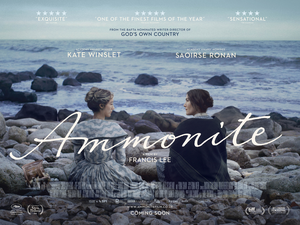
Mary Anning was a real woman.  She made valuable contributions to paleontology in the first half of the nineteenth century, although she wasn’t always credited for her work.  The movie Ammonite is a fictionalized account of her life at Lyme Regis, where she lived and discovered dinosaur fossils.  Being fiction, the movie focuses on how Mary “came out of her shell” by entering into a relationship with Charlotte Murchison (also an historical person, wife of the Scottish geologist Sir Roderick Impey Murchison) who was left in her care when she came down with a fever after trying to recover from melancholy by taking the sea air.  Mary had established a life of independence and wasn’t really seeking relationships; her mother still lived with her and, according to the movie, they had a distant but loving regard for each other.

I was anxious to see the film because it is sometimes classified as dark academia.  Since I’m trying to sharpen my sense of what that might mean, it’s helpful to watch what others think fits.  The academia part here comes from the intellectual pursuits of Anning and the academic nature of museum life (one of her fossils was displayed at the British Museum).  Anning, who had no formal academic training, tried to make a living in a “man’s world,” and in real life she did contribute significantly to paleontology.  The dark part seems to come in from her exclusion from the scientific community, and perhaps in her love for Charlotte, a forbidden relationship in that benighted time.  Of course, this relationship is entirely speculative.

Fictional movies made about factual people make me curious about the lives of those deemed movie-worthy.  Ammonite is a gentle movie and one which raises the question of why women were excluded from science for so long.  No records exist that address her sexuality—not surprisingly, since she lived during a period when such things weren’t discussed.  Indeed, she didn’t receive the acclaim that she might have, had she lived in the period of Jurassic Park.  She was noticed by Charles Dickens, who included a piece on her in his magazine All the Year Round, in 1865, several years after her death.  These days she is acknowledged and commemorated.  This movie is one such commemoration, although much of it likely never happened.  As with art house movies such as this, nonfiction isn’t to be assumed.  Nevertheless, it might still be dark academia.


Peace

Mother’s Day should be a time for peace.  In these days when misogyny is in style, it’s an especially important holiday.  The one holiday to explicitly honor women, it’s always been an occasion for reflection for me.  We have 364 days of warring and hatred, and one dedicated to the givers of unconditional love.  I can imagine a different world.  One in which women don’t have to become alt-right to gain positions of authority.  Where compassion and humane treatment would be world priorities.  I can imagine.  Although fathers are necessary too, we have no shortage of men pushing forward their personal agendas.  None of them would be where they are without mothers.  And women are the ones who give us care.  I can imagine a world where Mother’s Day wouldn’t have to feel so politicized, almost polemical.

With all eyes on Pope Leo, I can’t help but think how many treat Mother’s Day like an indulgence.  You know you want to get back to your vices, so why not pay for them in advance?  Celebrate mothers today so we can get back to business as usual tomorrow.  I don’t believe that we’ve lost the ability for transformation.  We can make the world a better place.  Think what it would be like if, before undertaking some cruel action, a person stopped to imagine their mother watching them do it.  Would not the world start to improve?  It is a world where we seem to prefer guns to roses, but it’s also a world with an unwritten future.  Pay attention to your mother.  Maybe things will start to get better.

I believe in the transformative potential of holidays.  We have to take their lessons seriously.  I’m sure I’m not the only working stiff who lives life anticipating the next holiday when things might change for the better.  We have to remember, however, what the holidays teach us.  Not treat them as simply facile days of obligation.  Think of Mom and then get back to the grind.  It doesn’t need to be a grind.  We can learn to cooperate and get along, just like Mom told us to.  Instead of isolating such thoughts to a single day, we could repeat them like a mantra.  I don’t know about you, but looking at the headlines, I could do with a bit of peace and love.  And I still believe that things can, and likely will get better.  And I give the credit to our mothers.


Shadow off Campus

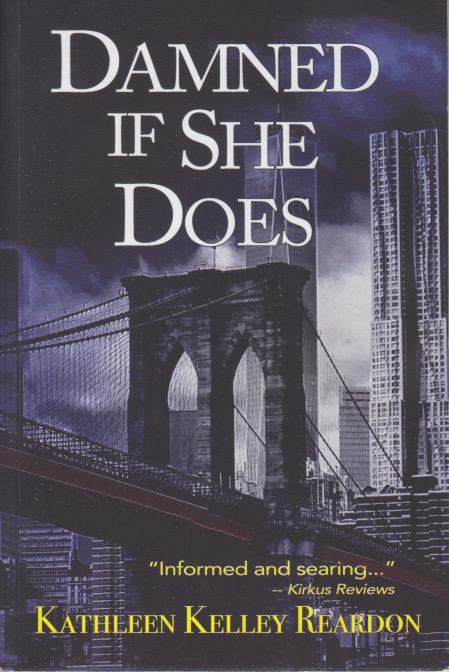
I’ve been to quite a few academic conferences in my life.  Some have been held in neighborhoods declared “unsafe.”  I even had a job interview in a hotel room (such can’t happen now) with a college that didn’t want to pay the fee for using the society’s services.  (A friend who’d also interviewed with the same school said to me afterwards, “I thought they were going to jump me!”)  (Neither one of us got the job.)  I even went to a conference where I had to drive through a crime-ridden neighborhood to get to an off-site hotel.  But I’ve never been to a conference where someone was murdered.  That’s the premise behind Kathleen Kelley Reardon’s Damned If She Does.  Reardon’s keenly aware of the kinds of issues women face in the professorate.  There are some unsavory guys in the profession and power is very difficult to wrest from those who hold it (generally white men).  In this follow-up to Shadow Campus, she tells Meg and Shamus Doherty’s experience with murder, and more, at an academic conference.

Academics are so necessary for studying things closely, opening up true understanding.  They are, however, people too.  And people can be petty, vindictive, and selfish.  They’re usually not inclined to murder, however.  I’ve been meaning to read that book about the murder of a religion professor at the University of Chicago several years ago precisely because such things are so unusual.  In dark academia, however, events like that are fairly common.  The thing is, many academics are also quite smart.  If someone were to put their mind to an undetectable murder, hmm.  The old gray matter starts churning.

In Damned If She Does, the apparent motive is publication in prestige journals.  In the end, it turns out that there’s more to it than that, but it’s somehow believable that a matter like publication could lead to homicide in academia.  As an editor, and writer, myself, I know how important publication with specific presses can be.  Even after doing this for over thirty years, an acceptance notice creates a sense of validation like no other.  Dark academia explores such territory.  I suspect that I’ve always been a bit naive when I’ve attended conferences.  I go, present papers, and keep interactions, well, academic.  I’ve heard whispers of them being places of temporary flings and I’ve seen colleagues use them as places to party.  On occasion I’ve seen established scholars very inebriated.  They’re people too, of course.  And as long as nobody is murdered, the code seems to be that what happens at a conference stays at the conference.


Horror Adjacent

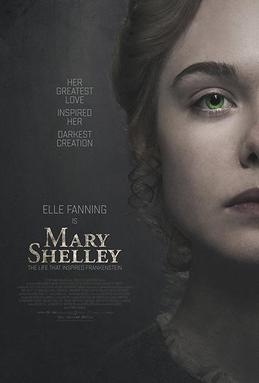
We have the basic facts, but still, it takes a good bit of imagination.  We simply don’t know what the life of Mary Shelley was like, as experienced by the woman herself.  The movie Mary Shelley isn’t a horror film but it’s horror adjacent.  How could a movie about the woman who invented Frankenstein be anything but?  The handling of Haifaa al-Mansour’s film is generally as a drama, or a romance.  The story takes the angle that it was her stormy relationship with both Percy Shelley and her own father that led Mary to express her feelings of abandonment in her novel.  And while we have to acknowledge the liberties all movie-makers take, it does seem interested in keeping fairly near the known details of Mary Shelley’s life.  Although other women were also writing then, it was still a “man’s world” she tried to break into.

I confess that one of my reasons for wanting to see this film was that Ken Russell’s Gothic had a powerful impact on my younger mind.  That movie, which is over-the-top, being the first I’d seen telling the tale, had become canonical in my mind.  I know the dangers of literalism, and I wanted to see someone else’s take on the story.  Al-Mansour’s treatment takes a female perspective to the narrative.  It seems that Percy Shelley and Lord Byron were both advocates of what might now be termed a playboy lifestyle, and that Mary, daughter of forward thinking Mary Wollstonecraft and William Godwin, was fairly liberal herself.  Although Percy Shelley, like Lord Byron, was quite famous in his time, that didn’t always equate to financial solvency.  I could relate to parts of that quite well—full of creative ideas and shy on cash flow.

Mary Shelley didn’t rock the critics, but many felt it was a thoughtful treatment.  It is dark and gothic, but with no real monsters.  It did explain a bit of inside baseball about Ken Russell’s film.  Both movies make use of Henry Fuseli’s painting The Nightmare to explore the famous meeting of Byron and the Shelleys that led to the writing of Frankenstein.  Indeed, Gothic makes a good deal of it.  Mary Shelley explains that Mary’s mother, Mary Wollstonecraft, had an affair with Fuseli.  I was unaware of that connection.  Something was clearly circulating among the Romantics, many of whom knew each other and, in their own ways, became formative of culture centuries down the road.  And although many critics weren’t impressed, I think it’s about time that a woman’s point of view was brought to Mary Shelley’s life in a world not kind to women.  Even if a woman gave the world one of the most influential books of the nineteenth century.


Around Us

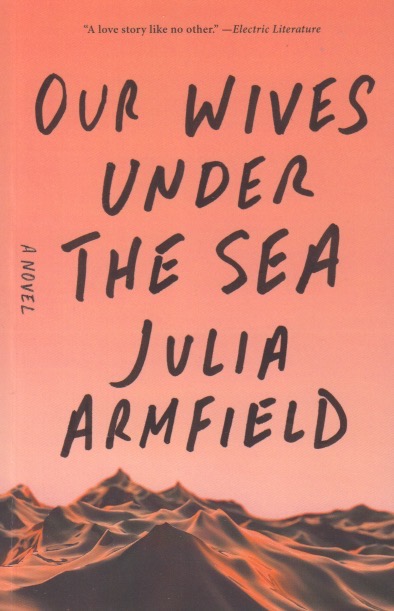
Our Wives Under the Sea is a gentle, but chilling horror story by Julia Armfield.  Two women are married and one of them is a marine biologist being sent on a submarine to explore deep ocean life.  A planned three-week voyage becomes six months and when the sub finally surfaces again, Leah, the biologist, has “come back wrong.”  She’s transforming.  Something happened to her under all that water.  Told alternately by Leah and Miri, the story is one of loss and mourning and lack of any reasonable explanation.  Haunting, in a word.  The writing is exceptional.  And probing.  I quite enjoyed this book.  I can’t recall how I first heard about it—it was published in 2022—but I knew I wanted to read it even then.  The sea is that way.  Moby-Dick, cited in an epigraph, has always been my favorite novel.  One of my early reading memories is Rachel Carson’s The Sea Around Us (also cited here).  The story is a winner.

There’s something about the ocean.  We, in reality, know little about it.  Penetrating the crushing depths requires a well-funded science, something we’ve moved away from in favor of personal greed.  Life takes unexpected forms deep under the surface, even as we deplete the resources we can reach—over-fishing and consuming.  We’re never told what it is Leah and her crew-mate see so far down.  We all know of lantern-fish (lately in the news) and other sub-surface terrors.  We don’t know the potential life we might discover if we only cared to look.  The company that sent Leah down, however, is as shadowy as the government.  Promising help but not answering the phone when you call.  Yes, this is a haunting book.

Mostly, however, at least in my reading, it is about coping.  We attach our lives to others and when something changes them we have to try to adjust, because love is that way.  Caregivers understand.  The novel evokes both the endless draw of the ocean and its mystery.  Even as a child I wanted to live on the stormy east coast, preferably in Maine.  I wanted to be near the water.  As my mother was in her final decline, one of her dearest wishes was to return to the ocean.  She’d spent a fair bit of her childhood in New Jersey and always felt the draw of the sea.  She was no swimmer, but just being near the ocean was something she loved.  And that has passed down, it seems, to my generation.  Fearful yet drawn.  It is the dilemma that can lead to effective horror stories that make you both think and feel.


Dark Smile

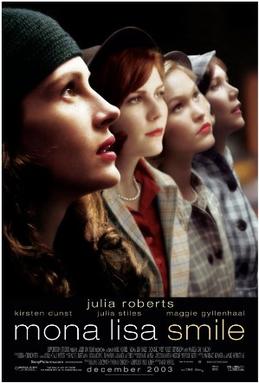
Romance.  It’s not the same thing as Romanticism, but it’s often part of drama.  It can, and often does, feature in horror.  Tender feelings toward someone we really love seem to be a human universal, even if social structures don’t always support such feelings.  Maybe I’m trying to make excuses for why I watched Mona Lisa Smile, but there is an underlying reason.  More than one expert considers it an example of dark academia.  I was curious, and honestly, it’s easier to get my wife to watch dark academia than it is horror (for that I’m on my own).  This was a film I’d heard about many times, but hadn’t watched any trailers for, so I wondered what it was all about.  In short, Wellesley.  One of the seven sisters.  But more than that—women struggling for equality in the 1950s.

A fictional Katherine Ann Watson takes up a post teaching art history at Wellesley, back in the day when a doctorate wasn’t required.  In order to demonstrate her expertise to her very well prepared students (I never, in nearly 20 years teaching, had students show that level of eagerness for any subject) she introduces them to modern art.  Traditional Wellesley isn’t prepared for that.  Moreover, she encourages them to develop careers of their own in a period when the MRS degree was still a main reason for women to attend college.  Watson’s own life isn’t without romance; a boyfriend back home in California and another professor at Wellesley both vie for her affections.  Some powerful students, however, make her life difficult and despite her popularity as a teacher, the administration allows her to remain, but with severely clipped wings.  She decides to fly instead.

Amid all the social commentary, a darkness remains.  A large part of it is patriarchy, but academic politics—driven by money—is the main culprit.  As Watson is essentially forced out, her students see her off with a display of camaraderie, making this, in some ways, quite similar to Dead Poets Society.  There were a few triggers for me.  Years ago I was indeed called into the Dean’s office and handed a letter to read.  While not nearly as dramatic as either Dead Poets Society or Mona Lisa Smile, I had students demonstrate their support for me as I was forced out.  Katherine Ann Watson seems to have had better prospects than John Keating, but both movies remind us that academic politics are dark indeed.  Even if it’s couched in the genre of romance.


Unholy Conception

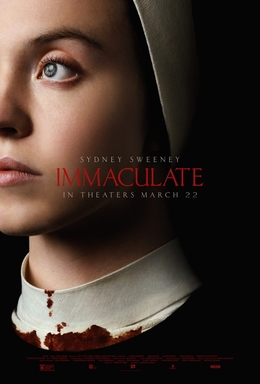
Religious horror is difficult to get right.  Immaculate received reasonably positive reviews, and did well enough at the box office.  Its message of women being forced into reproductive roles unwillingly is certainly timely.  Viewers with religious training, as well as experience viewing quite a lot of horror, might be less impressed.  The basic premise isn’t bad: a convent in Italy, which has one of the nails from Jesus’ crucifixion, is using the biological material on the nail to genetically engineer a new messiah.  The movie follows the novice/nun Sister Cecilia, a virgin, as she joins the convent and discovers that she’s pregnant.  The entire community—apart from a jealous nun and a friend trying to warn Cecilia—welcomes the news, presenting Cecilia as the new Mary.

The convent, which has a history of torture, realizes that Cecilia might be reluctant.  Past sisters have, and she isn’t the first immaculate conception the resident priest (a former biologist) has engineered.  Realizing, by the second trimester, that something sinister is going on, Cecilia tries to escape but is caught and confined, and her soles are branded to prevent her from running away.  After killing the Mother Superior, a Cardinal, and the resident priest, she does escape, gives birth, and kills the baby.  It’s not difficult to see the social commentary involved, but this is body horror and it’s not about gross outs.  It is pretty tense and has several scary moments, but the plot leaves some rather large holes that might following it difficult.  It’s never explained, for example, how the genetic material ends up inside Cecilia without her knowing it.  For those who’ve spent years reading about Marian devotion, this is not an unexpected question.

Although this would be a candidate for Holy Sequel, there’s just something off about the religious elements of the film.  Having never been a nun, I can’t say for sure, but the convent life (apart from the engineering a messiah) seems inaccurate.  And although the Bible is quoted, it’s presented in an almost Protestant way.  The underlying religious imagery feels slightly askew.  Judging from what critics have said, that doesn’t seem to bother many viewers.  If you’re going to make a religious horror movie, it is possible to get away without doing your homework.  In the end, however, it shows.  The acting is quite good and the theological message is worth arguing over, but like many other religious horror films, it has been weighed in the scales and found wanting.


Non-Demon

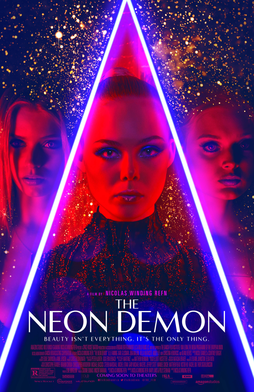
The psychological horror film The Neon Demon isn’t about a literal demon.  It’s a movie about rivalry between runway models in Los Angeles, but there isn’t a great deal of story.  And what story is told doesn’t really make sense.  Sixteen-year-old Jesse, who should probably technically be an orphan, has made her way to LA because all she has is her prettiness.  Some photos get to an agency that agrees to hire her.  The other young women become jealous of the attention Jesse receives.  Only one, Ruby, a make-up artist, befriends her.  The jealous models confront her, and the creepy hotel manager where she stays seems to prey on the women who are trying to break into the dream of the city of angels.  Jesse escapes to Ruby but Ruby’s interested in a sexual relationship that Jesse doesn’t want.  Ruby and two rival models kill Jesse and eat her.  This leads to the death of Ruby and one of the models.

Some of what I describe here is speculative since there are abstract, dream sequences thrown in and it’s not always clear what is going on.  I kept finding myself wondering if this was horror, as presented in the list where I found it.  The unrelenting male gaze could be considered horror for women, but the movie doesn’t take up that narrative.  There are a few male characters, and one of them actually seems to be a good guy, but the threat comes from the other women.  Reviews for the movie were deeply polarized.  Some declared it one of the best movies of the year (2016) while others gave it abysmal ratings.  At the box office it earned about half its budget back, and that budget was a respectful seven figures.

Horror is a difficult genre to define.  I keep coming back to the fact that it’s artificial.  The history of the term began with monster movies but eventually other films with dark themes were included.  Some have no monsters unless a human acting aberrantly counts (and some do count such as monsters).  Slashers have their serial killers and gothic tales have their haunted houses.  Well over seventy sub-genres of horror have been defined.  Casting about for freebies on the weekend leads to some that you just can’t pin down.  Neon Demon does, ultimately seem to fit the label, but many viewers will probably wonder exactly how.  Being out on your own can be frightening, and cannibalism is creepy, so I’ll go with that.


Historic Vampires

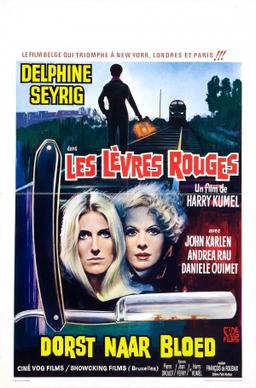
Vampire movies have always been a guilty pleasure.  The thing is, there are so many of them that watching them all would be the task of a lifetime (and a substantial budget).  Those of us who are constantly looking for, shall we say, new blood, can find that our lack of knowledge extends back for years, particularly if a movie didn’t make it big in our home country.  Daughters of Darkness is an early Euro-horror about Elizabeth Báthory.  A stylish, almost art house movie, what particularly struck me about it is that it was very well written.  The use of blood is restrained, given the topic, but verbal descriptions of Báthory’s excesses makes for a particularly gruesome scene.  So, about the story.  (This is from 1971, so I won’t worry about spoilers too much.)

A young couple (his backstory is inadequately explained in the movie, apart from being aristocratic), newlyweds, are headed to introduce her to his family.  Stefan (he) isn’t exactly the ideal husband (played convincingly by John Karlen), but Valerie (she) really wants to meet “mother.”  Stefan stalls the trip, and, in the off season, the couple have a luxury hotel to themselves.  Then Elizabeth Báthory shows up with her “secretary.”  Stefan is a little too interested in violence, as a string of murders make the headlines.  Meanwhile, Elizabeth begins making moves on Valerie.  We come to understand fairly early on that she’s a vampire, but no fangs appear and she’s always impeccably dressed and sophisticated.  Her secretary, who is having second thoughts, is accidentally killed while setting up Stefan as an unfaithful husband—again, the writing here is quite good—and Valerie becomes Elizabeth’s new secretary.

There’s a strong feminist aspect to this film, perhaps because Delphine Seyrig (Báthory) was a prominent feminist and would be attracted to such roles, it would seem.  The daughter of an archaeologist in Beirut, she supported women’s rights and there appear to be elements of this in the movie, although it was written by four men.  I was a bit too young for this movie when it came out, and art movies wouldn’t have stood a chance where I grew up, at least not in circles my family knew, so although Dark Shadows mainstay Karlen took a rare male lead role in the movie I’d been completely unaware of it.  But then, vampires are that way, aren’t they?  They tend to be old and well-hidden in the shadows.  Then they come at you with a bite when you least expect it.


Not the Witch

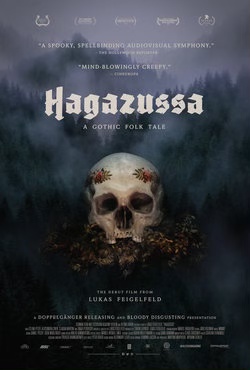
Hagazussa came to my attention from, I believe, the New York Times.  In the autumn normally staid news sources start suggesting horror films to watch.  Subtitled A Heathen’s Curse, this new Euro-horror (filmed in German) immediately reminded me of Robert Egger’s The Witch, but with a lot less plot.  It’s a moody and disturbing story of the life of an outcast young woman in the sixteenth century.  Raised by a poor, goat-herding mother, Albrun watches her mother die of the Black Death, when Albrun’s a tween.  She continues living in her childhood home, with a daughter whose origin, like that of Albrun, is never explained.  The locals shun her as a witch but a seemingly friendly villager befriends her before turning against her and betraying her.  After this neighbor, and then others, die, Albrun drowns her infant daughter after eating a toadstool in the woods.  She then bursts into flames atop a hill in the Alps.

As folk horror, the movie is more about the haunted landscape than about an intricately plotted story.  There’s nevertheless a great deal of symbolism used, including much regarding Eve—apples, serpents, and goddesses all play a part.  Locals fear pagans, and the church interior lined with bones reminded me strongly of St. Stephen’s Cathedral in Vienna, where plague victims’ bones fill the underground vaults.  Seeing such a place reminds you forcefully of your insignificance.  Hagazussa is an art film as well as folk horror, and it appeals to gothic sensibilities.  There’s very little dialogue.  Indeed, the loneliness of Albrun is a major aspect of this moody, atmospheric work.  Such stories always remind me of how difficult life was for those who had to try to scratch a living from the land.  Existence was tenuous at best.  Especially for women alone, as determined by Christian society.

The movie left me reflective.  It also underscored how religion and horror tread the same paths repeatedly.  The village priest tells Albrun that sacrilege must be cleansed, even as he hands her her mother’s skull, polished and decorated.  He wearily admits that he struggles to led the community.  Indeed, Albrun’s new “friend” castigates Jews and heathens, even as she takes part in the robbing of Albrun’s livelihood.  Witches, as “monsters” were invented by the church as fears reached out to point to new sources.  Even if they had to be fabricated at the expense of innocent people.  Fear operates that way still, as anyone who watches political ads knows.  It’s easier to persecute than to educate, it seems.  In the end, Albrun burns up and we realize we’ve just watched a parable.


Suitable Genre

As I muse over genres, it seems that “low-budget Lovecraftian horror” might be an—ahem—suitable one.  This is perhaps because Lovecraft has trouble being taken seriously as a literary writer and his stories are so easily parodied.  I watched Suitable Flesh unaware that it was a Lovecraftian (low-budget) movie.  I’ve seen quite a few of these over the years and they can be pretty fun.  This one was somewhat enjoyable.  Based on Lovecraft’s “The Thing on the Doorstep,” it’s a body-swapping, possession fest that involves two psychiatrists who have been friends forever but who both become victim of a nameless possessing entity.  It took some adjusting to believe Heather Graham in her lead role here—she doesn’t strike me as the Lovecraftian type.  She does seem to enjoy her role, nevertheless.

Lovecraft famously didn’t write many women.  He was xenophobic and a racist.  He didn’t much enjoy being married.  Modern films (and even novels) based on his works tend to redress this situation, sometimes creating a little disconnect with the white-male Lovecraftian universe.  Still, the story is fun.  Dr. Elizabeth Derby (Graham’s character) encounters a young man whom she supposes is schizophrenic.  In actuality, his body is being taken over by an entity that had possessed his father.  While possessed, the patient begins an affair with Dr. Derby and that leads to her also being a target of possession.  Although not considered a comedy it does seem that part of the story has an inherent humor about it.  Some consider it camp.  Lovecraft’s mood is difficult to translate to film.

Although cinema existed during Lovecraft’s lifespan, his writing wasn’t influenced by the possibility of film conversion.  The monsters are too enormous and the concepts too broad.  The real fear here, apart from the gross-out effects, is that of losing your identity.  The whole centers around a psychiatric ward where the supernatural events aren’t really accepted by the science that reigns.  People end up dying because the supernatural is inadmissible.  In this aspect, it shares some of the overarching concepts of some great horror.  The Exorcist, for example, derives a great deal of its energy from the fact that modern people have great difficulty in accepting that a demon could actually exist and science doesn’t seem to be working.  There are plenty of other examples of this.  Lovecraft’s stories bring us close to this realm, although Lovecraft himself was an atheist.  Maybe that’s one of the reasons his works are difficult to translate to film.  Or maybe something larger is going on.


Bodies Cubed

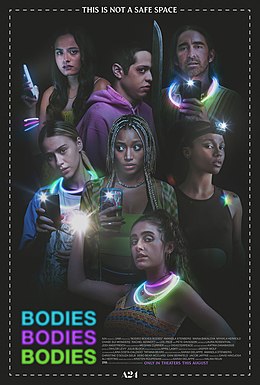
It’s difficult to know where to start with Bodies Bodies Bodies.  It was on my watchlist because it was distributed by A24.  I’ve come to trust them for smart horror, and then I saw that the movie was soon leaving one of the streaming services to which I have access.  Nothing like “leaving soon” to make a decision for you.  An ensemble cast of twenty-somethings (or so they play) gather for a hurricane party at the mansion of one of the group.  They do a lot of drugs and drinking and then decide to play Bodies Bodies Bodies—one of those games where one player is the killer and everyone else has to figure out who the “murderer” is.  They’re about ready to start the next round, but the power goes out in the hurricane.  The accused “killer” in the first game is found, dying for real, outside.  The only car on the property has a dead battery and the friends turn on each other, unsure who the murderer might be. (No bodies are actually cubed.)

All of this is interlaced with internet culture and the panic that ensues when the wifi goes out.  Now, this is categorized as a horror comedy, but the comedy is pretty subdued until the remaining four begin to accuse each other, using trendy jargon to describe relationships and psychological conditions.  The film opens with a couple of girlfriends, Sophie and Bee, who are the last to arrive for the party.  As the morning dawns the two of them are the only survivors, but they have become distrustful of each other because of things said during the hurricane night.  There is a twist ending but the house is full of bodies, bodies, bodies.

Written and directed by women, this horror film again demonstrates how intelligent the genre can be.  As for me personally, I found it pretty good.  I wouldn’t say it’s great.  That’s because of some of my own triggers—one of the trendy words they throw around.  Mainly, in my case, because of the drug scene that makes up the reality of the friends (I’ve never been part of that) and that the game resembles too much my all-time-most-feared childhood game, hide-and-seek.  The friends, convinced that one of them is a murderer, creep around the mansion in the dark, fearful of being found.  This leaves open the potential for jump startles, of course, and I’m not a great fan of surprises.  That having been written, this is a smart movie and the ending does make you think.  And perhaps wonder how well we really know anyone after all.


Firebrands

Although I’ve never lived there, I believe I have a fairly good idea of life in Ithaca, New York.  I’ve spent many, many days there over the past few years, often pondering how it is a city that would be an especially good fit for me, despite the fact I’m unhireable at Cornell and Ithaca College has never showed any interest.  It’s a liberal college town where even the street people appear to be educated.  The money of Ivy League students keeps it fresh and evolving.  And the shops in Ithaca Commons are set at eleven.  So it was that a headline in Publishers Weekly some months back caught my eye.  (I’m not behind only on movies, it seems.)  It showed a historical plaque for Firebrand Books, on the Commons.  The story stated that the plaque had to be placed on public land since the owner of the building where Firebrand started has a Christian prejudice against homosexuality.

I suppose I ought to take a step back and give a little history.  Firebrand was established as a feminist and lesbian publisher.  Its offices were on Ithaca Commons, but when the founder, Nancy K. Bereano, retired the press eventually found a buyer in Ann Arbor, Michigan.  (I have also lived in Ann Arbor, but for less than a year.  Likewise, it is the kind of place I felt instantly at home.)  Ithaca, meanwhile, wished to honor its contribution to literature and elected to put up a commemorative plaque.  The objection, however, was based on a particular reading of the Good Book.  (It must be stated that lesbianism is never explicitly forbidden in the Bible.)  To make a statement, the owner forced the plaque to the public domain.

We have a way of letting our prejudices become biblical.  I recently re-read 1 Corinthians—one of the infamous “clobber” texts for any number of people—and realized just how many of the words assumed to refer to “homosexuals” are words of uncertain Greek connotation.  King James, who seems to have preferred the company of gentlemen himself, was apparently not bothered by the text he had translated.  Of course, kings will be kings.  Our concern with sexual behavior is one of the hallmarks of our species.  We’re very concerned about how other people do it, even if it’s no business of ours.  And we consider it one of the highest moral concerns and a source of constant shame.  That was another thing that struck me while re-reading 1 Corinthians.  I wondered why Paul keeps coming back to it.  Maybe he was just being a firebrand.


Another Frankenstein

It’s a persistent bias.  Hollywood and the general public (at least critics) still downgrade the work of female directors.  I watched Lisa Frankenstein and loved it.  It’s a movie that was recommended both by a friend and the New York Times.  Okay, so it’s a comedy horror, but it’s well done and again, told from a female point of view.  It reminded me quite a lot of Edward Scissorhands and a bit of Frankenweenie.  But let’s step back a second.  Lisa is a high school senior whose mother was murdered by a maniac with an axe.  She lives with her father, step mother, and step sister in a new town and she’s got Goth sensibilities.  She hangs out in the overgrown cemetery, particularly at the grave of a Frankenstein.  A lightning strike brings the Victorian-era corpse back to life and since Lisa had said she wanted to be with him, he comes to her.

Missing some body parts, including his tongue, he begs Lisa for help restoring them.  This they do through murders (at first, accidental) so fresh parts can be sewn on.  After each addition an electric shock revitalizes the organ and makes the creature more human.  Of course, Lisa goes through the usual high school difficulties and her relationship with her bubbly, cheerleader step-sister keeps her going.  Especially since the step-mother is wicked.  With plenty of nods to classic horror, and an innovative story arc, I found it quite enjoyable.  It isn’t a perfect movie, but it is a very good one.  It shares a writer with Jennifer’s Body, which I discussed not long ago.  The movies have a bit in common, but are distinctly different while dealing with issues of girls becoming women.

I have a soft spot for gothic tales, as regular readers know.  Lisa Frankenstein manages to be gothic while also being funny.  Like Stranger Things, it revels in the culture of the 1980s and the sound track is quite good.  Written and directed by women, it falls into that category of movies that should’ve received more advertising.  I wouldn’t have known about it had not a friend recommended it.  While comedy horrors may be an acquired taste (I still prefer straight-up gothic tales), they often work well.  Another tie-in is clearly Corpse Bride.  There’s a healthy dose of Tim Burton aesthetic here.  Mixed with that pathos we all remember as high school.  The period when our chrysalis begins to crack painfully and we start to take our first steps as adults.  No matter what the cultural bias says, women’s experiences are just as valid as men’s.  And Lisa Frankenstein understands that.


Nightly Entertainment

A list of most gothic recent books, I believe it was, that suggested The Night Circus by Erin Morgenstern.  It’s a big book—over 500 pages—so I decided I’d wait until autumn to get underway.  It ended up taking most of September and half of October to finish it.  Since I prefer to start fresh, I had no idea what it was about.  A night circus, of course, as the title indicates.  It is set in the late Victorian period, although I’m not sure all the turns of phrase in the book were current at that time.  There may be a few spoilers in the description, should you want to go out and read this yourself first.  I mention that because something that only becomes clear near the end is a pretty good starting place for giving an idea of what the story’s about.

A very old man (who doesn’t look or act old) is a very accomplished magician (not the stage variety).  One of his students becomes very proficient and the two begin a rivalry that involves each setting a protege against that of the other.  It is a contest, we eventually learn, to the death.  The younger magician selects a daughter he didn’t even know he had, while the original teacher selects a young man without prospects.  The battleground on which these two duel is the eponymous night circus.  Each tries to outdo the other in creativity and wonder.  The circus is open only at night (hence the name) and is fueled by actual magic.  A cast of characters gets introduced, and they’re very well drawn.  In my experience of reading the book, they drew me back in because you pretty much liked most of them and with magic involved, well, you never know.

The novel was gothic in the Victorian setting and in the sense that there is an ancient contest underway here that interrupts into the then present.  There aren’t spooky castles, however, or really even damsels in distress.  The women characters are all strong and resilient.  The writing is lively and the resolution is satisfying.  The real draw for this book is the writing and the complex story that doesn’t overwhelm or leave you feeling too lost.  It’s a magical realism with boundaries and offers a good message that magic is all around, if we only open our eyes to it.  It’s a good book to get lost in for a few weeks.  I appreciated the fact that the villains weren’t the focus and the violence was mostly implied.  It kept me turning pages, gothic or not.