Monsters are Due on Main Street

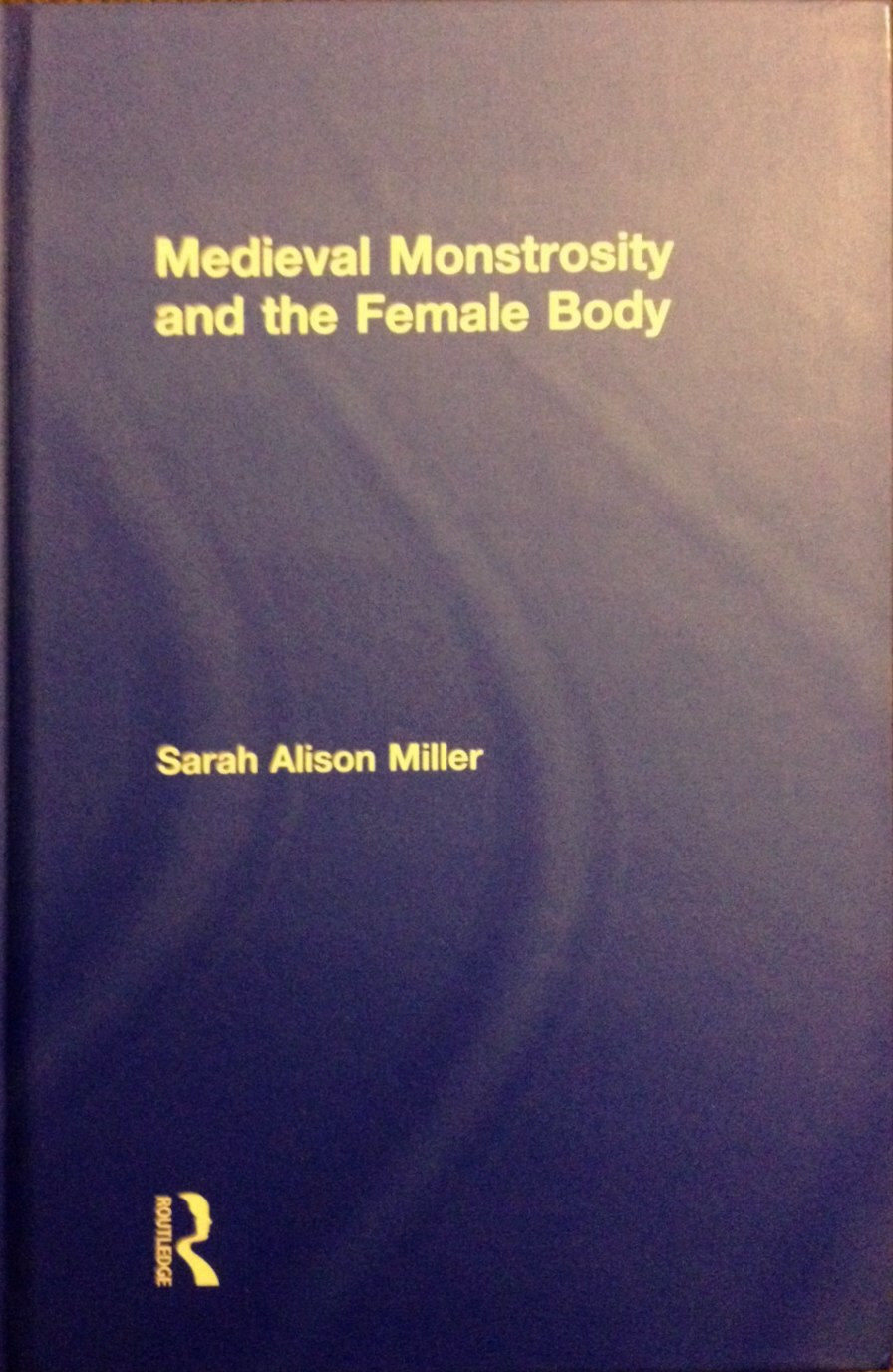
MedievalMonstrosityNow that the slow descent into darkness has begun, my mind naturally turns to monsters. In the early days of this blog I felt as though I had to justify writing about monsters when I was limiting myself (mostly) to religion, but it is now clear that many scholars have recognized the connection. Monsters cross over boundaries, and, given religions’ focus on proper borders, declaring monstrosity is often a sacred task. That comes through clearly in Sarah Alison Miller’s Medieval Monstrosity and the Female Body. Utilizing mainly three medieval texts, Miller draws out how they present various aspects of the female body as monstrous. Predictably, the source of their conviction is frequently the viewpoint of the church, the dominant institution of the Middle Ages. Biology was a touch more advanced than it had been in the biblical period, but despite the figures, many writers assumed the male to be the default model of humanity and the female somewhat suspect. Given the multiple pluralities of the natural world around them, this idea is passing strange.

This book is not for the squeamish. Miller plumbs the depths of bodily fluids and the beliefs surrounding them in a pre-scientific era. Male writers wondering at the changes the female body undergoes, however, may have been a necessary stage in the growth of knowledge. It is easy for us today to suppose that equality should have been always on their minds, but Scripture, a large source of authority for medieval mentality, had cast the sexes into an uneasy opposition. The only figure in the Bible who seems sensitive to the unfairness of it all is Jesus. And even his viewpoint couldn’t change the conservative conviction that somehow God was truly the über-male and that all the females of nature were somehow subordinate. Dare we say it? Monstrous.

Miller closes her brief consideration by delving into the writings of Julian of Norwich. Julian was a most remarkable mystic who wrote of God in strikingly feminine terms. Turning those boundary-violating bodies into the sacred, here was one medieval writer who saw the female as normative, salvific, even. Julian never commanded the kind of authority that a male cleric could, but as Miller shows, even men in this period were considering the feminine aspects of a wounded deity. Reformation, however, snapped a masculine, Protestant lid on any such speculation. Today, ironically, many Protestant traditions have, at first reluctantly, admitted female clergy. The religious body of the Middle Ages, the Roman Catholic church, still keeps women in a separate, somehow subordinate role. Monsters come in many forms and they break down boundaries. Some borders, however, may be meant to be breached.


The Goddess

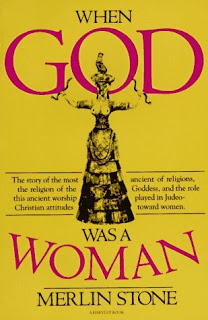
WhenGodWasAWomanMerlin Stone was a sculptor and an artist. I met her only once, a few years back when I was still recognized as an “authority” on ancient goddesses. At one of the many Society of Biblical Literature annual meetings I attended, she came and introduced herself to me, thanking me for my work. Of course I knew who she was—the author of When God Was a Woman, one of the books that was most influential in the revived goddess movement of the 1980s. I have always appreciated those women who have dared to take on the often amorphous patriarchal power structures of society to raise the necessary questions of fairness and justice. Stone was one of those women. Her book, while based on sometimes questionable historiography, nevertheless highlights some of the issues that many male scholars have chosen simply to ignore.

One of the biggest problems faced by authors like Merlin Stone and Marija Gimbutas has been the shifting sands of history. I recently had a deep conversation with a couple of feminist friends of mine where the issue of truth emerged. Truth, as I came to realize, may be a temporary phenomenon. What is true today (the earth is the center of the universe) may not be true tomorrow. It is always contingent. Historians reconstruct a past to which they do not have direct access, and further discoveries will often detail the errors made along the way. When God Was a Woman was originally published in 1978. Some of the historical constructs that Stone uses have since crumbled, but the main point of the book remains firm—women have as real a claim on the divine as do men. (I can’t help but wonder if there is some connection between this and the recent trend towards prominent male thinkers declaring themselves atheists.)

Although I can’t agree with everything Stone wrote, one of her ideas dropped a hook in my brain. In describing the sexuality that apparently attended worship of “the goddess,” she notes how male scholars came to refer, always derisively, to the such religions as “fertility cults.” Turning this phrase about, Stone wonders whether far distant future analysts will look at monotheistic religions that decry sexuality as “sterility cults.” Not that the goddess is all about sex. Religions, however, always weigh in when such spiritually significant activities as sex take place. Men, who are often eager participants, are the ones to construct religions condemning what should be a most obviously sacred human activity.

Merlin Stone may have died just over two years ago, but her book will stand as a yad vashem to half of the human race who have been religiously subjected to the other half. And perhaps there is a goddess out there yet who will bring about liberty and justice for all.


Super Women

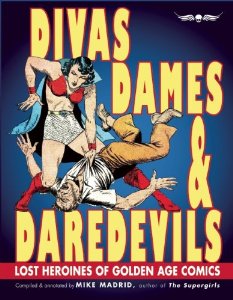
DivasDamesDaredevilsDivas, Dames and Daredevils: Lost Heroines of Gold Age Comics, by Mike Madrid, is a stroll down a memory lane that many of us never previously walked. My imagination is such that I no longer read comic books, but as a child they provided a cheap escape from a reality that didn’t feel so different from the crime-infested world that superheroes inhabited. For young boys reading these stories the absence of women was normal—there were some things of which Mom didn’t approve, and that was because she just didn’t understand. Boys will be boys. Still, Mike Madrid has ably demonstrated a secret knowledge that the 1950s would deem arcane—female characters once held a position nearly equal to that of men in the world of comics. Prior to Comics Code Authority in 1954, the women who helped win the Second World War were portrayed as tough, independent, and in charge (to an extent) of their own destinies. In the conservative backlash of the ‘50s, however, women were diminished, relegated to the home and domestic life. Comic books presented them as secondary to men. That myth has proven pernicious, even now, six decades later.

One of the perks of blogging is having someone you’ve written about contact you. Mike Madrid has been the subject of a previous post for his book The Supergirls: Fashion, Feminism, Fantasy, and the History of Comic Book Heriones. Madrid’s agent kindly sent me an advance proof of Divas, Dames and Daredevils, and I was once again struck by the historical scope of knowledge that these books present. Academics are—let me correct that—some academics are becoming aware of the fact that popular culture defines reality for many people. We find our troth in those who live on the big screen or on the pulp paper, those who rise above the constant threats of an uncaring world. We’ve seen that business can be its own evil empire, and superheroes, and everyday people, do have it within their power to act. Madrid shows that we were well on our way to equality of the sexes when the haircut and horn-rim crowd of the clean-cut 1950s insisted a return to Stone Age ethics in the treatment of women was appropriate.

In keeping with the general theme of this blog, the book has a chapter on the goddesses who became heroes. We all know Thor, but what of the forgotten Fantomah, Amazona, Marga the Panther Woman, Wildfire, Diana the Huntress, or Maureen Marine? Madrid’s book presents a story from several of the animated heroines of the days before censorship tamed the feminine mystique. More than that, he clearly shows how women—even ordinary women—were once deemed incredible and awe-inspiring. Then the titanium gate of male inferiority complexes and the vaunted “old ways” crashed down, trapping us all in a world fit to be ruled by men alone. I congratulate Madrid for resurrecting so many forgotten figures who never had a chance to become cultural icons. All women are heroes, and I know there is a hero that I miss very much, although even Mike Madrid didn’t mention her in his wonderful book.


Slippery Logic

Last week NBC reported on a baby in Tennessee. Babies in Tennessee, one might suppose, are pretty common. This one, however, was given a name stricken down by the courts. Child Support Magistrate Lu Ann Ballew declared that the baby could not be named “Messiah.” Apart from the statement that this is a title and not a name (don’t tell Judge Reinhold, please), the judge (not Reinhold) demonstrated her biblical illiteracy by stating that the title messiah has, “only been earned by one person and that one person is Jesus Christ.” Oh well, this is the Bible Belt, after all. Nevertheless, I would expect someone so deep in the Bible Belt to know the actual Bible a little better.

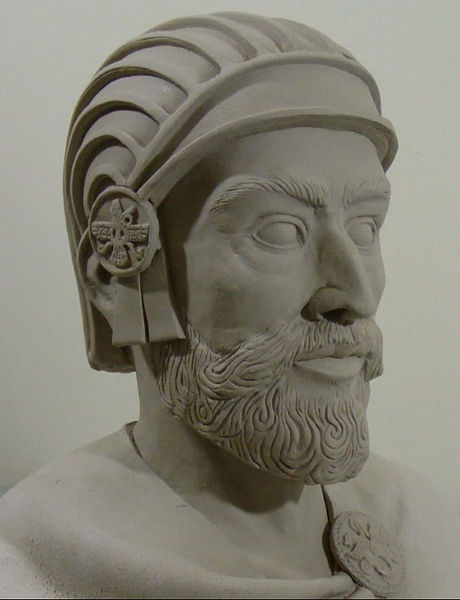
“Messiah” derives from a Hebrew word meaning “anointed one.” Its meaning is somewhat more literally along the lines of “smeared with oil,” for that is what anointing is. The title is used for several people in the Bible, not just one. Aaron, for one, was anointed. David was anointed as king, as were several other characters, including ill-fated Saul. And let’s not forget where Isaiah says clearly of Cyrus II, king of Persia, that he is “his anointed,” i.e., Yahweh’s anointed, in Hebrew, “his messiah.” Not Jewish, not Christian, Cyrus was a good old Zoroastrian. And he was just one in a long line of messiahs.

Where's your Messiah now? Oh, there he is.  (Photo by Persian Light.)

Where’s your Messiah now? Oh, there he is. (Photo by Persian Light.)

I’m not doubting Judge Ballew’s reasoning that it might be in the best interest of the child not to have such a controversial name. I do doubt, however, that it would be in the best interest of that child that he be raised being taught that evolution is a myth and special creation six thousand years ago is science. I do doubt that it is in his best interest to be taught that homosexuality is a sin and that it is something that only people have ever done because of their “fallen nature.” I do doubt that it is in the child’s best interest to be raised believing that if a woman is pregnant that a male-dominated government has the right to decide whether she carries the baby to term, no matter what. And once that baby is born, I do not believe it is the government’s right to decide on what his or her name shall be. And I expect that all the people named “Jesus” out there would agree. And Judge Reinhold.


Garden of Earthy Delights

AdmenEve I’ve self-identified as a feminist for as long as I’ve understood the word. I know that such a statement from a man must sound somewhat disingenuous, but I have never believed men are in any way superior to women. I suppose part of it may have been having men make such a poor showing in my early life, or maybe it was I simply realized people are all different from each other. Gender is just another one of those differing factors. It is always a surprise to me when I read, therefore, that feminism is no more. Some writers suggest that we are in second or third wave of feminism. I think we’re all just people, and that we should learn to treat each other that way.

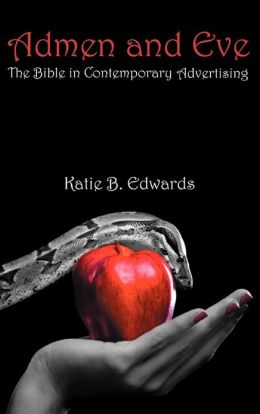
I recently read Katie B. Edwards’ Admen and Eve: The Bible in Contemporary Advertising. Edwards identifies herself with the contemporary feminism that is associated with biblical study. Reading the Bible from a woman’s perspective can’t possibly come at a cheap price. Nevertheless, Edwards focuses on the character of Eve, and specifically how she is used in post-feminist advertising. Admen who are targeting the younger demographic of women about up to thirty present Eve as a strong female, sometimes next to an insipid Adam (good-looking, but essentially brainless). Even though Eve may appear undressed, she is self-objectified, according to Edwards, and therefore is not objectified by the viewer. Along the way, Edwards also does some hermeneutical work on Genesis 2-3, and showing how the story is recast in terms of a buyer’s market.

As interesting as I found Edwards’ analysis, what stood out most strongly was the fact that advertisers have no difficulty in using a biblical character for a biblically illiterate public. Many people in the western world recognize Jesus (whether Buddy or the regular one), but of Hebrew Bible characters perhaps the only ones that readily come to mind are Eve and Adam, Noah, Moses, and David and Goliath. Some still recognize Samson. These characters, however, are almost always lifted from their contexts—they are caricatures rather than the object lessons they were originally intended to be. What Edwards demonstrates, the admen have known all along: sects sells. If you want them to buy, make the marks feel like it is a religious act. And we can almost hear the advertisers say, “Let us prey.”


Firelands

BayardFirelandsPiper Bayard has been a long-time blogging buddy of mine. She’s kind enough to comment on many of my posts and even kinder to like even more. Piper recently published her novel Firelands, and she sent me a copy that I began reading right away. My schedule this entire month has been unfriendly to literacy, but I was always glad to have a few minutes to read a few more chapters of an intriguing post-apocalyptic future. What’s more, Piper is keenly aware that religion is behind much of politics—a point she boldly makes by constructing a dictatorship based around a miracle-claiming prophet-king who oppresses those who don’t believe—the Seculars, or “Secs.” Interestingly, Piper decided on the name Josephites for the religious rulers, and there are dark undertones here for those who know their religious history. As an unabashed fan of allegorical writing, I saw quite a lot here that was, well, apocalyptic, in the literal sense of the word.

In a misogynic future, the Josephites, who dwell in cities, burn many women for various heretical crimes in autos-da-fé entitled Atonements. These human sacrifices ensure fertility and also help to explain the trials of life in a post-cataclysmic world. The protagonist, Archer, has to not only survive, but to try to save her cousin, a grandchild of the eponymous Joseph, from the flames. The Josephites live in a society of thinly rooted but strongly mandated religion. There is an underground of true Christians, and Archer, although a Sec, acts with more compassion than any of the Josephites, except perhaps her cousin. In a world that has lost its bearings, religion both undergirds and undermines a dystopian society where differences of faith have come to define everyone’s role in a harsh world. (Those who have ears to hear, let them hear.)

In this world where heaven is a fiery hell, I realized that Archer was more familiar than she first seemed. A female warrior, she opens the book by tracking a large stag to feed her starving people. Nevertheless, it took me many chapters to realize that she was a hypostatic Artemis, the goddess of the hunt. No wonder she couldn’t convert to the standard religion! Her example leads the way toward a renewable and sustainable future, in touch with nature, while the “religious” in their urban environment are dying on the vine as they appear to thrive. This is a world where old gods are more authentic than an enforced religion that few believe and that only rules through fear. There is much more I could say about Piper’s fascinating book, but I want you to read it for yourself. Visit Piper’s website for more information, and support the work of an author who really has something to say!


Human, All Too

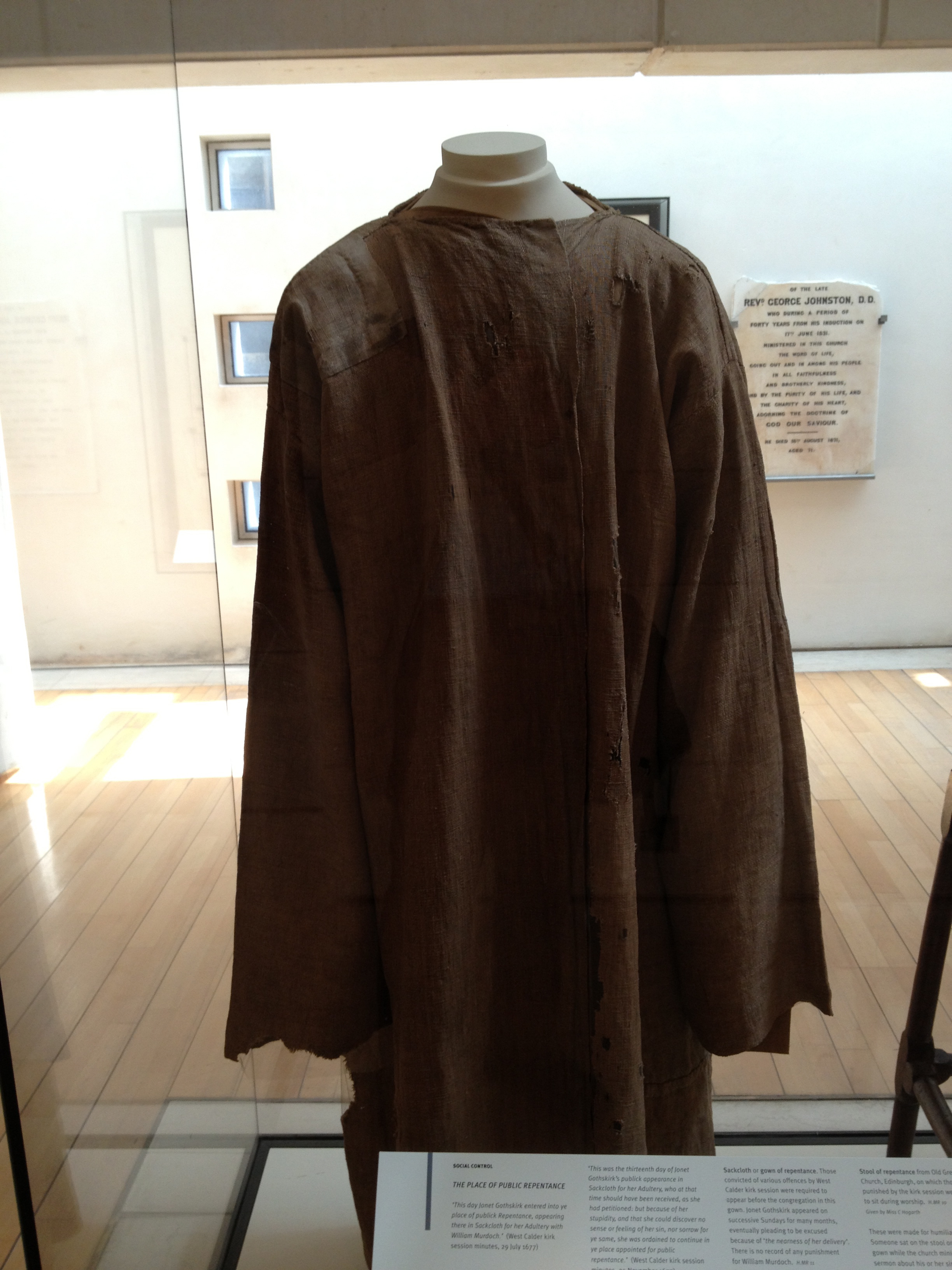
Back in the days of The Scarlet Letter, and before, an even more egregious double standard afflicted the sexual practices of women and men. Our primate nature promotes two conflicting principles: disgust at cheating and the desire to get away with what we can. Unfortunately, biology has often showcased female infidelity with the “illegitimate” child, and religions have stood in line to condemn the behavior that led to such circumstances. I was reminded of this while looking at a “gown of repentance” at the National Museum of Scotland. The Scottish Reformation led to an unusually severe kind of Schadenfreude when it came to pointing out the faults of others. Janet Gothskirk, spiritual kin to Hester Prynne, was convicted of adultery and had to wear a “gown of repentance,” literal sackcloth, to humiliate herpublicly. Her partner in crime, William Murdoch, is not recorded as having received any punishment for the affair, according to the placard.

IMG_0845

Thus it has always been: boys will be boys, but girls will be good. And when it comes time to dole out the blame, well, boys sometimes just can’t help themselves. This double standard is still in widespread practice throughout the religious world today. It shares roots with the same thinking that leads to many major religions denying sacerdotal leadership to women, and to the unfair punishment doled upon women in cultures where their behavior “dishonors” that of the men-folk. And we have all seen where male leadership has steered this ship.

What struck me hardest, staring at the dirty, ratty garment of shame, was that forgiveness seems so far removed from the religion of the Reformation. Christianity has always claimed a basis in the concepts of love and forgiveness, but when it comes to the very real circumstances of human failings, the animal tendency to attack the weak is often the driving force. We deflect because deep down we know that we all have failings. Clergy and braggarts may sometimes claim otherwise, but we share this very common liability of humanness. We should try to help each other through it. We should remember the golden rule. We should remember that sackcloth was meant to be self-inflicted and that the role of the church was to absolve the guilt, not to showcase it. Janet Gothskirk is forgotten to history, save for the garment she once wore to display her weakness for all to see.


Hansel and Regretel

HanselGretelHansel and Gretel: Witch Hunters was on offer on the trans-Atlantic flight. Since I missed it in theaters, I decided to watch it on my mini-screen inches from my face. Witches, among the classical monsters, have a strange longevity into the world of science—like van Helsing (of movie fame) the protagonists have steam-punkish gadgets to destroy the naturally invincible foes. What’s not to like? I could not help but be disturbed, however, at what seemed to be the inherent misogyny of the film. Perhaps it was the lighting on the plane, but I saw only one male witch among the monstrous hordes of females who were battered, shot, and burned with apparent sangfroid. Women were guilty, it seemed, until proven innocent. And Mina, the white witch, again underscores that women who are “clean” are still potential witches underneath. Naturally, she dies before it’s over, but in a noble way.

The witches in the movie are strangely removed from a traditional, satanic context. They derive their power, like modern wiccans, from nature and strange mixes. The source of their magic is never explored very deeply, but when they catch trespassers in their forest, their queen states that even God himself fears to go there. Bewitching bravado, to be sure, but where does this image of God originate? A god afraid of the very nature that (in a film such as this, certainly) “he” created? The sacrifice of children is a good biblical trope, but seems to do little more here than to build the tension.

Monster movies, I realize, are “guy flicks.” Something about all that testosterone seems to be energized by images of ordinary people fighting monsters, against incredible odds. The monsters here, however, are barely distinguishable from regular women. Folklore has a deep well of traditions about witches from which the savvy might draw to write an intelligent, entertaining tale of witch-hunters. After all, the real antagonist, traditionally, is the male devil. He is, in medieval tradition, the source of witching magic. By removing Satan from the picture, we are left with strong women who must be repressed, and the world is really no safer when Hansel and Gretel are done. In fact, the end of the movie implies that they will never be finished. An opportunity for a subtle shift of paradigm was missed in this film, and, as usual, it is women who end up paying the price.


Like Virgins

If you are reading this, I have safely arrived in the United Kingdom, courtesy of Virgin Atlantic. Given the lens through which I view everything, I somehow supposed that Virgin Atlantic was named after one of history’s two most famous Madonnas—the Blessed Virgin Mary, or just plain Madonna. It turns out that I was wrong on both counts. Virgin Atlantic, famously under the leadership of Richard Branson, borrowed its name from its older sister company, Virgin Records, also founded by Sir Branson. Virgin Records, I had supposed, was named after the only musical Madonna, but again, not so. The record company, new to an inexperienced Branson, was named by a colleague who noted that they were business neophytes, like virgins. The original logo showed an Eve-like virgin with a snake and everything.

Steve Fitzgerald's pic from WikiCommons

Steve Fitzgerald’s pic from WikiCommons

While in the UK I always call on Nick Wyatt, one of my doctoral advisors and now a good friend. As my mentor in Ugaritic, we always joke that I fly Virgin Atlantic because of the Virgin Anat, Baal’s famous warrior sister and sometimes lover. Anat was, of course, not the first perpetual virgin. The Mesopotamians had the idea that a goddess could be a perpetual virgin and still have kids, and what led up to said motherhood. Virginity is a status marker, still unfairly applied to women. I suspect a good part of it is biology (and if this seems weird, blame it on the jet lag), because the essential male reproductive function occurs whether or not a female is present, and even the most saintly men can not, from time-to-time, barring very extreme measures, avoid it. It is difficult to measure virginity in men, so why the double standard?

In this early morning haze (or is it really afternoon?), I suppose it comes down to not wanting to support somebody else’s child. Looks are at best a lackluster proof of paternity, and in the days before effective birth control, the only way you could be absolutely sure was to make sure your spouse was a virgin. Goddesses could get away with sex and still retain their purity. It was less sanguine for the human woman. Thus the Virgin Mary is accorded a special, but not unique status. But it turns out that none of this really matters because the Virgin I fly is merely a business virgin. And with a bit of experience, provides some of the best care in the air.


Unspoken Reality

In that impressive cultural marvel known as Facebook, a few gems amid the overburden occasionally appear. The post of a friend brought to my awareness a site known as everyday feminism, where, last year a post about religious privilege appeared. The brief piece entitled “30+ Examples of Christian Privilege” highlights one of the persistently overlooked aspects of religious liberty. No matter how much the founders of the United States valued freedom of religion, the colonials were, at least on the part of the non-slave side of the equation, Christians. Whether Jamestown, Plymouth Rock, or Guanahani, those Europeans who first set foot ashore did so under the banner of one variety of Christianity or another. (Such a case might be made for Vineland as well.) Religious liberty meant fleeing the oppressive practice of state religion—always Christianity—that kept shifting according to the whims of frequently unstable monarchs. For all its wide variety, Christianity is cut from a bolt of the same cloth. At least in the lining.

The Christian Privilege cited on everyday feminism is the most insipid kind brushed with the widest strokes. Still, it does reveal just how thoroughly Christian even the secular can be. Christianity, as I often told my students, pervades our culture. We live it, breathe it, ingest it. Often subconsciously. America was and wasn’t founded as a Christian nation. Intentionally, according to the wishes of the founders, no. Unintentionally, according to the dictates of privileged classes, yes. The problem here is not Christianity—it is privilege. Depending on whence you read the words of Jesus, his message seems to have been one of a general equality, or at least fairness. Those same words, however, can be distorted to support the monolith of the privileges granted those who follow the “one true faith.” The privilege to own slaves, for example. Or to oppress others born into less fortunate circumstances.

Ironically, among academics, I’m told, there is a push to hire those who are authentically unprivileged. Although I must, by my accidental Caucasianness, maleness, and inherited Christianity, be classified as privileged oppressor, I did grow up in economic privation. So much so that my wife feared to take our infant daughter to the unsafe house in which I was reared (which was, fortunately, condemned and demolished before that became an issue). It still shows in my natural, placating obsequiousness to supervisors and bosses—I was raised knowing my place. Yes, sir. As a first generation college student, I still find myself confused by why I was rejected by a higher education into which I poured all my youthful energy. Yes, in such circumstances, it is difficult at times to see the privileges. They are there, however, as anyone willing to walk across town with their eyes open may see.

IMG_0714


Guiding Girls

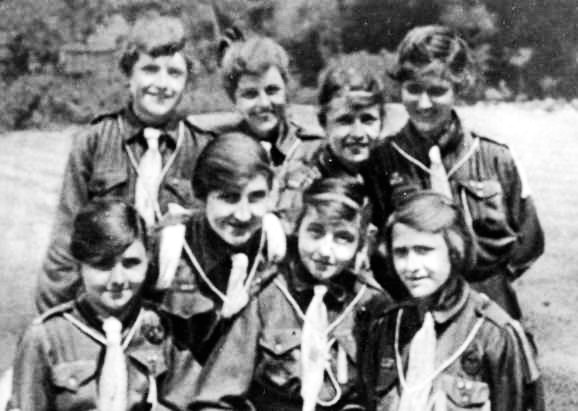
Girl Guides are the British equivalent to the Girl Scouts. I first learned about them during the three years that I lived in the UK, although, as far as I know, they don’t sell cookies. An article in the Huffington Post last week announced that the Girl Guides have decided to drop God from their pledge, as a move toward inclusiveness. I’ve often pondered the place god holds in various social societies. At my daughter’s Girl Scout bridging ceremony a couple weeks back, I noticed God in the pledge. In New Jersey, where diversity is synonymous with breathing, I wondered how this antiquated oath felt to those who maybe grew up without the concept. Stretching my mind back a few years, when my daughter was in Middle School, she was awarded a good student prize by the Elks. As I sat in the tastefully decorated meeting room, with only a very faint tinge of beer in the air, I wondered if I might ever join a fraternal order. One of the officers stood to welcome us, inviting applications for membership. Democratically, she was a woman in a “fraternal” organization. She reeled off the requirements. As an afterthought she said, “and you have to believe in god.”

How does one measure belief in divinity? It has been my experience that many beliefs fluctuate with time. I can decide to believe, but in many ways, belief decides me. As a mantra to modern society, on the old X-Files series Fox Mulder’s famous poster read, “I Want to Believe.” To join the Girl Scouts, the Boy Scouts, or the Elks, you have to say you believe. Nobody’s going to hook you up to a polygraph machine, but you need to make your public declaration. At least in the last case, beer come later.

Religious diversity is a reality of our lives. From the invention of the steam engine, it became inevitable. Our world was going to grow smaller as we met people who had previously been isolated from us by distance. In 1893 the World Columbian Exposition was held in Chicago. As part of it, the Parliament of the World’s Religions introduced many Americans to the religions of the world for the first time. Hinduism, once an exotic strain quaintly captured in the archaic spelling “Hindoo,” became a sudden fascination. Buddhism was a curiosity. How had it been that the United States seemed only to know about Christianity, Judaism, and Islam (in that order) when other belief systems existed? How could we have missed them? More importantly, what were we going to do now that we knew about them? We couldn’t unknow them, like you can unfriend someone on Facebook. We were going to have to learn to live together. After all, we all have just one planet to share. Social organizations are great places for introducing tolerance. You can be moral without being Judeo-Christian. And if our social organizations want to promote equality of membership, maybe the Girl Guides are truly living up to their name.

1918_girl_guides


Sleepy Jean

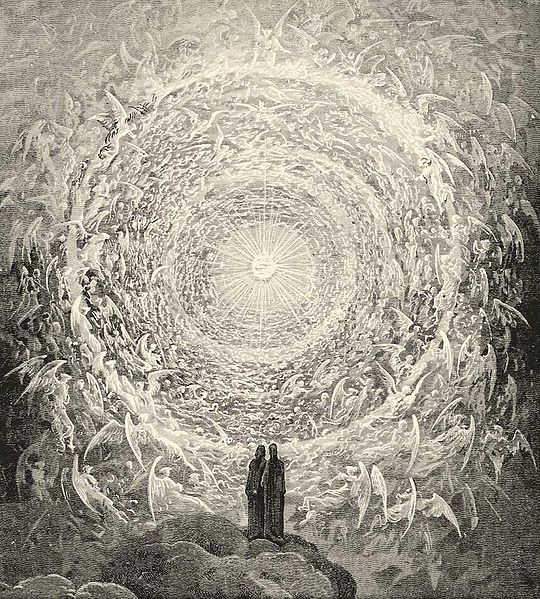
Last week in the Chronicle of Higher Education, an article by Cristina Richie entitled “The Scandal of the (Female) Evangelical Mind” appeared. Richie points out that despite great strides being made in employing women in religious studies positions, Evangelical institutions still fall behind. This dynamic is not unexpected, however. Those of us who grew up evangelical know that no matter how much it may talk the talk of equality, evangelicalism walks the masculine walk of deeply seated patriarchalism. For those who literally “believe the Bible” there is simply no way around a male Jesus. Even if you go that dangerously risqué step and suggest that the Holy Spirit is somehow feminine, when the divine couple gets together (and Father is always in charge), the offspring must be either male or female. In any literal reading, women cannot possibly claim equality. For their very salvation they are dependent on a male. A god with testosterone. As in heaven, so on earth.

Evangelical institutions have a difficult time with women leading men. They’re not alone. As early as the first century of the Common Era, Paul had the same issues. Literal religion in a biologically dimorphic world will always be problematic. Either there is one god, or there are three. In either scenario the males outnumber the females. Should we posit a divine couple (as some in ancient Israel appear to have done—please wave “hi” to Asherah for me) we still have a culture that is dominated by men. The divine couple will always have the goddess deferring to the will of the god. And you can be sure that he will never pull over and ask for directions. We already know which way this chariot is going.

Every once in a while, the Chronicle likes to sit back and take stock of the religious landscape. Religious studies is, despite the bad press, a thriving area of academic interest. Surely to those in more quantifiable fields, our little squabbles over whether god is a man or a woman must seem pedantic and a little pathetic. And yet, the evangelical institution has an instruction book. That book, if followed word-for-word, leads to eternal rewards for those who are willing to foot the hardships. And for at least half of those (and likely much more than half) that will mean living on an earth that mirrors that realm beyond the sky. Although you can’t see it with any telescope, if you believe hard enough, it is there. And in that ideal place, the god in charge is a man’s god.

540px-Paradiso_Canto_31


Sacred Herstory

NunsBehavingBadlyHave you ever read a book thinking the author was a woman, but later learned that it was written by a man? Or vice-versa? This creates a disturbing kind of cognitive dissonance, and I suspect that it is hardwired to our communal instincts. We want to know whether it is a man or a woman who is talking to us. Expectations of gender are deeply embedded in all societies, and they become problematic when they ossify into rules. Gender roles, in earliest societies, were a matter of biological necessities. In a modern, urban context such roles are obsolete, and certainly damaging—especially to women. Craig A. Monson’s Nuns Behaving Badly: Tales of Music, Magic, Art and Arson in the Convents of Italy raised this issue to a conscious level once again. Christianity, always very sensitive to issues of sexuality, had developed in a social context of women as property. In the Middle Ages, where dowries were expected, families couldn’t afford to marry off all their daughters, and convents provided an easy, if not always spiritual, solution. Monson’s book, although not filled with salacious tales, illustrates the point well. In a society where wage-earning was limited to males, females had few options.

Monson narrates the stories of five different convents where a nun (or sometimes groups of nuns) refused to play by the rules established by the male hierarchy. The infractions, viewed from the twenty-first century, seem minor: playing with magic, singing, producing art work, wanting to go outside the cloister walls, visiting (gasp!) an opera! (There are a few more complex issues too, such as arson and the love that dare not Ave Maria its name.) In each case, the masculine authorities were called in to investigate, punish, and restore order. The end result is, although fascinating, somewhat melancholy. These willful women were often acting against boredom. Their lives had no impact beyond the convent wall, and, ironically, I learned, even their enclosures had prisons. A nun could be moved from her cell to the cell. And sometimes the only crime was wanting to hear a professional singer perform.

Nuns Behaving Badly is a clever title for a book. As I read the histories, however, I became increasingly convinced that those behaving poorly were not the nuns. A society fabricated on the premise that men are the divinely ordained masters of their universe is no stellar example of men behaving well. Even the occasional bishop, archbishop, or cardinal who sided with the accused had to bow to the will of the Holy Inquisition. The victims, although not physically tortured, were women who had thrown their entire futures into the service of the church, in one of the few roles allowed females in an era already pressing into the early modern age. The nuns were not behaving badly. They were simply being human. The truly bad behavior came in the form of a male hierarchy that brooked no dissent.


Girls Rising

While I was home watching Bruce Almighty, my wife was attending a local screening of the documentary Girl Rising. (There was a good reason for this discrepancy; you’ll need to trust me on this one.) Chances are that many readers haven’t heard of Girl Rising; I know that if I weren’t the husband and father of Girl Scouts, I’d likely have missed it myself. Isn’t that part of the problem? Why does our society make females invisible, unless sex objects? Tabby Biddle has a thoughtful observation about this in the Huffington Post. She notes the importance of the film, but laments that the only way to make it through to the masculine mind is to pose the argument that educating girls will increase the GDP of less fortunate nations. Girls should be educated for their very humanness, Biddle suggests, but our view of a masculine God often prevents this from happening. While Biddle may have fallen a little under the spell of Marija Gimbutas, she makes a very valid point: there is no human reason that girls should not receive equal opportunities with boys. The fact that I even have to write that in the twenty-first century saddens me. It is not just “Third World” girls that have to struggle to gain what is rightfully theirs.

In my career I have been passed over more than once so that a woman might take the advertised position. (I have even been informed of this fact by friends on search committees.) Somehow I can’t find any injustice in this situation, as much as it has personally disappointed my hopes and dreams. Men have been frustrating female hopes and dreams for millennia. Maybe the matriarchy that Gimbutas envisioned never really existed, but the concept is sound: women and men both contribute to this thing we call civilization. Our religions, as they developed in our societies, have held the mirror up to the might-makes-right paradigm from the very beginning. Wouldn’t a male god with a more muscular upper body shove a fair, and giving goddess out of the way every time? Just ask Zeus. Or Odin. Or El. Divine civilization is only human projection, and we just can’t relate to a genderless God. So he becomes the excuse for female repression.

The face of divinity?

The face of divinity?

We’ve firmly entered a new millennium, and, looking at our treatment of half of our species, we still have an incredibly long way to go. In much of the western world, traditional religion has lost its grip, but I’m a little frightened by what I see taking its place. There are a few pockets of female-friendly religions awaking, but there are many more backlashes from the traditional male preserves of conservatism, patriarchy, and free enterprise. It is time for all men to consider that none of us would be here without our real-life goddesses. Some may rail against unorthodoxy, but unfair structures must be imploded for a new, and true, orthodoxy to be established. Women and men—not women for men, not women for profit—that is the only right teaching. So we should promote Girl Rising, and we should seek to move beyond the mere financial benefits for a free market to find the divine spark that masculine interest seems to have lost.


Witching Fiction

WitchesRoadLiterary fiction is a rich trove of religious thinking. Consuming fiction sustains the soul as well as the mind. Sheri Holman’s Witches on the Road Tonight was an impulse buy. The title, the cover, the intricate implications, the price were all right. It turned out to be a rewarding story that involved, possibly, witches and certainly religion. Not that it is a story about religion—definitely not. Yet, the protagonist is a weatherman who dresses as a vampire to present old monster movies on late night television. His relationships define him and, as his daughter learns, he may be the son of a witch. Deeply textured with the earthy reality of the rural poverty-stricken, at several points in the novel a thoroughly naturalized biblical vocabulary effortlessly flows. At crucial moments the story is poised on the crux of heathenism and religiosity. It is a book difficult to forget.

The fascination with witches has deep explanatory roots. When hopes are not realized as they are carefully planned, people naturally seek a scapegoat, someone to blame. Too often in history the blame has fallen on the powerless, the marginalized. Too often on women. In the somewhat enlightened twenty-first century it has become passably safe to declare oneself a witch. Our scientific worldview allows it as a harmless delusion, but the issue is more than it might seem. For some, witchcraft is the only channel available for a power that should belong to all. For others it retains a taint of evil, primarily because of a biblical point-of-view.

Israel in antiquity was a patriarchal culture. It was a man’s world that kept most women from any seat of power. “Witches” in this world are simply those who continue the trajectory of a kind of animistic faith in the vibrant life of nature. Prior to “revelation” it was self-evident that nature itself was full of vitality—spirits—if you will. When God was added to the equation, the life-force of nature fell on the “less than” side of the comparison. Even today children recognize the shaman under the name “witch-doctor,” euphemistically applied to those closer to nature than to the Bible. Reading Witches on the Road Tonight brought all of this back to me. Although largely set in New York City, it spoke to me as a rural urbanite who left something valuable in the woods of my childhood.