Layers

I’m all for not offending anyone. I became P.C. in principal just as soon as my consciousness was raised that the very basics of English grammar caused distress to others (often women), based on its androcentric orientation. It does seem, however, that God is even more easily offended than humans. This raises some tricky questions when it involves the highest perceived authority within or outside of the universe, the font of all morality. Some of the things that offend God, if the sources are to be believed, are most unusual. Last night I attended one of those you-should-send-your-child-to-Europe-while-in-high-school seminars that remind you that being a good parent always involves a touch of poverty. The trip is a very expensive bargain, giving your daughter or son a lasting set of life-changing memories. So far I’m on board. And, what is a trip to Europe without visiting some of the great cathedrals that exhausted local, medieval economies but left modern companions to Stonehenge all around the continent? Okay. Having seen my fair share of European cathedrals, that’s perfectly understandable. Then the kicker: since these are religious places, there is a dress code.

Anyone familiar with mainstream culture even in America is aware of this idea. To attend a place where God is supposed to be present, you must dress for the occasion. The Simpsons can throw around the phrase “Sunday clothes” and everyone knows what they mean. Attend a religious service dressed down and you’ll immediately discover it. Some traditions raise this to a high sartorial art—some Episcopalians I know are so fastidious that the very statues of Jesus seem decidedly underdressed. Since your child will be in Europe and be in cathedrals, you mustn’t offend God in a foreign land. No jeans. As the parent of a teen that means buying a whole new wardrobe to add to the pricetag. Apparently the Levi-Strauss tribe is not the same one in the Pentateuch. I spent some time in Israel a number of years back. The dress code is very strict around sacred spots. No shorts or visible shoulders. In the hot climate of the Middle East wearing excessive layers, well, it’s no wonder some folks get a little irritable. God’s standards are high. Celestial even.

Nowhere is God’s discriminating taste more evident in the required “modesty” of women. Nobody told me, but apparently women are quite a turn-on to gods. Read Genesis 6 and see if you don’t agree. The burden of public hiding beneath cloth falls on them. A man’s calf doesn’t excite God nearly so much as a lady’s. In Jerusalem they used to hand our hooded cloaks to wear over your street clothes for visiting holy places, just in case. Lord knows we wouldn’t want any unrest in the Middle East!

Having lived in Europe for three years, I know about and despise ugly Americans. At home I find our culture and manner of dress fascinating. Most of us don’t think what it says about our religion. If you ever catch a priest in church wearing jeans you’ll have your own local, mini culture-shock. I’d like to figure out why God is so easily offended by human fashion, but there is no time. I’m off to the street corner with my tin cup to try to raise money to buy clothes so my child won’t offend God in Europe.

No shoes, no shirt, no salvation.


All Saints

The movies of Guillermo del Toro, despite their success, must be watched with an astutely analytical eye. Although my movie watching runs a few years behind at best, a recent viewing of Pan’s Labyrinth left me feeling a little hollow and very reflective. The gruesome story is well told, and the fantasy world, even at the end, is hardly believable. Like most films that deal with disturbing issues, religious concepts are not far from the surface, or sometimes, the depths. In this case, the distinctly Christian trope of self-sacrifice opens a portal to a mystical world where a God-like father sits on a shining throne. But is it real? We are warned from the very first scene that this will not end well for young Ofelia, that “heaven” is but a fantasy seen through the hopeful eyes of a dying child. Even the faun (“Pan” of the English title) wears horns that suggest to modern minds the slightly diabolical, although he is in the service of the mystical king. I was so conflicted by end that I was glad the next day was a workday.

It is not difficult to notice that the heroes of the film are the female characters. Even the good men are generally ineffectual, but the strength of Ofelia and Mercedes bear the weight of showing any hope at all. Captain Vidal betrays his name of “life giver” time and again unless life is understood as unremitting pain and torture. Even the end of the film is set up as someone having to pay the price; the king demands innocent blood—will it be Ofelia or her baby brother? Of course, the girl must pay the price. In an interesting interpretation of the sacrifice of the only child, the daughter here becomes the savior.

Fantasy often has the power to heal. This is a key aspect that it shares with religion. Scientists have sought in vain a mechanism that would explain the brain’s remarkable ability to heal the body under conditions of belief. At times we’re reduced to name-calling, suggesting that somebody’s got something up their sleeve. After all, could a disreputable character like Rasputin really hold the key to physical wholesomeness (to say nothing of moral rectitude)? And yet, there are those who are made well by the most unlikely means.

The peoples of northern Europe believed that the veil between this world and the next was severely effaced at this time of year. Darkness is more prevalent than light. Pan’s Labyrinth begins and ends in darkness, and even the daylight—when it briefly occurs—is subdued. With Halloween behind us, the most veracious season of the year
lies ahead. Let us hope that this labyrinth contains fantasy.


The Body Apocalyptic

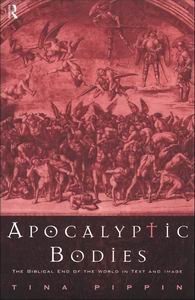
We are all products of our upbringing. Our early assumptions, although sometimes challenged and overcome, are generally with us for life. So it was that my progression of education led me to a small, conservative college to major in religion. Compared to what I learned at Grove City, the historical criticism firmly in place at Boston University sounded downright sinful. Nevertheless, it made sense, so I followed reason. At Edinburgh we were way beyond historical criticism in that wonderful, European way. Somehow in the midst of all the excitement, I missed Post-Modernism. “Po-Mo” has, like most recent movements, been quickly added to the pile of the passé, but I find it refreshing. I just finished reading Tina Pippin’s Apocalyptic Bodies (Routledge, 1999). This may have been one of the first truly Post-Modern biblical critiques I have read, and it was fascinating. Pippin is taking on especially the book of Revelation. If more people had read her book there would have been less panic back around May 21.

I find feminine readings of the Bible enlightening. As a member of the gender largely responsible for a book filled with sex and violence, it is often difficult to see how the other half of the human race might read that same text. Having grown up with a literal understanding of Revelation, I never questioned whether it was a good or a bad thing. The end of the world must be God’s will, therefore, by definition, good. One of the beauties of a Post-Modern interpretation is that everything is thrown open to question. Pippin does just that. Noting the ennui associated with eternity, she asks a question that always lurked in my mind—isn’t too much of anything eventually a problem? Eternity itself becomes problematic. Where do we go from here?

Perhaps the most striking comment Pippin makes is in the context of her chapter on the monsters of the apocalypse, “Apocalyptic Horror.” She compares Revelation to horror movies and demonstrates how all the elements are there in the Bible. She notes, “There are many monsters in the Apocalypse, but the real bad ass monster sits on the heavenly throne.” Pippin explains that God, in Revelation, joys in killing off humankind. As many of us have come to learn, people are generally good; at least most people have done nothing to deserve the heinous punishments gleefully doled out in Revelation. That, of course, raises the sticky question of ethics as applied to the divine. Here the book of Job comes to mind where our hapless hero declares that even though he is innocent, God still can count him guilty. It is the human situation. And Job was a good guy. Pippin’s little book challenged many of the assumptions with which I’d grown. Anyone who can read such a book and not worry about being a good parent is more Po-Mo than me.


Brain Death

The computer revolution has spoiled some of the wonder associated with old films that had been formerly staged with cheap props and poorly written dialogue. (Well, computer literacy has not always improved the dialogue, in all fairness.) Nowhere is this more apparent in the science-fiction/horror genre where CGI has made the impossible pedestrian. There’s little we’re not capable of believing. Back in the fifties and early sixties when even color film often went over budget, some real groaners emerged. Over the weekend I watched one of the movies at the front of the class for poorly executed. The Brain that Wouldn’t Die, however, is experiencing something of a renaissance with a stage musical coming out next month in New York based on this campy classic. Most horror movies don’t really scare me much, probably due to overexposure. The Brain that Wouldn’t Die, however, creeped me out in an unexpected way. Daring toward exploitation status (the movie was shot in 1959 but not released for three years), the “protagonist” is Dr. Bill Cortner who specializes in transplants. When his girlfriend Jan is decapitated in an automobile accident, Cortner keeps her head alive while seeking a body onto which to transplant it. Ogling over girls in a strip club, or even stalking them from his car while they’re walking down the street, the doctor imagines what features he’d like grafted onto his girlfriend’s still living head.

Campy to a nearly fatal degree, the film is nevertheless disturbing on many levels simultaneously. Although I was born the year the film was released, I was raised to consider both genders as equal. The unadulterated sexism of a man grocery shopping for the body he wants stuck onto his girlfriend’s head was so repellant that I reached for the remote more than once. A bit of overwritten dialogue, however, stayed my hand. Kurt, the obligatorily deformed lab assistant, while arguing with Cortner declares that the human soul is part in the head, yet partially in the heart. By placing a head on another body, the soul is fractured. Now here was a piece of theological finesse unexpected in such a poverty of prose. The question of the location of the soul has long troubled theologians, an inquiry complicated by the growth of biological science. Heart transplants are common today, but the resulting people are in no way monstrous. The amorphous soul, theologians aver, is non-material yet resides within a specific biological entity. Some have even suggested that you can capture its departure by weighing a dying body at the moment of death. Others suggest no soul exists—it is a mere projection of consciousness. Cortner, however, once his eyes have opened the possibilities, can’t look back.

Our social consciousness has grown considerably since the late 1950s. Politicians and Tea Partiers who hold that era up as a paradigm of sanity do so at the price of half the human race. On the outside with the oiled hair, polished shoes, spotless automobiles, society seemed clean cut and orderly. Women, however, were relegated to inferior roles while men made the rules. Life was less complicated then. We knew who was in charge. Or did we? As a species that has evolved via sexual reproduction, it has taken us surprisingly long to realize that both genders are essential to humanity. We still tolerate gender disparity in pay scales, often shored up with the tired excuse that pregnancy and childbirth disrupt “productivity” and therefore female efforts are worth less than male—never changing due to biology. Such trumped-up excuses ring as hollow as a head without a body. Many Neo-Cons will even use the Bible to support it. John Q. Public (always male, please note), they insist, yearns for the “good old days.” The days they desire, however, were days of cheap horror and unrealistic dialogue. If they can watch The Brain that Wouldn’t Die without flinching, our future is bleak indeed.


Ezekiel’s Equinox Paradox

Like the great celestial wheels of antique imagination, the seasons continue their wearisome roll across the earth. On a day long marked as a holiday among those more closely attuned to nature than most modern people in developed nations, we face the beginning of autumn. Change is in the air and already the gray skies that have predominated the eastern seaboard over weeks since Irene seem to have winter on their minds. Changes always call to mind how the human mind tends to divide what it sees into categories. The Bible is one place that this tendency is crucial. The whole scheme behind clean and unclean comes down to the need to make discrete that which nature shamelessly blends. When it comes to deity, the party line has always been (at least in the monotheistic religions) that God is like one of us. We can’t imagine human very well without gender, and so God becomes a guy. Notwithstanding protests to the contrary, early religions did take that distinction literally; divinity and masculinity were of a piece.

This fact makes it all the more intriguing when the Bible itself offers a few passages that call this orthodoxy into question. A few verses explore the trope of God as female, but they quickly back away and revert to the male God when taking on more literal terms. Hebraic culture was monistic, not dualistic. God as “spirit” was not really a possibility in the Hebrew Bible. God as a big man fits the picture better. One of the voices that claims dissent is that of Ezekiel. No surprise there—Ezekiel has been analyzed as everything from a dreamer to a dropper. Ezekiel’s understanding of God, however, is deeply imbued with temple imagery. Ezekiel was a priest without a sanctuary, and so his view of God suffered from temple vision. Nevertheless, the strange account of Ezekiel’s vision of Yahweh coming to Babylonia that opens his book demonstrates a startling lack of clarity when it comes to divine gender.

When two people meet, as psychologists have long noted, the first bit of information they attempt to discern is gender. Perhaps it’s the old fight or flight reflex from our reptilian brains, or maybe it is the opportunistic mating behavior that so obviously characterizes our species, but we are very uncomfortable when we can’t make a gender assignment. It is the whole premise behind Saturday Night Live‘s old sketch of “It’s Pat.” When Ezekiel first espies God he describes the deity in terms of glowing metal. But notice that he begins, “And I saw as the colour of amber, as the appearance of fire round about within it, from the appearance of his loins even upward, and from the appearance of his loins even downward, I saw as it were the appearance of fire, and it had brightness round about” (1.27). Beginning at the loins the prophet looks the deity up and down and concludes God is like fire. This image does not long survive the vision, for Ezekiel quickly reverts to masculine imagery for God. Even in the face of evidence that God is not gendered, the faithful must make him so, for the age-old appurtenance of male superiority suffers immeasurably without the camaraderie of God.


A Sense of Place

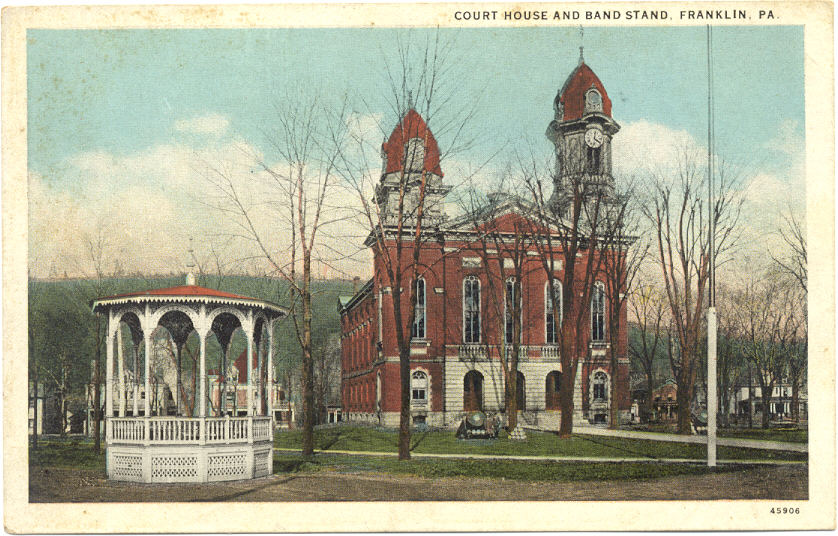
Franklin, Pennsylvania. The place I was born seems to participate in what is sometimes labeled “sacred geography.” No one really knows why people imbue certain places with a sense of particular significance, but we all do. Whether it is world-famous tourist sites or our humble hometowns, there are places for us that possess an emotional resonance that other places lack. By the time I was an adult I was eager to get away from my hometown, to stretch myself and see if there was more to this world than these ancient green hills were willing to disclose. But still I return. When something brings my town into prominence, it somehow still impacts me. In the second season of the X-Files Mulder and Scully came to Franklin. Of course, the episode was not filmed here, just set here. But that was enough. My small hometown had been validated. It is part of my personal sacred geography.

I recently learned about WestPA Magazine. While it still has a way to go before becoming mainstream, it needles into that sense of belonging that refuses to let me go. Reading about the grandeur that once settled over this town feels like reading my own biography at times. Last night, for example, I learned that one of the first steps of female equality—a small step, but we all must begin to walk somewhere—took place here. One of the inheritors of the oil wealth that originally put this region on the map was Charles Joseph Sibley Miller. He hosted two presidents on his yacht, partnered with John Astor and William Vanderbilt on a business venture, and had his car personally delivered by Louis Cheverolet. Although largely overlooked by history, Miller purchased a hot air balloon in which he took his wife, Mary Prentice Miller, for a ride, making her the first known woman aeronaut in history. One small lift for a woman, one giant lift for womankind.

There seems to be no scientific basis for sacred geography. It is simply something that we sense. I left my home region, the birthplace of the oil industry, a site of some importance in the Revolutionary War, to pursue a more tenuous, if abstract career track. And still I come back and find myself amazed. I suspect our sense of sacred geography evolved along with our penchant for territorialism, our desire for private property, and our need to find sanctuary of some kind. I can stake no claims for the accomplishments of those who settled this region, but for me it will always be a touch-point for sacred geography. When I make my occasional returns, it feels as though I might still belong.


Girl Meets God…

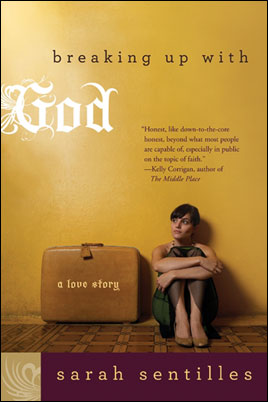
Once in a very great while I find a book that I simply can’t put down. It is a rare windfall when that book feels like it was written especially for me. I was instantly engrossed in Sarah Sentilles’ Breaking Up With God. Like Susan Campbell’s Dating Jesus, this book reinforced the fact that women experience a side of God’s character generally closed to men—the idea that God might be a lover. In our distorted, still patriarchal culture we have yet to grow beyond the idea that God is male. This simple, persistent teaching ensures that a gender-divide will always remain in effect when it comes to monotheistic religions. What truly spoke to me from Sentilles’ book, however, was not the theology, but the heart. Although the gender view from which I approach concepts of divinity must necessarily be different, here I found someone with a journey in many ways similar to mine. The honesty with which the author lays open her experience is beautiful and terrifying.

One of the recurring questions on this blog is whence the concept of God arose. Anthropologists, psychologists, and theologians come up with varying answers but the fact is the real impact is felt in very human minds. We have, perhaps unwittingly, devised a punishing image of the creator of the universe. A God who causes, allows, or at least condones arbitrary human suffering. A God who permits atrocities daily to be committed in his name (for this is a masculine god). A God who has left a burning ruin in his wake. Those of us who’ve attended seminary, as Sentilles makes vividly clear, are taught perceptions of the divine that can never be translated into the pulpit. Those of us who go on to graduate school are permitted a rare glimpse behind the veil to see something that it frightens us to contemplate, let alone write or speak about. It is a burden best worn like a hairshirt—beneath other clothes so that people don’t know it’s there. Many of us are then cast into the career outer darkness with nothing but our highly educated, disturbing thoughts for comfort.

Sarah Sentilles has given the world a gift with her revealing, sensible, and very human story. Having grown up with the image of God as a father, it was a shock when a seminary professor once revealed to me that God could never really fill that role. Nor, he added, could the church. While it cannot be the same as breaking up with God, the realization that what you were taught as a child was merely a metaphor forces a grand reevaluation of perceptions. My professor was, of course, correct. Carrying around a faulty image of God will lead only to intractable complications further down the road. Although Sentilles started down the path some years later than I did, it seems we have wound up in the same neighborhood. Her book deserves to be read widely, thought over carefully, and pondered for a time. We need to consider: what hath man wrought?


Just Druid Again

It would be difficult to suggest an ancient class of people with greater New Age credibility than the druids. Although I spent three years among the Celts, I claim to have no special knowledge of the druids, and when I saw Peter Berresford Ellis’ book on the subject, I decided to learn more. Not really a straightforward history—not enough of the druidic culture survived in any material form for the writing of such a history—Ellis instead summarizes a complex gallimaufry of evidence and speculations into a reasonable facsimile of who the druids might have been. Ellis suggests that the druids were more a caste of society, rather like the Brahmin caste among Vedic culture. Should that seem far-fetched, it would be difficult to read A Brief History of the Druids without noticing the obvious connections between the cultures. The Celts, of which the druids are a subset, have their origins in eastern Europe rather than the usual supposition of a homeland over the sea in Ireland, Scotland, or Wales. Connected to India via a common ancestral language, Indians and Celts both derive from the same Indo-European linguistic family tree.

Ellis’ book is so full of information that it is unwieldy at times, especially for those of us who find the formidable Gaelic names intimidating. Nevertheless, it is an excellent source for learning about the religion of the druids, insofar as it may be reconstructed. One of the most striking aspects of Celtic culture that emerges from the book is how it differed from the Roman culture that would come to dominate the western world. An obvious example is that Celtic society offered a much more enlightened place for female rights and leadership than would emerge along the Tiber. Another important difference was the Celtic antipathy to abuses of private property ownership. Gaelic bishops earned the ire of Rome by declaring that egalitarianism is the will of God. In the words of a fifth century Celtic bishop:

“Do you think yourself Christian if you oppress the poor?… if you enrich yourself by making others poor? If you wring your food from others’ tears? A Christian is [one] who… never allows a poor man to be oppressed when he is by… whose doors are open to all, whose table every poor man knows, whose food is offered to all.” Words a Perry or Bachmann might do well to read.

So noble were the druids in the eyes of eighteenth-century antiquarians that many suggested Abraham was the original druid and that the great figures of the Bible were part of the druidic heritage. The world, alas, has gone after Rome instead. Rather than druids we have CEOs and politicians worth a mint before they ever “swear” an oath of office. If the current Celtic revival brings back some powerful druids, perhaps the world might just become a more tolerable place.


Biblical Sex

Legislation covering female reproductive health maintenance has finally passed. Even in a nation where equality is highly touted, women will have, until 2013, been treated as more expendable than men. A few years back I read Mary Roach’s Bonk: The Curious Coupling of Science and Sex. There I learned that even as of the publication date of her book, many aspects of the female reproductive system were still poorly understood. The reason: lack of interest by (mostly) male scientists. Of all the great equalizers of humanity, it might be expected that religions would step in to champion the cause of citizens routinely treated as objects and chattels. Instead, the opposite has been the case. Most religions, and even until the last century Christianity in the forefront of them, relegate women a secondary status to men. Religion is all about power. Now that legislation will allow women basic reproductive rights without extra fees, Catholic hospitals are concerned about the implications. “They defied the bishops to support President Obama’s health care overhaul. Now Catholic hospitals are dismayed the law may force them to cover birth control free of charge to their employees.” Thus begins an article in today’s paper by Ricardo Alonso-Zaldivar of the Associated Press.

Instead of cheering equality, the church is muttering about medieval conceptions of conception. The entire idea that life begins at conception was not even possible in the biblical world where sex did not involve sperm and ova—such things were unknown in those days. The Bible has a few clues to when human life begins, and generally it is thought to be at first breath. Semen should not be wasted, however, since it was thought to be the full set of ingredients to grow new people. The uterus was simply a waiting area, a comfy place to grow with regular womb service. Men were the creators, women were the deliverers. That idea of reproduction formed the basis for all biblical and other ancient legislation on the subject. Comprehending “conception” as now scientifically understood, was only possible with the invention of the microscope. In response, a sexually underdeveloped church decided that the new data strengthened the male hold on ecclesiastical authority. Once the seed is planted, there’s no uprooting allowed. What male, after all, has ever had to carry an unwanted pregnancy to term?

Female religious leadership was recognized in many early societies, and even in some branches of early Christianity. No legitimate rationale exists for saying half the human race is disqualified on the grounds of basic hardware. After all “male and female created he them.” Concerns of “purity” for an age when menstruation was not understood could be marshaled to the cause of male supremacy. That mystery was solved when conception became clear. An unequal result emerged nevertheless. Since women couldn’t be discounted on genetic grounds, they could on the basis of “impurity.” And here we are two thousand years after pre-scientific Christianity was conceived, still waiting while a coterie of all-male bishops castigates normal health care for females. Believers like to suppose that their leaders receive special word from the mouth of God. Those leaders tremble in the face of true equality for the very first word the Bible has to say on the subject is “So God created man in his own image, in the image of God created he him; male and female created he them.”

Who's superfluous here?


Internet Asherah

Things represented on the Internet are not always what they seem. Removed to the back-bench of academia, I don’t have the opportunity for research that I once had. Every now and again, however, I still like to see what people are saying about Asherah. When I check the popular goddess books available off the shelf, my book on the subject is not often mentioned. At least on the Internet some researchers seem to have noticed it. A recent search for Asherah on Google, however, brought some surprising results. The first item of interest was a quinoa-based, organic veggie burger from Asherah’s Gourmet. The Asherah in question here, however, is simply a woman’s name. As a vegetarian I thought I would put a word in for the product, in any case. I found this brand at a health food store last week, but miles from home and with an air temperature of over 100 degrees, I was afraid the frozen products wouldn’t make it home without half baking in the car.

My next stop on the web was Sacred Suds. This New Age-themed site offers hand-made soaps, many of them associated with goddesses. The product entitled Asherah is named for “the Canaanite mother goddess” and is made with milk and honey. The website doesn’t actually state anything about washing away sins, but it seems difficult to go wrong by washing with a goddess. Another selling point—also not on the website—might be to point out that Asherah is known as the one who “walks upon the sea.” There is even a scene in the Baal Cycle from Ugarit where she is presented as doing her laundry in the sea. Asherah and soap, it seems, are a natural match.

One final product seems to be biding its time, although I suspect there is a market for it. The Asherah action-figure, privately made, does not appear to be commercially available yet. Garbed in an Egyptianizing cobra headdress, armed with a cobra staff, this heroine looks to be a suitable partner for Captain America, bringing the United States and Middle East together in an attempt to bring peace to a troubled region. Maybe heroes can accomplish what gods apparently can’t.

Not exactly big business yet, nevertheless Asherah appears to be on the move. Maybe once she breaks into the big time, those of us who’ve tried to make a living on her cape-tails might be dragged out of obscurity as well. In the meantime, it is about time for a veggie burger and a luxuriant bath.


Iraq’s Bell

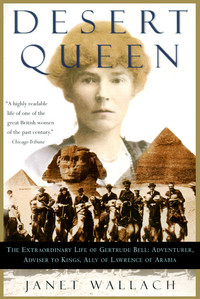
Gertrude Bell requires no introduction for students of the ancient Near East. A strong-willed, self-determining woman, her influence was arguably as great as that of her friend T. E. Lawrence (Lawrence of Arabia), but being a woman in a man’s world, movies were not framed around her life and she was not mythologized into a larger-than-life character. I have just finished Desert Queen by Janet Wallach, the life story of Gertrude Bell. Although tending towards the overly romantic in parts, this biography does a fine job highlighting the influence Gertrude Bell had on the newly formed country of Iraq at the close of the First World War.

Although Gertrude early lost her mother she was a child of a well-to-do English family. She was considered an anomaly at a still patriarchal Oxford in her day, but soon discovered the draw of the Arabian and Syrian deserts. Traveling seemed to be an antidote for being a capable woman in a man’s England. In the desert the sheiks and tribal heads came to treat her as an equal, like a man. (T. E. Lawrence, on the other hand, was famed for occasionally pretending to be a woman.) Assigned a government post in post-war Iraq, she helped draw up the borders of the present nation of Iraq and achieved a status with the desert tribes to which few of her male colleagues even aspired. Failing in health and fortunes, lonely in the desert she loved, Gertrude Bell committed suicide in Baghdad and was buried in the land she loved.

The story of Gertrude Bell is inspiring despite its sad ending. Here was a woman who refused to accept the model society cut out for her gender. Part of her loneliness resulted from her staunch unwillingness to be like other passive, subservient women of her time. After the reigns of political power slipped from her hands, Gertrude Bell founded the Baghdad Museum, collecting the initial artifacts herself and donating a substantial portion of her remaining funds to the museum in her will. Until the “Second Gulf War” it was the finest collection of ancient Mesopotamian artifacts in Iraq, where culture itself began. Gertrude Bell’s books are still read, but she is still known primarily as the associate of Sir Leonard Woolley and Lawrence of Arabia, although she was a woman on her own terms. She remains a symbol of what might be accomplished even when the standards of society declare a person unfit to lead based on gender or any other physical attribute.


Crossing Over

The periodic reforms that have swept through the church like so many Massachusetts tornadoes have often whirled around the matter of ceremony. Certainly there have been disputes over obtuse points of esoteric doctrine for which there is no final arbiter, but frequently the rancor involves what the faithful do when they meet together. In keeping with ancient templates, religion is generally a matter of what people do more than of what they believe. I personally had my love of ceremony beaten out of me by its plangent and perpetual repetition at an institution so enamored of it that humans and their needs were viewed as mere obstacles to sacerdotal perfection. Nevertheless, as the school year winds down, ceremony is all around us: graduations, awards dinners, rites of social passage. Last night I attended a Girl Scout bridging ceremony. Bridging is the symbolic crossing of a bridge to indicate a new level of commitment and integration into the larger Girl Scout community.

It's just a bridge.

As I sat staring at the bridge, waiting for the celebration to begin, it occurred to me that this was very much like a religious service. A group of spectators had gathered to watch a ritual unfold—a ritual that involved everyday objects invested with a new significance by the context. The bridge is just a small arch bridge over artificial water; before the ceremony kids run and jump over it with no fear of divine reprisal. Once the correct words are spoken, however, crossing the bridge becomes a solemn act. The ceremony opened with a kind of invocation, a creed (the Girl Scout law), a kind of Scripture reading—complete with exegesis of what that “Scripture” means and a reference to God as creator of all—a sacramental act of transformation, and even a hymn or two. The main difference I felt between this ceremony and most religious events was that the Girl Scouts are far more accepting and affirming than most religious conglomerations. Of course, there is the matter of gender distinction, but what is a church without any exclusivity?

I have great admiration for the Girl Scouts. In the face of a community that continues to act out male supremacy as a matter of God-given right, the Girl Scouts (and other similar organizations) offer a place for young women to assert their sense of belonging. Religion has just as often been used to suppress aspirations as it has been to uplift them. Life is difficult enough without God breathing down our necks. Human institutions that encourage thoughtful regard for those who are different, or underprivileged, or simply overlooked, often fill the gaps that religions callously leave behind. Yes, some religious institutions still display a social conscience, but if we wait for the religious to solve the suffering of the world, it is good to have groups like the Girl Scouts around who actually put their beliefs behind their ceremonies into action.


A Tribute

Judith Mills Gray, 2009

The death of a friend always covers life with a hazy gauze of disbelief for some time. In my fitful career I’ve taught several hundred students, and of those several hundred a handful have become friends. When the painful debacle of Nashotah House took place and I was reduced to a weeping mound of incoherent impulses, those who were friends tried to console me. Some had fortunately moved on by that point. Judith Mills Gray was one of those who had become a friend although she had made it to safety before me. Readers of this blog will likely not recognize her name—she never earned lots of money, the measure we use assess a person’s importance these days—but she was an artist, a deeply spiritual woman, and one of the kindest people I have ever known. In a day when the seminary actively discriminated against women, she managed to hang onto a place among the boys and did so with good humor. After my short stint as Registrar, she came along to lift that burden from my shoulders. When she left the seminary, my tiny family sat in her tiny house and wished her the joy that Nashotah could never offer.

Just two years ago we went to visit her in her native West Virginia. She was proof to me at that point that recovery from institutional abuse is possible, but I could see there were still scars. Many of those who suffered through years at the seminary left very bitter—I count myself among them—but Judith rose above it all. She was not perfect—none of us are—but she was a person determined to leave this world a better place than she found it. That is a tall order when the church, the putative bastion of good, turns all its guns on you. As Judith and I shared what would become our final reminiscences together, I sensed that ultimately she had come out the winner.

We are all born into a life with far more questions than answers. Jesus seemed to have had the idea that it was good to console those in difficulty, heal wounds, and try to make your fellow sojourners happy. Judith followed that path without the benefit of having the answers. Along the way we shared many laughs and quite a few tears. We both had experienced the face that the church carefully hides from the wider public, the face that finds Jesus a little too idealistic and hate and revenge a simpler and more effective option. Judith never returned hate for hate. She continued trying to find a path where, although not ordained, she could still minister to others. For those few of us fortunate enough to know her, she was an example of how to make gold out of lead. In my case, I know that there will be lead in my life for quite some time now that she is gone. I also know that lead can, and sometimes does, turn to gold.


Eyre the Apocalypse

Finishing Charlotte Bronte’s Jane Eyre last night proved timely from the point of view of today’s much anticipated apocalypse. (I hate to leave a book unfinished as the final trump begins to sound.) As I stress to my students at Rutgers (when I actually have a class), the Bible surrounds them whether they are aware of it or not. Quite aside from the present rapture-envy—that one’s just too easy—reading literature of the nineteenth century is an excellent way to show the Bible’s influence on western culture. Jane Eyre is suffused with biblical allusions and direct references, even with the faulty theological notions that the Scriptures had hatched in that century. Of course, the Bronte sisters, all successful novelists, were the children of a clergyman, but other writers of the period demonstrate an equally biblical worldview. In fact, much of the dramatic tension in the present novel revolves around distinctly biblical issues.

Interspersed with my reading of classical novels, I read many more recent literary explorations as well. A couple of weeks ago I completed Stephen King’s It, not a particularly favorite novel, but one that at times demonstrated that even masters of the macabre frequently draw on the Bible. For modern literature the Bible is the ultimate foundation. It would be interesting to live long enough to see if it still has any relevancy at the end of the present century. Jane Eyre, perceptive as most nineteenth century novels are, also pressed directly the wound that currently afflicts much of our nation. Cast upon misfortune, Miss Eyre is mistaken for a beggar. Miss Bronte observes, “Prejudices, it is well known, are most difficult to eradicate from the heart whose soil has never been loosened or fertilized by education,” a line that should be emblazoned upon the door of public officials who feel it is their right to withdraw funding from public education. You want an apocalypse? That’s the recipe right there.

Nevertheless, Miss Eyre presses on until she reclaims the man who had once “stood between me and every thought of religion,” dodging an impassioned missionary along the way. In revealing the manipulations of the cousin who dies on the mission fields, enriched by Miss Eyre’s beneficence, once again Charlotte Bronte displays her perception of how the church may ultimately rob a soul of its true potential. Upon learning of his death, the now Mrs. Rochester ends this penetrating novel with his words, strangely appropriate for this day of fictional endings: “’My Master,’ he says, ‘has forewarned me. Daily he announces more distinctly—“Surely I come quickly!” and hourly I more eagerly respond, —“Amen; even so come, Lord Jesus!”’” Of course, St. John is here quoting Revelation 22.20. Since I am scheduled to run a 5-K in a couple of hours, if the second coming is about to happen, it would be convenient should it transpire before I end up exhausted in my own personal apocalypse.

Jane Eyre stopping one of the horsemen of the apocalypse?


Dreams of Equality

Shortly after my wife and I married, over twenty years ago, while living in Scotland we needed cheap entertainment. Growing up one of my chores had been washing the dishes. I continued this calling all through college, working in the dishroom to pay my way through. My wife was pleased with this trait and offered to read to me while I scrubbed away. This was our cheap entertainment, but now, after more than twenty years of the practice, we have read over 100 books together. Last night the book we finished was Martha Ackmann’s The Mercury 13. Most Americans do not realize that during the space race, thirteen women received non-official tests to qualify as astronauts, many of the tests more extreme than those undertaken by the Mercury 7 crew. Because of social prejudices of the 1950s and ‘60s, the women were never given the opportunity to actually achieve space flight.

Apart from the moving account of how these women strove for the stars, this account also chronicles a social prejudice that remains today. Ackmann reveals that during the ‘50s and ‘60s, scientists and physicians had never really taken an interest in women’s physiology. They were, in this McCarthyian era, considered to be an inferior version of males, the dominant social gender. Although the Mercury 13 were accomplished pilots – some with more flight hours than the chosen astronauts – many political and military decision-makers feared that social fabric would fray should women prove as adept as men. It wasn’t until 1983 that an American woman was allowed to enter space.

Here in the 21st century, many religions throughout the world still staunchly hold to the myth of female inferiority. In a monotheistic worldview where non-gendered deities need not apply, one sex will always be somehow less god-like than the other. In a world where men still pay women less, they are reminded daily that God is a white man and that the mythology declares man was created first. Religion is as often used to repress as it is to liberate. The women who sacrificed careers without personal reward to demonstrate that space belongs not only to men deserve our gratitude. And even that old white man, sitting up there beyond the dome that surrounds our flat earth, must be smiling.