Witches of September

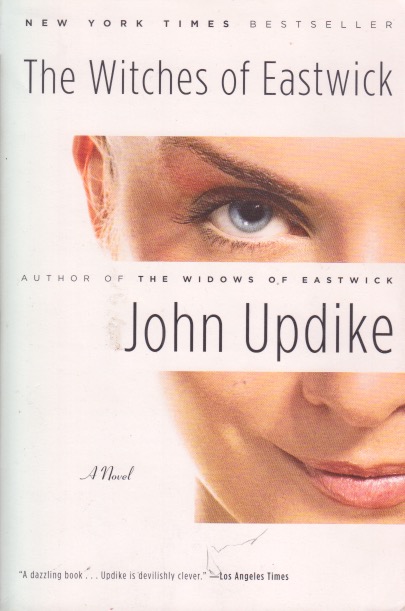
I’ve never read any John Updike before.  I understand that his novels foreground religion, which I didn’t realize.  I have watched The Witches of Eastwick, in movie form, a time or two.  In fact, I wrote a bit about the film in one of my books.  This got me curious to read the novel and I found a copy at a used book sale up in Ithaca some months back.  Now that September’s here, it seemed like an opportunity to see what the original story had to say about witches.  There is a problem, of course, in having watched the movie first.  Not only does it tell you which actors the characters should look like, but it also predisposes your orientation to what will happen.  In this case all that will mislead you.

The movie centers on Jack Nicholson’s Darryl Van Horne—like most Nicholson movies, his character takes over—whereas the novel is definitely centered on the three witches, Alexandra, Jane, and Sukie.  They don’t fall into the background, but neither do they always work in concert.  The movie tells, in other words, a very different story.  Updike’s literary treatment focuses on female characters and the mischief they cause.  Nor is it entirely clear that Van Horne is demonic, as in the movie.  A church features prominently in both versions, amusingly Unitarian in the novel, with Van Horne not upstaging the sermon but giving an invited one himself.  No fear of sacred places here.

The wrath of the witches isn’t directed toward Van Horne either.  A character left out of the film, who marries Van Horne and whose brother is his real target of affection, is hexed and killed by the witches instead.  In many ways this could be construed as a kind of gentle horror story, although it’s never marketed that way.  I kept waiting for certain scenes in the movie to be narrated, as it were, in the flesh.  This led to the revelation that these scenes were invented for the cinematic version.  Both novels and movies are stories.  When shown on the big screen, we expect them to be adapted.  My personal preference is for the film to present the same story.  It can’t always be done, of course.  In this case the movie left some questions open that I hoped the novel would answer.  Since the stories are so different, the questions remain.  I have a feeling I’ll read more Updike down the road, but I’ll avoid watching the movie first.


Which Wednesday

I’m not superstitious but it’s still pretty dusky when I go for my constitutional on cloudy days.  I was walking along thinking about Cernunnos, the way one does, when a black cat darted out of the underbrush and across my path.  My thoughts turned to witches.  Then a large toad jumped out in front of me in the half-light.  Perhaps it was because I picked up a booklet about witches recently, but this felt very uncanny to me.  There’s a place where the woods close in on both sides of the path.  The sun wasn’t yet up, and the clouds meant it wouldn’t have much mattered anyway.  When the bird calls stopped I began thinking about turning around and going home.  Nobody else was out this morning and although I don’t mind starting my day with the weird, I was thinking “not on a Wednesday.”

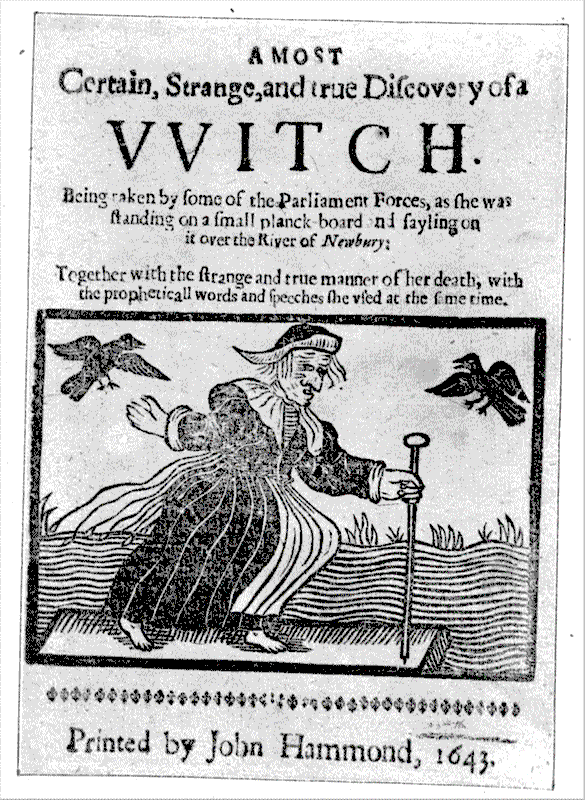
A thick mist lay over part of the path and I realized just how uncomfortable we tend to be when we can’t see clearly.  Despite that, and the black cat and the toad, I’ve never really been afraid of witches.  I guess I try to please people too much to think that someone might want to harm me supernaturally (at least among those who know me).  I recently found a booklet on witches—one of those strange impulse buys after being mostly house-bound for the better part of a year-and-a-half—that perhaps prompted my thinking this morning.  Although it seems to be most interested in earth-centered religions, it has an article about Salem.  Despite the more modern embrace of witchcraft in Salem, historically it had to do with human fear and hatred, a combination that is scary indeed when applied by those who are superstitious.

Cernunnos is a Celtic god generally portrayed with deer antlers.  Although lack of literature means we know little about him, he’s been adopted as the male counterpart to the female earth-goddess in some traditions.  Modern witchcraft is based on an orientation toward nature.  It’s kind of a ground-up religion rather than a top-down one.  Christians traditionally labelled it “Devil worship,” as they tended to do with anything they objected to.  Such demonizing helps no one, of course.  And when these ideas grow into superstitions people get hurt.  So I’m out here in the half-light because in the mornings days are shortening quickly and I have less and less time before work begin after the sun rises.  And I have witchery on my mind.


Moral Compass

Where have all the morals gone?  Well, not exactly song-worthy, but it is a question I think about a lot.  You see, I work in publishing.  Publishing, above all, is a business.  People make their livelihood at it, and so they have to find a market that pays.  Money and morals don’t mix well.  A recent New York Times story pointed out that the political polarization that’s tearing America apart is reflected in bestsellers.  Political nonfiction bestsellers have topped the charts since Trump was unfortunately elected.  Books both pro and con have flooded the market.  What’s this got to do with morals?  Well, I believe publishing should be in the business of educating.  If you’re going to publish nonfiction, it should be material that doesn’t cause more problems than it helps solve.

When I look at a book, after checking the title and author, I next look at the publisher.  Some publishers are conservative, and that’s fine.  That’s what they do.  Most, however, consist of highly educated professionals who realize the severe, and continuing damage that Trump caused.  These publishers, however, will produce pro-Trump books if the numbers look good.  There’s gold in them thar hills!  I often have these scruples working for an academic press.  Some ideas are clearly distorted.  I’m no elitist—I’m still pretty much working-class all the way down to the bones—but education reveals when something very bad (fascism) is happening.  Others see it too.  Still, the temptation of all those dollars… it’s a real pressure, almost like being at the bottom of the ocean.  There’s money pressing on us and we want it.

The gray lady story bothered me.  Instead of publishers looking out their windows and seeing the political grand canyon of this nation, they see profits.  This is business, after all.  Just business.  Is there any such thing?  Morality informs the way you live, the choices you make.  Do I promote education, reflection, and sound reasoning or do I promote a very real 2024 threat of a man who leads by refusing to lead?  After elected Trump immediately began campaigning for his next term, loving the rallies, the cheers, the adulation.  Who doesn’t want to be worshiped?  But is that what we want to see three Novembers from now?  I remember the shock the morning after election day 2016 in New York City.  I see the damage four years of environmental degradation caused just when the effects of global warming were becoming obvious.  I see women demeaned.  I see voting rights quashed.  And now I look at the bestseller list and wonder where the morals have gone.


Still Too Close

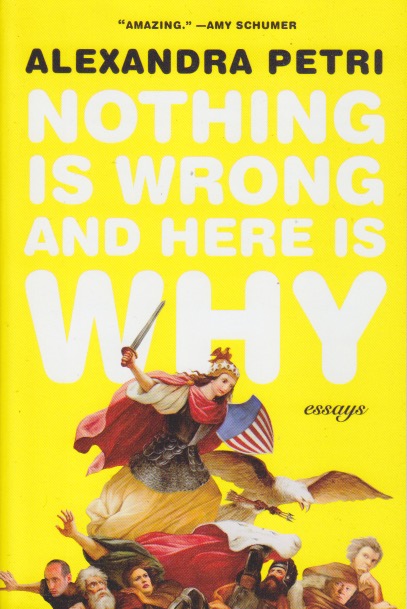
Parody is sometimes the best way to deal with a crisis situation.  As soon as I learned that Alexandra Petri had come out with a new book I was eager to read it.  Her last book, which I reviewed here some years ago, was such a delight—sharp and funny—that I fell in love with her writing.  Although she works for the Washington Post, I don’t regularly read newspapers (no time, if I want to read books) and therefore I don’t get regular doses.  Nothing is Wrong and Here Is Why is clearly a book written in a time of national crisis.  Yes, it’s funny, but the wound of the Trump years is still too raw to be able to laugh much about it.  Too many of his followers still don’t realize they were (are) being played and want him back.  It’s scary.

The first, and longest, section of the book are essays about the absolute ridiculousness of life under Trump.  It was a difficult and dangerous time for thinking people and although Petri excels as a satirical writer, the freshness of the terror—look at the Taliban and see if they are laughing—is just a little too intense.  Petri makes a great case for giving female leadership a try.  Any candidate, no matter which party, needs to know how the game is played.  And they must care about other people.  A pathological narcissist has no business being president of anything, let alone a democracy.  If you’re not familiar with satirical writing you’ll misunderstand just about everything Petri writes.

Once she gets beyond the section about Trump (shudder), the essays start to pick up some topics that it’s possible to laugh about.  Some of them are quite funny.  Although I enjoyed the book—when I started to put it down to get ready for work each morning I found myself saying, “I’ll read just one more.”  And three or four essays later I’d find myself rushing upstairs nearly late.  If it hadn’t been for the national tragedy called Trump, Petri’s second book might’ve been funny from the start.  Parody can be a defense mechanism.  At times things are just too painful to bear and those of us who write find ourselves doing our best to keep the mood light while society crumbles around us.  When things are ridiculous laughter is really what we need most.  We’re lucky to have Petri to provide it.  Here is why—she can bring a smile, or at least a smirk, even in a crisis.


Afghanistan

As much of the world watches in dismay, the Taliban have taken over Afghanistan.  Most religious rule ends up being harmful to women, it seems.  We have centuries of male-run Catholicism showing how both witch hunts and heretic murder became common in Europe.  Do we expect any better now that religious extremists have taken over a nation next door to Iran?  The mix of politics and religion has generally not been favorable and unfortunately if the Republican Party could have its way we would see a similar thing here in the United States.  An ill-executed coup d’état on January 6 of just this year led to the epiphany that the Republican jurists would protect those who tried to overthrow the US constitution in the name of religion.  And we know how they feel about women’s rights.  We should look at Afghanistan and tremble.

It seems difficult to believe that less than a century ago we went to war to defend democracy.  Senators alive to witnesses the privations of war are now recklessly trying to remake America in the image of a fascist state.  Instead of looking at Afghanistan as a mirror, the only thing they can see is this is a Muslim nation.  Christians would surely never try to take over a capital by force.  They turn a blind eye to our own insurrection, not yet nearly a year old.  Ironically the book they claim to follow contains a often quoted but more often ignored statement: “He that is without sin among you, let him first cast a stone…”   It’s no accident that their intended victim was a woman.

Religious politics can be maintained by force of arms or legal maneuvering. Both are evil.  The result is the same either way: women and thinking people suffer while the self-righteous rule.  Even such basic assumptions as protecting their own people from a horrible disease by the simple expedient of a free vaccine has been politicized for purposes of keeping in power.  When the moderates in their own party speak up they are shouted down.  How different is this than the shouts of triumph heard in Kabul?  The alternative—government that allows the freedom to believe what you will as long as all people are treated fairly—has been made out to be a sin.  The god worshipped both by Republicans and the Taliban has little sympathy for humanity.  He, and most certainly he is male, is all about power.  We watch in dismay.

Photo by Joel Heard on Unsplash

Pagan Perspective

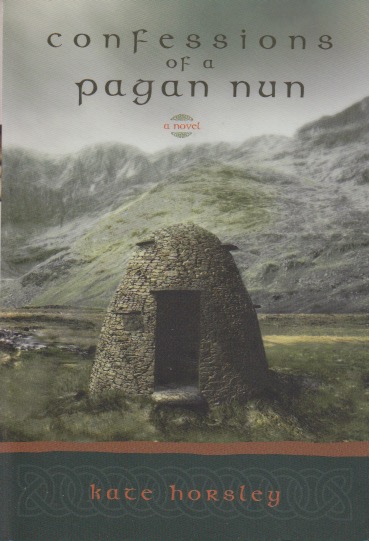
“I would live in a world of Christ-like humans, but not one full of Christians.”  So Kate Horsley’s protagonist Gwynneve writes in Confessions of a Pagan Nun.  This novel is an attempt to envision what life would’ve been like for a woman in medieval Ireland when Christianity came to the land.  Gwynneve is a spiritual seeker who comes to be a nun when it’s clear that this new religion has taken over the old ways.  Learning to write, she transcribes her story after hours in her clochan, or cell.  She recognizes that Christianity has brought good things to Ireland, but at a high cost.  The disparity between rich and poor increases, women are denigrated so that men can run things, and the land is ravaged for the benefit of their new way of living.

The novelty of the idea caught my attention when a friend pointed the book out to me.  I was a bit surprised to see that Shambhala, generally a nonfiction Buddhist press, had published the novel.  Since this is a story designed to make the reader think—it is contemplative, as a story from the point of view of a nun would likely be—the choice of publisher makes sense.  While it’s not likely that a book published there would make the New York Times bestseller list, as an erstwhile writer myself I can attest that novels outside the usual pale have great difficulty in getting mainstream publishers interested.  This too is a matter for contemplation.

One of the main themes of the story seems to be how a worshipper of the goddess Brigit has to become a devotee of St. Brigit when the church made the gods into saints.  This is something that happened historically as well as in novels.  Aware that it was easier to persuade individuals to convert to a new religion if they didn’t have to give up their gods, this seemed a small accommodation to make.  Horsley is not wrong, however, in pointing out that Christianity was not a free ride.  More than a religion, it was (and is) a powerful means for social control.  The vision it offers tends to benefit men over women, the wealthy over the poor, the powerful over the weak.  Despite what the Bible emphasizes, religion has its own conversion experience when it tastes power.  Confessions of a Pagan Nun is a story intended to shift perspectives.  The open reader will learn from contemplating its message.


Women and Mothers

This is our first Mother’s Day with a female Vice President.  After four years of a female-groping administration, it feels like we’ve made a turn in the right direction.  Ironically, it’s often religions that keep women oppressed, even while women are often more faithful to them.  Religions like to claim to have the answers, and for the monotheistic traditions an origin myth with Eve—the first mother—as the first picker of forbidden fruit, has suggested one answer that has held women down for centuries.  Taking origin stories too literally can cause so much suffering in the world that we’re confronted with the question of their morality.  Religions are for people.  If they exclude half the human race we need to pause to ask if we got something wrong.  It’s Mother’s Day, always on a Sunday.  It’s a chance to think about such things.

Many churches will have sermons honoring mothers today.  Will they work for the wellbeing of women for the remaining 364 days of the year?  Our society, purely on the basis of biology, routinely puts women at risk and underplays the need to help them when that happens.  I’ve seen this firsthand.  We’re finally starting to get some female representation in Congress, yet less than a quarter of the seats are held by women.  Isn’t government supposed to represent its constituents?  Why has half of humanity had to struggle for so long to be treated as equal?  Mother’s Day cannot be a salve to ease our consciences about mistreating women for the rest of the year.  Equity should not be a goal, it should be reality.

We’ll be thinking about our mothers today.  Still under a pandemic, we’ll be Zooming them or calling them.  Those fortunate enough to live close may even get to see them in person.  These mothers sacrificed a lot to take on that role.  Our society could not continue without them.  We’re starting to come to the realization, I hope, that it is male-devised forms of government and business that are the problem.  They protect the wealth and power of a few.  They jealously guard against letting men offer the true justice of equity.  Some religions have begun to address the obvious injustice they have largely originated.  The story of the Garden of Eden was meant to teach a lesson.  That lesson has been abused for centuries as a way of making women seem somehow less than men.  It’s Mother’s Day.  Let’s see if we can’t learn to read more deeply and apply what we have learned.


Lessons from Mars

It’s a parable.  This week, on a planet weeks away, earthlings achieved heavier than air flight.  Considering that we flew for the first time on our own planet only 118 years ago (within feasible limits of a very successful human lifetime), the achievement is remarkable.  What I found most fascinating about the live stream provided by NASA, however, was the human element in the control room.  Not only did all the engineers look young enough to have been my children, I was cheered almost to tears to see several women among them.  We’ve come a long way.  And I don’t mean just to get to Mars.  There’s a lot of work yet to be done on the planet on which we evolved, but it does me good to see scientists recognizing the contributions women make to progress.

While many cultures worldwide still consider women the property of men, that scene showed that with women in leadership roles we can achieve remarkable things.  Only with the priorities of diversifying the workplace could we realize a dream that began long before Kitty Hawk.  People of all genders and all ethnicities have much to offer our growing sense of accomplishment.  Mars is millions of miles away.  Perseverance and Ingenuity are being controlled across this godlike distance by a group of humans that consists not just of angry white men who want to rule this world.  Although the palpable  excitement in the room was for what was happening far away, my spirits were buoyed by what was happening here.

Our biology defines us, but it becomes a sin when it confines us.  We are capable of more.  We’ve flown on another planet, and yet we still need to learn that on this planet all people deserve fair and equitable treatment.  It boggles my mind that on that reddish speck I can see on a clear night, a speck so small that my pinkie held at arm’s length can obliterate it, we have landed a car-sized rover and a helicopter.  The math involved staggers this old mind, but the imagination inspires it.  We come to moments like these when women and men of various backgrounds come together and dream.  Double-masked and socially distant, young people have shown us a world far beyond what angry white men could even imagine.  Watching the video of a helicopter taking off, hovering, and landing on another planet, looking at the people in the room, I realize there is a parable here.


One, two, three

The danger of statistics is that they turn an individual into a number.  A few days ago an article in the New York Times addressed the rare blood clots that some women develop after receiving the Johnson and Johnson covid vaccine.  The response of the cited physicians was telling.  Many praised the decision to halt use of the J&J vaccine immediately.  Others, however, point to the numbers.  If a vaccine is halted many more could be exposed to and contract Covid-19.  It is better, they aver, to take the statically smaller risk and use the vaccine.  While I understand the logic here, I do wonder if the side effects occurring primarily in women has anything to do with the reasoning.  Why not save this vaccine for the men instead?

This raises once again the specter of consciousness.  Statistically the odds are small that a woman will develop a clot.  What if you are the woman who does?  This dilemma always bothered me while camping in the woods.  Statistically black bear attacks are rare.  How does that help you if your tent is one that looks like a candy wrapper to a bear of little brain?  You become a statistic instead of a living, breathing, feeling, blogging person.  Statistics.  There’s a reason some of us identify with the humanities, I guess.  I can imagine what it would be like to have your doctor say to you, “Sorry, this is rare, but look at the bright side—you now become a statistic!”

Photo credit: HB, via Wikimedia commons

The fact is we’re all statistics to strangers anyway, the government above all.  We are vote-bearing numbers to be gerrymandered and prevented from voting.  Beyond that we’re merely annoying.  This pandemic has introduced Stalin’s accounting with a vengeance.  542,000 is a big number.  Unless you know one or more of them personally.  Then the statistics seem to melt.  Life is full of risk, of course.  We’ve barricaded ourselves in our homes for over a year now, eating things that are likely more dangerous for us than a rare complication.  The virus, and perhaps some vaccines, are among various killers on the loose.  Nobody can declare with any certainty the correct course of action.  Actually doing something about the virus when it was first a known threat would’ve helped, of course.  We find ourselves on the brink, it seems, of getting Trump’s disease under control.  Would that we all could do so, without having to worry about lying down to be counted.


International Women’s Day 2021

Changing one’s way of thinking is difficult.  So difficult that we generally don’t try it unless we’re compelled to do so.  One such compulsion is education.  Cultures that have embraced education are those that have led to great advances.  In this context it’s more than a little surprising that women’s rights are still held to be less important than those of men.  More education is required, it seems.  Today is International Women’s Day.  Of course it’s not a day off work because capitalism is all about men’s need for endless acquisition.  At least we can pause and consider for a few moments that life itself wouldn’t be possible without women, and justice, nearly worldwide, is represented in feminine form.  What can we do to make the world open its eyes to the obvious?

I read a lot about religion.  While I post here about the books I read, they are really only the tip of an iceberg.  My job largely consists of reading.  One of the themes that constantly runs through my own personal continuing education is that religion has indelibly changed our ways of thinking.  Even strident atheists today announce their stridency from a context formed by religion.  I’ve pointed out on this blog numerous times where even scientific thinking is mired in a wider context that has been constructed by religious thought.  One of those larger contexts is the subordinate role of women.  It is likely no coincidence that matriarchal cultures developed where there wasn’t a religion devised by men to impose a patriarchal governance on the world.  It’s so obvious once you learn to see it.  We need to be educated.

Women, it is obvious from an unbiased point of view, are equal to men.  As we educate ourselves further about gender and how religion has informed its perception, we come to realize that even binary assumptions—either male or female—are premature.  Underlying it all is humanity.  Human lives.  Those of men are no more important than those of women, or of those between.  Religions often like to make sharp distinctions.  Those distinctions are more abstract than reality.  The world is made up of real people and roughly half of them are female.  Today is set aside to recognize and celebrate that fact.  To recognize the contributions women have always made to society and civilization.  Let’s take the opportunity to educate ourselves, and  let’s be conscious of the fact that women are just as valuable as men and their foibles.  More than that, let’s put this truth into practice.


Women’s History

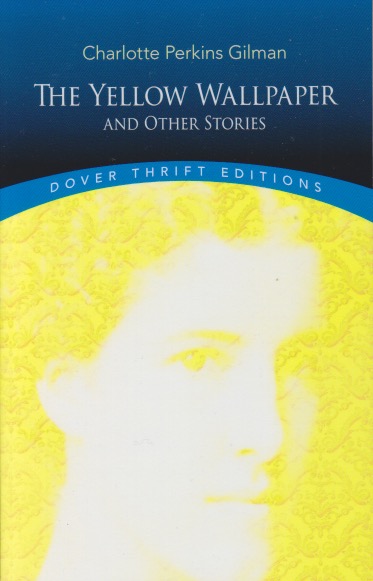
March is Women’s History Month.  My reading of actual history as of late has focused on the ancient Celts, so I confess to falling behind on modern women’s history.  Nevertheless, I came across an often forgotten piece in an unexpected way.  For quite some time I’ve wanted to read some work of Charlotte Perkins Gilman.  Her story “The Yellow Wallpaper” is known as a gothic classic.  Since a short story isn’t enough to make up an entire book, publishers have arranged different combinations of her tales into thin books that can be sold as a unit.  I purchased the Dover Thrift Editions’ version of The Yellow Wallpaper and Other Stories.  It was there that I learned Gilman was an early feminist who seems to have become unsung in more recent times.  Her fiction, at least as reflected in this particular edition, demonstrates the truth of the assertion.

Most of the tales in this little book require only a few minutes to read.  Although written around the turn of the nineteenth century, her stories anticipated many modern developments for women.  Her protagonists see the inequalities between the genders and work to overcome them.  They prove themselves successful at business and setting up their own houses.  There’s a gentleness to these stories that suggests quiet confidence may eventually wear down the often inflated male ego.  I found myself captivated even after finishing “The Yellow Wallpaper” itself.  Gilman isn’t judgmental, but she does note how unfairly the system operates.  She also offers solutions.

In this month of women’s history, it seems appropriate to rediscover one of the female writers who personally worked for women’s rights and expressed herself so fluently in fiction.  Her “If I Were a Man,” although clearly a period piece, takes a woman into her husband’s body.  She walks in his shoes, literally, and sees what “the world of men” is like.  This leads to both understanding and, above all, learning.  This would seem to be the very heart of history.  We read to learn both from what we did correctly to what we did wrong.  We have done so terribly much wrong.  The historical oppression of women is one of the greatest examples of our inability to catch up with our own ideals of justice and fairness.  There were historical reasons for this, yes, but we have moved beyond those times.  If only we’d act like it.  Although my reading doesn’t always keep in sync with the seasons, discovering Charlotte Perkins Gilman at this point in time was somehow more appropriate than anticipated.


Mothers’ Instinct

Maternity leave (not for me, but still) demonstrates just how sexist capitalism is.  This becomes very clear in publishing where schedules are reinforced by incentives (instead of paying properly) for meeting agreed-upon deadlines.  If an author gets pregnant while writing a book—not an unusual situation—it can throw shockwaves all through a book’s schedule from production all the way back up to editorial.  Why?  Because incentives are on the line.  It’s possible to counter with what if an author falls sick?  Or dies?  Yes, these happen too, but pregnancy isn’t an illness and isn’t infrequently a biologically constrained event—there is an age at which it ceases to become an issue.  So incentives, which are based on schedules drawn up before an author conceives, put the capitalist machine into a tizzy.

If employers didn’t rely on incentives, but paid better wages, this could make the issue less acute.  The entire system is devised from a male perspective.  Sickness and death do occur from time to time, but the invariability of a schedule (which ironically takes about nine months) is based on a view that doesn’t account for the somewhat likely event of a pregnancy.  I often think about this.  The corporate structure was made by men, for men.  We now give lip-service to equality while refusing to change the masculinist structure that underlies it.  By doing so the valuable contributions and improvements that women might make are kept under the standard business model.  No wonder it feels like we’re stuck in a rut.

Societal change is generally slow, and that conservative tendency preserves our property and our means of making a living.  If we gave women more prominence in leadership I would hope that this would start to change.  The male-oriented viewpoints of the capitalist entrepreneur, the stolid religious leader, and the halls of government, and even education, are reluctant to let people think differently.  We want to move forward, but we’re afraid of losing what we have.  This is why the conversation needs to widen.  Maternity leave reminds us that some things are more important than work.  Care for a helpless human being is something nearly all people would support.  It’s when they grow up that society feels it can safely ignore their needs.  We need a mother’s wisdom here.  Every time a pregnancy sets publication schedules in a frenzy I ask myself why we have to rely on incentives beyond just being the most human that we can be.


Savage Doc

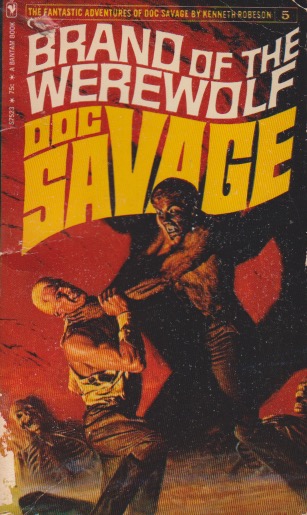
Over the past several years I’ve written quite a lot about childhood books.  Despite my ambivalence toward the internet, it has made it easier to find books from years ago.  Since one of my Modern Mrs. Darcy reading challenge categories was a book from my childhood, my thoughts went to Doc Savage.  I haven’t written much about the Doc on this blog.  I think I can understand why now.  Doc Savage, I suspect, was one line of inspiration for Indiana Jones, although the latter was much more of a hapless sort of adventurer.  Kenneth Robeson was a pseudonym mostly for Lester Dent, the author of many of the pulp fiction stories about Doc.  As a forerunner of the superheroes that were shortly to appear, Savage was a “Mary Sue”—a literary character with no faults.  The stories were originally written in the 1930s and ‘40s.

As a child I read many of these novels, beginning in sixth or seventh grade.  I recently found a used copy of Brand of the Werewolf, which I read as part of my challenge this year and I was embarrassed by what I found.  Not that Doc’s perfection came as a surprise.  No, my embarrassment was at the racial stereotypes that were so blatantly on display.  This particular story caricatures African-Americans, American Indians, and Spaniards.  It does so unselfconsciously with an air of entitlement that made me ill.  Sure, all characters suffer by comparison to Doc Savage, but those who aren’t “white” (or bronze, in context), are throw-away characters.  Unless, of course, they are pretty girls.  If so we’re reminded every time that they are pretty.

No wonder our culture remains so intolerant of difference!  Here the default human being is the white male.  Even Doc’s female cousin (pretty, of course) doesn’t really help at all.  The entire scandal is uncovered and resolved by the white man.  I realize that I might be putting too much stress on a pulp that just can bear much weight, but I do wonder about how such stereotypical messages, repeated decade after decade, blend into the cultural stew in which we all soak.  I was by no means the only tween reading these books in the 1970s, some three or four decades after they’d been published.  A friend of mine got me started on reading them, and they were still popular books at the time.  We need, it seems, to be aware that our prejudices will live on in our words after we’re gone.  And after all that there wasn’t even a werewolf in the book.  Childhood memories are sometimes unclear.


Sea Romance

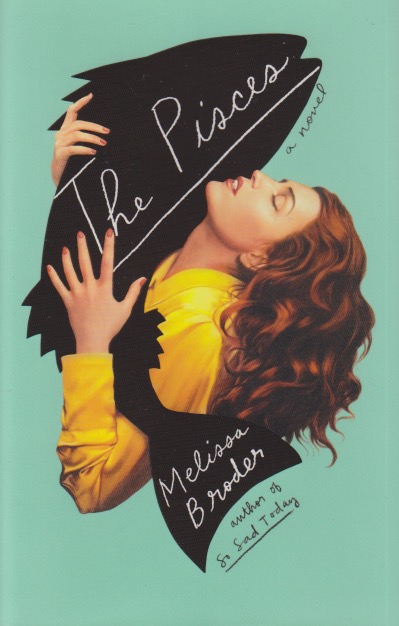
Sea shanties seem to be one of the early rages of 2021.  I’ll likely address this as a separate topic soon, but today I would note their appropriateness for discussing Melissa Broder’s The Pieces.  Despite my earlier concern about the Modern Mrs. Darcy’s reading challenge for this year, my family helped me put one together.  You see, January has become a bookish month for us.  Not only are books frequent holiday gifts, they are also a great way to anticipate a year of reading.  One of my categories was a book that makes you laugh out loud.  For help in selecting such a book I consulted some websites and found The Pieces so listed a few times.  The tie-in for sea shanties?  It’s the story of a woman’s love affair with a merman.

What defines a book as laugh-out-loud funny is largely the reader.  Yes, this is an amusing story with several parts that make the reader smile (or blush), but it seems to this reader a much more serious story than many reviewers suggest.  Yes, the idea of a merman makes it less reality based that much straightforward literary fiction, but the protagonist is portrayed as dealing with very real human relationship issues.  These made my reading of the book a pretty serious one.  When a person feels inadequately loved, it’s no laughing matter.  Sometimes such people (as the protagonist is portrayed as being) are driven to desperate measures, as the book suggests.  Perhaps some people find this funny, but others of us see a serious message dressed up in fiction.

Part of the draw here is clearly the romance of the sea.  Lucy (the narrator/protagonist) begins her relationship with Theo (the merman) because of the abusive kinds of relationships men have presented her with.  It’s a sign of Broder’s writing ability that she can make this kind of story lighthearted enough that some would call it hilarious or laugh-out-loud funny.  For me, however, when the issues raised are serious, even when couched in humor, there are underlying issues of sober import.  Relationships are complex.  Since the speculative element of a merman is thrown into the mix, it seems, many readers think the story is funny.  This despite the suicide attempts of one of Lucy’s friends and the death of the dog she’s watching for her sister.  For me laugh-out-loud books either have no serious consequences or dismiss such consequences as laughable in themselves.  The Pieces, however, made me think and, ironically, take a renewed interest in sea shanties.


BLM, MLK, and Justice

Martin Luther King Jr. was a martyr.  The word martyr means “witness.”  Given what we’ve all seen done by the Republican Party over the past two weeks, let’s hope they at least know the meaning of the word repentance.  King died trying to set people free.  Half a century later we’ve had to witness a sitting US president praising an armed mob, some of whom were carrying confederate flags, storm the Capitol.  Then, that very night, we watched Republicans still attempt to repress legitimate votes in order to keep white supremacy in power.  The set-backs of the Trump administration will take years to overcome.  King stood for equality.  He called for fair treatment.  He knew his Bible.  Now those who cynically hold the Good Book up for the camera can’t quote it but can tear down everything it stands for.

We need Martin Luther King Day.  This year especially.  We need to be reminded that all people deserve fair treatment.  Justice isn’t a meaningless word.  The color of one’s skin is no indicator of inherent worth—that belongs to everybody.  Throughout the country there are heartfelt memorials to King.  The various Trump towers—often segregated and reserved for the wealthy—are monuments of a different sort.  There is power in symbols.  Those who praise and crave money above human need will ultimately be remembered for how evil seeped into their bones.  How hatred of others and narcissism defined their rotten moral core.  Today we try to focus on a good example, but present reality keeps getting in the way.

Four years ago I joined about 1.3 million marchers in Washington, DC.  The Women’s March, as estimated by government officials on the ground, was more than twice as large as the media estimates still tout.  I’ve puzzled over this for four years—why when an oppressed group makes a stand officials and pundits feel the need to downplay it.  King made a stand and he had a dream that one day we wouldn’t have to make marches on Washington just so that everyone could have the equal treatment they deserve.  Human rights are the only rights we have.  Even as some haters are planning further acts of violence to object to a humanitarian president, we are given a necessary reminder that all people deserve fair treatment.  Black lives do matter.  Why has half a century not been enough to assimilate that simple message?  We need to sober up from the drunkenness of irresponsible power.  We need to learn the simple fact that nobody should be killed for being black.  That whiteness is toxic.  That we need to call out those who would use privilege to claim otherwise.