White Whales

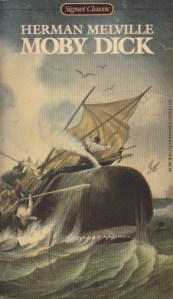
Every once in a while I return to Moby Dick.  I’m not sure why exactly Melville’s classic has such a hold on me.  Perhaps because I first read it while living in Boston.  For a land lubber like myself being so near the ocean was a kind of epiphany.  I read the novel as part of a course on wisdom literature in the Bible.  Harrell Beck, who was an influential person in my life, insisted that if wisdom themes were truly wisdom they would be found outside the Good Book.  We were assigned a list of modern novels from which to choose and I selected Moby Dick.  The thing that immediately struck me about the novel was just how biblical it is.  Ahab and Ishmael aside, the many references to Jonah and Job and incidental asides referencing scripture made this an intense reading experience.

I started reading it for the fifth or sixth time just before the pandemic became a crisis.  It is a large book and I didn’t want to rush through it.  I tried to pause and appreciate it this time around and I noticed just how remarkable it was that a man who made much of his life as a laborer, without any higher education, was so incredibly literate.  Classical references that I had to look up, and citation of sources blend together in a story that is compelling as it is unsettling.  Long explanations and descriptions are part of the tale, and the soliloquies are so philosophical that you have to sit back in a reverie after reading them.  I’ve read many novels in my life, but no others like Moby Dick.

As metaphorical stories go, the book is remarkably natural.  The descriptions of whales are as scientific in their own way as they are literary.  For an author with no scientific training this too is remarkable.  Indeed, a good part of the draw of Moby Dick is Herman Melville himself.  Although I have gathered a few degrees over the years, in my mind I am, like Melville, unlettered.  I’m sure he would’ve understood.  The fiction I write, although in a very different style, is a tip of the hat to him.  Friends used to tell me that nobody writes like that any more and that no publishers would show an interest.  The latter has proven to be true, and so much more’s the pity.  We could use more novels like Moby Dick.  And were my days not even fuller during the pandemic, I might even have a few moment to pursue my own white whales.


Honey and Wine

Academic writing tends to be limiting.  Don’t get me wrong, I still enjoy reading a well-crafted academic work, but when facing a new one I always experience that sinking feeling that this will be difficult work.  That doesn’t stop me from getting a little thrill when something academic I’ve written appears.  Pickwick, an imprint of Wipf & Stock, recently released the cover of Some Wine and Honey for Simon, the Festschrift for Simon Parker to which I’ve contributed.  As I’ve written elsewhere, this was an orphaned article that required some polishing up to be able to submit.  Thinking back on it, I reflect on how much has changed since then.  How I’ve left the land of Festschriften.  How my own research has changed.

Research, traditionally wrought, requires an academic library and lots of time.  You need to be able to spend your hours requesting books and articles that you can’t afford—really publishers?  $40 to purchase twenty pages that I won’t even enjoy reading?  Access to JSTOR will cost you if you don’t have a university post.  Now I trawl Academia.edu hoping to catch what I need in my net.  Sometimes it works.  Other times you bring up a coelacanth.  That’s the way of research outside the academy.  Also, I find myself reading books that appeal to me rather than strictly books on topic.  Many of them aren’t academic, but they are informative.  Part of research, it seems to me, is learning to access sources you wouldn’t normally find.  There’s the element of discovery.

Monsters appealed to me as a research area since there hadn’t been much written on them academically and I’d read most of what had.  The field is starting to take off now, which means  high-priced monographs and inaccessible research.  Working in publishing I think I understand the mindset—employees are expensive, especially in the United States.  They require salaries so they can live, and medical coverage so they can continue to live.  And most books sell so few copies that they really aren’t profitable.  But I like to think people would read about monsters, if they were priced down around the level of the demographic that appreciates them.  So one of my academic articles is about to be released to the world along with some wine and honey.  I’m still trying to sort out how to contribute from the margins.  And I hope Simon, who was always kind to me, appreciates the effort to honor a scholar and a gentleman.


Leg Up

It’s amazing how often J. D. Vance’s Hillbilly Elegy comes up in conversation.  The book struck a nerve.  Reading it wasn’t easy because there were so many shades of my own childhood that I felt uncomfortable at several points.  Not from the same circumstances as Vance (his family seems to have been better off than mine, from the descriptions), I was more a hillwilliam (shoutout to the author of Verbomania for the portmanteau) than a hillbilly.  We weren’t educated people, but my mother’s family wasn’t as poor as the one she married into.  We were socially mobile alright, but in the wrong direction.  Anyone who hasn’t come home from school to find carp swimming in the bathtub simply can’t understand.  The way of the poor is inscrutable, but something Vance gets spot on—it is almost impossible to improve yourself without a leg up.

The chapter where this really hit me was as he was describing how easy his life was after being admitted to Yale Law School.  He made connections and learned to work them.  That part never came in my case.  Like Vance I grew up without a father.  Unlike him, I didn’t have grandparents to come to the rescue.  It’s a long story, but when I left home my life became a search for a father figure only to discover than nobody really wants to help somebody else’s kid.  Although I was accepted into the high profile schools, I had no one to coach me to go there.  Even now people barely recognize Edinburgh for the wonder that it is.  It didn’t connect me the way Yale Law apparently does.  My career has been in freefall a time or two because of this lack.  As Vance explicitly notes, when you grow up poor you don’t have the training or family experience to know what to do.

Many people, I realize, are much worse off than I was growing up.  What Hillbilly Elegy, written by a Republican, shows is that the government simply does not care for the poor.  In what used to be the wealthiest nation on earth there is a tremendous amount of poverty.  Vance has a keen analysis of what the abnormal psychology of want does to people.  I grew up more of a Pennsylvania redneck than a full-blooded hillbilly, but many of the same lessons apply.  While some of us can muster the willpower to escape, we know we are in the minority.  We learn as adults that others don’t share our concern for those who struggle daily to get by.  This is an important elegy, and if only it were read seriously by those able to make policy there might be some glimmer of light in these dark hills.  The right leg up can do wonders.


Ethics of Nations

If it hadn’t started two world wars last century, Germany would likely have a stellar reputation.  I don’t say this because of my own Teutonic blood, but rather because as a nation they seem both intelligent and troubled.  Philosophical, if you will.  A story in Times Higher Education explains how Germany is planning its reopening with the input of humanities experts as well as scientists.  The stance is driven by ethics.  We know that when strictures are loosed more cases of COVID-19 will break out.  More people will inevitably die of it.  Germany realizes that this makes it an ethical issue as well as an economic one.  And ethics are best discussed by those who study humanities.  I noticed that they’re even including theologians on their panels.  This seems smart to me.

Meanwhile Boris Johnson’s reopening team in Britain is secret.  Not wanting the public to know who’s making the decisions that will certainly kill some of them, they prefer to act under cover of darkness.  The thing about the cone of silence is that it never works.  Historians will scratch their heads over how, in the course of one century, the good guys became the bad guys and the bad the good.  Have the Allies become an—to borrow a phrase—axis of evil?  The wealthy alone are worth saving, and the economy takes presedence over the welfare of the greatest number.  Back in my philosophy classes we learned about utilitarianism and also its problems.  You see, being a humanities specialist means learning to think through thorny issues, looking at all different angles.  Being a conservative means looking only at the bottom line.

Humanities are related to the concept of humanitarianism.  I know that’s a big word, and it doesn’t bring in much mammon, but still, it encompasses all of us.  This crisis could bring out the best in humankind, or we can let the narrative go to the Clorox-eaters and those who believe winning elections are all that’s important, even if there’s nobody left to govern when its all over.  Being a politician is a zero-sum game I guess.  Looking at the numbers, Germany seems to have brought the number of deaths down when measured against the count of established cases.  That to me seems like a human goal worth striving for.  Of course, we could just incite riots in our own countries to infect even more people.  Being reelected so as to give oneself even more tax breaks is all that really matters.  At least among the axis powers.


White Rabbit

There are books that make you feel as if everything you know is uncertain.  D. W. Pasulka’s American Cosmic is such a book.  Its subtitle, UFOs, Religion, Technology, only pauses at the brink of the rabbit hole down which this study will take you.  Over the years I admit to having been jealous of colleagues who’ve been able to make an academic career stick.  The credentials of a university post open doors for you, even if you’re a professor of religion.  Pasulka has opened some doors here that I suspect many would prefer to have kept closed.  This is a compelling book, threading together many themes tied to religious studies.  There are things we might see, if only we’ll open our eyes.

Although immediately and automatically subjected to the ridicule response, UFOs are a fascinating subject.  This book isn’t about UFO religions—of which there are many—but rather it connects this phenomenon to the study of religion itself.  In Pasulka’s related field of Catholic studies, there are those anomalous accounts of saints who did the impossible.  Like UFOs, they are subjected to the ridicule response, making serious discussion of them difficult.  Might the two be related?  As you feel yourself spinning deeper and deeper down that hole, technology comes into the picture and complicates it even further.  Pasulka was a consultant on The Conjuring.  I’ve written about the movie myself, but what I hadn’t realized is how media connects with perceptions of reality.  Yes, it has a religious freight too.

Every once in a while I reflect that my decision—if it was a decision; sometimes I feel certain my field chose me—to study religion might not have been misplaced.  Perhaps all of this does tie together in some way.  American Cosmic is a mind-expanding book that assures me all those years and dollars learning about religion weren’t wasted after all.  I had a discussion recently with another doctoral holder who’s been relegated to the role of editor.  We both lamented that our training was in some sense being wasted on a job that hardly requires this level of training.  Still, if it weren’t for my day job I probably wouldn’t have known about this book, and that is perhaps a synchronicity as well.  Life is a puzzle with many thousands—millions—of pieces.  Some books are like finding a match, but others are like informing you that you’ve got the wrong box top in hand as you try to construct the puzzle with the pieces you have.  If you read this book be prepared to come close to finding the white rabbit.


Ancient History, Part 3

It was an old idea.  I had it when I was still teaching at Nashotah House, that’s how ancient it is.  It seemed to me that if brains evolve with the rest of us, our perceptions of gods might change over time.  I’d been working on this for an Ugaritic conference held in Sherbrooke, Quebec.  The conference took place, but I’d been ousted from my position at Nashotah House.  The conference organizer, in what was an amazingly magnanimous move, came up with funding for me to attend.  I delivered the paper and Jean-Marc Michaud, of blessed memory, encouraged me to submit it to the tome with the very academic title Le Royaume d’Ougarit, de la Crète à l’Euphrate. Nouveaux axes de recherche, Actes du Congrès International de Sherbrooke 2005, Faculté de théologie, d’éthique et de philosophie, Université de Sherbrooke, 5-8 juillet 2005 (Coll. POLO–Proche-Orient et Littérature Ougaritique 2).  Unemployed and unable to access libraries, I had to decline the publication.

In one of those great ironies of life, I began to be approached to take on projects after I lost my academic position.  (This continues to happen; I received an invitation to contribute just last week.)  I often have to turn them down because I still have no access to an academic library and academics generally have no idea just how draining a nine-to-five is, with or without the commute.  In any case, a Festschrift for Simon B. Parker was announced.  I knew Simon as a student at Boston University School of Theology, and he wrote many letters of recommendation for me.  His sudden death shocked many of us.  Herb Huffmon, of Drew Theological Seminary, asked me to contribute to the Festschrift.  I still had this article that required some work, so I decided to try to finish it.  I received a note that the volume is about to go to press with Pickwick.  Academic publications won’t let me go.

If I had my druthers, I’d be getting along with my fiction.  I’ve had over twenty short stories published, and I’ve got many more in the works.  Every time I think, “Now I’m in the clear, I can focus on writing that is fun to read,” I get another academic invitation.  Those invitations don’t come with job offers, so I wonder why I have such trouble saying “no.”  Anyone who writes wants to be remembered.  We have ideas that we hope others will find engaging.  In academia you publish to keep your job.  Most of your work will be forgotten unless you’re groomed as an academic superstar (yes, they exist!).  I’ve never been groomed.  I write because I have ideas that beg to be expressed.  One of those ideas, many years old, will soon be available for consumption at Pickwick Press.


Begging Your Question

I still remember when I first consciously heard it.  The phrase “begging the question,” I mean.  I was a doctoral student at the time and one thing you do in grad school is ask a lot of questions.  I asked my advisor what the phrase meant.  “Asking a question when you’ve already assumed the answer,” he replied.  I’ve been writing quite a lot about feedback loops these days, and this was yet another of them.  Begging the question, in other words, is a fallacy where the asker isn’t seeking an answer, but is attempting to persuade another of a pre-decided outlook.  The concept is subtle, but important.  That’s why it disturbs me that most academics these days use the phrase “begs the question” when they mean “asks the question.”

I’m afraid I don’t have statistics here, but I read academese all day long—it’s my job.  I can’t footnote where this occurs but I can attest that it happens all the time.  Whenever I read “begs the question” I stop and reason it out.  Does the author mean “begs” or “raises” or “poses” or “asks” the question?  Begging a question isn’t the same as raising or posing or asking it since the latter three indicate an answer is being sought.  Precision in thinking is difficult work.  It can give you a headache.  We all fail sometimes.  Perhaps that’s why we eschew it, as a society.  It’s much easier to beg the question.  Still, doesn’t that mean this valuable concept is in danger of losing its, well, value?

I realize that posing such a question makes me sound like one of those old guys who says, “back when I was a youngster…” but the fact is the educational system in the United Kingdom made you ask lots of questions.  In a way that’s unheard of over here, where money assures your credentials, I knew two students who failed out of the doctoral program at Edinburgh when I was there.  One of them an American.  It wasn’t just a matter of laying your money on the barrelhead and walking out the door with a diploma.  I’ve read certified copies of dissertations (not from institutions in the United Kingdom) where Zeus was spelled “Zues” (throughout) and the biblical seer was called “Danial.”  Now, I suppose that raises the question of the value of degrees where you don’t even need to spell your subject’s name correctly.  Begging the question is a fallacy, not a synonym for asking.  And I know that if your thesis begs a question then you’re barking up the wrong tree, but that won’t stop you from landing a job in the academy.


Reading Connections

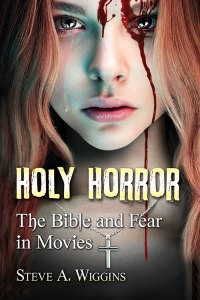
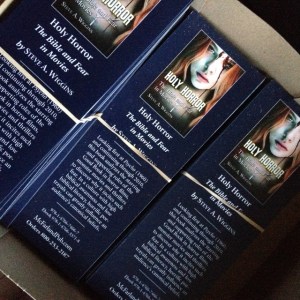
It’s flattering to have someone notice your work.  The other day I had the very first email from someone who’d read Holy Horror and wanted to discuss it.  It was from an undergraduate, no less, who was doing a report on religion and horror.  She’d read my book (and yes, it’s undergrad friendly) and wondered if I’d be willing to talk about it.  I can’t express how surprised I was (and still am).  You see, I have emailed authors after reading their books.  Many of them show no interest in carrying on a conversation with someone they’ve “met” through email.  I’ve had so many single-sentence responses with no enthusiasm whatsoever that I’ve begun to think of those employed in academia as hopelessly stuck in tunnel vision.  If you write a book you’re wanting conversation with those who read it, I should think.  At least I am.

Those of us outside academe don’t have tenure committees to please or effectiveness committees to placate.  We write books to try to engage readers.  Unfortunately Holy Horror is priced for the library market.  During our phone interview, my interlocutor asked about the cover.  She said something publishers should hear: when walking around with Holy Horror her friends asked what the book was about because the cover is intriguing.  (It’s actually based on Chloë Grace Moretz from the reboot of Carrie, discussed in the book.)  In the midst of a pandemic, this first show of interest made my day, like seeing the first crocuses after a long, hard winter.  I do welcome conversation about my book.  I don’t have a classroom of students to force to buy and read it.  It’s out there for discussion.

Nightmares with the Bible is nearly finished.  Of course, publishers have hit a bit of a slow patch with many of their business partners shutting down.  Some publishers have gone into hibernation during the pandemic.  Books, though, will get us through.  A colleague of mine said the industry reports are showing that novels continue to sell while nonfiction is suffering.  Well, I’m no expert, but I do wonder if nonfiction might do better if authors would be willing to respond to this who express an interest in their work.  I know it’s a radical idea.  I also know that my books reach nowhere near what most publishers consider a viable readership.  What people are looking for during enforced isolation is a sense of connection.  Reaching out to find someone reaching back.  Books can do this, even if we never physically meet.


Bunny or No?

Since we’re in the midst of a smaller holiday season (capitalistic societies can only get away with one major holiday season because the workers must work) many people are wondering whether they should go to church for Easter tomorrow.  I’ll confess I woke up from a nightmare this morning where I accidentally forgot about COVID-19 and went to church.  I stepped inside and the building was full.  I tried to find an empty pew to socially distance myself from all but the Divine, and there was no room.  I felt infected as others started to cough around me.  In real life I’d just read from the World Health Organization’s situation report (number 80, located here, in case you want to see) that we’ve just reached day 100 since WHO received its first notification of this new disease.  The report has guidance for those who feel compelled to gather for religious services.  It makes for very interesting reading.

WHO, like certain political parties, knows that people will listen to their religious leaders rather than reason.  (And still our universities cut positions in their religion departments since, apparently, it is best not to know about such things.)  Recognizing that a secular, science-based organization simply can’t compete, WHO urges religious leaders to spread the word about evidence-based responses to the outbreak.  Don’t gather large Easter-day crowds (they also mention Passover and Ramadan), but, interestingly, do keep the services going.  WHO recognizes the psychological (you can’t say “spiritual”) value of religious belief.  It gives people hope and comfort.  It keeps them going in difficult times.  Call it mental health, but the World Health Organization has wellbeing right there in its title.

Photo credit: ItsLassieTime, via Wikimedia Commons

Ironically, the same day I saw an email from the other acronym in my life, SBL (the Society of Biblical Literature).  They were releasing their annual report showing the dismal job market figures for the discipline over the last year.  These jobs are fading and although WHO recognizes billions of people are motivated by religion our smartest institutions are shifting their money away from understanding it.  The COVID-19 outbreak puts us in this strange place where disjunctures become focal points.  If you look at a field of uniform gray long enough you’ll stop seeing anything at all.  You need contrast for vision to work.  WHO recognizes that religious observance constitutes a major challenge for the effort to keep people isolated.  Universities now in isolation, continue to see no reason to study this.  I’m waiting to awake from this nightmare.


Distance Education

As an exile from academia, I do feel for my employed colleagues who are having to learn distance education techniques on the fly.  I do also feel compelled *ahem* to note that I was trained in online teaching long ago at Rutgers University.  The school declined to hire me then, and I’ve had no offers since.  Now it’s become fashionable for academics with virtually no online experience to look to the hills—whence is their help to come?  It’s not very often that I can claim to have been ahead of the curve.  In fact, I’m usually so far back that I don’t even know there is a curve.  Mismatches like this (someone who’s always been good at teaching, and trained to do so online, who’s been deemed exile-worthy while the unprepared now brush off their virtual bona fides) occur all the time in history.  It’s one of the things that makes it interesting.

Higher education isn’t a luxury.  I disagree with President Obama that all people should go to college, though.  Not everyone needs to.  Everyone should be able to attend, however, if they feel compelled to do so.  There are a number of myths about it that politicians of all stripes should seek to dispel.  One is that the more education you get the higher salary you’ll be able to demand.  As a Ph.D. holder I know that is decidedly not the case.  There are plenty of manual labor jobs that pay better than the options open for a humanities Ph.D. earner.  I also know that universities don’t tell new doctoral candidates this fact.  The old ways are changing.  I’ve often wondered if the collapse of civilization would be slow or rapid.  Living through it I now can see it looks slow from the inside.  Future historians will need to assess for future readers how it looks from the social distance of chronological clarity.

Historically crises have helped people pull together.  This one seems only to have divided us further.  If our government knew how, it could now model kind and considerate behavior.  It doesn’t know how.  The selfish often don’t comprehend how the wellbeing of others can affect their own.  Some companies are beginning to realize that customer loyalty after the crisis may depend on reasonable treatment at at time like this.  For others it’s more difficult than house-training a new puppy.  Nobody wants to go into exile.  When you do, however, you can’t help but notice how it changes your view of things.  Ironically I was hired away from academia the very year I had completed my training in distance education.  I can image how it might’ve been.  But then, I’m living in a land not my own.


Merch

I recall the time I first heard the word “merch” used as a verb.  I was with some wonderful ladies on the second annual Women’s March, in New York City.  We had to leave fairly early to get there from Jersey and as we made our way to the march route, we saw the goods.  Vendors had all kinds of things on sale, from the ubiquitous tee-shirt to refrigerator magnets.  One of the women in the group said, “I guess you can merch anything.”  And so you can.  People will buy all kinds of identifying marks.  It’s a craze I personally don’t get into.  I buy plain clothes, having more of an Amish aesthetic.  Still, I was a little surprised to notice that the Society of Biblical Literature is now merching itself.

Now, who can blame a non-profit for trying to score a little on the side?  We all know what that’s like.  What I find myself most curious about is who would want to advertise that they’re working on a degree that will, in all likelihood, find them on the breadline when it’s all over?  I’ve known many who’re proud to be nerds—they’ve got employment to give them creds.  Those of us tormented by the meaning of it all, not so much.  My decision to go to grad school was accompanied by the blessed assurance that there’d be plenty of opportunities, but there was no merch.  Indeed, I was two years into my doctorate before  I even found out what the SBL was—the great connector whence came jobs.  At least in theory.  I found my post at Nashotah House because a friend told me about it.  I still have some of their merch.

Knowing what I do now, would I have done it any differently?  It’s difficult to say.  Who can recall the frame of mind of his younger self with such clarity as to know his choices?  Having studied Bible I was curious whence it came—to turn back even further the pages of history.  As I sit here in the early morning I have on my last two remaining pieces of Edinburgh merch.  My moth-eaten woolen divinity scarf and my blue alma mater sweatshirt.  I try hard not to think how close to three decades ago it was.  I was so sure I’d find a job with that rare Scottish degree, imprint of John Knox’s breeches still fresh upon my head.  Instead the merch of my current employer—a coffee mug—stands before me, reminding me that work alone awaits.


See Index Saw

Too much of my life is taken up with indexes.  If life with technology is a teeter-totter, then my generation stands just above the fulcrum.  There are guys with whom I attended college who maintain no internet presence at all.  I’ve repeatedly searched for college buddies and come up blank.  Those in the decade following mine, if they want to work, have pretty much resigned themselves to tech.  Those in the decade before, not so much.  What does this have to do with indices?  Plenty!  You see, in academic publishing, and its consequent research, you need to look stuff up.  If you read multiple books on the same topic you’re not likely to be able to pinpoint a page number without an index.  You remember you read it here (you think) and so you stick a finger in the back and begin checking out the pages referenced until you (hopefully) find it.  That’s the old school way.

I’ve typed my fingers down to the marrow trying to explain to guys my age and older that the average academic no longer uses a print index.  Just about everything has been digitized.  Although I’m no fan of ebooks (I very seldom read them) looking things up is sure much easier with a searchable PDF.  Type in your search term and voila—an easy list of references appears that can be quickly clicked through and checked.  And yes, my colleagues, that’s what people are doing these days.  I lament the decline in print books.  When I set out to write a book I have a physical object in mind.  It has pages and a cover.  A spine.  I am writing a book, not “content” to be “exploited” in “multiple formats.”  And yet, the index is really no longer necessary.

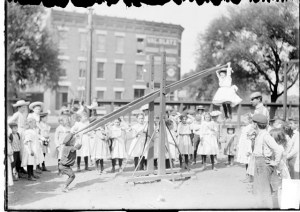
The typical academic author whose book is at the production stage fusses greatly over the index.  Calmly I explain that indexes are very rarely used.  They must have detailed indices, they insist.  The thing about teeter-totters is that they move.  I have an inner-ear problem.  As a child this prevented me from doing the usual playground things like swinging and seesawing and spinning, to different degrees.  I still can do none of those things well.  My wife and I bought a gliding rocker early in our marriage, that seats two.  We quickly learned that I couldn’t rock with her.  Indexes, you see, are on one side of that long board.  It’s the side on which the heavy weight of time rests.  So ponderous is it that the kids on the other side just can’t get it off the ground.  And I spend my days over the fulcrum trying to get the two sides to play nice together.  Without rocking the thing too much.

Photo credit: Chicago Daily News, via WikiMedia Commons


Classic Monsters

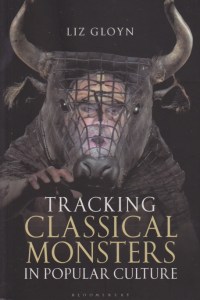
Convergent evolution is a term that’s used for when two unrelated species, separated by some gulf, develop a smilier trait independently.  I began studying monsters in biblical reception history before I really knew others were doing so.  After I’d written Holy Horror I discovered an article by another scholar who was doing similar things, even looking at some of the same movies.  Liz Gloyn, it turns out, was also doing something quite similar with classical monsters.  Her Tracking Classical Monsters in Popular Culture just came out a couple months ago.  Having taught classical mythology for a few semesters at Montclair State University, I have retained an interest in the subject and I was delighted to find a scholar who suggested that to get at the real substance you sometimes have to look beyond the heroes to the monsters they fight.  It’s the monsters who often prove more human.

Covering both cinema and television, Gloyn considers how classical monsters are represented in modern reception.  She looks at their appearance in literary forms as well.  Obviously not all of these reception avenues can be examined, but those she chooses are entertaining and informative.  In the case of biblical studies, I long ago came to the conclusion that biblical scholars pretty much just speak to each other.  The average person doesn’t read their books and the average pastor doesn’t either.  Laity, for the most part, get their interpretation of the Good Book from pop culture.  There’s a very good case to be made that, shy of sitting down and reading through a very big book, people would have little access to the Bible, or classics, if it weren’t for media representations.

Concurrent with my teaching classical mythology, the release of the reboot of Clash of the Titans transpired. (Gloyn covers both the original and the remake in her book.)  Students were really excited, anticipating the film.  It was one of the rare times (The Book of Eli was another) when I felt compelled to watch a movie as an adjunct professor, simply to share the experience with my pupils.  Clash of the Titans had made an impact on me in high school but the reboot failed to take me to the same place.  Still, here be monsters.  Those who’d never read Hesiod, Ovid, Pseudo-Apollodorus, or Homer, may have thought they were getting the straight dope from the silver screen.  That’s what reception history is all about.  Gloyn’s treatment kept me riveted, and I used to teach the subject.  Monsters have a way of doing that to you.


Without Peer

Peer review makes the world go round.  Well, at least the academic world.  It’s based on a simple enough premise: if your academic work is passable other scholars will be able to tell.  It’s a process fraught with peril, however.  Scholars, being human, are subject to fits of pique or of hypersensitivity, or just having gotten out of the wrong side of bed that morning.  Perfectly good projects can be shot down with a single, well-placed arrow.  Or even dart.  Problem is, there’s no better system for deciding if academic work is adequate, or even good.  There may be some objective measure out there in the universe, but if there is we don’t have access to it.  We have to rely on peer review.

During my teaching years, which numbered nearly twenty, I was never asked to peer review anything.  My first invitation came while I was working as an editor.  Of course I said “yes.”  A number of scholars, however, don’t share the basic reality that if nobody peer reviewed their work, they’d never get published.  Many scholars decline offers to review their colleagues’ work.  I even had a very senior scholar once blithely tell me that he had his own research to do, so why should he take time to review that of others.  Professional reserve prevented me from pointing out that if his colleagues felt the same way he’d be as unpublished as a fresh doctorate-holder.  Scholarship is a cooperative venture, no matter how many Lone Rangers ride the cuesta.  So why is it so difficult to find peer reviewers?

I’ll read your book if you’ll read mine!

Something I’ve noticed is that many scholars are coddled.  Constantly told that they’re brilliant and gifted, they come to believe it like miniature Trumps.  More to the point, perhaps, is the shrinking number of academic positions.  The few who hold actual jobs are bombarded with other tasks, including committee work, advisory duties, and sometimes even teaching (depending on the adjunct pool).  I know it’s tough.  Been there, done that.  Nevertheless, academia cannot survive without the basic peer reviewer.  Education is a cooperative venture.  We may imagine the academic alone in her or his study, but breakthroughs generally come through when people work together.  Of course, my job is one performed in isolation.  Increasingly, academics can be found not in their offices, but working remotely from home.  Is the sense of “peer” itself breaking down?  My own book, Nightmares with the Bible, was slowed down by peer review.  In a sense I’m glad it was.  Hi ho Silver, away!


CBD

They found me.  I used to call them CBD, but because of the popularity of a certain hemp-based product, Christian Book Distributors changed its name.  Now I knew about them long before they had me on their mailing list when I taught at Nashotah House.  When I was a seminary student in Boston I made occasional trips to CBD’s Peabody warehouse for sales—this was quite a boon to students who never have enough money (little did I know!).  Books you’d heard about in class were there, for a fraction of the price.  At Nashotah I always looked over their bargain page, because, well, professors like books.  I recognized their catalogue in my mailbox instantly.  The name is now Christianbooks.com.  Grab some munchies and sit down.

Not only the name has changed.  Back in my student days I could find academic resources here.  As religion in America has become more and more polarized, what used to be CBD (if I use their current incarnation my computer insists on putting links in) has become radically conservative.  Page after page of study Bibles reveal no hint of the mainstream bestsellers in the genre.  It’s as if they don’t exist.  More than that, if you leave them out maybe people will come to believe they don’t exist.  Even the bargain books are nothing an erstwhile professor would buy.  Instead of academic titles there are all kinds of Barnes & Noble-type gimmicks to get shoppers to spend their money.  Like junk food for the soul.  I look at the books on my shelf.  Some of them were purchased, cash in hand on the ground in Peabody.  Not any more.

There will be those who claim (fake news is the only news now) that what has changed is me, not them.  The fact is places like CBD used to be more open minded.  They admitted the possibility of doubt.  Now your choices are Scofield or Ryrie.  That should be enough for any appetite.  Not only that, but many of the titles now sound militaristic.  Battlefields and all.  Thumbing through, I wonder where Jesus has gone.  The evangelicalism of my youth was clearly Prince of Peace centered.  Now it’s politicized to the point that I’m not sure what it represents beyond GOP values of greed, opportunism, and power.  Anyone who thinks differently need not apply.  How CBD found me after all these years, I do not know.  I wish they’d consider saving the environment rather than printing catalogues to send me.  The climate, despite what they would claim, has changed.