Who Knows?

While I have nothing less than respect (and just slightly less than utter awe) for my alma mater of Edinburgh, I cannot help being bemused at times by the alumni magazine. Between my wife and I, when we fail to cover our tracks adequately, we receive almost as many alumni magazines as exclusive credit card offers. Anybody intelligent enough to graduate realizes that these magazines are attempts to raise money, but they maintain the illusion of giving actual news. Thus it was I found myself facing a pithy piece stating in no uncertain terms that “Near-death events are ‘tricks of mind.’” The rationale given is that psychologists at both Edinburgh and Cambridge have decided it is so.

Now, I’ve never had a near-death experience, nor do I really ever want to. I don’t know what to make of the stories of those who claim to have “crossed over.” The problem is, there can be no winner to the argument of authentic experience versus mind trick. Those who know, by definition, can’t tell. Each side has good points to make. Some religions, particularly those of western orientation, tend to offer an afterlife anyway, so when someone appears to have slipped over the edge and claims they saw a great light, well, why not? Scientists often make the equally valid point that the rapid images that occur in the brain may seem to stretch on into minutes or hours and may incorporate images that our culture lends us of what to expect when the darkness falls. The near-death experience is, they say, final jolts of electrical “noise” just before brain activity ceases.

Some things we just can’t know, even if we attended Edinburgh. “Near-death experiences are not paranormal but are triggered by a change in normal brain function, according to researchers.” So the article says. There seems nothing paranormal about death—it is as natural an event as exists. It is common to us all, including pets and pests. The “paranormal” is the idea that something continues after death. If that something includes a deity or two, it becomes “religious” rather than “paranormal.” Whether religious, psychological, or paranormal, intelligent people continue to debate what is actually happening to those who have been briefly dead and have the medical records to prove it. For my part, if there’s something on the other side, I hope it’s a lot like Edinburgh. Maybe with a few less alumni magazines, however.

Life, and then this.


Facebook Apocalypse

Facebook can be a fickle friend. Oh yes, there are rules that we know everyone doesn’t quite obey. You are not allowed to falsify evidence about yourself on the great FB, although characters like Jesus have their own pages. The Chronicle of Higher Education this week followed the efforts of a University of Nevada at Reno librarian who tried to use Facebook for educational purposes. Donnelyn Curtis had set up Facebook accounts for two students early in the twentieth century to give current students an idea of how times had changed. The pages were summarily removed by Facebook staff, leading to the unfortunate second deaths of Joe McDonald and Leola Lewis. Second deaths always get me thinking about the book of Revelation. After all, we are now into the fatal year of 2012.

My Mayan Calendar

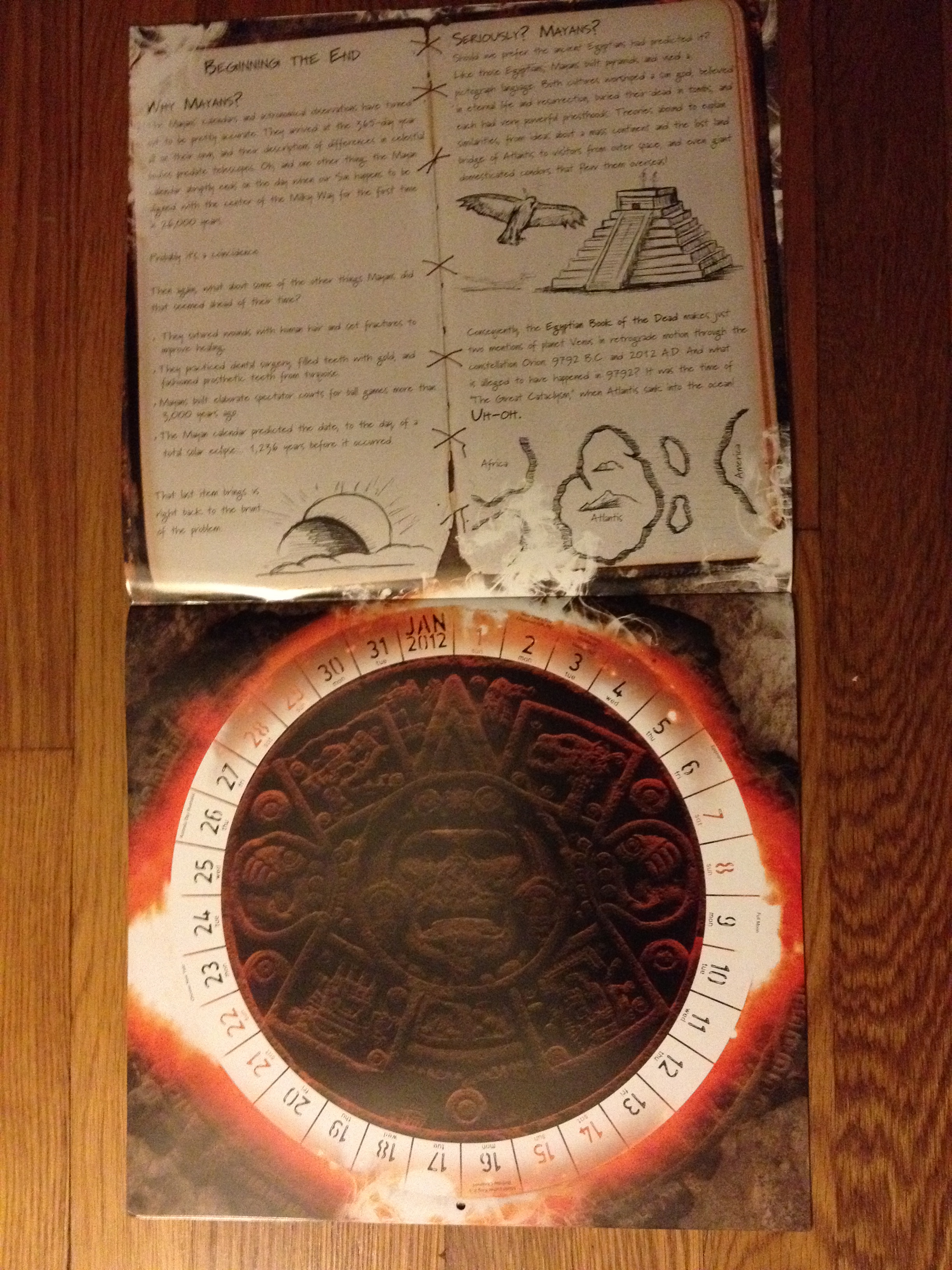
Few events elicit religious fervor like the end of the world. In the most highly touted end-of-the-world scenario since 2000, 2012 has emerged as the great contender for wrapping up the show we call life on earth. When I spotted a calendar to prepare the user for the end of the world, well, how could I resist? Each month on this terminal calendar features facts pointing to the culmination of this strange experiment that evolution hath wrought. If we can’t pull off a good, old-fashioned Evangelical rapture (sorry Rev. Camping), maybe the Maya can get the job done. They certainly managed to pull off an impressive vanishing act a few centuries back. Or did they? Despite the overrunning of enthusiastically avaricious Christian invaders, the Maya accommodated themselves to less-than-ideal circumstances and survived. They are still among us. Their culture, however, didn’t fare so well at the hand of the church. Nobody’s asking them about any of this.

Apocalyses occur all the time. When religions meet, one inevitably tries to vanquish the other. No one walks out of that arena without a limp. And the winners look over their shoulders for ever after. To prepare for this apocalypse, the January on my new calendar narrates how the Mayans and Egyptians shared some cultural secrets—such as how to build pyramids. How did they know about one another? My calendar says they could have walked across Atlantis, or they might have been carried by giant, domesticated condors. Either alternative seems as likely as the other. Either alternative seems about as likely as the world ending this year. But then again, already in 2012 a couple of promising young people have already been kicked off of Facebook for being dead. I think I feel the apocalypse beginning already.


Doubting Peter

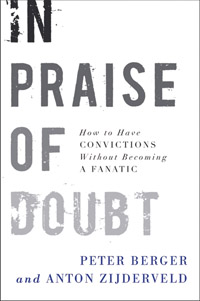
As a student at that university across the river from Harvard, it was clearly a matter of institutional pride that Boston University could claim Peter Berger. He was one that Harvard didn’t manage to get. Of course, I never took any courses with Professor Berger, but his work on sociology of religion is still considered the standard in the field. When his recent book, In Praise of Doubt, appeared a couple of years back, I knew that I had to read it. Originally published by an academic press, it was unnecessarily expensive (well, as the minion of an academic publisher I now realize the rationale for the prices, but I still get spasms in my wallet every time). When it appeared in paperback I finally located a copy that I could justify buying. I was not disappointed.

This little book begins innocuously enough, but by the end you find yourself realizing that you’ve just downed a potent draught. We are all familiar with doubt, but what many of us do not stop to consider is its role in different religious perspectives. Moving us through absolutism and relativism, In Praise of Doubt demonstrates how either position may lead to a “fundamentalism” of sorts, and for the same basic reason: neither position professes enough doubt. Having been raised in a fundamentalist environment, I knew that doubt was the great enemy. Certainty was the only true sign of faithfulness. The problem, for me, is that I’ve always harbored doubts. The more I learned, the less certain I became. Doubt had acquired the stench of sin, and I tried to avoid the very element that constituted my personality. Berger has finally given doubt its due.

In a world of extremists—extreme religionists and extreme atheists—the still, small voice of doubt is frequently drowned out. Doubt, however, has a noble pedigree and even more remarkable progeny: tolerance. Those who are certain tend to have little tolerance for those who differ, or worse, those who challenge their views. The doubter, as Berger (and co-author Anton Zijderveld) asserts, is less spineless than s/he appears, being open to the fact that no one has all the answers. No matter how eloquently Hitchens, Harris, or Dawkins may grow, they do not have all the answers any more than (god help us) Pat Robertson, Rick Warren or Tim Tebow. Probability and logic tend to suggest the former are closer (much closer) to the evidence than the latter, but who knows? It might even be possible that the Evangelical camp may one day learn the virtue of a little uncertainty by reading this book. But frankly, I doubt it.


Chronicle Illness

In a completely innocent blog post on the Chronicle of Higher Education, Geoffrey Pullum wrote about the use of singular “they.” I won’t try to summarize his work here—it is quite fine the way he writes it. What I would like to note, however, is what was likely an unintentional grammatical association that is quite profound. In two consecutive paragraphs, Pullum requires a synonym for someone who is unwilling to listen because they’ve already made up their mind. His choices are those who believe in “unquestioned dogma” and those who hold a “resolutely and hermetically theological view.” Both phrases indicate those who unswervingly accept religious belief. The article is lightheartedly written, and quite witty, but there is something serious here. Religion has built itself into the great bastion of intolerance.

The more I contemplated this correlation, the more it became clear—when we need to express someone’s complete devotion to unquestioned propositions, even when reason dictates conclusively that they are wrong, we are in the realm of religion. Religions may accept one another, but as long as truth is at stake, and as long as truth is one, there will always abide that smug satisfaction of knowing that my religion is at least a smidgeon closer to that truth than yours. Such thoughts, when matured and fully-grown, are bound to cast the seeds of intolerance abroad. Religions don’t take prisoners. Having spent a lifetime studying religions I’m not so crass as to put them all in the same cage together (that would be cruel), but history has demonstrated that when properly provoked any religion will turn intolerant. The provocation is mostly just daily life.

Literary folks have thousands of tomes full of words and ideas from which to draw. One of the joys of reading is finding so many ways of expressing that which we experience in fresh and insightful ways. With all these words and concepts from which to choose, the most immediately recognized to express unwillingness to listen belong to religion. Listening to Pat Robertson or Pope Benedict XVI, it is not hard to see why. Religions give the world much more than reasons to fear, distrust, and hate others. But they do include these components as well. The only way to change this image is replacing the arrogance of dogma with the willingness to listen with humility. If religions would do this, there would be room for everyone in this conversation; they’d like that, wouldn’t they?


Paranormal Activity

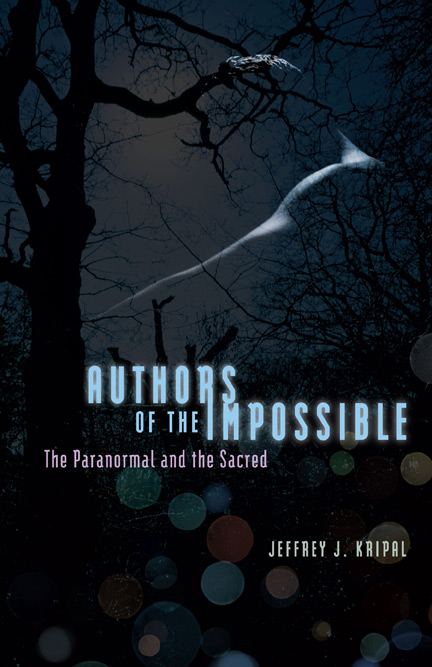
Once in a great while books with the potential to shift paradigms come along. These rare books often deal with taboo subjects, those areas of inquiry forbidden even to the most educated sectors of society. One of those books is Jeffrey Kripal’s Authors of the Impossible. I bought this book because of its subtitle: The Paranormal and the Sacred. I have argued before that paranormal subjects are very closely related to religion, but it is so unusual to find another scholar who openly takes on this question that I was shocked at finding Authors of the Impossible. Kripal is an academic who is willing to consider what is, as he admits, impossible. Those who’ve read deeply in the record of human experience, however, know that weirdness has accompanied us from the time we could write it down. It stands to reason that the uncanny stretches back before even that singular hallmark of human development. I have suggested elsewhere that it might even be the origin of religion itself.

Universities are establishment institutions. Free inquiry is not free, as I’m sure advocates of the National Security Act are glad to know. Most university professors who’ve seen a ghost or some unidentified object in the sky or an anomalous creature will never admit it. The easy equation of such things with mental instability keeps establishment people in line. It also cuts off honest inquiry into things people have experienced for centuries. Kripal is unafraid. In this book he considers the works of explorers most academics refuse to take seriously, despite their obvious intellectual ability: Frederic Meyrs, Charles Fort, Jacques Vallee, and Bertrand Méheust. Let’s have a show of hands: who has heard of any of them, except maybe Charles Fort? Each of these explorers was/is very educated. Each takes an aspect of the paranormal seriously. As Kripal points out, we will accept a physicist from CERN telling us that the impossible happens at the quantum level, but if you see a UFO you belong in an asylum. Is it because the paranormal violates not only the laws of physics, but also the laws of religion?

Life is too large to take it all in. We don’t even know what consciousness is. This is a question to which Kripal returns to conclude his book. His suggestion is that the paranormal is a literary hermeneutic—we are written by forces and powers outside our knowledge. Without denying science, indeed, while advocating it, Kripal suggests that it is not the whole picture. We are animals with two brains fused into one, and even scientists and materialists feel the sting and caress of emotion. Kripal is brave enough to assert that the emotive, imaginary side is just as real as the rational, materialist side. Noone can seriously doubt science and step onto a jet, Kripal shows that one need not doubt science to step onto a UFO either. If we are willing to participate in the reality our minds generate, the potential for human evolution really explodes. The only problem with Authors of the Impossible is that it is too short. An extremely deft writer, Kripal makes you laugh and think at the same time. And when you’re done, you’ll realize just how weird the world really is.


Unorthodox Accreditation

While going about my editorial duties, I found myself directed to the webpage of the Antioch School of Church Planting in Ames, Iowa. Okay, I’ll admit that the fact that I spent the holidays in Ames may have been what actually motivated me to look. Over the past twenty-some years I’ve spent many holidays in Ames, but I never knew of this particular institution. I had been checking up on somebody’s status when I found the Distance Education and Training Council. The DETC is an accrediting body. In a world where we can’t take anyone’s word for it—especially not a bunch of academics’ many words for anything—we have invented accrediting bodies. These watchdog groups maintain the high academic standards that we like to mix well with our beer and football to make the American college experience. The DETC, however, scopes out remote education programs. Often these schools have no campus. The ASCP is accredited by the DETC.

So I poked around Antioch for a while. The name is taken from the ancient Syrian city where the early Christians first earned their title. It became clear in a fraction of a second that this accredited program is an ultra-conservative answer to seminary education. How to get what looks like a regular degree to improve your indoctrination. Instead of being bemused (one seemingly appropriate response), I was actually a little bit disturbed. Education occurs every day in non-structured ways. I can get a whole life lesson just walking across Times Square. When we want standards of comparison, however, we rely on tried and tested schools to offer us degrees. When a program that supports opinions that run counter to the educational system’s standards gets accreditation, we all need to watch out. Somebody call the Bureau of Weights and Measures!

The distrust of academia often does not apply to such self-promoting schools. Americans tend to love self-made doyens who bring education down-home. As far as I could tell from the website, the Antioch School is an extension of a local Bible Church that is intended to provide future clergy with home-baked degrees. That in itself isn’t a problem, of course, but when the wider public doesn’t know the inner workings of higher education, and generally distrusts it, who’s to say whether any degree is valid or not? Aren’t all bachelors created equal? Not really. Accrediting doesn’t prevent abuses from slipping through the system—I’ve seen it happen firsthand, right under accrediting teams’ noses. It is a game we play. You can earn a master’s degree or a doctorate in planting churches. And if you ask me, that’s the same thing as getting a degree in planting corn, only much less scientific.

No way through this maze.


God Particle

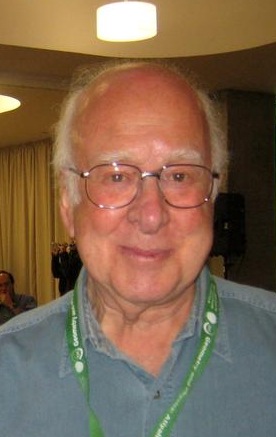
Over the last couple of days the Higgs boson has been in the news. Although I seldom ventured too far from New College and the faculty of divinity at the University of Edinburgh, it makes me glow with a special pride knowing I inhabited a small corner of the university of Peter Higgs. (And many other luminaries, including Charles Darwin.) My hopes of understanding the Higgs boson are more remote than even finding a university post (very long odds indeed), but I know that it is so important to physics that it has earned the moniker of “the God particle.” I first learned of the Higgs boson through Morgan Freeman’s Through the Wormhole series. At that stage it hadn’t yet acquired its divine status. Godhood must be earned, after all, at least in the eyes of humans. It is the proposed particle that stands to make sense of quantum physics, the world of the very small and the very weird.

There is an object lesson hidden in here. When even scientists get pushed to the limits of human knowledge, superlatives grow diminished. What can we call such a radical, powerful force in human thought? The particle itself, the boson, is not inherently stronger than a proton or electron, but its divine designation comes from its ability to, dare I say, replace god. In other words, it is the particle that explains so much that it is like the new god. News stories do not tell us where the nickname arose, but the best guess seems to be that some journalist with a flair for the dramatic brought God into the equation. God sells copy. But has the name also got enough room for a snake around the tree—or rather, around the nucleus?

In America, where science is under siege, any claims for God will be taken literally by some. We have witnessed again and again sheer silliness being paraded as “science” by Bible “experts” who take nearly half the population with them. The mental gyrations of the intelligent design crowd as they try to force God back into the equation should be warning enough. The God particle is baiting them and most Americans are ill-equipped to decide for themselves what is actually science. No sooner do we get a grip on nanotechnology than we begin building nanocathedrals. In that cathedral if scientists find the Higgs boson, it will not be god. It will, like god, open the door to many more unexplained phenomena, for god is not an explanatory principle. If we need a name to convey the great, rational explanatory power of such an elusive sub-atomic bit it seems to me—and I may be biased—that we call it the Edinburgh particle instead.


Silent Fright

Baylor University has begun to make quite a showing in the non-sectarian academic world of late. Knowing of the school’s Baptist heritage, I’d always been somewhat suspicious of any scholarship susceptible to doctrinal poisoning. I freely admit that my fear goes back to a hyper-evangelical college roommate. Even at the conservative bastion of Grove City College, John would lament the sorry religious state of the school and repeatedly thought of transferring to Baylor. (I need not fear that John will ever read this—he avoided liberal dribble like it was Planned Parenthood.) By association, Baylor became something in my mind that it apparently is not. When the administration recognized the direction the Southern Baptist Convention was going, they took steps to protect themselves from a takeover (something I’d witnessed at a much smaller school some distance north). The university press has been producing intriguing books, and the sociology department has been cranking out some fascinating studies of religion.

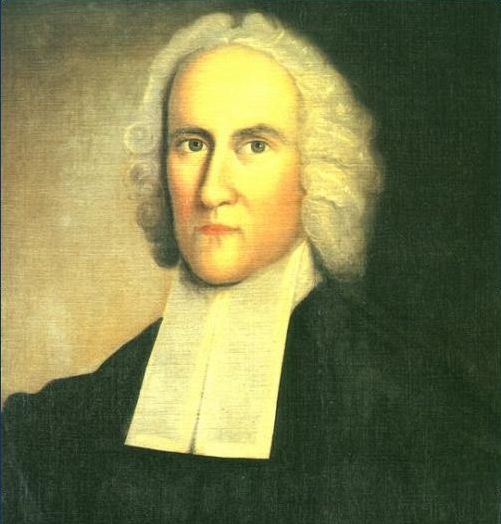
One of the more recent religion in America surveys from Baylor indicates that a correlation exists between the image of God presented by a version of Christianity and that contentedness of believers. More specifically, churches that promote a judgmental image of God (think Jonathan Edwards and his spiritual bedmates) tend to be anxiety-ridden and compulsive. Churches that teach a loving God have more balanced believers. Brimstone and hellfire, in other words, produce the expected results. What the Baylor study shows is not so much surprising as it is scientific. Well, softly scientific. As a social science, sociology relies on statistics and analysis to draw its conclusions. We now have a means of measuring religions outcomes.

Religion is, in many ways, self-fulfilling prophecy. By preparing believers for a literal Hell of a future, it cranks out automatons who’ll do anything to flee from the wrath to come. Herein lies its danger as well. Although some politicians may be naïve about the veracity of belief, many of them realize something their more liberal compatriots don’t—religion motivates. The religion of a loving God who has no Damoclesian sword hovering perilously over the heads of the faithful won’t get them to the polls. The god with believers on a skewer above the everlasting barbeque pit will. Baylor has shown us the data. If we ever hope to redress the damage constantly visited by politicians claiming God has told them to run for office, to invade Iraq, to commit war crimes in the name of the prince of peace, we must act on good information. If religion is a psychological anomaly, it pays to learn a little applied psychology. Otherwise the wrath of an angry god will consume us all.


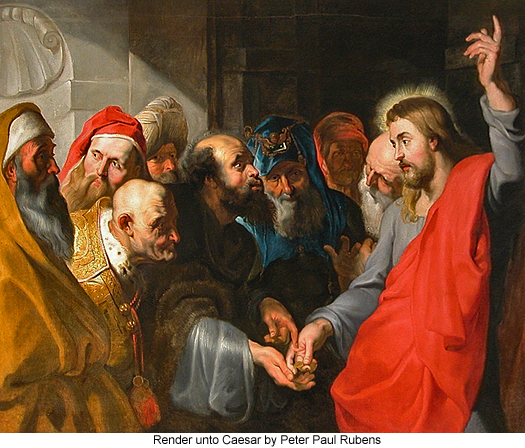
Render unto Caesar

My wife shared a very appropriate video concerning the ongoing tragedy of the GOP race for presidential nominations. Presented as an ad by Jesus, “Jesus” tells how Rick Perry has co-opted his name but not his message.

It is a fun look at a very serious issue. The serious issue is that people unable to think critically about religion are doomed to be its slaves. Where’s the proof that Jesus supports one candidate or another? When is the last time the voting, uncritical public ever demanded the proof?

Thinking back to just a few weeks ago, Herman Cain had made the spectacular claim that God told him to run for president. If the claim was sincere, how could he have withdrawn from the race? Where’s the lightning bolt (as long as we’re believing mythical images of God)? Has anyone checked his office lately to see if he’s still with us?

Religious gullibility is America’s most dangerous deficiency. We elect “the most powerful man on earth” based on his religion, and yet, very few know anything about it. But hey, it sure sounds good!

Religion is the elephant in the room. Nearly all people learn religion from their parents or guardians. Some rebel, but few study it beyond the requirements of their obviously biased religious leaders. Children trust adults to inform them of the truth. We fill their heads with images of a large, white man, bearded, sitting on a huge throne in the sky. You can’t see him, and he doesn’t answer when you talk to him, but he is very, very concerned about who you elect as president.

Many colleges and universities do not offer the opportunity to study religion with neutral experts. Those best poised to make a difference, like large state schools, often shy away from the study of religion completely. Those that do offer the chance to study often unknowingly hire a committed believer, sometimes presenting him or herself duplicitously as neutral and objective. And so the cycle continues. As the old hymn plaintively asks, “will the circle be unbroken?”

As a nation we value religious freedom, but we have set up a system to abuse that freedom. (One might say, “ritually abuse”.) Answer me honestly, Mr. Perry—is it not true? Oh, and that Frisbee is not a threat to national security.


On the Move

Truth is increasingly a moving target. And when the Chronicle of Higher Education runs an article about religion, academics take notice. Actually, the article is about irreligion. An interview with Routledge author and Pitzer College professor Phil Zuckerman was the centerfold for November 23’s Chronicle Review. Zuckerman’s article, “Taking Leave of Religion” follows up from the book I reviewed on the sociology of religion. On the very same day, in an article my wife pointed out to me, MSNBC online published an article about the church and the Internet. Interviewed was Heidi Campbell, another Routledge author, at Texas A & M. What struck me in both of these cases was not so much what was said, but how.

In these days of higher education under siege, the media has come to love the young scholar. It has gotten to the point that I can hardly watch a documentary on the ancient world without seeing a friend or colleague on screen. I suppose the interviewing of scholars is not itself new, but the burgeoning of the celebrity scholar gives pause. Was a time when scholars wrote for other scholars. There are problems with that approach, mostly the issue of social irrelevance. Let’s be honest—when’s the last time we read a heavily footnoted, dry, academic monograph for fun? Honestly. So scholars have taken to the media. In popular forums with trendy words they make scholarship accessible.

What could be wrong with that?

The fact that I am writing this blog demonstrates that I believe in the public sharing of knowledge. I find it crass when experts charge for sharing what they’ve learned, but, I suppose knowledge is a kind of commodity in the marketplace of ideas. Herein lies the rub. The business of education. Scholars have become entertainer-specialists in the realm of commerce. Back in the day you had to seek the guru on the top of the mountain. Now he, or not uncommonly she, can be accessed from the comfort of your own couch or chair. Frequently there is no debate. Truth handed down, byte after exotic byte.

Perhaps we have lost the capacity for honest, if dusty, debate. Not only that, but the media now reserves the right to determine the truth we will receive. The target is moving, but the receiver is not.


Name Recognition

Some two and a half years ago when my brother-in-law Neal Stephenson suggested I start a blog (primarily for the podcasts to which I intend to return), he asked me what I would call such a site. “Sects and Violence in the Ancient World,” was my attempt at a witty, non-committal riposte. Since I was unemployed at the time and still hoping some deus ex machina might put me back into a full-time university post, complete with an Ancient Near Eastern religions component, the title seemed apt. I determined that I would not exploit my relationship to a best-seller author since I wanted to earn my own readership. Sects sells, does they not? Since then I’ve had a number of curious readers wonder why I tend to address modern religious issues, unlike my title suggests. The reason goes back to what I want to be when I grow up.

How many eighteen-year olds really know what their lives will hold in store? Our society asks them to select majors and pick a career path far too young. I had visions of clergyhood in my head so I majored in religion. Like many children of alcoholics, I tend to be addictive in my devotion, so after completing a Master’s in religion, I had to have just one more degree—then I’ll stop—and a doctorate in religion finished ossifying my career track. Having been weaned on the Bible, I’d stuck with it for three degrees and found that during that time the job market had evaporated around me. As I watched society from the sidelines, I saw so many people at the place I had started out, staring wistfully at the Bible, looking for answers. Uncritically, magically expecting a miracle. Just like Oral Roberts said. Once my teaching career had been derailed by misguided Fundamentalists, I realized my interests were much more in the effect religion has on people. It was too late, however, to go back to school.

My way of dealing with any dilemma is to parse its history. That’s why I studied pre-biblical religions along the way to my doctorate in Bible. A couple of things had become clear along the way: religions are very fragile and easily splinter into sects. And most of the large-scale violence in the history of the world has a religious basis. (Probably much of the small-scale violence does as well.) Its origins are literally more ancient than history. What is religion in today’s world if not the direct descendent of sects and violence in the ancient world? And since my idiosyncratic musings have passed the 200K hit mark, it seemed all right to acknowledge the role my brother-in-law has played in all this. So, in good academic fashion, I’d like to acknowledge the suggestions and support of Neal Stephenson in starting this blog, but any errors are, of course, my own.


The Self-Importance of Nothingness

Not that I’m aspiring to Sartre, but being in the presence of so many academics brings out the natural existentialist in me. Religion is a funny field to engage in higher education. We are studying an intangible. Many would say an illusion. If we are too bold about what we find, no shaking hand will deign to sign the paycheck, and so we carry on, innocuous, unperturbed, self-assured. At conferences like this I sometimes sit back and watch others walk by. Having entered the academic world from humble, uneducated beginnings, I have no pretensions about what I do. Or where I might go. Yet I hear idolatrous whispers following those who’ve made a name for themselves. God-struck grad students with that theophanic gaze leveled at the man (sometimes woman) whose name graces the cover of so many books. God’s very representative here on earth. Incarnate in this very room.

I entered religious studies because I arrived at college knowing nothing. An exasperated freshman advisor finally insisted I chose a major. I said I didn’t know. “But what are you interested in?” To me religion wasn’t as much an interest as an imperative. Some churches raise their young to believe that all else is vanity. Every moment should be spent seeking that elusive deity, the one whose very words the clergy speak. I fell into religious studies. I fell far. Reading the Bible multiple times as a teen, classes weren’t that challenging. Ideas were. There comes a time, undefined so as not to be pinpointed, when an invisible line is crossed. Then, when you look back, everything has changed. A dark secret has been planted deep in your psyche and you realize that you are a religion scholar. There is no turning back.

No Einsteins exist in the world of the academic study of religion, but gods abound. Watching colleagues who’ve achieved the dream, who’ve been tenured and pampered and paid well to deign to share their lofty thoughts with the rest of us, I feel like I’m watching shadow puppets against a blank wall. When will they get God into the laboratory and switch on their fancy, humming machines, and the one that goes “ping,” to uncover the truth of the universe? How much lower can we mere mortals stoop? It often feels like I missed that crucial first day of school. Having peered long over the ledge, however, I realize that we are all in this together. Has anyone ever bothered to count the homeless in San Francisco? Has anyone ever bothered to look into their eyes? And that guy with high name recognition? I’ll ask him to write a book. And I will fawn and coo. Why? Because I know the hand that signs the check, and I know the price of idolatry.


I Left my Bible in San Francisco

Gideon prays for a Bible

I’m staying at the Hilton, Union Square in San Francisco. Surrounding me are over 10,000 (is that a proper myriad?) religion and Bible scholars gathered for the American Academy of Religion and Society of Biblical Literature annual meeting. I travel light. Having left my Bible behind I went to look up something in the Gideon general issue. It is not here. The world’s largest academic conference focusing on the Bible, four hundred years after the King James Version hit the shelves, and I am Bible-less in my hotel room. Of course, once I get to work I will be surrounded by Bibles, some of them walking, talking resources who have the whole book memorized. Yes, the Society is that kind of place. The Gideon hotel Bible is an American institution. It feels like a constitutional right. When my daughter was very young and we stayed in a hotel, she found the Gideon Bible and asked what it was. We explained that the Gideons leave a Bible in hotel rooms all across the country. “That’s just weird,” she said with all the conviction of a pre-teen.

There are current movements to remove Gideon Bibles from hotels. They do, after all, represent a privileged position to Christianity in a nation founded on religious freedom. No one is forcing you to read that Bible, but it is there, like a tell-tale heart, in your bedside table drawer. Thumping incessantly. To read or not to read? What’s on the TV?

My favorite discussions at conferences like this are with scholars who find the privileging of one religion distressing. Our culture is so grown up in so many ways; we are more enlightened about sexuality and gender and race, and yet, and yet… We still like to have that Gideon Bible nearby. We like our political candidates Christian. Preferably Protestant, although a Catholic will do if he (inevitably he) is on the right side of the right issues. We are vaguely and implicitly afraid of those who don’t share our convictions.

In a moment of levity near closing time yesterday, a customer stopped by to say Routledge should have more gimmicks. Many publishers have giveaways, and some have little games that bearded, bespectacled professors sometimes even play. The customer suggest darts, or even a little shooting range. I said, “Guns and theology are sure to lead to trouble.” Although he laughed, I was serious. Few things in this world can be justified as easily as religiously motivated slayings, at least in the minds of the perpetrators. And to borrow a phrase from a budding genius, “That’s just weird.”


Saints and Angels

From Wikipedia Commons

San Francisco. As I take a look down the coast I see Santa Barbara, Los Angeles, San Diego. So many saints and angels. And, of course, San Luis Obispo. I’m here in the city of Saint Francis (an odd choice for a rustic saint) for the American Academy of Religion and Society of Biblical Literature annual meeting. Before I began this blog, I attended this conference every year, and then the societies decided that they didn’t like each other any more and had a trial separation. Unwittingly, they were following religion, American style. If we don’t like you, even if you’re in the same tradition, we’ll take our marbles (presuming we have any) and go form our own denomination. This easy divorce of dogma is very American.

For such a religious nation, the United States is remarkably prone to hatred. Even scholars of religion can’t get along. We call each other names like “liberal,” “conservative,” “evangelical,” “secular,” “atheist.” Each a swear word. Long ago it was recognized that these two academies have more in common than not. I mean, come on! Dowdy professors studying utterly impractical, arcane beliefs bridging magic and modernity? Who do we think we’re kidding? I used to give papers here based on one single word of the Bible! So in the city of Saint Francis we are together again. American Academy of Religion, meet Society of Biblical Literature. In the same hotel, but maybe not yet ready to share the same bed.

We reflect the society we inhabit. Christianity in America has a venerable tradition of splitting and reuniting. Evangelical United Brethren, United Methodist, United Church of Christ, anybody but the Unification Church. We come together and soon learn that some molecule of doctrine is out of place—time for an atomic reaction. We are the scholars of religion, and we can’t stand each other. So we’re leading the way, America—we’re reconciling! We’re trying to get together for awhile. Next time let’s make it in a Protestant city.


Jesus? No News

Stepping into the Port Authority Terminal in New York City may be the last place I expected to see Jesus. But there he was, at Hudson News, his beneficent face forming a repeating mosaic before the hurried and harried commuters rushing to get to work. U.S. New & World Report’s special issue features Jesus. Obviously. Racking my half-asleep brain, I couldn’t think of any reason for this sudden popular epiphany; it seems out of sync for Christmas and Easter, and no big news discoveries in the archaeological world had been recently announced. Perhaps the editors know the American Academy of Religion and Society of Biblical Literature annual meeting is coming up next week. Getting 10,000 scholars of religion together in one location is enough to make even the most hardened skeptic pray for a miracle. So, what are these “Secrets of Christianity” that call for a special edition?

The sidebar taunts: “New Insights on His Life and Death,” “The Mysterious Virgin Mary” and “Has His Tomb Been Found?” I am curious about what makes Mary mysterious; she is a minor character in the Gospels who rose to a mysterious prominence only with Catholic hagiography. Well, the sidebar does also state that the special edition has “An Excerpt From Pope Benedict’s New Book on Holy Week.” Spoiler alert! Please keep in mind that Holy Week is months away yet. Perhaps it is in response to the overly religious tussle that is going on with Republican presidential candidates. What was once a forbidden topic of discussion is now headline news, and the average person might feel the need to brush up on Christianity 101. Problem is, apart from the Gospels—and their brief is not always historical—we have very little in the way of evidence about Jesus. In the first century he was just another radical rabbi, not likely to have garnered much public notice until after his martyrdom. That means that the smallest nuggets become huge in a world where we simply don’t know.

The cycling and recycling of Jesus into the public consciousness is big business in America. With the frenetic faith claims of political candidates lacing the headlines, it is almost like a high school locker room with each contender claiming to have the bigger God. Cracking open the magazine on my lunch hour confirmed my suspicions—there’s nothing here that scholars haven’t known for years. Problem is, scholars don’t speak on a level that most people can hear. I don’t recall the last time I saw a professor taking a bus or hanging out in a bus terminal. That’s the thing about Jesus, you can always find him hanging out with the common folk. If religious specialists would learn to speak in plain language there wouldn’t be so many “Secrets of Christianity.”