Lower Education

Is there anything that can’t be sold? I think in the context of the free market, with its oxymoronic name, the answer must be a resounding “No!” A concept may be sold as a piece of writing or a patent or a trademark. Souls may be sold to the devil, at least according to the entrepreneurship of demons, if centuries of folklore are to be believed. A person who has betrayed his or her ideals is a sell-out. We can sell anything. Two related stories in the Chronicle of Higher Education confirm, in very different ways, this truth above all truths. The first piece, “More Notes on the Rise of Thrun Credits,” by Kevin Carey, notes how universities are in the business of selling academic credentials. Those of us who’ve gone through the educational grind-mill that leads one to poverty with the dubious benefit of a Ph.D. diploma to hang on the wall of our cardboard hovels, found this out the hard way. What matters is not what you learned or how well you learned it: where did you go to school? That is the most important commodity that a university sells—its name. It is sad that academia has gone after Wall Street, but there’s no changing the direction of this charging bull.

The second article, which I only spied because of a link on the first, was a tribute to Irving Louis Horowitz, world-renowned social scientist and founder of Transaction Press. In my days of desperation at Gorgias Press, looking for a new position that would make use of my editing and higher education (sales) background, I had contacted Transaction and ended up having three lengthy interviews with Dr. Horowitz. He was well known for his quirks, but he always had a kind word for me, and even read my book to find out more about me. Such determination and depth of investment are rare these days. In the end, I never did find a place at Transaction, although it was literally a ten-minute walk from where I taught my Rutgers classes on Livingston Campus. Publishers, it stands to reason, are also in the business of selling on the basis of reputation. Once Dr. Horowitz said as much during one of my interviews. “Without reputation, what does a publisher have to offer?” he asked.

Both of these ventures in which I have participated began as sources of disseminating knowledge. I was naïve enough to suppose that such ideals could survive the onslaught of that hissing serpent called finance, yet it is sad to be in a world where nothing falls outside its coils. Long before the birth of capitalism universities managed solvency and provided the intellectual inquiry that eventually led to its own demise. Publishers always sold their wares, but many pieces were published for the sake of their content, not their earning potential. That world no longer exists. In order to be paid you must have something to sell. All other transactions are null and void. We send our children to college to find jobs, not to learn. Maybe it’s just as well. Schools are busy with marketing and branding, so let our young ones learn the only system that works. For those interested, I have some swamp-land in Florida to sell…


Brother, Can You Spare a Term?

Last Friday the Chronicle of Higher Education had a blog post asking how NTT (Non-Tenure Track) faculty pay the rent. In the light of recent news stories about the nascent gathering of data on the forgotten generation of scholars, universities are finally starting to scratch their heads and wonder, like Frankenstein, what they’ve created. Well, the article asked a question and invited responses. I couldn’t help myself—six scary years of my life were spent in that dark chasm of no security—and since I offered a few sentences about my experience, email reminders popped up for the next several hours when other comments were added. It made for a depressing day. All day long stories appeared of women and men with PhDs who live on food stamps, fall behind in their rent, and even cancel the classes the unsuspecting parents pay so much for because they can’t afford gas for their cars. Meanwhile, let’s build a new stadium.

Education is the most important invention of all time. Without it we’d still be warming our toes around the fire in our cave, wearing smelly animal skins. The natural enemy of education is sometimes the institution. Institutions, especially those that continually turn an envious eye towards corporations (often among the least enlightened of human ventures) as a model for emulation, are steering a sinking ark. Both church and university have become poster children for the corruption that creeps so insidiously into organized structures that have lost the way of pure intentions. The call of the wealth is far more savage than the call of the wild. The wolf pack does not devour its own.

Well-paid industrial analysts, I’m sure, are being offered handsome sums to figure out how to make universities more efficient. University presidents and sports coaches drawing down six-or-seven figure salaries shrug their flummoxed shoulders—what could possibly be the problem? Perhaps we need even more upper-level administration to sit and think this out. Meanwhile parents stressed to their financial wit’s end are slowly beginning to learn that the ones teaching their daughters and sons are the adjuncts who now make up well over half the teaching force in higher education. I would not presume to guess which direction higher education is going. It does seem entirely probable, however, that when the wolves are done with this meal, a scattering of bare bones will be all that’s left. After all, in the wild a lone wolf is a dead wolf.

The corporate emblem.


Professor Little

There I was, some 3000 miles from home, in the office of a professor I’d never met before. On her desk a Gorgias Press catalogue. In that catalogue a miniscule picture with my diminutive face. Such are the little ironies of life. My ric rac career began when others started making suggestions about how being a janitor might not be living up to my full potential. Sometimes, often, I wonder if they were correct. Cleaning up after other people’s messes in the halls of our educational system seems like an incredibly honest career to me. Instead I have steered a course between the halls of academia and the halls of commerce. It is easy to suppose that I’m not really in control since even if I choose the general direction, I haven’t selected the specific circumstances. Recently I attended a conference where Gorgias Press had a booth. I looked over the tables, spying names of authors whom I had given their first start in publishing. With books struggling for elbow room in my own head, it is a bittersweet experience.

Watching the glacial ballet of higher education unfold, it often occurs to me that universities are not smart. Many brilliant minds work in them, and much light shines from them, but on an institutional level decisions are often made that jeopardize the entire enterprise. Over-emphasis on sports, over-utilization of adjuncts, over-payment of administrators—these are not signs of soaring intelligence. They are signs of institutions in a muddle as to their true identity. Are they businesses or centers of creativity and education? The basic business model is not “one size fits all,” and universities managed to maintain an enviable idealism until they began to emulate the corporate world. The tattered results lie all around us.

All through my educational journey, there was no guiding light. In my experience, higher education was a wondrous journey that suddenly terminated when I didn’t measure up to someone else’s standard of Christianity. By that point, I was ill-prepared for the savage politics of higher education. The transition from author to editor may sound simple enough, but things are seldom what they seem. Education may not make one smart, but it sure puts ideas in one’s head. Sometimes I reflect on those books that will never be written. I’ve never been any publisher’s darling, but here I am staring at a little picture of a little man. I’m sure there must be a lesson here somewhere, but I’m not smart enough to figure out what it might be.


Stuff and Nonsense

I don’t pretend to know much about politics. Beyond the required social studies classes through which I was channeled as a high school student and as an undergraduate I glimpsed the halls of power and they seemed pretty dirty to me. Not that studying religion was a much better choice, but then, enough Bible-dust in the eyes can obscure any vision. So I see some political pundits claiming that Santorum’s victories in the southern states demonstrate that his conservative platform resonates with the electorate. In their sense of surprise, I wonder why the elephant in the room is generally ignored. No matter how enlightened the modern political scientist may be, the fact is that Mormonism is held to be a “cult” by many evangelical churches. Religion specialists have long made the mistake of dismissing right-wing conservative Christian groups as an aberration, a mirage that will disappear when the coolness of evening settles the turbulent air over the pavement. The Republican primaries should shatter such illusions, but it won’t.

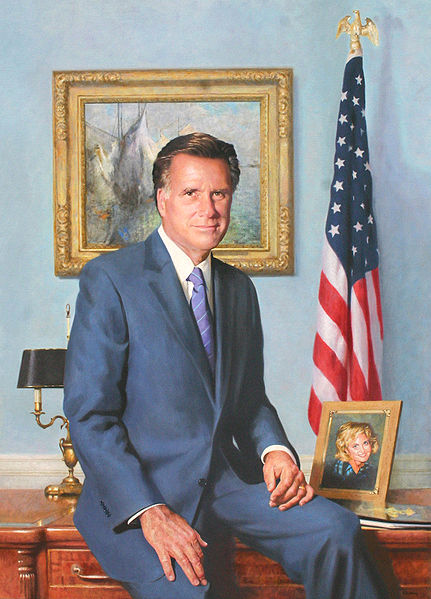
Just an ordinary guy, with his millions

While many of us have been trained to treat all religions as striving after the amorphous other, many others are raised to believe that Mormonism is a danger to society. Not that I agree, but I know from personal experience this is what they teach. I was raised on the tracts and texts that spelled it out in black-and-white claiming Mormonism to be a “cult.” The very word “cult” is eschewed by scholars of religion as a description for non-conventional theologies. As a term it is so 1980’s. Tell that to the electorate. The political pundits, it seems to me—and I may be wrong—underestimate how much people vote with their faith. Over the past twenty years, the Roman Catholic Church has demonstrated itself a champion of conservative causes. It has gone from pariah among the parishes to pontiff of the politicos. When evangelicals can’t stay in the race, it is difficult to distinguish Catholics from Pentecostals. Even scholars of religion should be scratching their heads.

The fact is we simply do not know enough about religion. Media treatment of the field is often dismissive or facile. Meanwhile, it is fueling the political engines that will lead to a showdown of worldviews in November. Maybe the Maya were correct after all. I don’t know much about politics. I’ve studied religion long enough to admit that I know little about it as well. I fear the experts with too many answers. If I turn out my pockets I find they are full of nothing but questions. (And lint.) Religion is what wins elections, yet our universities dismiss its study as juvenile and irrelevant. I read the headlines from the primaries—only a farce like this could make me miss Sarah Palin.


Fun with Dick and Jane

Occasionally somebody will ask me what the purpose of this blog is. I’ve read enough blogs myself to admit the question itself puzzles me. Those of us who are driven to write (and I know some of my readers can verify this—I’ve been a writer all my life, no matter what my job) are all Pontius Pilate. The reference is in the Bible, if you are unfamiliar with the allusion. Anyone uncomfortable with ambiguity will not find much satisfaction here. Our society likes to believe the truth comes in two shades only—black and white. Our society really should get out more. Even “black-and-white” pictures are actually shades of gray. Some people believe we should stick to our assigned roles, but a person is larger than the job society will allow her or him. Religions have often called this embiggening a “soul,” others have recognized it as “personhood.” No matter what you call it, an individual defined only by their job is mere shadow-play.

Back when I was teaching I always told my students that we are taught to read so early that we soon do it unconsciously. Yet, somewhere below the surface we know different materials hold different reading requirements. It is my sincere hope that the Constitution is not read with the same expectation as the sports page. For those who are willing, however, profundity can even be read in road signs. Reading is a two-way street: we bring to it nearly as much, if not more than, we take away. Truths may be out there, but no one down here can lay claim to their totality. If such were the case, there would be no need of elections, or more than one publisher. Bibles, properly speaking, have no covers.

Writing is an end in and of itself. Those few untrammeled moments of each day when the demands of work or responsibility lessen their grip just a bit, and the universe seems to welcome your thoughts. My experience of life from rather humble family circumstances has been that those better off like to tell you what to do. I have never been a boss, nor do I ever really want to be. My dreams are more vapid, vacuous, and vivacious. In my writing I can actually have fun. After I lost my long-term teaching post a career counselor told me that I had to separate myself from my job. Every day there are those who try to undo that sage advice. A blog is nothing more than a tall ship and a star to steer her by. If you can figure out what that means, please let me know.


California State of Mind

California, it is sometimes said, is a state of mind. I leave today after a few days in Santa Barbara with a bag of mixed impressions of one of our nations great schools. My first impression on the University of California Santa Barbara campus was almost a physical one. Literally. I had no idea of the bicycle culture and nearly stepped into a bike lane with the flow of a New Jersey storm drain during a Nor’easter. California is a culture of wheels. I’d never been to a campus before that has four traffic lanes for non-motorized travel: two bike lanes going opposite directions, a skateboard lane, and the humble pedestrian walkway. There are so many skateboards here that the counter-culture has become conformist. Sorry, Bart, it’s true. And concern for the environment is palpable. Reclaimed rainwater feeds the lush plant life, every possible recycled item is sorted and sent to the correct facility, students bicycle instead of drive, smart cars are very evident for the two-wheel impaired, and almost nobody smokes. And as I ate my supper alone in the student union two separate groups of Christian students were having very vocal conversations about their faith. Free spirits not realizing that they’re trapped.

One conversation with a Native American specialist stayed with me. She spoke of how missionary work has damaged indigenous cultures irreparably. I listened in fascination as she told me about the local history. How an historic Spanish mission was publicly adorned with the skull of a murdered Native American and how it took years of persuading to get them to take it down, even in the late twentieth century. Across campus students are praying to Jesus for the courage to continue witnessing. In Newark, I suspect, a couple of guys are still laughing.

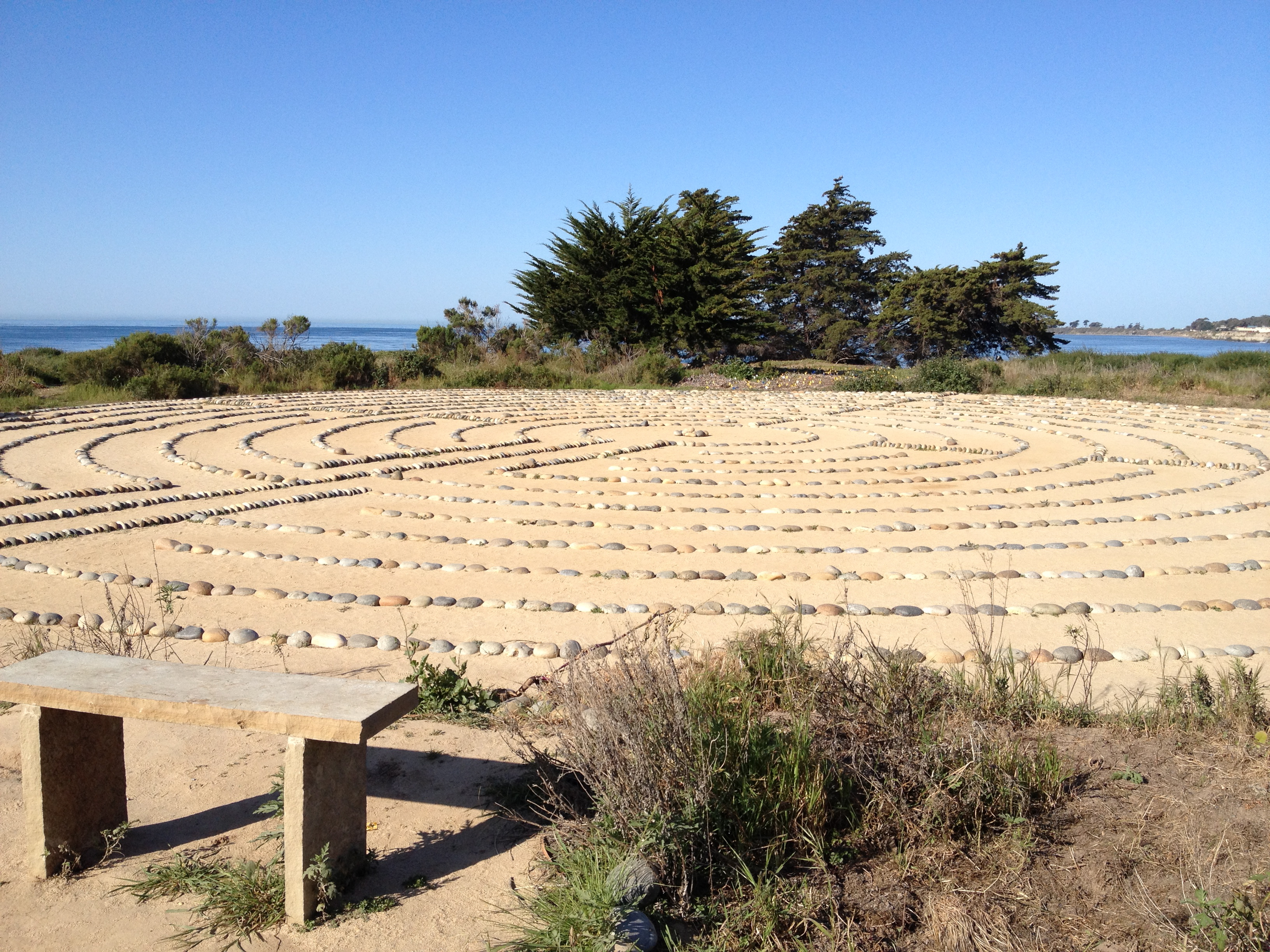
On a brief respite from my busy day of meetings, I walked the Lagoon (sorry, I can never see or say that word without thinking of Gilligan’s Island) Trail. Emphasizing the environmental features of this wetland habitat, the trail leads down to the ocean where flocks of pelicans and egrets fly overhead, unperturbed on the shores of the vast Pacific. In 1969 what had been to date the worst US waters oil spill took place from Platform A, still visible in the distance from the beach. My thoughts turn from Gilligan’s Island to Deepwater Horizon. My laughter to tears. The Lagoon Trail winds through the headland to a labyrinth. In today’s resurgence of interest in the labyrinth, it is viewed as a spiritual journey. Labyrinths appear in churches as early as the Roman Empire, but nobody knows what they mean. I silently stand beside the maze. What does it mean? Platform A leers from the ocean. Christian undergrads look to convert the world. And under the cross is not the skull of Adam, but that of an anonymous Native American. What does it mean?


I Pledge Allegiance

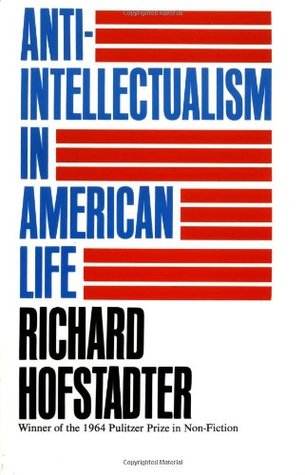
It would only be with the most tentative and hesitant of reservations that a person might call her or himself an intellectual. The denotation carries with it such possibilities and potentialities of arrogance that even being seen reading Richard Hofstadter’s Pulitzer Prize-winning Anti-Intellectualism in American Life in public could be cause for considerable timidity. The end result, however, is so rewarding that it is worth the risk. Seldom have I read a single book that explained so much of what continues to define our society. As an historian, Hofstadter was acutely aware of American self-perception—so much so that it seems foolhardy to distrust him. Although the book was published in 1962, it seems as though the five decades of my life haven’t had time to transpire—things are shockingly similar to the myth of the 1950s that still drives the Religious Right. Hofstadter could be lurking in the corner with his pen even now. I turned to this book because I had grown weary of having felt set upon by a society I have only ever wanted to improve. In tracing the roots of anti-intellectualism Hofstadter clearly demonstrates that the distrust is felt on both sides of the divide. Having not had the dubious benefits of an affluent rearing, I simply followed where my limited talents led. What future is there for a poor boy who likes to read and write? My earliest and most honest aspirations were to become a janitor. At least in that job you can see the filth being scrubbed away.

Expecting an objective historical account of intellectual history, I was surprised to discover that the first section of the book dealt with the privileged place of evangelicalism in early America. I’m not so obtuse as to have overlooked the obvious mockery that the intellect receives so freely from the coffers of Christendom; one need only glimpse the headlines or listen to street-corner evangelists for a fraction of a minute to learn that. I had supposed that my limited experience had made me naïve in assuming religion stonewalls free inquiry. The problem, it seems, is endemic. Those who would suggest that brains are actually meant to be taken out of the box and played with incur the wrath of the almighty.

Hofstadter resisted keeping the gaze too long upon the faithful, for there are clearly other forces at work. The rugged, self-made individualism of a nation that consisted of frontier until comparatively recent times also plays into this suspicion against the self-proclaimed sages. We have all had the displeasure of knowing the self-impressed, and their sticky indulgence in immodesty clings to many who simply can’t turn off the motor in their heads. Instead of walking away from the book feeling justified, I instead felt reflective. My own perceptions have led me down the path of trusting the guidance of the soul (whatever it may be), but the perceptions of others raised in different circumstances lead to materialistic assumptions, or the hunger for power. Deep down inside, though, I know that I shifted perceptions by the slow, steady influence of education. There is no unlearning that. And education has brought us this far. And a little intemperance in appreciating intellectual life may be the most venial of sins.


Academic Omelets

As an erstwhile accidental adjunct, I came to see a side of the academy increasingly rare these days: the professional who must earn his or her keep. That life is less than half-a-year away and I still look to see what is happening as higher education crumbles under its own excessively disproportionately top-heavy infrastructure. An article in a recent Chronicle of Higher Education outlined how an adjunct, on his own initiative, began a survey of working conditions for those in similar academic situations. The results went viral and universities felt the need (only occasionally) to justify their actions. Expediency at the cost of a few eggheads nobody worries about, but when the news starts to leak like so many yolks, it is about time to at least act concerned. The phrase that stuck in my shell as I read the piece was this: “many adjuncts nevertheless feel they embody a lower class in academe.”

I felt like a bulls-eye had just been struck, and that bulls-eye had been painted on my forehead. Higher education has always been subject to claims of elitism and exclusivity. I entered the industry because at every stage along the way my instructors encouraged me to continue since I thrived in that atmosphere. I had entered higher education, however, from a humble, working class family. No dreams of power drove me—it was the sheer joy of learning. When I tried to situate myself among those who had had a leg-up in life, it was an uneasy fit. It’s like that uncomfortable feeling when a homeless person sits next to you on the subway. You know you could help, but you know there is an invisible wall that separates your world from his or hers. And hopefully, somewhere deep inside, you also realize that that homeless person could have been you.

The adjuncts are the working class among higher education. At some schools the full-time faculty teach very little and get to earn their lights as the brilliant minds who write books. I’ve written a couple myself. The difference is, they are bona fide. Privileged. Education used to be considered a great leveler. As in most myths, the truths in that sentiment are heavily metaphorical. Education could level the playing field if people weren’t prone to accept privilege when it is offered to them. What adjunct would not just as soon become the full professor with a light load and the fame of being featured on television and interviewed in Time? I don’t mean to single out universities—people in all situations tend to behave that way. No, I don’t single out universities. It was just that I hoped they might have been above this kind of thing.

This is your life, on adjuncts.


Nevermore

Once in a while an uncanny clarity penetrates this fog of an asphyxiating miasma that passes for a life in higher education. It was a rainy, gray day in February when I stood outside 13 West Range at the University of Virginia, looking into Edgar Allan Poe’s restored room. Poe, who is right up there with Melville and Moses among the greatest writers of all time, lived a life that was short, sad, and silenced. Or so it seemed. Dead by 40, with a career that never really got a foothold, Poe would seem to be the ideal model of a failure. His currency, however, has preserved the voice of unrest that pulses like the very life-blood through American culture. Even as a teenager, I identified with Poe. Knowing that I could never attain his level of polish and perfection, even listening to the cadences of “The Raven” can still reduce me to tears. So, standing outside his room in the gloomy rain was a private epiphany.

13 West Range

Undefined was the sense of loose ends and hopelessly tangled threads of a life I tried to weave without the blessing of Athena. I ended up at a small seminary where my influence was limited to the few students with open minds. It was truly a gothic experience, living at Nashotah House with its medieval mindset and matching physical setting. Daily watching my learning being shredded by the staunch dictates of undying dogma, I never forgot Poe. When my own career was jettisoned by a bloated theology that had no room for questions, I spent many months in a depression so deep that life had almost lost that spark of hope that makes it worth continuing. Again and again the waves crashed over me—this was the doing of the church. Those who putatively followed the teaching of a man who said, “Do unto others—” Fill in the blank.

Poe was forced out of school by an unloving foster parent who valued money more than his adoptive son. Traveling up and down the east coast looking for a place to fit his writings into a slot for a little money, he died from causes that will never be identified. Today we know he was a meteor—a brief, brilliant light in a darkened sky. He is the patron saint of all those whose voices have been silenced by an unfeeling establishment. Even in my wildest dreams, I never hope to approach the depth and grandeur of his pen, but I can stand here in the rain and commune with him. The emblem of the Raven Society stands perched in that room, and its single word is the dying word of hope in the face of an uncaring world. And that one word will be the epitaph of society that refuses, even now, to listen.


Denying Truth, For Profit

Sometimes I’m questioned about why I bother with creationism. Everyone who’s intelligent knows it is religious ideology masquerading as science and people will eventually figure it out. But will there be time? An editorial in yesterday’s New Jersey Star-Ledger pulls the curtain back on creationism’s incestuous cousin, climate-change denial. As the editorial notes, key documents of the Heartland Institute—one of the major propagators of climate change as “just a theory”—have been leaked and show that they have learned their lesson from creationist tactics. They want “debate the question” instilled in science classes in lieu of facts. And much of their money comes from big oil. It is the hope of such institutes that an American public already woefully pathetic at understanding science will be led to believe “just a theory” equals “likely not true.” The data are stacked completely against them and the entire rest of the developed world knows that.

While the issue may seem less religious than creationism—which is based on getting Genesis 1 in the classroom as science, no matter what you call it—it has deep roots in that same insidious cocktail of politics, religion, and dirty money. Biblical literalists tend to believe the world is about to end. The belief has been around for at least two millennia. It is a damning and damaging belief that declares the world was made for raping because it is about to end. This deranged thinking is fueled, literally, by unrestrained economic interests. Sometimes the groups can’t see beyond the Bible to realize that they too are being screwed. Science is objective, and it is science that has been challenged by various religious and political groups since the 1920s. Today, when there is far too much information for anyone to stay on top of it all, and in an American society deeply distrustful of higher education, I smell an explosive amount of methane in the air.

Climate change is real. The “theory” is so well supported by evidence as to be fact. Is anyone really surprised that supporters of the Heartland Institute have also backed Newt Gingrich’s campaign? We have placed ourselves in a very dangerous position as the last remaining “superpower.” I tried to read a book on environmental issues that Routledge published, but was so scared after the first three pages that I had to put it down. What is the lesson here, class? Is it not that money is the root of evil? And that, my dear literalists, is biblical.

The future of human economic evolution


Jefferson’s Legacy

With the gears grinding in the political machine and candidates for the GOP nomination each trying to show they are more righteous than the others, the name of Thomas Jefferson gets used quite a bit. Jefferson’s famous Bible, literally cut-and-pasted together by one of our better presidents, removed miracles from the picture, and Jefferson’s writings leave open the question of whether Deist or Atheist is a more accurate description. I’m in Charlottesville, Virginia right now, home of that paean to Jefferson, the University of Virginia. For a state university, UVA has perhaps the largest religion department in the country. I noted with some irony, that the religion department is housed just above the political science department in Gibson Hall. While waiting for my first appointment, I sat in an alcove where two students began talking about politics. (This was in the religion department.) My chagrin grew as my grin faded with their lament about how poor the Republican candidates are, “but we have to get Obama out of the White House.” In order to do so, they’d elect a man whom they believe unqualified for the office.

Winston Churchill is often quoted as saying a person who doesn’t start out as a liberal has no heart, but who remains a liberal as an adult has no brain—or some such nonsense. The fact is, compassion never should go out of style. It seems to me that somebody changed the terms and what they mean. “Conservative” used to equate to a fiscal position that, while it favored the wealthy, still had sympathy—or even empathy—for those less well-off built in. Now it has come to define “selfish disregard of those different than me.” We see it all the time, not just in political speeches, but in acts passed in the name of Christianity. Jefferson’s Bible is being trampled underfoot. And we are told repeatedly that America was founded as a Christian nation. Of the students discussing politics here, the more conservative of the two was the woman.

Does she not realize that without the liberalizing tendencies of the suffragettes her own future would be limited? That does not excuse in any way the patriarchy that made suffrage necessary in the first place, but it does speak to how quickly we are taught to forget. Even in the land of Jefferson, there are those who would protect privilege and call it divinity. “It does me no injury for my neighbor to say there are twenty gods, or no god. It neither picks my pocket nor breaks my leg.” The words of Thomas Jefferson. In our great universities those who actually do learn are sometimes taught that empathy is weakness and fiscal gain is god. Unless it’s an election year. With great wealth going into the carnival we call the nomination process, we might legitimately ask what’s to become of us if those with no empathy are elected. After all, what are we, apes?

One of the few presidents worth casting in bronze


Adrift

We all have the gift of critical thinking to thank for the world of relative comfort in which we live. That doesn’t mean we always appreciate the source of the gift; in fact, America has had a long history of anti-intellectualism, a distrust of those educated “European style.” Nevertheless, universities in the United States far outnumber those in most nations. Overall they represent a tiny fraction of our culture and workforce, however, and when any institution become elite trouble will follow. I just read a review of Richard Arum and Josipa Roksa’s Academically Adrift in the Chronicle of Higher Education. Arum and Roksa, sociologists, have done a study of university outcomes in the United States and the results are failing. More specifically, a large proportion of students emerge from college having learned little and heavily in debt for their effort. Having just learned of the book, I haven’t had the chance to read it yet, but Kevin Carey, in his review, notes that the disparity breaks along the lines of privilege.

Those students who enter college from well-to-do backgrounds, having attended fine schools, learn a great deal and are very unlikely to end up unemployed. The other group, by far the larger of the two, is comprised of students from schools mediocre or worse, hails from somewhat humble financial circumstances, and will like find unemployment at the end of four years with little true education. There can be no excuse of ignorance, for universities have known of this for many years. In the words of Carey, “Academe was so slow to produce this research because it told the world things that those in academe would rather the world didn’t know.” Some of us emerged from higher education in profound debt, but even with good study skills, lack of connection equals great uncertainty. Classism is alive and well in America, but unfortunately universities have been quietly playing a supporting role.

The truly sad part is that many people already assume the worst about higher education. We like to claim education to be a great equalizer, but that will never change the fact of who your daddy is. The upper crust looks out for its own, and when it comes to the tremendous costs involved to maintain universities, the bulk of the tuition comes from those who benefit least. How long before university presidents with their pseudo-corporate salaries start asking for a federal bail-out? How many times can those who have too much cry that they can barely make ends meet? It can cost a lot to ensure your kids get the jobs they deserve. Universities have increasingly modeled themselves on corporate America, and the product has become shoddy and cheap. Perhaps those who distrust intellectualism have been right all along. Perhaps the logo outside campus should read “buyer beware.”

A rare view.


Revealing the End

I knew the end of the world was near when I saw the phrase “butt crack” in the Chronicle of Higher Education. As I turn over the February page in my 2012 Apocalypse Survival Guide calendar, I find that the Romans predicted an end of the world to arrive at 634. B.C.E. I’d say the Romans are still waiting, but they are long gone, the only residue remaining of their empire being the Vatican and its spiritual, rather than political, power. So why did the Romans think the end was near? It had, according to my calendar, to do with a dozen eagles being seen at once. In the spirit of Hal Lindsey we can parse that vision a bit. 634 was just 32 years after the infamous 666 B.C.E. Of course, no one knew it was 666, or even B.C.E. for that matter. Nevertheless, when God picks his super-three he stays with it. Thirty-two turns out to be nearly the traditional age ascribed to Jesus, but minus one year. Keep that in mind.

Eagles make occasional appearances in the Bible, but since God is a forward-thinking deity, the reference is surely to the United States! And how many colonies were there originally? Was it not 13? Again, the significant number is off by one. In some cases we might count this up as poor arithmetic, but with the subtle destroyer of the universe we know it is not only intentional, it is also significant. So, Rome saw the 12 eagles—the United States—in 634. What they really meant was the Maya, obviously. That would account for the missing one, since central America is less than the greatness that is the United States. And besides, there were twelve apostles, but when Judas was replaced by Matthias there were 13. What more proof do we need? These dozen eagles were indeed a divine sign. Only the world did not quite end in 634.

Maybe the problem was with the Julian calendar, or maybe the eagles were just confused. As my calendar says, “Antichrists been and gone” and yet we are still here. The transient nature of apocalypses never dampens the truly hateful spirit. We can’t comprehend this cobbled-together doomsday without at least trying to understand the evangelical despising of the world. This view is based on a quasi-biblical determinism that emphasizes God’s ultimate plan to destroy the universe that is only revealed in piecemeal fashion throughout select books of the Bible. But God is like a mystery writer who sadistically leaves out the last chapter of the book. The tension is unbearable. How much more before we begin to crack? But isn’t that what started this whole apocalypse in the first place?

The horsemen close in


Instruction, through Film

In an increasingly technological world, the acquisition of knowledge often seems like a moving target. For thousands of years the process of research meant lifting yourself out of the chair, or couch, or log, and going to where the written collection of human knowledge resided—the library. Assurbanipal, emperor of Assyria, assembled a great library in antiquity, as did the sages of Alexandria, Egypt. From those days until my own lifetime, if you wanted to learn something you went to where the books resided. The birth of the Internet has changed knowledge storage considerably, but not completely. You might find bits of Assurbanipal’s Akkadian wisdom online (Alexandria’s, unfortunately, didn’t survive antiquity), next to thousands of e-books, blogs, and tweets. And of course, videos. Although many of my blog posts refer to horror movies, one of my favorite sources of information has always been the documentary. Despite the fact that it’s spoon-fed knowledge, there’s nothing quite like watching the experts tell you what you need to know on this or that topic.

Assurbanipal, lion hunter, emperor, librarian.

I was, naturally, pleased to learn of documentary-log.com. The folks from the site were kind enough to contact me since they offer many religion documentaries for free. I suspect that most readers of this blog have some interest in religion since I seldom write about anything else. Documentary-log.com currently has over thirty professionally made documentaries from various producers (including the History channel) available for viewing. Just sit back, click, and learn. I added to my own knowledge-base yesterday. This is particularly nice for those of us who can’t really afford the constantly increasing expense of buying access to television service. If your interests are greater than religion, they have many other categories of documentaries available as well. There are much worse ways to spend an afternoon.

One of the questions that arises in my conversations these days is whether all of the material online is changing knowledge itself. There’s no question that it’s a time saver. Prof. J. C. L. Gibson once remarked, while looking for a passage in class at Edinburgh, “So much of scholarship is turning pages.” He was a man who still did not use a typewriter, up to the day of his death. There is something to the old form of knowledge that stays with me as I watch the world inexorably change around me. There was a thrill to finding a book from 1516 on the open shelves at the New College library of Edinburgh University, to touching its centuries-old pages and marveling. Sitting in John Gibson’s office as he puffed on his pipe and trying to defend my new ideas against his old ones, I felt that knowledge was being hammered into me. There is an arcane knowledge to starting every day with a wee dram and a prayer that the World Wide Web just hasn’t managed to capture yet.


Three Degrees Below Zero

Rick Santorum has turned his attack on intelligence against American universities, according to a story in the Huffington Post. He claims the left uses colleges for indoctrination to keep themselves in power. Sounds like somebody’s been sipping a little too much communion wine. I know many people who might have a right to make such claims, but Santorum isn’t one of them. Santorum earned a Bachelor of Arts, with honors, from the wicked, indoctrinating Pennsylvania State University. He then succumbed again to the indoctrination when he, apparently accidentally, earned a Master of Business Administration from the University of Pittsburgh. Somehow he stumbled onto a J.D. with honors from Dickinson School of Law. A man this indoctrinated, I say, has no business being president.

During these senior moments (not to offend any seniors who might actually make that claim) Santorum seems to have missed that universities are among the most under-funded, crisis-ridden institutions on American soil. With rare exceptions, universities are cutting programs, canceling positions, and slashing budgets. Don’t get me wrong, I’ve vented a fair amount of criticism on our universities and I know, firsthand, that they aren’t perfect. I rage because I love. It seems that some children of privilege like to rage because it’s in fashion. If you’re going to take on those smarter than you, at least try to get the facts straight. Higher education is such a small segment of the American employment force that the only reason you’d go after them is that, well, you’re in a church. Baptist Catholic Santorum made his remarks while at a church in Florida, a state which, despite insidious power-mongering, boasts some of the finest universities in the country.

Taking stabs at Obama, Santorum claims the president wants all kids to go to college, and that’s a bad thing. You don’t want an educated electorate. It is harder to get educated people to march in goose-step with everybody else. Talk about indoctrination! Vote for me, because I will keep you safe from the horrors of an education of which I couldn’t stop my self from taking advantage. Don’t send your kids to law school. There can be real danger even in sending them to grammar school, for there they learn to spell. I wonder, if in the course of earning his three degrees, Mr. Santorum ever learned to spell the word “hypocrite.”

Just an average guy, hanging with his buds.