Lost Professors

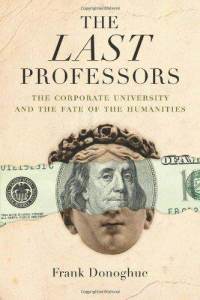
In front of my desk at home sits a chair.  That chair came to me when Gorgias Press was subleasing some of its office space and was necessarily divesting itself of unnecessary furnishings. Gorgias Press came to inherit the chair with the closing of the for-profit Katherine Gibbs School of Business, a branch of which leased half of the building.  I sit in that chair, contemplating the future of education.  I have just finished reading Frank Donoghue’s The Last Professors: The Corporate University and the Fate of the Humanities (as recommended by my friend Marvin).  Despite the fact that it is the first academic book I can recall leaving me in tears, it is a book every Ph.D. and potential Ph.D. in the Humanities should read and/or be forced to read.  Buck the trend!  Buy a book!  Donoghue is a rare individual who actually takes time to research what is going on in higher education and who has the courage to report it directly.  My regular readers will know that for nearly two decades I worked in higher education, spending every one of those years hoping that the next year things would get better.  Thank you, Dr. Donoghue, for speaking the truth.

I didn’t enter higher education as a child of privilege.  My career ambitions in high school were to be a janitor.  Encouraged along the way by well-meaning teachers and professors, I eventually found a job (lackluster as it was) in higher education.  What I didn’t realize is that the game had been rigged.  I recall being told with crystalline clarity that college and university positions were headed for a vast turn-over in the 1990s and jobs would be abundant.  Donoghue heard that story too.  His research shows that the writing had been inscribed on the wall as early as the 1970’s (before I reached high school) that this would not happen.  This is not hindsight either; studies were already indicating that higher education was going after the vaunted business model of the glitzy for-profit world.  Shiny baubles.  Worse yet, the roots of this inevitable transformation reached back to the Civil War and the nation that emerged from it—replace the dead on the battlefield with the dead in the factory.  Only only method of judging value existed: money.

The most disturbing aspect of all of this is the irreversibility of this trend: in today’s world only one value system is admitted, and it is purely material. No other way in higher education is capable of assessing worth. Rather, the alternate ways are being ruthlessly silenced by the transformation of university to corporation. That transformation was well underway long before the 1970’s, of course.  I had recognized at a young age that capitalism is a cancer that eats away the soul of people, convincing them that financial success is the only goal worth pursuing. I protested.  I spent years earning a doctorate in the Humanities to show that other values still throbbed away in the hearts of those who weren’t taken in by shiny baubles.  If you have any interest in resuscitating the human spirit, read Donoghue and weep with me.  The only consolation that I have is that I am sitting on a chair of a for-profit school that fell victim to the value system it once supported.  Capital and cannibal are too close for comfort.


Ms. Found in an Email

The other day I received a distressed message from a friend that I met in college. Marvin’s career somewhat parallels mine; he went on to get a PhD, taught for a few years in New Hampshire until the economy claimed his job, tried to make it as a fiction writer and adjunct instructor for awhile before moving to Boston to work with a publishing company. He’s never made any money for his writing, but that may be for his own good because the money that authors make goes to support the CEO of whatever corporation owns the publishing house. Still, I wish him luck. Yesterday he emailed me about a book he’s reading, The Last Professors, by Frank Donoghue. He’s convinced me that I should read it, but I thought his message would be appropriate for this blog. In Marvin’s words:

“If a more bleak preface has ever been written, I’m an illiterate ape who never reads. The writing has been on the wall for years, but those of use who are able to see it have been hopelessly myopic. In the preface he tells how industrialists since the end of the Civil War have been dead-set against liberal arts education as useless. People like the two of us who studied ‘useless’ fields, they would have as the cogs in their efficient machines, suppressing our thoughts. The only useful education they can deign to approve is one that earns them more money. There’s only one value system in the world, it seems.

“Don’t you feel like a sell-out, working in New York City, that cathedral of capitalism? Is NYU on anybody’s list of tourist stops for people down there in New York? Who goes to visit a university when there’s so much of commercial interest to see?

“And yet, corporate types are the ones who can afford tickets to shows written and put on by people educated in their ‘useless’ craft, but who are in reality their unwitting chattels. And who wants to be seen with authors and intellectuals to enhance his personal prestige, so that he will appear smart? Who are the dogs in the manger who keep everything they can’t possible use for themselves, for fear that others might enjoy it?

“We all play along with their game—we wear jeans on casual Friday and declare how good we have it. We speak their demeaning language, using humiliating phrases like ‘best practice,’ ‘core competency’ and ‘corporate values.’ In this dehumanized state we all live in cages that we’ve helped build. Corporate moguls hold their power over us because we let them. We, the workers, have the power to change it. They make the rules and we obey because we all want to be in their place.

“Education is the way out—that’s why they hate it. There’s an entire support industry built around it; those of us in the book business rely on educated readers. What happened to Borders looks prophetic to me. Time to close—I’ve just arrived at work.

“Sent from my iPhone”

Just another useless lay-about


Buying the Truth

Every now and again the Chronicle of Higher Education dips its trowel into the biblical archaeology debate. Those of us who’ve made extensive arguments based on ancient texts and artifacts know the territory a little too well. Archaeology, which largely grew out of biblical scholars attempting to “prove the Bible,” eventually started on its own track of scientific respectability with the predictable result of distancing itself from the Bible occurred. So far, so good. Then biblical criticism took a turn towards post-modern sensibilities. The truth cannot be known, and therefore the safest approach is to stop seeking any truth at all. Archaeologists in the know joined this venture (biblical scholars and archaeologists often cross borders in this exotic land), and began to deny historical Israel, as well as the rightly dismissed historical Abraham and Moses. Once you’ve walked a few leagues down that path, however, it is difficult to turn back. This is, of course, an over-simplified account of a complex dynamic, but the issues raised, as seen in the Chronicle, are real. Our perspective flavors our interpretation. If you don’t believe in a historical Israel you’ll never find one, no matter how hard you look. (A similar dynamic is at work in studies of religions and “paranormal” phenomena.) The word “evidence” is finessed as readily as fine hair treatments and the kinds of evidence that convince vary depending on the scholar. It is safest to admit we don’t know, sometimes.

The more troubling aspect, as far as I’m concerned, comes when the Chronicle introduces the concept of corporate sponsorship to archaeological digs. As an erstwhile volunteer on a dig (somewhere back in the Iron Age, it feels like now), I know that archaeology is frightfully expensive. There’s nothing like being on a dig to witness firsthand the amount of labor that goes into removing all that dirt–carefully! Carefully! Universities can’t afford it (stadiums don’t come cheap, you know!), so many digs rely on corporate donors–often television and film companies. And if you’re paying for footage, you want something to bring in watchers. An unnamed archaeologist quipped honestly in the Chronicle, “I don’t agree with everything they say in the films, but they pay me an awful lot more than I could ever earn from writing or teaching.” There it is, staring us straight in the face. The truth goes to the highest bidder.

That may sound benign enough, but in Israel especially, archaeology has high political stakes. You see, politicians are easily swayed by the “we were here first” argument. To get an idea of its specious nature, just ask a Native American! Proving the veracity of a David or Solomon no longer just gets God off the hook, it also builds the basis for claims against people who’ve been here an incredibly long time. The sad reality is that in archaeology, as in higher education, money speaks with an inordinately loud voice. As an agreed means of exchange, money is certainly important, but is it “true”? For those who’ve stopped short of the post-modern abandonment of that great philosophical ideal of Truth, we should be wary of allowing lucre to decide the issue. Those with money already help to decide what courses will be taught and what tels will be excavated. We run a real risk when we let those same people decide what will be considered the truth. In a society enamored of media and its ease of use, the truth is sometimes what comes across the television. There is another way, but it involves heavy digging and lots of reading. Maybe next time—but for now just pass the remote.


Occluded Religion

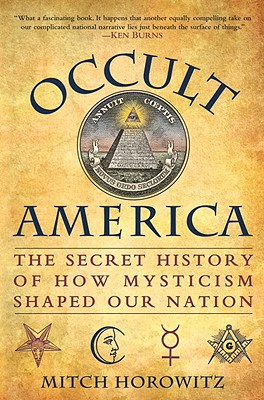
In my youngest days the word “occult” conjured the most perilous kind of fear in my inexperienced, Christian heart. It sounded malevolent and sinister, suggesting Hell, Satan, and the coercion of the divine. Therefore it took considerable time to pump up the courage to read Occult America by Mitch Horowitz. Well, maybe it wasn’t that dramatic—I learned in the course of my many years studying religion that “occult” is very difficult to tease out from “religion.” What I really feared is what others would think of me as I sat on the bus reading Occult America while heading to the Lincoln Tunnel. The word “occult” refers to the “hidden” or “secret” nature of certain religious practices. In ancient times it might refer to the Gnostics or Mandaeans, while in more recent days it might be used to describe Rosicrucians or Theosophists. Unconventional, yes. Evil, hardly.

Horowitz takes his readers through a whirlwind tour of some very colorful characters and, perhaps more importantly, shows just how deeply rooted occult practices are in the most Christian nation on earth. Few people realize just how influenced high office holders in this country have occasionally been by the occult. It seems a hard-and-fast rule that to be elected president you must be a professing Christian, strongly preferable if of the evangelical, Protestant flavor. Ronald Reagan made a great show of that while being personally convicted of the efficacy of astrology and some popular mediums. And Reagan has not been the only one. Still, politicians have to keep their more unconventional religious beliefs secret. The populace likes a straight shooter, devotionally speaking. The fact is that even what many people think of as regular Christianity has been seasoned somewhat with occult.

I can recommend this little book for getting a sense of just how deeply the occult has tunneled into the American psyche. The chapter on the ouija board took me straight back to a very straight-laced Grove City College, bastion of conservative evangelicalism. When I matriculated (which sounds vaguely occultish in its own right) the yearbook was called The Ouija. It was explained away as the combination of the French and German words for “yes,” but everyone knew, given what yearbooks are, that it had that spooky, occult vibe. By my senior year a more fluffy, evangelical-safe title of The Bridge replaced it. And many heaved a great sigh of relief. Christians thanked their lucky stars that they’d been delivered from the evils of the occult just as they were lining up to elect Ronald Reagan to a second term in office.


Religious Studies Project

Edinburgh University is often the overlooked gem in the academic crown of the British Isles. I have to confess that that declaration is in part based on the natural pride of an alum, but it also arises from seeing the various projects the university has in some way sponsored or spawned. The study of religion is still taken quite seriously at my alma mater, and among the more recent incarnations is a website called The Religious Studies Project. (It at first reminded me of the Edinburgh Ras Shamra Project, with nearly the same initials, initiated by a couple of talented chaps just after I left town.) Founded by a couple of post-graduate students in religious studies, the RSP offers weekly podcasts and various articles on topics of interest in the realm of my erstwhile and eternal profession.

The Internet has forever changed the way that people learn about religion. This democratization of knowledge is generally a good thing, especially for those who test what they read (or hear) against other sources. This is the heart of the academic enterprise. Many people think that higher education is all about getting the answers. This may be true in some fields, but the disciplines known as the humanities—the things that make us human—find education in the perennial raising of questions. Religions should be the source of questions, not the monolithic bastions of all-answers. You can always tell when you meet someone truly educated in religion—s/he will be the one admitting that s/he doesn’t know.

In our cost-effective society we live under a prevailing myth that when you pay for something you should get a certain commodity in return. In fact, education often works just the opposite way, robbing the learner of easy certitudes, leaving him or her wondering more deeply. So I’m pleased to give my colleagues a shout-out.

If you’ve found this blog you likely have some passing interest in religion. Having been trained in Edinburgh I laud the method I learned: ask questions. Seek answers. Ask more questions. This is the tradition of religious studies. Even if it doesn’t lead to jobs, we hopefully emerge from it a little bit wiser.


Artifacts or Theodicy?

Last week the Huffington Post ran a story that ties archaeology, religion, and monsters together in a package too neat for some researchers. Digging in a sixteenth-century grave for plague victims (something that strikes me as being so foolhardy as to be religious) archaeologists found a corpse with a brick in its mouth. The preliminary conclusion? Sixteenth-century Italian plague-weary society was attempting to stop a vampire. The find has, of course, been disputed. Other archaeologists, the story notes, claim that a loose brick could have fallen into the cadaver’s agape mouth just making it resemble the little-known technique of stopping a vampire by bricking its mouth open. This story, written with Huffington Post’s usual pluck, raised an issue I quite often encountered as a doctoral student in ancient Near Eastern religions: anomalies are generally categorized as religious.

When my wife first pointed this story out to me I thought I might learn something of vampire lore—itself inherently religious—from the sixteenth century. The fact is, however, that artifacts (including people) under the ground accumulate a lot more than dirt. Mystery attends the lives of yesteryear, and the further back we go in time the less we understand. It was a standing joke among those of us in the textually-based field of religious studies that any artifact for which no function could be discerned would most certainly be labeled “religious” by archaeologists. When no logic attends an action, call it religious. This might be a motto for academics and their approach to the study of religion. There are some who claim religious studies is not a proper field of inquiry at all. Excuse me, but where are you intending to fly that plane?

Vampire scares (whether or not that’s what was found in Italy) do, however, follow their own logic. Although early scientists may have made connections implicating rodents (and their fleas) as carriers of plague, the average citizen would have only seen the supernatural dimension. Morbidity on the scale of the Black Death is almost inconceivable and as Europe suffered through periodic outbreaks of plague it seemed that a good God couldn’t be behind it all. Evil creatures, such as vampires, get God off the hook. They are a device of theodicy. “Theodicy” is the jargon for the theological justification of God in a world full of suffering. When God’s goodness effaces to such a point that people grow frightened, well, isn’t it just easier to say a vampire is behind it all? The conclusion that logic draws is quite different. Nevertheless, I think I’ll be replacing the garlic on my nightstand with a brick. What will the archaeologists of the future say?


Religious Aliens

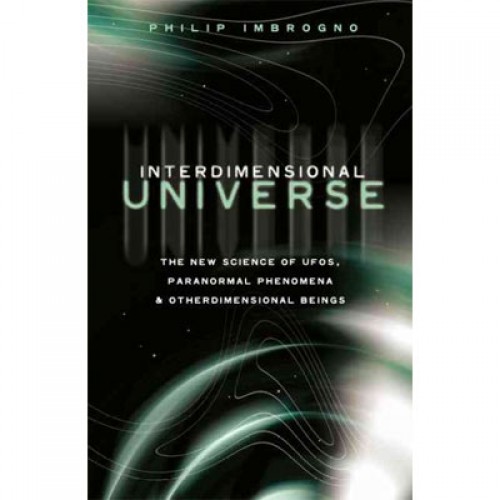
While surveying books purchased as texts in religion courses (something that an editor sometimes does), I came across a book called Interdimensional Universe by Philip Imbrogno. As I’ve often suggested on this blog, the study of the paranormal is related in people’s minds with the study of religion. I suspect a large part of it is because both deal with matters that go beyond mundane, daily experience. Indeed, the tiresome caricature of those interested in the paranormal is that they are individuals dissatisfied with their lives who project their disappointments into bizarre beings or situations to make up for the emptiness. Sometimes the same thing is said of those who are religious. What is really lacking in both fields, it seems to me, is people with strong critical thinking skills who remain open minded. There are serious scholars who study the paranormal—not many of them—and it is clear from the market-informed choices that Hollywood makes, people are intensely interested. So I decided to read Interdimensional Universe.

On the bus, however, I fidgeted to find ways to hide the cover and contents of the book. I don’t want some urban, Manhattan sophisticate seeing the letters U-F-O in my reading material. Still, like most honest, open-minded people, I have to admit curiosity. After a couple of chapters Imbrogno’s work appeared to be a standard UFO book. Then it started to get weird when he suggested that angels and jinn are, like aliens, interdimensional beings. He went from citing declassified Air Force and FBI documents to quoting the Bible. And not just quoting. He assumed the historicity of biblical accounts that scholars have extensively exegeted (oh, that word!) and demonstrated to have more plausible explanations. For the jinn he draws extensively on Islamic lore, believing that they are responsible for much of the trouble in the world, tricksters like the Marvel Universe’s Loki.

I put the book down disappointed. I still consider myself open minded. I admit to not knowing what is really going on with paranormal phenomena. If the number of reports alone are anything to go on much of the human race is either insane or is seeing some unusual things. The subject requires some real academic consideration. When self-proclaimed experts, however, veer into mythology to start explaining the unknown, we are getting no closer to finding the truth that, as Fox Mulder assures us, is out there. At the University of Wisconsin Oshkosh I taught a course entitled Myth and Mystery. It was some of the most fun I had in the classroom. It was also one of the most difficult classes for which I’d ever had to prepare. Is there intelligent life in outer space? I don’t see why not—the universe is awfully big to rule it out categorically. Are there jinn literally lurking in the closet? For that I’m afraid for that there is a much more prosaic answer.


Brown Out

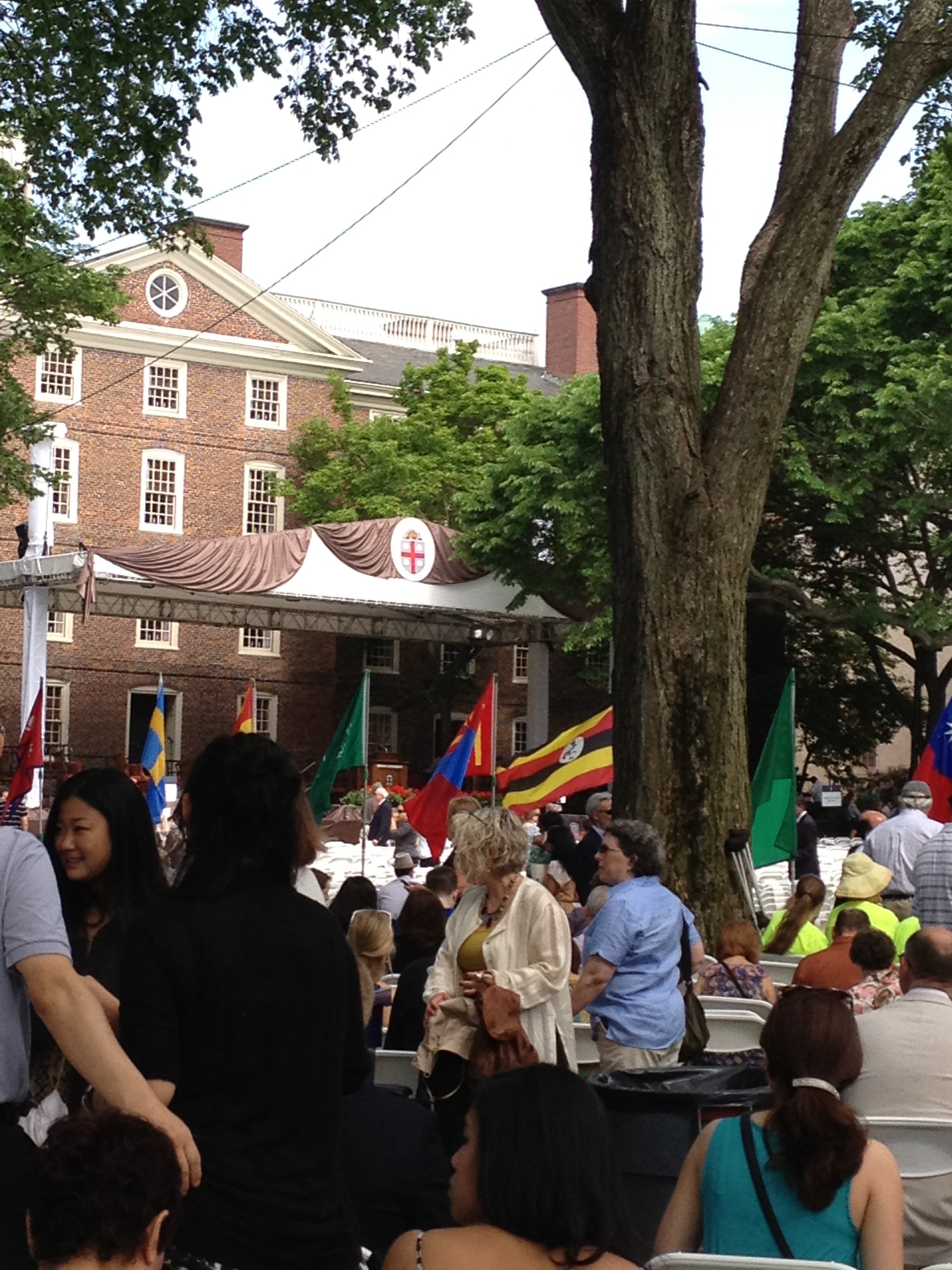
Brown University’s commencement ceremonies include a deluge of academic mythology. The curse of my chosen field of academic study is the tendency to see mythology everywhere. Some individuals see dead people, others see myths. I always feel an inordinate sense of pride in the graduates, especially those who are related to me, but the whole arrangement takes part in the mythology of higher education. Who wouldn’t feel awe in the presence of the illustrious recipients of honorary degrees? There on the Jumbotron, Viola Davis, Marilynne Robinson, Diane Sawyer, and John Lewis. In the program book the seemingly arcane symbols of academia are explained. These are the scriptures backing the mythology. I always wondered why some old professor always carried a mace in academic processions.

But the mythology of higher education runs deeper than the symbols and ceremonial. Education itself is under intense fire for participating in the realm of finance that it helped to create. Despite constant affidavits to the opposite effect, there is more to life than money. The cost in educating our young requires a greater input than becomes obvious in the immediate return on the investment. Often I hear concerns expressed over the cost of higher education, and there are certainly excesses that must be addressed. The real profit in this transaction, however, is our future. Who can look at the ocean of mortarboarded potential and not feel, deep down, a sense of optimism, no matter how guarded?

The mace is a symbol of violence. Education, if done right, is violence against ignorance and ossified old ways of prejudice, discrimination, and selfishness. For those of us who have tried—and some of us have not been successful—to shed some light on future generations, commencement is a humbling experience. While at Nashotah House I sat through many of them, and sometimes the mythology mingled with hypocrisy as I saw raw hunger for power and the lust to control the lives of others. It was refreshing to experience the mythology anew in a setting where genuine hope seemed to linger among faces full of optimism and pride of achievement. Perhaps it was the obvious inclusiveness instilled by outgoing president Ruth J. Simmons, but prayers by women clergy, and honorary degrees conferred across the spectrum of humanity are signs of hope. The mythology of academia is one myth worth believing in, if it is truly a commencement.


Convergent Evolution

Back when my opinion mattered—in higher education, you must realize, a scholar’s outlook only matters when s/he has a teaching post, no matter how abysmal the school. Once that post is gone you just become another guy with an opinion—I was invited to a conference. This is quite an honor for someone consigned to the bargain basement of academia, and for my paper I read from a burgeoning book that died a sudden death along with my academic career. In that stillborn tome I argued that many aspects of ancient mythology—including some in the Bible—made better sense in the light of science. I suggested that some of the infelicities in ancient texts might be the signs of continuing evolution of the human brain. Ancient people were able to believe what we find troubling. By the end of the conference many respectable scholars were looking askance at me when I stepped into the room. Honestly. I heard the word “Wiggins” uttered as if it were an archaic curse. Shortly after that I found myself working out of some guy’s basement for a salary fit for a knave.

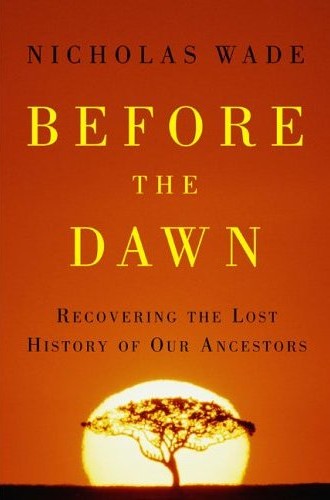
Imagine my delight, then, at finding a reputable scholar who argued that the human brain indeed continues to evolve. In fact, it has speeded up the pace as new challenges have emerged. Before the Dawn: Recovering the Lost History of Our Ancestors by Nicholas Wade was recommended to me by my brother-in-law. As I was updating myself this week on how we became human, I was surprised to see Wade suggesting what I had suggested in my paper—the patterns of human behavior (we both have an interest in religion, it seems) are tied to the evolutionary state of our brains. Sitting on a bus next to many other drones commuting like ants to New York City, I felt strangely vindicated. I had an idea scorned by my colleagues that is being suggested by science. Not that everyone will accept Wade’s conclusions. Many scholars of ancient religions will never even read them. When I explained my thesis to a colleague after losing my academic status, he said, “I don’t give much credibility to science.”

Convergence is the phenomenon of two species evolving an adaptation independently. Often it is difficult for people to believe that a trait shared by two populations is simply nature’s way of trial and error that happened to work twice, in different situations. Nicholas Wade and I experienced convergence on this point. He, of course, is a famous writer and I am nobody. Nevertheless, my unpublished idea was presented at a conference the year his book must have been in production. We had both been reading about evolution and wondering what its effect on religion might have been. I will comment more on Wade’s specific ideas about religion in the book in another post. He, of course, went on to write The Faith Instinct, which was widely acclaimed. At that time I was struggling to find work and it seemed that natural selection hadn’t selected me at all. I am glad, however, that my idea made it into print, even if it was evolved by someone else who is far more fit for survival.


Whose Call?

I think about religion quite a bit. Well, it’s actually a big part of my job. I also spend quite a bit of time sorting out where religion is represented in the spectrum of human learning, specifically in higher education. One can’t help but notice a profound disconnect between reasoned thought on religion and the often brainless way that it is played out in public forums. Often this ineptitude comes through the mental fumbling of politicians, but just as often the culprits are well-heeled preachers who learned their trade at the hand of like-minded individuals who castigate the usual methods of examining evidence. Even as recently as this week I saw disparaging remarks made in a Chronicle of Higher Education article about seminary education—something I understand a little too well. For all their faults, most seminaries try to teach students to interpret their faith intelligently.

Perhaps it is too fine a line to be etched in the sand, but the study of religion and the promotion of religion are entirely different entities. Our society desperately needs more of the former. I quite often lament the short-sighted lack of education about religion in higher education. Given the frequently destructive nature of religious teaching, it would behoove us to understand it a bit better. In my research on the state of education about religion in the United States, it has become clear that many—perhaps most—high-powered institutions of higher education do not offer the opportunity to study religion. Many secular schools, seeming to fear religious cooties, simply avoid the subject like Yersinia pestis. There is nothing particularly alarming about that. Until one starts to count the number of accredited institutions that teach indoctrination as education.

A simple survey of institutions of higher education in the United States will reveal hundreds of doctrinally based colleges that generally teach uncritical attitudes towards religion. Students graduate from such schools with bona fide parchments that claim them to be proficient in the subject. Meanwhile, at the local state university, no one can study religion because it is considered a subject unworthy of academic research. Maybe it’s just me, but I have trouble reconciling this lack of interest with what I see in a society where Tea Parties are steeping and sabers are rattling in the name of religion. Same sex unions are being shouted down. Women are paid lower wages for the same work as men. The ground is being fracked beneath our feet. The impetus for these destructive behaviors takes is fueled by religion, and they only scratch the surface. I would humbly suggest that if we want to see the state of the union clearly it is best done with eyes open rather than hiding behind an amendment and pretending religion is not there.


Come Sail Away

A profound sadness accompanied my reading of Academically Adrift: Limited Learning on College Campuses, by Richard Arum and Josipa Roksa. I mentioned this study when it was highlighted in the Chronicle of Higher Education a couple months back, and have just finished reading it. My sadness stems from having been told from my earliest years that I was a natural teacher, but having fallen victim to statistics. Higher education, Arum and Roksa assert, no longer considers undergraduate education to be its highest priority. This is statistically borne out. Often it is because colleges and universities no longer have the will or incentive to retain committed educators. Concerned parents sometimes ask me what’s wrong with the system. Truth is, I worked hard on my teaching only to be forced out—I simply don’t know. A large part of it, I believe, is that in the 1970’s the US government instituted changes in higher education policy to advantage freer market forces (i.e., capitalism). Our educational institutions have been on the decline ever since.

Not being a sociologist, I can’t assess all the data presented in Academically Adrift, but the portrait painted is a disheartening one. Middle class and working class people pay enormous amounts to send their kids to college. The majority of students do not learn much in the way of critical thinking when they are there. It became clear, however, that one thing higher education does not erase is class distinctions. The findings seem to indicate that, if anything, college deepens the rift. Those colonists who long ago fled the tyranny of the crown replicated their own version of a caste system in their new nation. I have not been the only one to notice that those of us who grew up in very humble circumstances just don’t stand a chance of earning credibility in academia’s elitist eyes. Our only hope is education—precisely what many college students are not getting for their parents’ money.

My critique of higher education is accompanied by just a small morsel of hope. I cherish every school I’ve had the privilege to teach in, save one. In each classroom I found some students who were eager to learn, some of whom would become friends. Education is pointless if it doesn’t make life better for people. We could be starving dogs growling for the same bone (just like capitalists) living in a junk yard or a desert. Education alone holds the promise of lifting us out from our bestial predilections. With its Midas touch, however, the free market has transformed higher education into a money-making venture eviscerated of its very soul. Unless our society can learn once again to support education for its own sake—the sake of improving our lives instead of improving the bottom line for the top one percent—we will find ourselves back in our caves scratching the fleas from our unwashed bodies. Of course, at least the one-percenters will have plenty of cronies standing in line to scratch their noble backs even then.


Random Science

Our world is defined by science. Empirical method demonstrates again and again and again that physical properties follow the same tired pattern without any divine intervention. Saturday was Rutgers Day. Instead of our usual visit to College Avenue to sample French cheeses, we went to the Busch Campus of science and engineering. There we were treated to a 90-minute physics lesson that consisted mostly of demonstrations for the kids with things blowing up, glowing, and being broken after being dipped in liquid nitrogen. Outside the building we watched a chaos pendulum which a grad student explained never followed a predictable pattern. Back in the day when I was subjected to religious rules stricter than any laws of physics at Nashotah House, I used to read about chaos theory. It is the most biblical of scientific ideas. As anyone who’s watched Jurassic Park knows, it means that ultimate predictability is futile. Well, there’s more to it than that, but I’m merely an amateur.

Returning home, I read an interview with Matthew Hutson, about his new book The 7 Laws of Magical Thinking: How Irrational Beliefs Keep Us Happy, Healthy, and Sane. It is now on my wish-list, but I haven’t read it yet. Despite the fact that Hutson is an atheist, he recognizes that magical thinking is both healthy and unavoidable. A door creeps open for the scholar of religion here. We are able to see that non-rational thought is human, so very human. We don’t often think about how driven we are by our emotions. When we see a friend we ask, “what do you feel like doing today?”, not, “what do you think like doing?”. Visiting someone recovering from hard times we ask how s/he is feeling, not thinking. Emotion is, after all, built on the root of “motion”—it is our motivating factor. Seldom is it scientific.

Not to demean science. I have read science books and magazines on my own since I was a teenager. The truths that have been revealed through science are endlessly fascinating and pragmatic. They work in a way religions seldom do. Nevertheless, I became a scholar of ancient religions, studying them scientifically. In the Middle Ages it was said that philosophy was the handmaid to theology. Truth was revealed, not discovered. Reason, thankfully, began to show the way forward. The epithet Dark Ages gained currency for a reason. Science is our means of comprehending our universe, and yet, superstition is hardwired into our brains. I am glad for the scientific worldview even when the chaos pendulum still swings crazily, unpredictably before me. Seldom do those in my field get to consider themselves Renaissance women and men. The pendulum swings where it will.

George Ioannidis' chaos pendulum


Degradation

Having felt like an automaton in the realm of higher education, I was occasionally overwhelmed by the number of students and lack of resources. One of my fervent beliefs is that multiple-choice tests do not really demonstrate what a student knows, but playing the numbers, I sometimes had to resort to them. Being an adjunct, I didn’t have access to Scantron, so I devised a method of stacking the sheets precisely and grading them with a power drill. It was my one bit of notoriety at Rutgers—I was the guy who graded with a drill. All the while, however, I knew that a truer method would be to allow students to write for themselves. Even that, however, is going the way of automation. A recent story in the Chronicle of Higher Education reveals that student papers are sometimes being graded by robots. Real robots. The truly scary part of the story is that the robots provide grading almost indistinguishable from the professor, a species quickly becoming obsolete. I tell myself not to panic.

“Don’t panic,” of course, was the catch-phrase popularized by Douglas Adams in the Hitchhiker’s Guide to the Galaxy. In a world overwhelmed by forces we can’t hope to understand, panic is a natural enough reaction. Adams gave us Marvin the Paranoid Android. Higher education has given us the paranoid professor. Parents who pay extraordinary—mythologically high—tuition rates often ask me where all that money goes. It certainly doesn’t line the pockets of humanities professors; indeed, many of the classes are taught by adjuncts who are the penny dreadfuls of academia. I don’t know where the money goes. I do know that university presidents and football coaches are not wanting for material goods, but even their greed can’t account for the entire greenback drain.

If I were still a professor I’d be tempted to ignore the sage advice of Douglas Adams about now. Courses can be covered by an overwhelming army of competent adjuncts, and grading can be contracted out to robots. Students really don’t even need to come to class any more as distance education has taught us. College becomes little more than an excuse to drink while away from home with a hefty tab being picked up by the folks back home. Higher education may have had the seeds of its own destruction always planted within itself. We’ve confused technology with the desire for increasing comfort and ease of lifestyle. It was only a matter of time before universities caught up. Standing by the grave of Douglas Adams in Highgate Cemetery I’m thinking that his bizarre vision of the future was more sensible than what has actually evolved in our culture. That, and I’m glad I learned to use a power drill.


Call for Papers

The following is a call for papers from my colleague Dr. Joseph Laycock. Anyone interested and qualified, please contact him directly:

Dear Colleagues

I have recently been given the privilege of guest editing a special
issue of Nova Religio on the paranormal. In the last few years,
several good books have appeared that consider so-called “paranormal”
beliefs, discourses, and experiences as an object of inquiry for
religion scholars. Like the category “religion,” the category
“paranormal” is poorly circumscribed and may potentially include a
wide milieu of supernatural and pseudo-scientific beliefs and ideas.
We seek papers that address the place of paranormal discourses within
the larger context of religious and cultural studies. We also invite
papers on religious aspects of specific paranormal discourses such as
UFOs, psychics, hauntings, etc.

Submission Guidelines
Potential authors should first review Nova Religio’s website to get a
sense of the aim and scope of the journal. Authors should follow the
guidelines for authors on the website for the format of the paper and
its citations.

Submission queries, including abstracts, should be sent to Joseph
Laycock: jlay@bu.edu. Completed articles are due August 1, 2012, and
should be approximately 8,000-10,000 words including all documentation
and critical apparatus. As the guest editor, I will make the initial
determination about which papers are suitable for publication, and
work with authors to improve their draft papers before forwarding them
to Nova Religio’s co-general editors. The co-general editors, Eugene
Gallagher, Joel Tishken, and Catherine Wessinger, will make the final
decision about whether or not a paper can be accepted for publication
in Nova Religio.


The PhD Supply and Demand Crisis

As a special treat, I am presenting a guest blog post by Sofia Rasmussen. This is an issue very relevant to readers of this blog. Enjoy!

The PhD Supply and Demand Crisis
By Sofia Rasmussen

It is traditionally believed that getting a higher education is the key to gaining successful employment. So it is not surprising that the number of students earning a doctorate degree, either through a traditional or online PhD program, is at an all-time high. However, with the economy struggling and job growth crawling, many job seekers with PhDs are having difficulty finding full time employment. The overabundance of doctorate holders has created a supply and demand crisis in the academic job market leaving highly trained PhD graduates looking for employment in other fields and often accepting lower wages. This crisis is effecting the university education system, PhDs and the economy as a whole as the nation’s brightest are unable to reach their fullest potential.

With the economic crash of 2008, the United States government was forced to make severe budget cuts to the university and education system. As a result, universities are unable to offer the same tenure track positions that were previously available to PhD holders. And although many doctorate students are being recruited for their research abilities, those abilities do not translate into full time positions once they earn their degree. Instead, tenure positions are being replaced by underpaid adjunct positions and recent PhD graduates are left struggling to find employment in the academic sector.

The supply and demand crisis for academic positions has had a profound effect on recent PhD graduates entering into the job market – there is a huge deficit in available jobs for PhDs. From 2008-2009, 100,000 new doctorate degrees were awarded while only 16,000 new professorships became available.

PhD graduates are left looking for employment in non-academic sectors. This is creating additional employment challenges for recent doctoral graduates since many non-academic positions do not require a PhD and many hiring managers are reluctant to hire overqualified candidates who would require higher salaries. This leaves many new PhD graduates in jobs unrelated to their academic expertise and making significantly less money than they would in an academic position. So what is being done to combat this employment tragedy?

Sadly, not enough is being done on the part of the American government and universities to quell the PhD job crisis. Free research in the form of graduate students motivates many universities to admit an increasing number of doctorate students every year. However, in response to the growing budget cuts to the university systems, many universities are cutting academic positions, leaving nowhere for PhD graduates to go for relevant employment. Between 2008 and 2011 there were 35% fewer assistant professorships offered in Sociology and 39% fewer assistant professorships offered in Political Science. In addition, for the 2011 fiscal year, funds for higher education where cut by $1.2 billion; and cuts are expected to reach $5 billion this year. With more budget cuts to universities and fewer endowments for students, the government is making little effort to expand academic positions and create more jobs for PhDs.

The PhD supply and demand crisis not only effects those who have earned a PhD, but it effects the university system and economy as a whole. As tenure track positions are being replaced by adjunct assignments, PhD graduates are forced to look elsewhere for employment. This drives the most talented PhDs away from the university system and leaves university instruction lacking.

This is a disservice to college students who are not getting the best education and entering in to the job market without having received the best training in their field. The economy is further affected as highly qualified people are unable to be adequately compensated for the skills, more graduates are unable to pay back student loans and less students are motivated to pursue a graduate education.

As the gap between the number of PhD holders and academic positions for PhD holders widens, more and more talented researches and scientists will continue to leave the academic sector in search of more lucrative careers. This leaves universities in need of talented professors and doctorates in need of relevant work. As the economy slowly recovers, more academic positions will become available but the mass discrepancy between academic positions and qualified candidates will only decrease significantly by increasing university funding and academic endowments for students.