Guide Me, O Thou Great

You are an apostate, or worse. Unless, that is, you belong to the relatively select religion known as Jehovah’s Witnesses. Having grown up in a town bereft of Witnesses, my first exposure came as the result of an American Religions course. Grove City, Pennsylvania was not an ideal locale to experience religious diversity, outside the Protestant Neapolitan flavor. When we had to visit a religious service outside that milieu, I joined some classmates for a trip to the local Kingdom Hall. There are few situations as uncomfortable as watching other people being religious. It is so intimate. When Watchtower study began, my classmates and I, good Christians all, were shocked to hear even a young child answer one of the questions put by the leader with “the Christian apostates!” She was quite enthusiastic. If you were not a Witness you were an apostate.

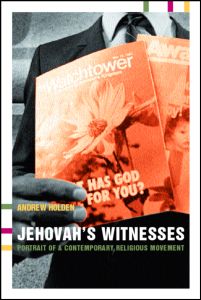
Since that time, Witnesses have been no strangers to my door, so I read Andrew Holden’s Jehovah’s Witnesses: Portrait of a Contemporary Religious Movement (Routledge, 2002) with interest. Holden is a sociologist who undertakes an analysis of the ascetic, millenarian group in a conflicted situation. Modern society proves quite difficult to reconcile with Witnesses’ authoritarian biblical literalism. The assertion, now quietly overlooked, that the world did not end on cue has proved an embarrassment more than once. Most recently Armageddon was scheduled for a 1975 time slot, but this stubborn, old world just keeps limping along. In many ways, it is a sad tale. Witnesses advocate clean living and fair dealing, but if you’re not part of the club you are a danger to those who are. Non-monastic, they nevertheless shut themselves off from much that the world has to offer.

Holden’s study is a model of fair-minded analysis. He is not out to humiliate or insult the Witnesses or their lifestyle. He remains true to the evidence (but not the doctrine) and offers a rare, objective look at a New Religious Movement. Distinguished as one of the few religions to have started in Pittsburgh (the city that also gave us the cinematic zombie), Witnesses are now a six-million strong, worldwide religion. While Holden gives only a cursory glimpse of their doctrine, he does offer a rare view into an exclusive faith struggling for the end of a pluralistic world. It is a study well worth reading. Especially for an apostate.


Deadly Morass

Swamplandia! is a novel ensconced in the reality of death. It is one of those books that I knew I would need to read as soon as I heard about it.  Alligator wrestlers, ghosts, and even a biblical-sounding Leviathan theme park based on hellish imagery create an eerie, almost supernatural feel to the narrative.  At the same time, it is a very human story of loss, assimilation, growing up, and more loss that might be gain.  I’ve read many novels where the characters and events faded relatively rapidly after I closed the back cover.  The cast of Karen Russell’s Swamplandia! has stayed with me, wraith-like, for several days.  As I’ve tried to work out why the story sticks so close at hand, and I think it may be because so many of the characters—the entire protagonistic family—are outsiders.  The loss of the mother spirals a carefree, largely off-the-grid family in a Floridian swamp into a forced confrontation with the mainland.  In these times of economic hardship, the loss of a dream is something too many people can understand.  I certainly can.
 
Death, in whatever form it may appear, is a religious issue because it deals with ultimates.  Paul Tillich, a theologian of the last century, famously declared that God was that on which a person staked their ultimate concern.  For many people today, by this rough definition, death has become a kind of god.  In the ancient world s/he was literally so. Of course, death is entirely natural.  Consciousness is the factor that makes it seem foreboding and dreary.  Swamplandia! deftly ties death and love, hope, and a kind of diminished redemption together in a tale where a young girl travels through an unlikely underworld to rescue a sister who saved her own life by her doubt.  It may not be the most profound novel, but it is certainly a moody one.
 
On my campus visits I’m increasingly hearing that novels are favored by some instructors to get at deep truths that textbooks miss.  Indeed, the analytical urge is strong, but not omnipotent.  Sometimes the truth can best be experienced by letting yourself go and just feeling what is happening rather than thinking it through.  Swamplandia! does a bit of that. Thinking back over my own long, academic tenure, I realize that the teachers I enjoyed most were those who had me read what were, at the time, unexpected things. In a world where education has become nothing but job training to produce satisfied cogs in the corporate machine, death as a character in our own stories can’t be far from the truth. Sometimes even alligators and ghosts aren’t the scariest features of our non-fictional landscape.


A Cougar’s Mother

While on a stroll between appointments at Indiana University in Bloomington, I came across a tree with flowers laid underneath and a memorial plaque at its base. I glimpsed the name Mellencamp, and for a fan of rock, it didn’t take much imagination to tie it to John Cougar. Indeed, the memorial is dedicated to his mother, an artist, who died earlier this year. I first came to know of Indiana University because of music. I married a musician who, like myself, had to sacrifice a career doing what she loved in order to “get by.” Although she hadn’t studied at Indiana, my wife knew the reputation of the campus well. At a sunny moment between appointments I sat outside one of the music buildings listening to students practice through the open windows and read about Marilyn Mellencamp. An article in a local paper explains that this week an exhibition of her art is on display in Bloomington. When I read the quote from Waldron Arts Center Gallery Director Julie Roberts that the arts “are viable ways to make a living and they are vital part of being a happy and alive person,” I felt a renewed sense of hope. There are others, it is clear, who see that the arts are called the humanities for a reason. In a culture where only money matters, there is no culture. Think about it.

Since the industrial revolution we’ve been told that the measure of a human is how much money they are able to make. Something profound has been lost since then as great universities cut programs for the arts and humanities while business departments build new facilities. Talk about gaining the world but losing your soul—business cattily replies, “I have no soul.” While John Mellencamp never rivaled the biggest bands for income, his work, particularly Scarecrow, is full of human empathy. I listened to that album over and over in 1985, recounting the farm crisis and the demise of those not driven by corporate greed. And looking at this maple tree I wonder when the last time was that someone honestly mourned the death of a corporate mogul.

It is the mark of a deeply schizophrenic society that we all aspire to what fails to inspire. Our economy is driven by the material—money—and not that which speaks profoundly to what it means to be a human being. We keep the arts alive because the wealthy require something worthwhile upon which to spend their lucre. Is not buying art buying part of another person’s soul? We can’t define souls materially, science must conclude they don’t exist, but every time you say, “I feel happy/fulfilled/satisfied” you belie the facts. Souls may not be material, and they may never be found in laboratories. They are nevertheless part of the human constitution, and I for one, would lay a flower under a tree and know that it is more than just fertilizer for the next growing commodity.


Edeniana

“On Jordan’s stormy banks I stand, and cast a wishful eye”—so begins a hymn I learned as a child and which has followed me to Bloomington, Indiana. Campus visits are an expectation of some academic editors, and as I stand and look at Jordan River on the Indiana University campus, I can’t help but feel a little disappointed. I have no idea if this little stream was named after the Jordan River of Israel fame, or if it just happens that someone named Jordan was a benefactor of the university. Given that there is a Jordan Hall, and a Jordan Street, the latter seems likely. Nevertheless, whether liquid or liquidity, any Jordan in contemporary society probably traces its origins back to the river that now separates Israel from Jordan (named after the river). Many hymns celebrate the mighty Jordan without the benefit of geographical experience. The mythic river is not mighty or majestic, but a slow-moving artery that sluggishly empties into the Dead Sea. With all the history of Christian imagination, however, we like to think of it on a par with the Euphrates, or at least the Mississippi.

Jordan’s stormy banks

Biblical images have a way of catching the imagination. Although many younger people have no training in the Bible or Christianity, our culture is steeped very thoroughly in it. For some who are just rising to voting age, it must appear incredible the amount of effort politicians still put into keeping the old faith alive. It is clearly so here in Indiana. Driving down from Indianapolis I passed many signs that the Biblio-Christic pulse still throbs in the heartland. As I stopped to check my directions, I realized I’d just parked across from Pray Street. In a land where an imperative verb for a religious function stands a chance of becoming a street name, anything is possible.

After I returned from my trip to Israel many years ago, I realized that I’d neglected to take any pictures of the Jordan River. It runs like a leitmotif through our national imagination that it almost seems worth going back just to snap a shot or two. The Jordan is redolent of Eden, a land that is, according to Genesis, defined by four rivers. Water is a precious commodity in the arid Middle East. Its fluid nature seems not to have achieved the level of metaphor for those who insist on warring over religion. For gardens to bloom, there must be water and its short supply raises tensions. Water connects, however, just as readily as it separates. One of the first steps towards the great civilizations was the technology of travel by water. Why can we no longer use it for connecting rather than gerrymandering? I don’t know why this little stream is called Jordan River, but I do stand by its banks and cast a wishful eye.


Kermit’s Secret

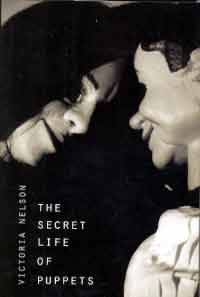
When I was a post-graduate student in that Gothic city of Edinburgh, I decided to spend some time reading Umberto Eco’s Foucault’s Pendulum. It was intended as harmless entertainment, but as anyone who has read it knows, the story soon unravels into an unbelievable world of dark religions that haunt a naive protagonist. While I was reading it, a packet, hand-addressed to me, with no return address, came to my student mailbox. The contents consisted of several tracts, in German, warming of the dangers of Satanism. No letter, no explanation. Foucault’ s Pendulum had me paranoid already, and this strange package completely unnerved me. Well, I’m still here to tell the tale. While reading Victoria Nelson’s brilliant The Secret Life of Puppets, I learned that she had a strange episode while reading the same novel. It was an apt synchronicity.

Nelson is a scholar who should be more widely known. I found her because her recent Gothicka was prominently displayed in the Brown University bookstore in May. I saw it after taking a personal walking tour of H. P. Lovecraft sites. Synchronicity. I had read, in a completely unrelated selection just a couple of months ago, Jeffrey Kripal’s Authors of the Impossible. Synchronicity. For many years I have honed my Aristotelean sensibilities, following devotedly in the footsteps of science. Problem is, I have an open mind. It seems to me that to discount that which defies conventional explanation is dirty pool in the lounge of reality seekers. I have always been haunted by reality.

I’m not ready to give up on science. Not by a long shot. Like Nelson, however, I believe that there may be more than material in this vast universe we inhabit. Indeed, if the universe is infinite it is the ultimate unquantifiable. The Secret Life of Puppets is alive with possibility and anyone who has ever wondered how we’ve come to be such monolithic thinkers should indulge a little. For me it was a journey of discovery as aspects of my academic and personal interest, strictly compartmentalized, were brought together by an adept, literary mind. Religion and its development play key roles in the uncanny world of puppets. Those who wish to traverse the realms they inhabit would do well to take along a guide like Nelson who has spent some time getting into the puppets’ heads.


Battle Bots

Our local high school robotics meetings start up again this week. Actually, they’ve been going on all summer since robots do not require the rest and mental downtime that we mere creatures of flesh do. Glancing through the headlines of the Chronicle of Higher Education I saw a leading article on a topic I’ve been reading about: the military use of robots. On a college campus visit last semester I came across a robotics display and, since I’ve picked up some of the lingo, I engaged an engineering student sitting nearby. He told me that most of the funding for robotics at the collegiate level (there, anyway) came from the Department of Defense. Earlier this year I had read Wired for War, a book as stunning as it is frightening. In fact, P. W. Singer is cited in the article. What makes this interesting, however, was the role of Ronald Arkin, a Georgia Tech professor of robotics and ethics. Dr. Arkin believes robots to be morally superior to humans at making battlefield decisions. He’s not alone in that assessment.

The more I pondered this the more troubled I became. Morality is not a scientific purview. Ethics that have been quantified always fail to satisfy because life is just a little too messy for that. Who is more morally culpable: the policeman who shot a thief dead when the man was only stealing bread because his family was starving? Hands down the most challenging undergraduate class I took was bio-medical ethics. It was thornier than falling into a greenhouse full of roses. Sick minds and reality cooperated to draw scenario after scenario of morally ambiguous situations. I left class with two more things than I’d taken in: a headache and a conviction that there are no easy answers. Having a robot vacuum your floor or assemble your car is one thing, having one decide who to kill is entirely another.

The article cites the rules of war. The main rule seems to be that no matter what, some people will always kill others. We try to sanitize it by making the inevitable death-dealing follow ethical conventions. While religion often takes a bad rap these days, one of the things that it is capable of doing pretty well is providing an ethical foundation. People may not always live up to the standards, but religions only in very rare situations give people an excuse to hurt others. Nearly all religions discourage it. The rules of a science-based morality would likely fall along a logical algorithm. Unfortunately, there’s more gray than black or white in this equation. Algorithms, in my experience, are not so forgiving. So as I get ready for my first robotics meeting of the year I need to remind myself that the robots are capable of great good as well as great evil. Like with humans, it all depends on who does the programming.


Queens and Playmates

Once upon a time, theology was queen. I’m no theologian, but then, I didn’t make up the phrase. A recent article in the Chronicle of Higher Education discusses how some scientists say there is no longer a need for philosophy. In passing the piece mentions that theology had, long ago, been considered the queen of the sciences. According to medieval thinkers, philosophy was her handmaid. Antiquated archaisms apart, I sometimes think back on this whole venture of education. Few today acknowledge, and most probably don’t know, that education began as a religious exercise. Writing, and reading, were overseen by the gods. Even in the modern world the earliest universities were founded to teach theology and law. Many of the ivy league schools, including Harvard, Yale, and Princeton, began as training grounds for the clergy. How quickly our forebears are forgotten.

It’s not that I think religion deserves a privileged place in the academy, but I do believe it deserves a place. Science has a long track record of spectacular successes. Not only that, but the advances in science often capture the imagination—and here we are back in the realm of the humanities, that place where feeling and possibility are unlimited. Many of those of us in religious studies—apart from creationists and their kin—gladly award science its deserved paean to successfully unpacking the intricacies of the material universe(s). As the Chronicle article demonstrates, some on the science side of the circle want to claim all the marbles and go home. Some of us want to keep the game going well after dark.

Maybe that’s a very wide metaphorical shift—from queen to playmate—it may be presumptuous. After all, what has religion, or philosophy for that matter, got to claim? What shiny Nobel Prizes to display gracefully, or great advances of which to boast? The benefits religion can claim are somewhat less tangible, but important nevertheless. While some people declare that meaning is a chimera, deep down, as a species, we know that it is important. Even more than that, the fact that you’re reading this right now owes its ultimate origin to religious thinking. Writing was the brainchild of the gods, an activity we learned in imitation of the divine. I will always find science fascinating, but I will always do so with a book held in my hands. “Now, here, you see, it takes all the running you can do, to keep in the same place,” in the words of another famous queen.


Coexistence

Sometimes I think I’m a punching bag. Not uncommon among scholars of religion, I suppose. I have read my fair share of overt attacks on religion: Hitchens, Dawkins, and even Jillette, and sometimes limp out of the ring wondering why I even bother. Still, science doesn’t completely explain the universe I inhabit either. Thus is was with some glimmer of hope that I read a story in Monday’s Chronicle of Higher Education entitled “Does Religion Really Poison Everything?” There can be no doubt that religious behavior has a track record of some execrable atrocities—some very bad behavior has been engendered by fervent religious belief. At the same time, those who despise religion have a hard time explaining it. As the Chronicle piece points out, religion is likely an evolved trait. There is some survival value in it, otherwise it would, by natural selection, disappear. Religion is seldom a rational enterprise. That doesn’t mean that it can’t be rationally studied, but rather that religion is primarily experienced as an emotional phenomenon. We find ourselves motivated by feelings, although reason will often drive us to do things we don’t feel like (like going to work). And emotion is necessary to be truly human.

It is often difficult to respond to those who castigate religion as an evil or poison, not for lack of reason, but because of feelings. Having spent most of my life with religion, it is not surprising that attacks on it often leave me feeling ashamed. But ah, that is an emotional response! It seems rational on the surface, but really, shame and embarrassment are typical emotional responses. This is the realm of religion. Reason may indeed indicate with great accuracy the way the universe works—of this I have no doubts. At the same time, I’m not sure the entire universe is something that humans can adequately comprehend. I have a hard time remembering what’s on a short shopping list if I accidentally leave it at home. Our brains aren’t equipped to the task of comprehending universes. Feel overwhelmed when facing a physics test? That overwhelmed feeling is an emotional response. With considerable cheek, might I suggest it might even be a little bit religious?

The Chronicle is a high-profile source for academic rectitude. I am pleased to see Tom Bartlett pointing out that the line-drawing in the sand between religious Fundamentalists and pro-science New Atheists will not solve anything. Religion is often guilty as charged. It is not, however, pure evil. There is enough evidence out there to suggest that religion is a tremendous coping mechanism for billions of people. And coping is not a bad thing, all things considered. Wisdom that is often attributed to the Greeks suggests that “all things in moderation”—the golden mean as it’s known—is the way to human happiness and success. The idea is older than the Greeks, and indeed, can even be found in the Bible for those who are willing to look. One need not be religious to see that, like most human inventions, religion has both good and evil uses. Evolution gave us religion, and it gave us science. It also gave us brains divided down the middle and strong reasoning that must dance with creative emotion in a tango that frequently makes abrupt shifts of direction. Our job, as humans, is to learn the steps to the dance.

Different, but equal.


Traces in Between

I first discovered Edgar Allan Poe as an adolescent who believed monster movies actually represented physical malefactors. By the time I was writing high school term papers, Poe had become my favorite author, and I delved a bit into his sad life story. It has taken a few decades for me to realize that no lives really fit into the prepackaged paradigms that we’re sold. We think of Poe as a writer, but he was also a man who wandered from place to place, dying in Baltimore and nobody really knows why he was even there at the time. Sure, he had lived in Baltimore fourteen years earlier, but his fractured career had taken him many places in between. Having nothing but his published writings and gut feelings to go on, it seems to me that Poe was a man who felt unconnected to any single place. His view of the world made others uncomfortable, as even a cursory reading of his obituary demonstrates. He may have been attempting to find a place to belong. Maybe that’s why I’m standing here in Baltimore next to his burial place.

In a world characterized by xenophobia, having a sense of place can be a matter of life and death. I often wondered, as a child, at the fact that I was born in a different state than either of my parents, and that my mother was born in a different state than either of hers. Where was my place? I really didn’t start to travel until attending seminary, and since then I’ve lived in many places. At times I think of Poe and his peregrinations—not that I would dare compare myself to him; Poe was a genius in a world that couldn’t understand him. I am merely a disciple.

On a recent college-visiting trip, I found myself in Charlottesville, Virginia, where Poe spent a few weeks as a student before being forced out by his debts. Later that day I was in Baltimore, and I could not neglect a stop to pay my profound respects. Throughout my life I have felt a connection with writers whose work I admire. Perhaps as an erstwhile dabbler in the literary arts I feel as though I might somehow connect to the guild. The sense of knowing, I realize rationally, is entirely one-sided. Standing here in Westminster Cemetery, however, feels like being in the presence of a friend. Even had I lived in the nineteenth century I would unlikely have ever met Poe, just as I am unlikely to meet most of the authors I read who still walk among us. Maybe I just feel no fear of rejection—call it a sense of place—among the deceased, unquiet spirit who is Edgar Allan Poe.


The Power of Magic

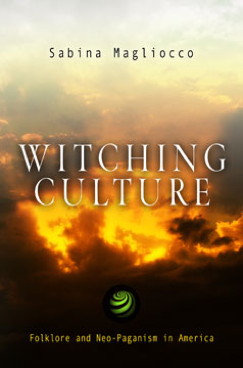
Open-minded academics are somewhat hard to find much of the time. This stands to reason when jobs are already rare and having a reputation for thinking outside the box frequently equals thinking outside the academy. I am always pleased, therefore, to find unconventional works by credentialed authors. I just finished reading Sabina Magliocco’s Witching Culture: Folklore and Neo-Paganism in America. Magliocco takes head on the dilemma that non-empirically verified experiences sometimes do happen. Of course, Paganism accepts that as a matter of course, and Magliocco notes that many Pagans hold advanced degrees in the sciences and some even have university posts. Experiences have a way of defying the rules. Most of us have had a bizarre coincidence or uncanny occurrence or two transpire in our lives. We are trained, via our scientific worldview, to shake our heads and try to dismiss it. Magliocco pauses to wonder if we’re perhaps being too hasty.

Sabina Magliocco is an anthropologist with a legitimate doctorate and a university post. Witching Culture is largely an analytical study of Paganism, but it also allows for the possibility that experiential knowledge might complement academic knowledge. This remains a debated issue among specialists: who can really know a phenomenon objectively? Many argue that empirical data reveal the truth of the matter, but truth remains a slippery concept. At the opposite debating table sit the smaller coterie that argue that you can’t study magic until you’ve experienced it firsthand. The debate does not divide along even lines and this is reflected in society at large. We accept the utility of science, but many still pray for divine intervention. Specialists in religion fear to take sides—after all, jobs are hard to find and increasingly harder to keep.

Fully aware that the modern Pagan movement is a revival movement following the hiatus of Christendom in Europe, Magliocco nevertheless admits to being a practitioner. Fascinating her readers with first-hand accounts of mystical experiences, she draws back to try to analyze what has just happened. And she tells us so. Years ago, as part of a seminary assignment, I attended an Al-Anon meeting as an observer. I am, however, the adult child of an alcoholic and when the circle came around to me I confessed to being both an observer and a person seeking healing. It was a difficult place to be, so I respect what Sabina Magliocco is offering us here. Anthropologists increasingly doubt the possibility of pure objectivity, and even physicist Werner Heisenberg realized that to observe is to be part of the experiment. And so are we all.


Thinking Zombies

Religion seldom makes as big an impression as when it concerns itself with the undead. Popular culture has gone after zombies to such a degree that they have engaged academic discourse well beyond the field of African-Caribbean religions. In fact, religious specialists tend to shy away from the topic in a kind of first-date embarrassment. Perhaps it’s because zombies in popular culture are so much cooler than their Vodou forebears. Within the past several months, however, zombies have shown up in Time, on the Center for Disease Control website, and now in the Chronicle of Higher Education. An article this week explores the academic implications of a paper by neuroscientists Bradley Voytek and Timothy Verstynen on the zombie brain. The two took on the project as a lark at the behest of the Zombie Research Society. Science fiction writer and head of ZRS, Matt Mogk gave an interesting take on zombies. He’s quoted in the Chronicle as saying, “Zombies are rooted in science, not superstition and myth.”

At the risk of sounding extremely uncool (one that I take rather frequently, I fear), I would point out that exactly the opposite is the case. Zombies are rooted in superstition and myth, i.e., religion. The entire idea that a person can be made to rise from the dead—originally to be made a slave—comes from that heady blend of Christianity and African religion that developed as part of slave culture. Slavers were notorious in not wanting slaves to accept Christianity because that might make slaves think that they were equal with their owners. By suppressing Christianity among slaves, the African religions in which many were raised came to blend with the Christianity that they’d garnered. One of the bi-products was the zombie. The zombie partakes of the Christian concept of resurrection, but in a twisted way. Once the new vision of the zombie presented by George Romero took off, yes, they did move into the realm of science fiction, often the forerunner of science.

A very serious issue underlies the zombie myth—the very religious concern about death. While not all religions comfort with an afterlife, they all in some way deal with ultimate issues. The end of life is about as ultimate, from our limited experience, as they come. Science loudly and repeatedly insists that death is the final frontier. We don’t cross back this way again, according to the available evidence. Scientists do not study ghosts or souls, and are very cagey about near-death experiences. The zombie, who is now threatening the careers of young scientists, is a most religious monster. Everything about the zombie points to its origin as a religious trope. Voytek and Verstynen wanted to interest people in science by taking a comic look at zombie brains. The problem is that zombie brains are brains on religion, not science.


Leggo My Congo

When I first saw the trailer for Congo, back in 1995, I was a new father and my interest in talking apes understandably took a back seat. While the movie sat back there like a quiet child, it was slowly forgotten. Something prompted my memory over the weekend, so I finally watched it. Now, I had plenty of time to read the negative reviews, but I have a soft spot for both talking apes and bad movies. The really fascinating aspect of Congo, however, was the fantastic liberties it takes with the ancient world, particularly the kingdom of Solomon. Solomon has been under investigation over the past few decades. Archaeologists have not found evidence of the biblical opulence concerning both his wealth and fame. It seems likely that he was an actual king, but the king of a small nation that did not have quite the pull that later tradition granted to it. Still, Solomon has become a cultural trope for great wealth and splendor, and if a movie-maker wants an easy frame of reference, well, some people will recognize old Sol. Those who do recognize Solomon probably won’t have a ready inventory of his assets to interrupt their enjoyment (that presumes a lot) of the movie.

The motive factor that brings our unlikely traveling companions together in Congo, are the fabricatedly mythical diamond mines of King Solomon, located in the Congo. A self-styled archaeologist and professional con-man from Romania assists to finance a flight to Africa to help return a homesick gorilla (Amy) who also, by the way, talks. The only realistic aspect of the heroes is that the university professors are the ones who are completely broke and have to rely on corporate funding to get their monkey off their back (well, actually she’s an ape). And then there is the huge communications giant (TraviCom) that needs the diamonds for their communications equipment. And a bunch of Africans who just want to stay alive (most don’t succeed). Solomon was never really associated with diamonds in the Bible. His wealth is described in terms of gold, silver, bronze, peacocks, and suprizingly, apes. Why and how he would have managed a mine in central Africa when even the Egyptians didn’t travel there is never explained.

Well, I shouldn’t be so hasty about the Egyptians. Our Romanian con-man is also able to translate Egyptian heiroglyphics, liberally scribbled on the walls of the fortress surrounding Solomon’s mine. These preserve the story of the “myth of the killing apes” that generated an honest-to-god guffaw from my cynical self. New mythology and corny characters aside, the movie didn’t fail to reach me. I’m always a sucker for talking apes and under-funded education, both of which represent a kind of extinction. If Solomon really had a reach all the way to the Congo, and if he extracted the huge diamonds the movie showed scattered around on the surface of the ground and if universities could actually get media attention for causes other than the shortcomings of their football programs, there could be cause for hope. In what is a bit of probably unintended social commentary, after the mine is destroyed in a volcanic eruption, only one diamond remains. And that diamond benefits neither the single surviving African nor the underfunded university professor. It becomes a weapon in the hands of a large, private corporation.


The Idea of a University

I have to admit that my sense of justice has been a bit offended by the loss of reputation of my chosen field. Seeing how universities are fast becoming job-training institutes, I fume about what once had been and no longer shall be. History is the lens through which I view the world (a subject many industrialists consider “useless,” but to their cause actually “dangerous”). Historians dispute which university was the earliest, although something similar to the idea of a university was developed in Bologna, Italy, around 1088.  The University of Paris was also very early, as were Oxford and Salerno.  While “business” as it was then known could be studied to some degree, a primary function of early universities was the training of clergy. No doubt, paranoia concerning heterodoxy and heresy helped spur on the idea that future clergy required extensive training. As universities caught on, many centers for the studying of theology (indeed, a branch of religious studies) sprang to life.  It could be argued that this was a “trade mentality,” but very quickly this became an academic point.  Who else but a theologian would every worry about how many angels could dance on the head of a pin?

Science was incorporated into theological studies from the beginning.  We all know about the antagonistic relationship between the Church and Galileo, but less often do we hear about the religious thinkers who were trying to put it all together into a workable system.  Often the university was among the few places where such abstract and critical thought could occur. Some of the great universities in the United States began as seminaries: Harvard, Yale, Boston University—they started as places to train clergy. How often do graduates of the Harvard Business School toot that particular horn? Permit me the privilege of a mournful sigh as I watch the torch pass from abstract thought to the abstract symbol of the gold standard. Money only possesses the value we assign to it.  Currency can be measured in less material avenues as well—the ability to think clearly and precisely and compassionately; these abstractions, I would lament, have inherent value.  Alas, the heart of the university has gone another direction. I have undergone the heartache of breakups before, and always one needs a little time to adjust to the loss.

The University of Virginia’s recent object lesson to higher education should perhaps serve as a warning tap on the brakes to those who would see higher education kneeling abjectly before the towering statue of commerce with its head of gold.  Maybe there is more to life than money?  Maybe education for its own sake is what sets civilization apart from life in the savage jungle.  Those who castigate our great institutions of learning seldom turn down the offer of an honorary degree.  While these academic niceties require neither coursework nor dissertation, they do offer a kind of credibility that the rich seldom find on their own.  So what is the idea of a university? Is it a place to learn a trade?  Sometimes.  The humble request those of us deemed useless make is that the university not forget its humble origins as a place of speculative thought in the service of religious thinking.  Critical thinking. Otherwise it will be more than irony that the city that gave us higher education is also the one that also gives its name to baloney.

from Wiki Commons


Just You Wait, Professor Higgs

They finally found him. Peering deep into the invisible world of the sub-atomic universe, his hiding place has practically been discovered. I knew that when it happened my alma mater, Edinburgh University, would be part of the equation. That’s just the kind of thing you know deep down in your sub-atomic parts. Scientists are now coming very close to announcing definitive proof of the “God particle,” or Higgs boson. Named for theoretical physicist Peter Higgs, who predicted the particle, this elusive piece of physics has been nicknamed the “God particle” by journalists who want to express just how great its explanatory value is. The average citizen knows very little about the inner workings of science—thus we have Creationists and Tea Partiers—so we require striking neologisms to help us comprehend that this is not only important, but really, really important. For explaining the way the universe works, the Higgs boson has been likened to Newton’s discovery of gravity, although apples had always fallen from trees even before he learned why.

I have always found it curious that when we need a superlative we dash back to the biblical worldview. As John Heilprin and Seth Borenstein of the Associated Press make clear, “God particle” is not utilized by physicists (although coined by one), but is used “more as an explanation for how the subatomic universe works than how it all started.” To get us to read about science they have to use mythology. The more we understand about science and the way our minds work, the more perplexing it becomes. Humans are meaning-seeking creatures and we often find story more meaningful than fact. Facts, however, determine what actually happens or what actually is. The Higgs boson is getting close to facticity. We whimsically call it the “God particle.”

Could the great gulf between science and religion, I sometimes wonder, be bridged by good, liberal arts education? The liberal arts, particularly the humanities, are all about understanding what it is that makes us, well, human. They aren’t precise like science, or profitable, like business. At the end of the day, however, in those few quiet moments, don’t we dwell among the realm of humanity? When we stop posturing for our co-workers, the media, or our neighbors, when we are who we truly are—then we are engaging in the humanities. Education can be in the service of becoming human as well as becoming rich. In one of its latest triumphs, it has produced physicists who have discovered the footprints of the Higgs boson, potentially revolutionizing the universe as we know it. And many of us would have never even heard if they hadn’t called it the “God particle.”

Like atoms over our heads


Burned Over

Western and central New York State, in any religious history of America, have acquired the nickname, “The Burned-Over District.”  This graphic metaphor arises from the constant evangelizing and, more importantly, the fertile soil for new religious movements left in its wake.  This region could claim to be the home of Seventh-Day Adventism, Spiritualism, the Oneida Society, and the Latter-Day Saints.  It was also an early home of the Shakers and the land chosen by the Publick Universal Friend for her new Jerusalem.  The sense of place is important to religions.  The Latter-Day Saints, however, grew restless in this region where Joseph Smith translated the Book of Mormon and began a torturous trek that would land the Mormons in Utah.  Joseph Smith never made it that far.  Religious leaders being persecuted are nothing new; Smith had been tarred and feathered, was wanted on charges of fraud, and was eventually murdered for his beliefs.  He was also one of the most intensely creative individuals America has produced. His extraordinary creative venture is often overshadowed by the religion that grew out of it.

With Mitt Romeny’s campaign stoking up steam, many people find themselves wondering about Mormonism.  I first learned about the Latter-Day Saints from a rather biased World Religions course at Grove City College.  One aspect which was true in that course, however, was the great secrecy surrounding Mormon teachings. Of course, the Book of Mormon is in the public domain and is easily available to those who wish to read it.  Official Latter-Day Saint beliefs, on the other hand, are frequently inscrutable.  For all its problems (and they are sometimes significant), mainstream Christianity is very open (and often vocal) about its belief system.  The same holds true for Judaism (mostly) and Islam.  If you want to know what they believe, just ask.  Americans tend to be a little perplexed by the Latter-Day Saints because there is always a feeling that there is something they’re not telling you.  It goes all the way down to the underwear.  All religions are concerned with sex.  Some may not disclose the details in public, but they all deal with it somehow.  Latter-Day Saints have rules about underwear–I’m sure other religions do too.

If Americans are really, seriously curious about the religious heritage of a potential president, a great way to find out is to read a bit of our own history.  I learned about the Burned-Over District back in college and have periodically read about it several times since then.  It is no secret.  Our society is not likely to expend the energy needed to learn about its own heritage.  As several of my recent posts have intimated, even higher education has no time for the study of religion (or history, or anything that doesn’t make money–Romney surely does!). Instead we will charge fearlessly ahead into the dark.  And when we are in the dark we may start to wonder why we’re wearing this unusual underwear. Wondering about religion is far easier than supporting those who study it.

Have you seen this man?