Abuse of Power

In many ways the naiveté of youth still clings to me. I was reared to respect authority and to trust those whom society placed in power over me. As skeptical experience wears away at this ancient veneer, I have become more retrospective of the whole enterprise of the social experiment. Perhaps I shouldn’t have read The Call of the Wild after all.

A few months back I wrote a post supporting a student at Butler University, Jess Zimmerman, who was being sued by the university for perceived slights against the administration on his anonymous blog. That post has forged a connection between Jess and myself, although I’ve never met him. That connection is one of justice and fairness, traits that should, above all, be upheld by institutions of higher learning. In an email last night, Jess updated me on his situation. The lawsuit has been dropped (my thanks to all of you who signed the electronic petition through this blog), but the recriminations continue. The details are available on Jess’ blog, but the short version is that in order to have a fair trial the university had placed him under a $100,000 bond. I am saddened, but not surprised, by this abuse of power.

Over the past several months I have wearily retrod this familiar path. I too have been the victim of institutional power in an episode that haunts me to this day. In slow motion I watch and rewatch men “in authority” dismantling the hopes and aspirations of a neophyte academic who was left wondering, like a dog, why he was being beaten so. There is no action to take. There is no club to wield. The only thing required is to be aware of the situation. Although I shouldn’t have done it, I did read Jack London’s Call of the Wild. And it is my hope that young students unfairly targeted, like Jess, have the resilience of Buck and will remember their pasts when they come to lead their companions in forging a better world.


Everything’s Better at Harvard (Except Religion)

My wife pointed me to an important article in Newsweek on the plight of religious studies at Harvard. Now, I have to admit to a couple of bunches of sour grapes right up front. I was accepted at Harvard but elected not to go. Only after I had completed my doctorate at Edinburgh University after a lifetime of the study of religion and found that no jobs were available did I realize my mistake. I met colleagues who had jobs while attending academic conferences. All of those well settled in respectable positions had graduated from Harvard. A similar phenomenon exists in Great Britain. Those who actually find satisfactory positions hold doctorates from Oxford. Problem is, neither Harvard nor Oxford corner the market on good education (oh, the heresy!). People, however, are simplistically impressed by lineage.

In any case, this article by Lisa Miller points out the high drama of academic discord at the Shangri-La of American institutions. The famous linguist, Steven Pinker, who personally believes religion to be a severely faulty means of seeking enlightenment, has worked to prevent a required course in religion at the famed secular university on the grounds that faith and reason do not share the same status. Miller goes on to express how small colleges and state universities are picking up on the slack. My limited experience at Rutgers bears out her observations. In this large, rambling, decidedly secular school, my classes in the religion department are always full and I have to turn students away. Yet the university refuses to allow for a full-time hire. Secular America is deep in a state of denial. Because many academics reject religion personally, they simply can’t see how vital it is to understand it. I personally believe no one should be allowed to hold public office without having completed a course in Bible and its political abuse.

Meanwhile, Harvard still holds back. Its reticence will not prevent misinformed people from using their religion as a means of power and destruction. Pretending that since religion is not personally important it is not important at all has deadly consequences. To me it seems obvious that it is not the school you attend that is important, but what you learn while you are there.


Gray New World

A few months back I purchased a book entitled One Thousand Languages by Peter Austin. Not a “reading book,” this is more of a reference manual to the often bewildering profusion of languages in the world. Having dabbled in the study of about a dozen languages over the course of my academic career, I was interested in seeing what tongues are being spoken in places I’ve only dreamed about. After introducing a plethora of different communication systems, the book dedicates a significant section to endangered and extinct languages. There is a sadness about a language dying; it marks the end of an important aspect of a culture and a move towards a bland universality.

O say what did you say?

Then a Rutgers student sent me this link. It is a video of Wade Davis lecturing on the topic of the rapid disappearance of minority cultures around the world. Initially Davis begins by telling the students that when they were born (this lecture was delivered in 2003), there were 6000 spoken languages in the world. As of 2003, there were only 3000. The rate of language extinction is (was) about one tongue dying out every two weeks. What makes this degeneration so unfortunate, as Davis explains, is that many are dying unnatural deaths. Cultures are obliterated because of exploitation. More powerful members of nations (artificial constructs, all!) ensure compliance by encouraging uniform languages and monochromatic cultures. It is culturocide.

I would encourage my readers to view this video; it is 20 minutes well spent. A major component of these dying cultures is religion, naturally. Davis makes very important observations about this aspect of cultural non-diversity as well. And I can’t help adding that one of the phenomena he addresses is how zombies are made! Quite apart from my fascination with the monstrous aspect of religions, Davis’ cautions are essential to recognizing the plight of the once diverse human cultural domain. You won’t regret seeing this – it is nutritious food for thought.


Prosperity Update

I didn’t have the opportunity to write a post yesterday because my PowerPoint file for my class had been deleted. I still don’t know how. I’ve been using varieties of the same computer I have now for about 20 years and I’ve never lost a file before. I discovered this, of course, just before I began packing the car with the sherpa-load of equipment that I need to haul the 50 miles to Montclair with me to teach my class twice a week. The loss of the day’s lecture notes weighed heavily on my mind as I climbed into my car and discovered a problem with the electrical system – the blinker lights on the right wouldn’t shut off. (They finally started to behave normally half-way to the university.) And a blizzard was on the way. At times like this my thoughts turn to my prosperity cross.

I wrote about the cross in a previous post where I indicated that I was going to try a good-faith experiment to see if God really wants me to prosper. The last 17 years haven’t been good financially, so I tried my best to believe, and I have been carrying the cross around with me for a few weeks now. In that time I have had a publication rejected, did not get a full-time job after a very good interview, didn’t win the lottery (I bought a ticket as an experiment although I never play normally), my wife had more hours added to her job with no increase in compensation, my health insurance company politely declined to pay for an expensive dental procedure, and I have yet to be paid for my four weeks of teaching at Montclair. Oh, and two cars very nearly collided with me yesterday (not because of my blinker! One tried to pass me on the left as I was making a left turn into a parking spot in a parking lot, the other passed me on a single-lane entry ramp onto the Garden State Parkway while I was merging at the posted speed limit). I’m beginning to think they sent me a defective artifact.

In my prophecy class we’ve been discussing divination. From ancient times people have attempted to discern the will of the gods through a wide variety of techniques. Watching birds in the sky, smoke from altars, oil on water (haven’t discovered smoke on the water yet), casting lots, reading animal livers, and having significant dreams – any of these might reveal the hidden will of the gods. And ancients carried talismans at times to hedge the odds in their favor. We like to think of ourselves as more sophisticated than that, relying on more updated and civilized ways of influencing the almighty. My pocket cross is one of those modern means to induce divine favor my way. Perhaps I am reporting too soon, since I’ve got a backlog of nearly two decades of financial woes to overcome. In the short term, however, it looks like a real blizzard is on the way.

Secrets of my sucess


Noah in the Underworld

I recently was subjected to the 1940 sci-fi/western film Radio Ranch (a compilation of the series Phantom Empire). This happy-go-lucky story with Gene Autry in his first starring role is a romp through the unbelievable in just about any sense of the word. Based on the premise that there is an underground world called Murania, the film pits Autry against evil scientists who want to get a “bushel load” of radium from Murania, the “Thunder Riders,” or national guard of Murania, and indeed, against his corporate sponsors who will cancel his contract if he ever fails to get to Radio Ranch by 2 p.m. for his singing broadcast! This creative approach to early science fiction will be reincarnated more successfully in The Mole People, a movie that I wrote about a few weeks back.

The connections between the two films do not stop at an underground world with humanoids wearing Egyptian costumes (there is an unmistakable uraeus on the helmet of Argo in Radio Ranch), but go as far as the associations with the Flood Myth. I pointed out the flood connections in my post on The Mole People, and it was startling to note that Radio Ranch begins (and ends) with Gene Autry singing “Uncle Noah’s Ark.” That coincidence is, in itself, barely worth noticing. When the evil scientists invade Radio Ranch, however, they are shown an artifact from the Thunder Riders (whose thunder-producing horses are, admittedly, pretty cool) and they immediately identify it as an “antediluvian” idol. At this point it became clear how deeply embedded the biblical flood story has been in our culture, and how freely it was used in early science fiction films.

At a guest lecture in the Middle East Studies Program at Rutgers on Friday, I mentioned that the flood story goes all the way back to Sumer, making it among the earliest religious stories in the world. Several students had difficulty with this and began asking, “but when was Noah actually alive?” These college students, well educated in science, engineering, or political science, can’t get beyond the biblical literalism they were raised with. It is no wonder that America is falling behind much of the world in science education: we haven’t moved beyond Gene Autry’s overly cheerful belief in a deluge that never occurred.


Black Job Market

An article in the paper has launched me into a curmudgeonly mood. The bright-eyed journalist, eyes full of statistics, was writing about how college graduates make one-and-a-half times higher salaries than their high school diploma holding classmates. I laughed then cried when I saw the standard salary of a diploma holder was higher than my salary with a Ph.D. My thoughts migrated to Mark Twain’s quip about “lies, damn lies, and statistics.” Something is very wrong with our system.

Granted, those of us with higher degrees (especially in the humanities) do not enter the profession driven by aspirations of wealth. We do hope, however, to be able to afford to pay the rent. Instead the university world, with a casuistry that would do even a Jesuit proud, has found ways of wringing years of cheap labor out of those who are educating the next generation for those good paying jobs. It is a position that Sisyphus himself would despair to face.

When will we, as a society, fess up to what we know is true? Every industry is driven by money. Hospitals encourage surgery even when it is not necessary to bring in the extra income. Churches hit the guilt or eternal damnation buttons and cash flows in. University presidents ride around in limousines while those who are dangled along by their Ph.D.s beg for the bare minimum of fair treatment. No, I have to disagree with our affable journalist. I believe in education – it is the only way out of this money-hungry mess we’ve evolved ourselves into – but I don’t believe in education for good pay. It just doesn’t ring true.


Anomalies in Paradise

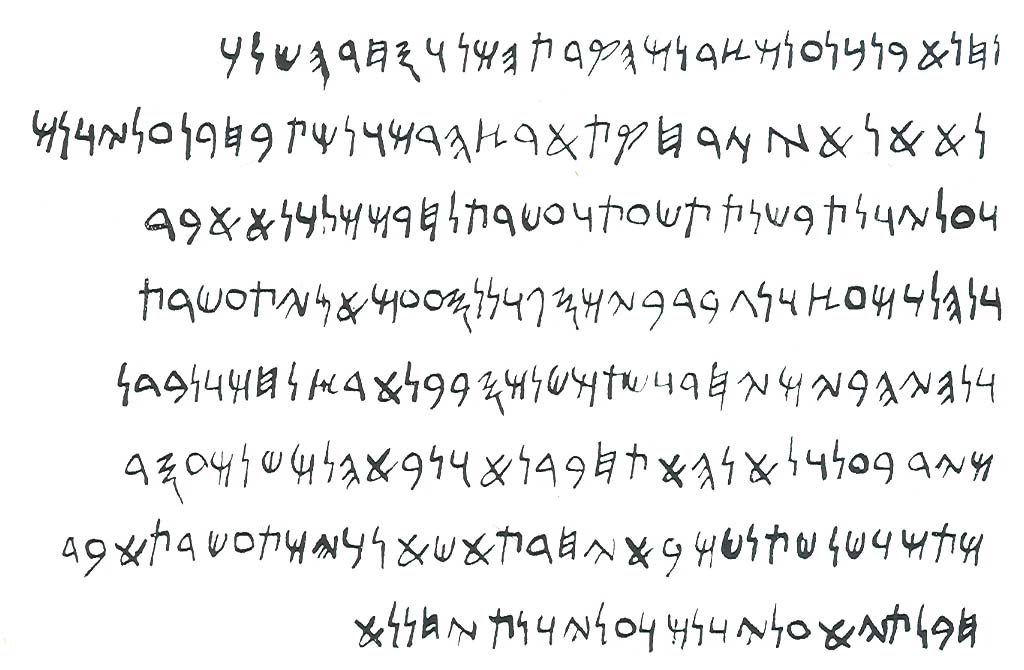
In 1874 (C.E.) a mysterious ghost of an artifact from Brazil was announced. In a story full of twists and turns and multiple Spanish surnames, a director of the National Museum of Rio de Janeiro had received a copy of a Phoenician inscription allegedly found in Brazil. Efforts to trace the letter to its source and to find the actual artifact both ended unsuccessfully, leading the director, Ladislau de Souza Mello Neto, to conclude the letter was a hoax and the artifact non-extant. The story might have ended there had not Cyrus Gordon, one of the premier Semiticists of the last century, allowed his open mind to reexamine the evidence. Gordon, in an article in 1968, argued that the inscription had to be authentic because of advances made in the understanding of Phoenician that would have been unavailable in the 1870’s. Gordon’s interpretation was in turn challenged by Frank Moore Cross, noted Harvard epigraphist, and scholarship heaved a collective sigh of relief and returned to the status quo. No Phoenicians ever crossed the Atlantic.

Neto's un-copy of the un-inscription

This little incident highlights one of the persistent conundrums of academic life. Anomalous objects are found/reported every once in a while and mainstream academia immediately debunks them to come back to center. A student of Hinduism asked me recently about the correlation of ancient calendars; before British colonialism hit India artifacts were dated to much earlier periods. Under the influence of Britain Dravidian culture grew younger and the background to European culture was considered more ancient, more time-honored. Those with investment in the system do not like to have privileged positions challenged.

While a post-graduate student at Edinburgh, my advisor had me read Peter James’ Centuries of Darkness, a study that challenged the accepted chronology of the ancient world. Intrigued, we set up a seminar with representatives from the Archaeology Department to discuss whether this was a feasible approach to the many problem areas of ancient chronology. The archaeologists duly trooped in, set up their weapons and took pot-shots at the book, blowing multiple ugly holes in its arguments. After about an hour, when the archaeologists were unable to answer a very specific question by my advisor, he asked, “How many of you have read the book?” Sheepishly, not a hand was raised. The premise of the book was sufficient for its well-deserved snubbing. I learned a valuable lesson about academia that day — open minds lead to trouble. It is a lesson that demonstrates a very basic insecurity of those who do not wish to have their assumptions challenged.


The Call of Balu

After writing a post on Natib Qadish, a modern revival of Canaanite religion in the United States, I received some comments from Lilinah of Qadash Kinahnu, another modern Canaanite religion revival. These movements are a fascinating development in an overly technological era — both movements have online resources that include serious scholarly treatment of ancient religions of the Levant. Both appear to be sincere attempts to get in touch with what modern religions seem to have lost. Both have heard the call of Balu.

In a society where universities seldom offer programs to study the Ancient Near East, people are starved to know about it. I realize that the field of study will never bring in the money that the sciences or finance do, but obviously there is something deeply satisfying about it. And students are hungry for it. Not only appreciated by those who start revivals of ancient religions, many of those who read more recent popular treatments are intrigued. Neil Gaiman’s American Gods was a New York Times bestseller. Although much belatedly, H. P. Lovecraft’s Cthulhu Mythos has become a paradigm for many undergraduates I’ve met. I was reminded of this as I watched Stuart Gordon’s 2001 movie entitled Dagon. A relentlessly tense and macabre film, the Lovecraftian base assures a constant draw for those who hear the call of the ancient deities.

We love technology. I’m posting this entry on an internet where ideas are simply electrons forced into recognizable patterns. We can’t imagine what life was like before being able to communicate with people just about anywhere in the world instantaneously, and where we can live our entire lives without ever actually touching physical money. Over all the noise of technological progress, however, can be heard the distinct call of Balu — a call to a simpler era, pre-Christian, pre-Judaism, pre-Iron Age. It was an era when human destiny fell into the hands of ancient gods.


Mortarboards and Greenbacks

I admit to being an idealist. I grew up far, far from academia. No one in my family had ever been to college before, but when my high school teachers described it, it sounded like a bookish place where knowledge for knowledge’s sake was valued above all more pedestrian concerns. There men and women read and studied and devoted their lives to learning. They lived in shimmering ivory towers and led the way of the future from their scholastic bunkers. And so I worked my way through college. Granted, studying religion may not have been the wisest choice for changing the future, but it seemed the right course at the time. I found a limited acceptance in academia, an idealist who just didn’t know when to give up. It was only after earning a Ph.D. that I stopped to look over the landscape with informed eyes and began to feel a deep dismay.

The best way to encapsulate that dismay became clear in a headline in the New Jersey Star-Ledger earlier this week: “More millionaires among college presidents.” It seems that the extremely rare job of college president is increasing becoming the path to riches. Now to a guy who has never found that mythical teaching position that supports a small family, this felt like a kick in the gut. More than that, it also summarized the dismal view I’d garnered of academia as a whole: it has become a money-driven enterprise.

The tawdry reasons given to justify college presidents earning six figures, some creeping toward seven, per year is that of unadulterated capitalism. Prestige, keeping up with the other corporate executives in academia, showing the strength of the school through the number of greenbacks wasted on the salary of a single individual — I simply don’t buy it. The college president worth his or her paycheck is the one who would take a pay cut for the honor of having the job. Okay, so I’m an idealist, but I believe that higher education, which began as an outgrowth of religious education in such institutions as the University of Paris, has lost its way. I know adjuncts at Rutgers who earn less than $30,000 a year (in New Jersey!) while the president’s salary tops $635,000. And don’t even get me started on the football coaches! I wonder who would win a purely intellectual contest: the University of Paris vs. the Big East Conference?

Education


Moral Monsters

trees

Everyone likes to feel vindicated. From my childhood I have felt marginalized because of my interests in monsters, and now a book has just been released from Oxford University Press that vindicates my interest! Stephen Asma, a philosophy professor at Columbia College, Chicago, has written a monograph entitled On Monsters: An Unnatural History of Our Worst Fears. Further vindicating my idiosyncratic interest is the fact that the Chronicle of Higher Education even has an electronic front-page article on the book this week. I am overcome with credulity! I haven’t been able to lay my hands on the book yet, but I hungrily read the article and look forward to the whole product.

Readers of this blog know my assertion that monsters originate in a mental space shared by religion. Both are responses to the unknown. Asma writes in his Chronicle article, “The monster concept is still extremely useful, and it’s a permanent player in the moral imagination because human vulnerability is permanent.” Indeed, his article is entitled “Monsters and the Moral Imagination.” The thesis he promotes is that our morality (again tied to religion for many people) benefits from its struggle with monsters. We imagine our moral responses to being faced with the truly horrific, and the monsters themselves are less frightening than our imaginary responses. The top box-office winner this past weekend was Paranormal Activity, a movie noted for not showing the menace, but implying it. There is an evolutionary advantage here; we learn about coping with real danger by imagining danger.

So as I look out the window on yet another cold, gray, rainy October morning, and see the trees swaying in the wind, my imagination takes flight. Those Saturday afternoons and late nights filled with cinematographic visions of even worse things that could happen are cast in a new light. Instead of scaring myself, I was building moral character! As my friend K. Marvin Bruce likes to say, “monsters are only mirrors.” Sometimes the mirror reflects a truly untamed world, and Dr. Asma informs us “inhuman threats are great reminders of our own humanity.” I would simply add, “and of our religions.”


What Are They So Afraid of?

I just had an email from a friend whose son is being sued. By the university he attends. The story was covered in Inside Higher Ed, and although I do not know the ins-and-outs of the episode, it reflects poorly on the state of higher education in this country. The student’s stepmother was dismissed from a chair in the Butler University Music Department and he blogged about it, feeling the dismissal was unfair. I am not privy to the details of the dismissal, but I am intimately acquainted with the ensuing scenario. When the student’s identity was learned, his father, my friend, did not have his contract as Dean renewed. The legal suit, claiming defamation, is still pending.

What saddens me perhaps the most, apart from the obvious social justice issues, is the breadth of such retaliation in institutions of higher education. Having once lost a position in higher education “without cause” shortly after making a principled stand against what I understood to be prejudice, I am particularly sensitive to how schools that have money to hire high-powered lawyers seem to have no difficulty in turning on anyone who criticizes or disagrees with official policy. Isn’t that what higher education is all about? I don’t agree with my colleagues on a regular basis, but that doesn’t mean I want them fired! We hand out and we take in.

If it were simply coincidence that I found a single colleague who also faced punitive action from a school for a perceived slight, I might be persuaded that it was an accident of tragedies — two unlikely victims sharing a prison cell. But no, the evidence has been building for some time. During my last years at Nashotah House I taught as an adjunct instructor at Carroll College in Waukesha, Wisconsin. A faculty search had stalled in the Philosophy and Religion Department and I was local and willing. I was present to watch as two colleagues (the remainder of the small department) were dismissed (denied tenure and forced out) after having been critical of some administrative decisions. They were among four faculty so targeted, and I watched them go with worry increasing in my gut. “Gag orders all around!” No one was permitted to discuss what was really happening.

It was the next year that I was terminated. After moving to New Jersey, I attended a professional conference (SBL, for those of you in the loop) in San Diego. It was probably not unlikely that the person next to me on the plane was also headed to the same conference since it was a 6 a.m. economy flight. Sure enough, I saw the woman reading some theological tome and knew we were headed for the same place. As I struck up a conversation with her, I learned that she had also been dismissed from a college in the south for advocating equal racial representation on the student council. This was not in the 1960s, but a couple decades closer to our own time. No reason was given, but her contract was not renewed.

By this point in time a clear image is coming into focus in my mind. It is not a pretty picture. The scene shows a juggernaut called Higher Education, bloated, powerful, wearing a mortar board, with a killer football team yapping at its heels like wolfhounds, but terribly afraid of criticism. Those who lie crushed under its great feet, the general issue instructors, have earned their place in academia by taking the hard knocks and criticism that are anticipated and constantly delivered in higher education, but the juggernaut drowns out any criticism of itself with allegations of being molested by the critical thinkers it hired to give it respectability and who now lie supine in submission beneath it. Something has gone horribly awry. And instead of talking it over, human-to-human, lawyers are hired to frighten off the weak and silence discussion. “Anything you say can and will be used against you,” thank you Sergeant Friday!

Like a co-dependent spouse, I will always love higher education. It has cradled our most influential minds and taken us beyond our earth-bound dreams. The academy has brought us to the place where we stand today. But universities now also parrot the corporate model and intimidate those who do not take their inspiration from free-market economy. If you feel inclined to voice a vote for the rights of students, this link will take you to a petition for the dropping of legal charges against my colleague’s son. (You will be taken to a donation page after signing the petition, but donations are purely voluntary.) I understand it to be a vote for common sense and personal freedom of expression.


Clergy Letter Project

A few years back I had the privilege of working at the same university as Dr. Michael Zimmerman, currently a biology professor at Butler University in Indianapolis. In my temporary stint as a Lecturer in the Religious Studies department at the University of Wisconsin Oshkosh, I discovered that Dr. Zimmerman, then the Dean of the College of Letters and Science, was the very man responsible for the Clergy Letter Project. I had read about the project before; in an attempt to demonstrate that Creationism is not mainstream Christianity (nor science, for that matter), the Clergy Letter Project was attempting to acquire a few thousand signatures from the ordained of various denominations who were willing to admit that evolution posed no threat to their religion.

As an occupational hazard of someone with my background, I know many, many clergy. I offered to solicit some help in reaching the goal on the list and spent the rest of the semester contacting various sacerdotal practitioners who rightfully saw the Creationist ploy for what it was and continues to be. Creationism is nothing short of an attempt to break through the church and state separation clause and attain federal support for a particular religious viewpoint. That particular viewpoint is not shared by the majority of informed Christians, but the population is easily swayed by Creationist rhetoric. Creationists do not deserve sympathy, for they are much more aggressive than they pretend to be. Subterfuge in the cause of truth is a contradiction in ethics.

Religion may be hardwired into human brains, but it need not seek to pick fights with factual truth as it is learned. At each stage along the progression of human achievement, various religious believers have felt that the new knowledge discovered confronted their faith with unsurpassable barriers. Faith, however, is a belief system, not a factual construct. If faith requires proof, as even the Bible itself says, it is not really faith at all. If you know any clergy who are willing to sign on for common sense and belief in the rational world in which we find ourselves, please send them this link and ask them to weigh in on the question. Nearly 12,000 clergy have signed to date. There are even separate lists for Rabbinical and Unitarian-Universalist clergy. Don’t worry about the Creationists. They will always be back for more.

An early Creationist attempt at intelligent design

An early Creationist attempt at intelligent design