Acts of God Algorithm

One of the oddest industry-standard phrases in use in secular contexts is “acts of God.” In a recent edition of Bostonia, the Boston University alumni magazine, an article entitled “The Acts of God Algorithm” seemed to promise some insight into this bizarre phenomenon. The piece, it turns out, is about an insurance analyst named Karen Clark. Of course, the place where “acts of God” are regularly invoked is in the insurance business. The reason this is so interesting is that in a nation as religiously motivated as the United States, people simply accept the slush-pile, default “act of God” as a given. The phrase, however, betrays a depth of fuzzy thinking and bad theology.

Does an “act of God” apply to an atheist? Does a devout Hindu have to accept any disaster that the monotheistic god and insurance companies present her or him with? Who tests to see if “God” is behind any of these acts? Given that monotheists differ widely on the day-to-day involvement of God in the natural world – certainly the world of insurance companies – how are any acts allocated to God? Legally! Predestinarians would assert that all acts are acts of God, and thus their insurance companies should be prepared for all such contingencies (they would, of course, have been predestined to deny this). Even those who accept less regular interference from on high would have trouble discerning whether a human-caused accident might or might not have had some hidden message from God. Are insurance moguls the ones qualified to decide?

To call any natural event an “act of God” betrays a level of jaded, if not indolent thinking that is inappropriate to all except those in the business of making money. Life is uncertain; it comes with no guarantees. Somehow our society accepts that if we pay good money to top-heavy, overly wealthy companies, bad things won’t happen to us, and if they do we get paid back. This kind of theology is diametrically opposed to the worldviews of the Bible and many monotheistic religious outlooks. Yet we accept that hurricanes, earthquakes, and floods are “acts of God.” The sneeze that causes a motorist to accidentally run a red light is not. And insurance brokers are weeping all the way to the bank.


Wasting our Breath

The internet is alive with the sounds of musings about the appropriateness of various types of scholars doing biblical research. The discussion revolves around a recent article by Ronald Hendel in Biblical Archaeological Review, a useful, if sometimes overeager, magazine. In it Hendel laments the policy of the Society of Biblical Literature, a professional group to which I have belonged for nearly two decades, of accepting overtures from evangelical groups in return for money they are able to bring in. The Society’s web page has a rebuttal and has invited discussion. I prefer to give my views on my blog – a place that I consider neutral territory.

I am not privy to the inner workings of the SBL. I have served as a chair of one of the program units in the annual meeting for several years, but I do not pretend to know the politics behind the scenes. I joined the society, like most young scholars, to find a job. Since that has never happened I have not become more deeply involved since I have no institutional base. It is clear, however, that over the past years conservatively motivated groups have felt an assonance with the Society, given that it is the gateway to academic respectability. The problem is that conservative/evangelical groups approach the Bible with doctrinal shackles firmly locked in place. Fearful of angering their image of God, there are questions they simply can’t ask. Secular or unaffiliated scholars are free to go wherever they believe the evidence leads. In the job market, the evangelicals are better placed to find work. In the wider academic world, however, their work is suspect.

Little did I realize as I laboriously worked away on my dissertation that many evangelical scholars flock to the field of ancient Near Eastern studies, providing, as it does, a way to avoid critical interaction with the Bible. They may thus become “Bible scholars” while leaving the confessional virgin Holy Writ intact. I entered ancient Near Eastern studies to get to the bottom of it all – to explore the origins of the Bible itself. All of us end up interviewing for the same jobs.

At the end of the day what it comes down to is an issue I’ve addressed before: who has the right to interpret the Bible? The answer often distresses scholars. It does not require a Ph.D. to read and interpret the Bible. Most times an advanced degree is a decided liability. A friend has recently pointed out that scholars write for scholars, intent on demonstrating their erudition while losing all public credibility. I’m not sure where the debate will end, but when it’s over not a ripple will be felt among the general public. The Bible will continue its reign in American society unchallenged.


Jesus at the Prom

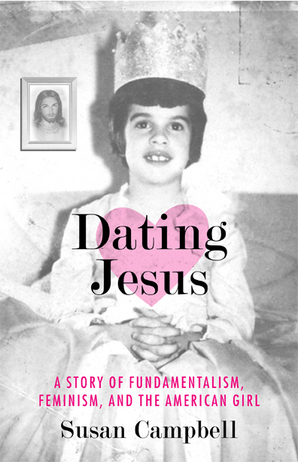
This week I read Susan Campbell’s Dating Jesus: A Story of Fundamentalism, Feminism, and the American Girl. Parts of her autobiographical narrative seemed so familiar that it was almost like we could have been siblings. Other parts demonstrated just how widely a religious upbringing in America may vary. Fundamentalism is a powerful force, and one that often feels impossible to outgrow. The added dimension of a constant, insistent criticism of gender made Campbell’s account truly wrenching at times. Having been raised in a similar environment, I had been taught that ministry is a male prerogative, an activity women were separated from just as surely as begetting babies. Having been raised mainly by my mother, however, I was more sympathetic to a woman’s plight than most of the outspoken advocates for male privilege. Campbell’s story hit close to home.

One of the most tenacious aspects of Fundamentalism is the brain patterning it impresses on young minds. Who doesn’t know that baby birds impress parenthood on the first creature they see after hatching? Young children, trusting well-meaning parents, are impressed with a religious branding iron before they can sort things out for themselves. We make our children in our own image. Few ever undertake the intense reflection later in life to challenge these impressions. Like Campbell, I attended seminary because I was curious. Many of my classmates had no questions in their heads – they knew already that they were to be ministers. Seminary was a hoop to be leapt through rather than a rung to be climbed for a different perspective. And their children will be taught their perspective. Denominations will continue to increase in numbers as acorns roll not far from the tree, but just far enough.

Campbell’s memoir is a gentle indictment of the male establishment. What once began as a biological division of labor has been given a religious imperative; male dominance is ordained by God, and women have no option but to comply. Even as the divine gets pushed into an unlit corner of everyday life, the deity may always be drawn back out for a session of gender oppression before being tucked safely away again. In these days of advanced technology and wide perspectives, women are still held down as some kind of inferior sub-species by men who believe that they are the default version of the image of God. It is time to be honest and admit that the only reason women are kept from the male preserve in any field is because of a jealous green-eyed god called privilege.


Dissing Mother T.

I pity the fool who challenges a powerful religion. Compelling religion. Tall towers. Tears of regret. The Empire State Building has a famous tower light show. Depending on the occasion, diverse wavelengths of light splash off the iconic skyscraper, and those who have the scorecard can see what’s important. In a city like New York there are countless occasions – holidays, Yankees and Mets games, significant birthdays. New York also houses a significant Catholic population. So it was not a popular decision on the part of the owner of the building to turn down a request to light up the town in honor of Mother Teresa’s centenary. I’m sure it was uttered with the purest of intentions, but the words of Bill Donohue, the president of the Catholic League, made me shiver just a little: “His [the owner’s] decision to double down at this juncture – in the face of massive support for our request – is something he will regret for the rest of his life” (according to the New York Daily News).

Mother Teresa, to many, is the epitome of Christian charity and selflessness. Devoted to helping the poorest members of a cruel world, she lived a life that many religious leaders could stand to emulate. On the front page of the same newspaper carrying this human interest story was the headline of how Seton Hall’s finalist for university president withdrew from the search after requesting a $300 K salary for the job. He is a priest, after all. Beg pardon, a Monsignor. And a professor of Christian ethics. I pity the fool who takes ethics seriously.

Somewhere between a 300,000 dollar salary and abject poverty, many religious believers are boggled by the mixed messages broadcast by their leaders. Most people in western religions are trying hard to avoid hell, complying with the traditions and new demands made by the spiritual CEOs. In a seminary setting someone once said to me that if Mother Teresa had advocated for responsible parenting (that great lumbering demon of birth control) perhaps the roots of the great poverty she daily redressed in Calcutta might have begun to dissipate. But the word from on high had been uttered and was immutable. She would not live to see her name up in lights. From what I’ve read about her, I have a strong feeling that Mother T. is just as happy to stay out of the limelight. I pity the fool who doesn’t understand.

A picture is worth $300,000


Bible Experts All

I seldom write follow-ups to my own blog posts – I’ve always found self-referential academics somewhat distasteful, and besides, what is creativity without some variety? Nevertheless, it seems that yesterday’s post has garnered a bit of interest in the disaffected outlook of a self-professed biblical scholar. (Actually, I have three “higher education” diplomas rolled up neatly in tubes in some untidy closet that show that some universities also accuse me with this charge.) Perhaps I need to clarify.

When reading a blog post, it is very difficult to determine the position of a writer’s tongue in relative proximity to his/her cheek. (Those with eyes to see, let them hear!) The subject might be funny if it weren’t so deadly serious. Despite my reservations with Christopher Hitchens, Sam Harris, and Bill Maher, they have all underscored a vital point – biblical literalism is very dangerous. This is even more so the case when, in their own minds, all people are Bible experts. We attend school and learn to read. Some learn to read more deeply than others, yet all “know what the book says.” There is no way to dispute that belief. Belief is belief, requiescant in pacem. Some commenters wondered why the opinion of “Bible experts” should matter at all.

When I’m feeling ill, I would prefer to ascertain the opinion of someone who has actually earned a proficiency in human physiology. When the car breaks down (again), I prefer to have someone who understands machines well as the repairer. When many, many people want to know what God doth require of thee, they turn to individuals who have not been thoroughly trained in Bible. I taught in a seminary for many years, and as an administrator, became quite familiar with the accrediting requirements of the Association of Theological Schools, the nation’s main seminary accrediting agency. I may unequivocally state that few seminarians emerge as full-fledged Bible scholars. Some “denominations” do not require any seminary training at all. So when your spiritual life breaks down, most folks head to an “expert” ill-equipped to handle the Bible, a homeopathic (no slur intended) literary diviner.

Purely from my own perspective, I would prefer to know what the Bible, in its own context, language, and words, is more likely to have meant. Delusions and all. Can’t buy that at your local church, with rare exceptions. That is the role of the humble Bible expert. As with any field of study, it is obvious when you have found a true expert. Such a one will readily admit that she or he has more questions than answers.


Pulp Bible

Everyone is an expert on the Bible. This is one of the factors that provides professional biblical scholars with generous ulcers. Everyone is an expert because they know what they believe about the Bible. The difficulty is very few people actually know much about the Bible. Belief and knowledge are very different features of the human psyche. In my introductory course on the Hebrew Bible last night, I showed the clip from Pulp Fiction where Jules exegetes Ezekiel 25.17 (which is a fictional verse concocted for the movie). This offers a springboard to discuss how the Bible is perceived in society at large. Many people believe that Ezekiel 25.17 actually reads as Jules quotes it. The writer/director of any movie may freely manipulate the Bible since they are as expert as anyone else on the subject. (Of course, Ezekiel is a safe bet for a false citation since few people have actually read the book.)

As an officially trained “expert” on the Bible who has learned the original languages and who has read far more books on the Bible than health or common sense would dictate, I often wonder about this. When the Jehovah’s Witnesses stop by, knowing that I have these credentials, they plow straight ahead and tell me what the Bible really means. They are experts as well. When my wife was pregnant and we visited the obstetrician for an initial interview, as soon as he discovered my vocation, the physician quoted Scripture for this nervous young couple before him. Would you not rather have a Bible expert deliver your first child? Where is there room for the bone fide Bible specialist?

Having read Hector Avalos’ The End of Biblical Studies some months ago, I found myself largely in agreement. In many quarters the Bible receives a privileged treatment that only creates problems. Politicians, rap artists, physicians, movie directors, and janitors are all experts on the Bible; why do we need those of us who’ve made it a life’s work? The answer, I believe, is that knowledge of the Bible is at an all-time low. Many venerate the Bible without understanding what it is. Until society gets a grasp on what it means to have so many experts on the Bible, everyone should ponder the meaning of the passage that reads, “The path of the righteous man is beset on all sides by the iniquities of the selfish and the tyranny of evil men. Blessed is he, who in the name of charity and good will, shepherds the weak through the valley of darkness, for he is truly his brother’s keeper and the finder of lost children. And I will strike down upon thee with great vengeance and furious anger those who would attempt to poison and destroy my brothers. And you will know my name is the Lord when I lay my vengeance upon thee.”


Robots and Religion

One of the constant duties I have as a “Robot Dad” (Soccer Mom just doesn’t apply here) is seeking funding for my daughter’s high school FIRST Robotics team. Always a supportive layman in the scientific venture to understand our world, I have encouraged this interest although I am pretty hopeless when it comes to understanding how it all works. So last night I found myself at a fund-raising, public-awareness event at the local minor league stadium. The Somerset Patriots stadium is just down the road, but I’d never been to a game before. I really don’t feel comfortable participating in crowd dynamics; I’d rather sit back and analyze than participate. And I have no real interest in sports. I wondered how I was going to survive being in such a foreign environment for several hours. Then my wife pointed out a, as it were, godsend.

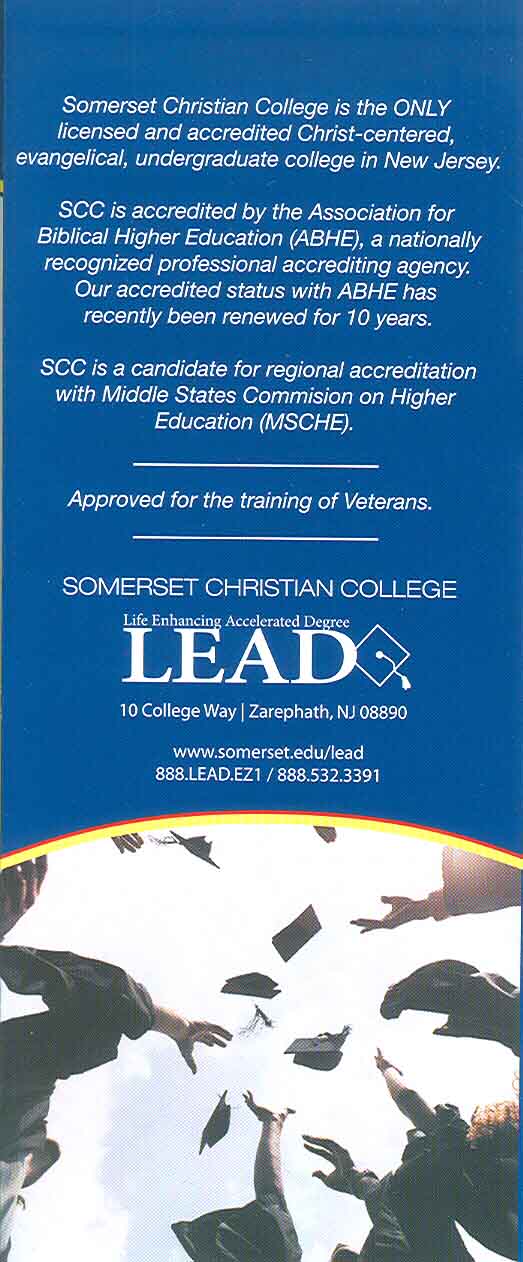
Last night was “Faith Night” at the Somerset County Ballpark. The event was sponsored by Somerset Christian College, “the ONLY licensed and accredited Christ-centered, evangelical, undergraduate college in New Jersey.” Located in the appropriately denominated Zarephath, New Jersey, the small, extremely doctrinal college bought the privilege of a pre-game sermonette. Not too often does a public sporting event begin with references to “our Lord Jesus Christ;” I looked around for him but then remembered he’d been hit by a car just under two weeks ago. One of the administrators addressed the crowd and, trying to capture the elated, anticipatory feel of the moment, compared his college to a baseball game. I was busy handing out fliers and missed the early stages of his rhetoric, but when I heard him say, “third base is love,” my mind shifted to a more familiar baseball analogy I’d learned in high school. I imagined the prospective students’ interest when he went on to declare, “home base is Heaven!”

As two Christian motorcycle clubs solemnly rode their hogs around the field and local Catholic schools hawked their own fliers in competition, the sound system belted out any pop songs that had the word “faith” in them, no matter what the context. It was a circus-like atmosphere. I was surrounded by techies deeply immersed in science and human learning. We, in turn, were surrounded by an aggressive Christianity eager to claim as much territory as possible. Above it all wafted scents of searing flesh and deep-fried snacks. It seemed to me that a microcosm of American life was indeed evident at the stadium last night. Perhaps there is nothing as American as baseball after all.

Lead us not...


Suddenly the Bible

Universities are generally reluctant to hire Bible faculty (except in the case of “Christian” colleges where Bible faculty must be a particular brand of “scholar” who has already decided the case before the evidence is presented). The stock reason given to department heads and deans is that religion just doesn’t make money. Universities thrive on the income from science grants and wealthy business and finance donors who want buildings named after them. Religion, it is claimed, doesn’t bring in money. The real problem is that universities don’t know how to market religion.

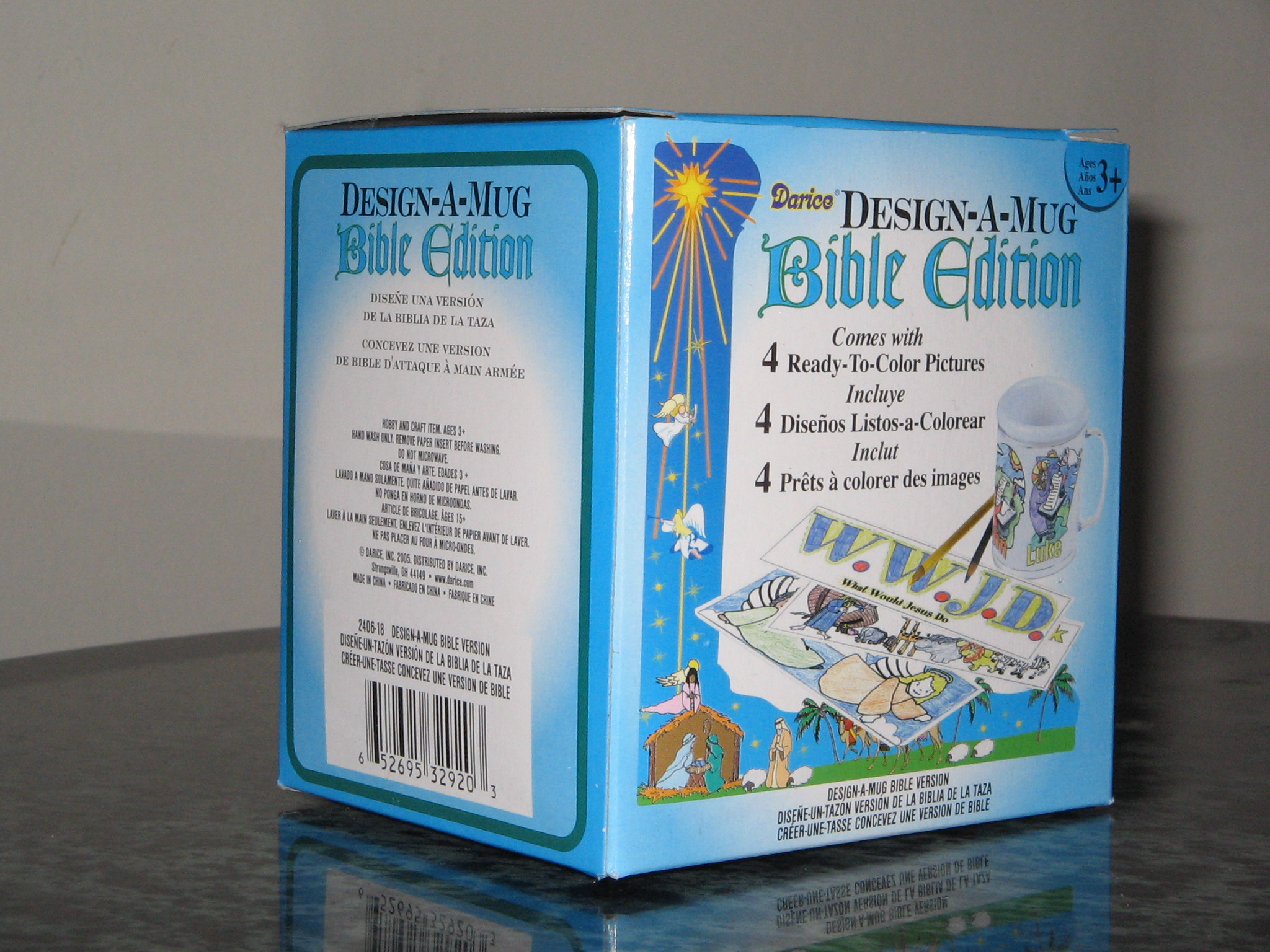
The other day I visited the local craft store to pick up supplies for a project my wife is working on. While in line I spotted this novelty item:

God in a box?

The shelf was full of them. When I returned later in the week, the supply was severely diminished. Someone had reasoned, correctly, that by putting a cheap length of paper-roll with “biblical” designs printed on it in a kit for making a throw-away mug, it would sell. Obviously universities and colleges couldn’t stoop to such a level, could they? Isn’t it far more respectable to draw your finest students into a mega-stadium to watch guys in tights throw around a fake pig-bladder and emerge drunk enough to vomit up all the costly snack foods they purchased? This is, after all, where the leaders of tomorrow are formed!

While looking up a troublesome word I can’t spell in an online dictionary, I was intrigued by this promotional inset (click to see). All I had done was type in a word on the Merriam-Webster site (it was not a biblical word), and when the answer popped up, so did this self promotional add for “Kiss of Death, Feet of Clay: Words From the Bible.” I don’t pretend to know how online advertising works, but it was clear that Merriam-Webster wanted the cyber-visitor to linger on their site, and the Bible was an effective way to achieve this.

The Bible is all around us. It would be difficult to nominate any other icon that would better illustrate American social self-consciousness. So immediately the sophisticated academic shuns it. Those of us who’ve put our lives into trying to understand the Bible phenomenon are deemed useless as money-makers while our counterparts in marketing and sales laugh biblically all the way to the bank.


Holy Amos, Holy Micah, Pray for Us

The semesters when I teach the prophets invariably find me filled with a holy rage toward injustice of all stripes. Unfortunately there is plenty of cause for basic human indignation caused by greed, cupidity, and elitism. I see New Jersey, my current home, as a microcosm. In this little version of the universe, a highly diverse population with over-crowded highways and endless financial woes, I see reflected some of the great challenges facing the human race. When such a delicate balance is guided by a self-serving government the human cost will always be high.

Our current governor, Chris “Slash” Christie, has made himself a national reputation by cutting the basic services required to buoy up a state where the underprivileged seek an opportunity to get ahead. The governor’s favorite target, naturally, is public education. Public school and university funds have been chopped with a zeal to impress Vlad the Impaler (the governor’s children attend private school, thank you). The Associated Press today, however, reports that the number of the governor’s staff who “earn” more than six figures has nearly doubled since our last governor’s term ended. We the taxpayers are being asked to fork over an extra two million dollars to the state budget to support those who live in comfort while our children are being systematically targeted as luxuries the state simply can’t afford. When will people say “enough is enough”?

The Republican Party, since it has shamelessly crawled into bed with religious conservatism, has flouted the message of the Bible in the name of the Bible. Only by ignoring the biblical characters known as prophets, and one guy from Nazareth who went by the name of Joshua, is it possible to see any right in feathering the nest of public “servants” while stealing from the children of their constituencies. I am glad Amos and Micah are dead. If they were alive and in New Jersey they would be suffering torment beyond words.


The Danger of Books

Yesterday the Hunterdon County Library booksale began. I did not grow up as a reader. As a child, television was my primary source of information. For reasons unclear to me, I took to books when I started junior high school. Suddenly I couldn’t get enough of them. I lived in a town with no bookstores, so I usually depended on what I could find on our periodic trips to Goodwill to look for clothes. While my mother was looking for apparel for my brothers and me, I hovered over the quarter-a-piece book bin, buying up to a dollar’s worth of used books at a time. I kept my books in a ratty old suitcase under the bed. There were no bookshelves at home, nor any room for them. Besides, I liked to keep my books separate from other aspects of my life. Perhaps it is an illness, but from that day on, I have not been able to resist the draw of books. It is perhaps natural that I would go into higher education (although my field might have been chosen a bit more wisely). In any case, yesterday I drove to Flemington, New Jersey, with, at least to judge by the traffic, three-quarters of the population of the county.

One of the books I purchased had a slip of paper tucked between the leaves. When I got home I read on it, “The naked witches have been regarded either as a jokey press gimmick or as a complete non-event. The truth of the matter is that the witches played a very important role in a whole series of monster invocations.” Intrigued, I wondered what the source of this unusual quote might be. Then I was struck by the religious imagery implicit in the piece: witches, no matter how defined, are a religious subject. Monsters, as I have frequently noted, share intense neural territory with religion. And invocation? It is a liturgical term! I can only wonder what the original context of this quote might have been, but the book in which it was stuck was in no sense religious. I am a very eclectic reader (so it is perhaps unusual that I would go into higher education) and no books I purchased had anything to do with religion. It seems that religion never fails to find me.

My devotion to books often reminds me of the day when Amazon used to include bookmarks when you purchased from them. My favorite bore a quote from Erasmus: “When I get a little money I buy books; and if any is left I buy food and clothes.” It sometimes drives my wife to frustration that I still wear clothes I purchased before we were married some twenty-two years ago. My informal student evaluations on Rate My Professor sometimes comment on my out-of-date fashion sense. The reason is, however, that I buy books before clothes, and yes, even food. And when you buy used books at a library book sale, you may learn that naked witches invoke monsters, and that may be valuable information. And my clothes are never in a condition Goodwill would consider accepting when I’m finally forced to relinquish them for lack of functionality.


I Have a Daydream

I don’t often comment directly on politics because I don’t like to get beaten up. I’m not a poly-sci major who has statistically verified evidence to present, and many of the issues are simply too complex for a guy like me. I’m left scratching my head like a confused ape. Nevertheless, I’ve just finished covering Micah in my Prophets class, and the eighth century prophets have a way of firing up even the most passive of souls on the issue of social justice. Also, newspaper stories continue to demonstrate that most elected officials, living in their world of privilege and power, have lost touch with the average citizen. After reading the prophets and dreaming of a better world, I have a proposal to end oligarchy and institute democracy.

No person who earns more than $100,000 a year should be eligible to run for public office. Now I live in New Jersey where the cost of living is high. I have survived here for over three years with an income far less than half of that figure, so I know it can be done. Observing the abusive tactics of bishops first-hand, I had suggested a similar measure for the church some years ago. To become a bishop an individual should be forced to take a pay-cut, bringing their income below that of those they serve. Politicians are “public servants” who’ve grown fat on the generous salaries they devise for themselves alongside their perks, kick-backs, and expense accounts. The same also applies to politicians in higher education. You want a really excellent university president? Reduce the funding for the post. Only those truly committed to the ideals of education would be willing to take on the job. Posers and playboys would have to step down.

Corporate-style greed has a strangle-hold on democracy. Most people are content to let the wealthy rule as long as they are left alone – freedom in exchange for accepting the demands of the self-indulgent. My daydream is of a world where people can free themselves from the never-ending greed of the corporate climber. And my system would not exclude anyone for seeking office. All the wealthy would have to do is be willing to live on a middle-class or lower salary for a few years. Politicians have forgotten (if they ever even knew) what is like to struggle, worry, and fear that any month, week, or day you might not be able to meet your obligations. They don’t personally watch the prices increasing at the pump or at the grocery store or on the electric bill. Their Olympian existence is beyond human suffering. It is once more time to ask, “what would Micah do?”


Smile, You’re Condemned

Yesterday at Montclair State University, I was sitting in the hallway (my office) prior to class. (Office hours are required, but space is limited for adjuncts such as myself.) While I was reading my book a student walked up and handed me a business card. “For you, sir,” she said politely. The card had a smiley face on it, and was designed to bring cheer.

Then I flipped the card over and found out I was going to Hell. A bit of a downer when you’re about to start class!

It isn’t the first time people have attempted to convert me without bothering to find out what I believe. It seems that if you already hold the zealot’s view you’ll appreciate the gesture of being condemned just to make sure your soul is saved. It is the thought that counts, after all.

The book I was reading was Joseph Campbell’s The Hero with a Thousand Faces – a book I’ve known since college but from which I have only taken a tipple until this year. Many scholars of mythology fault Campbell on being too much of a generalist and looking too much for connections where they are not obvious. His language can be florid and mystical, verging on “believer,” for those uncomfortable with any kind of faith. I find Campbell to be a welcome guide, although, as for any guide, I do not believe all he says! One nugget in particular stuck out at me: “Wherever the poetry of myth is interpreted as biography, history, or science, it is killed.” As we find ourselves on Good Friday, only those with eyes firmly shut will disregard Campbell’s wisdom.

I still remember my shock when I first learned that gods, centuries before Jesus, had been dying and rising. What had always been presented to me as a unique historical event actually had a long and venerable prehistory. It suddenly seemed as if the ministers I’d known hadn’t done their homework. Or perhaps they lacked the cognitive finesse to understand Orpheus, Adonis, Baal, Osiris, and even Ishtar, as types of either blatant or obscure resurrection. It is the Campbellian, or nearly universal hope: life prevails over death. As the young lady walked away, I sincerely wished her happiness in the quest she’s only beginning.


Naughty Religion is Bad Science

In the continual struggle of Fundamentalist Christianity against the rest of the world, new Creationist grounds have been made in Connecticut. Connecticut is not exactly the first state to spring to mind when it comes to extremist conservative religion, but Fundamentalism knows no bounds. Perhaps the largest disappointment, from the point of view of a student of religion who knows the Fundamentalists a little too well, is that otherwise intelligent people simply accept what their clergy tell them. Having been a seminary student and professor, however, I know the kinds of training clergy receive and if the whole wide world knew things would be different.

Clergy of all stripes of all denominations of all religions are just as human as the rest of us. They do not have special physiognomic features in their brains or hearts or cellular structures that allow them to receive private messages from God/the gods. Many are trained in special schools where people like myself teach them, often against the blustering of their clergy supporters back home, what we factually know about the Bible and other aspects of religion. Many successfully block out what they are forced to hear and emerge just as ossified, if not more so, as when they entered. In other words, their “education” has been an exercise in learning to ignore the truth. They are then made into clergy who continue the deception. Even worse are the clergy who receive no training at all, frequently fresh from an overly-heavy-dinner-induced religious experience, who claim that the biological responses to overtaxed gastric juices is some message from beyond.

The average citizen naively accepts the religious credentials of their clergy, supposing that this “holy” person has had some special word from on high. That word is often factually wrong, especially concerning evolution and the origins of life, but it is accepted as gospel truth and disseminated among unsuspecting children. Religion is a matter of belief, not of fact. As America lags farther and farther behind even developing nations in science education, Fundamentalist clergy give a self-satisfied smile. They have become the gods of a nation that was once able to land some of its citizens on the silvery moon in that great literal dome that surrounds our flat earth.


Biblical Outlooks and Science Fiction

Alumni magazines depress me. Between my wife and I, we receive a half-dozen every month. I thumb through and see the cheery faces of classmates, most of whom I don’t know, who’ve gone on to great things – writing books, world travel, scientific breakthroughs. They’re not on the couch Saturday afternoons in New Jersey watching 1950’s sci-fi and wandering what went wrong. Especially bad is Bostonia, since I attended Boston University with many noteworthy individuals. Being forced from academia early in my career because of petty religious differences, I just want to bury my head and grab the remote. An article in this month’s BU shame-fest, however, pictured a professor, younger than myself, who joined the school of theology after I left. The title of the piece is “Biblical Sexuality.” Well, the connection with this blog couldn’t be more obvious.

Dr. Jennifer Knust is a professor of Christian Scriptures at BU who has written a couple of books on sexuality and the Bible. I’ve read widely on this topic in the Hebrew Bible, and was curious as to what the post-Jesus crowd was saying these days. The article specifically addresses homosexuality, but I did applaud one of Dr. Knust’s statements: “My main argument is that biblical texts do not speak with one voice.” Amen. Bravo. Goal! Our society is so imbued with the bibliolatry of the Religious Right that it is difficult for most Americans to understand that the Bible was written by many people over a few centuries and these people did not always share the same outlook. The Bible is an exercise in multiple voice-overs. Specific religions, as many denominations of Christianity testify, have harmonized these divergent voices into a coherent, if biblically untrue, theology. Some voices must be stifled so that others may dominate.

We live in a religiously plural world. There are about as many religions as there are believing people. We experience the world through our own lenses and within our own gray-matter. Our perspectives are uniquely our own. And yet religious leaders bend, worry, and force views closer to their own so that they might have a theological quorum, a consensus that one viewpoint is right. They silence the Bible’s divergent voices and claim they do not exist. I wish Dr. Knust well. She’s got the right perspective, in the opinion of my own weary gray-matter. And speaking of gray, where did I put the remote?


Robo-god

Yesterday I again found myself among the robots. After an early-morning school-bus ride to the New Jersey regional competition in Trenton, a mentor to a team known as the Gearheads, I felt a little out of my league. Soon, however, I fell into the spirit of the competition and watched with increasing interest as individuals highly regarded in the world of robotics lamented the lack of science education in the United States. Having just completed the nightmare of two terms with a creationist president, is it any wonder? In any case, the competition, a modified soccer match for robots – with two teams from Brazil, no less! – soon became as emotional as any sporting event. Well, for the human participants, anyway. I’m not qualified to assess robotic emotions. As the event wound down, a respected (human) member of FIRST Robotics, during a recognition ceremony, overcome with emotion, called out “God bless you!” to the adult volunteers.

Many scientists I know are personally religious people. There is no fortified gateway between scientific reasoning and the childhood teaching of religious belief. Nevertheless, an irony became apparent that has been bothering me all night long. I joined Team 102 as a mentor because of my daughter’s interest in robotics and engineering. My role is to help with editing, since I am a “humanities” type. The irony that leaves me sleepless is that Ph.D.s in the sciences are highly coveted and have an assurance for jobs. Ph.D.s in the “humanities,” however, are a sure way to block you from career success. Since I began this blog I have been officially unemployed (I pick up a course or two here and there, but no full-time offers have been presented). The people who have been most empathetic and helpful in this time of difficulty have been the robotics team. People there have tried to hook me up with people who might be able to help, but I am like an alien on the autopsy table among scientists – where do you begin? How do you help an overly qualified “humanities” ex-professor find a job? Meanwhile my co-“humanities” colleagues helplessly wring their hands and do nothing. Worse, they interview me and decide not to make a hire, based on “religious” reasons.

The past several years, as the recipient of calculated cruelty from many religious folks, stumbling along trying to find a means of reasonable support, I have come to trust the robots. The robotics team has demonstrated the most humanitarian attitude to a fellow human who has been suffering for several months. The religious tell me that God will work it out and go their righteous way. Yesterday, being blessed by a “high priest” of the robotics world, I felt that I finally found a place I belonged. Now it might be time to go back to school and find the real pulse of humanity in the sciences.

Kids building robots