The Tube

I’m sitting in a medical facility waiting room.  I’m not afraid of dying, but medical stuff terrifies me.  To calm me down, inane daytime television is on.  I may be one of the very few who brings a book to such places, but I can’t read with the insipid chatter going on.  This time, since I’m waiting for someone else, I brought my laptop.  Nevertheless, I can’t help but think of Ray Bradbury at times like this.  Many people think Fahrenheit 451 is about burning books.  Bradbury did write about burning books in his short stories, and it does happen in Fahrenheit 451, but that’s not what the book is about.  In interviews he said that he intended, as is pretty obvious from a straightforward reading of the text, to warn about the invasive nature of television.  It was, metaphorically, burning books.

Waiting rooms always bring that to mind.  Not only that, but it’s Valentine’s Day and all the talk shows are going on about how it’s “the day of love” (every day should be).  It’s not a day off work; I had to cash in a sick day to be here.  The word “holiday” keeps cropping up on the television, to which I have my back. Ever since leaving Nashotah House I haven’t watched television.  On our recent move to Pennsylvania our cable company didn’t offer a non-television option.  It was unthinkable.  We pay for something we don’t use.  Burning books.  I don’t have time for television.  I see shows that have proven their worth via DVD well after they’re off the air.  And that only when I can read or write no more in a day.  I guess I’m a Bradbury disciple.

Like any disciple, I have changed certain teachings of my leader.  Bradburyism is a religion objecting to ubiquitous television.  At the same time, I grew up watching the tube, and to this day I’ll stop just about anything to watch DVDs of The Twilight Zone.  Rod Serling, however, selected stories and teleplays that were well written.  This was a literate show.  Besides, my daily life often feels like the Twilight Zone.  Like Valentine’s Day in a waiting room.  The book beside me remains unopened.  It’s the same when I take the car to the garage, or go in for an oil change.  You can’t escape it, even though everyone else is paying attention to their phones.  How long until we learn to switch off?  Of course, medical waiting rooms are the places where I may need brainless distraction the most.

Photo credit: Smithsonian Institution


Stickiness

As a concept, it’s what web designers call “sticky.”  Valentine’s Day, I mean.  And “sticky” has nothing to do with the expected chocolates or anything physical at all.  Stickiness, as I hear it used in these antiseptic clean-room days, refers to text, or an object, that stays in the same place as you change web pages.  Now, I’m no techie, in fact I’m probably a neo-Luddite, but this kind of stickiness is useful in thinking about St. Valentine’s Day.  We hardly need a reminder that humans are sexual beings.  Biology does quite well in that department, thank you.  Every year around this time, however, when the weather has been bleak for weeks on end, Valentine’s Day rolls in to give us hope.  I’ve noticed this as I’ve been out jogging.  The past couple of weeks the birds have been singing.  Me, I’ve mostly been shivering indoors as yet more cold rain falls.

Every year, I suspect (I haven’t stopped to look) I write about St. Valentine’s Day.  Valentine was an obscure saint associated, in the popular mind, with something saints shunned.  Such an embarrassment is this sexy saint that he was never mentioned in the liturgy of February 14th at Nashotah House in the days I was there.  (Given that most of the student body was male, there may have been a wisdom in that, but that’s a story for another time.)  Religions, as I used to tell my students in later settings, all have something to say about sex.  The two ideas, like monsters and religion, are tied closely together.  Scholars tend to blush rather than explore this.

There are so many things going on in the world that I could write about.  There are new scholarly developments every day.  Still, I keep coming back to this minor holiday.  Well, it’s not actually minor in the realm of economics.  Anything to get people to spend money in the middle of February!  Valentine’s Day is the embarrassing child of the celibate church.  Without somebody named Valentine, who may or may not have been martyred,  we wouldn’t have this uneasy reminder of winter’s impending end.  Instead of embracing him, however, many branches of Christianity second him to punch-out cards sold to school kids as teachers remind them that everyone gets a valentine.  What a sticky concept!  I’d been intending to write something about the state of the world.  I guess that can wait for another day.  Right now, as the sun begins to awake, I’ll sit hear and listen for the birds to start their sticky springtime song.


Symmetry Synergy

Symmetry.  It’s pleasing to the eye.  And significant dates are often the basis for holidays.  Today is one of those extremely rare palindrome days.  As my wife pointed out to me 02-02-2020 is a configuration that hasn’t occurred since 01-01-1010, or over a millennium ago.  The next one will be after we’re all long gone, on 03-03-3030.  Not only that, but today is part of a holiday cluster.  It’s Groundhog Day.  Yesterday was Imbolc, the Celtic cross-quarter day initiating spring.  Imbolc is also known as St. Brigid’s Day.  Today is called Candlemas, by liturgical Christian tradition.  We are living through a truly unique day.  Every day, I suppose, is unique, but the spirits are afoot today.

I’ve written about Groundhog Day before.  With its prognosticating rodent, it tells us if spring is on the way or if it’s going to be delayed.  Imbolc falls about halfway between the winter solstice and the vernal equinox.  In Celtic cultures this was a cross-quarter day, a time of uncanniness.  Spirits cross between worlds on days such as this.  In days of yore, it was also the feast of the goddess Brigid.  Christianity has always been an opportunistic religion.  When missionaries to places like Scotland and Ireland couldn’t convince the locals to give up their deities, they made saints of them.  St. Brigid is a fabrication of a Celtic goddess, not an actual saint.  For similar reasons in the quarter-year counterpart to Imbolic, Samhain, the church moved All Saints Day to November 1 and All Souls to November 2.  The Celts continued using the trappings of their cross-quarter day and eventually gave us Halloween.  Imbolc never caught on in quite the same way.

The early Christians didn’t know when Jesus was born.  Christmas was established on December 25 because of all of the solstice celebrations at that time of year.  All that pagan jubilation had to be subsumed under a more solemn occasion.  Building on that mythical date, New Year’s Day was January 1 because that’s when Jesus would have been circumcised, eight days later.  Thirty-three days after a male child’s circumcision, a woman was to make an offering for purification in the temple.  According to Luke, Mary did this, and 33 days after January 1, in keeping with our fictional date-keeping, is February 2.  A tradition grew that Christians would bring their candles to church to be blessed that day (Jesus being the light of the world).  This blessing of candles was named Candlemas.  I first encountered it at Nashotah House, where it was still celebrated even as a sleepy woodchuck in Punxsutawney was rubbing his eyes.  Not exactly a palindrome, but there’s a remarkable symmetry to it, no?


Remember This

Have you ever had one of those days?  You know the kind I mean—a day when you feel like you’re forgetting something.  Wednesday was like that for me.  You see, the first full week back to work after a long weekend (Martin Luther King Day) seems to stretch out like a desert road whose end you can’t see.  It always hits me on Wednesday.  The previous week the third day of work was the day before Friday (and I mean “Friday” metaphorically, as the last work day of the week).  The first full week you’ve been at it three days and on Wednesdays I realize, “I’ve got two more days to go.”  So, although it was sunny around here, I sulked all day feeling like I’d forgotten something.  I had.

I post on this blog every day.  I have for many years.  The way this works on WordPress is you get your post ready and you’re given an option to publish.  I get my post ready before going to work (which in my case means going upstairs to my office).  I delude myself into thinking I have regular readers and that they will be looking for the post at its usual time—around 6:30 (I start work early).  Wednesday I finished my post even earlier than usual and I thought, “I’d better not publish now, or my readers won’t see it.”  I trudged upstairs, however, and began to work.  Once work starts, all bets are off.  Even with the sun warming my chilly bones, I had a nagging feeling I was forgetting something.  I’d forgotten to click “publish.”  My post, which had been waiting patiently for publication (I know how that feels!) never got launched.  I didn’t discover this until Thursday.

You see, we’re not supposed to use social media at work.   Although I work remotely, unlike Republicans I play by established rules.  So I went through my day feeling I’d forgotten something, but not knowing what.  It’s not that I forgot you, my dear readers, I just forgot to click “publish” before heading up to work.  At the end of work, after staring at a computer screen all day long, I tend not to go online.  Most days I read a book, or get supper ready.  So I awoke on Thursday to find Wednesday’s post, well, unposted.  Some of us aren’t constitutionally compatible with the nine-to-five schedule.  My mind goes lots of places during the day.  Often those places are reminding me how many more days I have to do this before a break comes.  And some weeks, it seems, it never does.  If I recall correctly.


Truth, Justice, and

Martin Luther King, Jr. attended Boston University School of Theology long before I did.  We remember him today as a great leader, a man willing to die for what he believed in.  And all these years later we’re still struggling to find some semblance of racial equality.  We can’t seem to admit that race is a social construct and not a scientific category.  Indeed, the only race is the human race.  King saw that, and staked his life on it.  Today we’re ruled by politicians who, when faced with the truth immediately shout “fake news!”  “Liberal!”  They may stop short of using some words not because they don’t want to, but because they could cost them at the polls come November.  America is watching.  I’m sitting here thinking how Martin Luther King died when I was just five.  He’d started something righteous and just.  And millions were out marching in the cold on Saturday to say we still believe in justice. 

I didn’t pick Boston University School of Theology just because King was its most famous alum.  The other day a guy noticed my BU stocking cap and asked if it was “Boston University.”  This wasn’t an educated person, but I’m guessing that most school paraphernalia has to do with sports and the game was on in the background, so the question was logical.  I told him it was Binghamton University, a school with which I also have an intimate connection, one step removed.  He said, “Binghamton!  I saw your cap and thought Baylor?  No.  Must be Boston.”  But ironically he ended up with the right school for me, but the wrong school for what I was wearing.  I did pick BU because I realized that strong academics are nothing without social justice.  Of course, academia wanted nothing to do with that.

Recently I read how Republican resentment towards liberals has very solid roots in racism.  Oh, they will deny it—their “fake news” trigger-finger is very itchy—but the whole package is tied up with anger that an African-American was elected president.  Follow that up with an old, white racist.  How will history look back on this insane era?  I think we already know.  While the privileged are trying to build their own legacies, I ponder an African-American preacher with clear vision as the one we remember today.  I went to Boston University naive and full of hope.  I heard a lot about King when I was there.  I knew something of dreams and how costly they could be.  Today I sit here and cuddle the epithet “liberal” and think how it’s become a swear word for some, while its real meaning of “justice” continues to go unheeded.


Protest Day

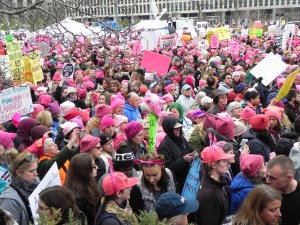
Today should be known as Protest Day.  Three years ago with over a million others I marched in Washington.  The media still routinely underreports the numbers there, despite the metrics used on the ground.  “They’re only women,” it seems to say.  I marched the last two years in New York City.  The protest can never stop.  Once a democracy has opened the door to evil, it can never rest again.  It’s cold outside.  There’s a winter storm in the forecast.  Women everywhere are out marching.  This mansplained world must come to an end.  We must hear all voices.  Despite having control of all branches of government, the Trump message isn’t being heard.  Perhaps there is justice in nature.  I like to believe it, even when it’s hard.

Patriarchalism wears many disguises, such as biblicism.  If all you take from the Good Book is the idea that men are more important, then you’ve missed the point.  The Bible is a book with a context and those who can quote it without knowing what it originally meant are left wondering why so many other Christians disagree.  The message must be heard.  Liberation theologians long ago realized that Jesus’ gospel had been drowned in the voices of legalism.  They did what we all should be doing today; they protested.

Signs of national and international weariness are everywhere evident.  Trump-supporting senators strike out with ad hominem attacks for all reason has failed them.  Used to be if you aided and abetted a criminal you’d get in trouble.  Now you just get bumped to a more influential committee.  So we protest.  History hasn’t forgotten Watergate.  It will never forget the disaster of 2016 when a political party sold its soul.  

A restaurant not far from here is owned and operated by a young woman.  A sign on the register says “The Future Is Female.”  I hope it’s so.  Our hunter-gatherer sensibilities have been suborned by the possibilities of agricultural surplus.  Where there’s surplus there’s mammon to be made.  In the Middle Ages mammon became the name of a demon.  Today it’s inscribed on the hearts of those who follow cash, no matter where it may lead.  Once upon a time a man from Galilee said the wealthy wouldn’t inherit the kingdom.  Like Caesar they dedicate the temple to themselves.  We may not all be able to get out to march today, but we can make our consciences heard.  Women deserve every right men have.  It’s time to learn to share.  Until that happens, we must protest. 


A Few Days

My fellow blogger over at Verbomania (worth following!) posted a piece on the word Romjul.  In case you haven’t read the post, Romjul is the Norwegian word for the period between Christmas and New Year’s Day.  It’s kind of a liminal period.  Not really holiday and not really not holiday, in northern climes it’s often cold and dark and you don’t feel like getting out to do much.  In many reasonable parts of the world it’s a given that this should be time off from work.  With all the preparation that goes into Christmas and the standard convention of starting the New Year with a freebie, and the fact that the days of the week for the holidays are movable, it just makes sense.  In these developed States, holidays are left to employers.  Mine granted two days off: Christmas Day and New Year’s Day.  What are your choices when they fall on Wednesday?

Romjul gave me a good feeling.  I cashed in a vacation day or two to take some time off.  The years when I’ve worked between the holidays I’ve found nobody in their offices or answering email, and that led to long hours of waiting for the work day to end so that I could actually do something productive.  In America we love our work.  At least employers love our work.  I talked to a young man who had to cut his holiday short to be into work on Monday, December 29.  He’d just returned from an international trip, but his employer insisted he be there.  There was no work he could do because his colleague whose input he needed had taken that day off.  Work is like that.

I recalled a snow day when I had to commute daily to New York City.  New Jersey Transit got me as far as Newark but the trains were shut down from there.  I had to take a PATH train that took me close to my Midtown location.  It was running late.  A woman was panicking about not being on time.  A wise, older gentleman said, “Employers just want you to show up.  They’re not looking for a full, productive day of work.  They just want you to come in.”  I believe he was right.  Employers like to make their puppets jump, no matter if there’s anybody there to watch the show.  In a civilized world, as in much of Europe, we would celebrate Romjul.  If not for religious reasons, then for simple humanitarian ones.  In late December we can all use a week off.


Hereby Resolved

Photo credit: chensiyuan, Wikipedia Commons

New Year’s resolutions have never been my thing.  Having had a good Calvinistic upbringing, I’m a natural self-corrector.  If I’m aware I’m doing something wrong, I attempt to change my behavior right away.  This makes annual reviews at work exceptionally uncomfortable for me.  I’d much rather have my boss point out foibles as they happen so that I can stop doing them right away.  I realize my mindset here may be weird to those who were raised in more normal ways, and employers love process.  So I sit here in Ithaca on New Year’s day, preparing to drive home to face all kinds of unfinished business from 2019.  I’m still doing research for Nightmares with the Bible, thus it’s not ready to go back to the publisher or series editors yet.  I’ve started a new round of queries to agents about one of my novels, but I haven’t sent them yet.  And don’t even mention projects that need to be done to the house.

Life is busy.  I’ve taken on some new duties at the church I attend, exemplifying that old saw “If you want something done, ask a busy person.”  As the pressures from that obligation mount, I start to think that most people don’t have any idea just how all-consuming writing a book can be.  I work long days and although I don’t commute much any more, most of the rest of each day is taken up with writing and reading so as to write some more.  I hesitate to call myself a writer since I make laughably little lucre from it.  I can’t stop myself from doing it, though.  And although it’s the season for resolutions, I don’t plan to stop.  I know from work that graphomaniacs can be a problem.  Anything can be overdone.  On days when I don’t have to work I have to be pried away from my computer.  Otherwise I’ll write all day long.  It’s an issue, I know.

Perhaps because life on the national scale is so depressing, writing about things like horror movies is a great release.  I’ve been so busy lately that I haven’t had the chance to write pieces for venues like the excellent Horror Homeroom.  I used to contribute to Religion Dispatches.  That time has been sucked into getting my books that nobody will read finished.  Having written that self-disparaging remark I have to remind myself that one of my alumni magazines published a notice about Holy Horror without me having to send said notice personally.  That self-disparaging thing requires some fixing, I guess.  And were I not too busy already in 2020, I’d start on it right now.


First Christmas Parable

The Christmas story is full of surprises.  This year near Bethlehem, a parable occurred to me.  Like many parables, it raises questions.  A question for all you men out there: when’s the last time you were pregnant?  Was it because some woman—who can’t be responsible for her urges—didn’t take proper precautions?  Isn’t this the way God punishes people for having the sexual intercourse he created?  Since God gave you an anatomy just like his, you certainly have priority in the cosmic scheme of things, but this pregnancy of yours—what are you going to do with it?  Oh, and don’t look to Onan for answers to your own urges; God stuck him dead for that kind of thing.  But that troubling “what if”… What if Mary had had a choice?  According to the Good Book she did.  “Be it unto me,” Mary said.  She could’ve said “No.”  Many men in your *ahem* delicate condition did not.  The problem with virginal conceptions is that people will talk.

Many people don’t remember at this time of year that Mary and Joseph were immigrants to Egypt.  Had the Nativity occurred today in these States that follow God’s word, Mary, Joseph, and the baby Jesus would’ve ended up in separate cages.  Wasn’t he born in a cage?  Oh, cave!  That’s definitely an improvement.  One wonders how the Gospel might’ve gone from there.  And what of those annoying buzzing creatures overhead calling for peace on earth?  Shoo!  Trade wars!  Tariffs!  Nuclear threats!  These were the gifts of the three wise men, were they not?  Or perhaps we should get biblical and follow Herod’s mandate.  Killing two-year-old boys isn’t abortion, after all.  After giving birth they’re your problem, not God’s.  You’ve got to get them born—that’s the most important thing.  And since women can’t possibly know what it’s like to be pregnant what are you going to say when they walk out and tell you, “It’s not my problem”?  “Be it unto me,” said Mary.

Shepherds, it should be noted, were the poor.  Ironically that first Christmas the good news was first revealed to them.  Herod, half-insane, kept shifting members of his government around.  He had put away his previous wives—perhaps because they made him pregnant—and assassinated all his rivals.  Unless that’s fake news—the old fox was known for that.  So the immigrant family thought it was safe to return after Herod was removed from office.  Jesus grew to espouse the message of love and acceptance—extending it even to foreigners.  The state, believing itself established by divine right, had him put to death.  It’s Christmas, and we’ve seen all this before.  If only those with eyes would see.  But parables, it seems, have gone out of style.


Seasonal Reading (Not)

I might excuse writing a post on Satan on Christmas Eve by positing that I misread the title of this book as Santa.  After all, as Ryan Stokes explains, the Greek form of the title is ho satanas, which clearly contains the first of the canonical tripartite “Ho, ho, ho.”  The reality, however, is that work on Nightmares with the Bible continues despite the holidays, and there’s so much reading to do that not all of it can be seasonal.  I’ve known about Stokes’ book for some time, even as I’ve known his name through his various articles about the Satan.  This book, while not exhaustive, is certainly comprehensive for the time period covered and lays considerable groundwork for future discussions of the Devil.  What becomes obvious working through it, however, is that many different ideas about the Satan are represented in the Bible and related literature.

Long ago, as far back as my dissertation, I realized that it’s a problem for modern readers to systematize what ancients viewed disparately.  The Bible has no single idea of the Devil.  We’re quite accustomed to saying that “Satan” (which Stokes shows may not be a name in the Bible) and “the Devil” and Lucifer are all synonyms.  That’s not really the case.  Ancient peoples had many names for beings that caused problems, but not all of these entities were evil.  Belial, Mastema, Melchiresha, Beelzebub (and the list could go on) were designations used by different groups at different times.  These entities are sometimes agents of Yahweh, doing God’s will.  At other times they seem to be enemies of God, adversaries.  “Executioners,” is Stokes’ emphasis in these roles.  In early (and more recent) attempts at systematization, readers have tried to roll these various images into one.  With but limited success.

Ancient peoples didn’t feel the necessity that more modern ones do to make everything fit “scientifically.”  After all William of Ockham hadn’t shown up yet to suggest complicated ways of explaining things should be simplified.  We get the sense from reading ancient texts, including the Bible, that lots of ideas were floating around as to who these nasty beings might’ve been.  And their nastiness was really the result of human perceptions of who they were because often they were in league with the Almighty.  Theirs was not a simple, binary world of black and white.  It was more like a photo that we would still designate by that term but which is really grayscale.  Grayscale shades from white to black with the chiaroscuro preventing simple explanations.  Although it’s not about Santa, this book is very informative and will raise any number of questions at any time of year.


Shortest Day

This is it.  It’s here.  Today marks the winter solstice, the longest night.  Those who campaign to keep Christ in Christmas prefer not to acknowledge that the date of said holiday was an attempt to displace Sol Invictus, the Roman (therefore pagan) celebration of the invincible sun.  The Romans, like other ancient peoples, celebrated the return of light, albeit slowly, from darkness.  While teaching at Nashotah House a colleague mentioned being “almost pagan” in the eagerness for the return of light.  You can strike the “almost.”  Deep down we all look for signs of hope in dark times, whether Christian, Muslim, or Hindu.  “The people who walked in darkness,” Isaiah rejoiced, have seen light.  Sometimes light comes from an unexpected quarter.

There are two high circulation Christian magazines: Christianity Today and The Christian Century.  The latter is more progressive and was launched as an answer to the former.  One of the founders of Christianity Today was Billy Graham and its readership is largely evangelical.  Just yesterday Christianity Today ran an editorial stating the opinion that Trump should be removed from office.  If I were a card-carrying member of the Republican Church, I’d be trembling.  Long touted as “Trump’s base” evangelical Christians have found themselves besieged by the flagrant and constant contradictions their party has thrown them.  Fear of divorce was enough to keep at least one woman I know in an abusive relationship for years.  Now a thrice-married, philandering man who pays hush money to keep his affairs secret is upheld as the new Messiah.  Many of us who grew up evangelical were certain that their old tribe simply wouldn’t cotton onto a straw man.  But  cotton they did.  They’ve become the very lint in his miserly pockets.

Those encrusted with hardcore hatred, of course, will not be swayed.  They’ve found a poster boy who says it’s okay to claim white male supremacy.  They can pick their political issues (usually having to do with protecting the unborn or the right to shoot those already born) and they can be certain that this protean protestant will have their posteriors.  Their leadership, however, has begun to show itself clearsighted.  Christianity Today is no friend of liberal Christianity.  The editorial makes it clear that Democrats had it in for Trump from the beginning.  There is, however, absolutely clear evidence of his crimes.  Even as southern senators state outright that they have no interest in seeing a fair trial, their base is speaking up.  Tonight is the longest night of the year.  Tomorrow it will be a little bit lighter than today.  At this time of year we fervently hope that the light will continue to grow.


Steel and Snow

I sometimes feels I need to pause before launching back into my usual reflections.  Commercialism tells me the holiday season is here (I noticed while watching Macy’s Thanksgiving Day Parade that the real highlight is Santa and the official start of Christmas).  Please don’t misunderstand—I love the holiday season and look forward to it every year.  It’s not that I want to get things or spend lots of money.  For me the holidays are about rest and respite from the constant stream of work that never really gets done.  I need to retreat once in a while.  Ensconce myself in a quiet room and not have to worry about the next crisis facing me as an editor or the publishing industry as a whole.  I do love the holidays, but I often wonder about how we’ve let their symbols become the main point.

Now that we live near “the Christmas City,” we attend the Christkindlmarkt in Bethlehem while family is home.  One of the more stark symbols of this festival is the juxtaposition of a Christmas tree against the now silent and rusting steel stacks of what used to be Bethlehem Steel.  The evergreen, of course, was a Teutonic symbol of life continuing in the midst of the shutdown of the growth season.  Nature hasn’t really died, although it may appear to have done so, but we feel that difficult times with short days and cold temperatures will now dominate our existence.  Our industrial efforts participate in this slowdown too.  What once identified one of Pennsylvania’s two steel cities has ceased an Bethlehem has had to adapt.  We see the change and wonder.  I grew up just north of Pittsburgh when it was a very large industrial city.  When I was in high school it was the 16th most populous city in the country.  Currently it’s 66th, with Charlotte, North Carolina holding its former place.  We adjust to changing seasons.

Christkindlmarkt is a lively place with four large tents dedicated to symbols of the season.  Christmas merchandise is a large part of it, of course.  Small business vendors, however, take advantage of the fact that crowds throng in.  Food, naturally, comes to hold a place of some significance as your blood sugar drops after spending a few hours on your feet.  Music is in the air and people don’t seem to mind the masses of others who all had the same idea.  I never purchase much at the event, but I enjoy being among those inspired by it.  Some of us are the rusty towers in the background, and others are the lively, decorated tree that stands before them.  The season has begun, and the symbols are open for interpretation.


Thanks for the Giving


The wonderful thing about Thanksgiving isn’t the food.  I object, on more than one level, to calling it “Turkey Day.”  No, the wonderful thing about Thanksgiving isn’t the food, but rather the universal aspect of the holiday.  From Fundamentalist to atheist, everyone can be thankful and we all have things for which to be thankful.  The holiday may have begun in a Christian milieu, but you need not believe in a God in the sky to give thanks.  We can thank one another, we can thank the universe, we can thank whatever powers that be, or we can simply be thankful, no matter to whom.  As I write this in the early morning hours, I’m thankful for being home after spending several days on the west coast.  Hearing the November wind howling outside, I’m thankful for this warm cup of coffee.  I’m thankful for the ingathering of family.  There’s so much goodwill today.

Thankfulness leads to a kind of optimism.  Thankful people can perhaps see that we need not hate others to feel good about ourselves.  I think of Thanksgiving as a feeling of love and acceptance.  Perhaps more than any other holiday.  I’ve heard people of many religions and backgrounds wishing others a happy Thanksgiving.  Would that all holidays could be so accepting!  Of course, holidays themselves have their origins in religions.  Were it not for beliefs, one day would be the same as any other.  There are religions that refuse to celebrate holidays, but when critics become too harsh on religious beliefs I’m thankful to remind them that they have religion to thank for both holidays and weekends.  We could all use a break.

Thanksgiving comes at different times in different countries.  In some places no equivalent holiday exists.  There are secular holidays, of course.  The very concept, though, of a “holy day” comes from that great generator of calendars—religion.  As chronologically challenged as I am (I can’t figure out time changes or time zones or even what time it is anywhere non-local) I often think of the marking of time and how a religious impulse started our species doing so.  Sure, it may have been the urge to start planting, or the awareness that the herds of prey were moving on, but in those early days such things were infused with religious significance.  And when calendars became canonical, there were religious impulses present to drive it.  So, in a way, it is good to be thankful even for religions—as problematic as they can be—on this Thanksgiving.  


Homemade Halloween

Halloween is a holiday that brings together many origins.  One of the more recent is the tradition of watching horror movies in October.  I don’t know if anyone has addressed when horror films became associated with the holiday, but Halloween hasn’t always been about startles and scares.  Histories usually trace it to the Celtic festival of Samhain.  Samhain was one of the four “cross-quarter days.”  Along with Beltane (May Day), its other post equinox cousin, it was considered a time of year when death and life could intermingle.  Spooky, yes.  Horror, not necessarily.  Many cultures have had a better relationship with their dead than we do.  We live in a death-denying culture and consequently lead lives of futile anxiety as if death can somehow be avoided.

As a holiday Halloween only became what it is now when it was transported from Celtic regions to North America.  Other seasonal traditions—some of English origin such as Beggars’ Night and Guy Fawkes Night—which fell around the same time added to the growth of trick-or-treating and wearing masks.  At its heart Halloween was the day before All Saints Day, which the Catholic Church transferred to November 1 in order to curb enthusiasm for Samhain.  As is usual in such circumstances, the holy days blended with the holidays and a hybrid—call it a monster—emerged.   When merchants learned that people would spend money to capture that spooky feeling, Halloween became a commercial enterprise.  Despite All Saints being a “day of obligation,” nobody gets off school just because it’s Halloween.

My October has been particularly busy this year.  One of the reasons is that Holy Horror, as a book dealing with scary movies, is seasonally themed.  As I was pondering this, weak and weary, upon the eve of a bleak November, I realized that home viewing of horror—which is now a big part of the holiday—is a fairly recent phenomenon.  Many of us still alive remember when VHS players became affordable and you could actually rent movies to watch whenever you wanted to!  Doesn’t that seem like ancient history now, like something maybe the Sumerians invented?  People watch movies on their wristwatches, for crying out loud.  I suspect that John Carpenter’s Halloween had a good deal to do with making the holiday and the horror franchise connection.  Horror films can be set in any season (Wicker Man, for instance, is about Beltane, and three guesses what season Midsommar references).  We’re so busy that we relegate them to this time of year, forgetting that we still have something of the wisdom of the Celts from which we might learn.


Book Festival

So it’s here.  The Easton Book Festival begins today.  The weather?  Partly sunny, temps in the mid-60s.  There’s no excuse not to go!  (Well, actually, there are plenty of reasons, but if you’re in the area please consider it!)  I have to admit that my involvement with it was opportunistic.  I contacted the organizer because I was looking to promote my autumnally themed book, Holy Horror, in the season for which it was written.  I understand delayed gratification.  What author isn’t delighted when her or his book arrives?  Thing is, mine came around Christmas time, and, while a wonderful gift, nobody was thinking about scary movies during the joyful winter season.  My observation is this: books are lenses to focus thoughts.  I enjoy Halloween, but I also enjoy Christmas.  One follows the other.  The Easton Book Festival just happens to be during the former rather than the latter.

It’s heeerrreee…

My own involvement with the festival doesn’t start until tomorrow.  Today’s a work day, after all.  Employers don’t give days off for self-promotion (or even for writing books) so festivals are extra-curricular activities.  I’ll be on a panel discussion tomorrow at the Sigal Museum and on Sunday afternoon I’ll be doing a presentation on my book, same venue.  Maybe I’ve got this backwards (nobody tells you these things), but I’m not doing this primarily to sell books.  I’m doing it to promote dialogue.  During my less-than-stellar book signing last week at the Morvarian Book Shop I had only one brief conversation of substance.  It was with a scientist who pointed out that science and religion had nothing to do with one another.  I guess my hopes for the events of the next two days are that folks might want to discuss the ideas in the book.  Or at least think about them.

Sunday morning I’ll be giving a church presentation on the book as well.  Being in the publishing biz I’ve learned the importance of authors getting out there to talk about their books.  Hands up, who’s read a McFarland catalogue lately?  Case in point.  The only problem with all of this is that I still have to get my weekend errands done.  My daily schedule doesn’t allow for trips to the grocery store or even putting gas in the car.  And no matter how much time I put into work, there’s always more to do.  Festivals, of course, are intended to be time set apart from regular pursuits.  So I’m going to put on respectable clothes and I’m going to speak about what’s on my mind this time of year.  If the Lehigh Valley’s in your orbit, I’d be glad to see you there.