Steel and Snow

I sometimes feels I need to pause before launching back into my usual reflections.  Commercialism tells me the holiday season is here (I noticed while watching Macy’s Thanksgiving Day Parade that the real highlight is Santa and the official start of Christmas).  Please don’t misunderstand—I love the holiday season and look forward to it every year.  It’s not that I want to get things or spend lots of money.  For me the holidays are about rest and respite from the constant stream of work that never really gets done.  I need to retreat once in a while.  Ensconce myself in a quiet room and not have to worry about the next crisis facing me as an editor or the publishing industry as a whole.  I do love the holidays, but I often wonder about how we’ve let their symbols become the main point.

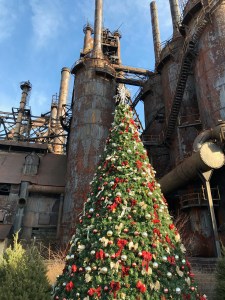
Now that we live near “the Christmas City,” we attend the Christkindlmarkt in Bethlehem while family is home.  One of the more stark symbols of this festival is the juxtaposition of a Christmas tree against the now silent and rusting steel stacks of what used to be Bethlehem Steel.  The evergreen, of course, was a Teutonic symbol of life continuing in the midst of the shutdown of the growth season.  Nature hasn’t really died, although it may appear to have done so, but we feel that difficult times with short days and cold temperatures will now dominate our existence.  Our industrial efforts participate in this slowdown too.  What once identified one of Pennsylvania’s two steel cities has ceased an Bethlehem has had to adapt.  We see the change and wonder.  I grew up just north of Pittsburgh when it was a very large industrial city.  When I was in high school it was the 16th most populous city in the country.  Currently it’s 66th, with Charlotte, North Carolina holding its former place.  We adjust to changing seasons.

Christkindlmarkt is a lively place with four large tents dedicated to symbols of the season.  Christmas merchandise is a large part of it, of course.  Small business vendors, however, take advantage of the fact that crowds throng in.  Food, naturally, comes to hold a place of some significance as your blood sugar drops after spending a few hours on your feet.  Music is in the air and people don’t seem to mind the masses of others who all had the same idea.  I never purchase much at the event, but I enjoy being among those inspired by it.  Some of us are the rusty towers in the background, and others are the lively, decorated tree that stands before them.  The season has begun, and the symbols are open for interpretation.


Thanks for the Giving


The wonderful thing about Thanksgiving isn’t the food.  I object, on more than one level, to calling it “Turkey Day.”  No, the wonderful thing about Thanksgiving isn’t the food, but rather the universal aspect of the holiday.  From Fundamentalist to atheist, everyone can be thankful and we all have things for which to be thankful.  The holiday may have begun in a Christian milieu, but you need not believe in a God in the sky to give thanks.  We can thank one another, we can thank the universe, we can thank whatever powers that be, or we can simply be thankful, no matter to whom.  As I write this in the early morning hours, I’m thankful for being home after spending several days on the west coast.  Hearing the November wind howling outside, I’m thankful for this warm cup of coffee.  I’m thankful for the ingathering of family.  There’s so much goodwill today.

Thankfulness leads to a kind of optimism.  Thankful people can perhaps see that we need not hate others to feel good about ourselves.  I think of Thanksgiving as a feeling of love and acceptance.  Perhaps more than any other holiday.  I’ve heard people of many religions and backgrounds wishing others a happy Thanksgiving.  Would that all holidays could be so accepting!  Of course, holidays themselves have their origins in religions.  Were it not for beliefs, one day would be the same as any other.  There are religions that refuse to celebrate holidays, but when critics become too harsh on religious beliefs I’m thankful to remind them that they have religion to thank for both holidays and weekends.  We could all use a break.

Thanksgiving comes at different times in different countries.  In some places no equivalent holiday exists.  There are secular holidays, of course.  The very concept, though, of a “holy day” comes from that great generator of calendars—religion.  As chronologically challenged as I am (I can’t figure out time changes or time zones or even what time it is anywhere non-local) I often think of the marking of time and how a religious impulse started our species doing so.  Sure, it may have been the urge to start planting, or the awareness that the herds of prey were moving on, but in those early days such things were infused with religious significance.  And when calendars became canonical, there were religious impulses present to drive it.  So, in a way, it is good to be thankful even for religions—as problematic as they can be—on this Thanksgiving.  


Homemade Halloween

Halloween is a holiday that brings together many origins.  One of the more recent is the tradition of watching horror movies in October.  I don’t know if anyone has addressed when horror films became associated with the holiday, but Halloween hasn’t always been about startles and scares.  Histories usually trace it to the Celtic festival of Samhain.  Samhain was one of the four “cross-quarter days.”  Along with Beltane (May Day), its other post equinox cousin, it was considered a time of year when death and life could intermingle.  Spooky, yes.  Horror, not necessarily.  Many cultures have had a better relationship with their dead than we do.  We live in a death-denying culture and consequently lead lives of futile anxiety as if death can somehow be avoided.

As a holiday Halloween only became what it is now when it was transported from Celtic regions to North America.  Other seasonal traditions—some of English origin such as Beggars’ Night and Guy Fawkes Night—which fell around the same time added to the growth of trick-or-treating and wearing masks.  At its heart Halloween was the day before All Saints Day, which the Catholic Church transferred to November 1 in order to curb enthusiasm for Samhain.  As is usual in such circumstances, the holy days blended with the holidays and a hybrid—call it a monster—emerged.   When merchants learned that people would spend money to capture that spooky feeling, Halloween became a commercial enterprise.  Despite All Saints being a “day of obligation,” nobody gets off school just because it’s Halloween.

My October has been particularly busy this year.  One of the reasons is that Holy Horror, as a book dealing with scary movies, is seasonally themed.  As I was pondering this, weak and weary, upon the eve of a bleak November, I realized that home viewing of horror—which is now a big part of the holiday—is a fairly recent phenomenon.  Many of us still alive remember when VHS players became affordable and you could actually rent movies to watch whenever you wanted to!  Doesn’t that seem like ancient history now, like something maybe the Sumerians invented?  People watch movies on their wristwatches, for crying out loud.  I suspect that John Carpenter’s Halloween had a good deal to do with making the holiday and the horror franchise connection.  Horror films can be set in any season (Wicker Man, for instance, is about Beltane, and three guesses what season Midsommar references).  We’re so busy that we relegate them to this time of year, forgetting that we still have something of the wisdom of the Celts from which we might learn.


Book Festival

So it’s here.  The Easton Book Festival begins today.  The weather?  Partly sunny, temps in the mid-60s.  There’s no excuse not to go!  (Well, actually, there are plenty of reasons, but if you’re in the area please consider it!)  I have to admit that my involvement with it was opportunistic.  I contacted the organizer because I was looking to promote my autumnally themed book, Holy Horror, in the season for which it was written.  I understand delayed gratification.  What author isn’t delighted when her or his book arrives?  Thing is, mine came around Christmas time, and, while a wonderful gift, nobody was thinking about scary movies during the joyful winter season.  My observation is this: books are lenses to focus thoughts.  I enjoy Halloween, but I also enjoy Christmas.  One follows the other.  The Easton Book Festival just happens to be during the former rather than the latter.

It’s heeerrreee…

My own involvement with the festival doesn’t start until tomorrow.  Today’s a work day, after all.  Employers don’t give days off for self-promotion (or even for writing books) so festivals are extra-curricular activities.  I’ll be on a panel discussion tomorrow at the Sigal Museum and on Sunday afternoon I’ll be doing a presentation on my book, same venue.  Maybe I’ve got this backwards (nobody tells you these things), but I’m not doing this primarily to sell books.  I’m doing it to promote dialogue.  During my less-than-stellar book signing last week at the Morvarian Book Shop I had only one brief conversation of substance.  It was with a scientist who pointed out that science and religion had nothing to do with one another.  I guess my hopes for the events of the next two days are that folks might want to discuss the ideas in the book.  Or at least think about them.

Sunday morning I’ll be giving a church presentation on the book as well.  Being in the publishing biz I’ve learned the importance of authors getting out there to talk about their books.  Hands up, who’s read a McFarland catalogue lately?  Case in point.  The only problem with all of this is that I still have to get my weekend errands done.  My daily schedule doesn’t allow for trips to the grocery store or even putting gas in the car.  And no matter how much time I put into work, there’s always more to do.  Festivals, of course, are intended to be time set apart from regular pursuits.  So I’m going to put on respectable clothes and I’m going to speak about what’s on my mind this time of year.  If the Lehigh Valley’s in your orbit, I’d be glad to see you there.


Shortchanging Halloween

In a local mall over the weekend where Christmas decorations were being uncrated, I felt cheated.  Now I’m not naive enough to suppose retailers can get by without the black season around Christmas, but as a writer of books Halloween themed I felt as if my thunder were stolen.  The normal person, I suspect, thinks of scary things only about this time of year.  Monsters and horror films are on people’s minds in fall, even though a good horror flick will make a few bucks even in spring or summer.  Halloween has a very small window of appeal, however, followed on closely, as it is, by Thanksgiving and Christmas.  Why can’t we give Halloween its due?

My wife pointed out that Halloween is a big retail event.  Indeed it is.  I started noticing Halloween paraphernalia on the shelves fairly early in August.  I know that even without capitalistic prompting I start to sense the season then.  It’s in the air.  Certain early August mornings you can smell a faint whiff of autumn on a breeze slightly cooler than expected.  The first leaves start to change and fall before September.  It will be another couple of months before the season makes itself felt in full force, but the early hints are there.  A believer in delayed gratification, I hold back.  I  don’t buy, but I absorb.  The melancholy grows through September until as the calendar tells me it is now officially October I can begin to exhale.  This is the time when those of us who are horror misfits can seem somewhat normal.  I walk into a store and “Ho, ho, ho!”  The joke’s on me.

Autumn already slips by too quickly.  Every year before I know it the ephemeral beauty of changing leaves is gone and the subtle chill in the air turns frigid.  Damp leaves are raked up to make room for snow.  The swiftness of this season is perhaps one reason so many people value it.  Summer can stretch long with its uncomfortably warm days and winter can linger for nearly half the year with its opposite feel.  Halloween is a holiday that intentionally falls in the midst of transition.  That transition has been commercialized, however, into buying seasons.  Only halfway through October the price of Halloween goods drops to sale rates.  Corporate offices are chomping for Christmas cash.  What I really need is a walk through the fallen leaves and a few untrammeled moments to consider where we are rather than what we might earn.


Dayglow

Yellow and orange leaves on a damp pavement.  A sky claustrophobically occluded with gray clouds.  A decided chill in the air.  All you have to do is add a few pumpkins and the feeling of October is complete.  I don’t know why this particular image of the change of seasons grips me the way it does.  As a homeowner I don’t want to turn the heat on too soon because the gas bills will jet up and will stay that way for seven or eight months.  I get depressed when skys are cloudy for days at a time.  Around here the leaves have only just begun to change.  In other words, there’s a decided difference between the way I imagine October and the way that it feels on the ground.  In my imagination there are Ray Bradbury titles, The October Country, The Autumn People, but here in the physical world I shiver and add another layer.

Over the past several weeks I’ve been struggling to figure out why horror appeals to me.  It seems to be the Poe-esque mood rather than any startles or gore.  The sense of mystery that hangs in the air when you simply don’t know what to expect.  Will it be a warm, summer-like day or will it be rainy and raw, a day when you wouldn’t venture outside without the necessity to do so?  October is like that.  It is changeable.  Beginning in late September it is dark longer than it is light and for much of the rest of the year I will go to bed when it’s dark outside.  It’s always still dark when I awake.  Is it any wonder that October has its hooks in me?

Short stories, of which I’ve had about twenty published, seem to be the best way to capture this mood.  You see, it isn’t a sustained feeling.  It’s piecemeal like that extra quilt you throw on your bed at night.  The urge to hibernate creeps in, but capitalism doesn’t allow for that.  October is an artist, and I’m just the guy wandering the galley, pausing before each painting.  This feeling only comes after summer, and it is fleeting.  In November the leaves will be down and the cold will settle in quite earnestly.  The candles we lit for Halloween will be our guide-lights to those we hold out to Christmas when the dayglow will begin to return at an hour that reminds us change is the only thing that’s permanent.  And in this there’s a profound hope.


Fall Festivals

Now that it’s October, it’s officially okay to be scared.  Determined to fight my fright of hubris, I make brave to mention that I have two appearances scheduled for the first ever Easton Book Festival, coming up from the 25th to the 27th.  The Festival has turned into quite an event, with some 200 writers taking part.  I got involved by being in the right place at the right time, for a change.  Authors are being brought in from as far as New York City, Vermont, and Massachusetts.  I know from experience that even Manhattan is a trek.  I contacted the organizers back in the summer since I have an autumn book that came out in late December last year.  For the festival I’ll be involved in a panel discussion “Poets as Prophets—Merging Art and Religion” on Saturday, and a presentation on Holy Horror on Sunday.

Like many people who write, I’m shy and not naturally good at promoting myself.  The other day while out for a walk my wife and I were run by by a group of shirtless high school guys, presumably on the track team.  It felt like the gallimimus scene from Jurassic Park—we’re smaller folks, and these confident, athletic sorts were not.  It felt like an object lesson to me.  Some of us are born with genetic dispositions to grow large and to feel confident.  Others not so much.  When we watched the caber toss at Celtic Fest last weekend, the contestants were all well over six feet tall, which I suppose makes sense if a caber is in the cards for you.  As they showboated for the crowd, I knew a small display with my book was just up the hill in the Moravian Book Shop.  Like me, in the shadows of the shelf above.

Perhaps my only regret about the Easton Book Festival is that I don’t have a fictional novel to present.  Well, I do, but it isn’t published.  Lately I’ve been exploring that wall of separation between fiction and non.  In the kinds of books I read in the fall, the wall is more of a hurricane fence.  And it’s only about waist high at that.  Holy Horror isn’t an academic book, it just plays one on the market.  If it were a standard academic title I wouldn’t have put it forward for the Easton Book Festival; people come to such events to be entertained as well as to learn.  This one will encompass pretty much all of downtown Easton for the weekend.  And that weekend is just before Halloween, when the wall between worlds is especially thin.


Snow in September

One of the trendy things when I worked in United Methodist youth camp was “Christmas in July.”  Although not quite six months out, the idea was to inject some fun when it was starting to feel too hot out and, as evangelizing efforts go, to talk about Jesus.  The origins of this tradition predate me, actually.  Even secular camps were using the idea in the mid 1930s.  By introducing the mystery of the unexpected, I suppose it might’ve helped to deal with camper homesickness, a perennial problem.  It worked, in my experience, because nobody was really thinking about Christmas in July.  It was a ploy.  Just after the summer solstice, Christmas would have to wait until after the winter solstice to materialize.  Now this past week we observed the autumnal equinox.  I usually write a post about that, but I’ve been kind of distracted lately.

Over the weekend I had to head to a big box home goods store.  I prefer to visit our local independent hardware store, but they don’t carry lumber and I needed some.  I walked in to find the store decked out for Christmas in September.  This was just a bit disturbing.  It’s not even Halloween yet.  In fact, it’s not even October!  For many people in temperate regions autumn is their favorite season.  Harvest themes, apple and pumpkins, turning leaves, falling leaves, and Halloween.  Putting on the occasional sweater for the first time after a long and hot summer.  Big boxes are leaping past all that to get to your Christmas bucks, even while you still have to mow the lawn when you get home.

Okay, so I’m not the only one to grouch about the premature appearance of Santa Claus and the extreme commercialization of Christmas.   I know that Bethlehem is called “Christmas City,” but as we wandered to the Celtic Festival underway downtown, people were sweating in the eighty-degree heat.  The leaves have begun to turn around here, reminding us all that Halloween and Thanksgiving are coming.  The holiday season.  I enjoy it as much as anybody else, but I don’t want to rush it.  I suspect the internet has accustomed us to instant gratification.  You want it?  If you can type it and click on it, it can be at your doorstep in two days.  You don’t need to wait for Christmas to catch up any more.  Meanwhile our landfills overflow with the stuff we throw away from Christmases past.  Christmas in July I think I get.  Christmas in September is just a little too much.


Upstate Reading

In terms of cash flow I don’t fall into the wealthy bracket.  My assets are largely in pre-printed paper form, and when I visit the local Little Free Library it’s generally to donate books rather than to take them.  Over Labor Day weekend I was in Ithaca.  One of the more famous features of the town is its weekend Farmers’ Market.  Indeed, the north-south corridor through town is a continuous traffic jam during Market hours.  Not only are there farm stands in the permanent open-sided structure, but there are a few craft booths and several places to buy al fresco fair from local restaurants.  In the summer parking can be hard to find, but the place has a carnival-like atmosphere nevertheless.  It also has a Little Free Library.  I’ve been to the Market many times but I’d never noticed it before.

Upstate New York is beautiful but it tends toward the conservative end of the political spectrum.  Ithaca is a pixel of blue in a screen of red, and that strangely showed in the Little Free Library.  Many of the books were either Bibles or popular kinds of devotional titles.  Given that Cornell isn’t known for its religion department (Ithaca College has a respectably sized philosophy and religion department, however) these books aren’t the kind you’d expect to find in an institution of higher education.  That’s why I was surprised to see a near mint copy of Bart Ehrman’s The Lost Gospel of Judas Iscariot on the shelves.  The Gospel of Judas hasn’t been big news for a few years now, but this was a book that suggests a different demographic than your average evangelical readership.

Like Ehrman, I once made a living as an adjunct at Rutgers University.  Indeed, it was this commonality that helped me to get to know him a bit.  He’s gone on to a kind of fame rare for biblical scholars.  Indeed, to have a sufficient number of copies of your book printed to end up in a Little Free Library—in other words, you have to have more cachet than your garden variety Ph.D.  In my local community LFL I like to leave books for others to take.  Just last week I stopped by and noticed that the summer had depleted the stock.  Ironically, I had noticed one of Neal Stephenson’s novels in the same circumstances as Ehrman’s.  I’m glad to see intelligent works on offer for the reading public.  And trading books with no money involved suggests to me that there’s a better form of economy than material greed.  All it takes is a Little Free Library and a little good will.


Making Monsters

It’s not so much I’ve been away from monsters lately, but that life has intervened between them and me.  Life can be scarier than monsters sometimes.  In any case, the summer is when my mind turns back to haunting even as on the breaks during heat waves a whiff of autumn can be caught on the air of a July morning.  Yes, we’ve past the solstice and days are getting shorter.  Slowly, of course, but that’s what builds suspense.  And there are local signs that I need to get my haunting in gear.  It is finally time to get Holy Horror out of wraps and give the book a proper launch.  Being published around Christmas last year was poor timing for a subject so readily coded for fall.

I received the welcome news this week that the Moravian Book Shop—the oldest continually operating bookstore in the country—will be hosting a book signing for Holy Horror in October.  This is a fortuitous turn of events because when I first approached them with the idea the price of the book made the idea look unrealistic.  But we’re now thinking of autumn, and with autumn comes Halloween.  There have been a spate of horror films this summer, all of which I’ve unfortunately missed.  Time, as Morpheus notes, is always against us.  There does, however, seem to be a lively interest in the genre and the curious wonder what it has to say about what we believe.  Horror loves religion, and indeed, thrives on it.  So it’s been from the beginning.

October will also see the Easton Book Festival in this area.  I will be on the program for that as well.  While none of this is earth-shattering, these events represent the first successes in trying to build awareness of Holy Horror.  This was a book written for a general readership, but not priced for one.  Working in the academic publishing world, this is a phenomenon with which I’m all too familiar.  Many colleagues offer to read and spread news about your book.  It seldom happens, though.  Academic presses can’t afford book tours (especially if they have to price books at $45), but these self-driven presentations are opportunities to spread the interest in ideas.  That’s what those of us who write really want—to be part of the conversation.  We’re in the midst of a heat wave here.  It’s the height of summer.  Even so, those who know about monsters can feel them coming, even from here.


Freedom’s Price Tag

Independence Day makes me feel conflicted.  Jingoism seems to be an international problem, and although patriotism is deemed next to saintliness, I have my doubts.  No nation is perfect *gasp!* and we would all do well to learn from others.  America is a nation in love with money and that affair has serious consequences.  One is our medical care system.  We’re one of the very few (if not only) “advanced” nations without universal medical coverage.  In fact, people routinely suffer because they lack insurance or their coverage doesn’t provide for what their physicians think is best.  This came home to me while staying with a family member who was hospitalized recently.  On the television the GOP was sponsoring ads against universal health care.  The irony was thick enough to be sickening.

Highly touted as the most affluent nation in the world, we refuse to take care of our own.  How am I supposed to get into the mood for Independence Day?  In Britain (as in most other places) they have universal health care.  I lived there for three years and knew that I could get treatment without emptying out the bank.  Here, in my native country, we have less care.  Someone might make a few dollars less, and that, we’re told, is unacceptable.  Anyone who’s experienced the illness of a family member knows the old one-two.  The treatment itself and the bills that come after.  Lately I’ve just been throwing up my hands and opening up my wallet.  It’s Independence Day.

Not that I’d expected much to change, but my first inkling of being a writer was winning a state-wide essay contest right here in Pennsylvania.  I wrote an essay on “Americanism” back in 1980.  It noted the false sense of righteousness that accompanied the notion.  I was an evangelical Christian then, but that didn’t mean I wasn’t cynical.  In my small town I’d seen John Cougar Mellencamp-level suffering.  I saw unemployment, drug use, and desperation.  I saw politicians saying everything was great and would be even better if we had more guns.  I saw trickle-down economics stemmed at the source.  I knew we were being lied to.  I did hope that things would get better, but now with the GOP fully behind 45 the true ugliness of jingoism has become clear.  It’s Independence Day and I feel sick.  I look across the ocean and see the nation from which we declared said independence suffering from a similar backlash.  But at least they can afford to go to the doctor.


Weathering the Sun

I may have given up on Weathering the Psalms a bit prematurely.  Those who know me know that the weather impacts my mood.  Now that I have a yard to mow that feeling has grown exponentially since perpetually wet grass is happy grass and is impossible to cut with a reel mower.  Today, while those of pagan inclinations celebrate the sun, there’s more rain in the forecast.  As there has been since Sunday.  If Yahweh’s the God of the sun, then Baal’s had the upper hand for some time now.  As an article on Gizmodo has pointed out, this has been the rainiest twelve months on record for the United States.  And we’re largely to blame.  We’ve known we’ve been warming the globe since the 1980s, at least.  Yet we do nothing about it.  You can’t stop the rain. 

Our species occupies that odd role of predator and prey.  Most predators, actually, are prey to somebody else.  Not being nocturnal by nature, we fear the dark when we feel more like prey.  Since we’re visually oriented, we crave the light.  Today, when the conditions are right, we have it abundantly.  Ironically, of the seasonal celebrations, the summer solstice is the only one with no notable holidays.  Easter and a host of May Day-like holidays welcome spring and Halloween and Thanksgiving settle us into fall.  December holidays around the other solstice are the most intense, but summer, with its abundant light and warmth, is perhaps celebration enough.  Or maybe we know that marking the longest day is a transition point, since now we’ve reached a natural turning point.

So, it’s the solstice.  From here on out the days start getting shorter and we slowly move toward the time of year when horror becomes fashionable again.  The light that we crave now ebbs slowly to the dark we fear.  There should be a holiday around here somewhere, for those of us outside academia continuing working right on through.  The problem is western religions, especially Christianity, place no especially memorable events here.  Resurrection’s a hard act to follow.  Calendars, apart from telling us when to plant and harvest, are primarily religious tools in origin.  When things are their darkest, six months from now, the church moved the likely spring birthday of Jesus to counteract pagan festivals encouraging the return of the light.  I, for one, would like to see a day to commemorate it, even if it’s raining again.


Time Off

Perhaps you’ve noticed it too.  Time away from work has an utterly different feel from time on the job.  Those rare individuals who really love their professions probably feel differently about it, but a timid free spirit since childhood, I’ve always noticed a difference.  And it has become more pronounced as time’s gone on.  Recently I cashed in a vacation day near a national holiday (Memorial Day) so that I could drive across the state to see my mother without feeling utterly wiped out from a twelve-hour drive on a regular weekend.  As I slipped back into work mode on Tuesday the change was palpable.  Time was no longer my own.  I tend to work well over eight hours daily—the telecommuter must prove his/her worth—and something about the quality of the time itself was decidedly unlike that of the previous four days (two of which had been spent driving).

That quality, of which we’re not encouraged to speak, is the feeling of freedom.  More precisely, auto-determination.  Okay, I’ve read enough philosophy to know this is just an illusion, but work with me here.  Few and exceptionally fortunate are those who find careers they love.  What the rest of us love is time off work.  Time when we can decide what to do.  How long to sleep.  When to cut the grass rather than waiting until the bell rings at 5 p.m. and the inevitable afternoon rain begins.  Perhaps best of all is going to bed knowing that the next day you don’t have to get up and report for duty.  I’m not dissing employment here, I’m just noticing something.  What I’m reaching toward is a concept of sacred time.  Unstructured time in which creative types thrive.

Early in life the concept of summer was instilled in my soft and malleable psyche.  It said once May was over you have three months to do whatever before facing regimentation again.  I grew to appreciate this schedule.  To love it, in fact.  It was part of why I decided higher education was the best vocational fit for someone of my particular disposition.  Every year when June rolls around I still feel it, like a migratory bird.  The reality, however, is the quality of time changes on Monday morning.  It slows down and feels more like sandpaper than silk.  I can see there’s a holiday just a month away, if I can only reach it.  And it is, perhaps with a dose of unintentional irony, call Independence Day.


World Environment Day

Do you like where you’re living?  Planet earth, I mean.  Today is World Environment Day.  It’s not enough of a holiday to score time off of work, but it is well worth observing nevertheless.  More than that, it’s vital.  Other holidays tend to be the decaying remains of religiously appointed observances or sops thrown to the Cerberus of patriotism, but World Environment Day impacts every one of us, all of the time.  Whether sleeping, waking, working, or playing, it’s in the context of the one planet we have.  Even those in space have to check in here to survive.  We might try to make World Environment Day an international holiday, but I’m sure we could never all agree to it.  Business would collapse if everyone took the same day off, all at the same time.  Instead we’re left to dream.

I recently watched The Lego Movie.  Although released in 2014 it perfectly anticipated 45 with “President Business.”  Overlooking for a moment that Legos represent big business, the film underscored the problem: the only thing hard enough to cut a diamond is another diamond.  And the only way to fight business is with business.  Perhaps there aren’t enough people to envision what life could be like without the constant stress of having to make more money.  It’s a sickness, really.  But it’s a pathology we worship.  There are some abysses, it seems, into which nobody dares peer.  Who doesn’t want to be in charge?  And those in charge care nothing for Mother Earth.

We have spent the past two-plus years watching helplessly as the Republican Party has done its level best to lay waste the planet.  Rolling back and abolishing environmental initiatives deemed detrimental to “business,” these are folks who need to feel what it’s like to lose a job or two and have to reinvent themselves.  Not that long ago, most of the humans on this planet lived on farms or supported those who did.  Daily in touch with the planet in a literal way that those who mow with industrial, sit-down lawn helicopters can never be—how can you be in touch when your feet never even meet the ground?—they knew that paying attention to the planet is crucial.  But that’ll have to wait.  It’s a work day, after all.  And a Wednesday, no less.  In the middle of the week-long worship at the altar of Mammon.  Still, I urge you to take a moment or two today to consider how to save the only planet we’ve got.  It’s worth celebrating.


Iron Ages

I find myself in Pittsburgh again.  We set out from the former steel city of Bethlehem and ended up in the former steel city on the other side of the state.  I’m not here for the metal, of course, but to visit family.  Making our way over the great eroded spine of the ancient Appalachians, I was thinking of how cities often take on the identity of their industries.  Pittsburgh and Bethlehem vied with each other for their facility with unyielding iron—one of the technologies so important to human history that we still use the Iron Age as a marker of advancing technology.  Pittsburgh’s now a tech city, much reduced in size from its heyday when only fifteen cities in the country were larger.  Bethlehem, it seems, is still trying to figure out exactly what it wants to be.

Back in college, I used to work in a church in the south hills.  I haven’t been to Windover Hills United Methodist Church since those days.  I was weighing my future then, deciding to attend Boston University School of Theology—the seminary the pastor had attended—and exposing myself to liberal thinking rather than more of the conservative milquetoast that was mistaken for milk and honey at Grove City College.  The memories that attended the drive were powerful and poignant.  I only lived in Pittsburgh two summers—the second working as a bagger at a grocery store (I should’ve known then where a college degree in religious studies might lead, even if summa cum laude).  As iron sharpens iron, so the Good Book says.

Recently I tried to recall all the addresses at which I’ve lived.  This seems particularly important because many of the buildings no longer stand and I greatly fear being erased.  Those of us who write often do.  I can recall the cities and even a few of the streets.  Numbers often escape me, for they seem to be mere place holders.  My days in Pittsburgh were decades ago, when life was really only just beginning.  Now I drive these hills with memories my only maps, wondering if I can find the place I’m seeking.  This place is part of me, even as Bethlehem is now becoming such a piece.  Cities change depending on the laws of supply and demand that can, as we know, even break iron.  And those of us who live in such places know that any industry is subject to memory, whether of God or of steel.