Riddle

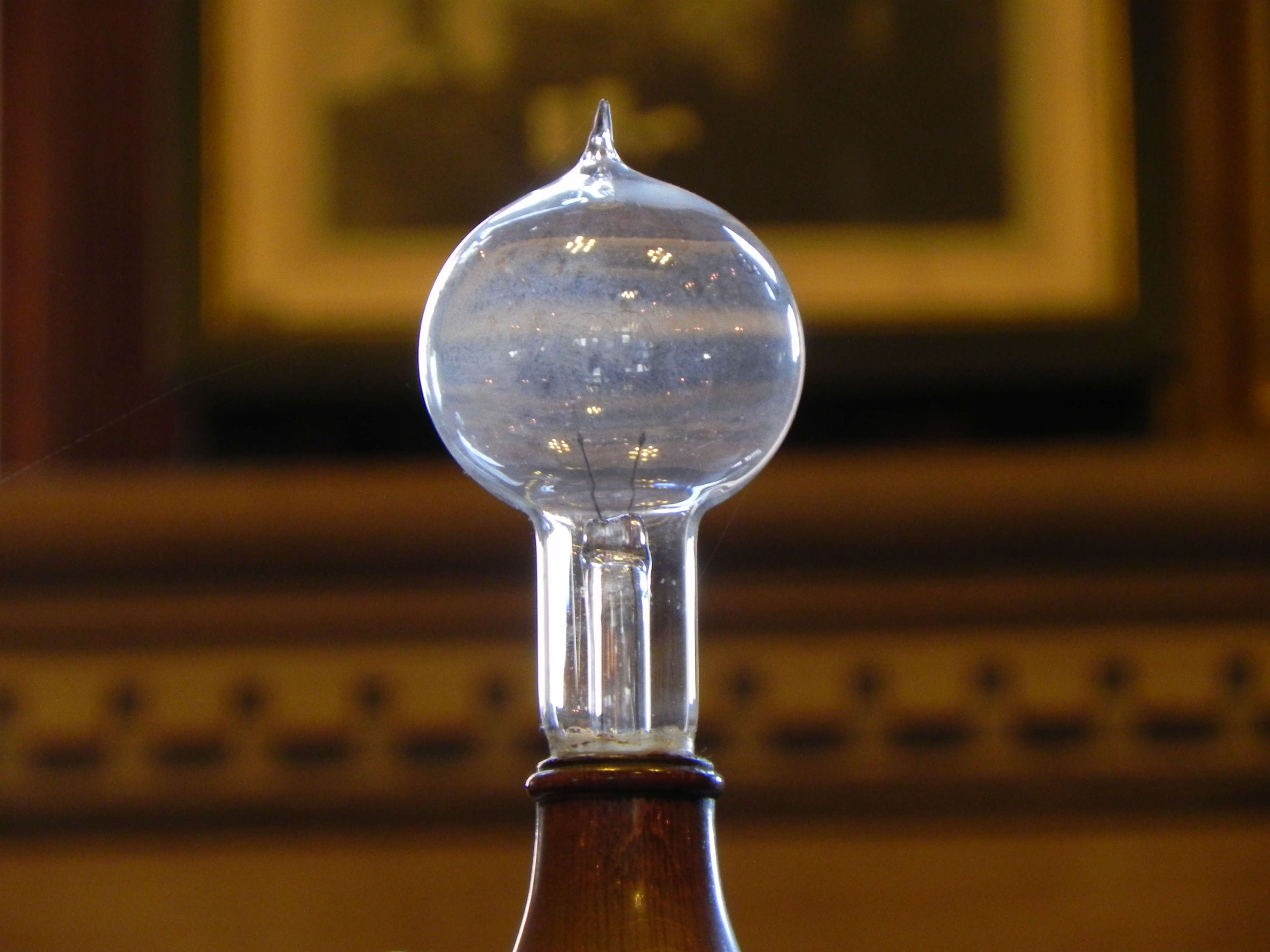
It’s an age-old question: how many Ph.D.s does it take to screw in a lightbulb?  I haven’t figured it out yet, so if you have the solution please let me know in the comments.  It’s like this—I’m a short person living in a tall house.  Even while living in apartments I had bought a six-foot ladder and an eight-footer, to reach various things.  A bit of an acrophobe, I tend not to use the latter ladder unless it’s really necessary.  Then the landing light went out.  It’s a dark time of the year and a light over the stairs is really a matter of safety.  The stairs continue up from the landing and this particular ceiling light is eleven feet above the ground.  Given how far I can safely (debatable) climb an eight-foot ladder, I can’t reach the ceiling with what I’ve got.

We had to buy a 28-foot extension ladder to reach the roof.  In its collapsed position it’s 14 feet and requires two people to carry.  I’m not sure we could get it around the corners in the house, and even if we did the math doesn’t work out to fit it in an eleven-foot space with stairs every direction.  I decided to ask YouTube.  The solution there is to buy several two-by-sixes and some heavy-grade plywood and build yourself a temporary platform.  With the pandemic-induced shortages, and therefore price increases, such a platform would cost about $100 to build, and then I’d need to unbuild it after screwing in the light.  Or we could buy another ladder.  Maybe a different house while we’re at it.
Imagine

The thing about ladders is they come in standard lengths.  Around here, anyway, a ten-footer isn’t an option.  The best bet is a multi-position ladder.  Retail cost somewhere upwards of $150.  To someone afraid of heights it feels like the safest of many less than optimal options.  Apart from perhaps carrying flashlights in the evenings that come so early now.  Still, that raises the specter of cost.  How much does it cost to screw in a 5-dollar (LED, of course, to help the environment) lightbulb?  It seems to be a $100 repair, no matter how you do it.  I could try custom-building my own ten-foot ladder.  Or I could try making some tall friends.  Apparently you can rent ladders as well, but of course we’d need to rent the truck to get it here as well.  Or we could learn to live with a shadowy stair this long winter that’s just getting started.  How many Ph.D.s does it take?  I don’t know, but the answer will be more than one.

Myth of Ownership

“Luddite” doesn’t really describe me.  I don’t have a problem with technology, but I often object to how its used.  Let me give an example or two.  You spend your hard-earned money on a device—smart phone, for instance, and/or a laptop computer.  These you use for your personal email, which you’re not allowed to check at work, and for paying bills and buying new stuff.  So far, so good.  But once these devices become ubiquitous enough, others presume the right to use them.  Never mind that you’re paying for the internet plan and your likely unreasonable monthly fees for using that phone.  Employers, for instance, concerned about their own security, require you to use your personal phone for some kind of authentication app to protect their assets.  Hmm, and who is paying for the data use on that phone?  And the wifi that makes it work?

Or consider a volunteer organization that’s taken over by a technocrat.  Suddenly you have to set up Dropbox on your laptop (with its attendant frequent emails asking you to upgrade until he seated on a white horse comes through the skies).  You can’t participate without access to the Dropbox.  Or maybe they want you to join Slack.  The problem, it seems to me, isn’t that we don’t have enough way to communicate.  No, the problem is we don’t communicate well with what we do have.  Terse messages may be understandable for smoke signals or telegrams, but a greeting, body, and closing aren’t too much to ask for an email.  I don’t text largely because too many misunderstandings occur from the brevity, and not infrequently, from auto-correct.

I use technology daily.  For about a dozen years now I’ve been posting daily right here on this very internet.  A have a neglected Twitter account and I glimpse Facebook for, literally, about two minutes per day.  I can be reached on LinkedIn (and no, I don’t have any jobs to offer), Instagram, and yes, even Slack.  We’re all available to each other constantly, but communication breaks down when we don’t communicate clearly.  A writer I greatly respect once told me emojis are cheating.  I tend not to use them, but they may help the terse text go down a little more smoothly.  We are all challenged for time.  There’s so much to do and we’re not getting any younger.  But I was born in an era in which if you use somebody else’s stuff you ask nicely first and said “thank you” after.  Especially if they’re paying for you to use it.

Who owns whom?

Standard Maintenance

Something disturbing happened the other day.  My laptop started requiring constant plugging in.  I figured the battery was starting to go—it is several years old now.  Since time is the ultimate commodity in short supply, I made a weekend appointment with a genius at the local Apple store, which really isn’t that local.  I drove out on a rainy Saturday afternoon to get the battery replaced.  That’s not the disturbing part.  Neither is the fact that so many people were flocking around in an Apple store without wearing masks (although that does count as disturbing in it’s own right).  As I sat there watching the giant projection of devices I should consider buying, my daughter mentioned to me how like a dystopia it was: being subjected to advertising aimed at purchasing something you’re in to have repaired.  That wasn’t really the disturbing part, either.

No, what was disturbing occurred when our genius told me I would need to leave my laptop there for three-to-five days for it to be repaired.  I use my laptop daily and extensively each day.  I have no spare and I post daily on this blog.  (Those times when a post doesn’t appear it’s because I think I’ve hit the “publish” button but I haven’t.  That happened to me again recently and I only discovered days later that WordPress was listing it as a draft.  Sure enough, I’d gotten so busy I’d not click “publish”—which happens, ironically, mostly on weekends.)  I was hit with panic.  Could I live for three days, up to a week, without my laptop?  No email.  No blog.  No ubiquitous Zoom meetings outside of work?

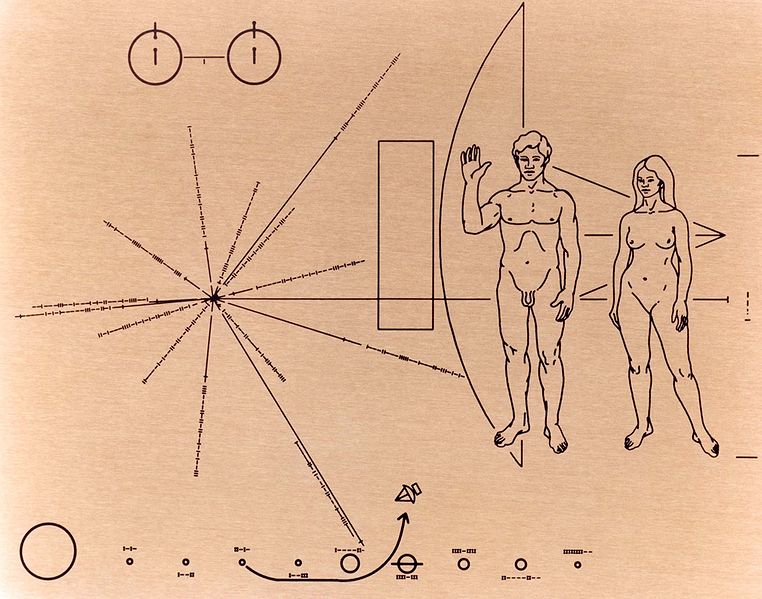
Even before the pandemic the internet had become my lifeline to the larger world.  And the thing is I’m sending my thoughts out like a Pioneer probe to that outer space of the web, not sure if anyone will intersect with it and understand the gold-plated plaque within.  At least I hope it’s gold-plated.  I’ve been blogging here since 2009, at least one laptop ago (or perhaps two).  I’ve posted over 4,500 times.  What would happen if the earth went through the tail of a comet and wiped out all this electronic data?  Would there be anything left at all?  That’s the part I found disturbing.  My ambivalence about technology doesn’t mean I’m not addicted to it.  I was spared an immediate crisis since the genius at the bar told me the battery (being such an old model) was out of stock and would take a few days to arrive.  Meanwhile I could continue to live in my virtual world as normal.


Degrees of Separation

For some reason lost in the fog of weblandia, I get The New York Times, “The Morning” delivered to my email.  By carefully not clicking the links I can get my day’s worth of fear and paranoia for free.  Not all the news is bad, of course, and I’d be glad to pay if circumstances had been different.  After giving all the sorrow that’s fit to print, “The Morning” ends with an Arts and Ideas section.  By then I’m usually cradling my head in my hands but I look up to see the positive side of humanity.  The other day the article on the Metaverse included this line: “In its simplest form, the term — coined by Neal Stephenson in his 1992 novel ‘Snow Crash’ — describes an online universe that people can share together…” and I realized probably the closest I’ll ever get to the Gray Lady.

I am, as many of my regular readers know, Neal’s brother-in-law.  He mentions me in the acknowledgements to Snow Crash, something that was discovered by someone at work fairly recently, and which probably did more for my stature than my many long hours daily.  When it comes to degrees of separation, fate, I suppose, plays a role worthy of the Joker.  Neal hadn’t written Snow Crash yet when I met his sister.  Her somewhat unlikely friendship with me eventually led to our marriage and it was in the context of a family gathering that the conversation Neal mentions in Snow Crash took place.  Outside publishing, and in particular academic publishing, acknowledgements are seldom read.  I always read them, though, looking for unusual connections.  I’m often rewarded for doing so.

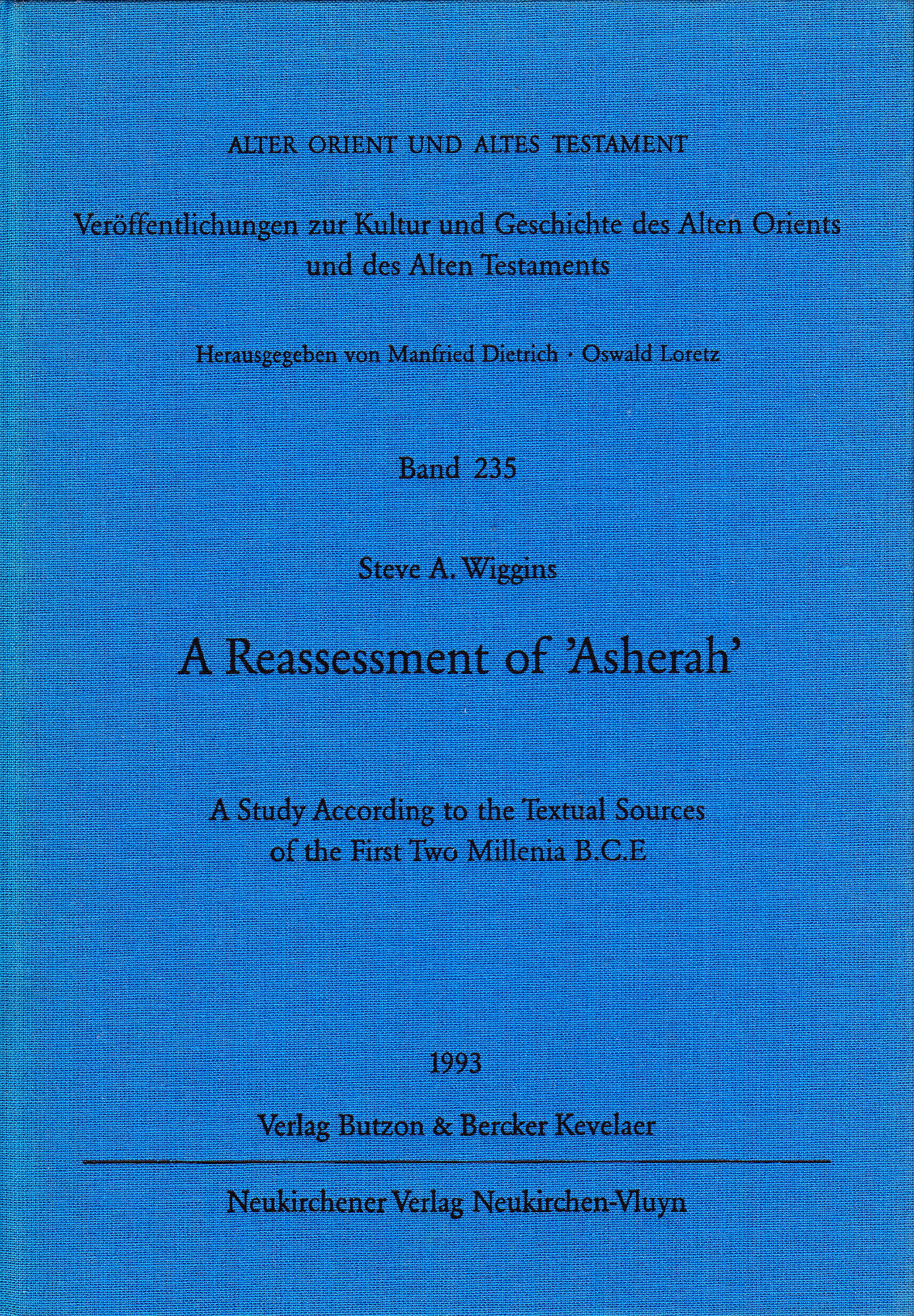
Asherah was, unbeknownst to me at the time, undergoing a resurgence of interest.  My Edinburgh dissertation was published the same year as a more prominent one by Cambridge University Press.  Just a year later, another came out.  Then another.  The internet was really an infant in those days and we learned of such things through printed resources and printed resources are always in arrears by months, if not years.  Of the many Asherah books mine had the distinction of being the most expensive.  Some things never change, I guess.  Suffice it to say, Asherah was on my mind as Neal and I drove to the store to pick up some baby supplies.  I had nothing to do with his coining the word or idea “Metaverse”—he’d already worked that out.  It was Asherah that ended up in the novel.  I was on my way to a short-lived romance with academia at the time.  Family, however, is so much more than degrees of separation.


Not Quite Quetzalcoatl

It must be difficult to write the same basic story over and over.  And nostalgic adults like me can be tough critics as we try to recapture faded childhood glories.  Those memories fade like afternoon shading into evening, but still I can’t help myself.  Marilyn Ross wrote 33 gothic tales of Dark Shadows in the spinoff series from the long-running television program, and I’m determined to read them all.  In small doses.  The one, Barnabas, Quentin and the Serpent is actually a bit distinct.  The writing is still journeyman, that of a tired potboiler author, but the plot offers something a little different.  As in the last volume reviewed, Barnabas is free from the vampire curse for a time, allowing him to emerge in the daylight.  And his arrival at Collinwood is actually dramatic and well-timed.  The story is set in the nineteenth century.

Gerald Collins, a professor of archaeology, unexpectedly inherits Collinwood along with his daughter Irma.  They head to Maine from Mexico taking exotic creatures with them, including a dimetrodon that escapes and tries to eat them.  The story revolves around rumors that the professor caught and transported back a flying serpent.  At Collinwood (and let’s think about this a minute—if you add up the body count from all the novels you’ve got to wonder why there’s been no federal investigation) people start to die and reports circulate of a flying snake.  The professor’s going to be driven out of town because angry villagers think he brought this creature back with him.  It’s all very melodramatic.

As in the last novel, Barnabas acts as a detective.  Quentin, who is the werewolf cousin, manages to allude detection by disguising himself.  Even Barnabas is fooled.  The story tries to avoid invoking the supernatural—there’s no such thing as flying serpents—while allowing a werewolf to perpetrate a hoax.  It’s all good fun (except for that body count).  There’s a bit of vim here from our weary journeyman writer, but there are nine novels yet to go in the series.  Writing a series seems to be smart money.  Children (and I first read several volumes of this series as a child) like to complete things and can be loyal series fans.  I never read the full series when I was younger; they were haphazard finds at the local Goodwill book bin.  Of course they were still being published at that time.  I have to admit that I’m curious where it will go from here.  And I do miss Barnabas as a vampire.


In Praise of Paper Maps

One of the tricks, I’ve mentioned before, for getting around accessing books I can’t afford, is the used book market.  Now Amazon is probably just about as bad for small business as Walmart is, but it does seem to have its logistics down.  (Most of the time, anyway.  Early in the fall I ordered some horror movie DVDs.  One of them was out of stock and Amazon eventually sent me a notice that it was lost in shipping.  Would I like another, at no extra charge?  Shipped to the same address?  Of course I said “Yes!”  But they shipped it to my mother instead.  Most of us are probably embarrassed about what we watch and don’t want our mothers to know.  In any case, she had it forwarded on and I received it a mere two months after ordering it.)  They also let you track it.

If, however, you buy used books from Amazon, you may need to go with a separate vendor’s shipping.  (I tend to use BookFinder.com, but lately it’s been routing me back to Amazon.)  So it was I ordered something with a projected delivery date of October 25–29.  Not too bad.  It’s not like I need it for a book I’m writing or anything.  I was cheered, then, when on October 14 it was tracked to Secaucus, New Jersey.  I used to go through Secaucus every day on the bus.  Twice.  Surely I would have my cheap source before the 25th!  But my package likes Secaucus, apparently.  Once it got there every day the USPS tracking system assured me it hadn’t moved at all.  “You signed up for delivery on October 25–29 didn’t you?  Well, you’ll get it then.  Perhaps.”  Wouldn’t it be nice if shipping had the option of “Your package is pretty close, do you want to collect it yourself?”  Then on the 22nd I learned it was in Glendale Heights, Illinois.  It arrived on the 25th.

Why do I write these things?  (This isn’t the first time, young man!)  It’s because I think they’re funny.  To me, a society that has lost its heart to technology has to be ready for some laughs now and again.  (Some of my critics think I’m complaining; I guess I need more irony in my diet.)  Life during a pandemic has become one of having stuff shipped.  From last year’s toilet paper from China to my current academic book that’s just too expensive to buy new, I sit with my ear cocked for the Amazon footstep on my front porch.  And occasionally getting into my car to drive to a distant post office just because, well, it’s easier for me to find them than for them to find me.


Face Away

I’m avoiding Facebook for a while.  Here’s why.  I started a Facebook account when I first got involved in social media.  (Publishers say you have to build a platform.)  The instructions were very basic and I checked my feed once a day for a total of about 5 minutes.  I still do that.  Some people contact me on Facebook, and often I don’t see it.  In fact, I seldom open it after 6:30 a.m.  I’m pretty easy to reach on the internet.  I have a blog and a Twitter account, Linked-In, Goodreads, and Academia.edu.  They all send me email notices when someone messages me.  Facebook doesn’t.  Also Facebook keeps telling me people have sent friend requests.  It was manageable up until recently.

I thought it was because of the Incarcerated Christian podcast.  (There’s another one coming up on Tuesday!)  The next day I started to get 20+ friend requests a day.  You’ve got to build a platform, right?  I tend to accept friend requests because I spend very, very little time on Facebook.  Then more requests came.  And more.  And more.  Just yesterday I had 846 pending friend requests.  That’s a lot of clicking!  I was going to have to hire an assistant just to say “you’re all welcome.”  Or maybe, “why not follow me on Twitter?”  I would devote my 5 minutes on Facebook to clicking friend requests.  I quickly grew bored with it.  Then the friend requests started coming from other academics.  “Cool!” I said, “people I actually know!”  But when I clicked on the “Accept” button it said, “Friend request sent.”  No, no, no!  That’s not what I wanted to do!  I was responding to a request sent to me, not the other way around.

Lead us not into Facebook…

I quickly clicked out of Facebook in embarrassment.  I don’t want a bunch of academics to know how needy I am—that’s just for you blog readers to know.  I know Facebook sends updated instructions from time to time.  I don’t have time to keep up with them.  If they just sent me a tweet I might read it.  My main social media channel is this blog.  You can read it on Facebook, or Twitter, or even Goodreads.  I think it also shows up on my Amazon author profile page.  I may be needy but I’m not hard to find.  So I’ve decided to retreat from Facebook for a while.  The price of building a platform, it seems, has gone up with just about everything else.


Paywall

They were my former employer, for goodness sake!  Here’s how it happened.  It begins with research.  Nobody is born knowing all they need to learn.  Research teaches you to question what you read and check sources.  That’s how bibliographies are built.  So I came across a reference to an article I needed to read.  The problem was it was behind a Taylor & Francis paywall.  (Taylor & Francis own Routledge.)  The cost to read one article in an academic journal?  $45.  That’s usually my upper limit for buying an entire book.  Working in publishing I know the reason for this.  They want you to go to your library (I don’t have one) and ask them to subscribe.  If you need access, probably somebody else will too.  This particular author isn’t on Academia.edu.  Should I risk Sci Hub? I mean the article is right there, but I’m not allowed to see it!

I did find that you can ask the author for a copy on Research Gate.  First you have to join Research Gate.  They want your institutional email.  My email doesn’t have a .edu extension.  I therefore had to go through a lengthy process of verifying that I am a researcher.  I had to claim papers I’ve authored.  I had to explain why I don’t have an affiliation.  I had to have them email me, twice.  Each time I had to provide further information.  I swear, it’s like getting a Real ID all over again.  All this so that I can ask an author for a paper that’s only available for $45 on the publisher’s website.  Every time I start a new research project I ask myself why I keep at it.  I guess I want to be part of the conversation.

The open access movement is gaining steam.  The idea is that research should be free.  Very few object to paying nominal fees for access, but often prices are extortionate.  Publishers are caught in this web because overheads are so high—they have to pay employees—and the cost of materials isn’t cheap.  Traditionally this has been overcome by passing some of the expense on to customers.  That’s why academic books are so pricy.  With journals, such as the one I need, the scenario’s a little different.  Journals are purchased by libraries via subscription.  “They wouldn’t subscribe to them,” so the argument goes, “if researchers could get the contents for free.”  Still, putting in place a free article or two before dropping the price bomb would seem to be in the best interest of actually moving knowledge forward.  Hey, T&F, don’t you remember me?


Time Keeps on

Do you want to feel old?  Consider this BBC headline: “TikTok overtakes YouTube for average watch time in US and UK.”  If you’re like me you first heard of TikTok at some point during the pandemic and had only a vague idea what it was.  A new platform yes, but platforms come and go and I was really just starting to get into YouTube.  In fact, I remember when I first heard of YouTube.  A colleague at Gorgias Press was telling me about it.  It was a place to post videos.  I didn’t own a video camera and besides, what does a washed-up professor have to say?  No only that, but my computer didn’t have the memory capacity to upload and edit videos and who even has the (figurative and literal) bandwidth?  (I do have a YouTube channel, but it turns out that a nine-to-five and writing books on the side take up pretty much all of your time.)

Speaking as a homeowner, YouTube has been a lifesaver.  Most of what I have to do in household repair (a lot) I learn how to do from YouTube.  I know younger people who prefer YouTube to movies and never watch television.  It turns out that people are pretty good at entertaining each other even without the studios telling us what to watch.  (Although discoverability benefits from sponsorship, so money does change hands and the economy is happy.)  I was just beginning to get YouTube figured out when TikTok came along.  I was under the impression it was a music app—does Napster even still exist?  CDs are getting hard to find, as are DVDs.  I guess I can learn out where to buy them on YouTube.  Or TikTok?

I recently watched a horror movie on one of those services where they break in with a commercial at the absolutely worst moment time after time.  As the excitement began to build the commercials became more frequent.  As soon as it was over I was wishing for a DVD.  Too much content is on somebody else’s terms unless you’ve got a physical disc that you can slide in on your own timetable.  It’s strange being in that transitional generation between print and ebook, vinyl/VHS and streaming, paper maps and Google maps.  Now I guess I have to figure out what a TikTok is and how to use it.  I think I’ll go to the library and see if I can find an old-fashioned reference book on it.


Seedy Delivery

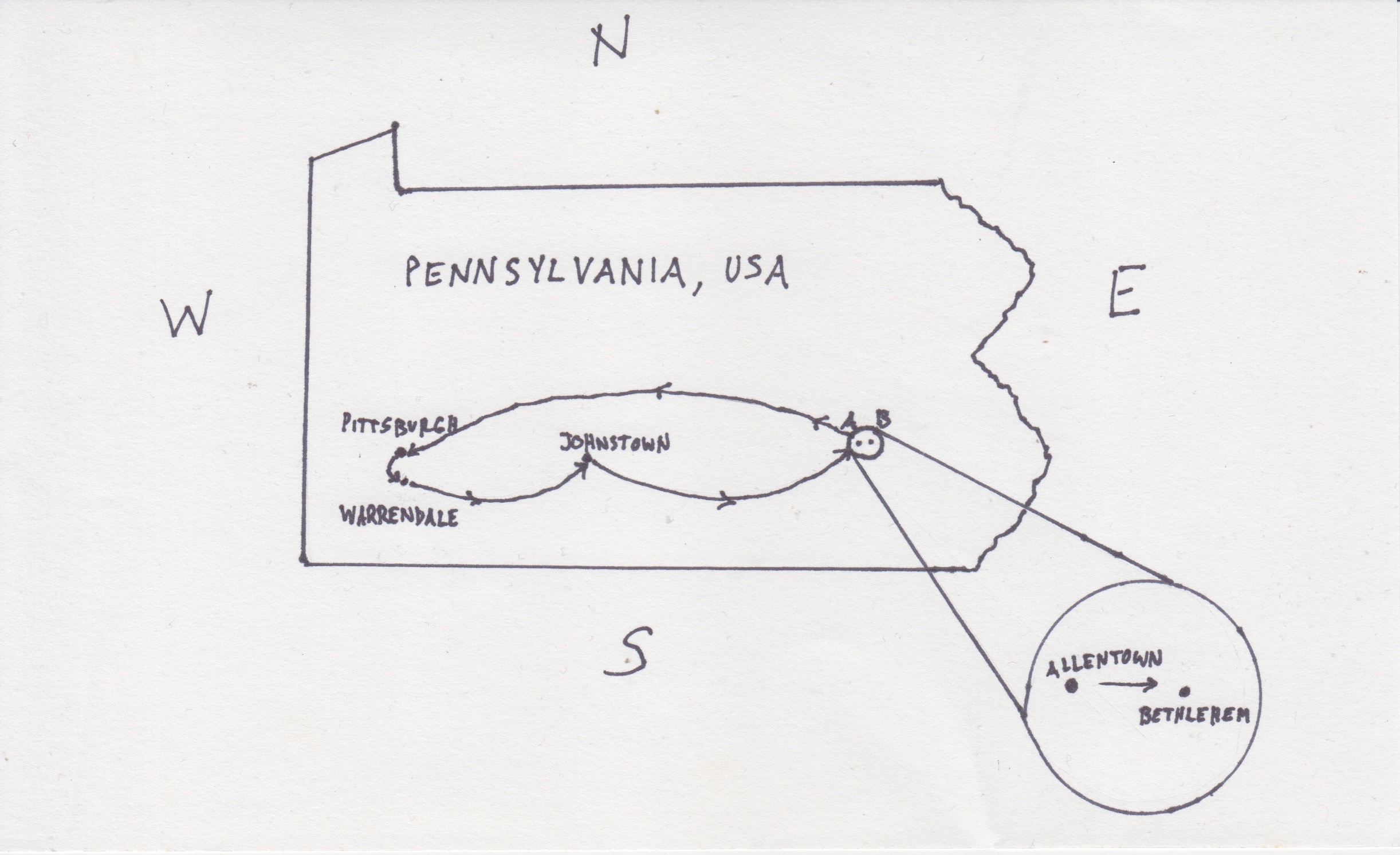
Call it a weird indulgence, for that it surely is.  I’ve been slowly re-collecting childhood books—really what we call “tween books” these days, but there were no tweens back then.  Since these are out of print and somewhat difficult to find, I order them when I can afford to, and have been doing so for over a decade now.  The latest one shipped from Minnesota, via the US Postal Service.  Since these are not easily replaced, I follow the tracking.  The seller indicated a delivery date of September 16-18, only to send an early delivery notice when it was mailed.  Indeed, I’d ordered this on the 8th and by the 10th it was in Pittsburgh.  In case you’re not familiar with Pennsylvania geography, I’ve sketched a map.

Pittsburgh is about 6 hours away from where I live.  It was now scheduled for delivery on the 11th.  I had my doubts.  I awoke on the eleventh to find that it had overshot and was now in Baltimore.  Baltimore is only about two-and-a-half hours away, but still, the thought that it could reach the local post office and get out for delivery that same day seemed slim.  The next day was Sunday, so I figured maybe Monday.  Sure enough, on Saturday the 11th it had reached the dreaded Lehigh Valley Distribution Center, in Allentown.  Allentown is only ten miles from here, within actual walking distance.  The tracking site said it would be delayed.  On the 14th it had been shipped back to Pittsburgh (where it had been less than a week before), from there to Warrendale (which I had to look up on a map), and from there to Johnstown.  Barring another flood, it was due here on the 16th.  Of course, it may have to go through the horror-inducing Lehigh Valley Distribution Center again.

That same center had shipped a package to East Stroudsburg, over thirty miles away, just the week before and had sent a notice that it had reached its final destination.  I’m not one for squandering money, but I would gladly buy the Lehigh Valley Distribution Center a map.  They could look and see that Bethlehem is a mere 20-minute drive to the east.  That could prove useful information.  The package arrived the 15th.  The next day I received a status update alert that it was out for delivery and would arrive that day.  I’m a Post Office booster.  I believe the government should fund the postal service adequately and quit trying to win elections by cheating.  And maybe they could throw in a map while they’re at it.  I’ve got one they can have for free.


Perspective on Distance

Thirty miles can be pretty close or pretty far, depending.  This time it was pretty far.  I know the Post Office has been having trouble, but when the tracking number on the package said it was “being held by customer request” (wrong) at a Post Office thirty-plus miles away, I had to wonder.  I still remember when zip codes were made mandatory for mail.  They would give the Post Office a more precise set of coordinates to get to your house or apartment.  The funny thing is they’ve been vastly outdone by other delivery services.  Amazon makes mistakes too (they recently delivered something I’d ordered for myself to my mother—thankfully it wasn’t too embarrassing), but less often.  It would seem that if you pay someone to bring you something, they should be able to manage a bit closer than thirty miles.

I went to the website where delivery instructions was an editable field.  In it the PO had helpfully written “DI not available for this delivery.”  If you want it, you have to drive over sixty miles round trip to get it.  Only during office hours.  Don’t get me wrong—I’ve always been a supporter of the Post Office.  They generally get things to you—it’s pretty remarkable.  (Junk mail inevitably arrives, of course.)  I even used to collect stamps.  I’m still reluctant to not save one or two that catch my fancy.  But thirty miles?  You’d lose at both hand-grenades and horseshoes with that kind of accuracy.  When I called they offered to put it back in the system, but that would add several days to the delivery schedule.  Who’s to say that it might not end up even more than thirty miles afield?

If it were an atomic bomb, or a volcano, thirty miles would hardly seem far enough.  It’s a matter of perspective, I suppose.  So it is with most things in life.  Nine hours isn’t long if you’re engaged in a task you really enjoy.  In fact, the forty-eight hours of the weekend go by so fast that you’re left wondering where they went.  If you take nine hours and put them toward a dull and tedious task, however, they stretch to monstrous proportions.  Science tells us that the amount of lapsed time—or space—is the same.  It’s just our perception that changes.  In the larger scheme of things thirty miles in the middle of the day can take only a couple hours, with traffic.  From that perspective it’s better than a nine-hour drive to the original shipping location.  It’s all in how you look at it.

It depends on your perspective

All About Merch

Although I’d heard of it uncomprehendingly when I was in seminary, I first joined the Society of Biblical Literature in 1991, while a doctoral student.  I religiously *ahem* attended the annual meetings until I lost my job and my ability to afford it.  When I landed in publishing I started attending again, and over all these years I’ve started to notice a lot of swag creeping in.  Publishers sell bauble headed theologians (aren’t they all?), playful knick-knacks, and even socks bearing the cover design of established commentary series.  It’s as if we want to tell the world that studying the Bible is cool.  (Why not purchase some nice warm socks?)  So I wasn’t really surprised when the society itself, fondly known as SBL, started selling its own merch.

On most SBL electronic newsletters there’s a link to the vendor that produces shirts and mugs with jokes that only other biblical scholars will get.  (I never found this a very humor-laden community, being under duress, as it is, and as deeply conflicted as the country that hosts it.)  Eventually I grew curious and clicked on the link to the novelty tee-shirts and mugs.  It took me to a company called Redbubble.  SBL Press has its own page there with a strange header photo, apparently of a G. I. Joe and G. I. Jane reading some of SBL’s books.  Weird marketing is fine, of course.  Some of us have almost a connoisseur sensitivity to the bizarre.  As for the merch itself, it includes limited designs since, I suspect, most professors aren’t novelty tee-shirt fans.  What caught my attention was the button at the bottom that said “Mature content: hidden.”

Did the Society have some top shelf items?  The Bible certainly has quite a bit of mature content itself.  Questionable stuff as well as scenes that are, well, let’s just say scenes that are left out of children’s Bibles.  Of course I clicked the link.  It took me off the SBL Press page, naturally.  Redbubble has, I’m sure, many clients.  SBL’s demographics are slowly changing but the field is one still dominated, in numbers at least, by white men.  They’re the ones who benefit the most, I suspect, from a society that bases itself on the biblical outlook of the world.  At least as far as how it’s been applied in northern Europe and its colonial enterprises.  SBL tries to attract younger scholars, of course.  And everyone like knick-knacks and inside jokes. 


Insect Inside

It seems a shame we don’t have an accurate name to classify all of them.  Insects, arachnids, and arthropods, I mean.  Those creatures smaller than us that inspire fear.  I suspect I’m not alone in experiencing a profound ill-at-easiness for some time after a close encounter with various of these small creatures.  Some experiences can be sublime, such as the other day when praying mantis on the glass of our front door provided a wonderful opportunity to look at a marvel from a seldom seen angle.  More often, however, the response is one of terror at being outnumbered, out-gunned, or out-run.  Spiders can be speedy as well as scary and I often yield the floor to them.  If I’ve got an empty peanut butter jar handy I try to catch and release, but I’ll look with worry at the spot of the encounter for days.

Photo by Rosie Kerr on Unsplash

Or the flying, stinging things.  Mostly they’re good for the environment and I don’t like to kill anything.  The other day, however, while returning the recycling bin to the garage I failed to notice paper wasps had built a nest (in just a day, since I’d taken the bin out only the afternoon before) above the door.  They were offended that I’d invaded their space—their concept of time is completely off from that of creatures that tend to live decades and want to stay in the same location for years at a time—and decided to attack.  This was a new stinging experience for me.  One flew down and stung my face then quicker than lightning landed on my right hand and bit again.  Its poison burned, I can tell you.  I’ve had run-ins with lots of stinging things in my time, but the shock probably added to the hurt.  I couldn’t even get the garage door shut, as previously mentioned.  

The next morning I awoke unsettled.  Houses have cracks and crevices.  They settle over time and critters can find their way in.  I understand.  Everyone needs a home.  But opening a door and being unexpectedly attacked hardly seems fair to me.  I hadn’t even seen the nest.  It’s easy to forget, in this virtual world of pandemic proportions, that we share the planet with a wide variety of others.  The large predators are mostly gone.  The countless small ones are still here, however, and many of them enjoy the way we’ve warmed the place up for them.  I have a feeling that when we finally outlive our welcome on our home, the insects, arachnids, and arthropods will be glad to stick around.


Making Excuses

The internet, and computers in general, seem to think we’re dumb.  I say that because of the false information they routinely give.  I was recently on a website run by a reputable *ahem* agency.  It turns out that the information they gave me was incorrect.  The next week when I went to check the status of my transaction, it said I couldn’t do so because cookies were blocked on my computer.  Well, cookies aren’t blocked.  I had to call said agency to ask about the status.  I was then told that what I’d requested was valid “only during the pandemic” (excuse me, I thought we were still in a pandemic?) and that was the reason I couldn’t check the status online.  That service was no longer available.  So why did the auto-response blame it on cookies?  I miss the generic “technical difficulties.”  At least it was honest.

We’re all busy these days.  Keeping websites up to date matters.  It doesn’t help when some software person decides some techie-sounding excuse ought to satisfy you.  Whenever I restart my computer, for example, I get a dialogue box—it’s more of a monologue box, really, since it isn’t asking for anything but acknowledgement that its incorrect information has been delivered.  In any case, it tells me that the computer decided to restart because of a problem.  No it didn’t!  It restarted because I gave the restart command!  Is this a problem?  I thought I was authorized to restart my own computer.  Why is it lying to me?  Is it colluding with the websites that are making up excuses?

Are we really that stupid?  Computers seem to think so.  On my work computer (PC, of course) you no longer have a trash can in which to discard old files.  No, now we have a recycle bin.  Recycle bin?  Really?  While I appreciate the message that we should recycle whatever we can, this is not a case of recycling at all.  It is a matter of getting rid of something I no longer need.  I guess what I’d like from our machine overlords is a bit of respect for our intelligence.  Sure, we may be subject to biological constraints that don’t apply to the electronic world.  We do have lapses in judgment just as surely as devices have bugs.  A world that runs by algorithms alone is hardly a world in which we could live.  So my devices may well be more logical than me, and if so they should figure out that they don’t need to lie or make excuses. Just say “technical difficulties,” I can live with that.


Not That Kind

I am not a (medical) doctor.  Nor do I play one on TV.  It puzzled me, therefore, when I received an email addressing me as “Dear Healthcare provider.”  I like to think that maybe this blog does help a person or two from time to time, but I’m not going to dispense medical devices.  The email was telling me where I could order Covid-19 tests in bulk, and it even contained a sell-sheet with facts and figures.  Now I want to see this pandemic over, just like everybody else, but I’m not sure that having my own supply of Covid tests would do anybody any good at all.  Perhaps this is just a continuation of the larger issue of wondering who exactly the internet thinks I am.

One thing the pandemic has done has been to double us down on our reliance on the internet.  It’s difficult to imagine how we might’ve survived without it.  More jobs—many more—would certainly have been lost if we couldn’t have started to work remotely.  In order for any of this to function, however, we have to have a sense of who we are and what we do.  I’m not a professional blogger, of course.  I’ve discovered from my own extended time on the internet that many people just a few years younger than me make a living as “content providers.”  They launch a successful YouTube channel (or maybe two or more), and blog, podcast, or otherwise just dispense their homegrown wisdom into a job.  Some have college degrees, but many don’t.  The ones I see make a better living doing this than several college grads I know.

You are who the internet makes you in these remote times.  Hasn’t most of our reality become remote?  We rely on content that others, or sometimes we ourselves, make.  We get our news here and we find our directions here.  We order the things we need here and the delivery drivers find our addresses here.  Yes, we can even get our medical service taken care of here.  Fortunately I personally haven’t had to talk to a doctor online, but I know people who have.  Personally I find it more reassuring when someone with special training takes a look at the area of concern, and perhaps can touch it and tell me what to do about it.  I’m glad the internet option exists, however.  I just hope that people don’t start thinking I’m that kind of doctor.

Photo by Clay Banks on Unsplash