Claim This Panel

Validation.  We’re surrounded by it.  Now that we have the internet, everyone seems to want us to verify who we are.  And we were told as kids that there are no such things as trolls!  Personally, I have no idea why a hacker would want to be me.  I mean for destabilizing the government by messing with elections, well, of course, but I mean for academic purposes.  How do you really know who I am?  I googled myself the other day—I’m curious how my most recent book is doing because I’ve heard nothing from the publisher since it appeared—and noticed that in the “knowledge panel” on Google they had the picture of the wrong person.  I guess I’d better verify myself!

The erstwhile academic (aka “independent scholar”) gets invitations via email from Google Scholar to claim their papers.  I suppose in an effort to provide competition to Academia.edu, the researcher finds her or his papers available on Google Scholar’s website.  So far, so good.  But the invitation comes with instructions to verify your “work email.”  Said email must end in a .edu extension in order to be valid.  In other words, “independent scholar” is an invalid category.  This train of logic demonstrates one of the serious problems with high education shrinkage and the industry becoming tighter and tighter with its positions.  How do you verify yourself if your email address is the same as any Jane or Joe?  You can’t.  “Scholar” is limited to those lucky enough to have picked up a very rare position, especially in some fields, such as religion.

My recent experience with the DMV was an exercise in validation.  I presented the woman my vital paperwork (which was less than I had to show to get the New Jersey license that I had to cash in to get a license in Pennsylvania) while wearing a mask.  Irony can be quite stunning at times.  How did they know I wasn’t some masked bandit stealing someone’s paperwork on the way to the DMV?  I guess they could ask me to verify by my work email.  Then they’d discover that I’m merely an independent scholar.  If they googled me they’d find the wrong person’s photo on my knowledge panel.  Won’t someone validate me, please?  It would be nice to be able to claim my own papers on Google Scholar.  But until “independent scholar” becomes a real thing, I guess you can ask that guy (who’s not me) on the “knowledge panel” that bears my name.
Which Wednesday

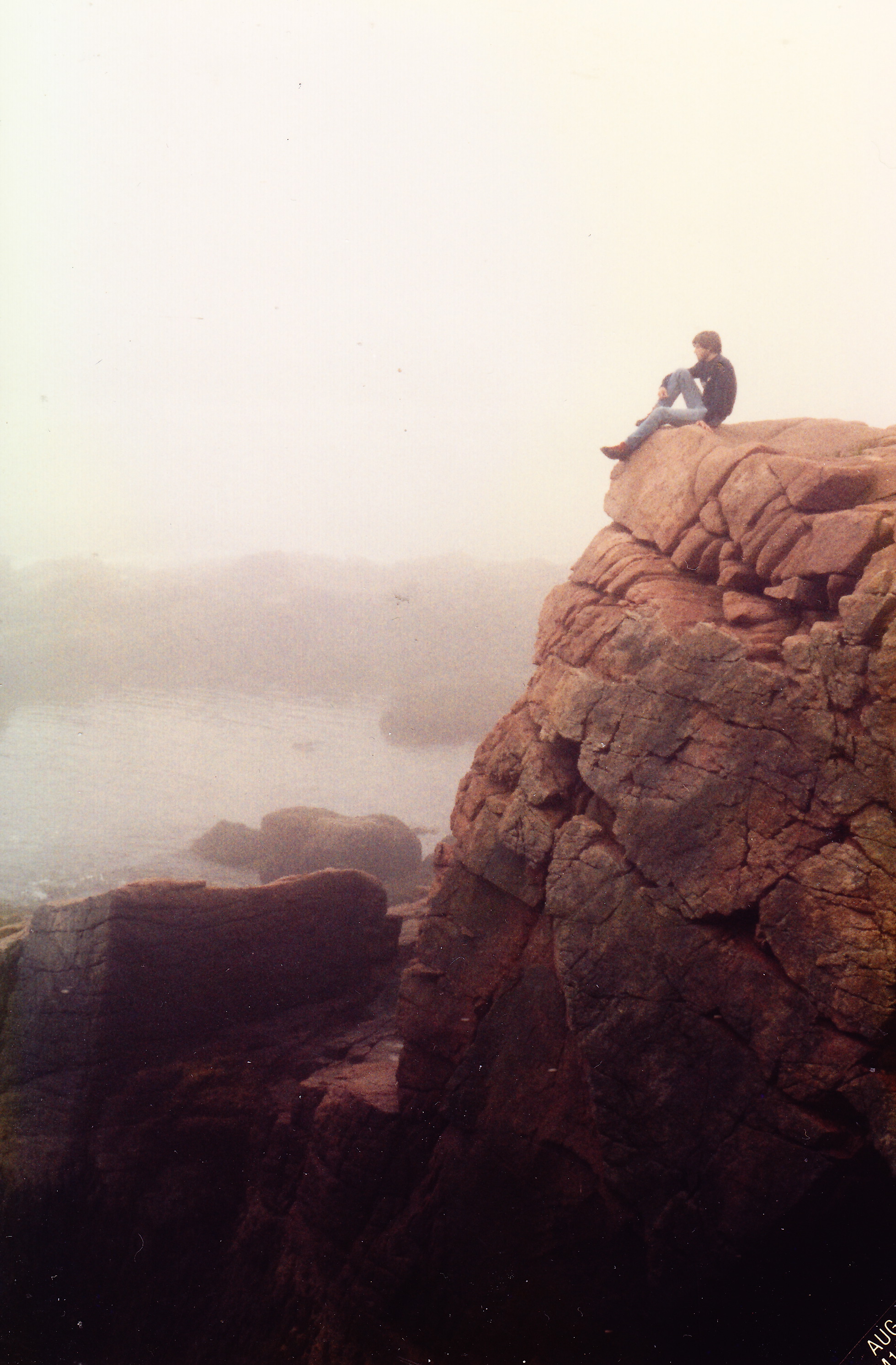
I’m not superstitious but it’s still pretty dusky when I go for my constitutional on cloudy days.  I was walking along thinking about Cernunnos, the way one does, when a black cat darted out of the underbrush and across my path.  My thoughts turned to witches.  Then a large toad jumped out in front of me in the half-light.  Perhaps it was because I picked up a booklet about witches recently, but this felt very uncanny to me.  There’s a place where the woods close in on both sides of the path.  The sun wasn’t yet up, and the clouds meant it wouldn’t have much mattered anyway.  When the bird calls stopped I began thinking about turning around and going home.  Nobody else was out this morning and although I don’t mind starting my day with the weird, I was thinking “not on a Wednesday.”

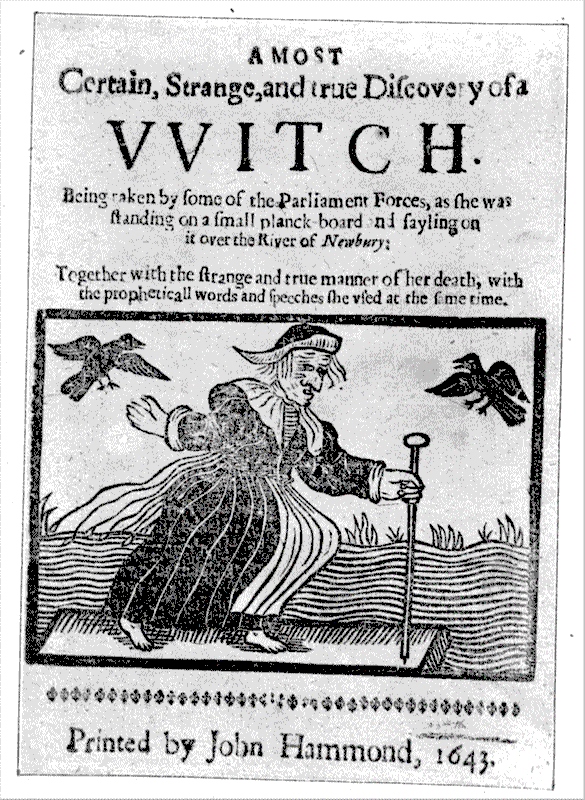
A thick mist lay over part of the path and I realized just how uncomfortable we tend to be when we can’t see clearly.  Despite that, and the black cat and the toad, I’ve never really been afraid of witches.  I guess I try to please people too much to think that someone might want to harm me supernaturally (at least among those who know me).  I recently found a booklet on witches—one of those strange impulse buys after being mostly house-bound for the better part of a year-and-a-half—that perhaps prompted my thinking this morning.  Although it seems to be most interested in earth-centered religions, it has an article about Salem.  Despite the more modern embrace of witchcraft in Salem, historically it had to do with human fear and hatred, a combination that is scary indeed when applied by those who are superstitious.

Cernunnos is a Celtic god generally portrayed with deer antlers.  Although lack of literature means we know little about him, he’s been adopted as the male counterpart to the female earth-goddess in some traditions.  Modern witchcraft is based on an orientation toward nature.  It’s kind of a ground-up religion rather than a top-down one.  Christians traditionally labelled it “Devil worship,” as they tended to do with anything they objected to.  Such demonizing helps no one, of course.  And when these ideas grow into superstitions people get hurt.  So I’m out here in the half-light because in the mornings days are shortening quickly and I have less and less time before work begin after the sun rises.  And I have witchery on my mind.


Not Precisely Superstition

It is quite fashionable, among some scientists, to equate religion with superstition.  The two, unlike religion and magic, are quite different.  They both involve belief, but, guess what?  So does science.  Superstition might best be summarized as traditional causality with no evidence, such as a black cat crossing your path causing bad luck.  Religion, on the other hand, tends to be a system of beliefs which, unless treated superficially, don’t look for causality as much as for meaning.  Superstition can be quite persistent.  It’s something that’s picked up in an ad hoc manner.  For example, I knew nothing of horseshoes growing up, apart from the very, very occasional game.  It wan’t until my mid-to-late teens that I heard my step-father say that an upside-down horseshoe was bad luck when hung on the wall of a building.

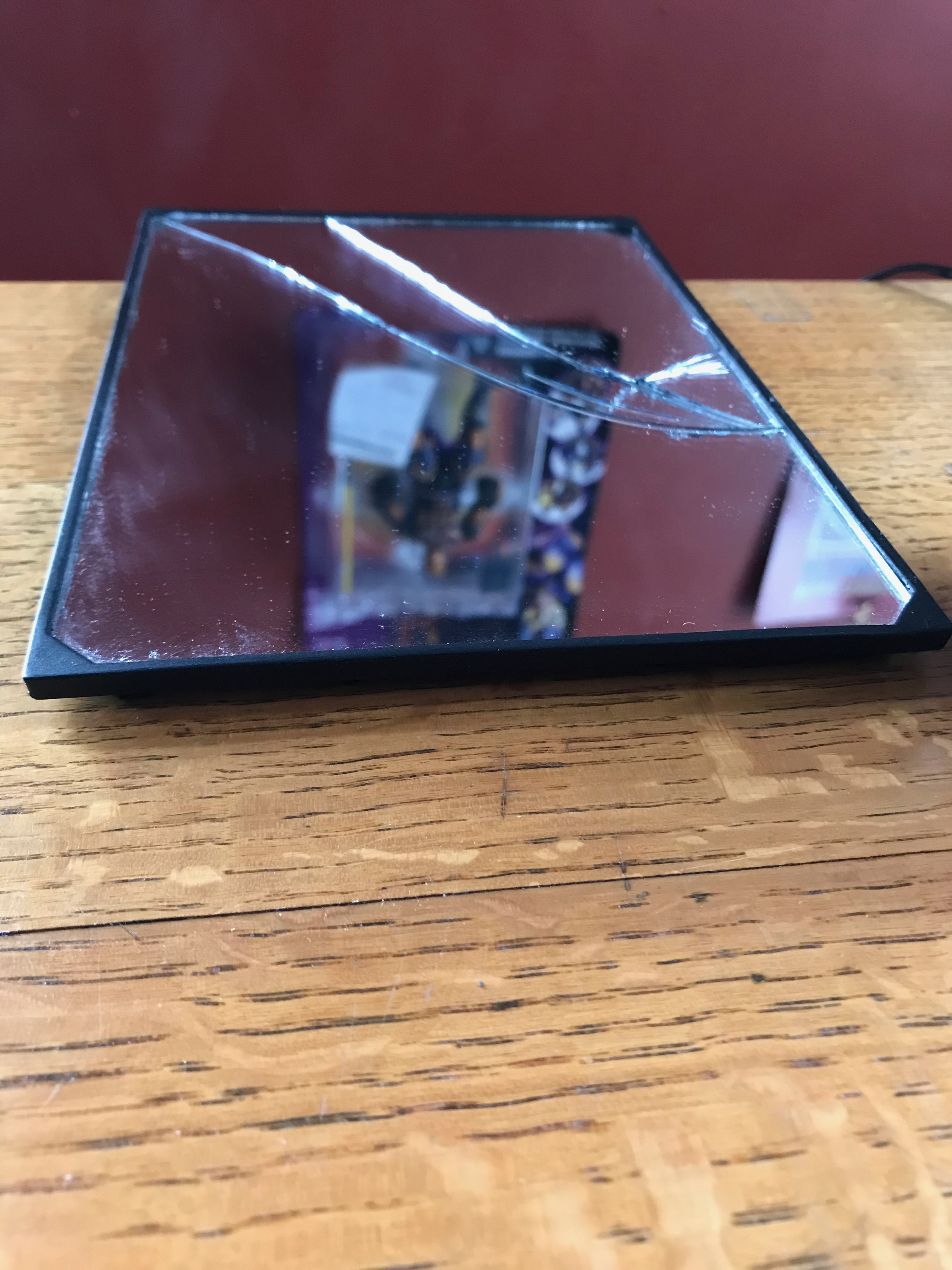
I had assumed that I had heard most of the relevant superstitions well before then.  I didn’t really believe any of them and they all seemed to be about luck, something I definitely didn’t believe in.  I was quite religious, after all.  I could tell the difference between religion—definitely true—and superstition.  Superstition was hearsay, or folk belief.  Never divinely revealed.  The thing about superstition is that it plants a doubt that never quite goes away.  Even if you didn’t believe it in the first place.  Say you break a mirror.  Seven years is a long time for bad luck to hit.  Any time something bad happens to you after said breakage, you naturally wonder.  Was it because of that mirror?

Good and bad happen to us all the time.  They are generally a matter of perspective.  A broken mirror means you may need to buy a new mirror, but it also means a seed a doubt will always be there for as long as you recall when you broke it.  You may naturally link the causality to the event, even when they have nothing to do with one another.  That’s the nature of superstition.  Some religions share some traits with this form of thinking, but entire systems or religion are seldom based on superstitions.  Black cats, mirrors, ladders, rabbits’ feet, four-leafed clovers—in what way would such things influence the world around them?  Yes, some religions attempt that as well, but many do not.  Like fear and religion, superstition has many overlaps but isn’t precisely the same thing.  Religion should be examined critically—it’s simply what humans do.  It shouldn’t be, however, be considered simple superstition.  Perhaps its bad luck to do so.


Al’s Rhythm

Algorithms.  Who can understand them?  I’ve been having some trouble with searches lately.  Not on the internet in general, but on specific websites (including this one).  While Sects and Violence in the Ancient World isn’t a particularly media-heavy site, I find it difficult to find images by searching.  For some reason, even when I put the title of the image in the WordPress search bar, it doesn’t always come up with the answer.  Well, given the time of morning I suppose I might’ve misspelled something.  Then I went to Amazon.  I’ve been working on my author page and wanted to update something.  I tried typing the distinctive title of my most recent book (Nightmares with the Bible—it is apparently the only actual book with that title [and titles can’t be copyrighted, in case you’re interested]) and found that it didn’t show up on the first three pages.  They were filled with books with other titles.  Algorithms.

Now granted not a lot of people seek the book on Amazon (I’m a realist), but if you type an exact, and unique title in the search bar and it doesn’t come up, isn’t something wrong with your algorithm?  (By the way, algorithm is one of the many words English borrows from Arabic.  It’s named after a ninth-century mathematician, al-Khwārizmī.  You could do worse than to have something so useful named after you!)  I’m not so naive as to think Amazon isn’t thinking to throw better selling books at you first—if you’re like others you’ll buy those before you’d consider shelling out a Franklin for mine.  But still, isn’t searching made easier when what you enter is what you want to find?

The internet’s primarily about selling you stuff.  Some of us look up sites for information or entertainment, but then someone tries to sell you something.  (I’m not trying to sell you my book here, by the way—it’s not priced for individuals, or even mortals—I’m not even putting a link to it on Amazon here.)  I’m just wondering why, if you tell websites exactly what you’re looking for they can’t find it.  You have to wonder if we’ve reached the level of too much stuff.  There’s a lot of sorting to be done and new webpages are added every day.  Even though I’ve been writing here a dozen years now, there are far older blogs and many more newer ones.  Finding things is an important exercise, and maybe if we sit down with al-Khwārizmī for a while, we’ll be able to figure something out.

Image credit: Gregor Reisch via Wikimedia Commons

Don’t Google Yourself

The internet has made us all less significant, in some ways.  Specifically I’m thinking about names.  “Wiggins,” when I was growing up, was an unusual surname.  In fact, people in Pittsburgh would sometimes send me clippings when a Wiggins appeared in the paper, it was so unusual.  Now with the internet I find plenty of Wigginses out there, and, in my case, several Steve Wigginses.  Not only that, but there are other academic Steve Wigginses, prompting Academia.edu to send me emails asking if I was the Steve Wiggins who wrote this or that article, often about agriculture or some other aspect of anthropology.  Who would’ve guessed?  There’s actually at least a third Steve Wiggins academic out there, an applied mathematician.  Perhaps there’s some mystical draw to higher education with a name like this?

But not so fast!  The most popular Steve Wiggins online seems to be the one who shot and killed a Dickson County, Tennessee deputy.  His act of violence, probably not for a Herostratic motivation, has nevertheless placed him in a pool of internet of fame.  So much so that a supervisor emailed me, jokingly, in June 2018, asking why I’d done it.  It’s difficult to build a good family name when some of us are going around shooting people.  A simple web search reveals that he is currently the best known Steve Wiggins in the country.  It could be because his trial was just last week, but still, but still…

One of my earliest blog posts here on Sects and Violence in the Ancient World was about the gospel singer named Steve Wiggins.  Prior to the murder of a police officer, this Steve Wiggins came to the top in any Google search.  To become well known you must release content.  In my world, which is small, that still means in print form.  Widely distributed.  And reasonably priced.  It’s clear I’ve got my work cut out for me.  The lessons we learn when we’re young have a way of staying with us.  It’s still easy to believe Wiggins is an uncommon surname—people still have no idea how to spell it—but the internet shows that’s just not true.  Even with both names there’s a significant number of both famous and infamous Steve Wigginses out there.  We all like to think we’re unique.  That we all have some kind of contribution to make.  Maybe mine is in the realm of horror movies.  Or Doppelgängers.  Only time will tell.

Who are you?

Mystical Trip

It’s easy to believe we live in a “post-Christian” world.  People aren’t tied down by Scripture strictures the way they used to be.  Sunday mornings are free for lots of people.  We don’t spend our time hunting for heretics.  One thing that might not be obvious, however, is that our underlying culture is deeply Christian.  Beyond mere assumptions, this goes down to the very presuppositions of the way we think.  While society might not be overtly Christian, it remains so at a deeper level.  I’m reminded of this when I’m out and about (which is starting to happen again) and able to hear, or overhear, people talk.

Grounds for Sculpture is a whimsical, fun space to visit in New Jersey.  It consists of acres and acres of a former fair grounds with sculptures of many different kinds scattered along the shore of a small lake on one end and a busy road on the other.  Many of the statues were designed by Seward Johnson, showing people in a wide variety of activities.  Since the displays change over time multiple visits are rewarded with new insights and displays.  It seems to be a popular place since pandemic restrictions have started to lift.  So much so that the usual seclusion that is part of the charm of a visit is somewhat stifled.  In a typical art gallery, the visitor has some space to reflect and contemplate.  The sheer number of visitors leads to a “wild animal in Yellowstone” situation where, if a creature dares appear, it’s immediately swamped by city-dwelling humans who’ve never seen a bear in the wild before.  This leads to some interesting overhearing.

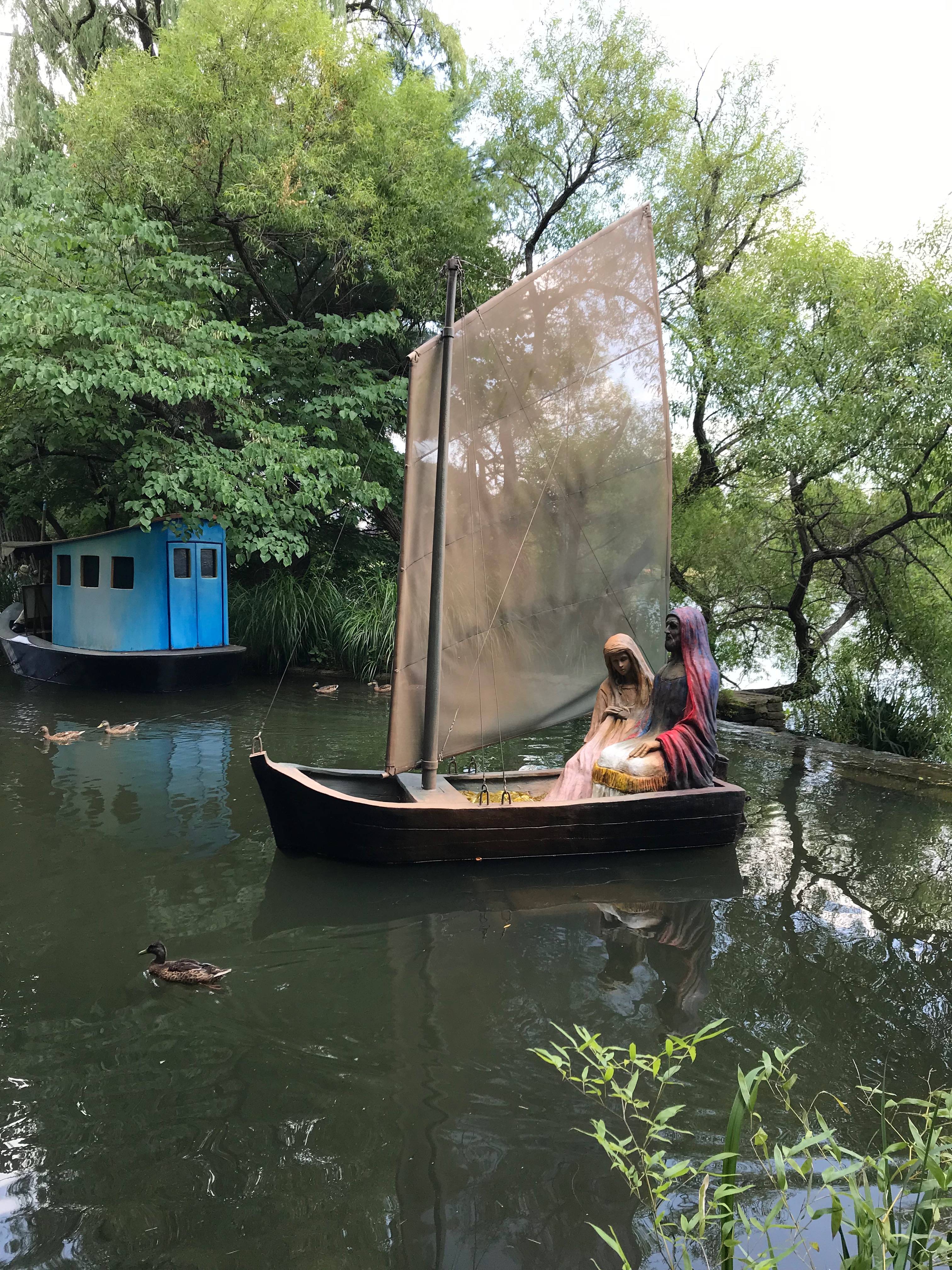
One of the sculptures I don’t recall having seen before is “Mystical Treasure Trip.”  It is a fantasy scene in which a couple, attired in what could be biblical garb, is sailing across the water in a boat filled with gold.  Perhaps it’s the dress of the characters.  They look like Mary and Joseph, perhaps fleeing from Herod, but with a boat full of gold.  Overhearing others commenting on what they thought it was I heard “they’re going to the ark.”  Admittedly, this is something I would never have come up with on my own.  Noah, according to Genesis, was six centuries old at the time and was commanded to collect animals, not gold.  Material for trading would’ve been pretty useless in a world devoid of other people.  Still, when our imaginations stretch for the interpretation of something we don’t understand, often they reach for the Good Book.  It’s its own kind of mystical trip, really.


Review Copy

You reach an age, or maybe a stage, where it’s difficult to recall details.  Too many emails about too many things and you just have trouble recalling where you read this or that.  Someone a few months ago, perhaps on this blog, lamented not being able to afford Holy Horror.  I wanted to let that person (or any other interested party) know it is now available free—for review—on Reading Religion.  Feel free to drop me a comment if you don’t know how to get this thing started.  When I was a grad student I learned about reviewing.  It was the way to get ahold of expensive books for free.  I’m no longer able to do them (conflict of interest), but I still think they’re one of the greatest perks for the literate.

Reading Religion does not require a Ph.D. to permit an interested party to volunteer.  Since it’s a religion site, many clergy do reviews.  If you’ve been talking to anyone about Holy Horror (and I’m just sure you have!) and they want to read it, let them know.  There’s nothing more embarrassing to have nobody wanting to read your book when it’s available for free.  Besides, reviews are how people find out about books.  Over half-a-million new websites are created each and every day, my friends.  We’ve got to help each other out!  I’ve been providing free content here daily for twelve years now—I need someone to review my book.  I know people are busy.  There are an estimated 1.7 billion websites, many with multiple pages.  Who has time?

I try to post about lots of books here on Sects and Violence in the Ancient World.  I know it’s not a frequently visited website (I’m a realist) but I know at least two publishers have taken blurbs from my words here to promote their books.  Those of us who read have to stick together.  Writing, to me, is how you pay back for all the reading you get to do in life.  It helps, of course, if people know about your books.  By the way, if you have an interest in religion at all you should check out Reading Religion.  It’s a great site to figure out what’s going on in books.  And you might even find something there you’d like to read.  I’d do reviews myself, but that’s no longer permitted.  I’ll put my thoughts here on this blog, though.  It’s only doing to others what I would appreciate being done back.


Phony

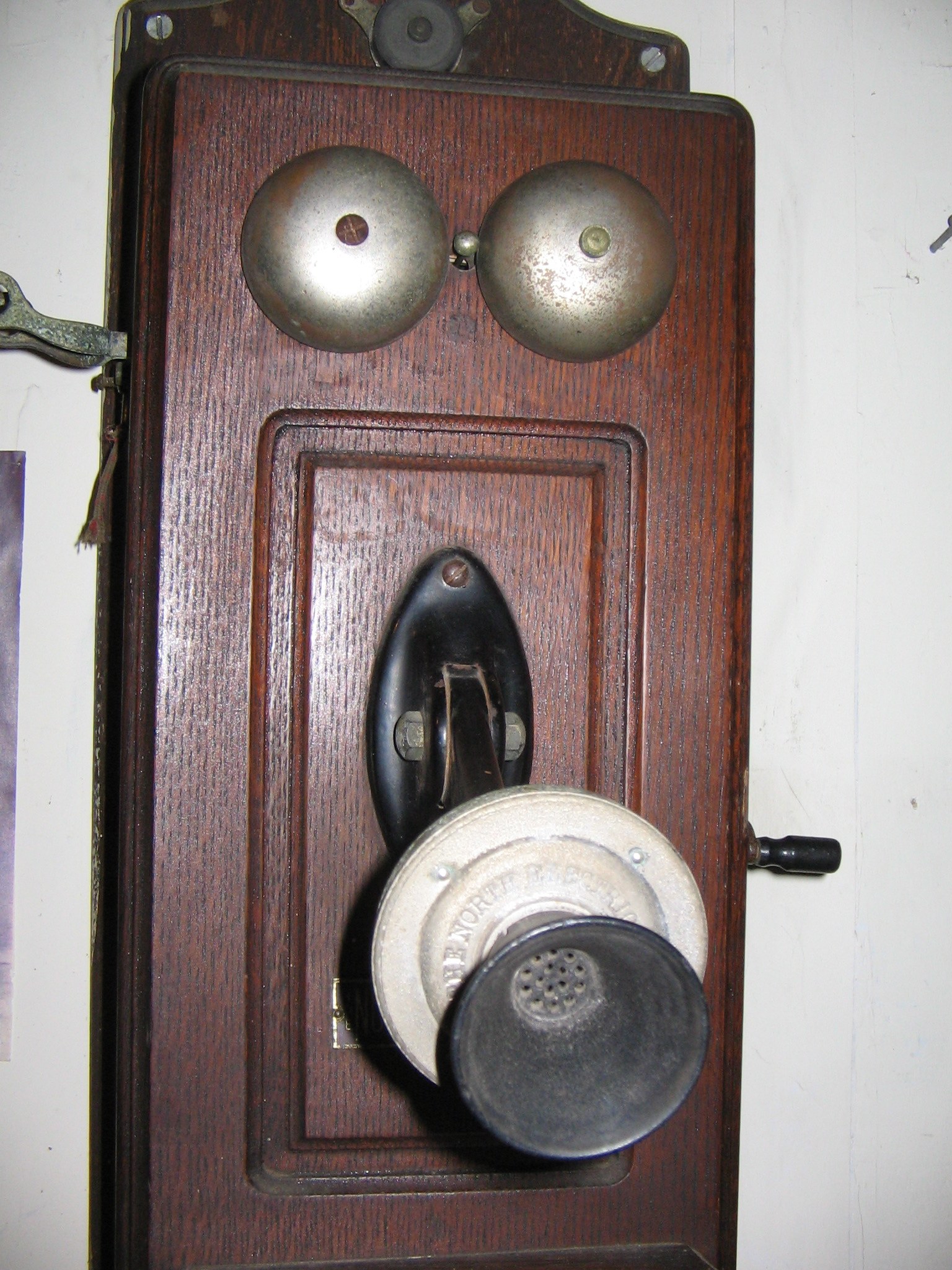
It happened right in the middle of a phone call.  The phone just died.  Well, honesty it had been sick for some time, but its departure was somewhat unexpected.  This is a landline we’re talking about.  Yes, I have an iPhone but I seldom use it.  Especially for phone calls outside the family.  I don’t want people calling me on what I consider a private number.  That’s what the landline is for.  Now, I had a call scheduled for later in the afternoon and I had to postpone it (via email—does anyone else see how strange all of this is?) until I could get a phone.  Since it was the work week the soonest I could get out was Saturday—I often have evening obligations after work.  So I ordered one online instead.

I was in a bit of a hurry, I’ll confess.  I don’t need a lot of features.  As long as it works for talking to others across a distance, I’m happy.  When it arrived I realized it didn’t have an answering machine.  Hadn’t thought of that.  The number of people who actually call me is quite small.  But if they are actual people I do like them to leave a message if I can’t get to the phone.  Then I remembered that answering machines used to be sold separately.  You didn’t need to have everything in one device.  Our modern way of living encourages that—keep everything together.  The phone in your pocket is a camera and computer and GPS all in one.  And more.  I’m more of a component guy.

Back when records were still a thing, my stereo was a component system.  Ostensibly because some components performed better for certain functions than others did, but really because some were on sale at Lechmere’s.  Nevertheless, the concept stuck.  I’ll admit that the all-in-one functionality is convenient, but I also think it becomes problematic when we have to buy more than we need just to keep up with the Joneses.  People are so reachable (with the exception, it seems, of many academics and contractors)—that we’re spoiled for choice.  In fact, it seems that the only polite thing to do is ask others how they’d prefer to be reached.  The telephone, of course, reaches into one’s private world in a way that email doesn’t.  I suppose that’s why many people are careful not to give out their numbers.  And if they do, we expect to be able to leave a message if they’re not home.


April Really Fools

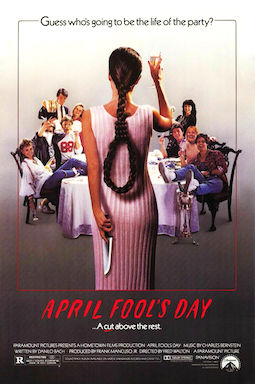
What’s the best kind of April Fools’ Day prank?  What about one that occurs nowhere near April first?  Actually, I’m no fan of practical jokes.  They usually come at the expense of someone and really aren’t that funny.  And where does that apostrophe really go anyway?  Still, because of a project I’m working on, and because it was available on a streaming service I use, I watched April Fool’s Day in July.  An example of holiday horror from the 1980s.  Although moderately successful at the box office, the movie never took off to become a cultural icon like, say, Halloween did.  In fact, I only recently heard of it.  Part of the reason, I suppose, is the ensemble cast is pretty large (nine friends together for a weekend) and none of them played by big names.  In case you don’t like pranks, there will be spoilers below.

The trope of a number of young people—often college students—isolated in some inaccessible location is common enough in horror.  The optimal number seems to be five, otherwise an hour and a half isn’t really time to get to know everyone’s character well enough.  Of course, one by one they get killed off.  Since it’s set on April Fools’ Day you’re led to think some kind of serial killer is loose on the island, but in the end the entire thing turns out to have been an elaborate prank.  Nobody has really been killed and the audience is on the receiving end of an extended practical joke.

As I try to catch up on horror movies I missed I quite often have to rely on those that come with one of the few streaming services I use.  When I was myself a college student I couldn’t afford to go to the movies often.  Home video hadn’t really become affordable yet to people of my economic bracket, and besides, I spent a lot of time studying.  As the only one in my family that watches horror, finding the time to do so remains a challenge.  And there is quite a backlog.  I’ve been trying to watch horror set on specific holidays as a way of keeping myself honest.  Even that can prove a challenge, however.  I can justify the time, however, and the somewhat modest cost, as research. Hey, somebody has to do it.  And that’s as good an excuse as any for watching April Fool’s Day in July.


Weathering the Sleep

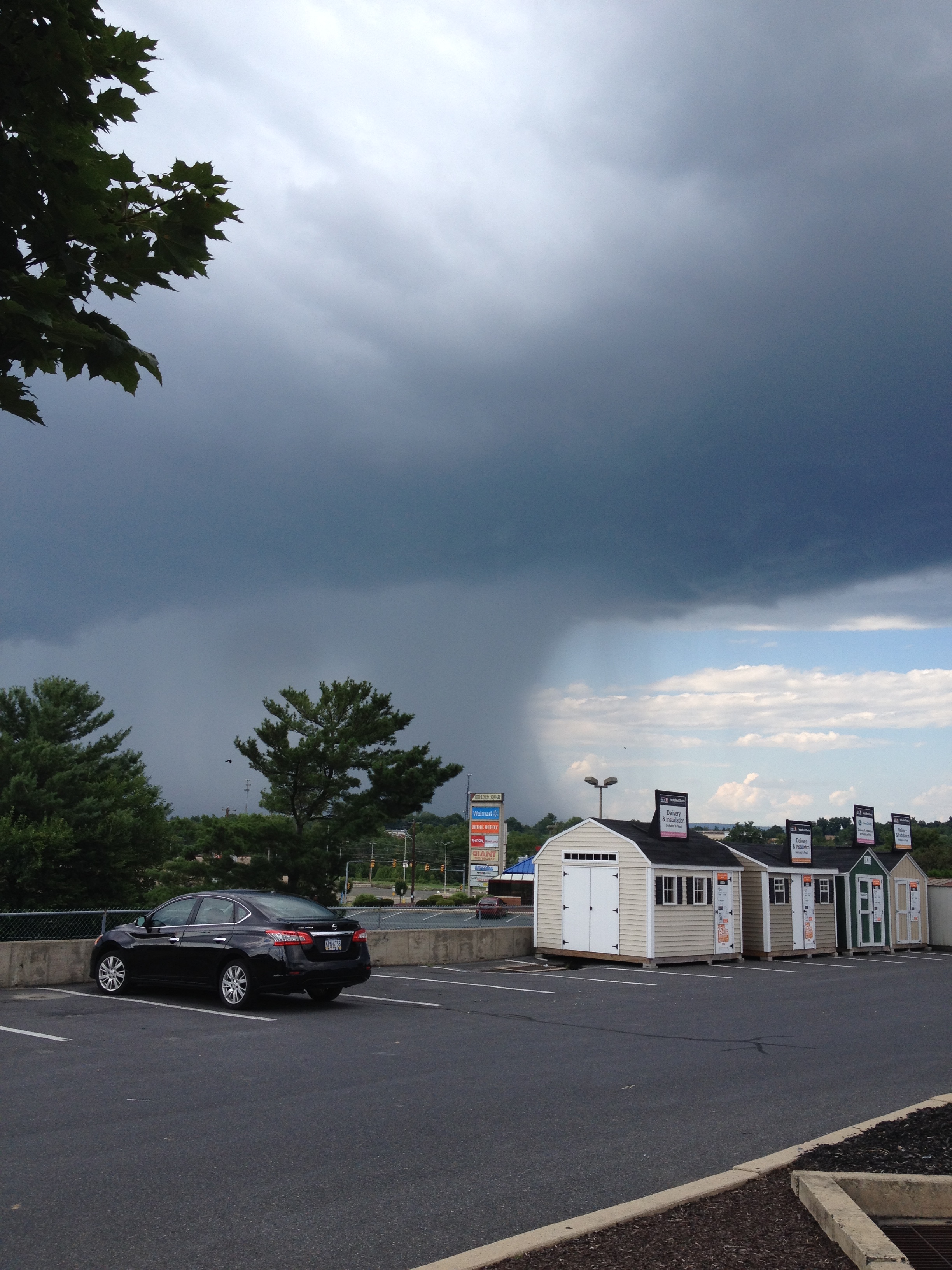
Weather still has a tremendous, if incremental, effect on life.  Patterns where a repeating weather cycle seems stuck in place are a good example.  While not exactly uncommon in summer around here, thunderstorms develop during the hot and humid days.  Our current pattern is that thunderstorms arrive in the middle of the night.  For days in a row.  We had a few days in our current series.  Some of us can’t sleep through thunderstorms, not least because we have to get up and close the windows, pulling fans out, so that the water doesn’t invade.  This means several nights of interrupted sleep and rather unforgiving work schedules the next day.  Companies don’t often take this fact of the weather into consideration.  I’m not the only one yawning all day.

Of course, other things interrupt sleep as well.  Any parent of a newborn has those perpetually baggy eyes that we’ve come to associate with trying to get an infant to sleep through the night.  Work doesn’t smile on that kindly either.  Both of these (and many others) are very real human concerns regarding slumber.  HR, on the other hand, looks at the clock with a frown.  This sort of work ethic is particularly bad in America where work is a kind of sacred obligation (unless you’re a minor, rich, or retired).  You owe that time, no matter how sleepy you are or sloppily you may work because of it.  In my case it’s the weather that’s been causing my drowsy days.  I guess I shouldn’t have given up caffeine a few years back.

Weather, although it’s treated as a “neutral” subject, affects everything.  There are deniers, but climate change is real.  It’s measured across centuries and millennia, however, and our point of view spans only the few decades of our own lifetimes.  We come again and again to the myth that this planet was created for us rather than the more factual realization that we grew organically out of it.  Our civilization is complex and grows more so all the time, requiring less and less time in nature.  Nature isn’t predisposed to be nice to us, or to any species.  It’s a matter of balance.  So it is with the weather.  This massive atmosphere above us seeks to balance itself out but we’re making it hotter than it should be.  Many suppose that God will sort it all out, if, indeed, forcing a crisis won’t compel divine intervention.  I just hope the “man upstairs” has been getting enough sleep.


Irony

It’s a funny old world, as the saying goes.  I don’t deal, as an editor, with many agents.  In fact, having been in publishing for nearly a dozen years it’s only happened three times.  The most recent agent is one to whom I sent a pitch for Holy Horror and from whom I never heard back.  The book he sent me isn’t too different from what I was doing in said volume.  That’s the way it goes, you say.  Indeed, I don’t disagree.  But who doesn’t like a dose of irony in an otherwise stainless steel world?  As I’m reading through the proposal I see that it cites the interest in the subject because of the great popularity of the Religion and Monsters sessions at the American Academy of Religion.  I was responsible for getting those sessions started.

Since irony loves company, none of the people I recruited to get that session rolling read my blog.  I’d been meeting with various scholars over the years and started to notice a common interest in religion and monsters, which I personally share.  I suggested to one of these gainfully employed scholars that we should apply for such a session.  She agreed and we invited another gainfully employed academic to join us.  I wrote the initial proposal.  The session was approved (the proposal being helpfully revised by my colleagues) for three years running.  Now it was being cited as objective proof of an idea that this very agent had dismissed when I presented Holy Horror to him.  Our society very much thinks having a university post means you have something to contribute.  No post?  No interest.

I’ve been working on religion and monsters for (conservatively) a dozen years.  I’ve written two high-priced books on the subject and I’ve received almost no traction in the field because I can’t put a university, or college, or seminary, behind my name.  I was formerly an associate professor, but who you are speaks louder than who you were.  Institutions speak even louder—much louder—than individuals.  The thing about privilege is that it works.  So in this funny old world I’m bemused to be watching my own idea helping propel a colleague’s case for an agent.  I’m working on my fifth book, and I sincerely hope this one will retail for less than thirty dollars.  That’s difficult to do without an agent’s intervention.  I know agents are swamped with proposals.  I know they’re very selective.  And I also know that the irony of being a biblical scholar interested in monsters will catch their attention.  Only, however, if you have an institution behind your name.  Funny, isn’t it?

Even the monster smiles

Byte Fragility

A few weeks back—context is always important—I mentioned how a storage drive slipped off my sleek laptop and went insane.  That is to say, it stopped working.  Unfortunately at the time it was the only backup method I was using.  And since my laptop forced me to move a huge amount of data so that it could do its regular updates, all my vegan eggs were in one basket.  (I feel like a bit player in this drama sometimes—it’s really the tech people who are in charge.)  There were literally years’ and years’ worth of data on that slipped disc.  Since then I’ve purchased two back-up drives and I’m backing up onto older discs and drives that are still readable.  It cost more than I care to confess to recover most of the data.  Some of it is gone forever.

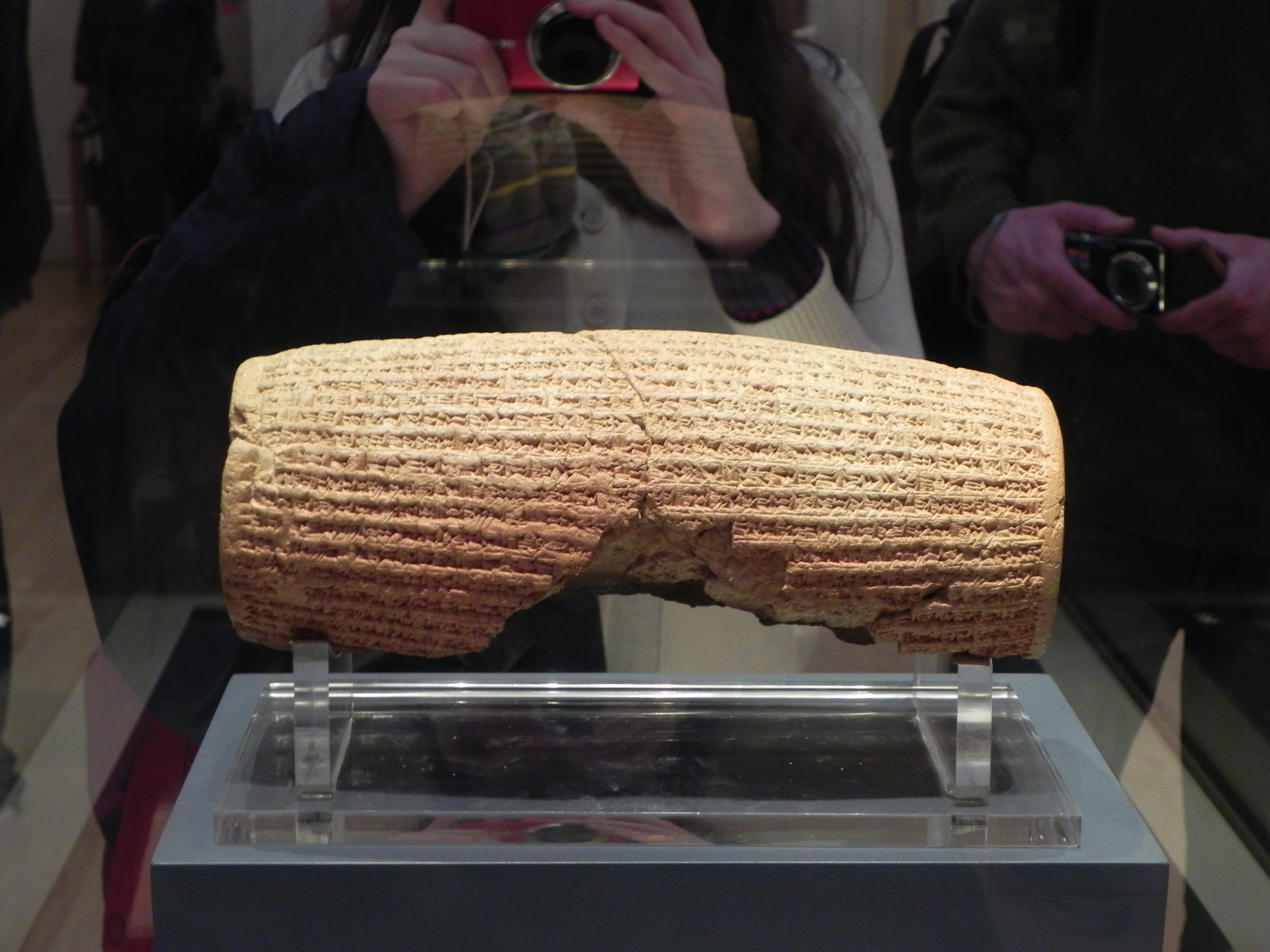
Although I can’t go into all the details here, the data recovery company I used—shout out to Tri-State Data Recovery—was able to recover about 99 percent of the information.  They were kind enough to suggest very solid-looking data backup systems so that a slipped disc could never happen again.  This all sent me back to my roots as an ancient West Asia scholar.  Scribes whose data still exists 4000 years later, simply got clay for free from the river.  The first writing material was the best.  I’ve quadruple backed up my recovered files now.  I’ve mourned some of the missing.  Still, I realize that if anything goes wrong I haven’t the technical skill to recover my ideas.  Or my photos.  They’re mere electrons.

I want to save trees.  I try to print only what’s necessary, but incidents like this reinforce my love of print.  Paper has its problems too.  Three years ago, when we moved into this house, torrential rains destroyed a couple hundred books in the garage waiting to be brought into the house.  Data were destroyed.  Granted, a flood can destroy clay tablets too.  In fact, if nature sets her mind to destruction there’s pretty much nothing we can do.  Just ask the dinosaurs.  Still, it disturbs me that all our data are so terribly fragile.  I write things down to be creative, but also because I can’t remember everything I want to.  If a drive falls off a slippery laptop not only does it make a sound, it also puts a dent in your bank account.  Down at the river bank, however, there’s clay free for the taking.


News Shipping

There’s no question that the pandemic has disrupted shipping.  It didn’t help that Trump basically tried to shut down the entire postal system so he could try to steal the election (which he instead tried to take by force on Epiphany), but shipping services still haven’t quite recovered.  I can’t help but wonder if it’s all the “middlemen” who’ve gotten involved.  I still buy things from the internet and if they’re not coming from Amazon they give you tracking numbers, sometimes for companies I’ve never heard of.  No matter whether it’s UPS or OSM, it always comes to the same message when you type in that tracking number that’s just shy of pi in length.  The package is awaiting USPS pickup.  I can’t tell you how many times that’s happened in the past several months.

Limbo is an old religious concept that seems to have been revived.  Your package simply can’t be found.  You can try the Post Office, but since they haven’t picked it up yet they can’t tell where it is.  Or you can call the company involved.  They’ll tell you the Post Office has it.  So you go stirring the alphabet soup of shipping company names while your parcel’s MIA.  I wonder if what these other companies do is go to the loading dock of the seller, get the package, then drop it off at the PO on their way home.  That sounds like the business to get into.  Why say you’re a shipping company when you’re just going to let the beleaguered Post Office handle it?  Because someone will pay you to do it, obviously.

We recently had a package that took three weeks from its drop-ship to UPS to get to the Post Office and finally here.  I stopped into the local PO and asked about this strange partnership.  The woman at the counter told me, “It’s the slowest way to ship, that’s why companies use it.”  Slowest, and therefore least expensive.  Never mind what they charged you for the shipping and handling.  Handling will cost you, you know!  Meanwhile I’m thinking maybe I should start calling myself by my initials and hire out my services to drop things in the local mailbox.  As a corporation I’d have greater protection by law than I would as a guy in his own car.  And besides, if I ordered something myself I’d be able to pick it up directly without having to wait for the tracking number to catch up.


Picture This

For a writer with limited time, a blog seems like a good idea.  Years ago WordPress emerged as the premier site on which to host such a venture—it was free (but like all things in the tech revolution it would eventually start charging a subscription fee), easy to use, and friendly to your average Luddite.  Now that I’ve been doing this some dozen years you might think that coming up with daily topics is the difficult part.  Well, it is a challenge sometimes, I admit, but the hardest part is coming up with images.  Occasionally I have an image around which to base a post, but the fact is I’ve discovered several blogs because I was searching for an image.  So I started putting an image in each post.  So far, so good.

WordPress has evolved over the years.  It has become more and more commercial.  After so much space is filled on your site (I pay regular fees for both the space and for the domain name) you must upgrade.  The next upgrade available to me is “Business.”  This blog is purely an avocation.  Any writer who doesn’t offer online content these days, at least according to the marketers and publicists I know, will never write a break-through book.  From my own experience, agents won’t even touch you unless you’ve got a far larger following than mine (and I’ve been faithful for a dozen years).  Anyway, I don’t want to pay for a business plan, so I reuse a lot of images.  That is the most time-consuming part of posting on this blog. 

You see, I post each day immediately before work.  To search over twelve years of images is difficult on WordPress.  Many of my images are my own, and my phone names them “img” (which autocorrect wants to make “omg”).  Searching those in WordPress to find a specific image can easily take an hour.  Considering the time these pieces are posted, you get an idea of when I have to start.  Good thing I’m an early riser!  My relationship with technology is an uneasy one.  I appreciate content.  Producing it is an act of pure creativity and it’s important to me to do it every single day.  But work is non-negotiable.  Metrics apply.  Consequences for not meeting them can be significant.  Where is that image I thought would be perfect for the post I wrote?  I should’ve renamed them before using them.  But just this moment, work’s about to start.  Now, what am I going to use to illustrate this post?

Remember the early days?

Rolling with Nature

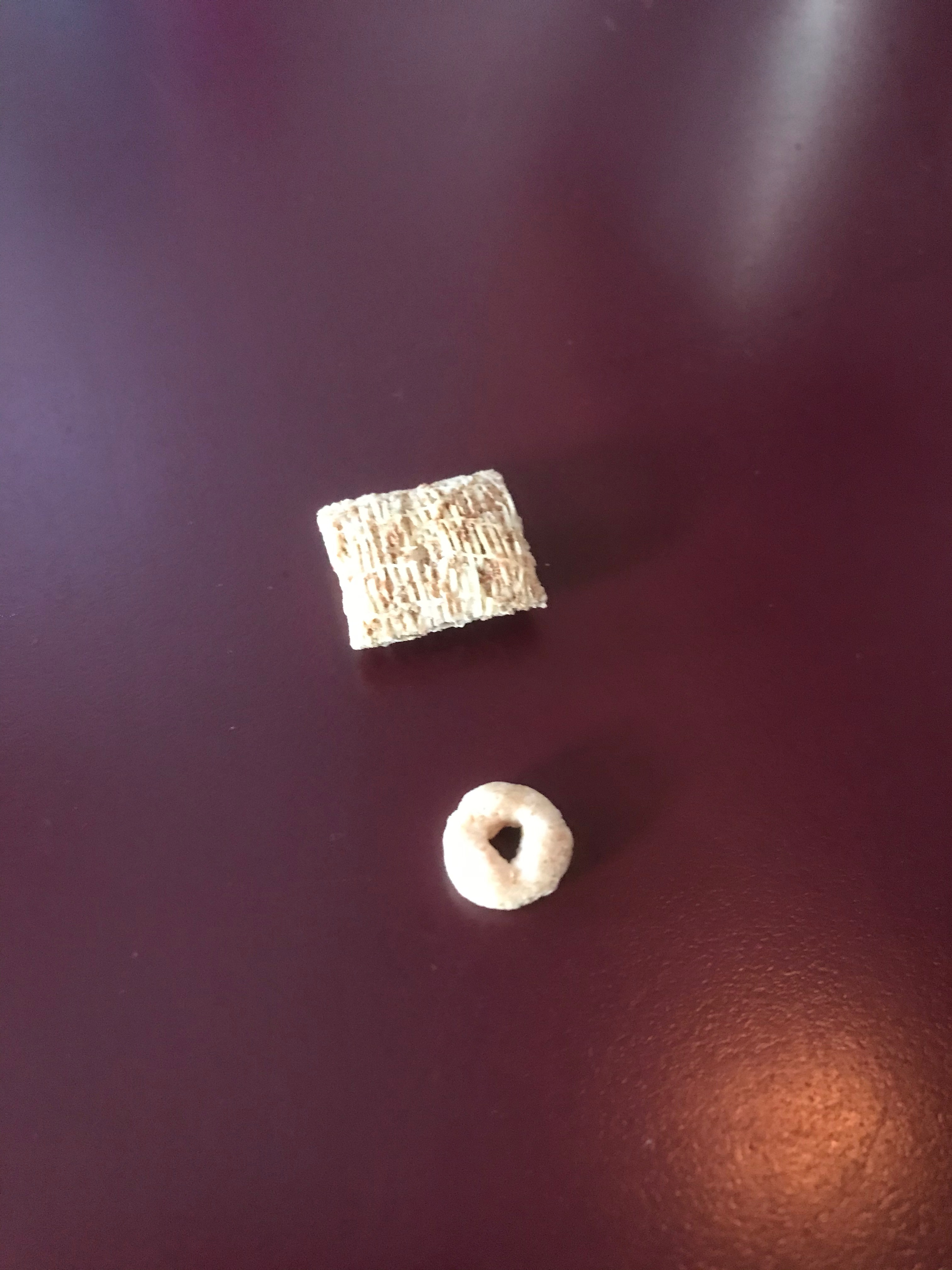
Even breakfast can be profound.  I’ve written before how our obsession with breakfast cereal was based one man’s religious conviction.  Now it’s widely accepted (whether true or not) that cereal is the healthiest way to start your day’s comestible experience.  Quite apart from that, it’s quick and easy and clean-up’s a snap.  The trick is finding healthy cereal.  Long ago I settled on a species of Shredded Wheat—the kind that comes in little squares.  Unadorned, it tastes fine and is more filling that a cereal puffed up with a lot of air.  (Breakfast is early for some early risers, and I need something to last until lunch.)  The Shredded Wheat model, however, benefits from extra flavor once in a while, so I try to blend in a different cereal (I experiment in the kitchen).  Lately it’s been Cheerios (originally named CheeriOats).

I’ve noted before that one of the fundamental issues with the tech revolution comes down to basic geometry.  The pixel is square but life on our planet is in the round.  You notice it everywhere natural.  Straight lines in nature are rare, but curves are everywhere.  This has practical implications while trying to pour two cereals at once (I told you I experiment).  The stolid, almost Episcopalian, Shredded Wheat does not pour easily.  It takes a bit of poking and prodding to get any action at all.  Cherrios, however, flow more naturally—more on the Pentecostal end of the scale.  As I mix my cereals in my pre-dawn laboratory, I began to understand something about life.  Square corners are superior for stacking and storing, but life wants to be round.  Organic even begins with an o.

The roundness of nature is everywhere evident: eyes, raindrops, plant stems in cross-section, even the great circular wind storms that blow across the surface of the globe.  Objects that are round roll and tumble easily.  Rough edges get eroded away.  The square is artificial, but useful.  It means that the pixel will never replicate the flow and ease of the organic.  Given the nature of pi, each circle is infinite, in one of nature’s greatest paradoxes.  We are the denizens of a spherical world.  Our planet shows us the way to exist upon it, in harmony with the other organic, circular beings.  I linger before I pour the oat milk.  A revelation before breakfast is never a bad thing.  It’s only too bad that after this, the rest of the day becomes artificial.