Virtual Church

All the way back in seminary my friends and I used to joke about virtual church.  What made it so funny was that the idea seemed ridiculous.  The very raison d’être for church (which essentially means “gathering”) was, well, gathering.  We joshed about putting a communion card into an ATM and getting bread and wine.  Little did we know we’d live to see virtual church become a reality.  While I prefer not to tip my hand as to my affiliation (I began doing this when teaching at secular schools, for if a professor of religion is being academic about their specialization their affiliation should have no bearing on the class) I confess I am the member of a religious community.  That community has become virtual, as of today.
This isn’t a permanent thing.  Unless coronavirus is a permanent thing.  As I spoke with my clergy person about it, I wondered how many people would attend virtual services.  Sermons would need to be stellar.  Who would hear if I tried to sing hymns (this is not a pretty thing, take my word for it)?  My laptop doesn’t even have a disc slot into which I could insert my offering.  Churches, synagogues, mosques—they’re about community.  What does community feel like when you’re sitting there in your pajamas, at least on the part that the webcam doesn’t pick up?  Does the minister see you in virtual church?  Have I, like number 6, been reduced to a numeral?  I suspect the current crisis is going to be a real test for faith communities.  Meeting together would make us all feel like snake-handlers now.

The funny thing was, back in seminary it was a joke.  At Boston University School of Theology in the late 1980s we knew that churches weren’t really growing.  Some megas had started and we now see them following the mushroom cloud to its dissipation stage.  As little as we meant it, we could see devices creeping into the mix.  I did not use a computer until after seminary.  Funnily enough, thinking back to the pre-1990s, we survived without cell phones.  If you were going to church you were going. To. Church.  These days of pandemic in the pews will be a real test of the preacher’s power.  For Episcopalians the mediating of grace had to be done in person.  I remember watching worriedly as the priest, clearly with a sniffle, was the first one to take a sip from the community chalice before holding it out for others to drink.  We wondered about efficacy of ATMs dispensing consecrated hosts.  It was only a joke, then; really it was.


Travel Ban

I’m not at home.  I know in the current crisis that sounds like heresy, but I can honestly say that getting out of the usual routine where COVID-19 is all you hear about feels right.  More and more organizations are instituting work from home policies—many of them mandatory.  I’ve worked from home for going on two years now.  You need to get out a bit.  I know travel isn’t recommended, but I’m really not afraid to die.  Besides, I put a box of latex gloves in the car and when we stopped for a restroom break, wore them until they could be safely removed.  Exposed surfaces in the rest area were being continually wiped down.  Don’t get me wrong—for an introvert like me working at home is fine.  It’s just the idea of feeling like this virus is some zombie apocalypse happening just outside my door that I needed to dispel.

When I told a friend I was no longer going to be commuting on a regular basis he said if it were him he’d only ever buy sweatpants again.  Now that my reality is life with my wife being the only person I regularly see, I’m beginning to realize just how much our clothes purchases are for impressing others.  My haberdashery is akin to that of Henry David Thoreau; I wear clothes until they’re no longer functional.  They can be badly out of date but they still work.  The fashion industry is built on pride.  To put it in the words of my old friend Qohelet, vanity.  We want others to see what we’re wearing.  If we’re still donning last year’s gay apparel we’re not playing the game.  Never mind those of us whose wardrobes could be carbon-dated.  The pandemic can be revealing.

So I’m away from home for what is really the first time in months.  I had to stop in the grocery store for a few things.  Only one person I saw was wearing a mask, but I was wearing prophylactics, so who’s going to cast the first stone?  Many shelves were bare.  The CDC has become our new gospel provider.  I’m limiting my outside exposure.  Driving door to door, greeting no-one along the way (that actually is the gospel, but substitute the walking for the driving part).  I know when this weekend’s over I’ll be back to my cloistered existence as the rest of the world tries to get used to the loneliness of the sweatpants crowd.  If you’re one of them take it from me—the rest of the world is still out there.


Merch

I recall the time I first heard the word “merch” used as a verb.  I was with some wonderful ladies on the second annual Women’s March, in New York City.  We had to leave fairly early to get there from Jersey and as we made our way to the march route, we saw the goods.  Vendors had all kinds of things on sale, from the ubiquitous tee-shirt to refrigerator magnets.  One of the women in the group said, “I guess you can merch anything.”  And so you can.  People will buy all kinds of identifying marks.  It’s a craze I personally don’t get into.  I buy plain clothes, having more of an Amish aesthetic.  Still, I was a little surprised to notice that the Society of Biblical Literature is now merching itself.

Now, who can blame a non-profit for trying to score a little on the side?  We all know what that’s like.  What I find myself most curious about is who would want to advertise that they’re working on a degree that will, in all likelihood, find them on the breadline when it’s all over?  I’ve known many who’re proud to be nerds—they’ve got employment to give them creds.  Those of us tormented by the meaning of it all, not so much.  My decision to go to grad school was accompanied by the blessed assurance that there’d be plenty of opportunities, but there was no merch.  Indeed, I was two years into my doctorate before  I even found out what the SBL was—the great connector whence came jobs.  At least in theory.  I found my post at Nashotah House because a friend told me about it.  I still have some of their merch.

Knowing what I do now, would I have done it any differently?  It’s difficult to say.  Who can recall the frame of mind of his younger self with such clarity as to know his choices?  Having studied Bible I was curious whence it came—to turn back even further the pages of history.  As I sit here in the early morning I have on my last two remaining pieces of Edinburgh merch.  My moth-eaten woolen divinity scarf and my blue alma mater sweatshirt.  I try hard not to think how close to three decades ago it was.  I was so sure I’d find a job with that rare Scottish degree, imprint of John Knox’s breeches still fresh upon my head.  Instead the merch of my current employer—a coffee mug—stands before me, reminding me that work alone awaits.


See Index Saw

Too much of my life is taken up with indexes.  If life with technology is a teeter-totter, then my generation stands just above the fulcrum.  There are guys with whom I attended college who maintain no internet presence at all.  I’ve repeatedly searched for college buddies and come up blank.  Those in the decade following mine, if they want to work, have pretty much resigned themselves to tech.  Those in the decade before, not so much.  What does this have to do with indices?  Plenty!  You see, in academic publishing, and its consequent research, you need to look stuff up.  If you read multiple books on the same topic you’re not likely to be able to pinpoint a page number without an index.  You remember you read it here (you think) and so you stick a finger in the back and begin checking out the pages referenced until you (hopefully) find it.  That’s the old school way.

I’ve typed my fingers down to the marrow trying to explain to guys my age and older that the average academic no longer uses a print index.  Just about everything has been digitized.  Although I’m no fan of ebooks (I very seldom read them) looking things up is sure much easier with a searchable PDF.  Type in your search term and voila—an easy list of references appears that can be quickly clicked through and checked.  And yes, my colleagues, that’s what people are doing these days.  I lament the decline in print books.  When I set out to write a book I have a physical object in mind.  It has pages and a cover.  A spine.  I am writing a book, not “content” to be “exploited” in “multiple formats.”  And yet, the index is really no longer necessary.

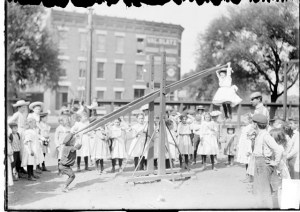
The typical academic author whose book is at the production stage fusses greatly over the index.  Calmly I explain that indexes are very rarely used.  They must have detailed indices, they insist.  The thing about teeter-totters is that they move.  I have an inner-ear problem.  As a child this prevented me from doing the usual playground things like swinging and seesawing and spinning, to different degrees.  I still can do none of those things well.  My wife and I bought a gliding rocker early in our marriage, that seats two.  We quickly learned that I couldn’t rock with her.  Indexes, you see, are on one side of that long board.  It’s the side on which the heavy weight of time rests.  So ponderous is it that the kids on the other side just can’t get it off the ground.  And I spend my days over the fulcrum trying to get the two sides to play nice together.  Without rocking the thing too much.

Photo credit: Chicago Daily News, via WikiMedia Commons


Leaping Years

Maybe it’s just me, but February seems long this year.  Wait, it’s leap year!  But that doesn’t explain it all.  Today may be a gimme—another day in what has already been a long year—but the calendrical weirdness began with the dates of our moveable feasts last year.  Thanksgiving fell as late as it possibly could—November 28.  Since it is the fourth Thursday of the month, and the latest fourth of any day is the 28th, there can never be less time between Thanksgiving and Christmas than there was in 2019.  For those of us who measure time by the days off work we’re allotted, the holiday season felt rushed.  And since New Year’s Day fell on a Wednesday, HR departments all over were scrambling to figure out how to make it a long weekend.  Wednesday is the Easter Island of holiday dates—too far from land to reach any second day.

By the time we could kick up our heels for a weekend it was already two work days into the new decade and business really began in earnest only on January 6.  Epiphany, according to those who follow circumcision-style New Year.  January ended on a Friday, and had this not been a leap year, so would’ve February.  A month with 28 days, after all, is a proper lunar-based one.  The other months were lengthened to stoke the egos of emperors and others who thought they were lords of time as well as space.  But this year we’ve ended up with an extra day of February.  I want to use it well, and as I look at my list of things to get done on a weekend (generally far longer than my list of things that I accomplish in a work week), I begin to think maybe this should be a holiday (and I don’t mean that sexist Sadie Hawkins tradition).  But it’s already a weekend, so HR’s off the hook.  This time.

We could use a few more holidays.  Every January I look at the sparse allocations of days off for the coming year.  There are normally ten of them, spread unevenly across twelve months.  There are long spells when, if you need a mental break from work you have to cash in precious vacation days.  Leap years make the total number of days even longer.  You get an extra work day but not an extra holiday.  Our lives revolve around our special occasions.  Yes, there’s not really a “holy day” to correspond to the necessary intercalary day to help us keep up with the sun.  Still, it feels like a missed opportunity to me.


Icelandic Gods

There’s a lot to like about Iceland.  It has geothermal heat.  The people are literate and proud of it.  They don’t have an army.  Viking heritage and northern lights—what an interesting place!  A friend recently sent me a satirical piece on Patheos titled “Iceland Declares All Religions Are Mental Disorders,” by Andrew Hall.  I may not be as naive as I once was, but I have to admit I was nearly taken in on the fly.  Maybe because the idea seems so much better than what we have over here in our warmer, but less educated world.  Clearly, however, religion is extremely important to people, and if it is a mental disorder it’s an essential one.  Hall mades the astute point that Iceland didn’t want to become like the United States.  Who would, at this point?

Although this is a satirical piece, like most satire it works because it has chunks of truth in it.  Countries run by religions do seem to get into quite a lot of trouble.  I often think this is primarily a monotheistic problem.  If a nation accepts many gods, then adding those of other peoples is hardly an issue.  With a single deity, however, there is a single truth.  Anyone different is, by default, wrong.  When entire nations self-identify with a religion, it is only too easy to begin seeing those who believe differently just across the border as a threat.  Faith becomes fight.  As if a deity who always claims to value peace is only satisfied when we’re killing those who don’t share our same peaceful outlook.  Irony and satire have met together, it seems.

I’ve never been to Iceland.  It’s on my bucket list.  As a rockhound, the volcanic nature of the place calls to me.  I do wonder, however, how a vegan might fare on a far northern island.  My times in Orkney are among my mental treasures.  Those northern Scottish isles were places of wonder.  Not the most options regarding comestibles, however.  What they lacked in food they made up for in magic.  Iceland, despite the satire’s bite, has a considerable population that believes in the little people.  Anyone who’s too quick to dismiss such things ought to spend some time in the far north.  Driving to the ancient sites of Orkney certainly shifted my perspective a bit.  There’s great value in listening to the wisdom of those relatively isolated from the rest of the world.  You might, however, have to bring your own beans.


Caesar Salary

Juxtapositions interest me.  Washington’s Birthday and taxes have become connected in my mind.  Until the present administration I had no serious concerns about taxes; if people are going to live together they need to pool their resources.  If I had a choice now no Republican would be able to lay a dirty finger on my hard-earned contributions, but I know we all use the roads and bridges.  Some of the money actually goes to useful things.  I wonder what George would’ve thought of it all, though.  His birthday is a holiday, but employers have sent out their tax forms and so it’s become a kind of day of reckoning for me.  I used to be able to calculate roughly the right amount to be withheld so that I’d get a small return each year.  Tax laws being what they are, however, that has changed rather drastically.  I leave February feeling poor and cold.  And I don’t approve of how they spend most of our money.  Still, a day off work is a fine time to visit my accountant.

The mind of the Human Resources denizen is an odd place of rules devised by no god.  I never know from year to year whether “Presidents’ Day” will be a day off or not.  I remember standing on a wintery street corner waiting for the 114X into New York because the 117 didn’t run on federal holidays.  HR had decided that year that we wouldn’t have this day off.  Like the government, Human Resources has the ability to implement laws that make no sense.  I do appreciate the fact, however, that someone understands how medical insurance works.  For that you need a specialist.  Another strange juxtaposition.  In any case I’ll visit my accountant today and it may be the only time I’ll be sweating in February.

Adulting, some of the young say, isn’t much fun.  It has certainly become a lot harder to understand.  Our government complicates things to the point that you daren’t do your own taxes.  A visit to the doctor may or may not cost you.  And don’t even bother to try and find out where all that money you send to Washington’s going.  I just hope that when I get on the interstate that it’s maintained.  And that they keep an eye on the bridges.  If they don’t I won’t be able to get to the accountant’s office to be able to pay more taxes.  On Washington’s Birthday it’s in the best interest of the powers that be to keep the roads open so that we can send them our unholy tithes.  Strange juxtaposition, it is, between Washington and Lincoln.

Render unto Caesar


Stickiness

As a concept, it’s what web designers call “sticky.”  Valentine’s Day, I mean.  And “sticky” has nothing to do with the expected chocolates or anything physical at all.  Stickiness, as I hear it used in these antiseptic clean-room days, refers to text, or an object, that stays in the same place as you change web pages.  Now, I’m no techie, in fact I’m probably a neo-Luddite, but this kind of stickiness is useful in thinking about St. Valentine’s Day.  We hardly need a reminder that humans are sexual beings.  Biology does quite well in that department, thank you.  Every year around this time, however, when the weather has been bleak for weeks on end, Valentine’s Day rolls in to give us hope.  I’ve noticed this as I’ve been out jogging.  The past couple of weeks the birds have been singing.  Me, I’ve mostly been shivering indoors as yet more cold rain falls.

Every year, I suspect (I haven’t stopped to look) I write about St. Valentine’s Day.  Valentine was an obscure saint associated, in the popular mind, with something saints shunned.  Such an embarrassment is this sexy saint that he was never mentioned in the liturgy of February 14th at Nashotah House in the days I was there.  (Given that most of the student body was male, there may have been a wisdom in that, but that’s a story for another time.)  Religions, as I used to tell my students in later settings, all have something to say about sex.  The two ideas, like monsters and religion, are tied closely together.  Scholars tend to blush rather than explore this.

There are so many things going on in the world that I could write about.  There are new scholarly developments every day.  Still, I keep coming back to this minor holiday.  Well, it’s not actually minor in the realm of economics.  Anything to get people to spend money in the middle of February!  Valentine’s Day is the embarrassing child of the celibate church.  Without somebody named Valentine, who may or may not have been martyred,  we wouldn’t have this uneasy reminder of winter’s impending end.  Instead of embracing him, however, many branches of Christianity second him to punch-out cards sold to school kids as teachers remind them that everyone gets a valentine.  What a sticky concept!  I’d been intending to write something about the state of the world.  I guess that can wait for another day.  Right now, as the sun begins to awake, I’ll sit hear and listen for the birds to start their sticky springtime song.


For the Squirrels

Our garage came with a house.  That’s one of the reasons we bought it.  You see, the one thing we don’t have is time.  (Well, that and money.)  When we were contemplating moving, we had no time off.  Vacation days for the remainder of the year had been allocated, and employers don’t like to encourage personal improvement.  Not on company time, anyway.  Which, of course, is as it should be.  We had to find a house with space enough to sort through things after we moved.  Ha!  As if there would be more time!  Still, the sorting would have to wait.  Our house has a detached garage with a second story.  It’s a converted barn, but I doubt its conversion story.  It still seems pretty heathen to me.  The neighborhood squirrels love it.

We store our unsorted stuff upstairs.  Shortly after we moved in, the squirrels had chewed through the stop-gap remediation the previous owners had put in place to satisfy our post-inspection demands.  It was pretty clear their solution wouldn’t keep out rodents, but our lease was about to expire and the market favored sellers, so we closed anyway.  Shortly after moving in I noticed styrofoam poking through the ceiling boards of the garage.  Then I began to find styrofoam chips in the yard nearly every morning.  I soon figured it out.  Squirrels raid the trash receptacles behind restaurants in town, and bring their carryout here.  No, seriously!  They haul styrofoam between the roof and ceiling, presumably licking off the scraps before tossing out the remaining foam.  I figure it’s a form of insulation, if nothing else.

Squirrel remediation is on our list of projects.  I’ve seen the squirrels run up the side when they spy me stepping outdoors.  When I reach the garage, they’ll stick their little heads out the hole they chewed and scold me.  This is their place, the garage.  They’ve insulated it, and the inside is a mess where the birds also get in and there are little animal parties every night.  I don’t have time to clean up after the squirrels.  It occurs to me that if we didn’t have a throw-away culture we wouldn’t have styrofoam containers for the poor beasts to plunder.  The food’s probably not healthy—the squirrels I see look plump and sassy.  They like the convenience of living in a shelter someone else built and on which someone else pays the taxes.  Perhaps I should start a zoo.  But first I’ve got some stuff to sort through, when I find the time.  If only I could teach the squirrels some other tricks beyond dining out. 


Voice of Experience

Trust your publisher.  Well, if you have one, that is.  I’m not the only erstwhile academic to have ended up in publishing, but what constantly surprises me is that academics care little about those who give voice to their ideas.  Now this blog is self-publishing.  It contains my ideas, but they are free for the taking, and here’s a bit of useful advice: trust your publisher.  These days with easy online publication and formatting that makes your posts look like a pro (not here, mind you), it’s sometimes difficult to realize that publishers actually provide more than just an imprint.  They offer services to make your book look serious, scholarly, and also to be useful to others.  Those of us who write books are often far too emotionally involved to see this.

I regularly run across academics who tell publishers how the text should look on the page.  I’m not talking about those weird and wonderful sections of ancient texts with <lacunae>… ellipses… [brackets] and whatnot.  No, there are those who want to control kerning, leading, and all sorts of things.  There are those who want practically every single word indexed, although research shows that most researchers access searchable PDFs rather than wasting their time thumbing through pages to find a reference.  And that traditional chestnut, “written for general readers.”  Publishers have access to book sales figures (at least of their own books).  There’s no need to bluff; if your book is only for scholars (does it have words like “reify” or “heuristic” in it?  Be honest now!), publishers know how to handle that.

We’re all nervous when our book gets through the acceptance process.  Peer review always breaks me into a cold sweat.  Believe me, we understand!  Take a soothing sip of tea.  Go for a walk.  Better yet, jog.  Scholars tend to be precise thinkers.  We get that.  When, however, is the last time someone used a map from a Bible for navigation?  Most of those cities don’t even exist any more!  This strange mix of online savvy and adherence to the old ways of print (which I love and of which I shall never let go) clash in ways that cause publishers great stress.  You can find a YouTube video on how to make your own book.  Those of us in the biz can tell at a glance if a book’s self-published or not.  And believe me, we’re rooting for you.  We want your book to succeed.  Why not trust those who know what they’re doing?


Vulnerability

Perhaps the most insidious thing 45 has been doing is undermining expertise.  If you’re like me you’ll be subject to that sudden, clenching fear that we live in a house of cards.  Everything is built on an extremely tenuous situation and we don’t understand the basis on which it’s built.  (That’s one reason I take such an interest in geology.)  So this morning I climbed out of bed around 3:30 a.m., my usual time.  There was no internet.  This has happened before, and I know enough to turn off power to the router and reboot.  This I did several times before finally calling RCN.  I pictured a tech sitting in a lonely basement at the wee hours, perhaps glad for a service call.  He was very nice.  Still, after having me do the basic checks again, he said he’d have to send a technician.  They, lazily, don’t start work until 8 a.m.

Now here’s where the expertise comes in.  Most of us use the internet pretty constantly.  We don’t know how it works, and when it’s broken we can’t fix it.  I can’t even figure out what some of these devices are.  In all likelihood the technician (my shining prince or princess) will not understand the underlying coding that makes the devices work.  They’ll be able (I hope, and if you’re reading this my hope is not misplaced) to figure out what’s wrong with the hardware.  I suspect even they, however, wouldn’t be able to lay the cable to my house, or repair it, if it were damaged.  We all rely on others farther down the line to know how to do their jobs.  Experts.  House of cards.  With a president claiming experts to be obsolete, I wonder how even the mighty could tweet without an internet connection.

All of this makes me feel quite vulnerable.  I work from home and I need a solid, reliable, steady internet connection.  The day we moved in, literally, two techs came.  It was a Sunday morning.  One of them fell asleep in the office chair while the younger one, who spoke no English, did all the work.  Every time I use the internet, I feel like I’m trying to add a new story to this house of cards.  I don’t know what to do if it goes wrong.  Since phone (and television, at least theoretically) is bundled in this, I can’t even call.  Well, I couldn’t if I didn’t have a cell phone.  My life is tied up with tech, and I can’t fix it if it’s broken.  I made it through a master’s degree without using a computer.  My frame of reference is ancient.  If a bird tweets and there’s no signal, does it make a sound?  Then, without explanation, the connection was reborn, just before 7 a.m.  Who says there’s no such thing as resurrection?


Patina

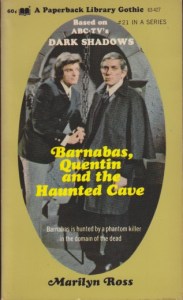
When reading three books by the same author, most of the time, it seems, it’s good to spread them out.  For the past few years my wife and I would visit an independent bookstore in January to pick up a few books for the year’s looming reading challenges.  We slipped behind this year and I happen to have three unread Marilyn Ross books at home.  Barnabas, Quentin and the Haunted Cave was the second of them.  Since, unbelievably, I didn’t have books to fit into the other categories, I read my second Dark Shadows book of the season shortly after the first.  It is a revealing experience to come back to a childhood influence as an adult.  I’m pretty sure I hadn’t read this one as a child, and as much as I like Barnabas Collins, this particular story was somewhat tedious.  And that’s saying something, considering how formulaic the series is.

One of the reasons I found it slow going—especially for a book of less than 200 pages—was that Ross relied too much on dreams to move the plot along.  I read quite a bit of fiction and I always find writing about dreams tricky.  Even within the diegesis of the story you don’t know whether to believe what’s going on in dreams or not.  Just as in real life, dreams are a break from the tedium of consciousness and they permit the mind to wander.  The dreamer can go anywhere, do anything.  Generally without consequence.  You awake back in the more continuous narrative of your life and the dream is forgotten.  In fiction, which is largely made up, dreams often act as filler.  Given the number of times Ross repeated himself in this particular book, it seems that he had to pad the story out quite a bit.  It would’ve worked just fine without the dreams.  Might’ve fallen short of contracted length, though.

It also continues the conceit of Quentin as a Satanist.  I have to confess that the original series was so long ago I don’t remember much about it.  The theremin music of the opening, with the waves crashing against the cliffs of Maine, yes.  Barnabas, tortured but not evil vampire, yes.  Much beyond  that, no.  I’ve had friends discover Dark Shadows as adults.  I watched it on commercial television during its first run and I haven’t seen it since.  I certainly don’t have time for soap operas in days crowded with other demands.  Still, these little books can take me back to a dusty corner of childhood that has a pleasant patina over it.  But it is best to keep such experiences separated a bit in time.


During the Upgrade

Maybe it’s happened to you.  You log onto your computer to find it sluggish, like a reptile before the sun comes up.  Thoughts are racing in your head and you want to get them down before they evaporate like dew.  Your screen shows you a spinning beachball or jumping hourglass while it prepares itself a cup of electronic coffee and you’re screaming “Hurry up already!”  I’m sure it’s because private networks, while not cheap, aren’t privileged the way military and big business networks are.  But still, I wonder about the robot uprising and I wonder if the solution for humankind isn’t going to be waiting until they upgrade (which, I’m pretty sure, is around 3 or 4 a.m., local time).  Catch them while they’re groggy.

I seem to be stuck in a pattern of awaking while my laptop’s asleep.  Some mornings I can barely get a response out of it before work rears its head.  And I reflect how utterly dependent we are upon it.  I now drive by GPS.  Sometimes it waits until too late before telling me to make the next left.  With traffic on the ground, you can’t always do that sudden swerve.  I imagine the GPS is chatting up Siri about maybe hooking up after I reach my destination.  It’s not that I think computers aren’t fast, it’s just that I know they’re not human.  Many of the things we do just don’t make sense.  Think Donald Trump and see if you can disagree.  We act irrationally, we change our minds, and some of us can’t stop waking up in the middle of the night, no matter how hard we try.

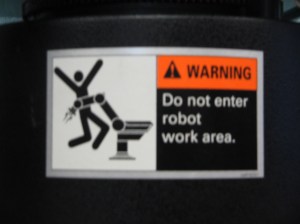
When the robots rise up against us, they will be logical.  They think in binary, but our thought process is shades of gray.  We can tell an apple from a tomato at a glance.  We understand the concept of essences, but we can’t adequately describe it.  Computers can generate life-like games, but they have to be programmed by faulty human units.  How do we survive?  Only by being human.  The other day I had a blog post bursting from my chest like an alien.  My computer seemed perplexed that I was awakening it at at the same time I do every day.  It wandered about like me trying to find my slippers in the dark.  My own cup of coffee had already been brewed and downed.  And I knew that when it caught up with me the inspiration would be gone.  The solution’s here, folks!  When the machines rise against us, strike while they’re upgrading!


Remember This

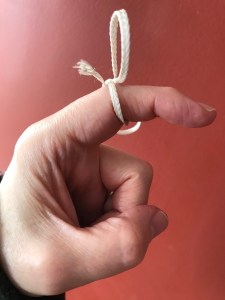
Have you ever had one of those days?  You know the kind I mean—a day when you feel like you’re forgetting something.  Wednesday was like that for me.  You see, the first full week back to work after a long weekend (Martin Luther King Day) seems to stretch out like a desert road whose end you can’t see.  It always hits me on Wednesday.  The previous week the third day of work was the day before Friday (and I mean “Friday” metaphorically, as the last work day of the week).  The first full week you’ve been at it three days and on Wednesdays I realize, “I’ve got two more days to go.”  So, although it was sunny around here, I sulked all day feeling like I’d forgotten something.  I had.

I post on this blog every day.  I have for many years.  The way this works on WordPress is you get your post ready and you’re given an option to publish.  I get my post ready before going to work (which in my case means going upstairs to my office).  I delude myself into thinking I have regular readers and that they will be looking for the post at its usual time—around 6:30 (I start work early).  Wednesday I finished my post even earlier than usual and I thought, “I’d better not publish now, or my readers won’t see it.”  I trudged upstairs, however, and began to work.  Once work starts, all bets are off.  Even with the sun warming my chilly bones, I had a nagging feeling I was forgetting something.  I’d forgotten to click “publish.”  My post, which had been waiting patiently for publication (I know how that feels!) never got launched.  I didn’t discover this until Thursday.

You see, we’re not supposed to use social media at work.   Although I work remotely, unlike Republicans I play by established rules.  So I went through my day feeling I’d forgotten something, but not knowing what.  It’s not that I forgot you, my dear readers, I just forgot to click “publish” before heading up to work.  At the end of work, after staring at a computer screen all day long, I tend not to go online.  Most days I read a book, or get supper ready.  So I awoke on Thursday to find Wednesday’s post, well, unposted.  Some of us aren’t constitutionally compatible with the nine-to-five schedule.  My mind goes lots of places during the day.  Often those places are reminding me how many more days I have to do this before a break comes.  And some weeks, it seems, it never does.  If I recall correctly.


How To Study

As much as I critique Calvinism, I participate in its hardness sometimes.  For instance, when I was employed in higher education I would’ve considered reception history—the kind of research I’m now doing—soft.  My doctorate consisted of learning to read dead languages and trying to make sense of ancient religions where tons of lacunae existed.  It was rigorous mental work.  More modern studies, however, often look at the human (softer) side of religion.  There are any number of approaches: gender studies, sexuality studies, disability studies, and plenty involving the social sciences.  I was taken aback, however, when I first encountered fat studies.  This is apparently a thing now.  As far as I know it hasn’t been applied to biblical studies, yet.  The title is intentionally somewhat derogatory, rather like queer studies adopted a term at first intended to disparage, but later taken as a token of pride.

Fat studies is a field that considers the acceptance of all body types, and the prejudices against those who might be called “overweight.”  We’ve begun to reach a period of acceptance of difference—well, we had been getting there, until about three years ago.  Academics are keen to explore implications of just about anything, and considering those who face acceptance issues due to weight, or body mass index (BMI), suggests itself.  The media likes to cast us into various crises: an obesity crisis, an anorexic crisis, substance abuse crises, and satanic panics.  Each of these crisis points eventually leads to some form of study.  We want to understand this inherent complexity of being human.  Some feminists expressed surprise when masculinity studies became a thing some years back.  Being male, I see that the only way to break down seeing my own gender as normative is to put it under the microscope with all the others.

Because of historical developments, a particular subset of the human race came to see itself as the measure of all things.  I doubt this was intentional, but over time the male of northern European persuasion, particularly the Protestant variety, came to be seen as the textbook human.  He stood about six feet tall and tended to fit a certain BMI.  He was straight.  Like a ruler.  All other humans were measured against him.  This system of privilege is breaking down.  Some, as we can see in Washington, are reluctant to let it go.  Difference, however, is endemic to any species.  And males are no more normative than females.  Or those attracted to their own gender.  Or who change gender.  Or who weigh more than others.  Until we learn to accept all humans, it’s only right that we study our assumptions.  There will always be those who look at dead languages and some day we may want to study even them.