Generation Tech

You can’t be lazy in a technocracy.  I find myself repeating this mantra to myself when dealing with many people who use technology only when strictly necessary.  They don’t realize the war has already been lost.  If you want to thrive in this new world order, you need to keep up at least a modicum with technology.  I deal with a lot of people for whom biblical studies means handling only pens and paper.  J. C. L. Gibson, one of my doctoral advisors, wrote all his books longhand and had his secretary type them.  That’s simply no longer possible.  For authors, if you’re not willing to put notice of your books on Facebook, Twitter (or, as it seems to be going, Threads) people aren’t going to notice.  Publishers don’t send print catalogues any more.  My physical mailbox has been quite a bit less used of late.

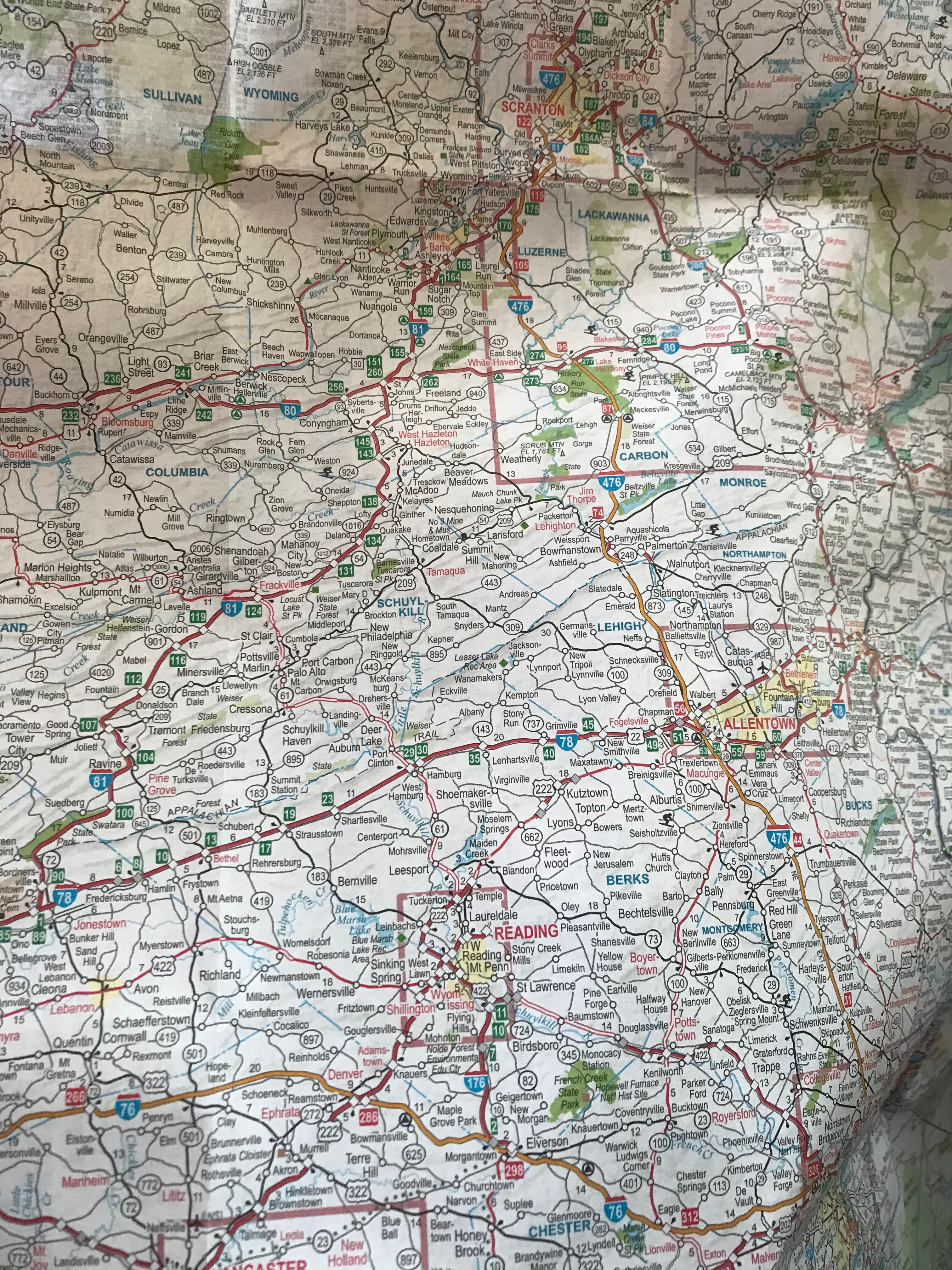
There’s an irony to the fact that the generation that grew up on Bob Dylan’s “The Times They Are a-Changin’” are now refusing to accept our robo-overlords.  AI is here to stay and shy of a total collapse of the electrical grid, we’re not going back to where we were in the sixties.  The times have a-changed.  And you know what Bob says to do if you can’t lend an appendage.  Now, if you read my blog regularly, you know that I don’t go into this future with a sincere smile.  But at least I try to keep up with what I need to to survive.  I have to stop and remind myself how to write a check.  Or fold a roadmap.  I suspect that many of those who object to doing academic business electronically also drive by GPS.  It beats getting lost.

How does this connect to the internet?

No, I’m not the first in line.  I still wouldn’t be using a headset for Zoom/Teams meetings if my wife hadn’t given me an old one of hers.  This despite the fact I complain that I can’t hear others who insist they can speak clearly without and whose voices are muffled by the echoes in their work-at-home room.  Nevertheless, if you want to be a professional of any stripe, you need to reconcile yourself with technology and its endless changes.  You wake up one morning and Twitter is now X and you find yourself xing rather than tweeting.  I need to get more followers on Threads, but you can’t do that on your laptop—I guess times are still a-changin’.


Who Are We?

I wonder who I am.  Beyond my usual existential angst, I tried to access some online learning modules at work only to have so many barriers thrown up that I couldn’t log in.  Largely it’s because I have an online presence (be it ever so humble) outside of work.  Verification software wants to send codes to my personal email and my company has a policy against running personal emails on work computers.  Then they want to send a phone verification, but I don’t have a work cell.  I don’t need one and I have no desire to carry around two all the time because I barely use the one I have.  By the way, my cell does seem to recognize me most of the time, so maybe I should ask it who I am.

Frustrated at the learning module, I remembered that we’d been asked to explore ChatGPT for possible work applications.  I’d never used it before so I had to sign up.  I shortly ran into the very same issue.  I can’t verify through my personal phone and I found myself in the ironic position of having an artificial intelligence asking me to verify that I was human!  I know ChatGPT is not, but I do suspect it might be a politician, given all the red tape it so liberally used to get me to sign in.  Not that I plan to use it much—I was simply trying to do what a higher-up at work had asked me to do.  So now my work computer seems to doubt my identity.  I don’t doubt its—I can recognize the feel of its keyboard even in the dark.  And the way my right hand gets too hot from the battery on sweltering summer days.  It’s an unequal relationship.

My personal computer, which isn’t as paranoid as the work computer, seems to accept me for who I say I am.  I try to keep passwords secure and complex.  I have regular habits—at least most days.  I should be a compatible user.  I don’t want ChatGPT on my personal space, however, since I’m not sure I trust it.  I did try to log into the learning module on my laptop but it couldn’t be verified by the work server (because the computer’s mine, I expect).  Oh well, I didn’t really feel like chatting anyway.  But I did end the day with a computer-induced identity crisis.  If you know who I am, please let me know in the comments.  (You’ll have to authenticate with WordPress first, however.)


Movies about Movies

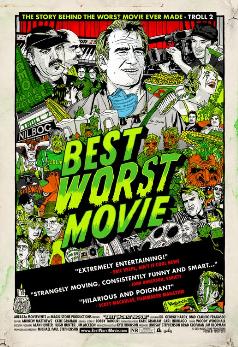
The category of movies so bad that they’re good sometimes spawns the phenomenon of a movie about the bad movie.  The Room, generally on the list of worst movies of all time, was followed by The Disaster Artist.  Not exactly a documentary, it was a movie about the making of the movie.  There’s a macabre fascination with films that dare to be so very bad.  They’re released nevertheless, and if they’re the right kind of bad they grow a following.  Ed Wood’s movies inspired Tim Burton’s movie Ed Wood—dramatized, but apparently not far from the truth.  Troll 2 was followed up by Best Worst Movie, directed by the child star of the original, Michael Stephenson.  Such movies are irresistible in their own right.  So when I finally saw Troll 2 I turned around and immediately watched Best Worst Movie.

A few things stood out in this documentary.  One is that being part of something larger, it’s not always clear what this larger thing will be.  Most of the people in the movie (which was released directly to video) found out about the release by accident.  Many of them never acted again but one thing they all knew: when they did see it, it was clear that it was a bad movie.  The one person in the documentary who doesn’t accept this is Claudio Fragasso, the director.  Fragasso is Italian and he still maintains that this is a great movie and everybody else is wrong about it.  He skulks around the tributes made to the movie and insists to both actors and viewers, that the movie isn’t bad.  They are wrong, he is right.

There’s nothing wrong with pride in achievement, of course.  Sometimes, however, it’s more graceful to admit that you simply got it wrong.  Best Worst Movie follows some of the actors to conferences where they expected huge lines and great attention, only to find a handful of disinterested spectators wondering what all the fuss was about.  At the same time, there are screenings of Troll 2 in major US cities that draw sell-out crowds.  Bad movies don’t appeal to everyone, of course.  They can, however, serve some good and might even add some enjoyment to life.  Best Worst Movie underscores that not all film fans have the same taste.  It also shows that those who enjoy traditionally bad movies aren’t alone.  There’s an aesthetic to being bad enough to be good, and even that can spin off sequels of its own.  And please, Mr. Fragasso, don’t make the sequel you’re touting—this kind of magic only comes once, unless you’re a genius like Ed Wood.


Bad Movie Therapy

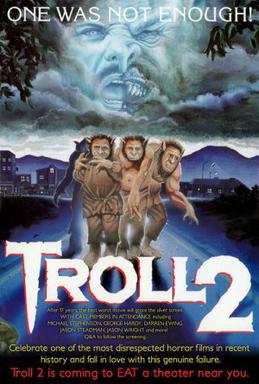
I haven’t see Troll, but it doesn’t matter.  Troll 2 has nothing to do with it.  As a frequent contender for worst movie of all time, Troll 2 is an anti-vegetarian screed and campy horror film that’s impossible to take seriously.  It’s part of my bad movie therapy.  And it’s also an example of religion and horror.  But first, let’s set the scene.  The Waits family (Michael and Diana, and their kids Holly and Joshua) is doing a house exchange for a vacation.  Before they leave, however, Joshua’s dead grandfather appears to him to warn him about the goblins.  The goblins, who are vegetarians, make people eat/drink a special substance that turns them into plants so that they can eat them.  (Yes, it’s that bad.)  Ignoring Joshua’s concerns, the Waitses head for Nilbog (goblin backwards) and go ahead with the house exchange.

The locals (there are only 26 of them) can make themselves appear human and they try in vain to get the visitors to eat.  Joshua prevents his family from eating the plant food by peeing on it.  They go to bed hungry as the queen of the goblins plans her next move to get them floradated.  About midway through the film, we’re shown a church scene in which the minister preaches of the evil of the flesh.  Ironically, this is not far off from the teaching of some Christian denominations.   He tells the trolls what they already know—they have to get the visitors to eat so that they can eat them.  If nothing else, it will make you forget your troubles for ninety minutes, unless your trouble is that you’re being turned into a plant.

Any number of reasons have been offered for why the film is so bad.  While filmed in Utah, the crew was Italian, and most of them spoke no English.  The movie was low budget.  The acting is just plain bad.  All together, however, these features work symbiotically to grow a wonderfully therapeutic end result.  Some of the crew claimed that it was the intention all along to make this a funny film.  Comedy horror or horror comedy is a recognized genre, after all.  The only problem I have now, however, is where to go from here.  So how does the Waits family escape their peril?  I’ll need to offer a bit of a spoiler here.  The goblins are frightened away long enough by a double-decker bologna sandwich that the family can touch the magic stone and destroy the conspiracy.  What are you still doing here? Why aren’t you watching this already?


Hoppy Fourth

Today is the one of the relatively rare summer holidays.  Modern industrialized nations tend to take a more relaxed view toward summers without having to give out too many prescribed company holidays.  This seems to follow on from school schedules because the kids are out in summer and adults need some flexibility when work demands collide with family needs.  The internet has made work-life balance a little tricker to achieve since work is always just a click away.  Some more generous employers gave yesterday as part of an extended four-day weekend, which is rejuvenating in a way that’s easily forgotten until you start to feel it.  The sense of obligation takes a couple of days to wind down, and then on Monday you realize “I’ve still got another day off!”  It’s a sublime feeling.  Why not watch holiday horror on it?

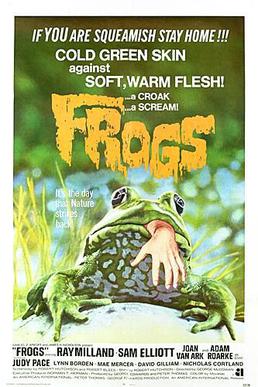
The Wicker Man is a holiday horror movie.  One of my arguments in the book is that holiday horror has to derive its energy from the holiday, and not just be set on it.  For example, I Know What You Did Last Summer and Return of the Living Dead are both set on or near Independence Day but the movies don’t really draw their horror from the holiday itself.  It falls into the same category.  Frogs?  Well, maybe.  Perhaps holiday horror, it’s definitely in bad movie territory.  A rich southern family is dominated by a Trump-like grandfather who controls the money and measures everyone by loyalty to him personally.  On his birthday, the fourth of July, nature revolts and his adult children and grandchildren (apart from one granddaughter), are killed by animals in this eco-revenge groaner.  But is it holiday horror?

One scene may suggest that perhaps it fits the category, but the real significance of that day is that grandpa won’t let it be celebrated any way other than by his prescribed plan.  Even as the estate is overrun by frogs (mostly), snakes, lizards, alligators,  tarantulas, and even some birds (thank you, Mr. Hitchcock), he insists that everyone do what they always do on the fourth of July/his birthday.  The only scene that suggests holiday horror is where the eponymous frogs hop onto a cake decorated like an American flag.  I normally like nature-revenge films, and this one starts out well but quickly goes downhill.  The environmental message is there, but underplayed.  There are some firecrackers and a number of dead rich folks, but otherwise the film seems to have no message at all.  It’s a bad movie.  Holiday horror?  Not really.  Something to watch for a day off work?  Definitely.


Not Dagon

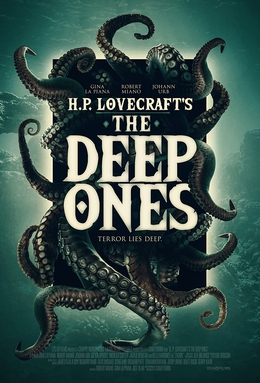
There’s an aesthetic to bad movies.  And when your production company is Crappy World Films you’ve got to wonder if it’s intentional.  Chad Ferrin’s H. P. Lovecraft’s The Deep Ones, which was released in 2020, isn’t a great movie.  It is kinda fun, though.  I’ve had a weakness for explicit Lovecraft films ever since Stuart Gordon’s very moody Dagon.  That film was clearly the inspiration for this one.  With the “low” budget of only a million dollars (it feels strange to write that), it nevertheless has a clean cinematography that shows some artistry.  The story just isn’t that good.  A young couple is seeking a getaway at an oceanfront AirBNB only to discover it’s part of a “gated” community.  Their hosts, who are living in the boat down at the marina, keep on stopping in, not leaving them much privacy.

The set-up is very much a Rosemary’s Baby scenario.  The community, as the title suggests, worship the Old Ones.  They introduce Cthulhu early on, but the young man of the couple has never heard of him (he obviously doesn’t spend much time on the internet).  Speaking of the internet, the film makes the point that everyone spends too much time on it, and there’s perhaps some truth to that, but, if you’re streaming the movie you’re also participating.  In any case, the community wants women to offer to Dagon—and the monster here is clearly low-budget—so they can bear more children for the Deep Ones.  Well, not so much bear children for them as to be pregnant with tentacles that can somehow convert newcomers.  Once you’ve been tentacled, it seems, you’re a member of the community.

There is a kind of Lovecraft vibe to the film despite the often wooden acting and throwaway dialogue.  One thing Lovecraft had learned from Poe was the consistency of mood.  It’s here that the movie runs into some trouble.  At times it’s a little scary, at times dramatic, but too much of it just feels silly.  The case could be made that Lovecraft’s writing tends toward the puerile and there’s some truth to that.  It is never silly, however.  Sometimes when translated to the screen the outlandishness of Lovecraft’s view of the world comes across as so weird as to be funny.  It takes an able director, and a strong writer, to adapt him to cinema successfully.  It’s no accident, then, that the movie is dedicated to Stuart Gordon, whose Dagon is still difficult for me to watch, so full of Lovecraft as it is.


A Theory

Do you remember that crazy college professor you had?  Chances are there was more than one.  As a late friend used to say, that’s why we pay good money to go to college.  I have an idea, perhaps even a theory, that the neurodiverse used to be largely institutionalized.  And I don’t mean in mental hospitals or “insane asylums.”  I mean in two well-respected social institutions: the university and the church.  Before you can object to the latter, consider that ministers, and before them priests, derived from shamans.  Nobody would doubt that shamans think differently than most people.  So, my theory is that when neurodiverse people came along in capitalist societies, they were shunted toward jobs in higher education and religion.  Out of sight to most people most of the time.  Then capitalism grew.

Both the church and the university became businesses.  Again, if you doubt me about churches, get to know a few bishops.  You’ll soon see.  In higher education, business people were hired as deans and presidents.  Not knowing how to handle their neurodiverse employee pool, they began hiring more “normal” people.  Those who, with no real insight or ambition, figure teaching is a cushy job.  It pays well, and it’s respectable.  But to do the job right you might just have to be neurodiverse.  Now, I don’t have the means to test my theory, but I suspect if you surveyed students over time as they graduated, you’d find fewer and fewer crazy professors.  As my departed friend would likely have said, they’re not getting their money’s worth.

Money doesn’t compromise.  Many people are driven by it without ever asking themselves why.  Do they want to be able to build private rockets to take them to Mars when capitalism finally destroys this planet?  Do they want private jets and the endless headaches of having to worry about getting even more money?  Studies tend to show that wealthy people are far from the happiest on the planet.  In fact, many of them are privately miserable.  They don’t have to work, true, but what do they think about?  Deeply.  I’ve never been driven by money.  I would like a bit more than I’ve been able to manage with my background and specialization.  Enough not to have sleepless nights over whether we can afford to fix the roof.  And still buy books.  It may be crazy to still read like a professor when I’m no longer in the guild.  I like to think I’m participating in a very old tradition.


Denver Memories

It may be a strange thing to say (or write, as the case may be) but I was kind of hoping to spend some extra time at the Denver Airport.  When I traveled to Denver for a conference last year, I arrived to a workload (attending AAR/SBL as an editor is all work, not play).  I had no time to hang around the airport.  I knew, however, as a recent New York Times piece states, that the airport has a reputation for the paranormal.  While the Times article focuses on Luis Jimenez’s sculpture “Mustang” to start, it quickly moves on to “conspiracy theories.”  And the parts of the airport passengers never see.  The place has a reputation for being weird.  During construction in recent years, the usually anodyne partitions that block construction from the view of passengers, housed images of aliens, bolstering rumors that Denver, and its airport, have some connection with our extraterrestrial neighbors.

The Times story points out alien graffiti in parts of the Denver Airport where travelers can’t go.  And it also points out that although the fiery red eyes of “Mustang” are to represent Jimenez’s father’s start in the neon business, they give the giant horse a demonic aspect.  The artist died working on the sculpture.  A piece fell during construction, severing an artery.  But the conspiracy theories began earlier.  The southwest has a reputation of being the home of the shapeshifting reptilians that have made it onto mainstream television.  Is it any wonder that Trump stands a possibility of getting the nomination while yet more crimes are actively stacked on his record?

Of course, I was in Denver to work.  I claimed my bag and got a taxi on a snowy southwestern morning.  While there I worked, of course.  It was cold, in any case, back in November, so getting out to see the sights didn’t particularly appeal, especially since it was getting dark by the time the book stalls were closing and I was there alone.  I always want to be on time, and since I’m an early riser, and since Thanksgiving was just a couple days away, I went to the airport three hours before my flight home.  I was thinking I might have some time to do a bit of X-Filing while waiting.  Alas, it was not to be.  The helpful flight attendant put me on an earlier flight and I ended up with a three-hour layover in Chicago.  But I also knew that several “mothman” sightings had taken place at O’Hare over the preceding months.  When you’re a traveler, however, they keep you away from the interesting parts of the airport.


Finding Yourself

Sometimes I look, fascinated.  At tracking info, that is.  I once ordered an item from Montreal, which is, I’m told, in the province of Quebec, Canada.  The estimated shipping time was five days.  It ended up being quite the tourist package.  Its first US port of call was Plattsburgh, New York, which makes sense.  The strange thing is the Canadian tracker didn’t include the states—just town names, all of them small, as if this were a covert operation.  From Plattsburgh it went to East Syracuse, because, well, who wouldn’t want to go to East Syracuse?  From there it leapt right over Pennsylvania, where I live, to Hodgkins, Illinois.  This is a town so small that you really have to be a fan of package vacations to find it.  From there it went to Maumee, Ohio.  It seemed to be heading in the right direction, in any case.  Maumee led to Middlebury Heights, still in Ohio.  Finally it reached Pennsylvania, in New Stanton, not terribly far from my childhood home.  Then Carlisle, about halfway through the state.  Finally to Easton, from which it reached me.  Surprisingly, on time.  

It’s gotta be around here somewhere…

Logistics baffle me.  I had it drilled into me as a child that the shortest distance between two points is a straight line.  Montreal is about 400 miles from here, pretty much straight north.  I wouldn’t venture to tell UPS (the carrier in this instance) how to do its job, but when you’re ordering something carbon neutral (that, of course, you can’t get close to home) it feels kind of excessive to have to stop in so many small towns only to skip the destination state by flying from New York to Illinois so you can drive it back to Pennsylvania.  Logistics people need jobs too, I guess.

Amazon has made many people ask why things can’t arrive more quickly.  The fact is, shipping companies have their own protocols.  It’s like when you have to fly south from a regional airport to get onto a flight north.  You have to reach a hub where they know how to direct your package.  And if your item requires sea freight, well, all bets are off.  There may be no tracking points between Shanghai and Los Angeles.  No matter how much some people may say they hate it, we live in a global society.  We rely on China, and Canada, and everywhere else, to make life go in these United States.  Even following your tracking information can, in that way, be an exercise in thoughtfulness as well as a learning experience. 


More Water Monsters

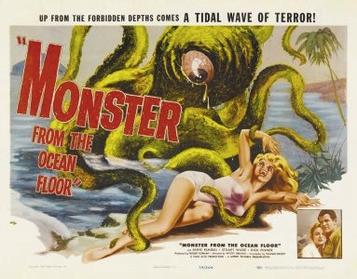
Monster from the Ocean Floor, one gets the sense, wouldn’t have merited a Wikipedia article were it not for the fact that it was the first film Roger Corman produced.  Despite its B-movie quality, there’s quite a lot to like about it.  First of all it has a strong female lead.  Julie Blair is the only gringo in Mexico to believe the locals that there’s a monster just off shore.  Steve Dunning, the scientist, is an avowed skeptic.  The plot is cheesy—the monster is an overgrown amoeba irradiated by the Bikini Island underwater nuclear tests, and it’s killed by getting a submarine in the eye—but there are some very effective cinematographic moments.  When the young boy talking to Julie in the opening turns to stare at the ocean where his father disappeared, the framing and emotion are perfect.

The theme music for the approach of the shark, and then the amoeba, anticipate Jaws by a couple of decades, and I have to wonder if John Williams hadn’t watched Monster from the Ocean Floor.  (I’m sure even cultured people watch the occasional B-movie.)  There’s also an unexpected religion angle.  A series of episodes in the film have a couple of locals trying to kill Julie as a sacrifice to the monster.  Despite the holes in the plot, it’s remarkable that in 1954 there could be dialogue suggesting that the Christian God (“the other god” according to a local woman) isn’t the God that Quetzalcoatl is.  All the same, the sacrifice is based on the folklore that the sacrifice of the “fairest” (Julie is, naturally, blonde) will appease the monster.  Maybe not the most solid theological basis, but still, not bad for a bad movie.

I’ve recently published a piece on Horror Homeroom about women and water monsters.  Having a strong woman in a 1954 film is especially remarkable.  Julie, despite the skepticism of the scientists, takes the initiative to dive right down and see the monster for herself.  It’s only when she comes up with physical proof that the men consider that she may be right (and in danger).  Of course, the men do have to rescue her—you can’t have it all.  Yes, it’s a cheaply made movie with a paper-thin plot but it was beginning to show that a woman could take the reins and with good motives (if nobody else will do something about the monster, she will).  Although she’s the love object of the movie, she’s so much more.  And a submarine in the eye—that’s gotta smart.


Iron Man?

As a vegan, I sometimes end up thinking more about nutrition than I used to.  Back when I first became a vegetarian colleagues wondered how I got my iron.  I’m one of those apparently rare individuals who really likes broccoli.  I could eat it nearly every day of the week without tiring of it.  In any case, iron is important for health.  I’ve known people with iron deficiencies and it can be a real problem.  Doctors recommend ferrous gluconate as a dietary supplement since the body absorbs iron better from it.  (It’s best on an empty stomach, I’m told, followed by orange juice.)  But I’m no physician.  In fact, I’m quite squeamish, which may seem strange for someone who watches horror.  Still, thinking about iron took me back to my childhood.

I was a sickly child.  Couple this with a tendency to think too much and I must’ve been a handful for my mother.  I remember trying to explain to her once that I didn’t believe reality was real.  I was maybe twelve at the time.  She prescribed ironized yeast.  Now, Mom’s no doctor.  She didn’t even finish high school.  So thinking about broccoli made me wonder about ironized yeast.  First a web search revealed it’s not sold any more.  Further, it was a health food fad beginning in the 1930s.  Although I remember the taste and scent distinctly, I couldn’t find a website saying what it was or how it was made.  More to the point, why did my poor, frustrated mother think that it would help me couple reality with what was happening around me again?  (And was that even such a good idea?)

Questioning perceptions seems to run in my family.  I’ve long known that my thought process is very different from that of other people.  My saintly wife still says the reason she was attracted to me is that she’d never met anyone who thinks the way I do.  My thought process has had plenty of opportunities to drive her crazy since those early days, I suspect.  My brother and I sometimes talk about what it’s like being, I suspect, were we diagnosed, neurodiverse.  It’s easy to fall into the perception that others think like we do.  I suspect all people do that.  Few, at least among those I’ve met, question the reality that their senses tell them really exists.  Physics tells us it’s mostly empty space.  And yet although I still don’t know what it is, maybe I’d better find someone with an old stockpile of ironized yeast to get back to business. It is, after all, a work day.

Who knows what goes on in the mind of others?

People of Slime

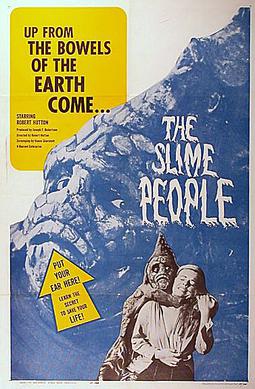
An old saying advises not to speak ill of the dead.  And I suspect this also applies to the living dead.  Night of the Living Dead (1968) is a classic horror film that represents the maturing of the genre.  Of course, it’s not the only horror film of the sixties, and I don’t mean to speak ill of it by suggesting that George Romero—who was used to working with a small budget—had seen The Slime People.  But I wonder if he had.  Directed by and starring Robert Hutton, The Slime People was released in 1963 and although it’s really bad, some of the scenes from this black-and-white groaner seem to have been borrowed five years later by the more able director.  The interviews by the newscasters and the driving country roads, and even the chasing of the angry mob could’ve served as direct inspirations.

The slime people are from subterranean earth, forced into action by underground nuclear testing.  Building a solid fog wall around Los Angeles, they take over the city while a pilot, a scientist and his two lovely daughters, and a marine, save the day.  Although the military had been fighting the monsters, they just couldn’t win.  The scientist really doesn’t help solve the issue but the pilot (Hutton) finds the creatures’ wall machine and the scientist is able to blow it up with a spear, saving the day.  This is one of those films so bad that it’s good.  The writing is poor and the plot makes little sense overall.  It doesn’t quite have the style of an Ed Wood film, but it participates in the aesthetic of watching bad movies.

Hutton isn’t a bad actor.  Hampered by a too-low budget (one of the signs that a movie might be one of the good bad ones), he couldn’t film the story he envisioned.  Much of the budget was reputedly spent on the slime people costumes, ensuring that Hutton drew no salary for his own role in his movie.  A couple of the other stars were veteran actors, and this prevents the movie from being a mere hack job.  I take some hope from the fact that many films like this eventually become cult classics.  Yes, sometimes it’s so that we can laugh at them, but I think there may be something deeper involved.  Those of us who watch bad movies might recognize something of ourselves in them.  We too struggle to tell our story, without big budgets and without studio support.  And yet we persist.


Insane Illusionist

The Dark Shadows novels supplemented my early watching of the television series.  It’s funny, but when I remember watching the show, in my mind I watched it alone.  During a conversation with one of my brothers recently, he assured me that he had watched the show too, pointing to the selectiveness of memory.  What I do know is that I was the only one who read the novels.  I bought them when I could find them used, and I kept them in an old pasteboard suitcase (we had no bookshelves and my parents didn’t read).  I didn’t have the entire collection by a long shot and I can honestly say I don’t know which ones I read back then.  I am now, however, two novels from finishing the entire series—a project I began around 2006.

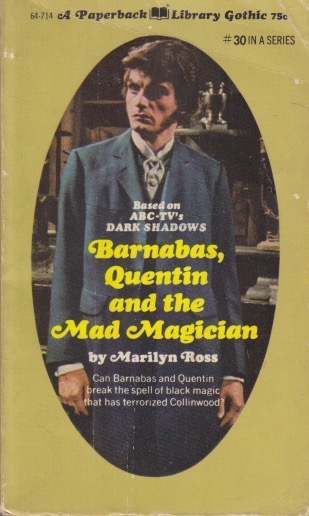
Barnabas, Quentin and the Mad Magician follows the usual formula, although this time around Barnabas is temporarily cured of his vampire curse and Quentin doesn’t turn into a werewolf at all.  They are on friendly terms and both are being set up by the rather obvious antagonist, the mad magician.  I guess you can begin to see the series winding down.  Most of the thirty-two stories are broadly similar and the writing is that rushed, breathless kind that seems characteristic of those who make a living delivering pulp fiction.  There have always been people like me who will buy it.  That’s the reason I typically use the phrase “guilty pleasure” when describing these novels.

As I note in my YouTube video on the phenomenon, Dark Shadows was quite popular in its day.  It’s what we might now call a cultural meme.  Television series, novels, two movies, comic books, lunch boxes—the whole coffin.  The monsters were likable.  That was true of some of the greats—you felt sympathetic toward them.  As horror began to “grow up” the monsters often became entirely reprehensible, with no redeeming qualities.  So as Barnabas and Quentin do their best to expose the true monster, their supernatural powers currently on hold, they have to rely on their money and connections.  Even at the end the “confession” is made suspect by the longer tacked on ending.  If you’ve read enough of these, you grow suspicious when there are ten pages left after the antagonist dies.  Stories such as this aren’t great literature, but they do fill a gap in the world of monsters that nostalgia leaves for those who knew Dark Shadows in the late sixties.


Boggy Down

Okay, so after watching The Creature of Black Lake I realized that I’d never seen The Legend of Boggy Creek.  I did watch The Mysterious Monsters, a documentary that came out in 1975, in the Drake Theater in Oil City.  I was struck by Peter Graves’ serious tone and the information the film conveyed.  I’d not knowingly heard of Boggy Creek then (Graves does list “the Fouke monster” as another name for sasquatch), and besides, Arkansas was far, far away.  Well, to make an honest man of myself, I decided I’d better see it.  The opening of Boggy Creek is clearly the inspiration for the opening of Black Lake.  Their opening shots are very similar.  (I guess I watched them in the wrong order.)

Although Boggy Creek does have a guy in a costume (better makeup than Black Lake), many of those in the film are the actual eyewitnesses to the events it portrays.  They’re clearly not professional actors.  Interestingly, the narrator constantly insists that there’s only one such creature and that it acts out of loneliness.  If there are sasquatch they, out of biological necessity, must have a breeding population.  There had to be a Mrs. Boggy Creek somewhere in the picture—at least on a national scale.  In any case, this movie has become a cult classic, but I can’t help but think it’s so that people can laugh at it.  The acting’s not great and the long, long shots of hunters getting their dogs out of the truck  show the problems with the pacing.  Then there’s that folksy song (also echoed in Black Lake) about the lonely monster.

Boggy Creek came out in 1972, making it one of the earliest Bigfoot documentaries.  Given that sasquatch has gone mainstream (lawn art and Christmas ornaments featuring Bigfoot are common), the movie perhaps started a new cultural meme.  In the movie the poor critter gets shot several times, engaging viewer sympathy (but maybe not enough to write a song about it).  The narrator reflects if this particular southern hospitality might not’ve been overkill.  After all, some of the armed witnesses said they couldn’t shoot it because it looked too human.  The pacing was slow enough to make keeping my weekend weary eyes open a challenging prospect a time or two, but overall it’s a film worth watching.  I have the feeling, however, that this chain of events might lead me back to The Mysterious Monsters.


Black Lagoon, er, Lake

There’s value in watching bad movies.  For one thing, it’s a learning opportunity.  (For another, they’re more likely to be found for free on streaming services.)  The Creature from Black Lake drew me in with its title similar to The Creature from the Black Lagoon, and its very low price tag.  It kept me watching with its poor dialogue and obviously low budget.  One of the spate of “Bigfoot movies” that came out in the seventies, this one is the story of two (unintentionally) inept college students looking into a Louisiana swamp creature, based on the beast of Boggy Creek legend.  They end up in Oil City (I had to keep watching now), Louisiana where the local sheriff warns them off and where his daughter is, naturally, attracted to them.

I won’t spoil it for you (although the creature of this creature-feature is so clearly a man with a gorilla mask) but the movie does have a cast of some recognized B-list (or C-list) actors.   And it was a very early effort by Dean Cundey, a cinematographer who went on to work with horror auteur John Carpenter on Halloween and The Thing.  (And also The Fog, although that one’s lesser known, but covered in Holy Horror.)   You’ve got to start somewhere and the premise is good enough, being “based on a true story”—something the movie doesn’t claim for itself since the events, as portrayed, never happened.

Riffing off the earlier Legend of Boggy Creek—a cryptid docudrama from three years earlier (1973), it fictionalizes the Fouke monster incident.  The Fouke monster (which my autocorrect hates) was a creature reported around Fouke (no, I don’t mean Fluke), Arkansas, starting in the 1940s.  This earlier film went on to become a cult classic.  Black Lake suffers from poor direction and even worse writing.  College students, one obviously suffering from post-traumatic Vietnam issues, try to make out with girls they know are in high school only to be saved from criminal offense by a monster attack?  They wind up in jail anyway only to be released by a tough but gullible sheriff who simply trusts them to leave Oil City since he told them to.  I grew up near the earlier and, I’m tempted to say, original Oil City, and I know of no movies set in that town with all its drama and weirdness.  Even with its issues (Jack Elam is a delight to watch, however) this film is a bit of bad movie homework that’s hard to pass up when it’s free.