Sleepy and Hollow

There’s a kind of charm to Chronicles.  I don’t mean the biblical book, but rather Chronicles of Tarrytown and Sleepy Hollow, a book published in the 1890s by Edgar Mayhew Bacon.  A somewhat poorly organized volume, you get the sense that Bacon had more curiosity than literary ability, but that didn’t prevent him from leaving a valuable record.  What’s more, other accessible books like it tend not to exist or be easily found.  There’s definitely a reason to write so that the average person can read your work.  I didn’t spring for an original edition on this one, as much as I love old books.  Nevertheless, the material’s still old and that’s what counts.  At least to someone with an historian’s point of view.

What really caught my attention here was Bacon himself.  Who was he?  His book was from that era of “you should believe me because I wrote a book about it,” but modern critics want to see credentials.  Although search engines are often good, if you’re looking for information on an obscure author (such as yours truly) they’re going to try to sell you something first.  Books, in the case of those of us who write.  If you scroll down far enough you’ll learn that Bacon was born in the Bahamas in 1855.  He wrote, it seems, five books.  He doesn’t have a Wikipedia page and I looked him up because (in addition to basic curiosity) he at times appears to be a bit of a curmudgeon.  He was only about 42 when this book was published, however, but writes like a long-time resident, slightly jaded.

Bacon was mostly a place writer.  His non-fiction books focus on places he lived or knew.  His educational history isn’t easily discovered, and again, the modern reader wants a degree (preferably three)  to show that one can be a proper historian.  He lived in an age, however, where gumption to write and complete a book likely meant finding a publisher.  The internet has changed that, probably forever (or at least as far as we can see).  It’s a buyer’s market for publishers.  But still, Chronicles of Tarrytown was brought back into print and was made available again, in an affordable paperback.  It contains some second-person history, closer to the events than we currently are, and a few legends as well.  It can’t be relied upon for history as we know it, but it can still offer a bit of charm for those curious about yesteryear.


Employment Opportunities

It’s important to be reminded that stories can also be told by what’s not said.  Non-narrative fiction can be a little tricky to follow, but often contains admirable aphorisms.  Such as “I believe in the future.  I think you need to imagine a future and then live in it.“  This is from Olga Ravn’s The Employees: A Workplace Novel of the 22nd Century.  One of the many things driving me insane at the moment is where I found out about this book.  I know I ran across a recommendation somewhere and I can’t recall the place.  It would be helpful to know since I wonder what it was about the description that convinced me I had to read it.  In any case, there will likely be spoilers below since it’s difficult to describe the book without them.  I’ll start off by saying it’s classified as science fiction, but it’s not your typical 1950s kind.

The story’s told via a series of employee statements to the company that owns a space freighter.  The ship has a mixed crew of humans and humanoids—androids that aren’t easily distinguished from biological humans.  They discover some mysterious, perhaps organic, objects on a new planet and the humanoids begin to request, or even demand, equal treatment.  The outlooks from the two perspectives, human and non-human, are quite different, but they argue that fair treatment is only, well, fair.  The situation gets out of hand and the company, as such entities often do, decides on the economical solution of killing everyone aboard the ship but preserving the exotic objects.  Though generally described as “comic,” I picked up on the seriousness of the issues of prejudice and inequality.  The quote above is from the very last statement from the ship.

Ravn has established a reputation as a poet and that shows through in this novel.  The quote above is an example.  According to the article about her on Wikipedia, she graduated from the Danish School for Authors.  That made me wonder why we don’t have such things.  This isn’t the same as an MFA program.  Indeed, the nordic countries seem to have abandoned their viking ways for literature.  There’s a deep wisdom in this.  Costs of living are high in such places, but so are happiness levels.  What’s not to like about a school option where budding poets and novelists can become acquainted with one another and imagine a better world?  Writers sometimes give us challenging stories but the reason, I believe, is that we can learn from them, view a better future, and live it.


More Proof

They’re here!  The second proofs for The Wicker Man have arrived.  Nothing makes you feel like a book will actually happen than seeing the stages unfold.  In the meantime I’ve begun seeking an agent for the next book.  This is always a tricky process—work a ton on a pitch, send it, and try to forget about it because most agents simply won’t respond.  If they do it won’t be for a month or two.  And even then they may not like what you’ve written.  It’s a weird system.  Meanwhile at least I’ve got proofs to read.  Proofreading is stressful enough.  I’ve read my new book proposal lots of times.  It was only after I’d sent it to a couple of agents that I found the typos.  You are your own worst editor.  Even if you’re an editor.

Still, you feel like proofs arriving should be occasion for a day off work.  Like your boss would say, “That’s quite an accomplishment!  Why don’t you take a day off to get started with it?”  I live in a fantasy world, I guess.  The proofs arrive with their shot of adrenaline and then you’ve got to read other people’s ideas for less interesting books (or so it seems).  Maybe this is why not so many editors write any more.  It’s exhausting.  Of course, I’m writing this post instead of reading the proofs.  Every diet should have some variety, even the literary kind.

I’m not a fussy author.  Some turns of phrase I will fight over, but I know copyeditors mean well.  I’ve done some copyediting myself, and I meant well.  Authors are people who are in for the long haul.  From the time you start working on a book (and if finding an agent is part of the process, you need to add several more months) to completion is generally measured in years.  It’s not unusual to get no pay at all for this work.  As Ivan Klima wrote: “A truly literary work comes into being as its creator’s cry of protest against the forgetting that looms over him, over his predecessors and his contemporaries alike, and over his time, and the language he speaks.  A literary work is something that defies death.”  If you can forgive the sexist language, there’s a great deal of truth there.  And part of that process is the effort to locate an agent who shares your vision.  And, of course, getting proofs back to the publisher on time.


World’s End?

I’ve been writing on religion and horror for quite a few years now.  Sometimes you come across a horror movie, or novel, which addresses this directly.  Paul Tremblay’s The Cabin at the End of the World is one such novel.  A friend strongly recommended this, and indeed, the first half went impossibly fast.  This despite my dislike of home invasion stories.  It nevertheless kept me on the edge of my seat.  I should probably say there will be spoilers here (there will), in case you haven’t read this but intend to.  I’ll hold off on them until the next paragraph, though, so if you’re a faster reader than I am a writer you won’t accidentally run upon them.  So, a family consisting of two fathers and an adopted daughter find the cabin, where they’re vacationing, invaded by four people who believe the world is going to end.  Spoilers follow!

The world is going to end unless the family agree to sacrifice one of themselves to stop the apocalypse.  The strangers are armed while the vacationers are not.  And, as usually happens when those with weapons confront the innocent, the armed prevail.  But.  But the family refuses to sacrifice anyone.  Then the brainwashed four do something unexpected—they kill one of their own.  They continue to do this, attempting to convince the men that if the invaders all die, and neither of the men is sacrificed, the world will end.  Quite a bit of the novel then becomes a theological discussion regarding what kind of god would make such a demand.  Of course, if you read Genesis you’ll already know the answer, right Isaac?

Tremblay knows not to tip his authorial hand as to what’s really happening.  As the cabin becomes a mess of blood and gore, the television seems to be showing predicted apocalyptic events.  The invaders can’t reveal their source of secret knowledge because they receive visions telling them what to do.  The whole thing raises that most troubling of questions: who is really in charge?  Is there a bloodthirsty deity who requires a willing death or are the invaders simply good at acting out their paranoia and interpreting events to meet their expectations?  So it is that Cabin becomes a disturbing story—nearly a theodicy—asking age-old questions of what happens when religious belief conflicts with rational materialism.  There are enough hints of supernatural happenings to make the reader wonder.  And when it ends it affirms something many of us are exploring these days—religion and horror have much in common but neither is clearly understood.


Ultimate Collectables

“Collectible ebook” is a phrase you never hear.  That’s because such a thing doesn’t exist.  Even though I work in the publishing industry, I’m not really a fan of ebooks.  I don’t write my books anticipating pointing to some screen and crowing, “I wrote that!”  No, books exist as entities and there’s a kind of contempt associated with making them disposable by creating them out of ephemera.  I’m not wealthy enough to be a serious book collector, but when I buy used books I notice the rare category of “collectible” with some envy.  This is a book that has been treasured.  You see, I know that when I die I’ll leave little behind apart from my books.  If they were ebooks they’d be worthless.  You can’t sell them or trade them in.  Or even put them into a little free library.

Sometimes buying electrons seems to be more convenient than the alternative.  For example, we’ve pretty much run out of space for DVDs and Amazon seems unlikely to fold soon (like UltraViolet did), so subscribing to a streaming for a movie seems safe enough.  Yes, you can resell DVDs, but often for a pittance and you gain by opening more space.  The space books take up demonstrates their importance.  We bought our house with an eye toward book space, and even though we don’t have many books that would be considered “collectible,” we do have many that are interesting.  Unusual.  They have been conversation-starters when we’ve had the curious over.  (I always look at other people’s books when invited to someone’s place, if they’re publicly displayed.  It’s how people get to know each other.  I’ve never looked at anyone’s ebooks.)

Books are a cultural object.  The big tech companies have been trying to drive traffic to ebooks for years.  The pandemic gave them a leg up, but book sales—print book sales—also increased.  You can watch only so much Netflix, I guess.  I have yet to find a study that shows something read on a screen stays longer, or receives deeper engagement than something in print does.  To be sure, electronic reading has its place, but its place isn’t to replace actual books.  I guess I’m suspicious of the electronic revolution.  It feels fragile and tenuous to me.  If the power goes out we’re left without our gadgets and their contents.  You can still light a candle, however, and read an actual book.  And if bought and treated wisely, you may even find something collectable on your hands.


The Goodreads Zone

It happened on Goodreads.  I suspect she had no idea how much that simple “like” meant to me.  Social media is too big to be everywhere, so I primarily engage with those who reach out to me (without trolling), on Twitter, Facebook, YouTube, and Goodreads.  Even with my activity on these venues, comments are rare.  Likes a bit more common, and always appreciated.  Several months after I posted a review of her book, As I Knew Him: My Dad, Rod Serling on Goodreads, Anne Serling liked it.  That may not seem like much, but this was the actual daughter of Rod Serling himself, liking something I wrote.  If you feel the way I do about The Twilight Zone this will be a personal brush with greatness.  Almost as if Serling himself approved.

I’ve met a few famous people in my time.  Mostly they are ordinary people and act like ordinary people.  Only those of us around someone famous know that millions of people have heard of one of us.  Heard of and admire.  The rest of us manage to get along, but we do so without notice.  Unless someone “likes” what we do.  It’s kind of like having someone famous blurb your book.  In any case, my childhood consisted of many snippets of things that made me who I am.  One of those snippets was The Twilight Zone.  I watched a lot of television growing up.  We were not a reading family (neither parent finished high school), so the television was the item of choice after work/school.  Much of what I watched washed off.  Not The Twilight Zone.

Like reading through the Dark Shadows novels, I’ve been slowly watching my way through The Twilight Zone alone.  Nobody else in my family cares for it and since I don’t have much free time I only get to it on rare occasions.  Now that mowing time is here, those occasions are even fewer.  I guess I feel that I have to justify why I’ve come around to writing about horror as an adult.  You don’t get to be an adult without having some kind of childhood first, and mine involved The Twilight Zone.  Anne Serling’s involved being raised by the creator of The Twilight Zone.  To me, that’s a validating kind of fame.  To be seen by someone who could, if she wanted, have an instant and ready-made audience.  A reverie, started by something that happened on Goodreads.


Many Days

Science fiction.  I used to consume it by the bookful, and even now I occasionally turn back to it.  Having read Doris Piserchia’s A Billion Days of Earth, I do have a confession to make.  I don’t know why I read it.  Literally.  As I’ve indicated many times before, I keep a reading wishlist.  It’s comprised of books that others recommend and things that catch my eye.  Every now and again a used book sale will bring something unexpected into the mix, but overall, I rely on my list.  I can’t remember who recommended A Billion Days of Earth, or why.  The cover is striking in that 1970s sci-fi way, and it took me back to the actual seventies when I was reading sci-fi quite a bit.  Some of that cover art still mesmerizes me.  So, about the book…

I didn’t know what to expect and received what I was expecting.  This is a philosophically heavy novel that, in the style of some other seventies fiction I read, was a bit difficult to follow.  The main idea (and there will be spoilers) is that Sheen, a silvery, shape-shifting being, emerges a billion days along.  Evolution has taken multiple tracks with animals such as dogs and rats becoming essentially what humans are today (or were in the seventies) and humans evolving into what the other animals call gods.  Sheen slithers about the world taking the egos from all creatures, kind of assimilating them.  A rat person and a dog person resist the relinquishing of their egos while the world around them begins to collapse.  The “gods” refuse to help.  Then, at the end, the gods board their spaceship, and released by Sheen, leave for another planet.

Although I was confused most of the way through, the book leaves a lot to exegete.  This is definitely a retelling of Genesis 1–3.  Sheen offers people (and animals) paradise in exchange for their egos.  Nearly everyone, except those who think (a small number) accepts this offer.  Even the gods are tempted.  We’ve got the snake (Sheen), the expulsion from paradise, and the gods who separate themselves from humanity.  But still, I’m sure there’s something more that I missed.  There are subplots for Rik (rat man) and Jak (dog man) and the rich Filly family that seem to evade conclusion or resolution.  Or maybe once the gods are gone there’s nothing more to say.  This seventies classic left me thinking.  And wondering who it was that recommended it to me.


Drifting

What really goes on in somebody else’s mind?  At best we can guess, and when that person’s been dead for a long time that guessing involves some reasoned speculation.  I enjoyed Jeffrey Rubin-Dorsky’s reasoned speculation in Adrift in the Old World: The Psychological Pilgrimage of Washington Irving.  The book itself is a few decades old now, but it does raise many relevant issues.  For me personally, it was, in parts, like reading my own psychological profile.  Irving is an interesting study.  (Unlike me) he had early success as a writer but he was a continual self-doubter.  He was also a poor investor, making money on his writing only to lose large sums investing in ventures that failed.  He also had a sense of not belonging which would seem strange for a New Yorker today.  Although he finally felt he fit in when he settled, as a famous writer, in Tarrytown, this book really only covers his European years.

While traveling for seventeen years in mainly Britain, France, Germany, and Spain, Irving wrote four very different “Sketch Books.”  These weren’t really short stories as we’ve come to understand them, at least not always, but they affirmed his place in the literary firmament.  Adrift in the Old World covers these four books while bringing incidental mention of several others into the picture.  Irving must be a difficult writer to cover.  He was not only prolific, but he wrote about diverse topics and sometimes at great length.  Of course, he was trying to make a living as a writer and people in those days had more time to read.  Breaking out a set of only four of his books makes this more digestible.

Even though I learned a lot from this book, it wasn’t always easy reading.  It gets a bit academic in parts and the paragraphs are far too long.  Still, there’s good information here.  I’ve been trying to wrap my head around Irving for some time now, as a glance at the books I’ve covered recently ought to suggest.  Although he’s not ignored by literary scholars, there aren’t many general interest books written on him.  There are other writers that more capture the modern imagination.  Still, literary history of the early United States is a fascinating venture in its own right.  For those who like to try to figure out what other people are thinking (and I have to admit to that avocation) this is a good entryway into what may have been the mental world of Washington Irving.


Insane Illusionist

The Dark Shadows novels supplemented my early watching of the television series.  It’s funny, but when I remember watching the show, in my mind I watched it alone.  During a conversation with one of my brothers recently, he assured me that he had watched the show too, pointing to the selectiveness of memory.  What I do know is that I was the only one who read the novels.  I bought them when I could find them used, and I kept them in an old pasteboard suitcase (we had no bookshelves and my parents didn’t read).  I didn’t have the entire collection by a long shot and I can honestly say I don’t know which ones I read back then.  I am now, however, two novels from finishing the entire series—a project I began around 2006.

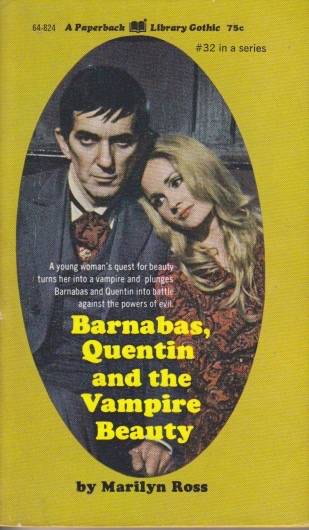
Barnabas, Quentin and the Mad Magician follows the usual formula, although this time around Barnabas is temporarily cured of his vampire curse and Quentin doesn’t turn into a werewolf at all.  They are on friendly terms and both are being set up by the rather obvious antagonist, the mad magician.  I guess you can begin to see the series winding down.  Most of the thirty-two stories are broadly similar and the writing is that rushed, breathless kind that seems characteristic of those who make a living delivering pulp fiction.  There have always been people like me who will buy it.  That’s the reason I typically use the phrase “guilty pleasure” when describing these novels.

As I note in my YouTube video on the phenomenon, Dark Shadows was quite popular in its day.  It’s what we might now call a cultural meme.  Television series, novels, two movies, comic books, lunch boxes—the whole coffin.  The monsters were likable.  That was true of some of the greats—you felt sympathetic toward them.  As horror began to “grow up” the monsters often became entirely reprehensible, with no redeeming qualities.  So as Barnabas and Quentin do their best to expose the true monster, their supernatural powers currently on hold, they have to rely on their money and connections.  Even at the end the “confession” is made suspect by the longer tacked on ending.  If you’ve read enough of these, you grow suspicious when there are ten pages left after the antagonist dies.  Stories such as this aren’t great literature, but they do fill a gap in the world of monsters that nostalgia leaves for those who knew Dark Shadows in the late sixties.


Finding Family

Sea Change is a probing story of learning to live with loss.  Of learning how to say goodbye.  I’m sure that I didn’t catch all that was being offered in this novel, but for those of us who did grow up without a father there’s a kind of therapy here.  I know that I eagerly awaited the end of work each day so that I could pick it up and read a bit more.  Framed as the story of the only child of Korean immigrants, the novel features Aurora (Ro), a young woman who has had to find her way ever since her father has gone missing.  And even before that, actually.  Her father, as a marine biologist, had captured an octopus (Dolores) who now lives in the aquarium where he once worked.  Ro, whose relationship with her mother is strained, takes a job in the aquarium after her father goes missing and befriends the remaining part of him—Dolores.

At the same time Ro’s boyfriend is accepted into a mission being launched to Mars.  (This isn’t science fiction, just to say.)  The loss is another deep cut to a woman who had to deal with the earlier significant loss of her father.  I won’t say much more about the plot since I think you should read the book, but it is a thoughtful, and from my experience, realistic journey through the mental states of those who cope with abandonment issues early in life.  Of course, I can’t speak to the experience of being a child of immigrants, but the novel shows we all deal with the same kinds of issues, no matter where we’re from.  At least we do in modern civilization.

Sea Change made me ponder, however, whether children raised communally would feel the same kind of loss if a parent they didn’t know was theirs left.  The mother-and-child bond is a deep one, so I guess it could be that fathers, after conception, would be expendable in such a situation.  It’s difficult to project how such a society would work.  The family unit is so deeply engrained into our experience that, unless a situation is truly dire, we know we can rely on our parents not to try to harm us, but rather to protect and love us.  Those of us who grew up without fathers (I’m not sure if that’s the case with Gina Chung or not) deal with insecurity issues that never quite go away.  This beautifully written novel was, for me, a healing kind of experience.


Golem Events

Public domain, via Wikimedia Commons

It doesn’t have a title yet.  At least not one that’s announced.  Still, when a friend pointed out this article that Daniel Handler, better known as Lemony Snicket, is writing a horror film about a golem, I sat up straight in my chair.  Since I don’t tend to dwell on children’s topics here, it may not be obvious that I was a real fan of A Series of Unfortunate Events, by Lemony Snicket, back when they came out.  Alerted to this series by a cousin who was my daughter’s age, we made this bed-time reading for a few years.  Handler, in the early days, did a pretty good job of keeping his identity secret.  He’s written some adult fiction, and those of us who write know that readers want more of the same thing from a writer—if you want to survive you do what they ask.

I’m a very eclectic reader—that may be one reason I don’t have many followers on this blog.  People like the same thing time and again.  (I’ve always been suspicious of genres.  One of the reasons, I suspect, that my students found my lectures interesting is that I drew from my eclectic reading, but that’s ancient history now.)  In any case, A Series of Unfortunate Events was formative in my own writing.  The movie remains one of the most gothic available, but it pales next to the novels.  Yes, they’re written for young readers, but they’re also very well written for young readers.  I discovered Snicket, or Handler, was Jewish when he wrote The Latke Who Couldn’t Stop Screaming.  And now he’s turned his attention to one of my favorite monsters.  The golem has been part of horror from the earliest days of the genre (that word!).

Paul Wegener and Henrik Galeen’s The Golem, part of a trilogy, came out in 1915.  Before the Universal monsters.  Even before Nosferatu.  The legend of the golem—which may have inspired Frankenstein—has a long history.  While not biblical, the golem does go back many centuries.  Unfortunately these early horror films are lost, or mostly lost.  The Golem and the Dancing Girl, from 1917, is a lost comedy horror.  The third film, The Golem, How He Came into the World, from 1920, survives and is sometimes called “The Golem.”  I wrote earlier about the excellent 2018 film The Golem by Doron and Yoav Paz, sensitive to Jewish issues in the seventeenth century.  This sub-genre of golem movies may be starting to come into its own.  It remains to be seen what Handler will do with it, but if his previous work is anything to go by, we may be in for a real treat.


Funny about Irving

The successful writer, John Green, has been on a tuberculosis kick lately.  You see, writers swing that way.  As the writer of books few people read, I’ve had my own little Washington Irving obsession lately.  So it is that I read Martin Roth’s Comedy and America: The Lost World of Washington Irving.  Roth knew a lot about comedy and he framed Irving’s early work as burlesque, rather than the more usual categorization as satire.  In doing this, he groups Irving together with other writers in the genre such as Laurence Sterne (who sounds like a fascinating character) and François Rabelais, among others.  (Jonathan Swift and Oliver Goldsmith also make appearances.)  Irving is analyzed in comparison to these other writers and his comic style is considered as polite satire, political satire, and domestic humor, as well as burlesque.

Insightful while occasionally assuming quite a bit on the part of the reader’s background, Roth provides quite a bit of good chewing here.  Roth was, by reputation, an unorthodox thinker.  He sounds like the kind of professor you would’ve wanted to have had in the classroom.  A book trying to parse comedy is a good sign, I suppose.  I learned a lot from reading it, and was pleased to see that I had independently come to some of the same conclusions he had.  That signals to me, anyway, that I’m not too far off track.  The benefit for those interested Irving is that, while critical, Roth isn’t judgmental.  It has always seemed odd to me that the premier biography of Irving had been written by a scholar who really seemed to hate him.  Roth, on the other hand, likes a good laugh.

As a used book my copy had lots of pencil marks in it.  So many that I had to erase them so that I could spot my own.  When I worked in the theology library at Boston University one summer I was introduced to the electric pencil eraser.  This was a device for heavy-duty removing of the marks of thoughtless patrons.  Before working for the library I stared in wonder when I would see students (perhaps not the brightest) sitting in the library, underlining in books they’d pulled off the shelf.  I think I was always too well aware that library books were not my own.  Because such folks, I’m sure, the electric pencil eraser was invented.  None of this took away from my enjoyment of Roth’s book.  I learned quite a bit about Irving’s context and, as an added bonus, got to remember using an electric eraser.

I would like to have had an image of the book cover, but mine lacks the dust jacket and finding it without violating copyright was difficult. I tried to trace this image to its origin, but I found it on Pinterest and the link didn’t take me back to the original poster. If you see and own this and want me to erase it, just let me know.

What Kind of Night?

“It was a dark and stormy night.”  If you’re like me, this evokes images of Snoopy sitting atop his doghouse, clacking away at his typewriter, trying to write the great American novel.  Many of us have tried a hand at that.  And as a writer, finding that allusive incipit, or opening line, is a major preoccupation.  For many years I believed the sentence “It was a dark and stormy night” originated with Edward Bulwer-Lytton since his 1830 novel Paul Clifford begins with this sentence.  Now considered melodramatic prose of the purplest kind, it may have been serious back then.  1830 was early in the days of novel writing.  Then I found the phrase from an even earlier work, Washington Irving’s A History of New York, from 1809.  Had Bulwer-Lytton read it?  Irving was quite popular in the pre-Dickens days.

This raises a question encapsulated in the other old phrase, “You can lead a horse to water but you can’t make it drink.”  Unless someone tells us explicitly that they read something—journals and footnotes often convey this information—it’s difficult to know.  There’s a whole genre of history books these days that examine the libraries of deceased historical individuals to determine what they read.  I suppose in the days before mass book sales there was a better chance that owning a book meant you’d read it, but not necessarily.  In college I worked as the secretary for the chaplain, Bruce Thielemann.  When he read a book he wrote a category of note in the margin and paid a secretary to go through and write the citation under a heading in a set of looseleaf binders he kept, with several pages dedicated to each category.  For sermon preparation he’d look up his theme and immediately see what he’d read.  I knew he’d read those books.

So, was Washington Irving the origin of the phrase, “It was a dark and stormy night”?  Many websites, many of them authoritatively, insist that the credit goes to Bulwer-Lytton.  I located an edition of A History of New York that replicates, word for word, the 1809 edition.  You see, Irving, like many writers, revised after publication and not all (or even most) modern editions tell you which version they use.  Irving indeed used the phrase in 1809, I confirmed.  The internet is wrongly giving credit to Edward Bulwer-Lytton for a phrase first printed by Washington Irving.  The two were contemporaries and ironically, Wikipedia points out that Irving first used “almighty dollar,” another phrased credited to Bulwer-Lytton.  It doesn’t however, point out that “it was a dark and stormy night” also belongs to Irving.  Something to ponder on a dark and stormy night.


Finally, Therapy

Like religion and horror, humor and horror can also get along well.  As an aesthetic, it’s not for everyone, but Grady Hendrix does it well.  It took some convincing for me to read The Final Girl Support Group.  I’d read one of Hendrix’s nonfiction books and was impressed, and that led me to his fiction.  It also demonstrates how an academic might actually be able to make a difference.  As you might guess, the novel features “final girls” from several fictional events, made into fictional movies, who get together for therapy.  It’s a funny idea and yet it’s not.  Hendrix clearly wants women to be treated fairly, but he’s also clearly a horror fan.  It’s sometimes a tricky balance to hold.  He does it pretty well in this novel.

The idea of a “final girl” comes from Carol Clover’s crossover academic book, Men, Women and Chain Saws.  This is the book that introduced the concept to the world.  As with most analytic concepts it’s only an approximation.  Clover noted the way that, in slasher films, the only survivor tends to be the virginal girl who doesn’t join in substance abuse.  Since the slasher genre is usually first credited to John Carpenter’s Halloween (Hendrix suggests in his acknowledgments that it’s Psycho), I’ve always wondered because Laurie Strode does take a toke in the car and we’re not really told much about her dating life.  I’m not a big fan of sequels, so maybe I’m missing something.  In any case, slashers have never been my favorites, and as sexist as it might sound, Poe’s observation about threats to beautiful women is something the “final girl” relies heavily upon.

The novel itself is pretty gripping.  I’m not going to put any spoilers here.  I was reluctant to read it but I’m glad that I did.  It’s classed as “horror” because of the theme but there’s definitely a lot of literary finesse as well.  It’s the kind of thing that doesn’t really seem to be deep, but upon reflection, it has more to say than you think it does.  The resolution of the novel is messy.  I suppose that’s one thing that makes it literary.  The characterization is amazing well done.  I had trouble keeping track of the back stories of all the final girls but that’s part of the fun.  While there are definitely horror moments, Hendrix never lets you forget that you are supposed to be laughing too.  It’s a fine balance and he manages to hold it together throughout while giving agency to final girls.


Eternal Return

Amazon gets a lot of bad press.  For me, anyone that sends me books gets a warm fuzzy association.  Besides, returns are a snap.  Amazon has sent me the wrong item a time or two.  You simply let them know and they’ll refund you.  No fuss, no muss.  Twice recently, in my effort to support both the planet and used book vendors, I have received the wrong item.  Here’s where I praise Amazon.  The most recent vendor (reputable and an old player in the used book market) required a multi-step effort to even make the claim of a wrong item, and then wouldn’t pay for the return.  Let me get this right: it is your mistake and I have to pay for it?  Just because someone who apparently can’t read the title put the wrong book in the bag and it took two weeks for me to receive it?  Is there any wonder people buy from Amazon?

To err is human.  I get that, believe me I do.  But if you make a mistake you fess up, you don’t charge the customer for your error.  Have they not realized that looking at the price tag after a trip to the grocery store is more effective than watching a horror movie?  I can’t afford to pay for their mistakes.  Then my existentialist friends come to the rescue.  Yes, they remind me, this is all absurd.  A world based on inheritance and privilege, where an active and alert mind sees that when an error is made, the one who did not make it takes responsibility.  I’m no fan of capitalism, but Amazon doesn’t make me pay for what I didn’t order.  I guess size matters after all.

Perhaps there should be caveats plastered across the internet: buy at your own risk.  If we make a mistake with your order, you will be responsible for it.  It just kills me to complain about book vendors.  Probably I care for books a little too much.  I try to buy responsibly, otherwise there’d be no house to, well, house the books.  I just don’t like feeling cheated when purchasing a used book.  It’s out of character for book vendors.  They’re the modern saints, those who are looking out for the good of the world.  Eventually the seller relented, but not happily.  My associations of Amazon will always go back to when I first discovered that there was a website on which you could find just about any book and have it delivered, and often cheaply.  I miss those days and their optimism.  I need that warm, fuzzy feeling again.  I need to buy a book.