A Girl Named Cthulhu

It was only a 25-word blurb in last week’s Time magazine. A Canadian couple decided to let the internet community name their daughter. As of the time of writing the third most popular suggestion was Cthulhu. WWLD? The internet has brought Lovecraft’s sleeping deity to life. Ironically this evil, belligerent, and fearsome god tends to have more fans than some of the more loving, cuddling varieties of deity around which western culture arose. Children are a parent’s ultimate investment (or should be) and the name we bestow will influence their view of life. I still recall the scandal of when I first showed my Mom a baseball card where the player was named Jesus (Spanish pronunciation, please!). I innocently asked if that was allowed since we’d been taught that although other biblical figures were fair game, the name of God was a retired number. There was only one Jesus, and this baseball card a monument to sinful arrogance.

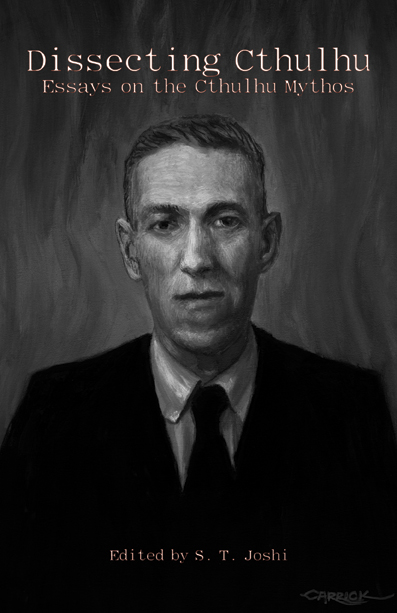
Cthulhu

Of course, we lacked the biblical training to know that Jesus is only the Greek form of Joshua, a name of fair game to any young lad. Naming after a deity was otherwise verboten. Of course, that has all changed now. Names are up for grabs, and it is getting harder to find unique ones. H. P. Lovecraft, who died in relative obscurity, could find publication only in pulp fiction magazines—the lowbrow literature of his day. The divine fruit of his fertile imagination has now taken on the dimensions of true divinity. How many potential names are out there on the internet? Lovecraft alone gave us many gods. All the Dianas, Thors, Carmans and Dylans out there are in good company. Why not name a child after a god?

Names do effect a child’s view of life. Growing up in a biblically literate family, I often thought of the Stephen of the New Testament. The first Christian martyr, he died with a vision of heaven in his eyes, earning the meaning of his name, “crowned.” I aspired to live a selfless life, in as far as such a thing was possible in the twentieth century. It was my name—it was my destiny. There are no other “Steves” in my family, and when I was old enough to comprehend that many children bear family names, I asked my Mom whence mine had come. It turns out that I was named not after a family member or even a saint, but after a cartoon character. Touché, Cthulhu! Long may those of us with unorthodox namesakes stick together. The world is our myth.


Dagon Cthulhu

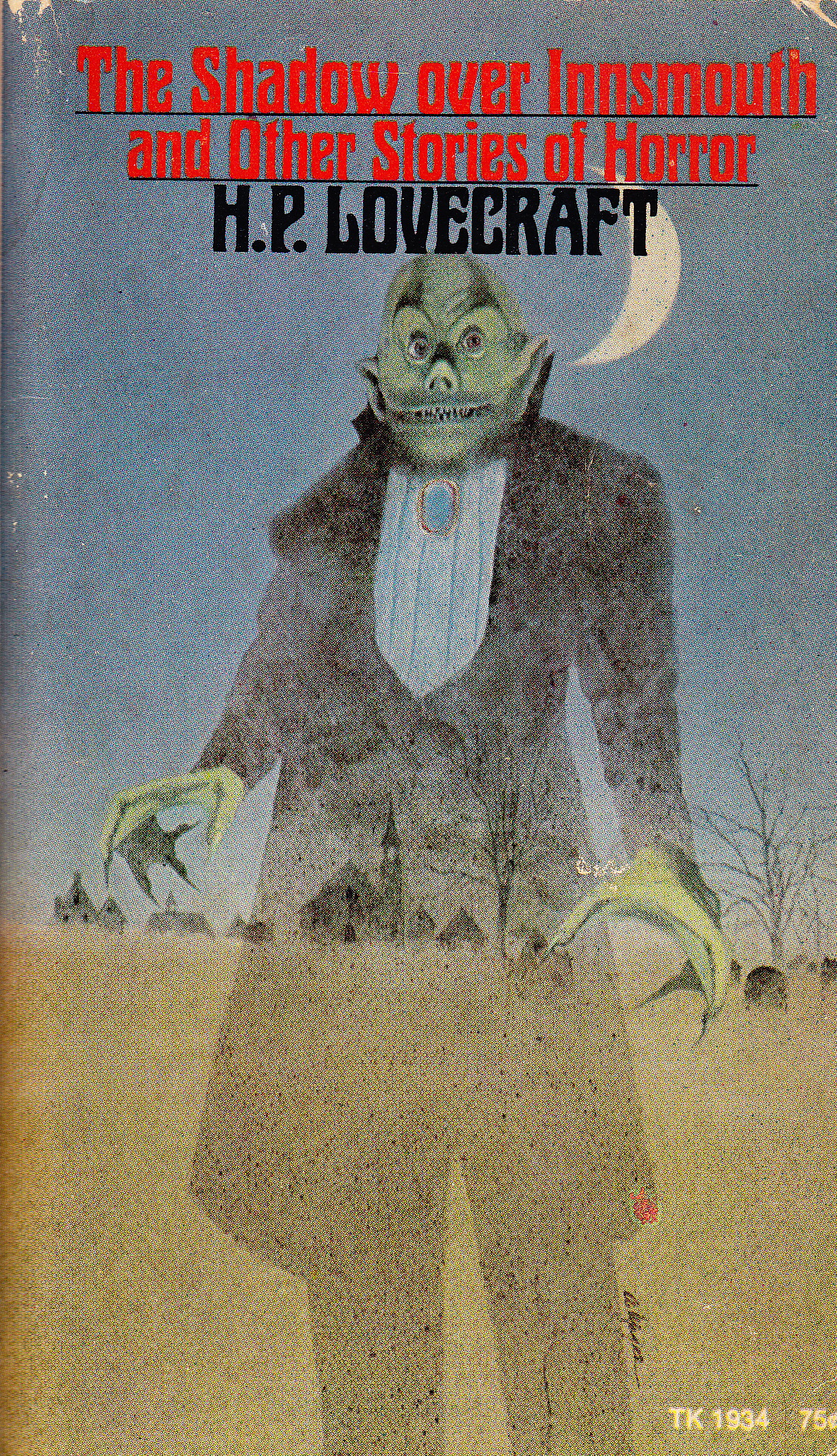
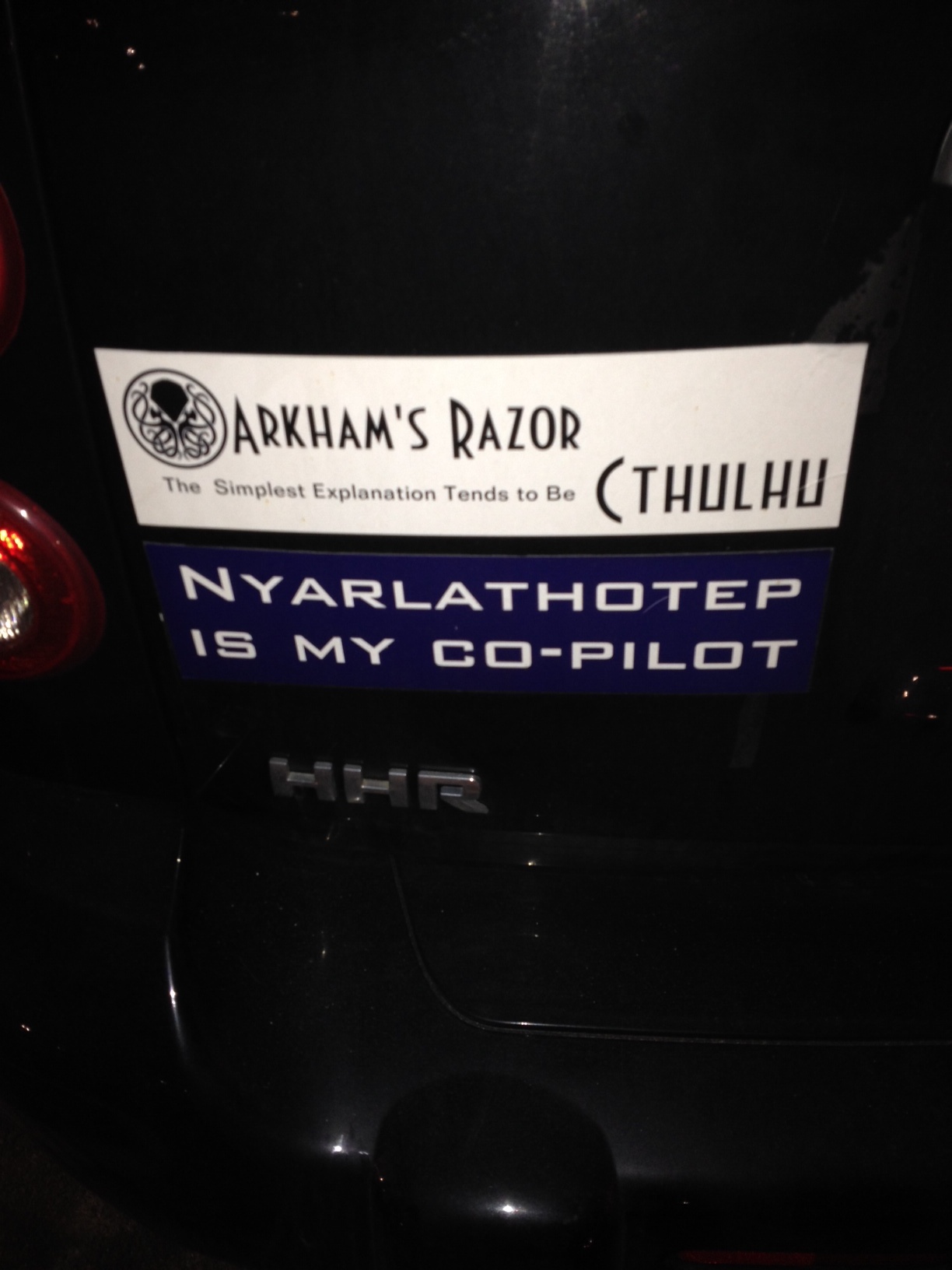
Cthulhu has taken over the world, thanks to the internet. I wonder what H. P. Lovecraft thinks as he lies dead, but dreaming under the loam of Providence. A lifetime of struggle to gain recognition as a writer left him without much of a following, relegated to pulp magazines for low brow and Innsmouth-dwelling mentalities. Now everywhere from Davy Jones’ face in Pirates of the Caribbean to car bumpers in any parking lot, Cthulhu has awakened. My wife sent me a photo of a couple of such bumper-stickers recently: “Arkham’s Razor,” reads one, “The Simplest Explanation Tends to Be Cthulhu.” “Nyarlathotep is my co-pilot” reads another. I first discovered H. P. Lovecraft through bumper-stickers.

Lovecraft

Back in my post-graduate days in Edinburgh, I had decided to write my dissertation on Dagon. This seemed a reasonable topic as no serious, book-length treatments of this elusive, Mesopotamian deity existed. My advisors talked me out of it, however, noting that material on Dagon was so scarce that it would be extremely difficult to scrape enough together to call it a dissertation. A few years later, it turns out, an academic book on Dagon finally appeared, but the fact remains that he was, and is, a major deity who somehow mostly disappeared from the ancient records—the victim of chance finds and perhaps more aggressive gods. For my birthday one year my wife bought me a bumper-sticker with a “Jesus fish” that had the word “Dagon” inside. I posted it on my office door in Oshkosh and the department chair asked me what the tentacles were meant to represent. An web search indicated that the Dagon was not the biblical “fish god” but the Lovecraft reincarnation. I had experienced an epiphany.

Lovecraft, although an atheist, knew his Bible. I once wrote a scholarly article on the Dagon story in 1 Samuel 5 where the Philistine statue of Dagon falls down, decapitated, before the captured ark of Yahweh. This is the sole narrative involving Dagon in the Bible, and it concludes by saying only Dagon’s “fishy part” was left intact. Lovecraft took this obscure Bible story and built an entire mythos from one of its characters. Cthulhu, Dagon, Nyarlathotep, Shub-Niggurath, and their companions have risen from the deep, and encircled the world in an electronic web. The fact that kids who’ve never read Lovecraft can identify Cthulhu at a glance, attests to his power. Even Batman fans who cite Arkham without knowing that it was originally Lovecraft’s creation keep the master alive beyond the grave. Isn’t that what resurrection is really all about? Even if a writer has to be discovered through bumper-stickers.


Of Cuckoos and Kings

One_Flew_Over_the_Cuckoo's_Nest_poster

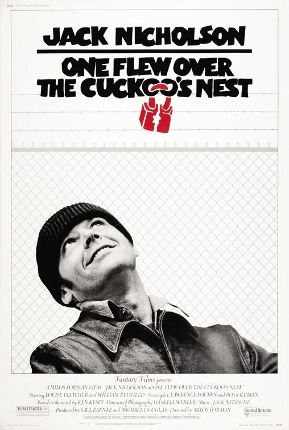
Having a life-long phobia of mental institutions, I shy away from situations that refuse to make sense. Some have attributed this to my having had an alcoholic father and responding with an über-rational expectation of analyzing how other people would likely act. Whatever its cause, the fear is real. So thirty years ago, when I watched One Flew over the Cuckoo’s Nest, I assumed it would be the last time. It was a relatively recent movie at the time, and it was required viewing for one of my college courses. With my phobia I really couldn’t get beyond the heebie-jeebies to consider what was going on beneath the surface, which is to say, most of the movie. Well, a few decades will cure many ills and I sat down to watch the movie again and my own experiences of asylum-like, heartless institutions in the intervening years had indeed hardened me a bit. I noticed much that I’d missed the first time around. For one thing the story of King David kept coming to mind.

For those who read the Bible somewhat objectively, David is a player, and not always the most admirable character. He has a subtle charm that wins the reader of the books of Samuel back time and again. He steps into a situation where his ambition is held back by a kind of Nurse Ratched named King Saul. So what does David do? He pretends to be insane and runs off to join the Philistines. He gathers a band of miscreants about him and goes to towns taking what isn’t his. He even brings a forbidden woman into his house. As R. P. McMurphy goes through these same shenanigans, he comes to really love young Billy (Saul’s son Jonathan). In the course of the movie our ersatz David takes a suffering nation and heals it. There, however, the parallels end and Ken Kesey’s story takes over.

Of course, I’m not suggesting that Kesey intentionally drew on the story of David—that would be crazy talk—but I do often wonder about the aphorism attributed to his son Solomon that there is nothing new under the sun. There were those who felt that Solomon had lost touch with reality as he sat down to write Ecclesiastes. The great stories, in some sense, have already been told. But not all. Those of us who write seek new truths, and sometimes use ancient sources to do it. David is remembered as one of the great biblical characters. One of the reasons, undoubtedly, is that he is so fallibly human—he’s not impossibly pious like Moses, or unfailingly sad like Jeremiah. He is a good man with peccadilloes for which we are willing to forgive him just for the pleasure of watching him go on. No, Kesey may not have had the Bible in his hand as he dreamed up the character of R. P. McMurphy, but he produced a true representation nevertheless. Of course, I might just be insane myself.


2013 in Books

Screen Shot 2014-01-05 at 6.03.10 AM

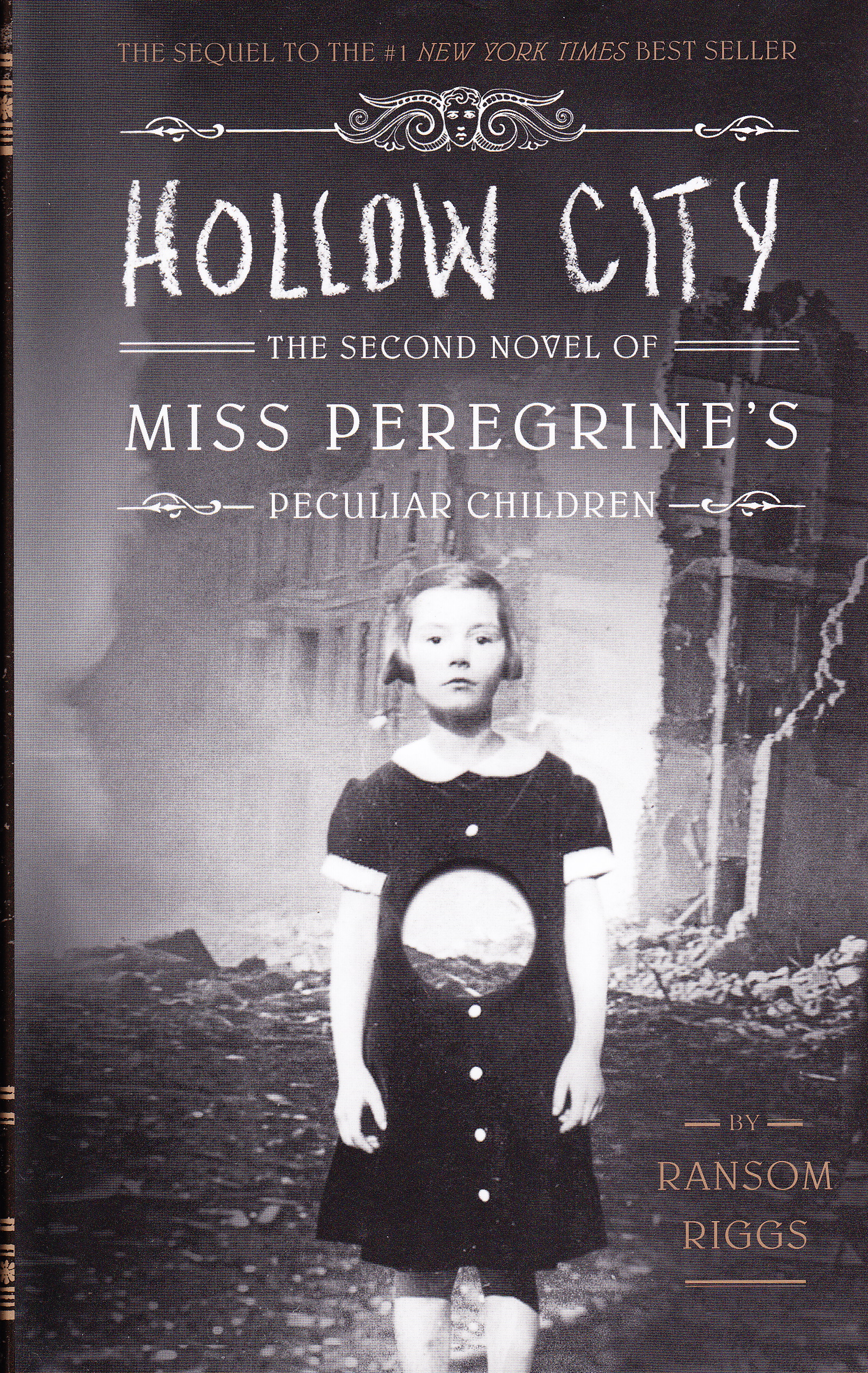
According to goodreads.com, I read 83 books in 2013. The beginning of a new year seems a good time to assess what is memorable among the reading material of the previous twelve months. I am an eclectic reader: this informed my research when I was teaching in higher education—nobody can know everything, and it doesn’t hurt to keep an eye on what fellow researchers in “unrelated” areas are doing. I always throw in a healthy dose of novels as well. Among the novels, some of the most profound were those written for younger readers (each of the books discussed here, by the way, can be found discussed in more detail by selecting the category “books” at the right on this blog). Neil Gaiman’s The Graveyard Book, Ransom Rigg’s Miss Peregrine’s Home for Peculiar Children, Suzanne Collins’ The Hunger Games, and Markus Zusak’s The Book Thief all stand out as particularly profound. They are all, as young adult books tend to be, stories about coming to terms with the adult world. The theme of death weighs heavily in all of them. In none do the children take refuge in religion.

Screen Shot 2014-01-05 at 6.02.33 AM

Among the non-fiction offerings, revisiting my most memorable also reveals trends, I think, in how religion might be usefully applied to an increasingly secular culture. It is no easy task to choose favorites, but I see that I read three books about comic books: Mike Madrid’s The Supergirls and Divas, Dames, and Daredevils, and Christopher Knowles’ Our Gods Wear Spandex. The work of Jeffrey Kripal started me on the quest of taking superheroes seriously as sublimated religious figures. Clearly that is the case, as has become increasingly apparent in top-grossing movies. Another set of books (Thomas Nagel’s Mind and Cosmos, John Angell and Tony Marzluff’s Gifts of the Crow, and Curtis White’s The Science Delusion) highlighted some of the deeply rooted flaws of a materialist reading of the world, whether they intended to or not. Robin Coleman’s Horror Noire, and Susan Hitchcock’s Frankenstein indicated that monsters are among the most eloquent of social critics, even when they have little to say. I would recommend any of these books without hesitation.

Screen Shot 2014-01-05 at 6.02.02 AM

Some of my reading was on specific religious traditions. Maren Cardin’s Oneida, Hugh Urban’s The Church of Scientology, Sean McCloud’s Making the American Religious Fringe, and Andrew Chestnut’s Devoted to Death each showcased either a single or several traditions that have emerged in the last century or two that have had a striking impact on America’s religious morphology. Katie Edward’s Admen and Eve is a great example of how businesses have figured out that a religiously hungry society will buy, if marketing pays attention to religion. Among the most powerful books I read were Susan Cain’s Quiet and Jonathan Gottschall’s The Storytelling Animal. Being human is, after all, the most religious of experiences. Starting with fiction, I’ll end with fiction. The novels for adults I remember most vividly are those with strong female protagonists: Sheri Holman’s Witches on the Road Tonight, Piper Bayard’s Firelands, and Elizabeth Kostova’s The Historian.

Screen Shot 2014-01-05 at 6.01.24 AM

This blog offers me a chance to give brief sketches of books that have much more to say than a few words might summarize. The fact that religious ideas and themes might be found in such a range of books underlines once again that we live in a religious milieu, whether we want to admit it or not. Read on!


An Odyssey

Jorge_Luis_Borges_1951,_by_Grete_Stern

I learned of Jorge Luis Borges through the recommendation of a friend some years back. Of course, knowing about a writer is never quite the same thing as reading what s/he has written. So it was that I recently picked up an edition of Borges’ short stories entitled, biblically enough, “The Aleph.” I find that these stories require slow reading, chewing over rather than swift gobbling down, like so much of what ends up on the mass market shelf. In lives squeezed for time between the incessant demands of cell phones, social media, and plan old television (satellite or cable), spending unrushed minutes with a thoughtful story can seem a waste of time. I suppose that’s the sole benefit to a long commute on public transit—reading is always an option (although, sadly, not one frequently utilized, to guess from all the electronic farts emitted by computerized devices all the way home).

The first tale in my volume is “The Immortal.” Perhaps it is the hand of the translator, but the sensibilities of Borges are not unlike H. P. Lovecraft. Borge was influenced by Poe as well, and as the narrator of this tale encounters Homer in the land of the immortals, it is only fitting that the question of mortality should arise. Joseph Cartaphilus, the narrator, notes that the three western religions all claim to offer immortality, but in reality focus on the only part we intimately know, the part we call being alive. Often this idea has come to me as well when encountering one so sure of an afterlife but so fearful of death. If immortality does not banish terror of the grave, what use is it?

Indeed, as Cartaphilus realizes that he has drunk from the river of immorality, even the company of a devolved Homer can not entice him to live forever. Off he rides in search of death, a solace that comes only once he has sold his story in the form of a used book dealer, within the back cover of the Iliad. Once the story takes on the life of the teller, he is free to die. There is so much going on in this brief tale that two readings have only begun to scratch the surface. Borges lays religion’s follies at its feet, but shows that there is still much more to fear. I can see the draw, and as a new year dawns, I can see myself becoming more acquainted with Borges and gaining the insight that only thoughtful fiction can bring.


Read Until Ragnarok

Wpa-marionette-theater-presents-rur“The play’s the thing. Wherein I’ll catch the conscience of the king,” quoth Hamlet. Shortly after the Velvet Revolution, my wife and I were shown about Prague by a friend who’d grown up in Communist ruled Czechoslovakia. As we watched the changing of the guard, he told us how Václav Havel, the final president of Czechoslovakia, had been a playwright and appreciated the need for pageantry in such civil ceremonies. I remember being impressed with what this playwright had accomplished while America had just survived being ruled by a lackluster comedic actor whose major contribution had been the myth of trickle-down economics. Havel was at one point selected as ranking high among the world’s top hundred intellectuals. Somehow Bedtime for Bonzo just didn’t seem to be worth bragging over.

Within another year or two, Czechoslovakia would dissolve, but the world would remain impressed by the Czech playwright. Karel Čapek was another Czech author and playwright of considerable import. Čapek, “public enemy number two” of the invading Nazis, died before the National Socialists could reach him. His brother died in Bergen-Belsen. Čapek is the author of the play R.U.R., or Rossum’s Universal Robots. Indeed, he coined the term “robot,” around which this play revolves. Over the holidays I finally had a chance to read R.U.R., and I was immediately struck by how prominent the meme of God appeared, and also how prescient Čapek was. Like his contemporary Franz Kafka, Čapek had an unsullied vision of human propensities. Not having seen a production of R.U.R., or knowing how it would play out, I was nearly buried under the layers of meaning that such a brief piece could convey. Harry Domin, the general manager of R.U.R., supplies the world with robots for the easement of human labor. These robots eventually acquire souls, through human tampering, but also rely on humans for their reproduction. All of humanity, save a sole survivor kept alive to make new robots, is destroyed. Alquist, the last man alive, realizes when one robot will lay down its life for its mate, they have become a new Adam and Eve, and humanity’s existence is truly at an end.

Although I’ve read about robots since I was a child, I didn’t know about R.U.R. until my daughter joined her high school robotics club. Robots have, in many ways, dominated my life since. Although Čapek’s play is funny in parts, it is dystopian and profoundly troubling. Our robots have evolved since the period of World War I, just after which the play was written, but our moral sensibilities have not kept pace. Helena, the eventual wife of Domin, feels that robots should be given a soul. At first they feel no pain, mental or physical. Once they acquire these, however, they begin their inexorable march to the elimination of humankind. Reading of how technocrats believe that our true function is now to service the robots who do much of our work today, while unemployment just won’t release its grip on the flesh, my thoughts go back to Karel Čapek, Václav Havel, and William Shakespeare. The playwrights create, but the actors just ape.


Writing the Cosmos

EvermoreOn occasion those with great wealth try to give something back to society. One such gift takes the form of libraries. The J. P. Morgan Library on Madison Avenue in New York is a touch pricey for those who live in humbler domiciles, but the Edgar Allan Poe display proved too immense a draw to ignore. Standing inches away from manuscripts written in Poe’s fine hand was a kind of communion. It wasn’t too difficult to believe he might have somehow been there. In Baltimore last month I didn’t have the opportunity to revisit his grave, but I picked up a book by one of his modern cousins, Harry Lee Poe. This Poe has theological training and an interest in seeing that his famous cousin isn’t theologically shortchanged. Evermore: Edgar Allan Poe and the Mystery of the Universe is a rare look at Poe and religion. Treatments of the theology of writers are hardly rare, but since Poe wasn’t openly religious, he was typecast a little too readily into the putatively godless camp of those of us with a taste for the macabre.

Evermore may not convince everyone that Poe was a profound religious thinker, but Harry Lee Poe marshals substantial evidence from both Poe’s published writings and letters that he was often caught in that crux between science and religion. Indeed, there is no evidence that Poe was an atheist. He wrote on what were considered lowbrow topics because those were the kinds of pieces that would sell. Since Poe was perhaps the first American to attempt to make a living solely by his pen, he had to pay attention to what people wanted to read. Evermore, while not a biography in the usual sense, does point out that Poe wrote across genres and that his life, while often tragic, had many spells of happiness and some contentment. Poe was a victim of character assassination after his death by a second-tier clergyman, Rufus Griswold. Much of the book is spent dispelling myths.

Perhaps above all, Edgar Allan Poe had a clear mind that could keep imagination alive in the religion and science debate that was to explode shortly after his death with Darwin’s Origin of Species. For Poe, the universe was a story being crafted by God. Creativity was essential to beauty, a concept that haunted Poe. A writer must be introspective, and this will often leave him or her open to criticism by those who prefer simpler answers. Great beauty can be found in complexity, however, and the practice of ratiocination requires a healthy dose of imagination to help make sense of a world that often seems to make no sense any other way. And standing here, my face inches from a handwritten copy of “The Bells,” I can almost hear them ringing.


Believe Eve

While NORAD has already begun to track Santa with DSP (Defense Support Program) satellites, and last-minute shoppers are being bombarded with Christmas carols to cinch out that extra dollar or two, it may be odd to consider the music Sine Nomine by Ralph Vaughan Williams. Better known as the music of the stirring hymn “For All the Saints,” Sine Nomine (“without name”) is some of the most inspiring music of the liturgical year. I remember a friend once leaning over after the hymn and whispering, “hard to believe it was written by an agnostic.” Vaughn Williams was an Anglican agnostic. At this time of year his piece “Hodie: A Christmas Cantana” may be heard in the households of anglophiles around the world. “Hodie” (“this day”) is an anthology of poems set to Vaughn Williams’ music. One of the poems, “The Oxen,” was written by Thomas Hardy. I really never paid much attention to it, until my wife pointed out the words and the liner notes by Alain Frogley on our CD of “Hodie.” Hardy’s poet recalls believing in his youth that oxen kneeling (as oxen do) was a reverential act on Christmas Eve. Now as an adult, the poet writes that if someone should invite him to see the kneeling beasts, “I should go with him in the gloom, hoping it might be so.” Frogley’s notes point out that Thomas Hardy, like Vaughn Williams, held a “complex agnosticism.” It is not the solid rejection of the divine that is all the rage these days, but a difficulty in believing something that is hard to let go. And Santa flies over Russia.

Faith can be a many faceted stone. We keep the myth of Santa Claus alive for our children, thinking it merely harmless fun. Then comes the moment of truth. Some prescient children at that point begin to extrapolate: what else have you been telling me that isn’t real? That the creator of an infinite, but expanding universe took time out of a busy schedule to be born in a cattle stall in Bethlehem two millennia ago? That a government might turn on its children and kill them rather than face a challenge to literal, kingly authority? That emissaries from the Middle East might come with rare and precious gifts? That Santa visits that homeless man I saw curled up on a corner of Seventh Avenue last night under a black umbrella as chilly rain pelted New York City? So much to believe!

Screen Shot 2013-12-24 at 6.59.21 AM

I once held a secure job in an anglophile seminary. The music of Vaughn Williams was often heard to echo through St Mary’s chapel, and many myths were propagated. Standing out under a frigid, clear Wisconsin night, it was almost possible to believe that Santa was up there somewhere, being tracked by North American Aerospace Defense Command. Yes, the oxen would be kneeling on such a night. This morning before dawn, I glanced at NORAD’s page. I saw the words “Secret Santa Files” and my mind flew to NSA. A government that keeps track of our personal emails and private phone calls even holds secret files on fictional characters whose motive nobody ever questions. Truth in advertising indeed. So, on this Christmas Eve, I imagine myself out among the free range cattle and sheep of first century Judea and there I happen upon two shivering artists in the dark, huddled around a campfire while others claim they hear angels singing. Vaughn Williams and Hardy exchange knowing glances, and Herod prepares to roar his decree from his one-percenter throne.


Sweet Something

SweetHeavenWhenIDieAs an observer of religion who always struggles to get published, I found a companion soul in Jeff Sharlet’s Sweet Heaven When I Die: Faith, Faithlessness, and the Country In Between. Although the book is a collection of very disparate essays, it shows the subtle faces that religion frequently takes. We’re used to hearing religion described in bombastic terms, but Sharlet is more attuned to its soft rhythms than that. Yes, an essay or two may have a strident believer, but most of the faith found here is so deeply woven into the lives he examines that you might not even notice it was there had Sharlet not already warned you. Here is a man of no particular religious conviction showing us how it is—not judging, not ridiculing, not pandering. Religion, despite the gleeful proclamations of its detractors, is not likely to die out. It is more likely just to go unnoticed.

A number of the essays here gave me pause. In the first Sharlet notes of a friend, “She was fascinated by the thought that God was entitled to kill you at any time.” This friend is, of course, of Christian persuasion. I had never thought of the biblical paradox in that way before—divine entitlement. It is so like Job; the Lord giveth and the Lord taketh away. Christianity, historically, comes with a whole cartload of guilt: not only is God entitled, but we deserve to be killed. The Christianity in which I grew up was explicit about this—we live on borrowed time. As a child I heard more than one evangelist thunder this good news. We really deserve to die. Once we are good and vulnerable, the preacher offers us a way out. Pass around the collection plate. God is entitled; I shall not soon forget that.

Toward the end of the book another of Sharlet’s interviewees declares that doubt is a calling. Again, the professional religionist is stunned. Many religions eschew doubt as somehow evil—wickedly questioning the divine. Doubters, however, seldom cause religious trouble. Those whose convictions lie deep and untested will burst open like a spring-loaded trap at various provocations. Those who survive are left to weep and wonder. The doubter, the friend of Thomas, does not seek to harm, but can’t live without discovering the truth. This is true religion.

There are any number of stories here of persons of various levels of faith conviction. You’ll find few clergy or specialists among them, but you’ll find a book whose honesty cannot be doubted. At points I struggled to find an implicit religious, or faith-based theme. It is there. You just have to listen. And trust that Jeff Sharlet will not lead you astray.


Making a Monster

I was maybe six or seven when Frankenstein’s monster charged us. My mother, brothers, and I were part of a small crowd at Niagara Falls, where we had gone to visit relatives, when we found ourselves in the monster’s path. We were among of a knot of tourists, and plate glass separated us from the great roaring beast, posted to draw visitors to one of the many plastic tourist attractions around the famous falls. Each time the monster charged, we all screamed, knowing full well he could never break through that glass. As a member of the Monster Boomer generation (although on the tail end of the boomer part), the monster that disturbed me the most has always been Frankenstein’s monster. I’m not sure whether that was natural squeamishness, or if it was that as children my brothers and I tried to divide things up evenly and I ended up with the vampire while one of my brothers claimed possession of “Frankenstein.” Certainly when I grew old enough to read the book, it only added to my discomfort. The concept of Frankenstein’s monster was old enough to have lost its scary edge, but the story was very sad. The monster was not evil, but lonely.

HitchcockFrank

Sarah Tyler Hitchcock’s Frankenstein: A Cultural History revealed a new angle on the monster. A thoroughly fascinating anthropological approach to one of the more modern constellations in the night-time sky of fear, what became immediately obvious in this book is just how religious a monster Frankenstein’s creature is. Many of us think of “playing God” as a recent phenomenon. Mary Wollstonecraft Godwin (Shelley)’s Frankenstein was published in 1818 with just that concept in mind. Mary Shelley, barely twenty when the book was published, had tapped into one of the most vital of religious topics—what it means to make life. Hitchcock’s treatment of the subject covers the conception of the monster, the book and its history, the plays and movies based on the story, and Frankenstein’s monster’s reception into popular culture. At every step of the way, religious issues are raised. Mary, in her birth of an immaculate creature, gave the world theological conundrums through which we’re still sorting nearly two centuries later.

Often on this blog I maintain that monsters and religion are cut from the same cloth. Hitchcock provides a compendium of supporting evidence in her compelling book. Even down to the contemporary debates of scientists over genetic engineering and cloning, the story of Frankenstein and the overstepping of ethical boundaries comes up again and again in scientific literature. I couldn’t help but to think how this reflects the current acrimony between the materialists and the dualists among the intelligentsia: is the forging ahead with manipulation of life simply an experiment we must undertake or is it really an ethical (read “spiritual”) issue after all? Mary Shelley was not so strident as her erstwhile husband Percy was regarding the necessity of atheism. Her monster seemed to be raising that question in terms profoundly theological for a girl not yet of seminary age. Sarah Tyler Hitchcock has done us a great favor by producing a history that stitches religion, culture, and science together into a beast that we still haven’t learned to control.


Poe Knows

CambridgeEdgarAllanPoeA recent trip to Baltimore prompted me to read Benjamin F. Fisher’s The Cambridge Introduction to Edgar Allan Poe. Well, that and the fact that I had purchased the book from an overstock table on a visit to a local indie bookstore (support your local!). Poe is a difficult writer to get to know. His personal life seems to have been largely an effort to find financial security while he knew his intellect was greater than those who employed him, and yet he was the one left without means. His literary talent, now considered one of the brightest constellations in the American writers’ heavens, was denigrated and demeaned and not fully appreciated until after he died of unknown causes in a city where he no longer lived. There is a profound sadness about Poe, and he seems a tragic figure. I do wonder, however, whether success would have ruined him. The more society woos you, the more you’re willing to lower your standards, I shouldn’t wonder. Not that I would know.

GhostsKnowFisher’s guide is a basic introduction that only toys here and there with Poe’s religious outlook. I’ve not run across much about Poe and religion, but there is a deep spiritual awareness, along with ratiocination, in his tales and poems. I suspect it might go back to the fact that religion and fear are so tightly intertwined. If a religious element is missing, it sometimes leaves a reader hungry. I’d also been reading Ramsey Campbell’s Ghosts Know concurrently with Fisher. This is a novel where a skeptical radio talk-show host takes on a stage psychic to see who really knows who might’ve killed a young girl. As the story unfolds it becomes less and less likely that the psychic is tapping into anything other than individuals’ wish projections.

While I found both of these books interesting, I pondered the fact that Poe referred to the scariest elements in his works as “terror of the soul.” The supernatural in Poe, as Fisher points out, is often really just a projection of an interior state of one of the characters—the eponymous tell-tale heart is guilt breaking through, not an undead heart beating. In an era where belief in the soul is waning, scary books seem less frightening. We’ve been robbed of both the supernatural and the soul, so what is left to fear? If death is only a more profound kind of sleep and morals are only a matter of social convention, then we are truly alone in this vast universe. Of what should we be afraid? Still, when the night stretches on for many long hours this December, I find myself inclined toward Poe and I wonder if ghosts truly do know.


Reach Out and

Contact_ver2Carl Sagan, one of the great proponents of the idea that earthlings have never been visited by aliens, wrote a novel entitled Contact. I haven’t finished reading it yet, but many years ago, on a long plane ride, I caught part of the movie version—most of it without the sound on, as I recall. While the ideas have been brewing for about a decade, I’ve been meaning to get around to watching the film. It is a bit of a slow-starter, but I finally sat down to watch it, with sound. While the movie ultimately remains agnostic—with a Twilight Zonish twist at the end—about whether the contact is truly alien or not, one aspect leaves no room for doubt: the movie is really about the relationship between religion and science. Eleanor Arroway cannot raise faith in anything but science, especially since her father’s premature death. Although she has a brief affair with Palmer Joss, a theological journalist, she just can’t believe what her senses don’t confirm.

Once the alien signal is announced, the response of the populace is overwhelmingly religious. One sect in particular seems to channel its faith into the hatred of science, and even Palmer, now an advisor to the president, questions whether science alone can really help humanity to progress. He is the one who nails shut the coffin of Dr. Arroway’s hopes of going to Vega to see the aliens. The reason: she doesn’t believe in God, and therefore is not qualified to represent the human race. Ah, the cruel irony of it all. When she finally does get a chance to visit space, the results are both Freudian and religious. She finds her father in a place like heaven, but her beloved science makes no record of her journey. At a congressional hearing she is made to admit that she believes in what happened without proof. Science is now standing on faith while the religious look smugly on.

Despite the pacing, Contact is an enjoyable movie. In many ways it hasn’t aged much since its 1997 release. Science and religion are still at loggerheads in some camps, and we are no closer to the stars than we were a decade and three-quarters ago. Reading books on the nexus of religion and science, one often gets the impression that the two are inevitably foes. Much of it goes back to a principle that recurs throughout Contact—Occam’s razor. The idea that the simplest explanation is the best does not seem to serve science (or religion) well. Although it works most of the time, it is because, as a friend recently said, we are willing to sweep the stuff that doesn’t fit off the table. Contact showed Occam’s razor with its indiscriminate cutting. Both the religious and the scientific end up bloody when it’s all over (metaphorically speaking, of course). It seems what religion and science really need is indeed contact.


The Write Place

In my mind, Baltimore is inextricably bound to Edgar Allan Poe. From the accounts of Poe’s life, it is clear that he sensed nowhere as a welcoming home. Indeed, he was barely mourned at his passing and the memorial gravestone in this city was only added decades later when his works had attracted serious attention. Many of the eastern cities now like to claim him: Boston (although with Bostonian diffidence), New York, Philadelphia, Baltimore, and Richmond. All have various mementoes of his transient existence in those places, although he was not made to feel at home there when he was actually alive. The writing life is a difficult and often lonely one. Poe knew that better than many. It is so lonely that nobody is even sure why he was in Baltimore when he died, or what the cause of death was. He has become an icon to many that write.

Ironically, my career has repeatedly shoved me back to the publishing industry. That doesn’t mean that it is any easier to get published, however. The world is full of words, and those who hold the key to publishing respectability have so little time (a fact I know well, as a sometime editor). Some of us resort to blogs and pseudonyms while others die young in Baltimore. The world loves a self-promoter. Those with something intelligent to say are often discovered only in retrospect. And soon their work enters the public domain and can be claimed by all.

Other writers have called Baltimore home. Not many have football franchises named after their literary works, whether here in Maryland or elsewhere. And Baltimore, like many of the major cities of the United States, has great swaths of the neglected, the poverty-bound, and the hopeless. As I drive through the city it is clear that many have been left to face the cruelties of a self-promoters’ economy. They live with little—overlooked and forgotten. But there’s a party in town for those who can afford it. As I settle down with a cask of Amontillado and my notebook, I know that I have only just begun to get to know Baltimore. Maybe I will meet the ghost of Poe here, amid the brightest lights of scholarship and the darker shadows beneath.

Poe in New York

Poe in New York


History Bites

historian-elizabeth-kostovaAfter reading a post I’d written about Dracula last year, a friend recommended that I look at Elizabeth Kostova’s The Historian. This novel is very easy for a vampire fan to lose oneself in, taking a sweeping scope of the Balkans and western Turkey, and adding enticing bits of northern Europe as well. Although it is a novel, it is also a history lesson in international relations and in the costs that accompany clashing religious empires. Christendom and Ottoman powers frequently exchanged hostilities long before the Bush presidency, and it was in this milieu that Vlad Tepes, the Dracula of history, emerged. Interestingly, although vampires had been part of religious folklore since the earliest civilizations, it took Bram Stoker to make Dracula into one. It is difficult to believe that, with the household name-recognition of Vlad III’s epithet, Dracula would’ve likely remained one of history’s more gruesome footnotes without Stoker’s undead imagination. Vampires would’ve survived, I’m sure, but Dracula might not have come back to life.

Kostova does an excellent job of blending fact and fiction in an epic vampire hunt. She also takes the somewhat unusual step of making the historical Vlad her actual vampire. A defender of the Christian faith against the Turks and their Muslim ways, Dracula did earn a reputation for cruelty (and unusual punishments) during his lifetime. Kostova keeps him alive through a kind of scavenger-hunt through history as his decapitated body must be brought back together with his head, and then through the wilds of Transylvania, Wallachia, Bulgaria, and even into the cosmopolitan streets of Constantinople. This is an intellectual’s vampire story if ever there was one.

Although Dracula’s association with the vampire mythos began with Bram Stoker, his role as a symbol of religious conflict boasts much older roots. Indeed, conflict over what is the “one true faith” has been a bloody avocation of humanity since universal claims of salvation began to be made. The conflict continues, in a somewhat more civil guise, as science flexes its considerable muscles over the less empirical realm of religious belief. No matter which strand of religion one believes, if any, faith has a strange ability to set people seeking one another’s blood. The symbol of the vampire does not seem to be departing any time soon, for vampirism is part of human nature. We may never shed the physical blood of another, but we continue to participate in cultures where the strong impose their wills on the weak. And that is a scene darker than even the scariest tomb painted in The Historian.


Honorable Theft

The_Book_ThiefYoung adult literature can be amazingly profound. My curiosity about Markus Zusak’s The Book Thief bubbled to the surface after the movie was released last weekend. I didn’t see it, along with thousands of others, because of its very limited theatrical release. I’m sure you know that distressing feeling when you type your zip code into Fandango and come up with zero results. Short of going all the way into New York City just to see a movie, I was pretty much out of luck. The silver lining is that it made me read the book. I’m not sure what I was expecting (I can also be the victim of hype), but what I found was deeply engrossing while also being deeply disturbing. Spoiler alert!

The Book Thief is set in Nazi Germany. It is narrated by Death. The protagonist, Liesel Meminger, represents the plight of all people; we have no control over when, where, or to whom we’re born. With parents considered enemies of the state, the Book Thief is raised by foster parents who are German, but who are also poor. They are good people, and much of the tension in the book revolves around their hiding a Jewish friend in their small house. The convention of Death as a narrator predates George Pendle’s Death: A Life, by three years. Although in the end Death is the only survivor, he is remarkably sympathetic to the human condition. Death also supplies the main religious observations in a book otherwise devoid of God. When Death attempts to pray during the horrors of war, a devastating conclusion is drawn: “God never says anything.” Is that why Veteran’s Day celebrations tend to be so silent? There may not be any atheists in foxholes, but there’s no God there either.

As Death stalks all those who are dear to her, Liesel finds her comfort in books. Although she begins the story illiterate, and although books are difficult to find in a poor family in a nation at war, Liesel discovers that words have a power that even dictators can’t steal. Her love of reading saves her life as her street is obliterated in an air raid. Even Death has to question the futility of war. In my most idealistic of moments, I hold the conviction that many of the world’s evils would be eliminated if people just read more. We would discover, for example, that even the devastation of war can be overcome by words. The only book Death is portrayed as reading is the Book Thief’s life story. And this gives Death pause, because even young adult literature can be amazingly profound.