Masked Reality

Before I make my confession you need to consider that I spent much of my professional life as a seminary professor.   Never ordained, I nevertheless donned the cassock and taught future priests what they’d be assumed to know (the Bible) while trying to earn an academic reputation through my publications.  It was a double life in which one half involved the church.  Shortly after that job ended I saw trailers for Nacho Libre, a movie in which Jack Black plays a monk who moonlights as a luchador, a Mexican professional wrestler.  I never saw the film, but I had been raised on a white trash diet of World Wrestling Federation fandom, back in the day when that involved gathering around the television to watch grown men posturing and preening while knowing that none of it was really real.  I secretly wanted to see Nacho Libre.

Recently I visited friends who had the movie.  They warned me that it was corny, but I had already supposed that.  What I didn’t realize until after it was over (for movie viewing is now followed by internet viewing) is that it is based on a true story.  “Based on a true story” doesn’t mean, of course, that a movie accurately portrays events, but I had no idea that a Mexican priest had actually supported an orphanage for over two decades as a masked wrestler under the name of Fray Tormenta.  I followed up the movie with a little web research because the film was remarkably respectful of the church.  The character of Ignacio never criticizes Catholicism, and he clearly cares for the orphans for whom he serves as the cook.  His wrestling winnings go toward purchasing better food for them.

Earlier in the day we watched the movie I’d talked to one of my friends about how religious life, no matter how seriously it’s taken, involves acting.  People generally put on masks before going to church (or any other function in which they interact with others).  Religion requires a level of piety impossible to sustain in the real world.  Early in the history of Christianities it became clear that the church would hire some religious specialists to try to take on the lifestyle toward which all faithful should aspire.  I’ve trained many priests.  I’ve seen them when they’re in mufti.  I know that in the vestibule, at the altar, or in the pulpit they’re wearing masks.  Many of them have the heart of Nacho Libre, but outside the church doors they still have bills to pay and family and friends who know them as they really are.  As we slipped the DVD in I didn’t know what the movie might be like, but it was based on a true story in more ways than one.


Significant Places

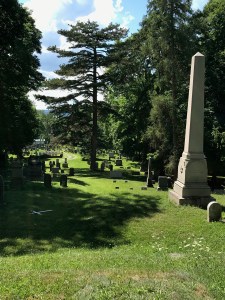
Upstate New York may not get the attention that the state’s largest city does, but it is a place of wonder.  One of those sources of significance is the unique blend of individuals who’ve impacted both American culture, and, in turn, my life, that called this region home.  It’s difficult to describe what I’m feeling as I’m standing next to Rod Serling’s grave.  This is a man who held a profound influence over my outlook by letting his imagination go where it would.  It’s more than the Twilight Zone—although its theme is one of the ringtones on my phone—it’s the sense that I somehow knew this man I never met.  It’s also the sense that his gravesite is so humble, in a rural area outside a small town, the kind that often featured in the stories he wrote and presented.  It’s the sense of connection.

As I young person I practiced writing short stories based on the mood set by the Twilight Zone, with a dash of Ray Bradbury thrown in.  From a small town myself, imagination was my means of enlarging my world.  We didn’t have the money to go many places but the magic box in our living room could take me to weird places alive with transcendence.  The results were beyond price and there was something deep and liberating here, even for a kid whose religion said it was all nonsense.  Even religion requires escaping sometimes.  I know the publishing world has moved beyond what was fashionable in the sixties and seventies, but that can’t dislodge the shard in my chest right now.  If there are spirits in cemeteries, they are here.

Some time ago I began, as I had time, uploading my photos of famous writers’ graves (along with those of other recognized names) on Pinterest.  On the way to Interlaken, I wondered aloud why nobody seemed to show an interest.  I find cemeteries peaceful places, and sacred spaces are those where people significant to us have been, in some form, at some time.  I know Rod Serling loved upstate New York.  It was his escape from the busy life of a writer whose cachet was marketable back in the days when anything seemed possible.  Retreats are those places we go to restore ourselves when work simply won’t allow creative people to have unstructured time.  I wasn’t expecting a huge mausoleum or towering monument here.  Others have found their way to this place nevertheless.  I am in a sacred place and the quiet here is kind of a prayer.


Gods, Monsters, and Publication

One of life’s great ironies is that those of us not born to wealth have to spend the years we’re young enough to enjoy ourselves stabilizing our situation until suddenly we realize we’re too old to do that kind of thing any more.  I know I’m being overly dramatic, but it often does feel like life operates backwards.  My professional career began where I’d hoped it would end, as a professor.  I taught and published for almost twenty years and really nobody paid much attention.  At least I had my teaching.  I also had a family to support, so I had to accept the shift to publishing when that came along with an offer of a full-time job.  Thus it has been for about a decade now.  Within the last decade colleagues have begun to approach me, asking me to contribute to academic volumes, or to be involved in pursuits that are more associated with professors than editors.  I could do with more irony in my diet.

All of this is a long-winded invitation to check out the new Journal of Gods and Monsters.  I probably won’t be writing articles for it; lack of library and research time (both of which I had when invitation-free) assure that my scribbling will be non-technical and hopefully of the more general interest crowd.  Then why am I telling your about this journal, fresh from the box?  I’m on the Executive Advisory Committee and the first Call for Papers has been issued.  Now, this blog really has no way to include attachments that I know of, so if anyone wants in on the ground floor for this journal please contact me (the About page on this website says how).  I contributed to the first number of the first volume of the Journal of Ancient Near Eastern Religions and look where I am now!  You just never know.

In addition to the books on which I’ve been assiduously working, I’ve got a number of commitments to edited volumes and encyclopedias (these invitations waited until I was safely out of academe before rolling in).  The monster crowd is, I assure you, a welcoming one.  As we seem to have turned the corner into autumn a touch early this year, and I see leaves beginning to change before August is out, my mind turns toward the realm of the uncanny.  It may be less academic than ancient religions, but the world of monsters feels much more relevant these days.  If you’re a researcher in these realms I’ll be glad to send you a call for papers.


https://godsandmonsters-ojs-txstate.tdl.org/godsandmonsters/index.php/godsandmonsters


The Holy

It’s perfectly natural.  Trying to make sense of things, I mean.  It’s been a little difficult in America for the past three years or so, given that nothing seems to add up beyond greed and narcissism supported by a senate majority.  Still, as I retreat into my horror films I realize that there’s a logic to it.  Over the past several months I’ve been attempting to articulate it.  You see, I have a couple of presentations to give on Holy Horror in October and one of the questions likely to arise is why.  Why bring together the sacred and the scary?  Those who’ve studied religion formally—and many who’ve not—are aware of Rudolf Otto’s classic The Idea of the Holy.  It’s outdated and I’ve been waiting for someone to write its replacement, but we’re past the era when one scholar corners the market.  Has nothing new emerged this past century?  Nevertheless, Otto’s main ideas still make sense, before he lapses into a Christocentric view.

Mysterium tremendum et fascinans isn’t an incantation, but with a little imagination the Latin makes sense.  The holy, according to Otto is a mystery that is both terrifying (tremendum) and fascinating.  To the laity in the pews this may be strange, but chances are pretty good that your minister has read this book.  In the monotheistic west, the divine is terrifying.  It’s not splitting hairs to suggest terror and horror differ, nor is it unreasonable to suggest they have much in common.  Horror seems more embodied—a working-class variety of terror.  Still, both have that element of fascinans.  We fear but we can’t look away.  I don’t have the time to sit and ponder that a Gilded Age academic had.  Otto didn’t have to keep up with Facebook and Twitter.

Although academia required far more than eight hour days, the time during those days wasn’t spent “on the clock.”  As one intellectual I admire once quipped, staring out the window is work.  Not as far as HR is concerned, however.  Productivity in an industry under stress is its own kind of mysterium tremendum, I guess.  It doesn’t really allow for unstructured hours to read, take notes, close your eyes, and read some more.  Work measures inspiration in terms of currency, which is one of the problems that stretches past beyond these last three years.  Struggling hard with an idea is like wrestling an angel until dawn.  You can’t win, and you can’t lose.  But when the sun clears the horizon it will be time to be at your desk and ideas will have to wait another day.


Linking

So I’m active on LinkedIn.  I try to keep social media down to the essentials, but you never know when opportunity might rap its knuckles next to your shingle.  When LinkedIn began they ran the warning that you should only connect with people you actually knew, since people can say bad things about you and hurt your job prospects.  Since that kept me down to about a dozen connections (many academics, being secure with tenure, don’t bother with LinkedIn), I eventually followed the advice of a wise friend and accepted invitations from people I didn’t know because, as he pointed out, they might be the ones with jobs to offer.  That made sense.  There is a flip-side to it, however, and that is people think I have work to offer.  I don’t.  At my job I have no hiring capacity whatsoever.  (I can feel the links being broken even as I write this.)

The vast majority of people who contact me on LinkedIn want something from me.  They obviously don’t read this blog.  (See paragraph above.)  Many people send me messages wanting me to publish their books.  Editors, my dear and gentle readers, work in specific disciplines.  No one contacting me on LinkedIn has written a book about the Bible, although my profile indicates that’s my gig.  And besides, many companies, including mine, have policies against doing business over social media.  I often think of this because the book business is easily researched.  There’s a ton of information both online and on shelf about how to get published.  Messaging someone on LinkedIn is not recommended.

Writing a book takes a lot of effort.  I know, because I’ve done it a number of times.  If you’re going to put years into doing something, it pays to spend at least a few minutes learning about how the publishing industry works.  I made rookie mistakes in my younger days, of course.  But that led me to learn about publishing even before I had a job in the industry.  Quite apart from my job, I freely admit to being a book nerd.  And publishing, despite its many problems, is an inherently fascinating industry.  Although I’ve had academic books accepted for publication, I still struggle getting my fiction to press (I have had short stories published, but my novels remain unread).  I won’t contact other publishers I know through LinkedIn, though.  I’d rather have it be a personal experience whether it’s acceptance or rejection.  And that’s something social media just can’t replicate.


Reading Railroad

Rereading books takes time.  When I was a professor my reading time was largely limited to the summer and winter breaks.  Those who haven’t experienced the academic lifestyle firsthand may not realize just how incredibly busy you are during term time.  Class prep, grading, delivering lectures, leading seminars, committee meetings, office hours—it really is much more than a nine-to-five job.  Time to sit down and read through books is limited, and since those books are heady, academic tomes, they take considerable time.  (I’m reading an academic book at the moment and I can only get through a finger-full of pages at a sitting.)  All of this means I’m generally reluctant to reread books.  Not that I’m a traditional academic anymore, but because I have a huge and growing stack of books I haven’t read yet.

Nevertheless, a project on which I’m working required rereading Gerald Brittle’s The Demonologist.  I read this about two years ago, while commuting.  The thing about reading on a bus is that the quality of reading time is strained.  Recall isn’t the same as when you’re in a comfy, stationary chair, and no stranger’s head is lopping onto your shoulder as they doze.  (Yes, that happens, and frequently for those of us on the first bus of the day.)  In any case, my copy of this book doesn’t have an index and I couldn’t remember if some specific instances were discussed.  The only thing for it, then, was to read it again.  My second reading was done with more skepticism than I could conjure on a bus ride, but still my original sense remains: we willfully cut out much of human experience if we stop our ears completely.  At least in principle.

Ed and Lorraine Warren were self-taught ghost-hunters.  More often than not, their cases turned into what they believed were demonic cases.  Since academics tend not to publish much about such things, the self-taught are pretty much free to declare themselves experts—just switch on reality TV and check me on this.  Experts are those with experience who are willing to share it.  The other day I met someone who, like me, used to live the commuting life.  We both agreed that telecommuting was a more authentic way to exist—your otherwise mandated three or four daily hours traveling can be more sanely used at home.  Still, we had to agree, bus time could be used for activities like reading, and once you stop commuting you have to carve time out for it.  In such a situation rereading a book is at times necessary.  When I was a professor, I reread frequently.  But then, it was mostly articles or books that I wouldn’t take on in their entirety.  In the reading life there’s never enough time.


Meatings

It was almost a little too real.  As I looked at the fake blood—this wasn’t a horror movie—I had a hard time accepting this wasn’t the real thing.  I mean Beyond Meat’s vegetable-based sausage.  My daughter recently sent me a captivating article about artificial meat.  Unlike many paeans to its virtues by fellow vegetarians and vegans, this was written by an omnivore who unabashedly stated that we’ve reached the point where synthetic meat has surpassed the real thing in flavor and the eating experience.  The piece on Outside made me glad.  Feedlots, apart from being the largest industrial polluters in this country, are a horror film based on a true story.  The way we treat “food animals” violates just about every ethical stance in the book, and it’s a big book.  We do it for profit, of course.  Now that artificial meat is turning a substantial profit, those who slaughter are starting to pay attention.

I recently ate at a local restaurant where our waiter recommended the cauliflower burger.  The thought wasn’t appealing.  Don’t get me wrong, I do like cauliflower.  I prefer it raw, however, since cooking brings out its more cruciferous qualities.  In any case, our server said, “It’s new on the menu.  We offered it once before and so many people requested it that we’ve made it a regular item.”  Now we don’t exactly live in a hippie haven here.  Still, enough people are asking for alternatives that we’re discovering it pretty easy to find plant-based protein in some pretty remarkable places.  It put me in mind of my most challenging course in college: biomedical ethics.

A class that asked, and then pressed on very sensitive questions, biomedical ethics required a term paper.  I wrote mine on animal testing.  This was back in the 1980s, and technology has moved on since then.  Even back in those dark ages of Reaganomics, artificial tissue was being lab grown, eliminating the need for animal testing on many products.  Now we’re reaching the point where the same may apply to comestibles.  I’ve long used vegetarian alternatives (now vegan ones) and they’ve increasingly improved.  When I had the most recent alternative, however, I couldn’t believe it wasn’t meat.  It was too real.  I’m not morally opposed to verisimilitude, I assure you.  The closer they get to the real thing, the better it is for the animals who’ll never need to be born to be killed by us.  It’s just I find the fake blood upsetting, and I’m happy to be reminded that this is only a simulacrum after all.


Building on Water

I try to keep up.  Really, I do.  Although my specialization is in ancient religions, at heart I’m an historian of ideas and I try to keep up with the origins of the many Christian denominations.  You see, with so many competing versions of the one correct way to please God it pays to hedge your bets.  Thing is, there’s so many options and some seem to spring out of nowhere, like toadstools after the rain.  The other day I attended a local community event.  One of those kinds of affairs where local organizations set up tents and sometimes sell food.  Many of the tents were for churches.  As supporters of community values (mostly) this isn’t unusual, even with the declining numbers in the mainstream.  Then I heard a voice.

“Do you read?” the man asked.  I confess to having a bookish look, so I admitted I do.  “We want you to have a free book,” he said, handing me a plastic bag (warning sign one) containing a small paperback and several fliers.  Now, I was here to look around and maybe get a bite to eat, so I thanked him, tucked the bag under my arm and walked on.  Only on the way home did my wife look at the contents.  The church—for it had to be a church giving such things away—was one of which I’d never heard.  This would’ve been disorienting if it weren’t for the fact that ever since college—where I learned quite a lot about denominations—I’ve been noticing new varieties of Christianities, cropping up somewhat frequently.  Each seems to believe it has found the answers, despite the threadbare denominations that have been around for centuries.

I make fun on nobody’s search for meaning, or the truth.  It is, after all, a lifelong quest.  I am suspicious of those who claim to have already gotten there, however.  For those traditions that declare they’ve found the answer centuries ago, the passing years with their constant changes have worn on them.  Especially if they’re awaiting a divine cataclysmic ending to it all that’s been delayed for a couple of millennia now.  Others are, apparently, wanting to pump some fresh air into these tired lungs.  This group featured a website “the famous one [all one word].com.”  I was surprised and a touch saddened to see Jesus relegated to the role of a media celebrity.  But then again, I can’t keep up like I used to.


Book Culturing

The other day I met one of the organizers of the Easton Book Festival.  Coming in October, this festival is something new.  It took the efforts of a couple with vision—the owners of a small, independent bookstore—to get other people on board, but now it’s going to happen.  A weekend dedicated to books.  I found out about the Festival as I was looking up area bookstores that might let me do a presentation on Holy Horror.  For whatever reason, my last book missed its projected autumnal publication date, and fall is when people are really thinking about horror movies.  Approaching its birthday in late December, it never really had a proper launch.  Priced the way it is, I don’t expect a sales boost, but I would like people to know about it.  When you spend years writing a book you’d like it not to be completely obscure.

In any case, when looking up one of the Easton shops—hey, book lovers, the Lehigh Valley has lots of bookstores!—I noticed that the Festival was still seeking participants.  Since it falls just before Halloween, the timing felt perfect.  I signed up.  Now this is one of the many new tricks for this old dog.  I tell authors all the time that self-promotion is key to book sales, even when a press is fairly widely known.  In fact, the store owner himself writes books and has to pay for his own tours to promote them.  Book culture is worth promoting.

On a personal level, it does me good to see that there are others who appreciate books.  They are a form of collective mind.  A communion.  When I’m feeling down, or uninspired, a trip to a bookstore—or even a library—often helps.  Reading books leads to a sense of accomplishment.  Every year I set a goal on Goodreads.  I don’t set the goal to make me read—I’d do that anyway—but to share with others both what I’ve been reading and what I think about it.  The Easton Book Festival will be a way of doing something similar, hopefully with those many others who feel the draw of books.  Writing, for me, is a labor of love.  I don’t know too many people personally, so meeting them through books is one of my own goals.  Just the other day I met an academic who wanted to read Weathering the Psalms.  Such things happen only in that wonderful land built of books.


Belonging

You never know where you might find yourself, but wherever it is it’ll cost you some money.  Well, at least in this instance it did.  Nashotah House sent me packing just as we were thinking about college for our daughter.  It took several years to find any kind of full-time position again, and when university time began I had had a full salaried job for a total of one year of the last seven.  Not ideal, of course.  I remember sitting (again) in the financial aid office, explaining the situation and, as it often goes in higher education, receiving no mercy.  As much as I remember the conversation, I don’t recall a photographer in the room.   There must’ve been, though, since I recently showed up on the Binghamton University website.

I had, of course, applied for a job or two there.  When out of state tuition is riding on such a deal, however, I doubt there’s any way to get considered.  I actually like Binghamton University quite a lot.  I appreciate the fact that it doesn’t pour its money into a football team and that it has the reputation of being a “Public Ivy” school.  I even like the campus removed from city bounds—just like Nashotah House.  I did end up paying them quite a bit of lucre through the years, even as my own alma maters were asking alms.  Higher education is a funny world.  Standing somewhere between a money-making venture and a site of education for its own sake.  Many professors don’t realize just how privileged they are to have jobs like that.

Upstate New York, although I’ve never lived there, is one of my ancestral homes.  My grandfather and his family had lived in the area at least as far back as the 1770s.  I tried to convey that sense of connection in my application, many years ago now.  Academia doesn’t put much stock in the idea of belonging, I guess.  It has become far too businesslike for that.  Binghamton was also the town in which Rod Serling, one of my childhood heroes, grew up.  There seemed to be so many reasons to be in that area.  Eventually I settled for life in my own native Pennsylvania.  People sense, although academics less than others apparently, that they belong in a place.  And if you can’t actually be there, you can still spend your money in any location.  I’ve now got a picture to prove it.


Glossophobia

For a guy so full of phobias that there’s no elbow room at Hotel Fear in my head, people are sometimes curious as to why I don’t suffer one of the most common sources of terror: speaking in front of crowds.  Glossophobia is extremely normal.  I suspect it’s one of evolutions tricks for keeping metaphorical cooks out of the allegorical kitchen.  If we’re all talking at once, who can be heard?  The internet will prove to be some kind of experiment in that regard, I expect.  Thing is, I’m not what most public speakers appear to be: confident.  I’m not.  Beneath the surface all kinds of phobias are vying for the next private room to become available.  Over the weekend I had a public speaking engagement, and that made me consider this again—why doesn’t it bother me?

Although the answer to “why” questions will always remain provisional, I have an idea.  It’s kind of creepy, but true.  In my fundamentalist upbringing, I was taught that my life was being taped.  You see, it goes like this: since the book of Hebrews says “And as it is appointed unto men once to die, but after this the judgment,” some Fundies like Jack Chick illustrated this as an outdoor cinema in Heaven.  Or rather, in the clouds just outside Heaven.  Here you’d be summoned, buck naked, as soon as you died.  Other nude souls would gather round the big screen and your entire life would be projected for all to see.  Since everyone’s dead there are apparently no time constraints.  As a kid I realized that I was being watched.  All the time.  Now, I’m not conscious of this constantly, but I did translate it to public appearances.  We’re all, it seems, actors.

With a lifetime of performing experience, by the time I was a teen I wasn’t afraid of public speaking.  Introspection was a big part of my psyche, and when I had a speaking engagement, I knew that I had to be conscious of what I did and said, because people would be watching me.  I learned to play the part.  I did take a college course in public speaking, and even a preaching course offered by the Western Pennsylvania Conference of the United Methodist Church, but both of these were long after I’d begun taking public speaking roles.  I make mistakes, of course, and early on I learned to laugh at them before the audience did.  We were all being taped, after all, and there’s no outtake reel before the pearly gates.  Strange, but true.  If you’re afraid to speak in public just remember—you’re being watched, all the time.


Hidden Monsters

I don’t think much about having been born male.  I’m starting to realize that that’s because I don’t have to.  The same is true of being caucasian, although I’ve always objected to the labels of “white” and “black” as being polarizing and wildly inaccurate.  Although I grew up in poverty, my “social markers” put me in a place of privilege, even if others sharing my demographic have locked me out of the club.  These thoughts were raised by Mallory O’Meara’s excellent The Lady from the Black Lagoon: Hollywood Monsters and the Lost Legacy of Milicent Patrick.  As soon as I saw the book announced, I knew I had to read it.  As O’Meara would doubtlessly not find surprising, I had never heard of Milicent Patrick before.  I’m not surprised that a woman designed the Creature from the Black Lagoon, however, because woman create memorable monsters (can I get a “Frankenstein”?!).

The reason I don’t think about being male is because the crumbling society built by males assumes that it’s the default.  Men have always been shortsighted, I guess.  Having been raised by a “single mother” (she was technically not divorced because a male-made religion said it was sinful), I always believed women to be protectors, capable heads of families, and far more empathetic than the men I met.  I didn’t realize at the time that we lived so close to the brink because men devalue women.  Milicent Patrick grew up in a family where this was much more obvious.  A talented artist, she incurred her family’s lasting wrath by going to Hollywood and doing what was then movie makeup work.  That she designed the beloved Gill Man makes sense to me.

O’Meara’s book is sure to make thoughtful readers angry.  Not at the author, but at the behavior of men.  Perhaps due to my unbalanced upbringing, it has taken many years to see what others probably notice much more readily: women have to struggle for that which someone like myself can simply claim.  Bud Westmore, Patrick’s boss at Universal, claimed her creation as his own work.  There are monsters in this book, and I’ll give you one guess as to their gender.  Still, I’m glad to have read it for I know I’ve found another monster fan.  O’Meara’s clearly aware of how those of us who admit this odd passion are marginalized in a world that prefers super heroes and those good with finance over those who see monsters everywhere.  This is an important book; read it and you’ll see them too.


AKA

“Professor?”  While not technically correct, I was surprised and not unpleased to hear the title yesterday while on the streets of Easton.  One of the greatest compliments a former teacher can receive is word from a former student.  While dressed in Saturday clothes on the way to the country’s oldest continuously operating farmer’s market, I wasn’t sure the voice intended was for me.  I’ve been out of the classroom now since 2011.  Sure enough, one of my students from Rutgers recognized me and called out.  We had an ersatz but wonderful conversation after a completely chance meeting.  Already since graduating he’s had a few different jobs, but he remembered the classes I’d taught and I recalled that he’s the person who started me reading Neil Gaiman.  Teaching is, you see, a two-way street.

I’m doing a guest service at a local church next Sunday.  In preparation I’ve had lots of emails (for me).  One of them was from the music director.  He opened by calling me “Reverend.”  I’ve never been a reverend.  The idea isn’t unappealing but I’ve gone pretty far down the path of independent thinking and any church that would ordain such as me would need to be comfortable with that.  In fact, I heard a sermon recently by an Episcopal priest and was pleasantly surprised at how welcoming and, dare I say, liberal it was.  I was never really welcome in that club, I know.  When I was still fairly fresh out of seminary and working on my doctorate the idea of being “Rev. Dr.” was still appealing.  Now I go by my first name.

Labels.  I tend to eschew them.  Like my young colleague I’ve had to learn that work doesn’t necessarily define you.  (I’ve had many employers, however, who not only beg, but insist to differ on that point.  The ideas of owning individuals die hard, apparently.)  On the weekend, though, off the clock, people are calling me “professor” and “reverend.”  I’m generally sitting in a corner with my laptop on those early mornings calling myself a “writer.”  For none of these things do I receive any pay.  (Well, perhaps some for writing, but very little and very infrequently.)  The move to our new location was a chance, I think, to try to remake myself.  A chance to figure out what labels, if any, really fit.  Better throw “telecommuter” and “remote worker” into the mix.  Those are the ones, come Monday morning, that matter most.


Infinity

It occurred to me the other day that I will never read all the books on my list.  Only in my fifties, it’s not as if I’m knocking at death’s door, but who hasn’t been aware that that gentle rapping might come at any time?  Macabre?  Maybe.  Realistic?  Definitely.  Perhaps I’m a little old to be thinking about prioritizing, but it’s pretty clear that between work, writing, and the requirements of daily life (taking the car to the shop, scheduling a dentist appointment, trying to find time for a haircut, lawn care), that something’s got to give.  Work’s the non-negotiable since without it avoiding starvation (or perhaps getting medical coverage) becomes a full-time job.  Best to leave that sleeping dog slumber.  Then come the other three Rs: relationships, reading, and writing.  After that the time left to divide is pretty petty indeed.

My reading list grows almost daily.  Reading is a form of relationship.  I’ve recklessly written to writers after finishing their books, convinced that they’d written it to me.  I’ve also read material that, when done, makes me regret the time spent.  Still, I don’t, I can’t give up.  Writing is a form of giving back.  The other day an editor who’d accepted one of my fictional stories wrote that she couldn’t stop reading it.  It doesn’t matter that the magazine doesn’t pay—I’ve received back already what I’d planned for all along.  A kind of relationship with a reader.  If WordPress is to be believed, there are some followers on this blog.  Most think I write too much, and some, perhaps, too little.  Writing, however, like reading, is the formation of relationships.

Like relationships, reading takes time.  I carve out a spot for it daily but that doesn’t really make a dent in the growing reading list.  I can’t claim that it’s because I’m no longer a professor.  Except during the summer I read more now than I did when I was teaching (the professor’s life isn’t what most people think).  It is, I believe, that there are so many interesting ideas out there that one person simply doesn’t have time to think them all.  Reading and writing are a form of very slow conversation.  Of course, with technology the rest of life is speeding up.  Things seem now to happen instantly.  The world of books is slower, and the pace is far more sane.  I may never get through my list of books to read, but at least I have good conversation with those I don’t know, and that’s what really matters.


The Price of Writing

Academic writing strives to remove personality from your work.  It can be soul-crushing.  I remember well when my daughter—a talented writer—came home in sixth grade with a note from her teacher.  An otherwise ideal student, she was writing her science projects with *gasp* her own voice!  Mr. Hydrogen and how he joins Mr. Oxygen—that sort of thing.  Granted, it would never be published in a scientific journal, but it was a personalized expression that demonstrated an understanding of the concepts.  Having been the recipient of an old school education, I also learned that academic writing should lack personality.  Those who’ve bothered to read my academic papers, however, may have noted that I don’t always obey the rules.  Subtle bits (very small, I’ll allow) crept in amid the erudition.  And now I find myself wishing I’d persisted a bit more.

Pure objectivity, anyone living in a post-modern world knows, is a chimera.  It doesn’t really exist.  We all have points of view, whether they eschew adjectives or not.  I still write fiction, but since my publication history has been “academic” I indulge in it while trying to break through where someone’s voice isn’t a detriment.  I’ve been reading non-fiction by younger women writers and one of the things I’m finally catching onto is that your own voice shouldn’t be the enemy.  It may be so for most publishing houses, but I’m wondering at what cost.  So many ideas, just as valid as any staid publication, never see the light of day beyond some editor’s desk.  That’s not to suggest that anyone can write—I’ve read far too many student papers to believe that—but that those who can ought not be shackled by convention.  If only I could get an agent who believes that!

Holy Horror isn’t exactly flying off the press, but it does represent a kind of hybrid.  It’s transitioning to a kind of writing that allows some personality onto the page (yes, I’m old enough to still believe in pages).  A now departed family friend—he’d known my grandfather—was determined to read Weathering the Psalms.  He didn’t make it through.  It was an academic publication.  In the humanities, it seems to me, we need to allow authors to be human.  It’s in our title, after all.  Please don’t take this as professional advice; careers are still broken on the wheel of tradition.  Writing, however, shouldn’t be a caged bird.  But then again, the clock says it’s now time to get to work.