Epistemic Epistemology

I’ve been thinking about thinking, if you’ll pardon my meta.  More to the point, I’ve been thinking about what happens to thinking when it becomes writing.  Thoughts may or may not be safe if they’re left in your head, but once they’re on paper other people start to get concerned.  A diary, of which the weblog is a public variety, is often private.  You may write to remember.  You may write to stab at mortality.  You may do it just for fun.  No matter why you do it, if enough people read it, your writing will be misunderstood.  Ironically, even in a nation with freedom of speech, and the press, the writing rights of individuals aren’t guaranteed.  Take this blog, for example.  Over the decade I’ve kept it, a few jobs—two actual and one potential—have instructed me in what I could or could not write.  Like Niagara Falls, you’re getting only a portion of what flows in my river of thoughts.

Thoughts can change the world.  Considering the news lately that might not be such a bad thing.  In any case, the vast majority of writing remains private.  Even with Amazon and others making self-publishing simple, it’s not easy to get ideas out there.  Getting the attention of a major publisher has odds that are vanishingly small.  And the internet’s a big place, getting bigger by the day.  In cyberspace nobody can hear you scream, I guess.  Even on a smaller scale, my own computer complains that I write too much.  “Not enough space for updates,” it says in its dialogue box dialect, “too many documents.”  Never mind that I purchased it for writing, and a bit of surfing.  It wants more of the latter.  Other’s words, in other words, commodified.

My writing life began young, but not as young as that of many fictional writers like Jo March or Francie Nolan.  Our apartments and eventually small house had no space for one of the kids to hole up and write.  When I did start, in my early teens, I breached the dam without anticipating the results.  I’d been reading a lot, and writing seemed the right way to join the conversation.  I started composing novels before high school, but my first published book (and for many years my only one) was my dissertation.  I always believed that writing could be done on the side for any job, but that’s not the case.  Well, it is if you keep it in your diary, I suppose.  If you open the tap, however, you’d better make sure you have a mighty big glass in hand.


Refuge in Diversity

The Easton Saturday morning farmer’s market is a happening place.  Daring to spend a non-raining Saturday away from mowing, my wife and I decided to check it out.  If you’re not familiar with Easton, Pennsylvania, it has more than the Crayola factory that smells like childhood itself.  The downtown is marked by a traffic circle with an island in the middle large enough to fit, well, a thriving farmer’s market.  As usual, large gatherings attract those selling spiritual rather than material goods.  A very well dressed gentleman handed me a flier and when I got home I had to look up Refuge Church of Christ to find out what it it’s all about.  A New York City-based denomination of predominantly African-American membership, the church has over 500,000 members.  That I hadn’t heard of it before is no surprise.  There are well over 40,000 denominations of Christianity alone and it’s difficult to keep track of them all.

There comes a time in the life of anyone who takes religion seriously enough to study it professionally when s/he’s inclined to ask which is the original.  Think about it: you’re bartering with your eternal soul on the barrelhead here and don’t want to make the wrong choice.  When someone invites me to convert (I don’t know the secret handshake to show I’m already a member) I’m curious about them.  The unfortunate thing about all of this is that each tradition believes it has the truth and most, if not all, others have got it wrong.  Few are the faiths that declare, “Believe whatever, just believe.”

I once tried to make a denominational genealogy chart.  Part of the problem is that tracing things back to Catholicism isn’t quite right.  The Roman Catholic Church as it exists today is quite different than anything Paul, or Peter, or James would’ve recognized.  To say nothing of Jesus.  And that’s inevitable.  Religions don’t stay the same.  They evolve as soon as they pass from person to person.  Those who belong to denominations often do not know what the official teachings of the body are, and getting back to the original they’d find that their denomination started out believing things quite different than its own current theology.  If you’ve got only one soul with which to make that eternal decision and literally thousands of choices, well, let’s just say that you don’t want to think about it too much.  Besides, we’re here for fresh fruits and vegetables.  And it’s a rare gift of a Saturday without rain, no matter who’s responsible.


Not from Nazareth

The world just doesn’t feel safe any more.  I’d better give a little context as to why.  You see, I just learned that what I thought was the work of carpenter ants is actually that of carpenter bees.  I never knew such things existed!  This still might not give you the thrills you were hoping for, so here goes a true story: when I was maybe six or seven my mother took my older and younger brother and me to a place in the woods where we could run around and holler and not bother anybody.  We had our dog there too, as well as our grandmother.  After a while my brothers started a game—throwing a stick to see who could get to it first, me or our dog.  I was running along, stepped on a stump, closely followed by the dog, when a swarm of angry yellowjackets flew out.  I was wearing shorts at the time and received multiple stings on my bare legs.  We didn’t think our dog would survive; he was completely covered.  So I have a thing about bees.

My phobia isn’t as bad as it used to be.  I’ve been stung many times since, and it always feels like an insult as well as a bad memory.  (I still don’t wear shorts, except on very rare occasions, when the bee quotient is zero.)  Believing in turning the other cheek, I’ve even captured and released bees from the house rather than killing them.  Still, to this day, when I get a haircut if the woman pulls out a set of clippers you have to pry my fingers from the naugahyde when she’s done.  Anything that sounds like buzzing near my ears sends me into spasms of terror.  Please pardon the graphic fear.  It’s heartfelt.

I used to have nightmares about killer bees.  I still worry about them a lot, and wonder that if, instead of a wall, we might put up a massive, small-weave net this side of Texas.  I don’t know how high they fly, but we should try to do something, don’t you agree?  Now I’ve learned that bees can eat you out of house and home, literally.  The carpenter bee, to the untrained eye, looks like a bumblebee.  They’re big, heavy-bodied insects that can crawl through three-eighth-inch holes, perfectly round the insect guy tells me.  They’ll eat and mate, and release their larva, ready to grow stingers, into the world of my back porch.  They appear to enjoy the global warming, judging by their numbers.  Maybe it’s a good thing we settled not far from Nazareth because a friendly carpenter might soon come in handy.


Trees and Cities

Some years ago I decided I’d read A Tree Grows in Brooklyn.  I had no idea what it was about, but I’d heard cultural references to it over the years.  So I decided to read it.  Then I saw how thick it was.  I confess I shouldn’t do this, but when I sign up for reading challenges, I want to make sure I can finish them.  Books tipping the scales at over 400 pages make me nervous.  Although I work with books, I’m a slow reader, and I panicked when I saw the size of Betty Smith’s ouvre.  All of which is to say that I’ve finally done it.  I’m glad I did, although, as someone who grew up in quite humble circumstances, with an alcoholic father, some of the story hit pretty close to home.

What really stood out, however, was how women and girls were treated in the early part of the last century.  They couldn’t vote.  Full-time work was often difficult for them to find, and when they did it didn’t pay well.  Francie Nolan, however, overcomes this because she’s smart, driven, and literate.  Her reading ultimately rescues her family after her father dies prematurely.  I’m certain there are other messages in this novel.  Other lessons to be learned.  Reading is nevertheless a great takeaway from any book.  As a symbol of its time, Francie learns to read from the Bible and Shakespeare.  These days that combination can get you into trouble.

Perhaps the most disturbing part of the book, for someone who writes instinctively, is that Francie gives up her writing in a deal with God.  When her mother goes into labor and Francie fears she’ll die, she makes a bargain that, strangely, she doesn’t seem to regret too much at the end of the story.  Some of us find writing as natural as breathing or eating.  I can forget to do both when I’m thoroughly into the zone.  I can’t image having that taken from me.  Smith notes that as she reflects on her unholy deal with the Holy One, that she now better understands God.  Indeed, in a kind of Kierkegaardian moment about halfway through she declares she no longer believes in God at all.  Her teacher doesn’t understand her writing.  Ah, but that’s a familiar dilemma to those of us who dare to attempt this craft.  For its size, the book was a fairly smooth read.  It took several weeks, but I learned about myself as a writer, and that makes it worth it.


Night of the Living

The New Yorker view of the world, so the joke goes, sees the five boroughs in great details, then a very thin New Jersey across the Hudson with a vague California somewhere out west.  Having worked in New York City for nearly a decade now, I know that such a view is exaggerated, but has a small glimmer of the truth.  We can only pay attention to so much and things are constantly coming at you in Gotham.  I sometimes forget, now that I’m in Pennsylvania again, just how diverse my home state is.  I’m not from old Pennsylvania stock—neither of my parents were born here and neither of my mother’s parents were born in the same state she was.  Still, when you’re born in a place it’s natural to feel that’s where you belong.  You inherit the outlook.  I inherited Pennsylvania.

Pennsylvania is a bit unusual in being a commonwealth divided in two by a mountain range.  Laid out with an horizontal orientation, it’s about 280 miles across, and once you’re over the Appalachians, you’re into a different subculture.  On our way into Pittsburgh, signs for Evans City reminded me that among its many contributions to American culture, the Steel City also gave us zombies.  Now from a history of religions point of view, zombies came from Caribbean religions that fused indigenous African beliefs with Catholicism.  A religion that arose among people commodified as slaves.  A zombie was a body with no will.  It took George Romero, living in Pittsburgh, to give us the movie zombie with The Night of the Living Dead.  Pittsburgh, among some, is glad to claim the title of zombie capital of the world.  Its zombie walk is a thing of legend.

Ironically, the western end of the state, beyond the mountains, tends to be more conservative than the side closer to the seaboard.  (Pennsylvania is the only of the original thirteen colonies not to have direct Atlantic Ocean water frontage.)  Yet it has adopted the most egalitarian of monsters—the living dead.  Romero tapped into the universal fear of unsettled death to make what were later to appear as “zombies” the unnamed monsters of his most famous film.  Everyone has to die, and no matter our religious outlook (or lack thereof) the question of what comes after is asked on both sides of the Appalachians.  And even by those across the Hudson in New York City.  There may be even something between the two.


Iron Ages

I find myself in Pittsburgh again.  We set out from the former steel city of Bethlehem and ended up in the former steel city on the other side of the state.  I’m not here for the metal, of course, but to visit family.  Making our way over the great eroded spine of the ancient Appalachians, I was thinking of how cities often take on the identity of their industries.  Pittsburgh and Bethlehem vied with each other for their facility with unyielding iron—one of the technologies so important to human history that we still use the Iron Age as a marker of advancing technology.  Pittsburgh’s now a tech city, much reduced in size from its heyday when only fifteen cities in the country were larger.  Bethlehem, it seems, is still trying to figure out exactly what it wants to be.

Back in college, I used to work in a church in the south hills.  I haven’t been to Windover Hills United Methodist Church since those days.  I was weighing my future then, deciding to attend Boston University School of Theology—the seminary the pastor had attended—and exposing myself to liberal thinking rather than more of the conservative milquetoast that was mistaken for milk and honey at Grove City College.  The memories that attended the drive were powerful and poignant.  I only lived in Pittsburgh two summers—the second working as a bagger at a grocery store (I should’ve known then where a college degree in religious studies might lead, even if summa cum laude).  As iron sharpens iron, so the Good Book says.

Recently I tried to recall all the addresses at which I’ve lived.  This seems particularly important because many of the buildings no longer stand and I greatly fear being erased.  Those of us who write often do.  I can recall the cities and even a few of the streets.  Numbers often escape me, for they seem to be mere place holders.  My days in Pittsburgh were decades ago, when life was really only just beginning.  Now I drive these hills with memories my only maps, wondering if I can find the place I’m seeking.  This place is part of me, even as Bethlehem is now becoming such a piece.  Cities change depending on the laws of supply and demand that can, as we know, even break iron.  And those of us who live in such places know that any industry is subject to memory, whether of God or of steel.


Cool Cash

The seller’s market is the place to be in a capitalist society.  Last year, when we were looking for a house, it was a seller’s market.  Our realtor said he’d never seen inventory so low and staying so low.  We found a domicile we liked, but it was older and had obviously (only after moving in) been neglected.  The previous owners, it was clear, had simply let things go (and they were younger than us, and had no excuse).  When we asked for a new roof they had flat-out refused.  With no other options (our lease was about to expire) we agreed to take it on anyway.  We’ve been having the roof done in installments—and if you’ve been getting the record levels of rain that Pennsylvania has, you know our decision was, in a literal way, short-sighted.  Ah, capitalism!

So, just after I noticed the piles of sawdust that the web tells me are carpenter ants, the refrigerator died.  Of course.  I tried to keep cool.  We don’t have what the overlords call “liquidity.”  Our cashflow is dammed at the source, as it were.  A new major appliance was not a welcome addition to the fixer-ups that appear nearly every day.  The first warning was that my soy milk was room temperature when it splashed on the cereal yesterday.  All of this made me reflect on how much we rely on our appliances, our modern conveniences.  When talking to my mother later in the day, I realized that as recently as her generation not everyone had a refrigerator.  You could live without one.  You could also live without a dishwasher, believe it or not!  

The whole episode of packing the food in ice sent me on a Calvino-esque reverie of what we keep in the refrigerator.  There are foods that must be kept cool or they’ll spoil, foods that are better if they’re kept cool but can be left at room temperature, foods that you prefer to drink cold but can be kept anywhere, and items which are technically not food.  Considering the state of our kitchen, there are also foods that you keep on top of the refrigerator because no amount of cupboard space is ever enough.  As the carpenter ants make their free lunch of our porch, we have to throw away food for which we paid because an appliance has come to the end of its life cycle.  And since it’s a holiday weekend we’ll pay for a more expensive replacement unit because it’s on a holiday sale.  For unlike my soy ice cream, I lack liquidity.


Rock Solid

Old interests don’t die so much as they become sublimated.  As a child I picked up a cheap “gem display” in a small cardboard box at a yard sale, probably for a quarter.  A couple of the samples were missing, and those that remained were tiny, but I was fascinated that rocks came in such varieties, especially since the ones I tended to find on my own were all shades of gray.  Science education wasn’t especially great in my small town, and besides, I had a massive interest in not going to Hell, so religious study took precedence over my predilections toward scientific studies.  Still, as a child and later, I read a lot about science and I never doubted that it could teach us about the natural world.  Years later I rediscovered my love of rocks.  I joined the Wisconsin Geological Society.  I bought a rock hammer.  I began hounding.

One of the first truisms you learn about life is that movers don’t like heavy things.  Seems that if you are in the business of helping people move (for money, no less), you might be stoic about such matters.  But I have yet to move and not have the guys complain about all those boxes of books.  Well, the rock collection is even heavier.  I discreetly marked the boxes “heavy collection,” hoping nobody’d say “What you got in here, rocks?”  Because, well, yes.  I like rocks.  While in Wisconsin the collection grew—we lived in a house at Nashotah, and we had space.  I had a rock tumbler going in the basement.  We attended rock and gem shows.  Then we moved three times in three years.  I became embarrassed of my petrine peccadillo.

On my way out the door yesterday, I spied a fossil I’d picked up in Ithaca.  Immediately my old inclination to rocks returned.  I don’t know why I bought so many books on geology and seriously considered changing professions after my academic position fell apart.  Perhaps in a life so unstable rocks seemed solid, reliable.  Or maybe it was nostalgia for my young days when a cheap white box of neatly labeled specimens provided hours of transfixed wonder.  I still pick up interesting rocks, and even go to places where collecting is permitted.  This whole world under our feet is full of surprises and an interesting stone can send me into a reverie that is, if I’m honest, as spiritual as it is scientific.  


Thunder Towers

It sounded like brontide.  The Martin Tower, the tallest in the Lehigh Valley and once corporate center for Bethlehem Steel came down yesterday morning.  Completed only in 1972, the following decade saw the collapse of the steel industry, and the building has sat vacant a dozen years.  Now it’s gone.  The reasons the building could no longer stand are many and I won’t try to explain them as if I understood.  The fall of the tower, however, put me in mind of human folly and the belief that corporate profits will only ever grow.  Capitalism is built on a set of myths that the wealthy truly believe—I suspect many others do too, otherwise the system couldn’t possibly last.  Adam Smith may have been right academically, but in reality humans are greedy, venal, and shortsighted.   At least those who “rise to the top” are.

We didn’t move to the Valley for the steel.  Having settled in New Jersey just about when the Martin Tower was abandoned, like many other displaced academics I was looking for a job.  There were cities in the Midwest—we weren’t far from Milwaukee or Madison—but there was no work.  If you’re “overeducated” your best bet is to settle near a huge metropolitan area, as closely as you can afford to.  Then hang out your shingle.  Capitalism, however, has made New Jersey affordable only for the excessively wealthy.  Besides, I was born within the imaginary lines that we call the Commonwealth of Pennsylvania.  In fact, when I got my license transferred last year the computer asked me if I still lived in Venango County, where I was born.

I didn’t see the tower come down.  It’s not visible from my house, but it was always right there when I drove to Lowes to pick up some necessary hardware to survive in this area.  (Weed-whacker and lawnmower—reel variety.)  My mythology of towers always takes me back to Babel.  In the biblical worldview towers were a sign of arrogance.  God seemed to think they were trying to invade divine turf, and so he made it so we could no longer understand one another.  There hasn’t been a moment’s peace since.  We build towers tall to show what we can do.  We don’t really need an angry deity to come down and confuse our language any more.  We’ve got capitalists and their excess money to lead the way.  The sound of thunder roared and I divined just where such leadership will guide us.


Drowning in Words

One of the features of this blog, which as inclined more lately toward books of all sorts rather than simply religion, is that I only write one post per book read.  There’s no law that says this should (or must) be the case, but I’ve held myself to that standard for about a decade now, and if I have trouble recalling a book this blog is generally a kickstarter for my memory before hauling myself off to the attic to find the physical copy—long live print!—to do a bit more detailed work.  This method sometimes leads to crises of my own making.  Long books take some time to get through.  And despite the action-packed picture you get of my life from this web log, many long weeks are spent doing work and I can’t really share the details here.  And so it goes.

Like many people I read multiple books at a time.  Although I have a kind of general plan, the actual books being read at any one time often depend on my ability to lay my hands on a copy.  And since I’m in the final stages of Nightmares with the Bible, I tend to prioritize books I really should read in whole for that tome.  I also read (and write) fiction.  Normally I reserve my fiction for bedtime reading; it’s more pleasant to prepare for sleep with an engaging story that I know isn’t factual enough to haunt me.  Sometimes the fiction is a long book too.  Two lengthy books going simultaneously feels like trying to pass a truck going uphill.  Or swimming underwater.  The insistence of the necessity of taking a breath (writing a blog post on a book) strains against me as I look up and see the surface still some distance away.  Drowning in words, however, isn’t that bad.

As I confessed to a friend the other day, I am a graphomaniac.  I write incessantly.  To do that it helps to read incessantly.  At any one time I’ve got several books going, and I’ll let you know when I reach the end of any of them.  This is, I suppose, the bookish life.  Ironically I read more now than when I was a professor.  Those days were filled with lesson prep, teaching, and reading student papers.  Grading tests.  Fulfilling administrative duties.  On the days when I feel like lamenting my lack of time (and those are most days) I need to remind myself that a great deal more of my effort is now spent with books than it used to be.  You’ll have to trust me on that since I don’t always get to write about reading until the long books are done.  And that’s okay by me.


Price of Learning

Holy Horror, as some are painfully aware, is priced at $45.  Even those of us in publishing have lessons we must learn, and one of them is that writing a trade book involves more than just a “friendly narrator” style and non-technical language.  It also involves a subject the public finds engaging (or at least what a literary agent thinks the public will find engaging).  Holy Horror throws two apparently disparate topics together: horror films and the Bible.  The fans of each don’t hang out in the same bars—the fans of the latter, in some circles, don’t go anywhere near bars!  My thinking was that this juxtaposition was odd enough to qualify as trade, but I also knew that you have to work your way up to that kind of readership.  That’s why I’m on Goodreads, Twitter, and Facebook (followers and friends welcome!).  It’s not like I’ve got tons of spare time, but platforms must be built.

Book publishers face a dilemma: they have to sell books, but as I’ve noted before, they must do so profitably.  There are people like yours truly who’ll occasionally pay essentially a dollar a page (or at least a two-page spread) for a book that’s essential to their work.  As the capitalists grin, it’s “what the market will bear.”  I never thought of myself as a market.  To me, knowledge is priceless.  The effort that it takes to write a book is truly unimaginable to those who haven’t done it.  Obstacles exist almost from the inception.  Getting the resources you need, unless your employment comes with a free library pass, involves sacrifice.  I still look at other books I must read priced at about $45 and groan—how can I justify the expense?  It’s a strange club to which to belong.

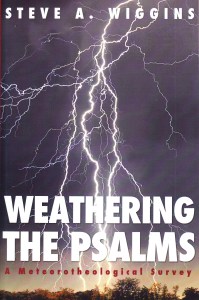
My mother asked about Weathering the Psalms: “Is it the kind of book you get money for?”  In theory, yes.  I’ve yet to see any kind of profit from it since the tax forms you need to file for royalties cost more than the actual checks contain.  At least it’s not vanity publishing.  And you truly learn what it means to rob Peter to pay Paul.  It has nothing to do with gentiles.  Publishing is the price you pay for following your curiosity.  My books are very different from each other, a fact that comes with an invisible price tag that has little to do with money exchanging hands.  Well, maybe it does.  And maybe it does have something to do with gentiles.  Or maybe it’s an appeal to a higher power.  In a capitalist nation we all know what that is; herein lies holy horror.


Relatively Unknown

The Edinburgh Festival draws people from around the world to experience culture and fun in one of Europe’s most beautiful cities.  The festival also attracts the fringe—artists not associated directly with the festival, but who get included in what used to be a huge, thick catalogue that would keep us busy for hours, considering what a student and spouse could afford, and what you could not afford to miss.  One year a group called Outback was performing at an area church.  It featured Graham Wiggins on the didgeridoo—an Oceanic aboriginal instrument that is essentially a tree branch hollowed out by termites.  It’s so long ago now that I can’t recall if I knew ahead of time, but the leader of the group, the didgeridooist, was Graham Wiggins.  While not exactly a rare surname, Wiggins isn’t common either and when I saw him a strong family resemblance was immediately obvious.  So much so that after the concert we went to meet him only to find out his Wiggins side was from Oxfordshire.  Mine was from South Carolina.

Graham Wiggins, who was a month younger than me, was known as “Dr. Didg” because he held a D.Phil. in solid-state physics from Oxford University.  While an American, he had decided to stay in the UK to make a living from his music.  Some months later, on a Christmas break, we saw him busking in Bath on a chilly night.  We bought the band’s second CD from him that evening.  When my wife put on our Baka disc the other day, I grew curious whatever became of him.  I was surprised and saddened to learn that Graham Wiggins had died three years ago.  I knew we shared a surname and a family resemblance, as well as UK doctorates, but I learned he went to the British Isles from Boston University, which is where I had studied before attending Edinburgh.  He left the year I arrived.

Websites are reluctant to say of what Wiggins died.  I learned of this just days after finding out that a high school classmate had passed away, so mortality has been on my mind.  Wiggins, unlike this Wiggins, was a talented musician with a brilliant mind.  We saw him interviewed on television about the physics of didgeridoo playing.  I never did find out if we were distantly related.  The US Wiggins clan from South Carolina doesn’t have strong genealogical interests, although we know they started out in North Carolina many years ago.  It stands to reason they had come from England at some point, since it’s an English surname.  I only met Graham of the clan twice, but now I can’t get the fading didgeridoo sounds from my mind.


Thoughts While Flying

Uh-oh!  I seem to be airborne.  All that’s in front of me is concrete.  If I don’t do something, my exposed hands will hit first.  Tuck, and try not to hit your head.  Still, on impact the first thing I do is look around to see if anyone saw that.  It’s embarrassing to trip and fall, especially when you’re old enough to be avoiding that sort of thing.  I jog before it’s fully light out, however, and the sidewalks can be uneven.  Just in case anyone’s watching my Superman impression, I immediately climb to my feet and resume my pace.  I’ll be sore tomorrow.  As a jogger since high school you’d think I’d have this worked out by now, but you’re never too old to learn, I guess.

The amazing thing to me is just how much you can think in those fleet seconds that you’re actually in the air, about to hit the ground like a sack of old man.  That’s exactly what happened, though, from the split second I felt my toe catch in an unseen crack and felt my balance give way.  Taking additional steps while trying to straighten back up sometimes works, but my top-heavy head was too far out of sync and my feet were sure to follow.  Your memory of such things goes out of body and you watch yourself comically flying, without the grace of a bird, toward an unforgiving substrate.  Such is the fate of the early morning runner.  I don’t have time to do it during the day.  What if someone emails and I don’t answer?  They’ll think I’m slacking off.  Remote workers!

Despite the occasional spills, I’ve always enjoyed this form of exercise.  In the post-Nashotah House days while still in Wisconsin I’d sometimes do nine miles at a time.  Whenever I’ve moved to a new place I’ve gotten to know the neighborhood by jogging around.  Even if it’s not fully light you can see plenty.  (Although the cracks in the sidewalk aren’t always obvious.)  I tend to think about these things as life lessons.  Parables, if you will.  One of the deep-seated human dreams is that of flying.  Birds make it look so easy, and fun.  A human body feels so heavy when it impacts the ground.  I suspect that’s why we find gymnasts so fascinating to watch.  As for me, I’m just a middle-aged guy in sweats and wearing glasses.  And even as I head home I’m already thinking how remarkable the number of thoughts are in the few seconds while in flight, somewhere over the concrete.


Final Stretch

There comes a point, in my experience of book writing, when you can think of nothing else.  This is near the end of the process.  For months and months you’ve been working at it in increments, and the sudden realization hits you that other people are (you hope) going to read what you’ve been scratching out for a couple of years.  My interlocutors tend to be in print or email form.  I don’t work day-to-day with colleagues who know about the book, nor, I suspect, would they care very much.  In my case this comes as I’m trying to generate attention for Holy Horror, with very limited results.  But I don’t have time to think about that now.  Nightmares with the Bible is almost ready to submit.  If only I had more time to read everything.  If only.

Writing is a challenging form of expression.  Let me qualify that: getting writing published is challenging.  The actual craft flows.  The book that is intended to pass scholarly muster, however, must be full of notes and quotes.  I’m trying to leave those behind as much as possible since I’ve been reading about these topics for decades and that ought to count for something.  Still, that nagging doubt awakes you—haven’t you overlooked something?  Some vital source that you should’ve cited?  Some argument that knocks your book off its stilts?  Near the end of the process it’s hard to concentrate on other things such as blog posts and tweets.  Yet you need to build your platform while you’re standing on it.  And then there’s the small matter of work that will demand well over forty of your waking hours this coming week.  And the index—you can’t forget the index!

In the intervening months you might’ve read some newspaper headlines, read some books off-topic, read other people’s blogs, kept up with social media.  Now, however, you have tunnel vision.  You’ve said what you have to say, you think.  You must check it.  And recheck it.  Did you leave a sentence open for later comment?  What chapter was that in?  Have you figured out how to close it?  Woe betide those to whom this happens at tax time.  Or before a business trip.  Making a living as a writer you do not.  This avocation, however, is your life.  Your legacy.  Editors who’ve been remembered are few.  A book is a stab at immortality.  There are meetings.  There are work deadlines.  There’s a lawn to mow.  Those, however, are mere distractions at this point.


Horizontal Thinking

“Theology” is a word that means very different things in different contexts.  I dislike labels in general and I seldom call myself a “theologian” since that implies a systematic or “dogmatic” theologian on this side of the Atlantic.  (And a better paying job.)  In the about to exit Britain “theologian” tends to mean someone who studies religion and can be used regardless of discipline.  In any case, I avoid the use of the title since my interests tend toward the history of religious ideas, not making them into a workable system.  I was a little surprised when I received an invitation from the journal Horizons in Biblical Theology to contribute a piece on horror and the Bible.  The issue in which the article was published (41) has just appeared.  Ironically, invitations to contribute seldom came when I was employed as an academic.  Of course, “independent scholar” is now a fairly common avocation.  Especially in theology.

Horizon

I won’t post any spoiler alerts for the contents of the article—I don’t want to quell the stampede of those eager to read it—but the basic idea is that biblical studies has embraced horror.  Like long-lost cousins, they have come together at last, realizing that they are both pariahs.  People generally don’t know how to carry on a discussion with a biblical scholar, as if those of us who spend time with the Good Book are constantly judging others.  I can’t say as I blame them since that image is reinforced fairly constantly.  Horror scholars, on the other hand, are thought to be weird examples of arrested development—stuck in the juvenile phase.  Social respectability isn’t their strong suit, although horror movies do well at the box office and one of the most successful writers ever is Stephen King.

Religion and horror share more than being associated with troglodytes, however.  Both address primal human fears.  Religion may not be “all about” fear, but a healthy dose of it is.  If life was peachy all the time, would we have any need of religion?  We need help coping with our fears, and religion has a long history of dispensing it.  Knowing we’re going to die, and in all likelihood will experience some suffering before that, whether physical or psychological, is a heavy burden to bear.  Religion has always been there to provide meaning and sometimes even solace.  Horror, or at least the best of it, does so too.  I’m not sure I would call it theological, but if you’re interested you know where to find my latest musings on it.