Noah in Time

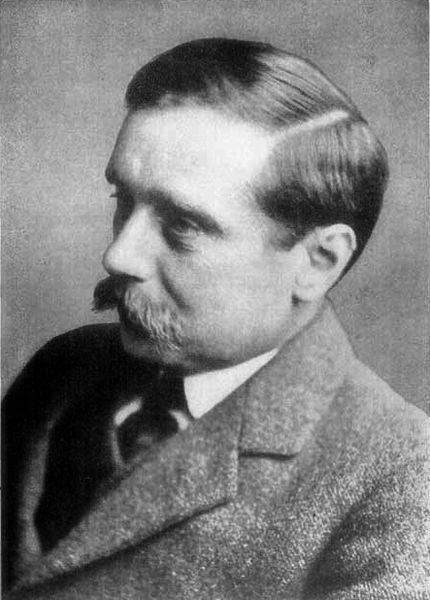
When the silence was first broken at Gorgias Press, one of my colleagues suggested that I read The Time Traveler’s Wife by Audrey Niffenegger. The title suggested to me some kind of point-of-view rewriting of H. G. Wells’ classic The Time Machine, a novel that had a large influence on my young, science-fiction inclined mind. For some reason I wanted to keep this place sacred to the memory of Wells and I dismissed the suggestion with polite demurral. Since that time Niffenegger has been constructing quite a reputation as a novelist, and because I enjoy the implications of time-travel and I like to keep current – fashionably late, of course – I finally took the time to read the book.

I wasn’t sure what to expect; it is a sensitive love story, wrenching in parts, but the mysteries of time travel are left to a genetic defect and not some technological invention. In the course of wending in and out of past and present lives, the main characters, Clare and Henry, carry on a dialogue that includes the dynamic of a protagonist raised Catholic. Once, while discussing the bizarre nature of time traveling, Henry suggests that Noah is a fairy tale to which Clare replies, “Noah is in the Bible. He’s not a fairy tale.” This statement reaffirms that, for many people, Noah is the obvious touchstone of the Bible and modern society. A versatile figure, enigmatic and only sketchily drawn in the Bible, Noah reappears regularly in the popular media. Just this summer I noted how Justin Cronin’s The Passage also cites Noah as a schematic for much of the plot that bears the story. A few weeks ago I mentioned how the remake of The Day the Earth Stood Still viewed Klaatu’s ship as an ark. Noah from outer space.

Noah is a foundational figure for our society. This should not be surprising since the flood myth is among the most ancient of stories that humanity has relegated to religious literature. The Sumerians and Babylonians told the story long before Genesis was composed. In its own way, the Noah story is an example of time-travel. A tale whose origins are lost in the pre-literate stages of humanity, it becomes history with the uncritical acceptance of the Bible, only to become a defining myth of twenty-first century literature. The world of the twenty-first century often feels like a fragile environment ripe for a catastrophic flood. Consciously or not, we are still looking for our Noah.
Another kind of Noah


Sinful Moonsters

Wednesday night a student asked me about the moon god Sin. The name “Sin” has nothing etymologically in common with the usual English word for wrongdoing; they are simply homonyms. Nevertheless, when students first encounter this odd juxtaposition they often think that there must be something to it. This particular student pointed out that many activities classified as sinful take place at night, under the moon. Could they be connected? Linguistically, no; but it did get me thinking about the idea of the moon’s baleful influence on various creatures of the night.

Serious academic works seldom take vampires, werewolves and witches, some of the moon’s most infamously unholy acolytes, to be worthy of valuable research time. Meanwhile Stephanie Meyer and company are laughing all the way to the blood bank. Popular culture gives credence to the children of the night that the academic world ignores. I tried to do a little research on the moon and its mythology only to find that most moon books deal either with serious attempts at astronomy or serious attempts at astrology, neither of which I was seeking. I wanted to know when the moon had slipped from being the gentle god/goddess of the night into its role as the overseer of evil.

Evidence was scant, but it seems that in the Middle Ages, maybe influenced by late Roman ideas, scholars began to recognize the moon’s potential as a dismal influence. The moon has long been popular in folklore as a source of lunacy and luck. Lovers crave the moonlight, but so do teenage vampires and raging werewolves. This is, apparently, a concept of no great ancient pedigree. In any case, the moon here has nothing to do with sin.


Religion in the Underworld

One of the unspoken truths of the study of religion is that it has an unacknowledged, problematic sibling in paranormal studies. There are many obvious differences: for one thing, religious study is respectable, if not really considered essential, whereas paranormal study is suspect and not generally acknowledged by established scientific or mainstream research institutes. Nevertheless, both religion and paranormal phenomena deal with unquantifiable experiences, aspects of human perception that cannot yet be measured. So it was with a large grain of salt that my wife signed me up for a year’s subscription to the TAPS Paramagazine. I’ve posted on this particular magazine before, but a new issue arrived just yesterday that contained so many references to the Bible and mainstream religion that I thought it worthy of reiteration.

In general I am skeptical about supernatural claims. At the same time, I am aware that we understand only a fraction of the universe and some aspects of theoretical physics are more bizarre than your average ghost story. When the magazine arrives I read through it with my salt-shaker within easy reach. Nevertheless, a feeling haunts me that at some deep level my specialization is connected with paranormal activity. The first article in the current issue concerns the Underworld. The author suggests that biblical and Mesopotamian references to the Underworld may be supported by the findings of ghost hunting investigators.

I’m all for a couple of working guys (plumbers Jason and Grant) daring to tread where scientists fear to go, but the problems of using ancient materials to bolster ghost-hunting claims are legion. Just a glance at the popularity of Zecharia Sitchin books warns against a simplistic reading of complex, ancient civilizations. We don’t need ghosts in the machine to explain the Sumerians or Babylonians. At the same time, we don’t have many academic options for uncovering the many, many ghost claims that have made throughout history. Mass neurosis is less believable than occasional hauntings. So although I have to disagree about the viability of a literal Underworld – a good understanding of ancient mythology helps to clarify that one – I do reserve some space for wondering if religious studies might not end up in the same final resting place as paranormal studies once science is able to penetrate the veil.

My all-time favorite ghost photo


Kingship Divine


All conspiracy theories and history’s mysteries aside, there are some interesting correlations between the ancient Egyptians and the pre-European “New World.” Temples, pyramids, and large ceremonial structures are among the common features they share. Perhaps it is inevitable that where a ruling class becomes oligarchic that grand structures to their greatness will follow. Some factors transcend all times and cultures. It may be no surprise then, as MSNBC announced yesterday, that tunnels have been discovered under the ancient Mexican city of Teotihuacan. The tunnels, first noticed under the temple of Quetzacoatl, may be the entry to the tombs of the royalty, not unlike Old Kingdom Egypt. This great pre-Colombian city was already abandoned by the time the Aztecs came along. They gave the city its current name, a title that may be translated as “the place where men become gods,” according to Mark Stevenson of the Associated Press.

Not being an expert on ancient Americans, it is difficult to interpret all this information. Having read extensively on the ancient Near East, however, the parallels are unavoidable. The place where men become gods may well apply to several aspects of ancient Near Eastern thought as well. Not only the Egyptians, but also most ancient peoples attributed divinity to their kings. We have no personal statements from such rulers indicating their personal satisfaction at having been considered better than their fellow citizens, although one might speculate that captains of industry and finance share those views today. The ancients, however, seem to have taken this literally. Kings were gods. When kings died, and were conveniently no longer observable, they were among the unseen realms of the divine, continuing to influence the world from beyond the grave.

Even the Bible shares, to an extent, the idea of divine kingship. David comes pretty close to the mark in the books of Samuel, and certainly the idea had appeal in the pre-monotheistic eras of ancient Israel. The place where men become gods is, however, in the imagination. The great and powerful pharaohs do not govern the affairs of modern Egypt, nor do the shades of Assyrian and Babylonian emperors protect the war-torn realities of life in Iraq. We don’t even know who built Teotihuacan. The fate of divine kings, it seems, is to grow obscure and irrelevant to all but historians and reluctant school kids. There are those who still aspire to divine kingship. They may have lives of immense wealth and power, but if they read a little more history they would glimpse their own fate in the tombs of the divine kings.


Climb Every Mountain

In Ancient Near Eastern religions class, we’ve been discussing where the gods live. At least beginning with the Sumerians (perhaps earlier, but since writing hadn’t been invented, we can’t know) the gods typically dwelt on a high mountain. Older writings on Sumerian religion call this the mountain of “Heaven-Earth,” a name that conveys the point, but also misleads. The concept of “Heaven” is much later than the Sumerians, and in western religions, later than the Hebrew Bible. “Heaven” in this sense is nothing more than sanctified sky. The gods live up there, beyond all the trouble we encounter down here. The idea proved remarkably resilient, stretching through the concepts of Mount Sinai, and Mount Zion in the Bible, and Mount Zaphon among the Ugaritians. Even the Greeks found their gods on Mount Olympus.

The logic of the day was simple: no one has been up the mountain to prove otherwise, so the assertion has never been falsified. Mountain climbing is a leisure activity – in ancient times leisure was not a general expectation. Mountains were obstacles, not opportunities. In their remote and rugged heights, where humans could not reach, the gods dwelled. And, perchance someone did climb a mountain and find the wrong gods? There were plenty of extra deities to go around, so no worries there.

An element of the divine on the mountains still exists. Various tourist companies offer Noah’s Ark climbs of Mount Ararat in Turkey. Even without such support, misguided but determined groups still head to this mountain to prove the veracity of the Bible. In their own way they too are seeking god on the mountain. The problem is that we’ve climbed every mountain and not found the gods. In our cosmology the divine has been shoved out further into space. When space becomes infinite, God moves beyond infinity, always one step ahead of our ability to find him. The ancients bequeathed an undying, if evolving concept upon us when they fabricated the mountain of Heaven-Earth.

Andrew Behesnilian's photo of Ararat from Wikipedia Commons


Nebuchadrezzar’s Dream

One of history’s great ironies is that, despite being visually oriented creatures, we often do not know what famous people looked like. The further back in time we go the more difficult the reconstruction is. Ancient people practiced portraiture, although their efforts may have been hampered by stylistic conventions. Egyptian artwork is recognizable at a glance, and Mesopotamian art, with its weightier, angst-laden form is easily distinguished. Their stylized images generally do not allow for direct correlations to Renaissance portraits. When searching for specific individuals, even famous ones, however, the likeness may be completely absent.

Among the most notorious (from a biblical viewpoint) ancient emperors was Nebuchadrezzar. Demonized for his role in the destruction of the sacred temple in Jerusalem, Nebuchadrezzar becomes the hypostasis of Antiochus IV Epiphanes in Daniel and even worse in Christian apocalypticism. For all that, Nebuchadrezzar seems to have been a jolly good fellow. An able emperor, he was noted for his building an empire and the loveliest gardens in Iraq. Yet no images of him survive. They may be out there, buried, waiting to be found, but we do not know what this emperor looked like.

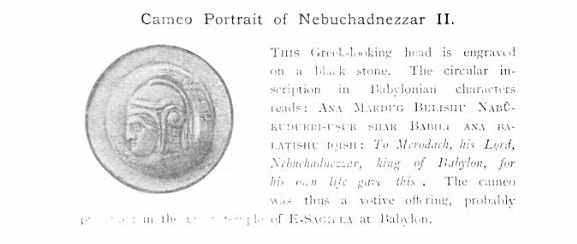
A recent web search nevertheless turned up the clearly Greek version of that famous, if forgotten, face on an onyx cameo. It even appears on Wikipedia’s page for Nebuchadnezzar II as an actual image of the man, the legend; this despite the fact that William Hayes Ward, in the American Journal of Archaeology in 1887, explained how the cameo was an early forgery. Originally an “eye of Nabu,” the proto-cameo was the eye of a statue, the pupil of which was carved by a reconstructionist Greek artisan into what he supposed Nebuchadrezzar looked like – a Greek warrior – centuries after the fact.

From Ball's Light from the East

This might be a simple historical curiosity were it not for the fact that evangelical websites and wikis are quick to claim that this clean-shaven, Olympian-profiled vision of masculinity is an actual image of Nebuchadnezzar. Why? He occurs in the Bible and therefore must be “proved” to have been historical. Not only for the real Chaldean Empire, but also for the fictional one concocted by Daniel. Seeing is believing. While history did not see fit to leave a lasting image of Nebuchadrezzar, evangelical websites will use the tried and true god-of-the-gaps methodology to show us what he actually looked like (not).


Giving Lilith Her Due

Lilith Fair has announced its 2010 tour dates and excited fans are already purchasing tickets. Lilith Fair is a collection of women artists who share a stage to showcase the female contribution to contemporary music and donate a considerable share to charity. The event name, of course, is taken from the mythological character of Lilith. Popularized as a rare example of “Hebrew myth,” Lilith is a character who likely derives from ancient Mesopotamia, although her origins are obscure. Best known as “Adam’s first wife,” her somewhat sexy story in Judaic tradition evolved into Lilith being the original woman. Unlike Eve she was created simultaneously with Adam. Things were fine until she wanted to be on top during intercourse – males were not made to be dominated, according to patriarchal old Adam, and Lilith ships out to shack up with Satan. She is demonized (literally and figuratively) and becomes the “night hag” that snatches babies and claims the first right of intercourse with every male (an etiology for nocturnal emissions). She becomes the mother of demons.

This story shows all the traits of a late development, but the idea of a strong female figure in Eden is an appealing one. Lilith has come to represent the empowered female, and the modern trend towards accepting her as an icon of feminine independence is apt. Long ago I was intrigued by the female side of the story. Perhaps because I was raised primarily in a single-parent family for my formative years, I have always wondered about the disparity in our “advanced” culture that still considers the male as the “default” model with the female as kind of an adjunct after-thought. This fascination led me to the study of goddesses in the first place, culminating in a doctorate on Asherah. In the Bible men have Adam, Noah, Moses, David, and countless other role-models – even God himself according to standard interpretation. Why not admit the goddess?

It is telling that when Lilith becomes too powerful she is presented as evil. Anthropological explanations have little to offer by way of adequate explanations for such a development. Not to blame biology (or to lay claim to an excuse), but Frans de Waal’s Inner Ape demonstrates that males are hopelessly paranoid about showing weakness. Female primates tend to express their power by group cohesiveness while males try to blunder their way to the top with brute individualism. Adam had nothing to fear from Lilith. To those who perform in Lilith Fair, I only have to say, “Rock on!”


Theophagy, Or How do you Like your God?

Ancient folk did not always want to be close to their gods. It really depended on the kind of god you worshipped. In a gross characterization we might suggest that ancient Assyrians and Babylonians preferred to keep their gods at a cautious distance unless needed. Mesopotamian deities (like their environment) were (was) unpredictable and capricious. And with moody gods, distance is on your side. The ancient Egyptians, on the other hand, with their steady and regular flooding of the Nile, felt that gods were friendly and helpful. It was good to have them near ⎯ indeed, as close as possible.

When it comes a step further than being close to a god, the options seem to be inhaling or ingesting a deity. Inspiration (breathing in) is a familiar enough religious concept today, as is theophagy, or eating deity. Theophagy is a regular practice in many branches of Christianity that believe in transubstantiation or consubstantiation. During these Eucharistic events, the communion elements are believed to either transform into or go along with the body of Christ. Christianity traces this concept to that of animal sacrifice where God was thought to consume the animal (or in very early culture, perhaps the human victim). Somewhere along the line the concept was reversed so that God could be consumed.

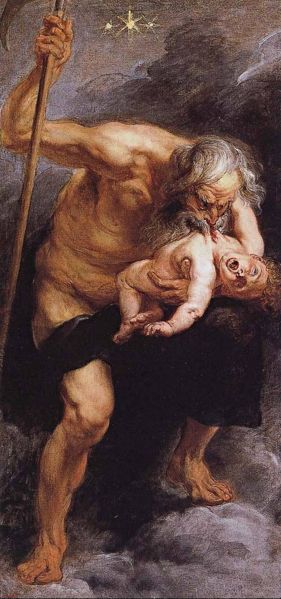
In preparing for my mythology class, I was reminded of Hesiod’s Theogany and the story of Cronus eating his children. This episode, dating from the eighth century B.C.E., has a jealous Cronos trying to prevent a takeover on the part of his kids by the extreme parenting measure of swallowing them. Not to worry, however! Zeus manages to be born on Crete and is able to free his siblings from the gut of his dysfunctional father. Cronus’ intention was to stop the gods by eating them while today theophagy is an attempt to absorb the deity. Ancient religions give us insights into modern religions, but only with a generous dose of evolution. It all depends on what you’re trying to accomplish by interacting with the gods.

Cronus has a little snack


Portrait of Poe as a Young Man

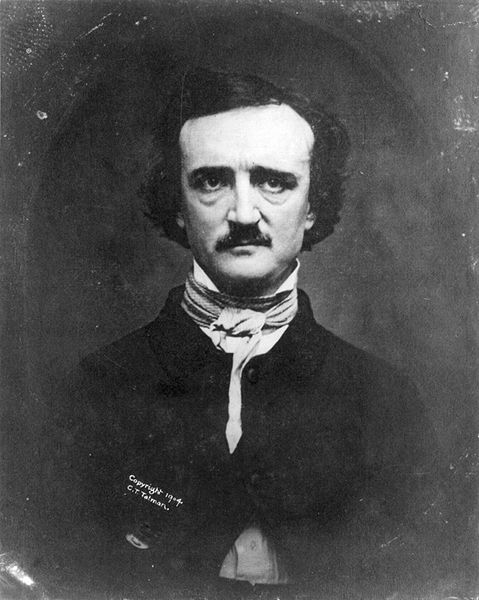
An obscure portrait of Edgar Allan Poe has come to light and is scheduled to be auctioned off. Reports indicate that the watercolor painting reveals a young man without the world-weariness of the more familiar images of Poe. He may even be smiling.

Poe has long been one of my personal muses. His writing captivated my imagination as a young man, and his sense of tragedy encased a golden nobility. Although many consider his works to be juvenile, like the slightly later stories of Sherlock Holmes by Arthur Conan Doyle, Poe grew to a mature sensibility concerning life that rivals that of Job. Intrigued, years ago I wrote a high school term paper about the writer and discovered a spiritual compatriot who couldn’t outstrip the “unmerciful Disaster [that] Followed fast and followed faster.” Now on the side of years beyond the lifespan of my muse, I begin to understand how a happy young man becomes a Qohelet in his time. In his personal difficulties, Poe was able to speak for many of us.

To me this young portrait is cast in the tint of Dorian Gray. The real image of Poe is that of a man given few breaks in life. A man of keen sight and keener insight. There have been thinkers like Poe from ancient times, but they are generally resigned to the depths rather than to be found basking in sublime sunlight. When Ludlul bel Nemeqi or Khun-Anup pour out their souls to an unhearing sky, they create a fellowship for latter day Poes and Melvilles and Lovecrafts. I hope the portrait of a young Poe finds a good home and the message of its subject rings as loudly as the bells.

Poe-ever Young


Blessed Bovines

In perhaps one of the greatest ironies of history, throughout the Ancient Near East, cattle were currency. The entire system of fair exchange is based on what humans deem to be valuable — gold is not inherently of more worth than iron. We choose to agree on such value systems and the chosen material becomes a means of trade. In the Bible, before coinage evolved, wealth was measured in animal possession. The rancher with the largest herd was the richest person around. This should be familiar to readers of the Bible, and it is attested in the surrounding cultures of the Near East as well. Even in Egypt, which has the reputation of looking down on cow-pokes (see Genesis 46), bovines were sacred. The apis bull and the usual representation of the goddess Hathor attest to that.

Wikipedia's prized gnu cow

In reading the Iliad over the last few days, the value of cattle among the ancient Europeans also stands out. War prizes from Troy and other conquests are often valued in terms of how many cattle they are worth. Even captured human prizes are symbolically weighed against their worth in moo. The sacrifice that gods appreciate most is that of the beefy variety, although the small-scale farmer may only be able to spare a caprid; when the gods are showing temper, throw another steak on the divine grill and all will be well. It would be difficult to find a stronger religious continuum in antiquity than the pacifying value of bovine sacrifice.

Bovine worship gone crazy

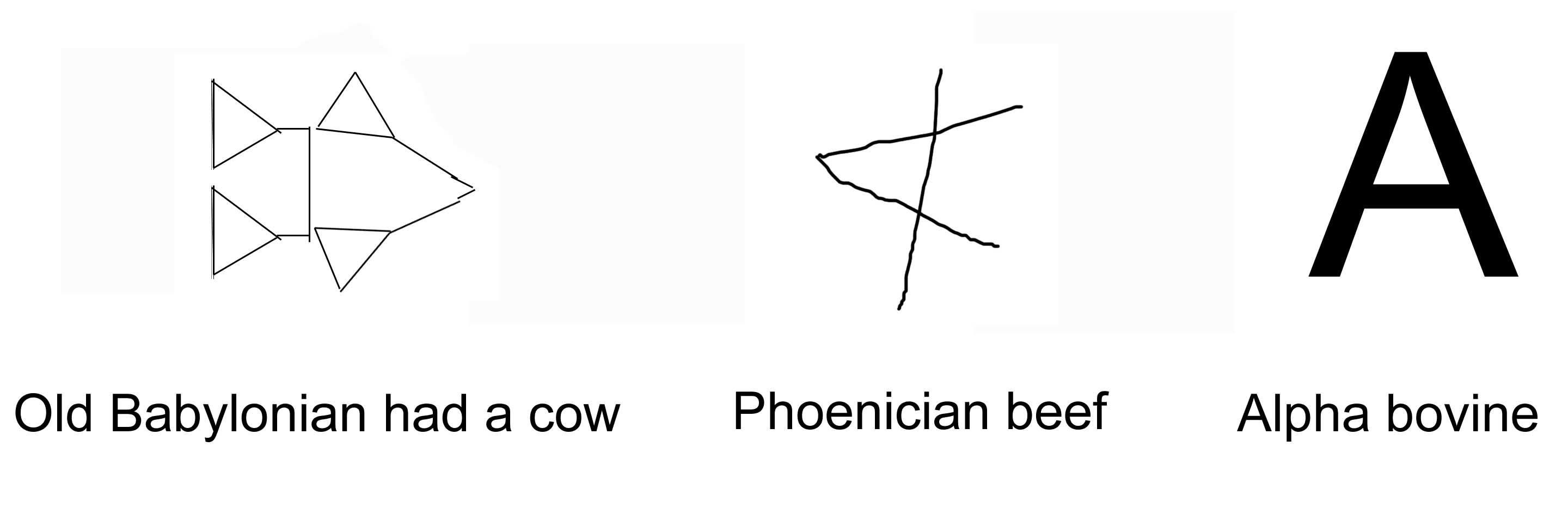
One of the lesser recognized features of our ancient ancestors’ bovine-fixation is found in our own alphabet. Writing began with pictographic symbols representing their referents. Since cattle were so important, their characteristic visage made up a frequently utilized symbol. As cuneiform developed, drawing was replaced by wedge-shaped writing on clay, and the bovine head was represented as a series of wedges and lines. When the inhabitants of ancient Aram (very roughly our Syria) devised their non-cuneiform alphabet, the very first letter was an ox head. The Greeks turned our abstract cow onto its horns and gave the world its alpha, a form that survives in Western scripts today as a Latin capital A. In this industrialized age when, unless they go to the 4-H fair, many people never even see a real cow, every time we tap out messages on our keyboards, we still acknowledge the sacred bovine.


Syncretism Synchronicity

By strange coincidence I had two friends ask about syncretism over the last few days. As generally understood, syncretism refers to the blending of religions. In the ancient world when one culture came into contact with another inevitable sharing resulted. Since all religions at the time were polytheistic, there was no concern about sharing deities too. Ancient people wanted to assure their good fortunes and survival just like modern folk do, and so the safest course of action when you become aware of a new deity is to placate her or him. There are few risks at worshipping additional gods in a polytheistic system, since all deities thrive on adoration. Some ancient societies, such as that of the Mesopotamians, realized that the number of gods could grow well beyond reasonable proportions. After all, many kinds of phenomena had gods, including the natural world, human inventions, and the cosmos. Recognizing overlap between the roles or functions of certain deities they began to draft up lists equating the various gods. Some of these lists are quite extensive.

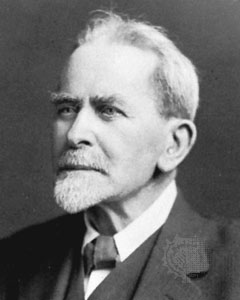
This is the practice of syncretism. Your Yarikh is my Sin, and why offer two sacrifices when one will suffice? Ancient worshippers did not worry about the endless confusion that this would cause for future monotheistic scholars rediscovering their lost civilization. James Frazer, of Golden Bough fame, was a Victorian scholar who saw syncretism everywhere. Ancient cultures became a melting pot with countless variations on every theme. With more sophisticated anthropological methods Frazier’s work eventually fell into disfavor, and syncretism with it. Each ancient culture was distinct, with nuances and subtleties unguessed by rampant blending and blurring of the lines. Some scholars today shy away from the word syncretism since it has such unholy associations.

Fallen Saint James George Frazer

Part of the issue is where our culture stands. We are not the final word in discovery or understanding of our world, and yet monotheistic religions, the majority position in the western hemisphere, make absolute claims. Those of us who examine ancient religions are born into these outlooks, assured that modern-day religion is the true religion and that it, unlike other aspects of culture, will cease to evolve. Religion, however, changes as soon as it leaves its founder’s mouth or hand. The multiplicity of human perceptions and outlooks assures us that each believers’ religion is unique. We may be ashamed by the implications, but syncretism, it seems, will always have the last laugh.


Death’s Door

Podcast 18 considers the perceptions of the world of the dead, according to Ancient Near Eastern sources. Specifically the question addressed is can the dead return from the underworld, based initially on the story of Samuel’s return from the dead in the Bible — this leads to a description of the underworld based on ancient sources. The Zoroastrian connection is encountered in the development of the realms of heaven and hell.


Biblical Science Fiction

1950s science fiction films are perhaps the most parsimonious celluloid genre. Standard Saturday afternoon fare in my childhood, I still have a soft spot for the unapologetic self-confidence of these movies with their painted backdrops and hokey effects. The messages are frequently self righteous and often biblical. So yesterday as I treated myself to a viewing of The Mole People, I went on instant alert as the biblical references began right away for an audience that would have known the Bible well enough to take it all in. Set in “Asia,” the archaeologists are digging for Sumerian artifacts when then discover a stone tablet “below the great flood level.” That makes it at least 5,000 years old, the assembled academics declare. A diffident Dr. Roger Bentley tells his fellow excavators, “in archaeology all things are possible!” When a young boy of the indigenous population discovers an oil lamp shaped like a boat, the archaeologists note, “the flood’s been proven to be a historical fact.” The boat is a model of Noah’s ark, the Sumerian version. The scene of the expedition climbing Mount Kuitara includes footage from the 1955 Fernand Navarra trek up Mount Ararat during which a wooden beam was found, reputedly from Noah’s ark.

If you can stomach the bogus Sumerian you’ll learn that ancient Mesopotamians also survived the flood, a kind of “children of Cain” motif. These Ishtar-worshiping pagans are practitioners of a kind of social Darwinism, killing off their own kind when resources in their underground world become strained. Their great underground civilization parallels that of ancient heathenism while more advanced civilization on the surface of the globe has the benefit of an enlightened Christian worldview. Even the Sumerians whipping the actual mole-men is reminiscent of the Egyptians whipping the Hebrews in the Ten Commandments (released the same year).

Fast forward fifty years. We now live in a technologically advanced civilization where the myths of ancient people have little place. Science provides logical explanations for most of what we encounter in the world around us. Yet there are still otherwise intelligent people seeking Noah’s ark on Mount Ararat. The past is impossible to escape. The Sumerians in the film (whose walls are inexplicably decorated by Egyptian artwork and hieroglyphics) represent those who hold onto a confused religion that has become a form of terrorism in the eyes of the more advanced archaeologists. Perhaps the paradigm has shifted, and those who use religion today to gain political power and personal gain have become the self-righteous Sumerians of The Mole People.


Billion Dollar Babies

Yesterday I attended a holiday-themed concert. It was an unusual mix of the archaic and post-modern in that although many traditional holiday pieces were sung, the readings were from an assortment of writers, some still living. The theme, not surprisingly, was the wonder of birth. One of the readings was from D. H. Lawrence, a writer more often associated on the making of babies end of the equation. Nevertheless, as the soporific music flowed I found myself once again thinking of special babies.

The concept of a special child marked at birth has an ancient pedigree. Long before Samuel, Samson, and Moses there were ancient heroes known from their unusual births. The theme is at least as old as Sargon of Akkad, and probably even older. Those who grow to achieve great things in life must, by back-formation, have had a wonderful birth. Of course, when they were born nobody knew they were special yet, and so our mythopoeia demands we devise incredible births for them. Anyone who is a parent knows that time stops and the entire world stands in rapt silence as your own child is born. All babies are billion-dollar babies.

The subtext to all of this is that without even looking for a special child we should realize that all people have inherent value. If religions truly taught that message there would be a lot less religious violence in the world and the dreams of many more infant dreamers might be attained. Perhaps all religions should take the stories of their own origins more to heart and hear them more often than once a year.


Towers of Babel

Yesterday I ran across a graphic on the Awilum blog that juxtaposed the tower of Babel with the Burj Dubai, the world’s tallest structure, to be completed next month. Perhaps it is a “guy thing,” but I can’t stop being fascinated by very tall buildings. An inveterate acrophobe, I avoided New York City until I was in my twenties and I was gritting my teeth the entire visit the first time I went to the top of the Empire State Building. Although they frighten me, I can not keep away from them. Driving through Chicago while living in the Midwest, I always kept a wary eye on the Sears Tower, lest it should fall my way. When the Society of Biblical Literature met in Toronto, I braved the CN Tower and even stood on one of the thick glass plates that give a bird’s eye view of the ground far, far below. Now there is an even taller building that fully deserves the name “sky-scraper.” At 818 meters, the Burj Dubai in the United Arab Emirates soars far beyond other efforts at the ultimate masculinity. It will be nearly twice as high as the Empire State Building when it is completed.

Gnu view from Wikipedia

Joseph Campbell, the late mythographer from Sarah Lawrence College, has had an enormous impact on the study of myth. As a specialist in Ugaritic mythology I find many points of disagreement with his assessment of mythic symbiosis, yet he once said something that has stayed with me ever since. In his Power of Myth video, he states that societies show their values by their tallest buildings. This statement is perfectly justifiable — the amount of resources required to erect enormous buildings does show a dedication to a quasi-divine purpose on the part of a society. Campbell’s example was the medieval cathedrals, and for anyone who has visited a medieval town this is easily affirmed. (St. Vitas Cathedral in Prague and St. Andrews Cathedral in Scotland confirmed this for me.)

The Hebrew Bible, however, casts another view on tall structures. Buildings such as the Tower of Babel are the ultimate in a Judaic assessment of hubris. Genesis 11 makes short work of Babel, stating that God has to stoop down to see this great effort, yet he feels threatened by it nevertheless. Our towers today demonstrate our conspicuous consumption, yet I can’t help but be impressed. Where some see only shifting sand atop endless pools of petroleum, other visionaries see the tallest structure on the planet. Just thinking about it, I find myself clenching again. I don’t plan a visit there anytime soon, but it is in the neighborhood of Babel, for those who speak the language.