Jekyll and Jekyll

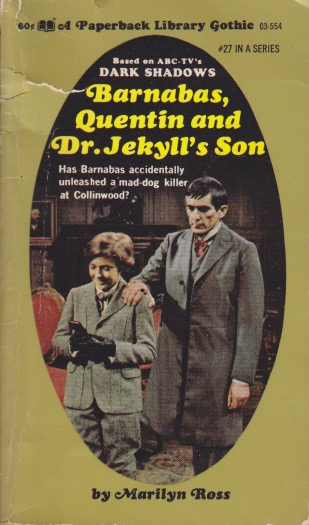
W. E. D. (“Marilyn”) Ross was a journeyman writer.  Prolific, he produced more than 300 pot-boilers, and he only started writing at mid-life, which kind of lends hope to me.  (He, however, didn’t always pay attention to literary niceties.)  I’ve made a determined effort, over the past decade or so, to collect and read all of his Dark Shadows novels.  These aren’t great literature, and I generally have to space them out to recover from them.  I just finished number 27 (of 32), Barnabas, Quentine and Dr. Jekyll’s Son.  Although I watched Dark Shadows as a child, it’s pretty clear that my cosmology of Collinwood was primarily shaped by Ross.  Living in an area without a regular bookstore, and without the cash to regularly buy books, I found what volumes I could at Goodwill and read them avidly.

Barnabas, Quentine and Dr. Jekyll’s Son is now a rather rare item on the used market.  It’s pretty clear that as Ross went on and on in the gothic fiction genre, he tried new things and these generally improved his work.  This story, set in the past, involves Dr. Jekyll’s grown son accompanying Barnabas Collins to Maine in order to escape his father’s reputation and, as a sidebar, to try to cure Barnabas of his vampire curse.  This means that one of the Collins girls, Emily in this instance, falls in love with Jekyll rather than Barnabas.  It also marks the point at which Ross tries to make it clear that both Barnabas and Quentin are good guys, but being under their own curses, they have to follow their vampire and werewolf natures, respectively.

I think I may have read this one as a child.  Although each book was stamped with its number in the series, I was dependent on when my mother decided to go to Goodwill and what they happened to have on hand in their book bin.  Some scenes from this book came back to me in the reading—although it was perhaps forty or more years ago—and one of the most important of these was one where Barnabas and Quentin collaborated on capturing the criminal.  Among the true fans of the series, they are known as the immortals (and Quentin isn’t always a werewolf), and they revisit Collinwood over the centuries.  Quentin can be both good and evil, but Barnabas is generally a sympathetic character.  Dr. Jekyll’s son isn’t such a strange guest at Collinwood, and the stories do seem to have improved over time.  It’s still Ross writing, but this one was more than a surface refinishing of a classic tale.

Nope, Not Yet

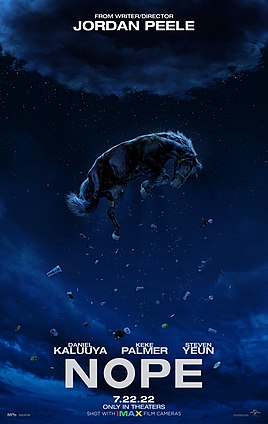
It’s perhaps this summer’s most hotly anticipated movie, but I’m not sure when I’ll get to see it.  Jordan Peele’s Nope opened in theaters this weekend but I’ve been busy.  For many Peele may have seemed to come out of left field with his 2017 directorial debut, Get Out (it took me a couple years to see that one), but he’d been working in films prior to that.  Then Us appeared in 2019 and instantly established him as the auteur of black horror films.  Like many in horror, Peele has a strong element of humor as well.  His films feature black actors falling into circumstances that whites have tended to claim for themselves—being the victims of monsters (often human).  I unfortunately missed Peele’s attempted reboot of The Twilight Zone in 2019-20.  Nevertheless, I know he’s a kindred spirit.

I try not to watch trailers before seeing a movie.  They give away too much.  I don’t need any enticement to see a Peele movie.  Even as I await a free weekend, I think about how horror has been a field accepting of auteurial diversity.  Women have directed horror since at least the eighties.  James Wan has been a major player in the genre since the early new millennium.  M. Night Shyamalan had his start shortly before that.  Good horror is good horror.  Often such films are quite smart as well.  Get Out drew attention for its social commentary—something for which Rod Serling was famous, and thus the naturalness of The Twilight Zone.  But when will I have time to get out and see Nope?  Perhaps I need to cash in a personal day so I can take in a matinee.

The trick will be, of course, to be on the internet without reading about it before that can happen.  Taking time off work is punished with skyscrapers of emails when you return.  But when I start having dreams about my boss coming to my messy house and helping me do necessary repairs, I think maybe I’ve been working too hard.  Movies, in such a life, seem like superfluous luxuries.  Of course, I’ve long accepted the thesis that films are our modern mythology.  They are our cultural referents, and not infrequently the source of meaning.  They explain our world.  And they require taking at least an hour-and-a-half out of the mowing, painting, hammering, and hauling that never seem to end.  Nope, I won’t have time to see the movie this weekend.  Yep, I’ll be looking forward to the first opportunity to do so.


Stay Safe

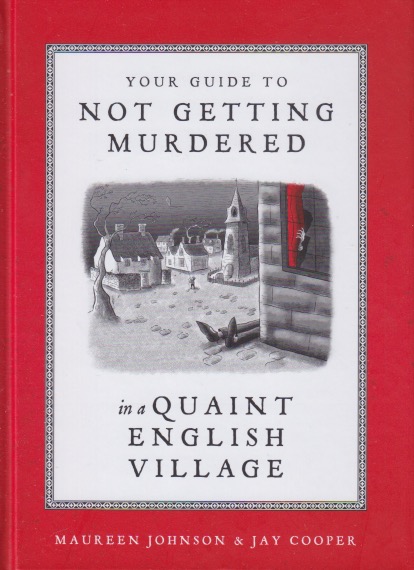
I’m not an impulse buyer.  Having grown up poor, I tend to walk into stores with a list firmly in hand and I don’t deviate from it.  Advertising has virtually no impact.  I don’t pay attention to ads unless they’re for things I know I need, and even then I shut them out most of the time.  I do let my guard down in independent bookstores, however.  So it was that I found in Aaron’s Books in Lititz, Your Guide To Not Getting Murdered in a Quaint English Village.  It was totally an impulse buy, easily read in a sunny afternoon in a caboose motel.  Or a rainy afternoon in an English manor house.  Maureen Johnson and Jay Cooper have produced a wonderfully witty illustrated guide here.  It helps to have lived in the United Kingdom for a few years.

Shelved face out in the thriller section, it’s a great opportunity for murder-mystery, gothic literature, horror movie fan types to laugh at themselves.  Some parts are snort out loud funny.  Okay, so I was on staycation and being a bit free with cash for a change, but I’m sure I will keep this one near my desk and turn back to it from time to time.  Maureen Johnson is known for her young adult novels and Jay Cooper is a children’s book illustrator.  Their talents, however, work together incredibly well for this slightly naughty guilty pleasure read.  The Wicker Man even gets a nod or two.  Something that those who disdain horror don’t often realize is that it quite frequently has its own sense of humor.  It’s an intelligent genre that doesn’t take itself too seriously.  At times it does, of course, but those of us who are fans can tell fantasy from real life.  Maybe.

Independent bookstores are starting to make a comeback.  A significant part of our population isn’t on board with retailers trying to convert everyday life to the metaverse.  We want to hear our music with the occasional pop and microphone hiss.  We want to drive our own cars.  We want to browse in actual bookstores.  Given my buying record online, I have to laugh every time I look at the recommendations.  The electronic world brain doesn’t know me very well at all.  It assumes it knows why I bought that ladder or that round blank four-inch stamped electrical cover.  Some of us play in nontraditional ways with such things.  And we get ideas from wandering into independent bookstores.  As long as they’re not in quaint English villages.


Sacred Hudson

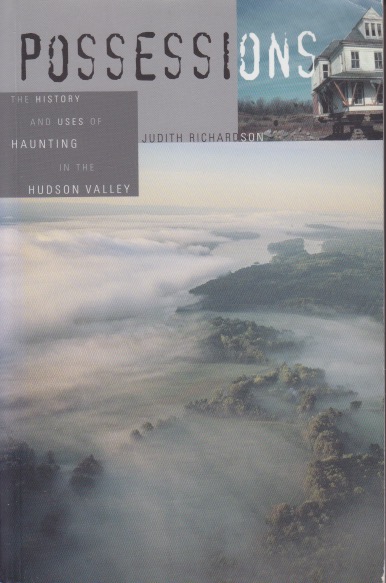
As scientific as we may wish to be, there’s no denying that there is a sense of place.  We know that some animals, at least, also feel it.  Whether theirs is a more pragmatic desire to return to where conditions were favorable to be born, or whether something deeper draws them there, we have no way of knowing.  People feel it too, this sense of place.  We know where we’re from, and if we don’t we often want to find out.  The space is somehow part of us.  There’s a compelling exploration of this in Judith Richardson’s Possessions: The History and Uses of Haunting in the Hudson Valley.  While not America’s first haunted location, the Hudson Valley was singled out for this treatment by Washington Irving.  He, however, didn’t invent it.

I’m not from the Hudson Valley.  I could never afford to live there.  That doesn’t mean the area can’t speak to me.  Richardson’s approach is academic yet readable and she considers how hauntings fill needs and how they play a role in that ever-contentious enterprise of land claims.  Ranging through literary treatments, whether the fiction of Irving or tour books of the next generation, or indeed, more recent literary efforts, Richardson deftly guides the reader through American Indian and Dutch and other inhabitants’ stories of themselves.  Race inevitably plays a part, and her tracing of the origins of some traditional tales is really remarkable.  Who owns the land?  Who truly owns anything?   

Similar treatments (I can’t help but feel somehow lesser) must exist of other haunted locations.  Richardson doesn’t engage in arguments over whether ghosts are factual since ghosts serve so many other functions.  Our lives are the stories we tell about ourselves.  Many of those tales involve the place we are or places we’ve been.  In our highly mobile society, few of us, it seems, can make a living where we’re from.  Those of us born in small towns range far and wide to find employment.  In many cases we may not want to go live where the drama of our childhoods unfolded.  Yes, there are pleasant memories there, but there are also ghosts.  Richardson explores how this plays out in one small stretch of the country.  Indeed, it’s a small stretch of New York state.  Stories of hauntings continue in that particular valley.  Uncanny, perhaps, but there are places in this world like that, and this book is a sure road post on this particular overgrown trail.


The Horseman

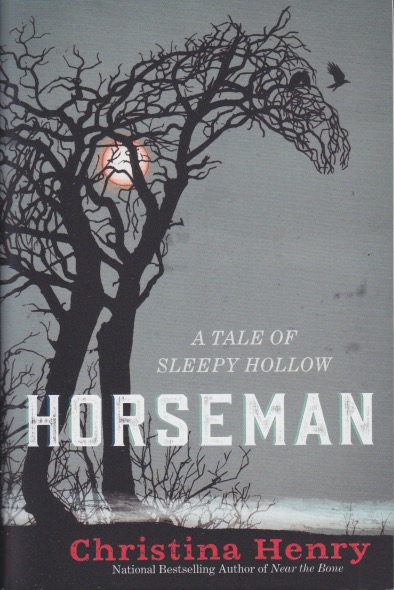
Washington Irving’s tale, “The Legend of Sleepy Hollow,” perhaps due to its being the earliest literary American ghost story, has been retold time and again.  When I saw that Christina Henry had a take on it that came out last autumn, I knew I’d be reading it.  I’d read her The Girl in Red late last year, but I couldn’t wait until fall to read this one.  Henry has a way of taking traditional stories and making them relevant.  Horseman is set two generations after Ichabod Crane and Brom Bones and Katrina Van Tassel, but they all appear in it.  According to Irving’s story—and this is often changed in cinematographic treatments—Brom and Katrina wed.  The narrator of this tale is Ben, who in today’s terms would be considered transgender.  He (his preferred pronoun) is the grandchild of Brom and Katrina.

Henry is a master of magic realism.  There really is something in the woods of Sleepy Hollow and it’s taking children’s heads.  Some influence from Tim Burton’s film version is found here, but the story has its own trajectory and inner logic.  Ben actually sees the monster, but nobody will believe him.  Not until it’s too late.  The one person who does believe is Katrina, Ben’s grandmother.  She, however, wants Ben to act like a girl because he was born female.  She wants him to stay home and learn sewing and cooking.  Ben’s hero, however, is Brom.  He’s a good man, if rowdy.  He married Katrina for love, not wealth.  Ichabod Crane does appear, later in the story, but since how he appears is a spoiler I’ll need to let you read for yourself.

Americans are often raised with the wrong-headed notion of canon as the one way a story goes.  Retelling is as ancient as writing itself.  Homer, Apollodorus, and Ovid were retelling stories.  So were many Bible writers.  People tell one another tall tales.  Washington Irving didn’t invent the Headless Horseman out of whole cloth.  Neither did the people of Tarrytown.  How the story goes is a matter for discussion.  Bet yet, it’s also a matter for retelling.  Henry’s version could be made to fit with Irving’s, but with a bit of prior assumption, some posthumous collaboration.  Hers, however, is a tale for our times.  Just like in Red, the protagonist isn’t conventional, according to conservative sexual standards.  Both are, however, authentic.  And although both may be flawed in various ways, there’s no denying that they’re heroes.


Having X

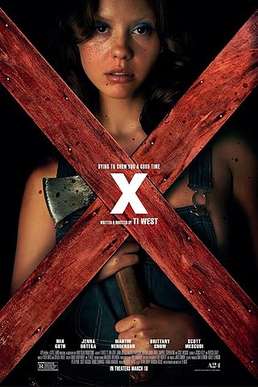
The final girl is such a classic horror trope that even horror novels can be titled after it.  You know the drill—teens hanging out, doing things that teens do, end up being killed off one-by-one by a monster or a disturbed person(s).  The one to survive is the virginal girl who doesn’t drink, use drugs, or whatever.  As a long-term horror watcher, I think the trope has been exaggerated, but it does occur enough times that there was clearly something to be noticed.  Enter X.  Released earlier this year, a slasher that rather obviously juxtaposes religion and horror, X features a “final girl” who is anything but virginal and sober.  The religion aspect is blatant from the beginning when the opening sequence involves a televangelist preaching to a viewership of the dead.

The title derives from the premise (which is a throw-back to the classic slasher era) that a would-be independent movie producer wants to shoot a pornographic movie.  Since this is strictly low-budget, he contacts an elderly gentleman on a remote Texas ranch who has a guest house.  With his one male and two female stars, a cameraman/director, and an assistant he drives to the isolated location.  They are all divided into couples, with each of the women having sex with the male star.  What makes this creepy from the beginning is that the old man, and his elderly wife, create a sinister presence.  She sneaks up on the young people, watching them through the window.  She misses her younger days when she was young and attractive.  As night falls the young people are killed off by the older couple one at a time.  What’s more, they’ve done this before.

X is a reflection on aging.  More than that, it’s a reflection on how religion leads to horror.  To say precisely how would involve giving away a spoiler, so I’ll leave the reader to watch the film to find out.  Suffice it to say, the televangelist is preaching about how sex leads to evil and the older couple kills because they’ve been listening to him preach.  X is not for the faint of heart.  I generally don’t like jump-startles and there were a couple of those that caught me off-guard.  (I try to anticipate them when watching slashers, or any horror, for that matter.)  But what of the final girl?  There is one, but it’s one who flies in the face of horror convention, if there is such a thing.  


Carter’s Creations

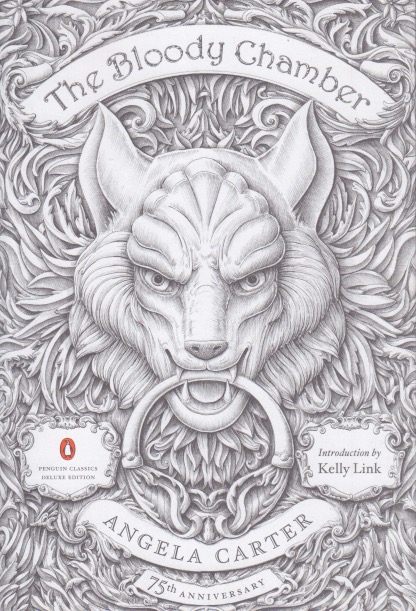
Angela Carter was a novelist whose best known work is her short story collection, The Bloody Chamber.  Often acclaimed as both gothic and feminist, these repurposed folktales and fairytales leave the reader in a thoughtful state.  I have to admit to having not known of Carter or her work until quite recently.  I’d seen a biography about her, but there are so many writers and my time seems always so limited.  Then I saw The Bloody Chamber mentioned on a list of best gothic fiction.  I had to find out what this was all about.  The stories are indeed unlike much of the feminist literature of the seventies.  The stories are focused on women, often young, and how they deal with being treated as the property of men.

The first, and lengthiest story, “The Bloody Chamber,” is a retelling of Bluebeard from the point of view of his last wife.  It’s an extended reflection on feeling owned and boxed in—literally trapped—by men’s economic rules of property.  Carter keeps readers on edge, even if they know the base story.  This isn’t a simple retelling.  Nor is it a lament about the natural, biological unfairness of sexuality.  There’s an ambivalence here, an enjoyment tinged with melancholy that gives the story a gothic sensibility.  The women in the different stories here prefigure more recent Disney heroines that take charge of their circumstances.  And there’s also ambivalence about the setting of the stories.  There are contemporary appurtenances but still castles and baronial mansions.  You’re lost in time.

The collection has some stories, such as beauty and the beast, retold twice and ends with three versions of werewolf stories that play, to an extent, on little red riding hood.  Some were tales with which I had no familiarity.  The effect of the whole is thoughtful contemplation of the human condition.  Much of the world, it seems, has been unduly influenced by a kind of literalism—a story, whether biblical or traditional, is supposed to go like this—that has not only robbed great texts of their depth, but has entrapped human beings in a stone-chiseled certainty.  A self-righteousness, if you will.  Even writing a text in stone doesn’t prevent others from interpreting it, however.  Since none of us have all the answers, we are each interpreters.  There was no historical Bluebeard.  There have, unfortunately, been many men who embody his attitude towards women.  Carter’s genius is to remind us that every story has at least two sides.  And the woman’s side may well be the truer of the two.


Keeping Your Head

Horror is a gift that keeps on giving.  Not many horror fans are among my regular readers, but I like to keep a finger in the pie nevertheless.  Just earlier this month it was announced that Paramount has hired Lindsey Beers to direct a new big screen Sleepy Hollow.  It’s early days, of course, and the movie hasn’t been titled, let alone filmed.  Beers is just wrapping up a prequel for Pet Sematary (not yet titled) that I’ll be eager to see.  Women horror directors tend to bring refreshing angles to the genre—and why shouldn’t they?  Women writers were crucial in developing the Gothic genre that evolved into horror as we know it.  No matter what the Supreme Court says, they are just as important—probably more—than males.

I’ve been reading quite a lot about Sleepy Hollow over the past several months, which is how I came across the intelligence about this new movie.  It’s nice to know that the Hudson Valley is evergreen.  My visits there have offered brushes with the uncanny, but nothing explicit.  A weekend near the ice caves of Sam’s Point, geocaching in the woods outside Poughkeepsie, a visit to Sleepy Hollow itself to visit Irving’s grave and tip my hat to the Old Dutch Church.  With deep family roots in upstate New York, I’ve always thought it would be a great place to live.  Alas, not on an editor’s salary.  It’s been too long since I’ve given the area a visit.

John Quidor, The Headless Horseman Pursuing Ichabod Crane, via Wikimedia Commons

There have been many takes on Washington Irving’s “The Legend of Sleepy Hollow.”  Even in the silent era movies were made of it.  In retrospect, it seems odd that it took so long for Tim Burton to bring it back to the big screen.  There were some television movies, usually with plodding plots to draw the story out to commercial length.  Disney had early on devoted half a feature to it, as if the story couldn’t support its own weight.  For better or worse, that film was probably the first introduction to the tale that many people had—the story itself was written for adults.  Of course, many written kids’ versions have come out since then.  The satirical original was meant for a somewhat sophisticated readership with a sense of humor.  The story lends itself to horror treatments, however, if they’re done well.  It may have been an early viewing of the Disney tale that set me moving in this direction.  I like to think I’ve kept my head over it, however.


Paperback Nightmares

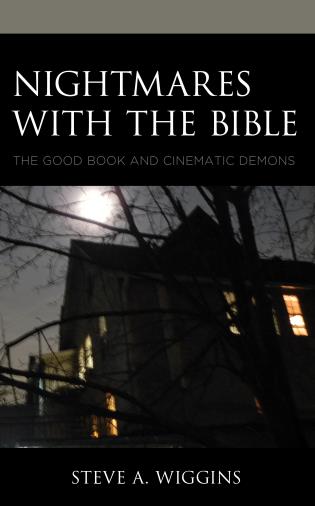
I’m not assertive.  My voice is not loud and even when I have strong opinions I like to let others have their say.  Those of us who’ve been beaten down too many times can be like that.  So it took a lot of courage to ask.  “Is it possible that Nightmares with the Bible might be issued in paperback?”  You see, I know that “academic” books almost always sell the copies they’re going to sell in the first year.  Some follow-up sales continue into years two and three, but beyond that it’s about done.  And I also know that when authors ask for a paperback it almost never sells as well (or even more poorly) than the hardcover.  I’m hoping the paperback of Nightmares will buck this trend because it published into the pandemic.  That was a game-changer.

When you’re worried about staying alive you might not feel like reading about demons.  Of course, what better time to do so is there?  Paperbacks are often produced, in academic settings, to appease authors.  I have long believed—and this flies counter to the orthodoxy of the publishing world—that if books were initially published in paperback and priced affordably they would sell better.  The fear is that the higher priced hardcovers wouldn’t be purchased by libraries.  Librarians would, oh tremble, purchase the reasonably priced paperbacks and rebind them for less expense than the stratospheric price put on a 208-page monograph.  Publishers are often afraid to try anything different.  Assured sales are a blessing that can be bankrolled.

I’m hoping, once the paperback comes out, to do some more promotional work on it.  This blog was started long before I had books to flog.  It’s free content for those who like the less sweet kinds of treats in the bowl.  I do appreciate the occasional free advertising I can do.  It’s my hope that there’s always something to learn offered with it.  Successful content providers can make a living doing it.  Others pay for the privilege.  I often ponder what will happen to this blog when I run up against the size limits of my WordPress account.  The next level up, commercial, is beyond my price range.  Perhaps, like a phoenix, it will be time to start all over again when that moment comes.  In the meantime I’ll reuse images as often as I can, because each new one takes a byte out of my account.  And when it’s all said and done, Nightmares will still be available in print. Hopefully in paperback next year.


Devils and Days

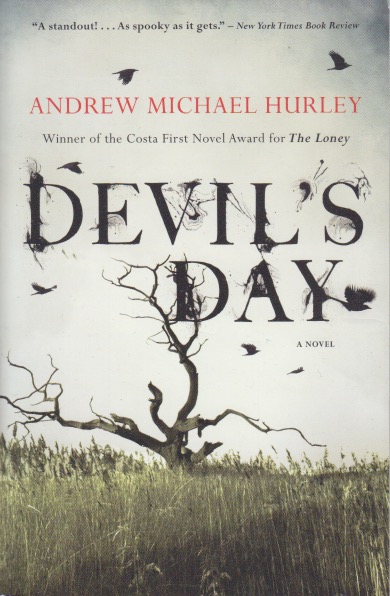
The kind of devil envisioned by Andrew Michael Hurley in Devil’s Day may not be the traditional one, but it’s scary nevertheless.  In his follow-up novel to The Loney, Hurley demonstrates that he knows the devil can still be frightening.  The Endlands, in northern England are hemmed in by the moors.  The landscape plays such a commanding role here that this can only be folk horror.  And it fits folk horror to a tee.  Tradition, an unchanging life in a land untouched by technology, and forbidding moors where survival is difficult, all amid an English sensibility brings this tale into the folk category neatly.  As should be clear already, Hurley is well aware that religion and horror belong together.  This novel makes their companionship clear.

John Pentecost (note the name) has decided that he and his young, expectant wife—both of whom hold professional jobs—are going to move back to the family sheep farm.  The death of John’s grandfather means that his own father is left to run the farm alone.  Knowing that he belongs there and that his unborn child will need to tend the farm when he dies, a visit to help with the gathering of the sheep, and the celebration of Devil’s Day, turns into a lifelong commitment.  At the same time, the devil has been body-hopping as sheep are killed and family members die and a family of bullies cause more harm than their due.  There’s an inevitability to all of this and at the end you’re not really sure who the devil really is.

The story builds slowly.  By the day of the gathering you really have trouble putting it down.  Putting the Devil into a story can be a dicey proposition.  It’s been done successfully a handful of times, but that doesn’t make it an easy sell.  Our worldview has moved beyond a literal netherworld and the theology that accompanies it.  That doesn’t mean we can’t spot legitimate evil in the world.  Or that evil isn’t often vested in the garments of righteousness.  Ways of thinking that jeopardize others for theological purposes that simply don’t match what we know to be just and fair.  Powerful exploiting the weak.  Wealthy taking advantage of the poor.  Bullies getting their way through brute force.  In this novel the devil is active in a number of characters for a short time.  And you never know where that devil might turn up next.


Godic

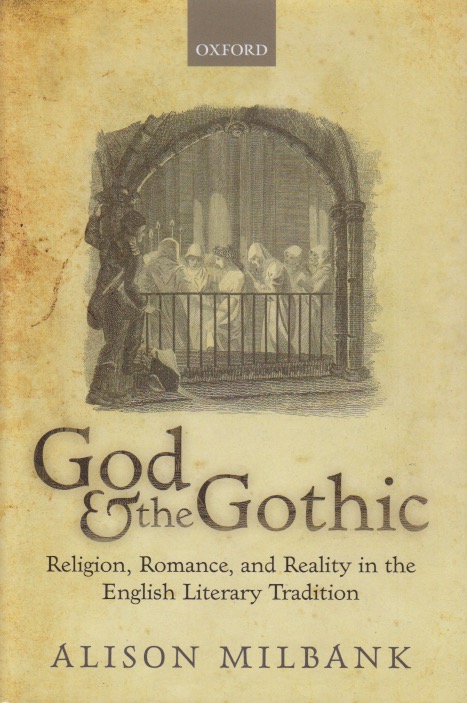
I have tried, in my halting way, to articulate what religion has to do with horror.  Alison Milbank is more experienced than I and it shows in her book God and the Gothic: Religion, Romance, and Reality in the English Literary Tradition.  There can be little doubt that the gothic is the direct ancestor to what became horror in the twentieth century.  In this intriguing study, Milbank explores just how the gothic made extensive use of religion, a sensibility that has carried over into modern horror.  Having taken a good long look at this myself—the fascination was there before Holy Horror and reaches back to my childhood—it is nevertheless affirming to find another student of human fears and fascination regarding the darkness has come to similar conclusions.  I always walk away from books like this with a renewed reading list.

Milbank points out, in the context of the literary world of England, how horror and religion not only cover the same theological ground, but come into direct contact time and again.  She does so by suggesting that Protestantism constantly seeks the lost Catholicism.  In England this came to be embodied in the Church of England, the middle way between Catholic and Protestant.  She covers various aspects of this such as melancholy, the doubling of characters, supernatural creatures, and death.  And more.  This isn’t a quick or light read, but I found myself making many connections I had missed.  Much of this, admittedly, came in books I’ve not read.  One of the problems with interest in the classic gothic is that bookstores don’t cater to selling older books and some of them weren’t successful in their own day, let alone ours.

There is a vindication in finding you’re not alone in a field.  Many of us who work on religion and horror know one another.  We’re a somewhat small, hidden group.  Milbank approaches all of this from the point of view of theology.  Theology is a somewhat distinct practice from religious studies and even from biblical studies.  There is overlap, of course, but theology is generally distinctly Christian in a context like this.  And that fits the living context of the many authors explored in this study.  Many familiar, and a few unfamiliar names appear.  What they have in common, apart from making up the cadre of gothic writers, is that religion influenced their writing and they weren’t shy about noting it.  This book explores the shadows very well and I’ll be revisiting its insights again and again.


Old Ghosts

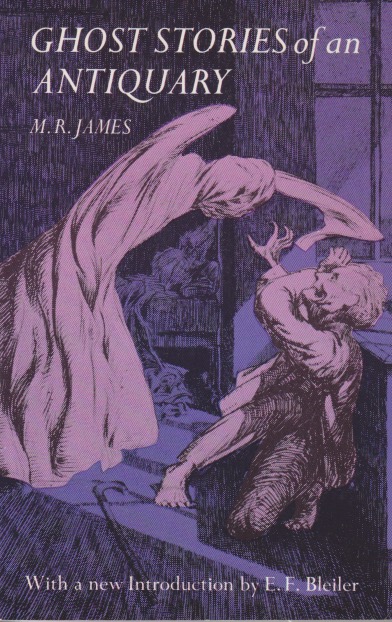
As someone who reads about ghost stories, as well as ghost stories themselves, I’ve long been aware of M. R. James.  His Ghost Stories of an Antiquary is regarded as a classic in the ghost-story genre.  Sometime in the haze, I recollect it was years ago, I found a copy at a used bookstore on the sale rack.  Something I’d been reading about ghost stories lately made me decide to read it through.  Now James was an actual antiquary.  He was also an academic at Cambridge University.  His tales are erudite, generally focusing on some ancient secret that releases ghosts, or sometimes monsters, after the individual who discovers the antiquity.  The stories are varied and inventive, but not really scary to the modern reader.  They assume a different world.  One in which antiquaries were monied individuals—often university men—who have both servants and leisure time, rarities today.

I found myself constantly asking while reading, how could they get so much time off?  How did they access such amenities that they could even get to the places where the ghosts were?  James’ world is both textual and biblical.  It’s assumed the reader knows the western canon as it stood at the turn of the nineteenth century.  The Latin, thankfully, is translated.  James, it is said, was a reluctant ghost-story writer.  A university employed medievalist, he had academic publications to mind as well.  Nevertheless he managed to publish five ghost-story collections.  Clearly the idea seemed to have had at least some appeal to him.

The aspect I find most compelling here is that an academic could admit to such an avocation.  While it’s becoming more common these days among the tenured, I always felt like I was walking the eggshell-laden pathway to academic respectability.  I was, after all, at a small, haunted seminary that few outside the Anglican communion knew about.  It was risky to admit being drawn to anything speculative.  Come to think of it, although I read novels while I was there I don’t recall reading many, if any ghost stories.  It was scary enough to be about on campus at night, particularly if you were going to the shore of the small lake to try to photograph a comet alone.  There were woods punctuated by very little light.  On campus ghost stories were fine—the librarian even showed me a photograph of a ghost in the archives—but off-campus such things could never be discussed.  I was an antiquary without any ghost stories. James showed the way.


Updating Irving

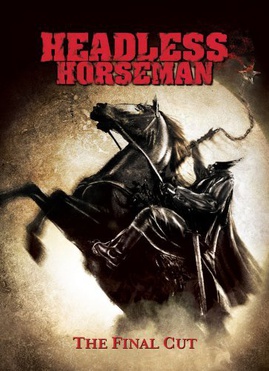
Movie quality is measured by many standards.  It’s pretty clear that budgets can make a difference—Hollywood movies generally outshine television movies.  Streaming services, like Netflix and Hulu, have been gaining ground here, but they still lack some of the qualia that come from long-term players in the industry.  Often this was measured, pre-pandemic, by box office success.  I’m not sure how it’s all quantified now, but I’m sure it still comes down to money.  To me, the deciding factor about the quality of a movie is often the writing.  Even with a modest budget excellent writing can make up a lot of ground.  Headless Horseman originally aired on the SciFi channel (now Syfy) in 2007, and I wrote a tiny bit about it in a former post.  I recently rewatched it with an eye toward how religion is integrated in it.

Headless Horseman is not a great movie.  Its writing doesn’t inspire and it leaves too many gaps in the narrative to carry the viewer along easily.  Still, religion plays an important role in the story.  This one resets Washington Irving’s tale in the south—from the license plates, Missouri.  The horseman is a serial killer who offered his victim’s heads to the hydra, the serpent that guards the entrance to Hell.  When the killer is stopped and his body sent through the gateway, he comes back every seven years to chop heads.  The town where all this takes place has the biblical name of Wormwood, and everyone in it is literally family.  So every seven years they have to trap seven outsiders to make their offering.  The person who originally stopped the killer was the local priest.

Even this brief synopsis reveals how deeply religion is engrained in this retelling.  Irving’s classic story is set in an overtly religious period (particularly Protestant, of the Reformed variety), and wears this lightly.  Everyone can be assumed to go to church and the Headless Horseman is a Hessian mercenary decapitated by a cannonball during the Revolutionary War.  Over time, with many retellings, the horror becomes more and more involved with religion.  To the point that the religion itself is the real engine of fear.  A town protecting a Hell-guarding hellion doesn’t exactly make them Satanists, but it does mean they’re not far from it.  The in-breeding is, however, a bit insensitive.  My recent rewatching wasn’t with an eye toward the Bible, as my last viewing was.  When retelling the story, however, it seems religion will surface where once it was only in the background.


Various Plagues

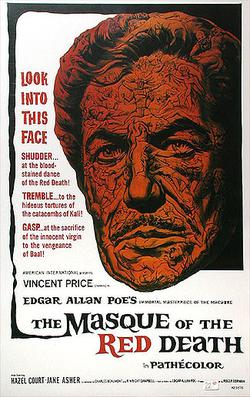
At the encouragement of a friend I watched Roger Corman’s version of Poe’s The Masque of the Red Death.  As I’ve mentioned from time to time lately, making short fiction into movies requires padding.  Poe’s tale is easily summarized: Prince Prospero and his wealthy friends attempt to socially distance themselves during the plague of the red death.  During a masquerade, one of the characters is the red death and they all succumb.  Getting about 90 minutes out of this was something to which Corman was well suited.  The interesting thing, and the reason my friend, I suspect, recommended it, is that Corman did so theologically.  Vincent Price’s Prospero is cruel to others to make them face reality.  He’s also, and not unrelatedly, a worshipper of Satan.

When the red death breaks out in a small village, Prospero holes up in his castle where he tries to win over a local girl that has caught his attention.  He’s drawn to her not only for her beauty, but for her faith.  Francesca believes in the goodness of God as strongly as he believes that Satan will welcome him.  The film is further padded out by blending it with Poe’s story “Hop-Frog.”  Despite the Corman hallmarks of quick production and low budget, this adaptation draws much from conflicting religious views.  In fact, this story centers on them.  Granted, this was in the sixties, but the ideas still resonate these decades later.  Rumors of Satanism still spread panic and spark the same kinds of discussions.

Interestingly, the film ends up suggesting that death is stronger than Satan.  And that justice dictates that at least some of the faithful will survive.  Those dedicated to their faith, their family, and their friends make it through alive.  Death specifically lets them go.  Prospero, however, seals his fate by his selfishness.  Apparently his explanations of his motives do him no good.  Death doesn’t condemn him for his devotion to Satan.  The treatment of his fellow humans, it seems, is the ultimate measure used.  Some would argue that theology is best left to theologians, but it seems to me that we all work with the same data.  Philosophers attempt to convince based on the power of their reason.  Theologians try the same, but there’s always something external and unknowable in the equation.  How you know this unknown is on the basis of sacred texts and sacred tradition, as well as reason.  Why does it seem unlikely that writers and directors might have something to add to the conversation?


Pure Fear

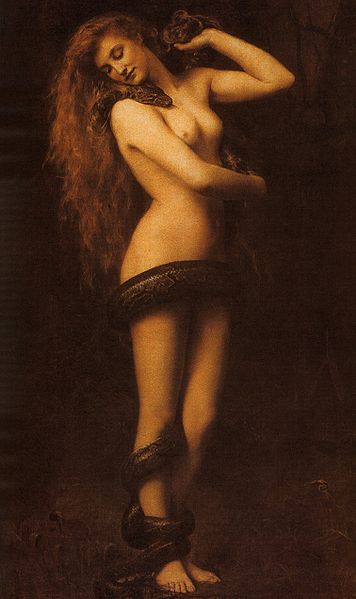
At work we have the opportunity to say a little about ourselves on a shared document for our teams.  This is a fairly new thing, so people I’ve worked with for years have no reason to look at it.  A couple of new hires, however, have noted that I watch horror movies and this has led to some budding friendships.  Since we’re all remote workers it’s mostly a matter of a line or two in an email about whether I’ve seen this or that film.  One of those recommended was the Hulu original Pure.  It’s actually pretty good.  The idea is a bunch of teenage girls are brought to a retreat center for a purity ball with their fathers.  This kind of thing can get very creepy very fast, given the incestuous overtones for such a thing.  Not only is it a religious event, it’s based on the story of Lilith.

Collier’s Lilith

The pastor preaches his first sermon about Lilith, but the girls from cabin 4 sneak out at night to meet some guys.  (Their presence is explained at the end of the movie.)  That night the girls summon Lilith, whom the minister’s daughter says is a demon.  The summoning works.  Lilith begins to interfere with services as the girls are tempted by the guys who are hanging around.  At the end, Lilith “possesses” Shay (the lead girl) and frees them from being controlled by the men in their lives.  The message is a refreshing one, and Lilith ends of being, well, somewhat as Shay puts it, “One man’s demon is another’s angel.”  

Religion and horror make a good couple.  I’ve never seen a movie that features the story of Lilith before.  The thing is, she’s not the scary part of the movie.  The religious believers, the fathers who try to control their daughters rather than giving them support after listening to them, are.  Parenting is tough, no doubt about that.  None of us are born into life with all the answers.  We quite often find ourselves not knowing for sure what we should do.  I couldn’t imagine being a parent claiming to have the solutions for all problems.  I’m a guy who watches horror for a form of therapy!  What I do think, however, is that we can try to be reasonable, loyal, and supportive.  I learn as much from being a parent as I teach.  The same was true of being a professor.  Humility, along with a willingness to continue learning your entire life is the only way that makes sense to me.  Although not a major studio production, this was one of the scariest movies I’d seen in a long time.