Come Salem Away

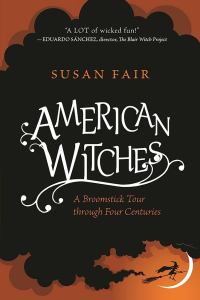
It’s the season.  Here in the fast waning days of September we can already taste October and thoughts turn toward ghosties and ghoulies and their kin.  Susan Fair’s American Witches: A Broomstick Tour through Four Centuries is, as any book in the nation of Salem, a mere skeleton crew of a long and feared tradition.  As is true of most things in the last two years, this book takes on a poignancy that was perhaps unintentional since it was written for fun.  It is a somewhat uncanny combination as it is—witch accusations often led to (and perhaps lead to, far from official eyes) someone dying.  We fear witches.  Fair reaches back pretty far, going even to the point of discussing those (generally women) hanged on ships on their way to America because their shipmates thought them witches.

Salem so dominates our witch consciousness that we sometimes forget these other episodes.  Fair explores, along with snarky asides, many early cases outside Salem.  In fact, the sad chapter in our history where hearsay became fact—one can’t help but think of “fake news”—the mass, “legal” murders carried out in Salem, is part of a larger pattern.  Not surprisingly women feature as the victims in this unholy web of fear and piety.  The combination is a dangerous one and otherwise rational people sanction evil rather than confront what is a mere perception of evil.  Fair moves on, however, to discuss other witchcraft scenarios—the witches (fortune tellers) of New York, the murder of a “witch” in Booger Hole, West Virginia (did I mention there was snark?), and the hex murder of York, Pennsylvania.  All of these represent an underlying fear that won’t go away.

This breezy tour ends near the author’s hometown outside Burkittsville, Maryland.  Although it is widely known that The Blair Witch Project was fiction from start to finish, this tiny town has been beset by those who refuse to accept that reality.  Such credulousness should stand as a warning to a country even capable of electing someone like Trump.  We are a suggestible nation with many people incapable of independent thought.  We are natural believers.  At the same time we’re a people that sees no value in studying religion even as it destroys us.  It’s like that embarrassing relative we never talk about.  But people still come to Burkittsville nevertheless.  Fair’s book was written before the election that showed who we really are.  Although the writing is charming, it’s hard to laugh about the subject these days.  We have forgotten Salem and all it taught us.

Museum Monsters

Timing has never been my strong suit.  As soon as I stopped my daily commute to New York City, the Morgan Library and Museum opened a display titled “Medieval Monsters: Terrors, Aliens, Wonders.”  To appreciate the irony of this fully, you need to realize my office was just across the street from the Morgan Library, and the daily visits would’ve provided a good opportunity for a lunch-time break with my beloved monsters.  Instead I was spending the time moving further west and unpacking.  Still, displays like this are a tacit form of validation.  Those of us who admit, as adults, that we like monsters huddle under a cloud of suspicion.  Monsters are a matter for kids—like dinosaurs and fairies—not something on which an upwardly mobile adult spends his time.  We’ll take whatever validation we can get.

Perhaps we’ve been too hasty to dismiss our monsters.  Even the Bible, after all, has them.  They help us cope in a chaotic and uncertain world.  A world of hurricanes and Trump.  A world lacking compassion and sense.  Monsters have always been symbols of the borderlands.  Creatures that cross boundaries and that shouldn’t exist but somehow do nevertheless.  Science has helped us understand our world, but in our desire to grow up enough to use Occam’s razor, we find that it shaves a little too close.  Besides, what can be more unnatural than shaving?  When we lose our ability to believe in monsters, we lose a piece of our ability to cope with an unpredictable world.  Monsters have their practical uses indeed.

If the world were more predictable, I would still be teaching instead of editing.  Or I’d still be living in an apartment rather than a house.  Moving is chaos embodied.  Like monsters, it’s best left to the young.  It’s just like this world for a monster display to open just across the street right when you’ve moved out of town.  I should expect no less in a cosmos marked by uncertainty.  Medieval Monsters isn’t the only museum display of the weird and wonderful.  Monsters have a way of showing up again once you think they’re safely gone.  Family and friends share with me their visits to other monster exhibits at other museums.  They may wonder at my fascination with them—an adult with a sober doctorate in the field of history of religions, biblical studies, ancient Near Eastern religions, whatever.  It’s kind of a monster in its own right, on display here daily.  If you happen to miss it, don’t worry.  It’ll remain lurking in its own corner of the internet.


Scriptural Slashers

Let me relish this a moment.

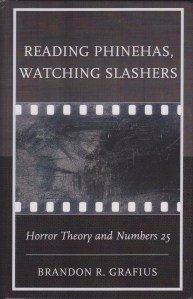
Thanks.  You still there?  It’s not too often, you see, that I get to feel like I’m near the front of the crowd.  I began writing Holy Horror when there were a small handful of books on the market concerning horror and the Bible.  I wasn’t aware of Brandon R. Grafius’ work at the time, but it sure is gratifying to see that others have noticed the connection.  Reading Phinehas, Watching Slashers: Horror Theory and Numbers 25 is pretty much what its title says.  I’ll be having more to say on it in a different venue—don’t worry, I’ll let you know—so I’ll keep to the basics here.  My spellcheck, and I’m sure not a few others, might have trouble identifying Phinehas.

In one of those weird, short, violent episodes for which the Good Book is justly famous, the story of Phinehas is clearly part of a larger, untold narrative.  Like the sons of the gods marrying the daughters of men in Genesis 6.  The grandson of Aaron, Phinehas was one of the hereditary priests of early Israel.  The Israelites wandering for their 40 years in the wilderness were nearly as xenophobic as the Trump Administration.  When one of the chosen people chose a foreign wife, Phinehas, full of zeal, grabbed a spear and skewered the couple.  Tradition says in flagrante delicto.  This act of violence stops a raging plague sent by the Almighty, so Phinehas looks like a hero in context.  If you want to read the story the subtitle tells you where to find it.  Or you could read Grafius’ excellent book.

Horror, which should be already obvious, enters the picture in the form of theory.  Yes, there is such a thing as horror theory.  Grafius uses it to analyze this story, along with other methods.  This is what I’m relishing.  I certainly wasn’t the first to notice the connection.  Many years ago Phyllis Trible wrote Texts of Terror, noting how the Bible seems less holy (my expression, not hers) when read from the perspective of a woman.  Indeed, many accounts that seem like standard issue narratives of God laying down the rules and humans disobeying tend to fall pretty heavily on females.  And the punishments used are fit for horror films.  Grafius focuses specifically on slashers, but one gets the sense that this book is just the start of something larger.  This reader, at least, hopes that is the case.


Nun Among Them

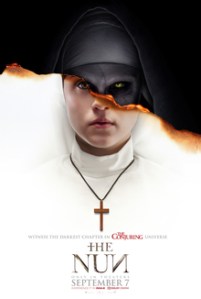
Life is sweet when watching a horror movie counts as research.  It’d be sweeter, of course, if a university paid for it, nevertheless, I went to see The Nun on its opening weekend.  My wife gamely went with me (no sponsor was paying for this) on a rainy Saturday afternoon.  Now, if you haven’t been following The Conjuring universe, you might not know about The Nun.  The full story will be revealed in Nightmares with the Bible, which is coming along nicely.  Suffice it to say it’s a movie about a haunted convent in Romania.  Those who know the Dracula tradition will perk up at the mention of the location.  The scenery is quite lovely in a horror genre kind of way.  And it also has ties to The Conjuring diegesis that bring the story full circle.

Ghostly nuns, it turns out, can be scary.  Religion, after all, involves coercion and threat as well as love and salvation.  Sister Irene, the protagonist, is a novice nun sent on a mission to investigate said convent.  The film reveals both an awareness of religious motivation and a seeming lack of research regarding monastic life.  Sister Irene, for example, tells the students at her school that the Bible isn’t to be taken literally.  It’s “God love letter to humanity.”  Well, parts of it are.  Still, the struggle with biblical literalism is a present-day issue that the movie addresses head on.  It was difficult to believe, on the other hand, that even a novice would walk into a chapel where someone is praying and call out “Hello?”.  Many years at Nashotah House taught me something.

Cloistered environments, although not part of most people’s experience, are great locations for horror.  For example, the first night she spends in the monastery Irene is told that the great silence is observed until dawn.  Did I mention that in chapel no one can hear you scream?  There’s an element about that in actual cloistered life.  The discipline of secrecy is heavy and full of threat.  We spent a great many silent days at Nashotah House and the sense of violation as sin was heavy indeed.  The part that truly stood out, however, was where the nuns used their only recourse against evil; they had to pray.  In the world of action movies, striking out with whatever is at hand is the expected response.  Spiritual entities, although the film does relent, can’t be touched except with spiritual threats.  The praying nuns looked so helpless in the presence of a demon.

There were less than a dozen people in the theater.  The Nun may not be a runaway hit.  The devoted will see it, however, and some of us will include it in our working life as a kind of spiritual exercise.


Horrible Delays

It’s not that the delay is actually horrible.  Horror movies, after all, come into their own with the darkening days of fall.  Nevertheless it occurred to me that now August is about to exit stage left, some may be wondering where Holy Horror is.  After all, the website originally said “August.”  The truth is nobody really understands the mysteries of the publishing industry.  Like so many human enterprises, it is larger than any single person can control or even comprehend.  I work in publishing, but if I were to subdivide that I’d have to say I work in academic publishing.  Further subdivided, non-textbook academic publishing.  Even further, humanities non-textbook academic publishing.  Even even further, religion—you get the picture.  I only know the presses I know.

It suits me fine if Holy Horror gets an autumn release.  I don’t know, however, when that might be.  I haven’t seen the proofs yet, so it’s hard to guess.  Appropriate in its own way for horror.  The genre deals with the unexpected.  Things happen that the protagonists didn’t see coming.  In that respect, it’s quite a bit like life.  My work on Nightmares with the Bible is well underway.  When you don’t have an academic post your research style necessarily changes, but I’m pleased to find that books can still be written even with the prison walls of nine-to-five surrounding one.  It may be a bit like Frankenstein’s monster (happy birthday, by the way!), but it will get there eventually.

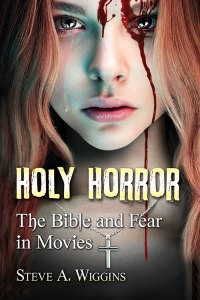
Of my published books so far, Holy Horror was the most fun to write.  It wasn’t intended as an academic book, but without an internet platform you won’t get an agent, so academic it is.  It’s quite readable, believe me.  I sometimes felt like Victor Frankenstein in the process.  Pulling bits and pieces from here and there, sewing them together with personal experience and many hours watching movies in the dark, it was horrorshow, if you’ll pardon my Nadsat.  We’re all droogs, here, right?  I do hope Holy Horror gets published this year.  Frankenstein hit the shelves two centuries ago in 1818.  Horror has been maturing ever since.  So, there’s been a delay.  Frankenstein wasn’t stitched up in a day, as they say.  And like that creature, once the creator is done with it, she or he loses control.  It takes on a life of its own.  We’ll have to wait to see what’s lurking in the darkening days ahead.


Cthulhu You Knew

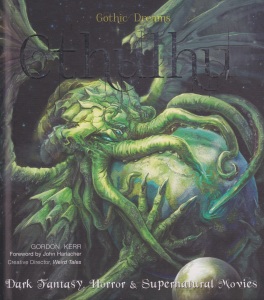
Humans tend to be visually oriented.  Arresting images stop us cold, causing us to focus on what we’re seeing.  As a tween I could be transported by large, lavishly illustrated, full-color books of other worlds.  While these went the way of Bradbury, I still sometimes recollect scenes that stopped me in my young tracks, making my juvenile mind wonder, what if…?  As an adult I realize “coffee table” books are heavy and a pain when you’re moving.  Printed on specialized paper, they have more heft than your mass-market paperback, or even most academic tomes.  Nevertheless, Gothic Dreams Cthulhu was a book that carried me, like a time-machine, back to my younger years.  Unlike in those days, however, I read the text as well as lingered over the images.  And I wondered about Cthulhu.

You see, I didn’t know about Lovecraft as a child.  The only reading regularly done in my family was Bible-oriented.  I discovered science fiction and gothic literature as a tween and, living in a small town, had no one to guide me in my choices.  Rouseville (the town pictured in the background on this website) had no public library.  My reading was left to my own, uninformed devices.  I discovered Cthulhu through my long fascination with Dagon.  I’d pitched Dagon as my dissertation topic, but settled on Asherah instead.  While teaching religion at the University of Wisconsin Oshkosh, I discovered Lovecraft, and Cthulhu, through Dagon.

Gordon Kerr, the author of Gothic Dreams Cthulhu, might be forgiven his hyperbole about H. P. Lovecraft.  Lovecraft was not a great writer—that’s not intended as any kind of slight, I hasten to add.  Classically, however, he didn’t have the level of literary finesse of Edgar Allan Poe, for example.  Still, Lovecraft created credible worlds.  His was a life of imagination—one might almost say divinity.  He was a creator.  Cthulhu has become a cultural icon.  With the magic of the internet bringing a writer still obscure to international attention, many people who never read horror fantasy nevertheless know who Cthulhu is.  Or they think they do.  As Kerr explains, the descriptions by Lovecraft himself are spare, thus the variety of ideas represented in the delicious artwork on every page of this book.  As Lovecraft earns more academic attention, surely others will notice the religious potential of the Great Old Ones that were, in their time, gods.  A guilty pleasure read, to be sure, Gothic Dreams Cthulhu fits well into this serious world of chaos we’ve created for ourselves.


The Distortion of Absence

I’m sure it’s happened to you, too.  After some time away, you return to somewhere familiar.  For some reason this doesn’t seem to apply to places you spend only a little time—for example, the cabin where I tend to go on vacation every year.  Rather, it impacts quotidian spaces, the places you see nearly every day.  Returning after an absence, the place looks strange, as if you’d forgotten what it was really like.  A fairly common example is a college dorm room.  When you return to it after, say, the winter holiday, it looks not quite how you remembered it.  It’s a little smaller or larger than you recalled, or you didn’t remember that the floor tiles were that color.  Within a day or so the feeling disappears and you accept the “new normal.”

The strange, or unfamiliar, is the source of many monsters.  Freud famously phrased the uncanny as “unheimlich,” un-home-like.  It is close to what you expected, but not exactly.  The uncanny valley is that place where things are about right, but slightly off.  It generates a creepy feeling, as if reality is being distorted.  On a business trip to Boston a few years back I visited Boston University School of Theology, a place where I spent over two years in my twenties.  745 Commonwealth Avenue hadn’t been renovated, but I stepped inside and was stunned by how wide the hall was.  In my mind it had become far narrower.  It was downright disturbing, as if I’d walked into somebody else’s past.  It made me wonder—is any of this really real?  Or more frighteningly—is my memory that fragile?

I recently spent a day working in the New York office.  While the office itself seemed the same, the city did not.  Emerging from the Port Authority Bus Terminal I knew exactly where I was.  Or did I?  I’d walked roughly the same route daily for almost five years, and two years before that a similar track.  It was as if the bus had exited the Lincoln Tunnel into an alternate Manhattan.  Unheimlich.  I’ve returned to many places after being away for awhile and this distortion of absence always creeps me out.  Can my memory be that faulty or is all of this an illusion?  The gap between present reality and remembered reality provides crevices into which monsters crawl, waiting.  By the time I reached the block of my office the feeling had gone away.  But somehow, the monsters remained. 


August Mornings

It’s August and I’m already starting to feel haunted.  While science may declare it nonsense, there’s a feeling in the air—particularly in the early morning—that tells us the seasons are changing.  While it may be different for everyone, for me it begins in the tip of my nose.  I can smell the change coming.  That doesn’t mean that we won’t have more hot days—a long string of them yet awaits—but the shift has begun.  Autumn is perhaps the season closest to the soul.  While I like all seasons for what they represent, fall has always put me in mind of melancholy rapture.  It’s a difficult concept to explain,  a kind of blissful evisceration.  A hitching of the breath in my lungs.  A sudden rush of joy followed by sadness.  The ease of summer living is ending.

Summer is the growth season when we look out and see the promise of provisions that will see us through long months of cold and chill.  The times we huddle down only to be blinded by the arctic beauty of the sun on a snow-covered day.  The indoors time.  Summer is when we can dash outside without a coat, giving no thought to whether we will be warm enough.  The scent of autumn is a slight chill.  It reminds me that while the crops have been growing, the monsters have too.  There’s a reason horror films are released in the fall.  I’m not the only one who knows they are coming.

Late summer is a liminal time.  While the calendar may tell us summer lasts until the autumnal equinox, traditional cultures marked time in a different way.  Equinoxes and solstices were closer to the middle of a season than its start.  Most years we begin to feel summer in May, or even April.  Winter cuts through November, and the thaw may begin as early as February.  When I step outside just after sunrise and breathe deeply, I can feel the monsters coming.  In a way I can’t explain, their lurking fills me with a frisson of anticipation.  Already the days are noticeably shorter.  Daylight itself seems to be fleeing before the ethereal chill that is still available in our rapidly warming world.  The seasons are all about feelings.  Emotions suffuse the changes of weather and human habits that accommodate to it.  There are shivers and then there are shivers that the creatures of autumn bring.  They’ve already begun to gather.


A Few of My Favorite Monsters

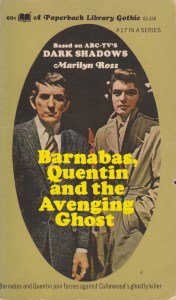
It was a guilty pleasure read.  We’d just moved and I needed a new novel for bed-time reading.  Most of our undamaged books were still boxed up and, well, enough excuses: I like Dark Shadows novels.  Hardly well written, these pulp potboilers are like extended, Gothic Scooby-Doo episodes.  I first started finding them used at Goodwill when I was a kid and I’ve re-collected a number of them as an adult.  Although they feature a vampire, and sometimes a werewolf and witch, the crisis of the story generally devolves to a hoax at Collinwood.  So it was with Barnabas, Quentin and the Avenging Ghost.  I hadn’t thought to write a blog post about it until I came across a passage mentioning Rocain.  In context, one of the characters explains how Rocain, the son of Seth, shows that sorcery goes all the way back to Genesis.

Genesis was one of my lines of research during my academic career, although I never published anything I was working on.  I didn’t, however, recall having read about Rocain.  The internet quickly pointed me to Legends of Old Testament Characters by Sabine Baring-Gould, chapter 8.  Clearly this was where Marilyn Ross, or his source, got his information.  Baring-Gould sits on my shelf as the author of The Book of Were-Wolves.  He also wrote the hymn “Onward, Christian Soldiers.”  There was an era, overlapping with Baring-Gould’s lifetime, when a minister could be an independent scholar of repute.  Although much that’s found in his many publications is now disputed, his was a lively and lifelong curiosity that led to several books.  

Upon reflection, Sabine Baring-Gould, who was a priest fascinated by occult topics, would have fit quite well into the Dark Shadows diegesis.  Although set in the late 1960s into the mod ‘70s when the television show aired, these were Victorian vignettes of a conflicted vampire and his strange, wealthy, and somewhat clueless family.  All kinds of guests, some of them quite Lovecraftian, drop into the Maine mansion and its grounds.  The writing of the novels is tepid at best, but the series was surprisingly literate.  Dark Shadows is nevertheless undergoing a kind of revival these days, and friends sometimes tell me they’ve just discovered this oddly compelling world.  I invite them in.  I’ve unpacked a few more boxes since selecting this pulp novel, and one of them, I note, holds books by Sabine Baring-Gould.  The guilty pleasure read?


Special Delivery

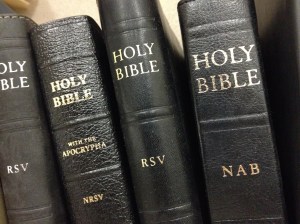
Apotropaic is a word that can be translated as “turning away evil.”  For all that, it’s a perfectly good English word, although seldom used outside realms such as religious studies and anthropology.  Although the word itself may be unfamiliar, the concept is one that everyone recognizes—the charm that wards off evil is the most common example.  The rabbit’s foot means good luck (except for the rabbit) because it’s an apotropaic device.  In perhaps one of the oddest twists in Christianity’s somewhat lengthy history is the fact that the Bible itself has become an apotropaic device.  You’ll see this quite a lot in horror films, and if you read Holy Horror when it comes out you’ll see it quite a bit, although I don’t use the technical term for it.  Apotropaic outlooks also pervade society as a whole.  A recent article on Mysterious Universe proves the point.

Pennsylvania is a weird state.  Having grown up here, I know that to be the case.  In Wilkes-Barre (which itself is a strange name) a ghost-hunter was arrested for breaking into a haunted house bearing a sword, shotgun, and Bible.  That should cover your bases.  Of course, I couldn’t help but notice the odd equivalence of these three weapons.  One is intended for close combat (the sword), one for a reasonable distance (the shotgun), and one for an enemy so close that they might get inside (the Bible).  Make no mistake about it; the Bible is indeed a weapon.  Probably intended as an apotropaic device in this context, it was nevertheless an object to defend the ghost hunter from evil.  The sword and shotgun, however, seem to betray a lack of trust in Holy Writ.

The Bible has been used for offensive purposes ever since people figured out that it can be used to control others.  Coercion, in whatever form, is a kind of violence.  Interestingly, reading the Good Book would seem to indicate that such usage of holy things is inappropriate.  Then again, the Bible doesn’t refer to the Bible.  The idea of Scripture as a powerful object developed only after the Good Book had become an iconic object.  The final authority.  Who can argue with what is claimed to be the word of God?  That idea has become more important than what the Bible actually says, as any “Bible-believing” Trump follower will prove.  Against ghosts, however, it might serve as an apotropaic device, but it won’t prevent you from being arrested, it seems.  A lesson worth pondering.


Trending Horror

It’s not often that I can claim to be ahead of the curve.  A “late bloomer,” I was a timid child whose reaction to most of the world was a species of phobia.  It probably didn’t help that I watched monster movies and was an early fan of the original Dark Shadows.  As I learned to relate to others and take consolation in religion, these more macabre interests became latent rather than obvious, only to come out into the open when working at a Gothic seminary in the woods of Wisconsin and then being fired from said seminary, casting me into the outer darkness.  I found myself being interested in horror again although I’d put it aside from bachelor’s to doctorate.  Now it started to feel therapeutic.

My wife sent me an NPR story by Ruthanna Emrys titled “Reading Horror Can Arm Us Against A Horrifying World.”  The premise is one I’d read before—we find horror compelling because it gives us skills that we need to survive.  It teaches us how to separate evil from mere shadow and how to (or not to) fight such evil.  In other words, horror can be heuristic.  Those who know me as a generally calm, quiet—shy even—individual express surprise when I confess to my secret fascination.  One of the most common responses is the question of “why?”  Why would anyone want to watch such stuff?  My observation is that those who ask haven’t tried.  Horror is not often what it seems.  Or perhaps they have better coping mechanisms than I have already in place.

The names of many writers of what might be considered horror have gained mainstream respectability.  Stephen King’s name alone is enough to assure the success of a novel.  These days you can mention the name Lovecraft and a fair number of people will have at least heard of it (him) before.  Jorge Luis Borges has respectability for having been Argentine.  Joyce Carol Oates for being both an academic and a woman.  If you’ve read their works, however, there’s no doubt that something scary is going on here.  As Emrys points out, with our world becoming a more polarized and frightened place, horror may be ready to hang out its shingle saying “the mad doctor is in.”  In fact, it may become even more popular than it is already.  We human beings set ourselves up for horror constantly and repeatedly.  I’m seldom ahead of the curve.  I hang back to see what might happen to those out in front.  Call it a survival technique.


Water Monsters

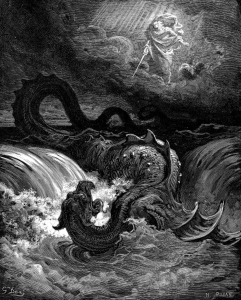
Chaos is a monster.  More than personal opinion, that’s a biblical view.  If, like many modern people with theological training, you’ve been taught that Genesis narrates a creation out of nothing, you’ve become a victim of this monster.  You see, although ancient Israel had no “systematic theology”—the Bible can be quite inconsistent if you’re willing to read what it says—the view that chaos was constantly lurking outside the ordered realm of creation was a common one.  One of the more intriguing episodes in Ugaritic mythology involves a broken text where the god Hadad, aka Baal, refuses to allow a window in his palace.  The reason?  Apparently he feared chaos (in the form of Yam, the sea) might slip in and kidnap his daughters.

More than a theological statement, the story of creation was actually a singular episode in Yahweh’s ongoing struggle against chaos.  Step outside and look at the sky.  If it’s blue it’s because there’s unruly water being held back by a great dome over our heads.  If it’s gray, it may be raining, or it probably will be soon.  Stroll to where the land ends.  What do you see?  Water.  That water is lapping at land, trying to take it over.  Although the ancients didn’t have geologic ages (the Mesopotamians came close, with ancient kings living thousands of years) rivers eroded land and they had tendencies to flood.  The thing about chaos is that it makes you start again, from the beginning.

One of the many unfortunate things about biblical literalism is that it loses sight of this biblical truth.  It exchanges something everyone can understand for a theological abstraction that makes no sense in the world that we experience.  Ancient belief held that the human role in the world was to fight chaos, not to get to Heaven.  In fact, in the Hebrew Bible there’s no concept of Heaven at all.  Instead, the commandments were all about order.  You can’t build on the water.  What you do build water tries to wash away—Israel has a rainy season, and one of the characteristics of such seasons is the occasional violent storm and heavy rains.  Although we need the water from the heavens, heavy rains cause, well, chaos.  In ancient thought, this was the monster hiding in plain sight.  That blue sky is a reminder that a dragon awaits.  Rather than starry-eyed Heaven-gazers, the ancient biblical person was a monster-fighter.  And that’s the biblical truth.


Childhood’s End?

Writers are agents against chaos.  Those of you who read this blog frequently know that chaos has been one of my themes lately.  Moving, which is a process that takes months and months of time, is pure chaos.  Whenever I settle down to write, yet another moving-related task comes to me—this box needs to be unpacked, that gap in the fence must be mended, where did I put the toolbox?  Mundane things.  Writers like to think the world conforms, somehow, to their inner lives.  In reality, things are far more complex than that and don’t seem to be getting any easier.  Starting to learn about house ownership is something best left for the young, I suspect.  Every question (where should we put the television?) leads to a daisy-chain of other issues (but first we need to move that hutch, but it’s too heavy for either of us to lift, etc.).

In ancient times water symbolized chaos.  Before we left on vacation, the main issue was to get all boxes off the floor in the garage.  We haven’t had time to move them safely inside yet, what with planning for vacation and all, so plastic became the order of the day.  We do need, however, to get things inside eventually.  A slow process for two middle-aged people with full-time jobs, even without jet lag.  Writing feels like a luxury item, for what is most required is time—time to move things to their proper places.  Time to figure out what those proper places are.  Time to go to work again.

Had we thought this through, we might’ve used vacation this year to unpack.  We bought our plane tickets, however, before we bought the house.  This latter transaction is one of chaos embodied.  Who knew, for example, that the grass had to be cut so often?  That all roofs leak?  That chaos is constant, and not intermittent?  In biblical times, one of the signs of God’s greatness was the ability of the Almighty to hold chaos in constant check.  The waters were always lurking, looking for any opening—except when you need rain and it just won’t come.  Sitting here writing feels like the giddy irresponsibility of childhood where there’s so much to get done and so little time in which to do it.  And neighbors don’t appreciate the lawn being mowed before the sun is properly out of bed.  The renter pays a price for living with, for at least some stretches of time, chaos-free maintenance.  The home-owner quickly learns that any time left over for writing feels like being irresponsible, and a little bit divine.


Chaoskampf

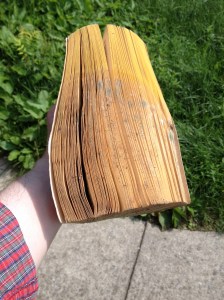
It’s a poignant thing to hold a dying book in your hands.  What was once, straight, flat, and dry, now dissolves into a pulpy mess that, if it ever recovers, will be warped and distorted out of shape forever.  The loss of dozens of books hit me hard.  I think one of the many reasons for this is that books represent, for me, order.  They stand at attention all in a row, many on shelves I built lovingly for them.  I remember where I purchased them, the thoughts and feelings of that time.  In a world that’s far too bumpy and lumpy, books represented the ultimate in orderly array.  Now The Golden Bough is melting in my palm, smearing my fingers royal blue.  The forecast for the week—more rain.

The story of creation in the Bible—more properly, stories, for there are many—is not creation out of nothing.  Creation is the making of order out of chaos.  Ancient people, including the Israelites, believed that water was chaos, if not an actual dragon, that constantly worked against order.  You can’t build on water, it attacks the shoreline, it drowns those who fall in.  Never a seafaring people, Israel equated big water with evil.  God, then, fought constantly this unruly foe.  Whether it was with word or sword, the Almighty vanquished that sloshing, thrashing element that tries to tear apart everything we build.  Read Genesis 1 closely; the water is already there when the creating starts.

Life has a way of getting out of control.  It’s not without irony, however.  A person buys a house to store their books, and before the books can be moved in, they’re destroyed.  It’s rather like a parable, don’t you think?  If that person unfortunately thinks of him or herself as a summation of the books s/he’s read then the loss is like losing a limb or two in that endless battle against the forces of confusion that attempt to overcome our world.  When this happens some of us turn to books for comfort.  The books, however, are disintegrating in our hands.  My Amazon account, it seems, is mocking me at the moment with it’s mover’s discount.  Why buy something that will only hurt me when the water gets in once again?  The people of ancient times knew that the waters of chaos had to be held in check constantly.  They look for any opportunity to get in and destroy.  Ancient writers knew that in order to defeat them, only the most powerful gods will do.  


Hidden Origins

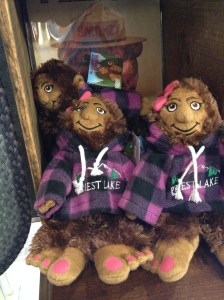
This blog was born at the very lake I’m about to leave.  Although it’s relaxing, there’s an element of chaos to a family vacation that stirs up creativity.  Tomorrow’s long day of travel back east, however, will mean another day without a post.  Flights leave so early that you barely have time to slither out of bed to the shuttle, and the airport hotspots want your money to connect.  I’d rather maintain radio silence for a day.  That doesn’t mean I won’t keep my eyes open for religion hidden in the interstices of American life.  Since religion and mythology share sleeping quarters, I’m reminded of something I saw up here in the northwest the other day.  While in a local grocery and souvenir shop (for all groceries in this area carry souvenirs) I saw sasquatch dolls.

Such cryptids are unknown to science, of course.  Even if they really exist, their liminal status now places them firmly in the realms of mythology.  Being in the wilderness can be an uncanny experience.  Long accustomed to dwelling in cities and towns, we feel vulnerable out in the open.  Taking walks in the woods might just put you in the path of black bears, grizzlies, or mountain lions.  Who knows what else might be hiding in these woods?  It’s easy to believe in our myths here.  Vacation, in addition to being the ultimate reality, counts as time borrowed against work and its punishing rationality.  Religion thrives in the quiet moments when you’re not sure what might be hiding just out of view.

Did ancient people devise belief in such circumstances as this?  (Well, without the wifi and indoor plumbing, of course.)  It’s not hard to feel the spirit of the lake.  Standing chest-deep in the water, being rolled by the waves, there’s a kind of secular baptism taking place.  In the quiet unearthly voices can be heard.  No television or newspaper tells you that it can’t be happening.  Listening is much easier with no distractions.  These woods are vast.  Human access to them is limited to marked and maintained trails.  Beyond these borders, who knows?  Science comforts us with the assurance that there are no monsters out there.  Standing isolated from any other human beings, surrounded by ancient trees, you might begin to wonder if such assurance is as certain as it sounds.  The sasquatches are children’s toys, and the sense of the numinous you feel can, like all extraordinary things, be explained away.