Paranormal Prophets

At the suggestion of a friend, I watched The Mothman Prophecies last night. Very loosely an updated version of the collapse of the Silver Bridge in Point Pleasant, West Virginia, the movie both satisfied my monster movie habit and my interest in things biblical. As a monster flick, it was satisfying in maintaining tension, never clearly showing the creature. As a representation of prophecy, it falls into the camp of Nostradamus.

Reports of the “mothman” began in 1966 and continued over the next year. It was reputedly seen near the Silver Bridge, the artery that connects Point Pleasant with Gallipolis, Ohio. After the tragic collapse of the bridge, resulting in nearly 50 deaths, the paranormal prophet was never seen in the area again. While in West Virginia last year, a friend introduced me to a couple from Point Pleasant who stopped into her store. They looked a little embarrassed when the mothman came up in conversation.

Point Pleasant's mothman statue from WikiCommons

Prophecy, in the vernacular, refers to predicting the future. Although some biblical prophets correctly intimate future happenings, mostly the image of prophets in the Bible is that of effective speakers. Prophets are individuals who participate in the reality of the world by adding their powerful words to the mix. If their words regard a future event – fairly rare in the Bible – they affect the outcome because their words have influence in the world. It is a supernatural view of the spoken (or written) word, to be sure, but it is a long cry from predictive ability. It is a matter of perspective.

Interestingly in the movie, Alexander Leek, the specialist on mothmen (apparently there are many), suggests that they see farther because they are higher in the sky than humans. In other words, it is indeed a matter of perspective. Certainly the mothman must go down as one of the oddest cryptids sighted. I give them no credence as prophets, but I will think twice before driving over bridges from now on.


The Mist in the Pulpit

With the teaching schedule I have, vacations are not viable. One semester blends into another like some demonic tapestry with blurred edges between the somewhat discrete components. Breaks just aren’t part of the picture. While my family is on a well-deserved vacation, I’ve been home doing class prep and lecturing. On those nights when I have no classes, I sometimes watch a movie to hear the sound of human voices. This week one of my picks was The Mist.

My fascination with horror films stretches back to my college days, concurrent with my first degree in religious studies. Never a slasher fan, I’ve preferred the more thoughtful movie that has a (hopefully) profound message. I’d never read Stephen King’s novella on which this movie was based, so I didn’t know what to expect. All I knew was “there’s something in the mist.” The build-up was great until the creatures were shown – after that it became a standard monster flick. A human menace arises in the form of Mrs. Carmody, a religious zealot who is convinced the mist is the apocalypse. As the survivors try to form some plan of action, Carmody’s preaching becomes more and more strident and self-convinced as the “wicked” die and the “righteous” are spared. Not having read the book, I’m not sure if her over-the-top rhetoric originated with King or with Frank Darabont, the screenwriter/director.

I have often posted on the relationship of monsters and religion, but The Mist is almost too easy to cite. Perhaps released too late to make it into Douglas Cowan’s Sacred Terror, the connection between religion and fear is patent and bald. Mrs. Carmody’s religion, apart from being very generally Christian, is hard to identify. She insists on human sacrifice while constantly referencing the Bible. Although there are examples of human sacrifice in the Bible, that particular cultic activity is never advocated for monster invasions or the apocalypse. Carmody is a parody of religious over-reaction to the unfamiliar and dangerous. In her insistence that others take her point of view, the caricatured Carmody becomes a danger that threatens the community. It is left indeterminate whether her followers survive or not.

The religious agitator is a trite and tired character, but one that has instant recognition value. In The Mist, however, I came for the mystery and stayed for the monsters. Mrs. Carmody could have said much more by saying much less.


Blogging the Blob

It has no shape. It has no brain. It oozes in where it is not wanted and wreaks havoc on the innocent people of the local community. It is in the hands of an apocalyptic clergyman. No, it isn’t the Republican Party, it is The Blob (1988). Having just watched the remake of the 1958 sci-fi film of the same name, a number of elements relevant to this blog (blob?) stood out in sharp relief. The most notable change from the original movie comes in the form of the role played by Reverend Meeker, the (apparently) Catholic priest turned tent-preaching revivalist. Of course, the whole government conspiracy plot is also new to the film, but that is best left to other blogs.

As noted in previous posts, religion and horror genres share much common ground. While it is hard to take a blob seriously – the role of Bob the blob in Monsters vs. Aliens is precisely comic relief – the idea of a crazed minister unleashing chaos is perhaps a little too believable. The real source of terror in the 1988 version of The Blob is not the monster but those who control it: the government and the church. When the government demonstrates that it cannot control the monster it has generated, it moves into the hands of Reverend Meeker. Here it rests until, after a sermon about the end of times, the reverend pulls out his jar of blob and indicates that as soon as he receives a sign from God, it will be released.

In a strange way this strange film proved prescient. The move of religion into politics was underway already in the Reagan years, but it was a threat few took seriously. It was not until W’s reign that the implications began to become clear. A religiously motivated electorate resembles a blob in significant ways. Once released it is difficult to contain, even by its creators. In aspect it is laughable, but in consequence it is deadly. It stops at nothing short of total domination. This film, which never made the impact that many horror films achieve, may turn out to be the scariest movie of its era after all.

Not your parents' blob


Zombies, Golems, and Robots – Oh My!

A truly great metaphor is hard to kill. Despite detractors and naysayers, the zombie has clawed its way into the modern psyche as a denizen of the living death of a world we’ve created for ourselves. Joblessness, environmental disasters, tea parties – just when you thought it couldn’t get any worse, the dead refuse to stay dead. Elsewhere on this blog I’ve written about the origin of zombies in Voodoo, and I mentioned in passing the connection with the golem. The golem is a mythical Jewish creature that serves the role of protector of the oppressed (one can’t help but think of the Democratic Party). It is strong, dedicated to its task, brainless and soulless (one can’t help but think of the Religious Right). Like the zombie, the golem has no inherent ability to think for itself, and it must be animated by a magical word written on its forehead.

Golem around the corner

One of the most famous golem stories involves the Golem of Prague, defender of the oppressed Jews in that city in the Middle Ages. The Prague connection also forever ties the golem together with robots in Karel Capek’s 1921 play, R.U.R. (Rossum’s Universal Robots), the very origin of the word “robot.” Like the golem the robot putatively has no soul. It too is controlled by a code written precisely for it. Unfortunately on my one trip to Prague back in 1991, I didn’t know to look for the golem – I did find the statue of Jan Hus, however. Right around the corner the golem lurked, standing guard over the oppressed. It is a powerful image when the world is in such a state.

We need a hero

With the recent release of George Romero’s Survival of the Dead, the zombie has been given renewed life. Watching the Republican Party gearing up for a major thrust at the very soul of America, lining up the local BP station to support big oil, spouting false rhetoric about what the Bible says, I think I’d rather take my chances with the zombies. Does anyone out there happen to have a golem for sale, just in case?


Cryptid Be Thy Name

While poking around the internet last night to take my mind off the heat and humidity surrounding me, I stumbled across an article entitled “The Religious Struggle over Cryptozoology” on a site called Science and Religion Today. The piece was written by Joe Laycock, a doctoral candidate at one of my alma maters, Boston University. Having just finished Bruce Hood’s Supersense, there was a pleasing euphony in the coincidence. Cryptozoology is the study of unknown animals, and is not necessarily based on the supernatural (although it may fall within Hood’s definition of it). Laycock notes that two religious elements in society have latched onto this study: New Agers and Creationists. Creationists, it seems, see in certain cryptids, such as the Loch Ness Monster, hold-overs from the Mesolithic Era that prove the Mesolithic Era never existed. God can still make dinosaurs today, therefore the Bible (which doesn’t mention dinosaurs at all) must be true.

The draw of the unknown

One of the most welcome parts of Hood’s thesis was its consonance with Stephen Asma’s On Monsters, a book I’ve posted on before. Both authors explore how the human psyche reacts against what it perceives to be “strange mixes,” beings that cross-over between readily defined categories. Hood addresses this by tackling the concept of “essence” while Asma notes a dread accompanied by a sense of wonder. Hood demonstrates that from a scientific point of view, there is no such thing as the “essence” of a person, object, or living thing. Such ideas are the cling-ons from the era of souls and radically distinct species and genders. Closer observation has taught us that many such things are more of a continuum than a series of sharply defined types. Religions prefer to have fixed categories. Religious ethics often depend on them.

Laycock suggests that both New Ageism and Creationism “can be read as a religious response to the cultural authority of science.” Religions fear that which can be empirically demonstrated since it throws the god-of-the-gaps into the dryer and he comes out smaller each time. This is so, despite the fact that Creationists crave scientific respectability. While teaching my course on Myth and Mystery at the University of Wisconsin Oshkosh, I dwelt on cryptids for a few sessions. They are indeed often surrounded with a religious mystique. I wouldn’t necessarily dismiss the possibility of undiscovered species, many new ones are described by science every year. Nor would I say that they are supernatural. Nature has ways of surprising us still, and as Asma clearly demonstrates, we still have a need for monsters.


Life Without Dragons

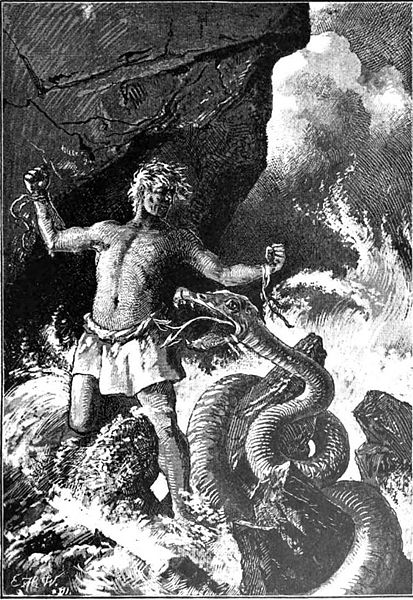
Every now and again, the great cosmic spheres align in their eternal turning and something just right clicks into place on our little planet. Such a juxtaposition must have recently occurred, for just when my worry about dragons had been reaching a crescendo, I received an offer for “dragon bane,” a beautifully crafted double-axe in the Minoan tradition, for only $39.99. The double-axe, or labrys, actually predates the Minoans, probably originating in ancient Sumer. The dragon predates even that.

Labrys dragon style

I’ve posted on the origin of dragons before, but of all mythological creatures dragons are perhaps the most tenacious. In various guises they reappear when we thought that they were gone. They are among the most ancient of feared creatures. Representing the untamed, indeed untamable areas of life, the dragon is the perfect symbol of chaos. Dragons are the disorder against which gods always struggle. Metaphorical dragons are always more troublesome than physical ones.

Although the idea of being a sword-swinging hero out to vanquish the forces of evil is an appealing one, I know that I won’t be purchasing this collectable. I have too much respect for dragons to see them slain by gods or mortals. What would life be without our dragons?


The Danger of Books

Yesterday the Hunterdon County Library booksale began. I did not grow up as a reader. As a child, television was my primary source of information. For reasons unclear to me, I took to books when I started junior high school. Suddenly I couldn’t get enough of them. I lived in a town with no bookstores, so I usually depended on what I could find on our periodic trips to Goodwill to look for clothes. While my mother was looking for apparel for my brothers and me, I hovered over the quarter-a-piece book bin, buying up to a dollar’s worth of used books at a time. I kept my books in a ratty old suitcase under the bed. There were no bookshelves at home, nor any room for them. Besides, I liked to keep my books separate from other aspects of my life. Perhaps it is an illness, but from that day on, I have not been able to resist the draw of books. It is perhaps natural that I would go into higher education (although my field might have been chosen a bit more wisely). In any case, yesterday I drove to Flemington, New Jersey, with, at least to judge by the traffic, three-quarters of the population of the county.

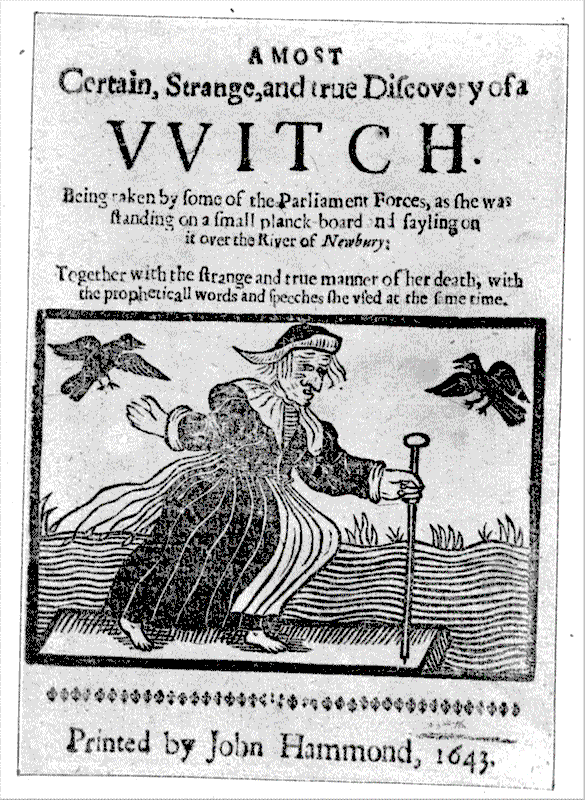
One of the books I purchased had a slip of paper tucked between the leaves. When I got home I read on it, “The naked witches have been regarded either as a jokey press gimmick or as a complete non-event. The truth of the matter is that the witches played a very important role in a whole series of monster invocations.” Intrigued, I wondered what the source of this unusual quote might be. Then I was struck by the religious imagery implicit in the piece: witches, no matter how defined, are a religious subject. Monsters, as I have frequently noted, share intense neural territory with religion. And invocation? It is a liturgical term! I can only wonder what the original context of this quote might have been, but the book in which it was stuck was in no sense religious. I am a very eclectic reader (so it is perhaps unusual that I would go into higher education) and no books I purchased had anything to do with religion. It seems that religion never fails to find me.

My devotion to books often reminds me of the day when Amazon used to include bookmarks when you purchased from them. My favorite bore a quote from Erasmus: “When I get a little money I buy books; and if any is left I buy food and clothes.” It sometimes drives my wife to frustration that I still wear clothes I purchased before we were married some twenty-two years ago. My informal student evaluations on Rate My Professor sometimes comment on my out-of-date fashion sense. The reason is, however, that I buy books before clothes, and yes, even food. And when you buy used books at a library book sale, you may learn that naked witches invoke monsters, and that may be valuable information. And my clothes are never in a condition Goodwill would consider accepting when I’m finally forced to relinquish them for lack of functionality.


Soulless Robots?

Robots have taken over my life. At least in the short term. As my friend Burke commented on Easter: “Alleluia! The robots have risen… up against us?!” Actually, the robots I encounter are benign and all follow Asimov’s rules. I have mentioned before the phenomenal First Robotics program, a venue to encourage high school students to consider careers in engineering. Team 102, Somerville High School’s robotics team, recently won a regional competition in Hartford, Connecticut. My role has mostly been to watch other people design and construct the robot while occasionally correcting the grammar on written documents. The joke my friend made, however, has at its roots a deep-seated human concern: how do people deal with soulless machines?

Stephen Asma, in his book On Monsters, has a chapter concerning the human fear of a robotic future. Electronic gadgets with uncompromising metal bodies and no consciousness that we recognize present a frightening combination. The question that concerns me more, however, is the concept of the soul itself. The Hebrew Bible has no concept of the soul as it would later be adopted by the Judeo-Christian tradition. In the Hebrew Bible a body is a soul; when the soul dies the body dies – people are a monistic unit, not a dualistic entity with a part that hangs around the spirosphere after the biological part rots away. Of course, in Christianity the soul has become an essential aspect of church doctrine and we fear other creatures that lack them. Souls have never been observed in a laboratory and we have yet to prove their existence.

Reading the news and seeing how biological, soul-fueled humans treat each other is a sobering task. Each day I lay the newspaper down with a new kind of dread. Perhaps souls are only mythical beings concocted to shore up a theology that can’t survive without them. Or maybe all living beings have souls. Perhaps even mechanical ones. As Team 102 heads to the national competition in Atlanta in the days ahead, I know that I’ll be rooting for a soulless machine that may be a bold step towards humanity’s continuing evolution.

Sorry for the blur, the robot just wouldn't stop shaking me!


Clash of the Titans

Over the weekend I joined the thousands flocking to theaters to see Clash of the Titans. I first met Perseus in fifth grade and have been intrigued by classical mythology ever since. I tried not to believe that it was nearly three decades ago that I sat in the single screen theater back in Oil City, Pennsylvania watching a film with the same title and Ray Harryhausen’s famous stop-motion animated creatures. I was anticipating great things. While the new Clash is visually stunning at several points, the post-modern story line primarily demanded my attention. While there are gods galore in the film, the message is maybe not atheistic, but, to coin a word, anolatric – denying worship to the gods. Time and again Perseus refuses the help of the gods and when he finally meets Zeus, his absentee father, he shows him anything but respect.

Who let the trogs out?

The Greeks, like all ancient peoples, primarily feared the gods. Not offending deities was a societal expectation since an infraction on the part of any citizen might lead to divine repercussions. Dictys, Perseus’ adopted father, rails against the gods for allowing the degeneration of society, a trait that Perseus takes to extremes in the movie. In battling the monsters, Perseus is storming Olympus itself. In a nod to the Easter weekend crowds, Perseus defeats death himself by banishing Hades to an incongruously fiery underworld. I left the theater slightly stunned; here had been a hero standing before the very gods but refusing to worship. Clash of the Titans indeed.

While my family was off winning the Connecticut Regional First Robotics competition in Hartford (go Team 102!), I had consoled myself the night before seeing Clash by watching the cheesy 1968 Japanese giant monster classic, Wrath of Daimajin (also known as Return of the Giant Majin). I had seen the original Giant Majin some time ago, but here was a “monster” movie where the destructive colossus was himself a god. The Giant Majin is a protective mountain deity who, when injustice grows unchecked, breaks free of his rocky home and destroys the wicked. The Wrath of Daimajin included startling biblical imagery: as the Majin stomps through the sea the waters part as if Moses were on the god’s shoulder. The faithful female protagonist is being executed on a cross (burned at the stake, but tied to a cross), and the Majin breaks the gibbet and holds her aloft, the very tableau of the evil-banishing crucifix. As always, the Giant Majin vanishes at the end, leaving the oppressed to build their own, better future.

I dream of Majin with a dark green face

Such movies are benchmarks of public theology. Made by laypersons trying to express their ideas about the divine world, I find them a crucial measure for any teacher of religion to watch, mark and inwardly digest. In just 24 hours I saw a Shinto god go Christian and a Greek polytheist lose his faith. The world just can’t figure out if the gods are for us or against us.


Mournful Metaphor

Sometimes the concept is great but the results disappoint. Those who have followed this blog know that a unifying concept over the past half-year has been the often hidden relationship between religion and monsters. Certainly this fascination has its roots in my refusal to admit that I’ve grown up, but with the popular media pushing the undead into our collective consciousness on a daily basis I feel a happy vindication. I posted last week about Seth Grahame-Smith’s new book, Abraham Lincoln: Vampire Hunter. Well, now that I’ve finished the book I would say that the jarring concept of our most honored president leading a secret life was fun to wrestle with, but the book failed to win me.

Lincoln’s great contribution to our nation is still echoing through a society slow to admit the equality of all. Perhaps that fact alone would render any book trying to throw some comic relief on a deadly serious issue mute before it even begins to spin its yarn. That, and I didn’t like the portrayal of the vampires. I’m no undead purist, and I’m aware that vampires have changed form and character over the centuries, but having masses of them in one place felt like being the proverbial cat-shepherd. Giving them political ambitions, with a nod to Francis Ford Coppola’s Bram Stoker’s Dracula, was too much. The issue of slavery, clearly the metaphor being utilized by Grahame-Smith, is hard to smile about. Lincoln’s personal suffering is difficult to lighten with his career as a vampire hunter. The story just didn’t work.

I’ve had enough bumps in my own life to eschew easy categorization. Even my current career must be listed in the TBD category. Nevertheless, I wasn’t sure if what I was reading was a serious attempt at a novel or a humorous exploration of a funny idea. I found the book catalogued in humor, but its narrative seems to have the earnestness of a determined novelist. When the story ended I felt as if I’d read a dime-store novel I’d purchased at Comedy Central. And with the headlines the way they are these days, I’d been hoping for a good laugh. Instead it seems that I have been bitten by a vampire wearing shades.

Two heroes, no smiles


Politicians and Blood-Suckers

The old icons and heroes are gone. It is best just to deal with it. No one is above reproach since we are all in this human morass together. Nevertheless, I’ve always held a soft spot in my cynical heart for Abraham Lincoln. I know he wasn’t perfect, but he stood for an issue that has been a driving force for my life: fairness. Now I see that he was a vampire hunter. After having read Seth Grahame-Smith’s Pride and Prejudice and Zombies last year, I’ve decided to give a try to his Abraham Lincoln: Vampire Hunter. My fascination with monsters and religion has not been disappointed in this fanciful story.

Our quasi-fictional honest Abe begins his vampire-slaying ways when he learns that, yes, a vampire killed his mother. As a boy of only twelve, he finds the knowledge stressful to the point of burning the family Bible that he used to read to his departed mother. Why? In Abraham’s own (fictitious) words: “How could I worship a God who would permit [vampires] to exist? A God that had allowed my mother to fall prey to their evil?” I admit that I was secretly pleased to see the classic issue of theodicy being raised in a story concerned with the undead. It is the dilemma of all who want to see a good God behind all the suffering in the world. It is a dilemma that stems from the same deep wells as our inhuman monsters. We can imagine a better world, but we can’t have it.

Politicians with axes

As I see New Jersey’s governor Christie (for whom I decidedly did not vote!) slashing away again and again like Freddie Kruger at the state’s educational system, I see the twin peaks of vampirism and theodicy peering distantly over the horizon. I am deeply disturbed by the facile disregard this “visionary” Republican has for the future of his own state, for the future of our children. And I am forcefully reminded once again that vampires are symbolic of all those who prey upon the unwary. When staring into the fireplace on a cold night, I imagine myself standing beside Grahame-Smith’s fictional Abraham Lincoln, wondering what god it is that vampires worship.


Horror and Head-colds

Religion is such a pervasive vehicle for movies, whether disguised or blatant, that pointing out such connections might seem too easy. Finding these connections in horror movies is child’s play since religion constantly probes our deepest fears. Trying to get over a lingering head-cold and suffering from lack of sleep, I pulled out Ken Russell’s 1988 film, Lair of the White Worm. The film itself is not unlike a Nyquil dream, disjointed with sudden shifts of setting and context. The immediate connections with The Cult of the Cobra and Stuart Gordon’s Dagon – based on H. P. Lovecraft – were unexpected bonuses.

Through all of the B- special effects pulses a strong religion subtext. The crucifixion vision juxtaposed with Roman soldiers raping nuns was a dead giveaway. The supporting female characters bearing the names of Eve and Mary could not be more obvious. And the snake wrapped around a tree – is this Sunday School 101? Lacking the sophistication of Robin Hardy’s Wicker Man, Lair of the White Worm nevertheless does strike some similar religious chords. When archaeologist Angus Flint discovers a Roman temple dedicated to Dionin under a convent in England’s north-country, a mosaic of the great white dragon wrapped around a cross tells the viewers all they need to know.

Like Marduk, Baal, Yahweh, Zeus, and St. George, Lord James D’Ampton becomes the dragon-slayer. Chaoskampf (god slays dragon motif) is perhaps the most ancient form of religion, alongside the world-wide flood and dying gods returning to life. These archetypical images populate many films to the point of saturation and Lair of the White Worm is a treasure trove of them. The plot successfully invents an ancient deity, Dionin, whose name and cult have clear connections with that of Dionysus, himself a dying and rising god. This religion is in conflict with Christianity, and the film is opaque enough not to reveal the winner. I need to ponder this some more. In the meantime, I think I need another dose of Nyquil.

Take it with a dose of Nyquil


Transformations

Last week my colleague James of Idle Musings sent me a review of Stephen Asma’s On Monsters that I’ve been meaning to incorporate into a post for several days now. Since New Jersey has been buried under more snow than it’s seen since the last Ice Age, I’ve been busy shoveling and navigating icy roads to class and only now am finding the time to respond. (Still, I have to say that the snow we have here now is no comparison to good old lake-effect snow where I grew up. Of course, the population back home was much smaller so the media never made a circus of it. After all, it is just winter!) In today’s paper, however, there was a review of The Wolfman that graciously affords me another opportunity to address one of my favorite, if under-represented, areas of religious studies: the monster.

Local film critics haven’t exactly panned the remake of the 1941 classic, although it is noted that the new version tries to avoid the essential subtexts of “alpha-male dominance, sexual repression, compulsive behavior and father-son feuds” (from Stephen Whitty’s Star Ledger review; Whitty also notes, on the cheerful side, that Universal is trying to revive its monster franchise). The werewolf has always been my favorite monster character. Aside from the negative aspects noted by Whitty, the werewolf also represents transformation from the helpless, lost, and confused Lawrence Talbot to a purposeful, confident, and unambiguous wolfman. The werewolf is everyman/everywoman pressed to the limits by a demeaning, heartless society until individualism breaks out in all its savagery and power.

Apart from the religious elements in all monsters (is the werewolf not a paragon of spiritual transformation?), a political subtext also emerges. While the front page declares the financial woes of the state and the continued trouble trying to pass any healthcare reform, page 3 declares “Top 5 health insurers post soaring profits.” One person’s cancer is another insurer’s boondoggle. Meanwhile the Larry Talbots of the world are being told, “give a little more – everyone’s got to share this burden.” Eventually, however, there will be a full moon and transformations will take place. As a student of religions, I can recognize the werewolf as more than a monster and as containing far more symbolism than a Robert Langdon could ever untangle.

Who's not afraid to look in the mirror?


On Monsters

Long-term readers of this blog (both of you – you know who you are!) are aware of my interest in monsters. Constant companions of my childhood, I spent lazy days and sleepless nights both curious and fearful of these imaginary creatures. Like the concept of the holy, they both repel and attract simultaneously. Back in October, when I first heard of Stephen Asma’s book, On Monsters, I knew I would have to read it. I have commented occasionally during the progress of my time spent on the book, but having finished it I stand in a better position to consider the whole.

Not a monsterologist, I have nevertheless been fascinated by the juncture of monsters and religion, a point that Asma repeatedly emphasizes. His book is a masterful treatment of the subject from many angles, working through a roughly chronological treatment of the changing faces of the monstrous. Although monsters first appear with the earliest civilizations, they have persisted even in the strong light of scientific thinking and rationalism. As we comprehend our world, the monsters appear in deeper and darker corners, in the very folds of our throbbing gray matter, in the microbial world that floats invisibly around us, and in the smiling beneficence of technology. At many points in his historical presentation Asma is difficult to read; human brutality and emotional distancing have made for the most horrific of real-life monsters he cites.

Particularly useful in Asma’s treatment of the subject is his contention that monsters still have a place in our society. The word itself retains its usefulness in describing human, all-too-inhuman treatment of others. Unfortunately, the motivation for such treatment can often be traced to bad religious education. We may not be so fearful of the werewolf or the (supernatural) vampire, but we still fear those who treat others without empathy or human concern. Anyone with the parallel interests in religion and its aberrations owe it to her/himself to take a careful look at On Monsters and consider its implications.

A classic monster


Special Babies

Roman Polanski has been in the news quite a lot lately. While I haven’t been following the story, his name is perennially associated with Rosemary’s Baby in my mind. In my youth I feared this movie and made no attempt to watch it until I reached my 40s. Like other works conceived by Ira Levin it features a threat to what we value most; the original Stepford Wives is still almost too scary to watch. While Rosemary’s Baby remains a good psychological thriller, the counter-Christmas theme became quite evident the last time I viewed it. I won’t worry about spoilers since the movie was released in the 1960s, but if you’re still waiting to watch it and want a surprise ending, you might want to turn to another post at this point!

The 1960s were times not only of a strong counter-culture but also a period of fear. Many popular evangelists were warning of the coming of the Antichrist and the Time article entitled “Is God Dead?” is featured in the movie itself. Although it is unclear until the end, upon first watching, who fathers Rosemary’s baby, the child-spawn of Satan is presented with many of the trappings of the first Christmas as Rosemary herself makes the discovery. In fact, Christmas comes as Rosemary is pregnant, and the film carefully accentuates the contrast between Mary and Rosemary. The suffering of the expectant mother still makes the film difficult to bear at points.

As Christmas nears in this very commercial and recession-ridden season, many lawns are sporting “Keep the Christ is Christmas” type displays. Isaiah is being taken out of context and the Religious Right continues its attempt to make Christmas a political petard. Babies represent new beginnings. And while Rosemary’s baby was born six months after (diametrically opposed to) the celebration of the birth of Jesus, in both cases the infant represents a radical change. Any human parent knows that babies are special and that knowledge demonstrates that a young Roman Polanski recognized a theme that would scare audiences for at least forty years.