Okay, Look Now

When you think of Daphne du Maurier’s film adaptations, Alfred Hitchcock probably pops to mind.  He shot Rebecca, Jamaica Inn, and The Birds, based on her works.  One non-Hitchcockian adaptation is Don’t Look Now, by Nicolas Roeg.  I’d made the decision to read the story first—which was a good idea—but it was long enough back that I couldn’t recall many details.  This was also good.  Don’t Look Now was the main release by British Lion, in Britain, with the B movie, The Wicker Man, as its follow-up.  While writing a book about the latter movie I’d wondered why this one was chosen as for lead billing.  It’s certainly more mainstream, and an art film in many ways.  Typically labelled a “thriller,” it’s also called “horror,” causing me to question the relationship between the two.  In any case, the movie.

Since this was released in 1973 I won’t worry about spoilers.  The film is a fairly faithful adaptation of du Maurier’s story as well.  Laura and John Baxter are in Venice, trying to recover from the accidental drowning of their daughter.  John has work there, restoring a church—there’s plenty of religious imagery—and Laura befriends two older women.  They’re sisters and one of them is blind but also psychic.  Heather, the psychic, claims to see their drowned daughter and Laura finds relief and comfort from hearing about it.  John is skeptical, but, Heather claims, he also has psychic abilities.  John begins to think he’s seeing their daughter still alive and she leads him down isolated alleys—this is dangerous because there’s a serial killer on the loose.  John then thinks he sees Laura with the women after she has flown back to England to attend to their son at his boarding school.

Movies, like stories, are open to interpretation.  Mine is that the psychic phenomena in the film are portrayed as real.  I had the same impression from du Maurier’s story.  Much like The Wicker Man, appreciation for Don’t Look Now has grown over the years.  It was fairly well received upon release, but is now considered even better than it was at the time.  Maybe not as essential as some Stephen King movies, it is nevertheless believed to be one of the more important films on the horror palette.  I’d been prompted to watch it by several references I’d recently come across.  Typical for me, however, I took it in the wrong order, having seen The Wicker Man years ago.  Classics back then, it seems, took longer to be recognized.

Not Murphy’s Mansion

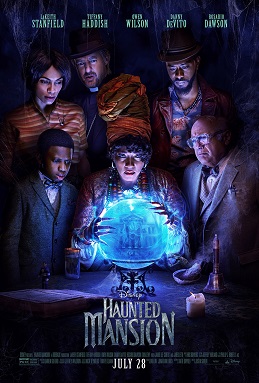
One of the dangers of streaming is that you can be talked into a movie by the fact of its availability.  Curiosity drove me to Disney’s The Haunted Mansion movie and that led to the discovery that there had been a reboot.  I’m drawn to haunted houses but not to theme parks, but well, you wonder how they might’ve thought they could’ve done it better.  The original movie failed to rock the critics, so, as the saying goes, try, try again.  Last year’s Haunted Mansion is over the top.  The story is more complex, with an ensemble cast, and not really funny or scary.  Based on a sad premise—two families with deceased spouses—they’re drawn, with three other New Orleans outsiders, to a, well, haunted mansion.  The main ghost is looking for a soul to harvest but as the two hours wend on, the characters reveal their sadnesses (one doesn’t).  Perhaps the idea is catharsis, but there are too many subplots and too many abrupt shifts of mood.

A movie should know, it seems to me, what it wants to be.  You feel for the sadness and loss of the characters but  I know something about using horror cathartically, and this movie doesn’t do it.  There are jokes and running gags, but they’re not really funny.  There’s religion involved, but it turns out to be fake, with even a faked exorcism.  There are literally 100 ghosts.  And really only one bad guy among them.  There’s drinking to drown sorrows, murders, and even adult humor that is somehow deeply disturbing.  There are a few nods to the original movie but the plot is quite different and it leaves you feeling drained.

With a budget of about $150,000,000, stops were pulled out all over this organ.  It doesn’t, however, have a focus.  In the original film, the Evers family really has a need to reconnect.  The mansion does that for them, through its ghosts.  The reboot implies at the end that two broken families might heal each other and that evil leads to its own punishment.  Still it leaves open the question: what is this movie trying to be?  The more cynical might say it’s only for money (the worldwide gross didn’t reach covering its budget), but I have to think that those who make movies do so for more than just a buck.  Coping with death is a profound human need that begins when a pet or, more seriously, a family member dies.  I’m not sure that Disney is the best authority on the subject.  At least not for those of us who use horror as therapy.


Six-Hundred and Sixty-Six

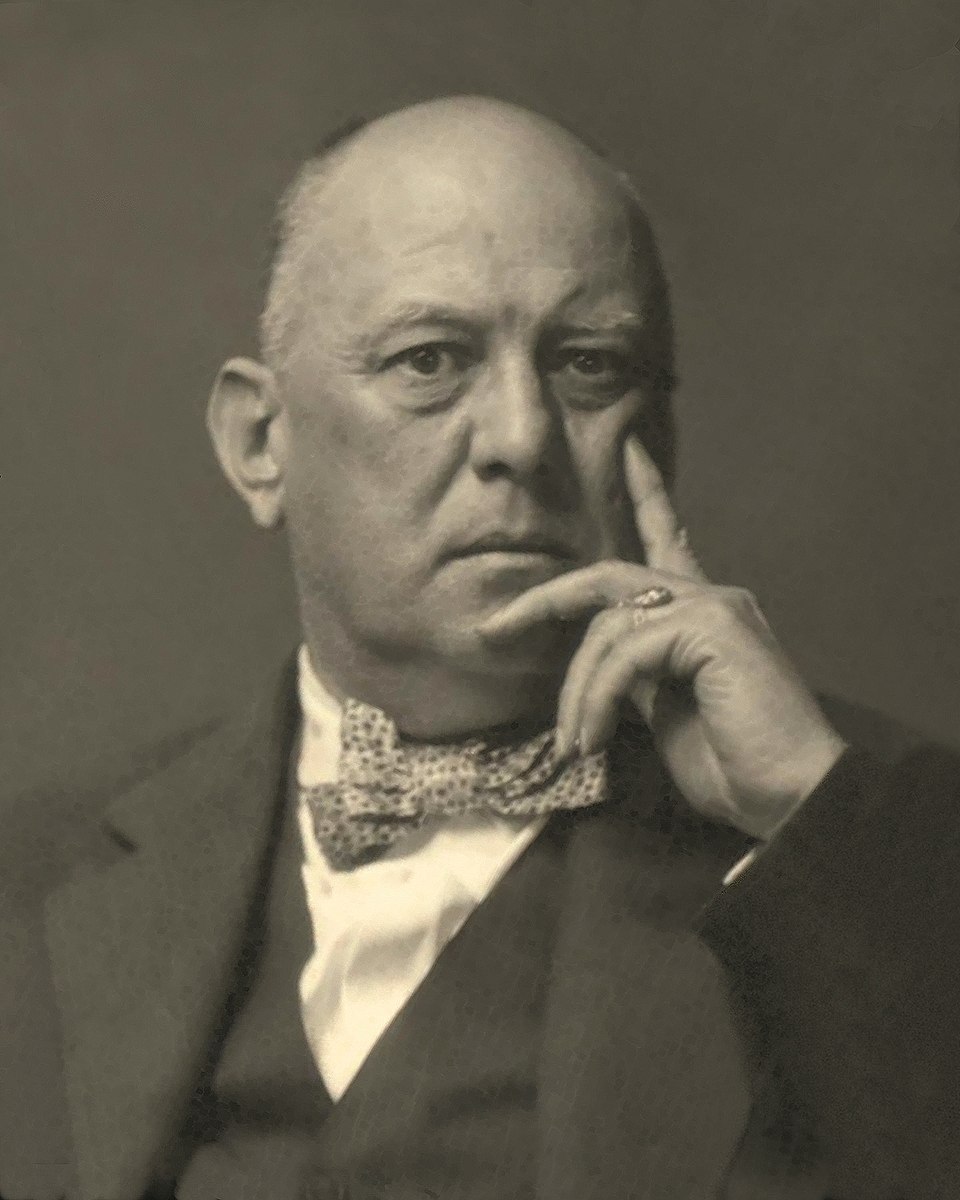
I have to confess to never having read a biography of Aleister Crowley.  I’ve known of him since I was a teenager, however, since you can’t read very much about esoteric stuff without running into his name once in a while.  Crowley was famous for starting the religion called Thelema, revitalizing interest in magick (the additional “k” was to distinguish it from stage magic), and for generally being a bad boy.  In fact, he declared himself the “wickedest man on earth” and liked to be called “the Beast” and loved the number 666.  It was the latter point that caught my attention recently.  In pop culture, 666 really only took off after The Omen.  (Movies often dictate, or at least inform, our religion.)  Crowley, who lived much earlier than the film, saw the marketability of 666 and I wondered how it caught his attention.

Aleister Crowley, public domain via Wikimedia Commons

As I recently posted, the end of the world as we know it is a fairly modern construct.  I happened to be reading about Crowley recently and learned that he was raised in the Plymouth Brethren tradition.  (They don’t loudly claim him as a native son, for some reason.)  He is probably the most famous of the Brethren, across all walks of life.  He even earned a place on the cover of Sgt. Pepper’s Lonely Hearts Club Band.  The Plymouth Brethren were massively influenced by John Nelson Darby, the inventor of dispensationalism.  Dispensationalism is the fairly new Christian belief that time can be divided into ages, or “dispensations,” during which God has a plan already mapped out.  He apparently waited for Darby before letting the rest of the world in on this secret.

Things about Crowley then began to make a little more sense.  His choice to name himself after Darby’s preoccupations adds up.  I haven’t read any biographies so this may be old news, well known among scholars of esoterica.  It nevertheless bears pondering because the religion we teach our kids may have unexpected consequences.  Crowley rejected the Brethren (whose moral predilections were not to his liking, especially as a hot-blooded young man) but the religion influenced him nevertheless.  I wonder if the teachings Crowley received as a child encouraged him to become, in his own mind, the opposite.  Crowley wasn’t “the Beast.”  His precepts included “love is the law” (granted, his version of love was a touch earthier than Christians with whom he’d be raised, but still), not a bad start for an ethical system.  Even the wickedest man on earth believed in the power of love, even if his religion introduced him to 666.


Price Drop

Here’s a public service announcement for your Friday.  If you’ve been wanting to read Holy Horror but found the price too high, McFarland has now lowered the cover price to under $30.  Here’s the link: Holy Horror.  Of my non-academic books, this has been my “best seller.”  Since I’m currently shopping around another book, and since agents aren’t interested (at least not any more), I wondered whether McFarland might look at it.  The editor who handled Holy Horror had left, and the new editor responded to my concern about pricing by telling me that they lower prices after a couple of years.  She noticed, however, that Holy Horror had been overlooked in the price lowering process, so voila!  It’s now affordable.

This model, while not the same as trade publishing’s efforts to get primarily front-list sales, seems to make sense.  Too many publishers raise prices year after year, so if you don’t buy immediately you’ll pay more.  McFarland tends toward a paperback first model.  The first couple of years are aimed at library sales—and they do well at those—then they lower for individual purchase.  All I had to do was ask.  Two years ago I asked Lexington/Fortress Academic if they’d do a paperback of Nightmares with the Bible.  That poor book never had a chance.  The editor said they were considering it.  Instead they did the trick that publishers seem to like: decoupling the ebook price from the hardcover.  So you can buy some expensive electrons instead of holding a real book.  So it goes.  I’ve written a museum piece.

It’s a little too soon to say about The Wicker Man.  My experience has been that university presses, particularly British ones, like to raise prices rather than chasing sales.  If you’re reading this blog you know that I’ll market my books.  I even printed bookmarks for Holy Horror at my own expense.  Maybe it’s time to start distributing them again.  What a difference ten dollars can make!  I’m a book booster.  (You might not have noticed.)  I’m glad that McFarland understands that individuals will buy books, even if they’ve been out for a while.  The standard wisdom among academic publishers is “three years and then you’re done.”  If you’re inclined to help prove that business model wrong, you can now get Holy Horror without having to take out a second mortgage.  That’s cause for hope—any writer has the dream that her or his book will keep on selling.  Sharing this information will, it seems, make it wider known. Please pass it on.


Why Weenie?

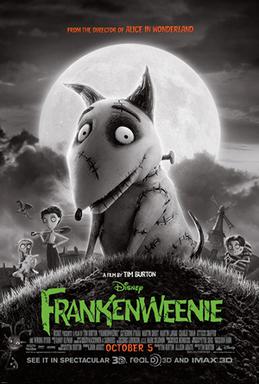
Often I ponder how incredibly influential Frankenstein has been.  Even those who don’t care for horror instantly recognize the creature and what he represents.  (At least partially.)  Tim Burton thought of tying Mary Shelley’s story to a pet dog in Frankenweenie.  This was a black-and-white, live-action short released in 1984.  It wasn’t aired much before being locked in Disney’s famous vault.  It wasn’t really what Disney was known for.  Ironically, then, in 2012 Disney released a feature-length version, also black-and-white.  This one was stop-motion animation, however, inspired by Burton’s Corpse Bride characters, at least to a point.  At its core the story of a bereft boy bringing his dog back to life, the original showed the mayhem introduced by crossing the border between life and death.  Not too different from what Shelley was intimating some century-and-a-half before.

The remake, or reboot, was feature length and had to develop the plot a bit.  Along the way there are numerous nods to other horror films.  Critics have noted that horror is an amazingly self-referential genre.  Comedy horror delights in parody.  So, as a Vincent Price-like science teacher inspires Victor with the concept of reanimation via electricity, the boy decides to resurrect his pet.  Other school children find out about the undead Sparky and decide to make their science fair projects reanimated pets.  Or sea monkeys, in a clever take-off on Gremlins.  Naturally, the other pets lack Sparky’s good will, not raised out of love, but out of a desire to win a competition.  One student’s resurrected turtle becomes a Godzilla-like kaiju, allowing for winks at Jurassic Park.  The cat-bat reminded me, anyway, of Gremlins 2.

Ultimately, the story comes to the same resolution as the original short.  Of course, this isn’t scary horror.  Comedy horror is an odd genre.  It permits darker-themed elements to play against fun and fantasy.  Frankenweenie isn’t really laugh-out-loud material, and if you’ve seen the previous version the story arc is already known.  Still, it’s an effective movie.  Although it made millions at the box office, it wasn’t as many millions as Disney has come to expect.  But it is quintessential Burton.  It also has a moral attached—that even scientists need to pay attention to love and the motivation for learning.  The parents at the PTA meeting are scandalized by what science does, in a bit of real-life parody as well.  So Frankenweenie came across as pretty good to me.  I like monster movies.  It did lack, however, the emotional impact of the original.  Of course, the tale of a boy and his dog is its own kind of archetype, I suppose.


The Movie Maker

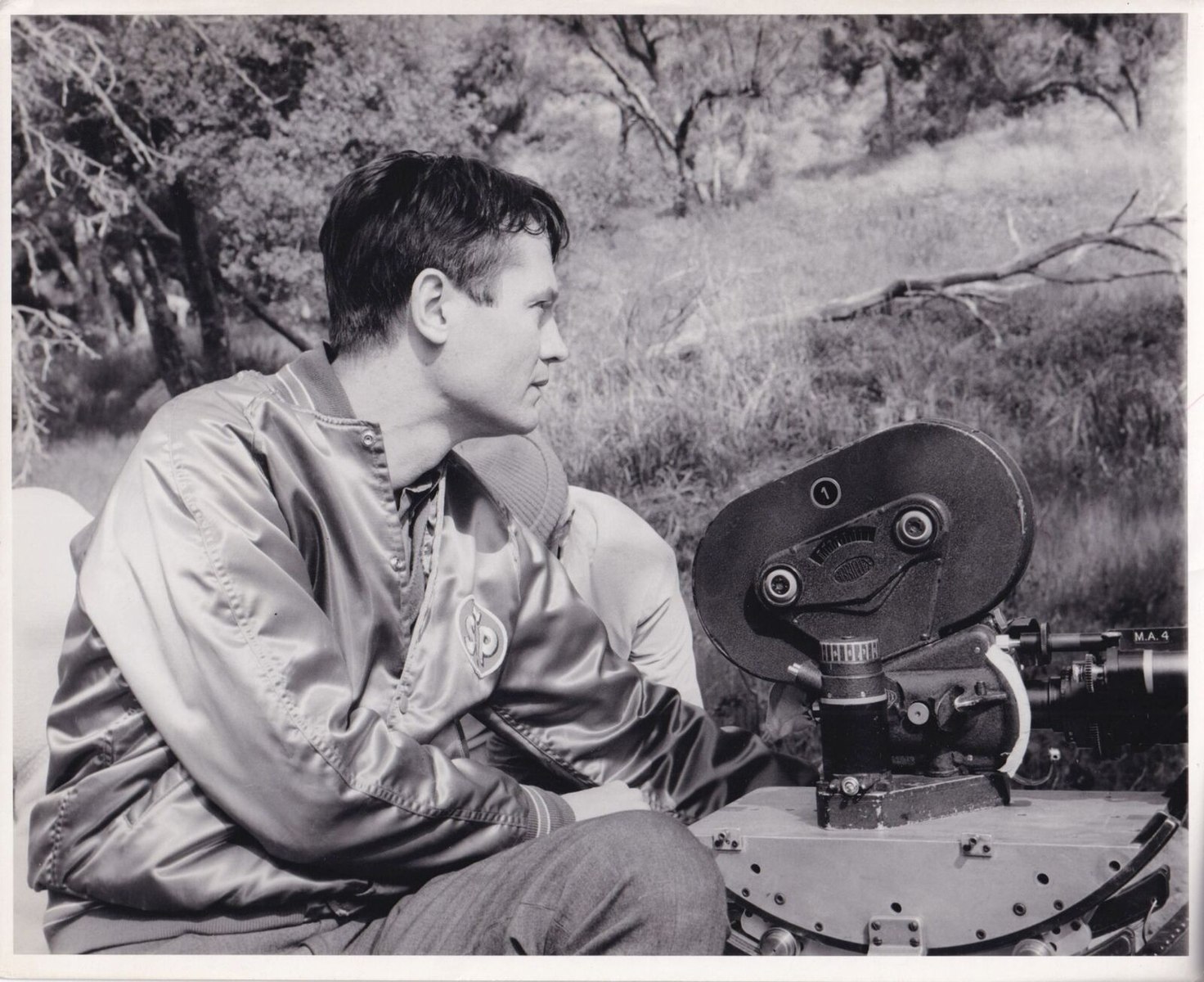
Roger Corman has died.  So passes an era.  I’ve always had an appreciation for the speculative films of the fifties and sixties.  Many of these involved low budgets and content intended to shock.  Or at least excite youngsters.  And Roger Corman was a huge name among directors, producers, and promoters of such schlock.  He entered the realm of horror in 1955 with Day the World Ended.   Attack of the Crab Monsters a couple years later put the focus firmly on monsters.  Producing and directing three or more movies a year, he built a reputation for being cheap and quick, but that didn’t prevent him from creating some good movies.  A film’s producer is the one responsible for overseeing the production.  Often they come up with the ideas of what to film.

Roger Corman, publicity still; public domain via Wikimedia Commons

As the sixties were dawning, Corman produced several films “based on” work by Edgar Allan Poe.  I remember seeing some as a young person and wondering what they had to do with the Poe I’d been reading.  Still, he managed to grace cinema with House of Usher and The Masque of the Red Death.  These are good films, despite limitations.  At the same time, Corman was still producing creature features as well, wracking up an impressive list of nearly 400 produced films.  As an established player in cinema he also took on the role of distributor from time to time.  When The Wicker Man was being ignored in Britain, Corman undertook the role of US distributor, likely saving the movie from total obscurity.

Circling back to Day the World Ended, we’ve become accustomed to believe that some kind of divine or human ending is in the offing.  These ideas get embellished over time, as I suggested in my new piece on Horror Homeroom.  Corman knew that this putative end would get the attention, whether or not there was any truth to it.  Perhaps that was the genius of his work—he knew how to attract attention.  And he wasn’t afraid to do so.  The business of cinema is one of attracting viewers.  Telling stories we want to hear.  We remember reading Poe, and even if the movies differ from the stories he penned, they are nevertheless reminders, reminiscent of what we’ve read.  If there are monsters they are somehow perhaps even more effective for not really being believable.  In short, Corman was a showman.  He made a living doing what he loved.  And he influenced many lives along the way.


Downtowns

I recently wrote about the movie Peeping Tom.  I mentioned a scene, particularly creepy, where a news agent sells a girl a candy bar after selling an older man pornography.  Writing about this reminded me of my own youth.  After we’d moved to Rouseville, the nearest town with shops in western Pennsylvania was Oil City.  It had a reasonable downtown then—a couple of blocks with a Woolworth’s, Thrift Drugs, a movie theater (the lamented, lost Drake), stationary stores, and the like.  By the time I was in fifth grade I’d begun to discover books.  (Ours was not a reading family, being much more of the television crowd.)  Finding books in Oil City was a bit of a challenge.  There wasn’t a bookstore.  The nearest regular bookshop was all the way over in Meadville, and Mom didn’t want to drive that far too often.

I’ve noted before that I bought used books at the Goodwill up in Seneca (where we bought clothes and household items as well).  If you stayed downtown in Oil City, though, you could find books for less than a dollar in a bin at Woolworth’s.  (I still have a few of those cheaply printed and bound “Easy Eye” editions on my shelf.)  There was, however, just a door or two down, a mysterious shop where I’d spied a rotating wire rack of paperbacks.  I was curious and although Mom never forbade us to go in, she certainly didn’t encourage it.  I was a tween ravenous for new reading material.  This shop also sold magazines and tobacco products.  Some of the magazines had their covers obscured, and although on the cusp of puberty, I was really only after books.

One time I went in to give the wire rack a whirl.  I seem to recall that the owner gave a rather wry look when a minor, myopically focused on books, wandered in.  The fare there was not what I was used to.  There was a novel about Bigfoot, I recall.  I thought maybe that would be of interest, but I didn’t buy it.  When I walked out, I had that creepy feeling that seedy places seem to leave palpably on your skin.  I guess it might’ve been the feeling of that innocent little girl wandering into a shop selling nudie pictures to buy a candy bar—probably because it was the closest shop to home.  Such downtowns, and undoubtedly, such stores still exist.  They’ve become rare.  Downtown Oil City is no longer recognizable when I go there.  Now, it seems, there’s nowhere to buy books at all.


Finding The Exorcist

This blog is the closest thing to a diary that I keep anymore.  It’s also the place where I remind myself when I read a book or saw a movie.  I started this blog (actually, my niece did, but I started putting content on) about a decade-and-a-half ago.  Most of the books I’ve read since then (but not all), have been featured here.  It didn’t start out that way with movies.  I watch a lot of films.  The other day I was wondering when I first watched The Exorcist.  I figured that it must’ve been something I’d blogged about, knowing me.  It could be that I watched it before 2009, or it could be that the search function on WordPress doesn’t allow me to find the post, if it exists.  You see, I don’t know what else to search for beyond “The Exorcist,” because I can’t recall what I might’ve written about it.  If I did.

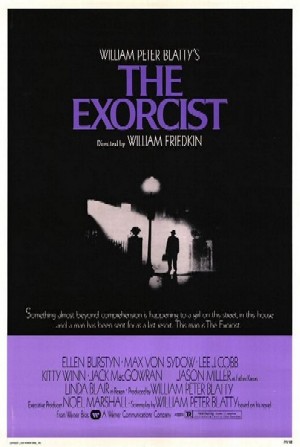
So, in case I haven’t, I do want to say a bit more about that experience.  I was only eleven when the movie was released.  Three movies that I grew up terrified to see were Rosemary’s Baby, The Exorcist, and The Omen.  I finally saw them as an adult.  Since it was the DVD era (preceded by the VHS era, and followed by the Streaming era—all within about three decades) I bought the disc.  In all likelihood this was at FYE, which used to be a thing, just like Blockbuster before it.  Of course by the time I sat down, trembling, to watch it I’d seen many clips, stills, and parodies.  Still, I was afraid.  The movie, some thirty years old, lived up to its reputation.  I was left trembling more than when I started.

Many books have been written about The Exorcist, and although people sometimes laugh at it today, most horror fans I know still speak of it with reverence.  This movie changed horror.  It also changed demons.  Today what we believe about demons derives largely from this movie.  Its explanatory value is that it offers somewhere to turn when nothing else works.  Religion as a last resort.  And, ultimately, religion works where everything else fails.  It is possible, that somewhere in this sprawl of a blog, that I wrote first impressions of seeing it.  It would’ve been 2009, or perhaps I saw it as early as 2006.  I was struggling with my own demons then.  And, as often happens in such cases, precisely when things happened can be a little difficult to determine.


Murphy’s Mansion

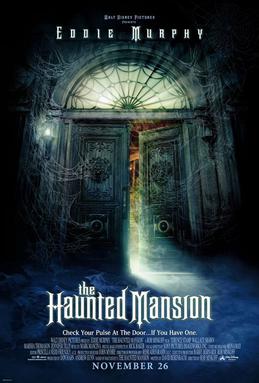
2003 was quite a year for me.  Nashotah House had experienced a fundamentalist takeover and, were I as good at reading writing on the wall as Daniel was, well, you know.  I was still working on Weathering the Psalms and teaching my classes, remaining academic dean as well.  My daughter was still pre-ten and I’d taken a very active interest in geology.  I didn’t have time for many movies.  My recent (if approaching two decades can be termed such) re-interest in horror hadn’t yet begun.  All of which is to say, I had no reason to watch The Haunted Mansion.  Oh, Disney was a big part of our lives, but I was trying hard to raise a child better adjusted than I ever was.  A haunted house movie didn’t seem like a good idea.  Especially at Nashotah.

The critics didn’t like Haunted Mansion, unlike the other Disney ride-inspired movie earlier that year, Pirates of the Caribbean.  We even missed that one in theaters, only catching up with the sequel.  In any case, Haunted Mansion, upon first viewing, isn’t as bad as I was led to expect.  The story has some depth and even seems to recycle the undead from the Black Pearl.  Disney had explored the dark side before, but this was, at the time, the closest they’d come to actual horror.  Well, comedy horror anyway.  I suspect that Eddie Murphy doesn’t tend to bring horror to mind, but he plays his part well enough.  The story is relatively compelling, although some of the elements are standard tropes.  And with Disney’s budget, it was well made.  I’d watch it again.

It seems that it falls into that twilight zone of Disney movies that have become cult classics.  We expect Disney to be either plain old classic or forgotten and locked in the vault.  Those who appreciate darker themes, however, have brought both Haunted Mansion and The Black Cauldron up to the level of having cult followings.  You tend to think well-funded studios would fail miserably when they fail and never speak of such things again.  And yet, The Haunted Mansion got a reboot last year.  Disney’s flirtation with horror speaks to the fact that kids don’t mind being a little scared.  For adults, there’s nothing terrifying here.  There is, however, a story.  A moody atmosphere—although broken up by Murphy’s renowned patter.  And plenty of ghosts and even some musing on Purgatory, Heaven, and Hell.  There’s a bit to unpack here.  So more on that the next time I watch it.  But it may take some time since I’m still catching up.


Influential Horror

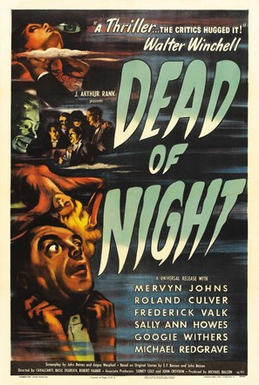
Media has a tremendous effect on society.  We all know that, and every four years elections prove it time and again.  Like an infinite loop or Mobius strip.  The Brits knew this well.  During the Second World War (which we seem eager to repeat), it was against the law to produce horror films in the UK.  Such things can demoralize, don’t you know, old chap?  The first British film to claim horror’s reopening was Dead of Night, released in 1945.  Germany had surrendered in May and Dead of Night, like a breath being held, was released in September.  Although hardly scary by today’s standards, it was an enormously influential film.  It’s an anthology with a framing story that ties all the pieces together.

Walter Craig is an architect called to visit a farmhouse that requires renovation.  Upon arriving, although he’s never been before, all the people at the house are familiar to him from a recurring nightmare he has and vaguely remembers.  He feels that something bad will happen since his dream seems to be a premonition.  Meanwhile, each of the guests tell their own uncanny stories.  Since this is horror, we know that the nightmare will exact its due.  Craig ends up murdering one of the guests before waking in bed.  It was his nightmare.  He receives a call to come to a farmhouse that requires renovation.  When he arrives it reminds him that the nightmare is about to play out in real life.

The movie influenced many others.  The most famous segment—a ventriloquist that goes mad when his dummy takes over—was fuel for many haunted doll stories.  One of the tales was based on a real-life murder than had taken place in Britain in 1860.  As I learned from Wikipedia, however, the most stunning effect the movie had was on cosmology.  You may remember from science class that a debate about the origin of the universe was fought between two models: the Big Bang theory and the Steady State theory.  What they don’t teach in science class is that Fred Hoyle developed the Steady State theory based on this movie of the recurring loop of a nightmare that the dreamer is helpless to escape.  I’ve been saying for years that horror is due a lot more respect than it’s given.  These movies, as an integral part of the media, do have a very real effect on the world around them.  Dead of Night is a good example of that.  And it’s still a bloody good film, after all these years.


Happy Beltane!

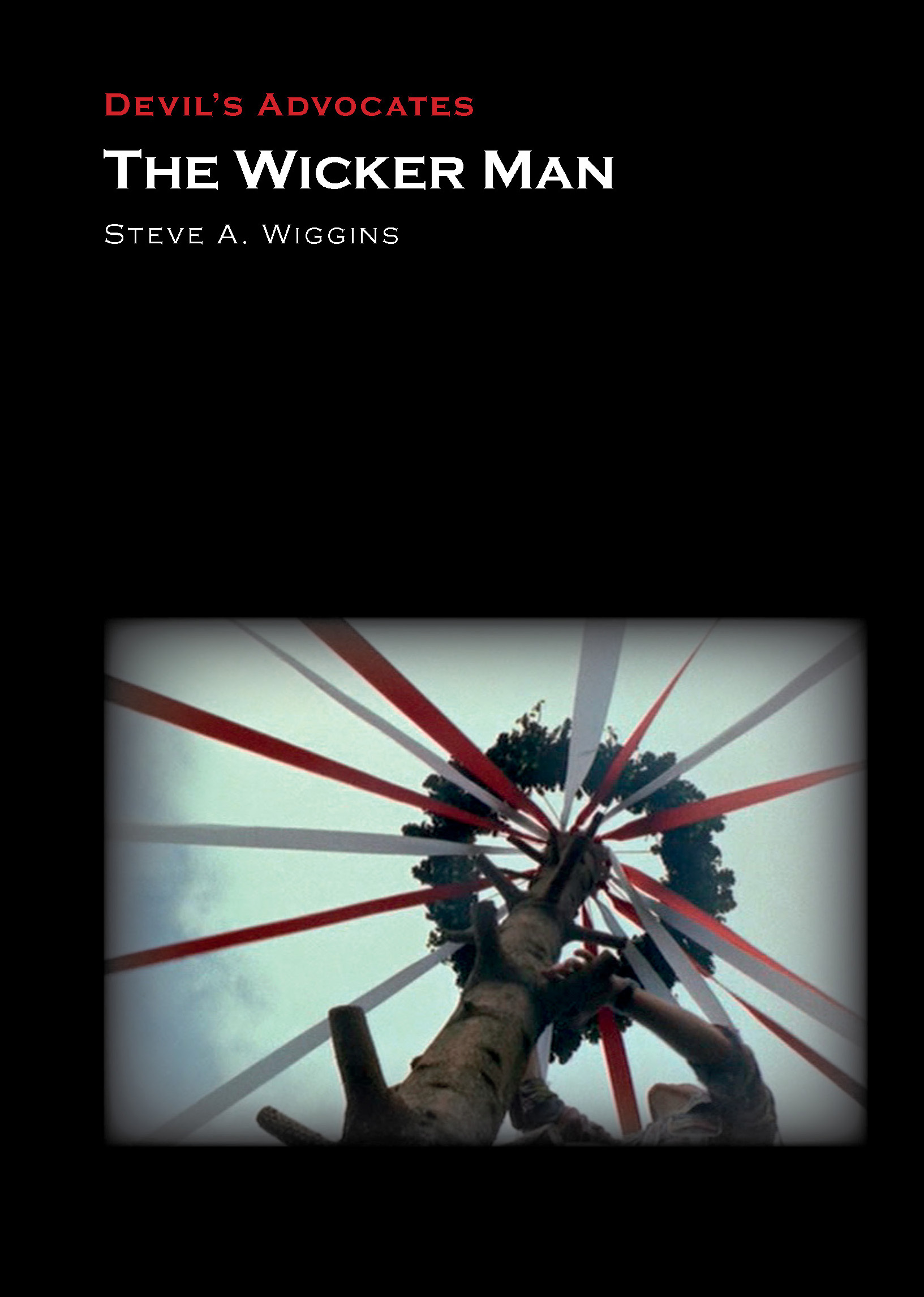
They creep up on you, these holidays with no official recognition.  I’ve been so busy that it didn’t even occur to me that today was Beltane—May Day—until my wife mentioned it to me before I headed up to bed last night.  Why is that important?  It’s not a day off work, so why bother?  Well, for one thing it’s the fuel behind my book published in the summer of last year.  Or, according to the Celtic calendar, the fall (just before Lughnasadh).  In other words, this is the first May Day for The Wicker Man.  I should’ve been trying to drum up a little interest, but things have been busy.  Besides, my profile hasn’t grown since its publication.  Nobody even cites it on the Wikipedia page for the movie, although it takes a distinct angle.  So I’ve been busy with other things.

I’ve been trying to find a publisher for my next book.  A couple friends know what it’s about but mostly nobody else because it’s time-sensitive.  Agents haven’t nibbled.  Well, one did.  He had me rewrite the book and then decided he couldn’t sell it after all.  Back to square one.  Even presses that publish mostly non-PhDs weren’t even interested enough to respond to queries.  Nothing like writing a book to make you realize how insignificant you are.  Like Sgt. Howie, I’m caught on Summerisle.  Ironically, I didn’t even think of writing a post for my book today when I was jogging yesterday and a haze over the moon (I know the movie ends with the sun—I’ve seen it a time or two) made me think, “That sky looks like the ending of The Wicker Man.”  Well, when I get back from my jog I have to start right in to work.  And Beltane’s not a holiday in these parts.

May Day used to be celebrated, even in the United States.  Now it’s just disappeared into the haze of work days.  And we don’t have time even to watch movies on work days.  That’s a weekend activity.  Of course, my weekends are full of trying to find publishers.  Two are currently considering my unagented book.  Four have already rejected it.  I’m thinking that I could use a trip to the Green Man with Howie.  At least on Summerisle they know how to celebrate May Day.  Of course, it’s the ending that makes it horror.  And Beltane snuck up on me this year.  Without it, The Wicker Man wouldn’t even exist.


Facing Fear

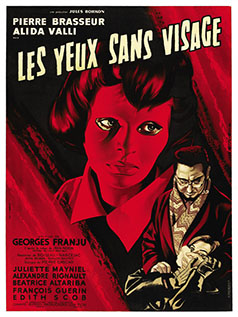
The relationship between fathers and daughters is intangibly profound.  (I can’t speak for fathers and sons, from either side of the equation.)  That was the angle that Georges Franju took when approaching Eyes Without a Face.  I have to confess that I knew the basic idea behind this movie and it took years to build up the courage to watch it.  I’m squeamish, and the fear that the film might show too much was a very real fear.  After you watch a movie, it can’t be unseen.  Still, it is a classic of the horror genre (although that is disputed) and it gets referenced all the time.  In case you haven’t heard about it, a plastic surgeon is attempting to graft a new face onto his daughter after she’s mutilated in an automobile accident.  Things, as you might guess, don’t go as planned.

Critics didn’t care for the movie when it was first released, but, as we’ve seen from time to time, re-evaluation changes things.  It is now considered good enough to be part of the Criterion Collection and ratings on the usual websites are quite favorable.  It’s often cited for its poetic treatment of the subject, and the response of Christiane, the daughter, seems to bear that out as she moves from complicit in her father’s crimes to sympathetic to his victims.  Indeed, the surgeon himself is conflicted, but that father-daughter relationship is something he can’t ignore.  He seems compelled to help her at any cost—it’s the price of parenting, I suppose.  It’s not for the weak.  But we’re in movie-land, aren’t we?

Christiane is sympathetic to the animals her father uses for his experiments.  When she frees them, after releasing the last intended victim, she’s depicted St. Francis-like, with the doves.  Knowing her own suffering, she can’t bear to impose it on another.  Our bodies are how we present ourselves to the world.  We rely on faces to tell us much of what we need to know, even without words passing between us.  Interestingly, even when wearing her mask, Christiane’s eyes tell the viewer much of what she’s experiencing internally.  Poetic, as the critics say.  If there’s a monster here, however, he’s driven out of love in the context of an imperfect world.  Eyes Without a Face works as a horror film and the reported fainting that took place among viewers early on demonstrate that we tend to feel for others, just as Christiane comes to.  And the father?  Well, that’s the unanswered question.  He’s a victim in his own way.


Which Mountain?

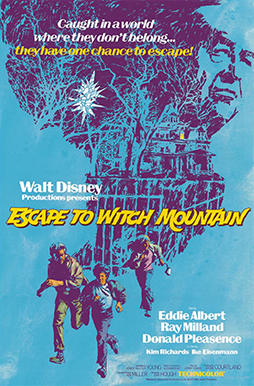
Disney movies—and I still think of Disney primarily as a movie studio—were part of my childhood.  A small part, but there nevertheless.  We didn’t go to theaters often but we caught some movies on television (do you remember eagerly reading TV Guide to find out what was going to be on that week?).  We did watch The Wonderful World of Disney and some of their series—I recall the one ones on Daniel Boone and Davy Crocket.  Still, I missed a lot.  I didn’t see Mary Poppins, for example, until I was in college.  So the other day I got curious about Escape to Witch Mountain.  I’d not seen it as a child and never saw any reason to watch it as an adult.  I’ve been taking a break from bad movies, and, as it turns out, Disney.  So there may be spoilers below, in case you’re waiting to see it.

I didn’t know the backstory or the plot, so seeing this the first time I wasn’t sure what to expect.  The movie shows its age (I was a mere lad of twelve when it was released), but the story is interesting.  Tony and Tia are adopted but have to be sent to an orphanage.  We quickly learn that they have “powers,” and that adults like to exploit such things.  A wealthy villain has his fixer pose as their long lost uncle to get them to his house, under his control.  The children realize that they must escape to, well, Witch Mountain.  Actually, that takes some time and a sympathetic adult who can drive.  In the end it turns out that they’re aliens, not witches.

Not cheery like many Disney films, Escape to Witch Mountain, although you know it will end well, has a fair bit of tension.  Especially scary is the mob mentality that takes over the locals when they start their literal witch hunt.  Armed and dangerous, those who want to preserve the uniformity of small-town mentality are serious about their convictions.  As usual, they focus on the enemy without getting to know who, or what, they really are.  Obviously, there are larger issues to consider, as there are when anyone has an advantage.  But the kids, aliens, are sweet and mean nobody any harm.  All they want is to get back to their people.  Can humans, however, ever be satisfied knowing that there are others out there more advanced than we are?  Perhaps there’s a reason for cover-ups, after all.  Disney often says more than it’s given credit for saying.  Even if I missed it until now.


Panic Inducing

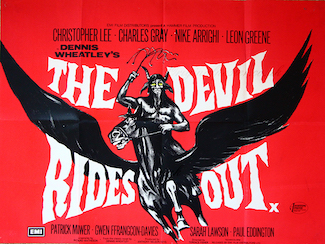
Many movies appreciate in value over time.  The Devil Rides Out (also known as The Devil’s Bride) was not well received initially, but has become a highly regarded horror classic.  One of the few with a G rating, no less.  It’s also hard to see in the US, due to lack of streaming (at least where I stream) and DVDs coded to Europeans viewers.  Anyway, taken from a Dennis Wheatley novel, and screen-written by Richard Matheson, it features Christopher Lee in an heroic role during the days just before public concern about Satanism would become downright panic.  The story itself, effective if long-winded, develops among the aristocracy in England during the 1920s.  It was released, by the way, the same year as Rosemary’s Baby, which helped play into the Satanic panic.  Movies do influence the way we view “reality.”

I’ve never read any Dennis Wheatley novels, but it’s safe to say the story is pretty Manichaean in its outlook.  A coven of Satanists wants a young man and woman to complete their number but the chosen young man has a couple of older friends who quickly comprehend what is happening and attempt to put an end to it.  The Satanists, however, control real power and the movie is pretty much a tug of war between the young man’s friends and the coven.  This is done in such a way that you see very little blood, no gore, and surprisingly for the subject matter, no nudity or sex.  The Satanists here are old school—they want to worship the Devil in exchange for personal power.  It’s pretty clear that some research was done before undertaking all of this, even if the paranoia born of such things was fueled by largely imaginary scenarios. 

I’d been wanting to see this film for some time because of its clear connection between religion and horror.  There’d be no Satan, as we know him, without Christianity.  Indeed, there’s heavy Christian imagery in the film, in keeping with Wheatley’s outlook.  Crosses cause demons to disappear in an exploding puff of smoke.  Interestingly, however, there’s no crucifixes or holy water.  This is a Protestant view of the Dark Lord.  The Satanists, however, are defeated by the spirit of one of their own who refuses to allow them to sacrifice a young girl.  The ending stretches credibility a bit more than the rest of the movie, but still, overall it isn’t bad.  A Hammer production, it never had the box-office draw of its contemporary Rosemary.  Still, The Devil Rides Out was influential in its own right.  Even if finding a viewing copy requires almost selling one’s soul.


Wolfing Hour

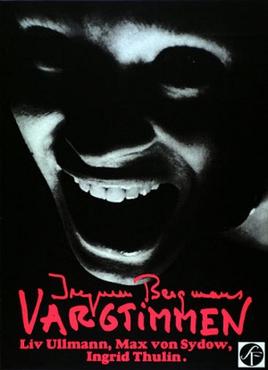
It’s not that I didn’t grow up watching horror; it’s that I didn’t grow up watching horror in theaters.  I’m sure Mom wouldn’t have had it, and besides, we could only afford movies spread apart by wide intervals.  You’d think that now I’m an earning adult (or so I’m told) that I’d have more control but watching is a kind of addiction and money’s still not abundant.  Every once in a while, however, I’ll splurge and pay for a film.  Mostly when they’re not available via any streaming service.  Like many Christians who’ve never read the whole Bible, I know the canon only piecemeal.  So I came to watch Hour of the Wolf, the Ingmar Bergman classic.  Now (at least then) streaming nowhere.  Intellectuals have always flocked to Bergman films since they’re full of symbols and not easy to understand.  (If you want to “get” Robert Eggers, though, you’ve got to do your homework.)

Hour of the Wolf is generally considered psychological horror.  It’s black and white—how scary can it be?  Pretty, depending.  The story of an artist’s wife (Alma) who lives with him in a small shack on an island in Sweden, it’s a tale of unraveling.  Nightmares become difficult to distinguish from waking realities.  The wife reads the artist’s diary, foreshadowing Wendy in The Shining, to discover that he seems to be going insane.  The island’s not abandoned, as they thought.  Soon Alma begins seeing other people too.  And attending their awkward dinner parties.  They speak freely of her husband’s previous affair.  There also seems to be an instance of a real person on the island that the artist keeps secret.

If this doesn’t give you enough to piece it together, well, it’s a Bergman film.  In college we watched The Seventh Seal.  And at least part of Wild Strawberries.  But in 1968 I wasn’t an intellectual and we were poor.  If I’d even heard of Ingmar Bergman it was via reference in some TV sitcom.   I knew to expect strangeness.  These days the box elder bugs are mostly gone from the house.  The weirdness started when, having never seen the film before, I began to pour a glass of water at the very second the artist picks up and begins to pour a glass of wine.  Strange coincidence, I thought.  Several minutes later I saw something edging around my glasses.  A box elder bug crawled right over my right glasses lens.  Like a scene in a Bergman movie.  I knew I’d have to ponder this for some time.