A Peculiar Resurrection

Although it is not my regular practice to splash melodrama across my blog, my recent experience with losing the Internet for four days prompts me to consider resurrection. After consulting with three technical agents and giving my laptop a kind of electronic enema, I am now once more able to access that mysterious nirvana called the world-wide web (and even the www2, whatever that is). This experience has taught me something about the human craving for resurrection. I began this blog in July of 2009. Since then I’ve added new entries almost daily. Even in places as remote as the northwoods of Idaho, if my laptop receives a signal, I can post my unorthodox thoughts for the world to read (at least the very small cross-section of the world that stumbles upon my pages). Being forced to go without Internet connectivity in New York City, of all places!, was itself a surreal experience. I literally wept in frustration. No one could help. This morning the Verizon tech assistant had me connect via an Ethernet cable and with his omnipotent hand remotely guiding my cursor, brought these dry bones back to life. Praise the landline!

The writers of the Hebrew Bible did not believe in resurrection. The book of Daniel, written just before the death of Antiochus IV Epiphanes (“the manifestation” as he humbly called himself) in 164 BCE, is the earliest hint that Jewish thinkers were beginning to consider the resurrection concept. The Egyptians had, many centuries earlier, played with the idea. They eventually developed it into a national pastime—building pyramids to ensure the king got to live again—but other ancient people were more pragmatic. Death was the end, so live this life to the fullest. As far as we can tell, Jesus taught his followers about the possibility of life beyond life. Some take that to mean a literal reconstituting of life after death while others understand it metaphorically. Both ideas can be, broadly speaking, labeled “Christian.” Some Jewish thinkers accept resurrection, others do not. Other religions, as mentioned earlier this week, go for the cyclical approach of reincarnation.
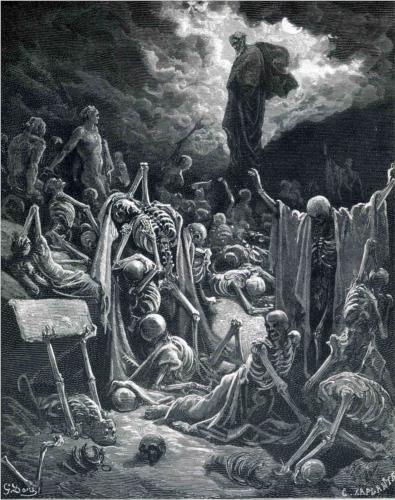
Ezekiel, according to chapter 37 of his surreal book, saw a valley of dry bones. These people were, as the Munchkin coroner croons, “really most sincerely dead.” Ezekiel did not believe in resurrection. If he had the miracle would have been lost on him. Reviving the dead was considered the most extreme, impossible feat in his entire (if limited) universe. The people of Judah, defeated by Babylonia, carried into exile, their temple—God in their midst—destroyed, believed it was all over. There was nothing to bring home into such a desolate landscape. Some suggest Ezekiel was schizophrenic or perhaps addicted to psychedelic mushrooms. In reality, I believe, he owned a MacBook that could not connect to the Internet. Once that divine signal from on high penetrated the arid air of exilic lassitude, he rebooted and without the aid of any drugs, saw God in all his/her glory. (Ezekiel refuses to give God a gender, but that is a topic for another post.)

September’s Child

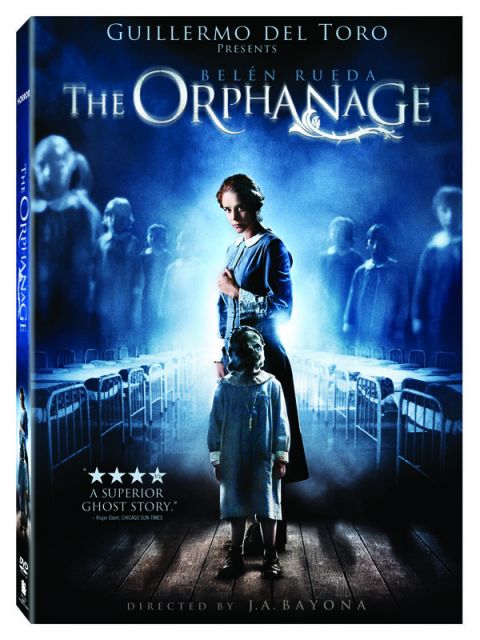
This was an appropriate weekend for a scary movie. With Guillermo del Toro in the news of late, I selected The Orphanage to fit the mood. Foreign language films can present a challenge when too much action is interspersed with dialogue, but the pacing and deliberate unfolding of The Orphanage solved that problem. As always when screening horror films, I was watching to see how religion played into the plot. The story follows the disappearance of a child adopted by a couple who wish to open a home for special needs children. Laura, the mother, is unwilling to accept her child’s disappearance while her rational, physician husband, Carlos, feels that the outcome is inevitable. In a show of support, however, Carlos lends Laura his Saint Anthony’s medal, just until their son is found.

The association of Saint Anthony—perhaps the most famous Franciscan after Francis himself—with lost items is a worldwide phenomenon. The city of San Antonio bears his name (although it is easily found). In the movie he is invoked to find the lost child. The distraught Laura religiously wears the medal until the child is found (in what state I’ll not say, for the benefit of those who’ve not seen the film). When Carlos comes to seek his wife, he finds the medal, bringing the movie to a close. The orphanage also features a very gothic chapel that sets the mood in a few scenes as well. “The Good Shepherd” is the very biblical name of the institution. Although not central to the story, religion is woven throughout, demonstrating once again that fear and religion are closely related.

Like Saint Francis before him, Anthony was born to a wealthy family in the Middle Ages. Both young men forswore their material goods to seek spiritual wealth. Both died relatively young (not uncommon in the Medieval Period) and in poverty. Choosing such a selfless character as the means of recovering that which has been lost may seem counter-intuitive, and The Orphanage exploits that idea very nicely. Over this gray weekend when many people were thinking about loss, an orphanage seems an appropriate metaphor. Although a Saint Anthony medal may inspire confidence, it can never restore what is truly gone. Even so, religion may assuage the anxiety, but in the end we still must find our own way home.


The Truth of Ghosts

Strange noises in the night. Objects moving of their own accord. Disembodied voices laughing fiendishly. It must be nearing autumn. After having a brief discussion on novel writing with Brent Monahan earlier this summer, I decided to read his book, The Bell Witch: An American Haunting. Setting the story in the “found manuscript” genre, Monahan tells this famous account through the eyes of Richard Powell, one-time elected official in the Tennessee House of Representatives. The can be no doubt that the story has some basis in actual events, but the serious study of “ghosts” is a taboo that serious scholars break at their own peril. On my long bus rides this week I read Monahan’s version of the story as the rain continued to fall. As I read I was continually reminded how dependent we’ve become on genre labels. The book purports to be an eyewitness account and there is no genre declaration on the back cover. The Library of Congress Cataloging in Publication (CIP) data declares it fiction. Where is truth to be found?

Human beings are capable of great and terrible acts. Working in a city the size of New York after having been raised in small towns, the amount of distrust is very blatant. Security is evident in many places with cleverly locked doors and guards surveying those who enter buildings. We simply can’t trust everyone. Or anyone. When it comes to literature, stories often blend fact and fiction. Guidelines on books or classifications in bookstores help us to decide if our reading material is conveying actual events or not. The Bell Witch is one of those reminders that sometimes the truth will never be known. Historical records can be searched, but even these are often subject to human error. If someone tells us a ghost story, we base the veracity on the teller’s reputation. At the end of the day, sometimes we just can’t know.

Perhaps the most poignant aspect of Monahan’s version of these events is his reconstruction of the history. Although the supernatural remains intact at the end, Powell is able to uncover the “fact” that Betsy Bell was abused as a child and that the poltergeist-style events that pervade the story are an extension of her trauma. Actually, the treatment is very closely tied to the religiosity of the Bell family, good church-going folk who ran afoul of a fine point of church teaching. In the end, it is this rejection by the church that pressures John Bell to the point of incest. Is the story true? Yes. Did it every really happen? Probably not. The two are very different questions. In a society that increasing seeks easy answers, stories like this remind us that we are all a blend of fiction and fact. Easy answers are inevitably wrong. The movie An American Haunting once again revived “the Bell witch” but also raised the specter of the ambiguity of truth. Is it out there? If it is, how will we know when we’ve found it?

What really happened here?


Biblical Muppets

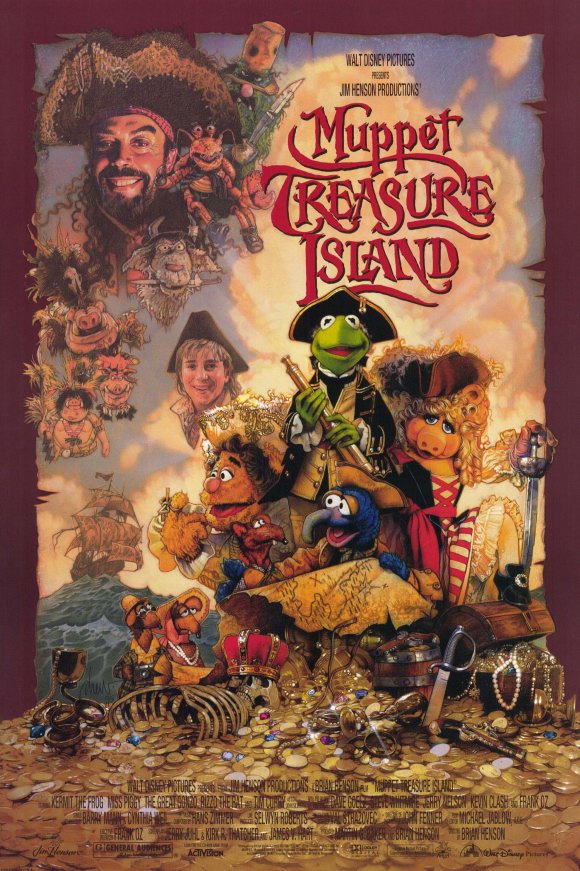
Back in the days when I was teaching intensive summer courses, I frequently used movie clips to help break up the three-to-four hour class sessions. I would find movies in which the Bible featured in what I’d call a minor supporting role—almost as a character—and would try to get the class to discuss it. One of the immediate observations is that such an exercise is starved for choice: the Bible appears frequently in films, both secular and religious. Sometimes its role is pivotal, at times incidental. Last night as my family prepared to return to work and school, we watched a movie to say goodbye to summer. The movie was Muppet Treasure Island.

Like most children of the 60’s I learned about Muppets from Sesame Street. By the time I was a teenager The Muppet Show had emerged on prime-time. Before long Muppets made their way onto the silver screen. Muppet Treasure Island was a movie I had missed until my daughter saw it in primary school. I have used it as an example in my summer classes for years. The story follows, as faithfully as Muppets can, Robert Louis Stevenson’s Treasure Island. Tim Curry—selected for Long John Silver because of his fame in the Rocky Horror Picture Show—makes a believable singing pirate. In this version of the story, when the pirates reach Captain Flint’s treasure it has been absconded by Benjamina Gunn (Miss Piggy). The pirates, now guilty of mutiny, give Long John the black spot. (For a generation raised and weaned on Pirates of the Caribbean, the black spot requires no explanation.) Long John, playing on the superstitious nature of the other pirates, sermonizes them because they used a page of the Bible to draw the black spot. Terrified of this sin, the pirates beg Long John for forgiveness.

This is a textbook example of the Bible acting as a magical book. Often in the movies it functions in that role; the Bible has the invisible authority to bring mortals to their knees. Pirates in need of paper might dismember any other book (I might suggest Going Rogue: An American Life), but the Bible is itself sacred. This particular role for the Bible reflects American sensibilities about the nature of religion particularly well. Without ever reading the Bible many people venerate it as if ink on paper is a little piece of God. There is a grain of truth in that, for literacy is a little piece of God and books do guide us. The problem is limiting that role to one single exemplar. Perhaps after all the Muppets shall guide us to a deeper truth.


Tea Party Science

I sometimes jog in the morning before the sun begins his course across the sky. Funny thing is, sometimes I beat him. I know the sun is a guy because the Bible says so. When I startle a bunny from its hiding place along my path, I am amazed that those little creatures chew the cud just like bovines. It is the word of God. Occasionally a suicidal insect tries to fly into my mouth, and unless they go about on all fours, with legs above their feet, I spit them back out. If they do meet Leviticus 11’s strict standards and I accidentally swallow, I try not to think of Deuteronomy 14.19. I am surprised that the Tea Partiers haven’t tried to correct science on this point: the Bible is clear that insects (technically “flying creeping things”) have four legs, not six. Open your eyes people! Six legs? All those sixes seem to be from the antichrist. That’s why I feel comfortable with the potential of handing our nation over to the Tea Party. Certainty is better than scientific orthodoxy, hands down.

“I don’t know how much God has to do to get the attention of the politicians. We’ve had an earthquake; we’ve had a hurricane. He said, ‘Are you going to start listening to me here?’” The words are those of Michele Bachmann. Those of us who were taught that hurricanes result from the heating of Atlantic waters, swirled by the rotation of the earth (it does not move, according to the only proven source of science, the Bible) have egg on our faces. Do I ever feel silly! Empirical evidence suggests that the earth’s crust consists of tectonic plates that sometimes bump and rub and pull apart. Earthquakes result. Last week’s earthquake creates a problem for me, however, since North America is not mentioned in the Bible. I now live in a country that can’t possibly exist. We had better elect leaders who know how all this really works.

According to a Religion News Service poll this year, 40 percent (that’s more than half, in Tea Party mathematics) of Americans believe natural disasters are signs from God. I am relieved that this clearly shows science to be wrong—surely that many individuals must be correct. That’s the way math works. I sometimes imagine the United States as the Titanic (movies are another good source of science). Ismay, the Tea Party, declares, “But this ship can’t sink!” Thomas Andrews, the engineer (representing science) replies, “She’s made of iron, sir! I assure you, she can… and she will. It is a mathematical certainty.” Ismay, believing the rich are too wealthy to die tragically, refutes the findings of science. When the colossal ship slips into the icy Atlantic, however, he’s nowhere on board. Like the rest of his party, he’s already secured himself one of the rare seats on the lifeboats inadequate to save those of us in steerage. Since the ship can’t sink anyway, why are we even worried about this?

Full speed ahead and damn the icebergs...


Tomorrow Ever After

Last night as we said goodnight to Irene, my family decided to watch The Day After Tomorrow. Beyond The Perfect Storm and Twister we didn’t have any other weather-related disaster movies on hand. I became convinced long ago that weather was somehow key in the conception of divinity. Working at a seminary that required attendance at chapel twice daily where we would lugubriously and laboriously recite every verse of every Psalm according to the unforgiving schedule of the Book of Common Prayer, I began to notice the weather. Among the more common images used in the “hymnal of the second temple,” weather was seen as an essential aspect of divinity. Religions with celestial orientations frequently view the sky with a sacred aura. I began to compile all the Psalm references to the weather and eventually brought them together into a book, still unpublished. What became clear at the end of this exercise was that ancient people had no way to interpret the weather other than as a divine phenomenon. Listening to all the hype about Irene, it still seems to be the case.

In The Day After Tomorrow, our ill-fated teenagers are trapped in the New York Public Library as a super-chilled tropospheric wind freezes New York City. They build a fire and when you’re in a library, naturally, you burn books. I kept looking at all the furniture they spared as they consigned the books to the flame. A minor character called Jeremy is shown clutching a Bible. A girl named Elsa asks if he thinks God will save him. Replying that he is an atheist, Jeremy says that this is a Gutenberg Bible, “This Bible is the first book ever printed. It represents the dawn of the Age of Reason. As far as I’m concerned, the written word is mankind’s greatest achievement. You can laugh, but if Western Civilization is finished I’m gonna save at least one little piece of it.” This little dialogue represents the full circle of the celestial god. Jeremy doesn’t believe in this god, and the Bible requires human protection. Instead of being the instrument of war and political badgering and tea parties, it is seen as a symbol of enlightenment. It represents the first steps toward reason.

As Hurricane Irene still gusts outside my window, dropping rain as if New Jersey were a desert receiving its first drink in a century, the Tea Party is busy crafting ways of getting the Bible back in the White House. Their Bible is the antithesis to the Age of Reason. It is the symbol of superstition and prejudice and authoritarianism. It is the means of political power. The god of the Tea Party is a white-bearded man living in the sky, sending his fury against the liberal cities of the East Coast in a mighty wind. He is the punishing god of the Psalms. As the helicopter lifts off over a frozen Manhattan, the teenagers saved by a flawed father who walked from Philadelphia to New York to find his son, the camera pans across Jeremy as he hugs the Bible to his chest. I was in Boston for Hurricane Gloria back in 1985. Watching the waves crash on the beach at Winthrop I felt the power of fierce nature at the beginning of my own journey to, I hope, enlightenment. When it was over, however, there was not yet a Tea Party threatening an even worse, unnatural disaster to follow.

Irene, the early days


No Sanctuary, No Renewal

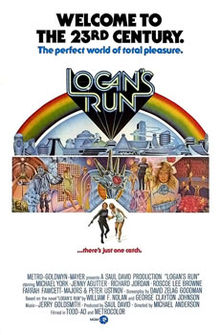
My penchant for dystopias won out over what many would suggest is good sense and I rewatched Logan’s Run for the first time since the 1970s this weekend. Dystopias, of course, are the antonyms to the religio-political utopias that seemed possible to dreamers of the Enlightenment. Since those optimistic times power structures in society have grown ossified and privilege has been entrapped in enclaves of excess wealth, both religious and secular. Seeing the film as a teenager I am certain I missed the savage social commentary in Logan’s Run. Despite its weaknesses, the movie still carries an unexpected punch, given subsequent developments. The premise, for those unfamiliar, is that in the twenty-third century life is ease and hedonism until you reach thirty. To control overpopulation those losing the bloom of youth are euthanized in a religious ceremony to be “renewed.” Logan discovers there is no renewal and, the mythology fractured beyond repair, begins his eponymous run.

In a society just beginning to come to the realization that population trends were leading toward the elderly outnumbering the young, film-makers and novelists were trying to predict where human nature might lead. Movies like Soylent Green, Rollerball, and even The Stepford Wives dealt with issues of potential population pressures. One thing they share in common: the prognosis isn’t positive. 1984 came and went, and savvy politicians learned that control may easily be blended with religious sensibilities. Hot-button issues that have little to do with government (defining marriage, deciding which gender has the right of self-determination, declaring biologists in default of creationist fantasies) easily deflect attention from the serious issues of ensuring a healthy economy and providing reasonable care for those who are actually now alive. Spending too much time gazing into the future can be counterproductive.

Logan heard rumors of a place called “sanctuary” where the aging are free from the draconian enforcements of society. He takes his lady (dystopias are nothing without a love interest) and flees to discover this idealistic place. There is no sanctuary. Outside the safe, hermetically sealed domes of society is a ruined civilization. It is a world full of possibilities, but practically devoid of people. Finding only one survivor, the only option is to convince the police state he fled that all of this is a lie. Religions too, often rely on offers of sanctuary. Some who believe may find it while others will not. Logan’s Run (now being remade) may not have been the most convincing dystopia, but in bringing ethic and myth together in a world of unheard suffering, it may have read the pulse of society better than several of its more fondly received exemplars.


Whatever Happened to Marshmallows?

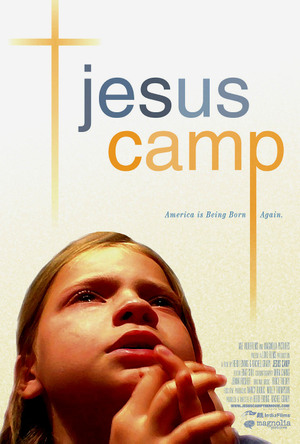
A rainy Sunday evening seemed like a good time to watch a scary movie. I had already viewed an exorcism movie or two over the last couple of days, so my wife and I decided to try something scarier: Jesus Camp. This 2006 documentary shows the workings of an evangelical, Pentecostal children’s camp run by Becky Fischer. By not skewing the evidence but by letting the organizers and children speak for themselves, a disturbing political agenda is revealed. Even more disturbing is the psychological scarring that accompanies such childhood indoctrination in a religion of fear. Fischer is obviously concerned with militant Islam, but her tactic of countering it with militant Christianity where children are soldiers (“this is war!” she shouts at one service) feels equally wrong. Part of the problem with such “Bible based” groups is that the Bible contains many contradictions and the Fundamentalists must pick and choose. For example, Rev. Fischer has chosen to disregard 1 Corinthians 14.34, stating that women should keep silent in the church. (I certainly do not advocate the literal application of that verse, nor of many others that made their way into a misogynous Bible.)

Utilizing the Bible only goes so far as a political tool. At the Kids on Fire camp the children are geared up to an emotionally intense state and lectured about the evils of abortion, evolution, belief in global warming, and Harry Potter. No mention is made that the Bible says nothing about abortion or evolution, and global warming had not yet become an issue. I can’t seem to recall Harry Potter being mentioned by name in the Bible, but other fictitious characters are from time to time. The Bible, having been written over a span of about a millennium, contains differing voices making statements for specific circumstances, and never intended to be used as political platforms. One gets the sense that “Bible believers” seldom read the Bible seriously themselves. Certain favorite passages are committed to memory and rehashed to death while others molder in dank corners of Fundamentalist basements.

What is lacking here is the long view. Once such groups win political power—they should be taken far more seriously in this arena—the religious freedom that will have launched them to that position will disappear. Like all human enterprises, however, it too will eventually crumble. Ted Haggard was spotlighted in the film, shot before his own hypocrisy came to light. At the camp George W. Bush is held up as a saint with Samuel Alito as his acolyte. The psychological manipulation and emotional abuse that the children trustingly accept is condemnation enough in itself. The camp was shut down after the film was released, but Becky Fischer, like Arnold Schwarzenegger has declared, “I’ll be back!” This is one Terminator I truly fear. Having watched a couple of exorcist movies over the weekend as well, I am left wondering which is scarier: demons that possess children or false prophets who do the same?


Parsing an Exorcism

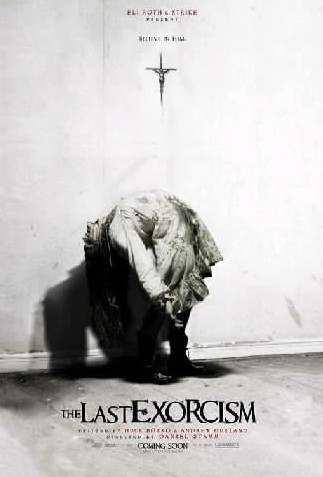
The latest in my spate of scary movie viewings is The Last Exorcism. The press when it was released last year made claims of extreme fright, but my impression was that I’d seen it all before. The “found footage” fantasy is difficult to maintain—although the camera work in the film is good—and the premise of demonic possession is frightening if the viewer is a believer. The hook for this movie, however, is that the exorcist himself doesn’t believe and becomes a victim of his own unbelief. The pattern overall follows The Exorcist, but without the creepy soundtrack and staged lighting effects, The Last Exorcism relies heavily on the viewer’s willingness to believe. The demonic possession is presented as extreme contortionism and self-destructive behavior, as well as the uncharacteristic violence by the victim. When Nell Sweetzer gives birth to a demonic child, a la Rosemary’s Baby, the role of good Christian gone occult feels a little hackneyed.

I’ve tried to analyze what scares so many people with movies of demonic possession. The core fears seem to come down to two: belief in the reality of demonic possession and the fear of being out of control. Historically the concept of possession was originally relegated to the gods with demon possession apparently arising as a pre-scientific attempt to explain epilepsy. The fact that most Christian denominations no longer recognize physical demon possession (a fact exploited by The Last Exorcism) makes it more frightening still. For a generation of media-saturated viewers convinced that cover-ups are common the credibility of the church, struggling with its own metaphorical demons, is suspect. Perhaps demons are out there—a common enough assertion on the reality show Ghost Hunters—and the church has lost control over them. When Jason and Grant explain what demons are, however, they are pretty far afield from Legion being cast into a herd of swine.

If the Internet is any kind of reliable measure of people’s fears, zombies and demons appear to be nearly on a level when it comes to belief. Both are supernatural and neither stretches credulity to the point of humans growing fangs or matted fur. Both participate in the idea that there is more to be feared beyond death. Both fail in the court of science. The Exorcism of Emily Rose raised the ambivalence of demonic possession to the level of the courtroom. One thing I learned on jury duty last week is that the truth is measured on the basis of the judgment of a quorum of rational individuals. The implications of this are frightening indeed: those who accept the reality of non-physical monsters (the jury is still out on ghosts) are fully capable, in a legal setting, of deciding the truth of the matter. The only corrective to witch-hunts and state-sponsored exorcisms would seem to be education. Today education comes via the media where zombies and demons freely roam.


Capricorn Too

While seeking the official Flat Earth Society website (don’t ask) I became aware of the fact that several such societies exist. Frequently used as a slur against Luddites and troglodytes alike, the Flat Earth Society would best be classified as a modern religion based on ancient paradigms. This is clear when considering the motivation of Samuel Birley Rowbotham, the erstwhile founder of the movement and author of Zetetic Astronomy. Rowbotham also published a broadside entitled “The Inconsistency of Modern Astronomy and its Opposition to the Scriptures!!” (c. 1850, exclamation points in the original). Those who still doubt the religious nature of the movement should consider that the full-text of Zetetic Astronomy is available on Sacred-Texts.com. The objection to non-geocentric astronomy, although now based on several factors, is religious in origin.

The clashing of worldviews is inevitable when empirical evidence comes into play. As early as the days of Pythagoras and Aristotle thinkers were questioning how physical reality fared against apparent reality. As animals who evolved to cope with apparent reality, the fact that the earth bolts around the sun at a dizzying speed is of little practical value to humans. Making that successful hunt, however, depends on the beneficence of the gods—incredibly important. In such scenarios religion wins out against science every time. The truth of actual existence is more fascinating but indescribably less rich than a mythological worldview. Instead of Dagan, Baal, Zeus, or Thor, we have static electricity. Sure, lightning still behaves in unpredictable ways, but there’s not a god out their hurling it towards sinners. Abstruse laws of fluid dynamics and the flow of electrons determine what is actually happening. Yet we flock to theaters to watch Thor.

While most educated religious believers seldom put too much credibility toward the biblical worldview, they often sense relief at having “flat earthers” to ridicule. Ironically, the stated goal of websites such as Sacred-Texts.com is to promote religious tolerance. For most modern believers, already under the gun of science, tolerance is understood to extend to religions like ours. Those that are outside: modern paganism, flat earth beliefs, ufo religions—such belief-structures deserve ridicule. Is such a mentality not indicative of a certain level of discomfort with “mainstream religions” as well? No matter how far Hubble peers, even to the ends of the universe, it spies no God. No matter how deeply geologists sound, no Hell is beneath our feet. We cannot easily let go of such concepts, no matter how pre-Enlightenment they may be. It may be a good exercise for modern-day people to occasionally read Zetetic Astronomy to remind ourselves that religion comes in all shapes and sizes.


Monsters Are Due on Elm Street

November 1984. George Orwell’s dark vision had not fully emerged, but the veneer had worn off of the fairy-tale world promoted by the evangelical, free-market professors at Grove City College. As a blue-collar kid in a blue-blood institution, I was out of place. The campus was buzzing, however, about a new movie—A Nightmare on Elm Street—for which I finally plucked up the courage to ask a cute coed for a date. I’d never seen a slasher movie before, having sampled mostly traditional monster-flick fare as a child. I felt a sense of accomplishment since some of my college friends had to leave the theater for fear. On the big screen, with no previous knowledge of the plot, the film worked for me on many levels. Last night I decided to watch it again.

My first reaction was a sense of surprise at how much of the movie I still recalled with pristine clarity. For having been nearly thirty years ago, such clarity is a rare phenomenon for many details of life, often reserved for memories of early girlfriends. A second reaction was noticing how religion featured in the film. The girls skipping rope chant, “One, two, Freddy’s coming for you / Three, four, better lock your door / Five, six, grab your crucifix.” Indeed, the crucifix features in several scenes as an ineffectual weapon against Freddie Krueger. The days of defying vampires are over when your own subconscious turns on you. In one of the early chase sequences, Freddie, raising his infamous glove, says, “This is God!” Religion and its overarching concerns with death and suffering come together with horror in that one moment. The traditional power structures of religion have lost their power to defend the troubled teenagers. The only one well adjusted is, ironically, Johnny Depp’s Glen. Even he falls victim to the revenge sought by Krueger.

Surprisingly, the scene I had most trouble recalling was the end. I recollected the bright, hazy sunshine, but couldn’t remember how Wes Craven released his audience from the drama. Of course, there is no end. Freddie came back in countless sequels, none of which I ever watched. Although I wouldn’t know it at the time, Robert Englund based the screen presence of Freddie on Klaus Kinski’s Nosferatu in Werner Herzog’s classic remake of that silent gem. Freddie is the vampire that defies religious cures. Movie villains are among the most adept practitioners of resurrection on the silver screen. The occasional E.T., Neo, or Spock will come back from the dead, but those who repeatedly return are the denizens of our nightmares. As Orwell’s vision continues to unfold in subtle ways, 1984 looks like an age of innocence before the ineffectual god worshipped by the establishment became self-image, writ large, on Elm Street.


Demo-God

Not having access to the news wires, I am generally scooped by CNN’s Belief Blog. Of course, blogs dealing with religion are a pretty cheap commodity these days, especially since, as I’ve mentioned before, everyone’s a self-proclaimed expert on the subject. So it appears appropriate that God’s approval rating was put to the polls. According to Public Policy Polling, God only enjoys a 52 percent approval rating. Only 9 percent of those surveyed dared give God a negative “disapprove,” but that still leaves a large middle ground where— to borrow a phrase—God is in the dock. The scenario where a democratic society expresses its opinion on leadership, both human and divine, makes me recall the movie The Mission. Fr. Gabriel has to remind Fielding at one point, “We [the church] are not a democracy.” Religion is handed down from on high and those who inherit it have no right to question.

Or do they? When I was growing up in the sixties one of the common social references in the media was the teenager (oh, what rebellion!) yelling at his parents, “I didn’t ask to be born!” In the current universe, however, that is where all religious believers find themselves. With the exception of the few who suppose themselves somehow self-generated, we all realize that we are subject to the whims of the creator. That, of course, does not prevent us from sharing our opinion on the issue. Fr. Gabriel is right: this is not a democracy. The stereotypical 1960s teenager is also right: we did not ask for this. No wonder the approval ratings for the divine have plummeted. It seems that the tenets so readily accepted in more submissive times have eroded. Is God about to retire? Step quietly from center stage?

What’s next for the Big Guy? Will he write his memoirs—wait, he’s already done that; what do you think the Bible is? Perhaps an unemployed creator would be interested in making another universe. The problem is that wherever consciousness exists, ideas will soon follow. Some ideas fit comfortably in the system: do as you’re told because I’m stronger than you, for example. When the expression of power as an inappropriate means of governance evolves, however, the voices of democracy will emerge. Maybe it is safer to schedule an apocalypse after all. Let’s just hope that God doesn’t take a page from the politicians’ handbook, otherwise nothing will ever really change.


Who Made Whom, Now?

John Lennon has great currency, in part, because he is a martyr. Music has moved on since the ‘60s and ‘70s, but aging Boomers still like to quote him, especially his song “Imagine.” In an article written for the Los Angeles Times, reprinted in the local Sunday newspaper, J. Anderson Thomson and Clare Aukofer cite “Imagine” as the statement of what a world “that makes sense” looks like. I applaud their idealism. Citing psychological and sociological work that has been done over the past decade in the attempt to unravel “homo religiosus” they entitle their article “God didn’t make man: man made gods.” Much of the evidence they cite has been discussed elsewhere on this blog, but the overarching issue—whether this explains human religious behavior or not—remains open. In other words, if evolution provided us with religion, it must have some survival benefit and humans are not easily going to dismiss it.

Admittedly, the evidence for human conceptions of God arising from the need for close connections in community is pretty convincing. Nevertheless, the issue of whether there is a God or not will never be answered by empirical observation. As I tell my students, belief is not based on empirical observation. We do not yet know why people believe, and even if we find the right node, neuron cluster, or sensory stimuli, there will always be those who insist that the hardware is sparked into action by the unseen Other outside the system. It is the classic chicken or egg debate, taking place in that henhouse in the sky. The problem is that God is more like the rooster in that scenario.

The human brain is an endless source of fascination. Science has given us a sense of wonder about our own on-board computer, but it has not managed to capture the sine qua non of the totality of the experience of owning one. Scientists also read, go to shows, make love and eat fine meals for the enjoyment of it all. But as Cipher says in The Matrix, “I know this steak doesn’t exist. I know that when I put it in my mouth, the matrix is telling my brain that it is juicy and delicious. After nine years, you know what I realize? Ignorance is bliss.” Our perception of the world as a stable, unmoving center of existence is an illusion. Science has revealed an even stranger reality involving equations that used to haunt my nightmares. Should God ultimately be reduced to formulae, true believers will find another entity to name as the divine. “Imagine… no religion too”? As long as humans are humans such a world remains pure imagination.

Imagine


Parry Hotter

With the final Harry Potter movie opening this weekend, it is clear that the brainchild of J. K. Rowling will live forever. When the books first started to gain popularity numerous Christian groups protested that children would be tempted into witchcraft by the appeal of the young protagonists. Ironically, standard Christian teaching denounces the power of witchcraft, although some groups do still acknowledge a very active devil. Now that the series has run its course–all the movie spin-offs of the novels are complete–many are coming to the realization that the message is profoundly ethical if not downright religious. As usual with knee-jerk protests, the message is missed for the medium, and those with fragile faith clamor for a spell of their own to put an end to opposition.

Joining the bandwagon late, I first started reading the Harry Potter books when the third or fourth volume had been published and public interest was riding high. I haven’t kept up with the movies, however, last watching Goblet of Fire at a theatre in Wisconsin while contemplating my own position at a school like Hogwarts, minus the magic. The books, however, convey the message more clearly–the power of evil is real, good is not always what it seems, and institutions can’t save you. The importance of love (the main thrust, many would contend, of the preaching of Jesus) is the driving force behind the story from the moment Lord Voldemort (the Darth Vader of the twenty-first century) failed to kill young Harry Potter. Perhaps the true concern that many religions have with Rowling’s work is that it has trumped the traditional mythology with a bit more style and panache.

As a regular Protestant Christian, Rowling expresses traditional beliefs in her writing. The fantasy of witchcraft, however, has always maintained a lure for those cut out of society’s pathway to wealth, recognition and ease. In the days before Christianity, the early Israelites believed the power to be real to the point of making witchcraft a capital offence. Of course, omnipotence had not yet been invented. Once a deity becomes all-powerful, why should fear remain concerning magic? More likely protests against Harry Potter had less to do with the witchcraft than with the insecurity that many believers feel about God. The plan doesn’t seem to be unfolding as the Pat Robertsons and Timothy LaHayes are saying it should. Doubt is a much more powerful force, it appears, than magic.


Deliverance from?

At times it seems strange that I missed so many formative movies when I was growing up, but then my wife pointed out that many of the films were released when we were minors. That, combined with the fact that most of them bore R ratings, acted as an effective deterrent at the time. So it was that we only saw Deliverance yesterday. References from friends, colleagues, and even The Simpsons made us feel like we’d missed a part of American culture that everyone else had seen. Of course we knew the basic story, but seeing it played out intact is a much more satisfying experience. Since I am scheduled to do a church talk on Christianity and the movies later this morning, I was interested in the way the church is portrayed in the movie.

After the three survivors make it back to civilization, the first building that meets them at the riverfront is a plain white “Church of Christ.” At the moment of their eponymous deliverance, the church is there. As Ed and Bobby are being driven to the hospital in a taxi, however, the church appears again. The valley is being flooded to bring hydroelectric power to Georgia, the reason the men set off to see the river in the first place. Since the town is shortly to be flooded, the church is being moved. The taxi driver tells the men, “We might have to wait a minute for the church to get out the way.” In the extras director John Boorman spoke about the highly symbolic nature of the film, including the way that the symbol of stability in the community, the religious establishment, could not hold its own ground.

I also sensed another element of irony here. The church had been, symbolically, in the way of the advancement of civilization. Paralleling this inhibition is the utter, and bewildering freedom from the law experienced by the men following the murder of the mountain man. The viewer is left to decide which is the worse fate. Now that I have seen the film, I think I can understand the depth of struggle it represents. As the continuing debate on the relative merits and demerits of religion in society rages on, there is always a very human aspect that stands beyond simple formulae. Perhaps we save religion in the hope that it will save us.