Spirits and Souls

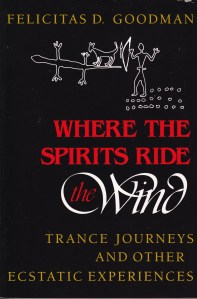
I first became aware of the work of Felicitas D. Goodman because of her classic text on spirit possession. Published by the reputable Indiana University Press, that book has become a standard for anthropological understanding of a strange phenomenon, which includes demonic possession. I found Where the Spirits Ride the Wind: Trance Journeys and Other Ecstatic Experiences in a used bookstore. Recognizing Goodman’s name, and always eager to learn about spirituality, I picked it up, It’s one of those books that makes you wonder. In an effort to experience trance states, Goodman began to experiment with various posture represented in the archaeological record. When she taught classes where students had no foreknowledge on the postures, she found they they reported similar visions during their trances while using the same posture. Matter, it seems, can effect mind.

I couldn’t help but wonder, as I read her account, what Indiana University Press must have thought about what they were publishing. This could be some serious woo, depending on how far you’re willing to go with Goodman. She was a doctorate-holding professor, so academic convention suggests she should be taken seriously. The BISAC classifications (those categories that often appear on the back cover of a book) tell the reader that this is Anthropology and Psychology of Religion. Neither field tends to give a whole lot of credence to the supernatural. At least not necessarily. And yet, there it is. Neither field really captures what Goodman describes in this book. Nobody really doubts that trances can happen; alternate states of consciousness are acknowledged phenomena. What we don’t have, however, is an explanation of what’s really going on.

A good deal of the this book consists of her students’ accounts of their visions. Although a native of Hungary, Goodman, through fieldwork and experience, became quite adept at Native American and other indigenous religious practices. The images that suggested the postures to her come from archaeological contexts around the world. This suggests that, according to Goodman’s worldview, these are some universal experiences. Attaining trance states, like meditation, takes practice. They can shift perceptions of reality. We tend not to hear too much about religion faculty who explore such things too openly. It’s a dangerous move in academia. Ironically, the institutions we build to understand our world tend to restrict themselves to the physical world or those fields that make ample lucre. I’m impressed that, even if by labeling it anthropology or psychology of religion, at least one university press took a chance at offering an exploration that might have some real world consequences.

Zounds Like

Liberation from the confines of academia allows for the occasional indulgence in taboo subjects. I can’t remember when I first heard of stigmata. I didn’t grow up Catholic, and, like many Protestants, distrusted much of what came from Rome. Still, I was interested in the supernatural. When I learned that people in this modern day and age sometimes developed unexplained wounds corresponding to crucifixion, I was intrigued. Ted Harrison’s book, Stigmata: A Medieval Mystery in a Modern Age, is the first I’ve actually read on the subject. It has some fascinating observations to share. It was some time after seminary that I learned that Francis of Assisi (aka St. Francis) was the first stigmatic. I had admired Francis for turning down wealth to assist the poor and commune with nature—what’s not to like?—but I didn’t realize that he had initiated this rare, but real phenomenon.

Harrison considers the question of why it was only in the 13th century that the stigmata began to occur. They have occurred ever since, in very small numbers, primarily in Italy and primarily among women. But why then? He points out that the church, shortly before this time, began to emphasize the physical suffering of Jesus on the cross. We’re probably all familiar with some of the gruesome images that emerged from the church and its artists at that time. As such images proliferated, people were given a visual focus that directed their devotions. Every great once in a while, this led to stigmata. Why women? As Harrison points out, men with intense spiritual needs could become priests. Women could not. The church would not forbid personal devotion, and if such devotion led to stigmata, well, a person arguably had a direct line to the divine. That was something normally preserved for priests through the Eucharist.

Stigmata have to be understood in the context of mysticism. The more recent cases studied by Harrison include some non-Catholics and some other unexpected candidates for what is, after all, a very intense spiritual experience. What emerges is a thoughtful, one might dare say contemplative, approach to the issue. Some stigmata have been self-inflicted. Some have not. Medical personnel have witnessed and examined these improbable wounds and have not explained them away. Once, during a faculty meeting at the New College of Edinburgh University (I was post-graduate student representative) one faculty member groused after one of my advisors had presented a challenging idea: “you’ve dropped us in a mythological world. I want to get us out.” There it is in a nutshell. Some people can live in a world where stigmata occur. Others have to explain it away. The difference is all in the matter of perspective.


Night and Day

Jim was aghast. The joke had been entirely inappropriate. I had asked him about the Pentecostal service we’d just left. Jim was my college roommate and had invited me to see what his tradition was all about. I’d witnessed speaking in tongues before, but never on such a scale. That wasn’t what was bothering Jim, though. The minister had told a joke about a demon. It had something to do with a man possessed by a coffee demon. The exorcist declared to the demon “You have no grounds to be in him!” Inappropriate. It might make people think there weren’t real demons. We used to disagree on many points, but remained friends. I lost track of Jim. He dropped out of college to go follow a spirit-filled man in Waco who’d learned Hebrew and Greek without ever having studied them. His concern about that joke, however, raises an interesting question.

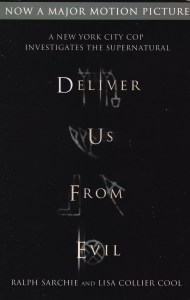
I’ve just finished reading Ralph Sarchie and Lisa Collier Cool’s book, Deliver Us from Evil: A New York Cop Investigates the Supernatural. It’s hard not to like Sarchie. A rough and tumble associate of Ed and Lorraine Warren, he is most sincere law enforcement officer (now, at my age, retired). Openly believing in the supernatural, claiming his traditionalist Catholic faith, he hates demons for the misery they cause both humans and God. I admire such unquestioning faith. At the same time he’s clearly aware of his own foibles and weaknesses—something we might like to see more often in the police force. He doesn’t doubt, however, that demons are real. The concern, however, is that he might sometimes be a bit harsh on non-Christian religions. He admits that he’s not the most studious of demonologists.

No doubt, belief is important. Belief with knowledge is even better, it stands to reason. Problem is, academic or scientific studies on demons are sorely lacking. Sarchie was an associate of the controversial Malachi Martin (whose book Hostage to the Devil I blogged about some time ago). I feel for someone who wants to know more but runs into the limits imposed by academia. Where do you find information if the recognized specialists in a discipline don’t write about it so regular people can read it? It is a real dilemma. A scientific approach would declare the events in Deliver Us from Evil (also published as Beware the Night, before being released as a movie) are anecdotal. This is technically correct. No laboratory procedure exists to confirm something science denies exists in the first place. The only weapon against such a foe is faith. Thinking back to college, I don’t know what happened to Jim, but on this point I’m sure he would have agreed.


Twist of Lime

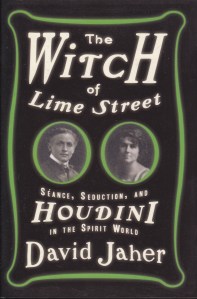
witchoflimeOctober enters as a liminal month. A few remaining hours of lingering summer but more shortening days of winter’s encroaching wolf. A time of harvest and celebration. Lengthening nights bearing strange noises. It was a couple of Octobers ago that I noticed The Witch of Lime Street either on Amazon or some bookstore shelf. I knew I’d read it this time of year, but I had to find the time to appreciate it appropriately. David Jaher’s debut book, subtitled Séance, Seduction, and Houdini in the Spirit World, spins a story appropriate to this time of year. The story of Mina Crandon, aka Margery, is as misty as the ghost she apparently conjured during the roaring ‘20s. The story is all the more remarkable in that the medium who’d attracted so much attention has been all but forgotten now that mediums and psychics tout their wares “for entertainment purposes only.” No one wants a fraud misdemeanor on his or her record, just in case.

Margery emerged during a contest set up by Scientific American that offered $2500 for any medium whose effects could not be explained by science. A board of experts, including Harry Houdini, was established and the contestants tried their best. Unlike most mediums Margery was from a secure household, being the wife of a surgeon. In other words, she didn’t need the money. Some of the feats she performed, according to the records scoured by Jaher, are truly amazing. So amazing that she had nearly convinced the prize committee that she deserved the prize. Houdini, however, led the opposition. During the course of all this she had, at points, convinced Harvard faculty that she was genuine, and submitted herself to controlled conditions. Some very intelligent men, including Sir Arthur Conan Doyle, believed she was authentic. Never actually caught in trickery, evidence suggests that she faked some manifestations, but many educated observers nevertheless believed in her powers.

This engaging account has as many twists and turns as a corn maze, and features several prominent players. Houdini and Doyle clearly top the charts, but for those who’ve read about the history of parapsychology there will be some familiar names throughout. The one who is least known is Margery herself. Being an historian, Jaher can’t proclaim his own verdict on the medium’s claims. His account, however, is even and provocative. Based on the many records that were available on the subject before seances became artifacts of a more gullible age, this book will leave you scratching your head. Then, you may wonder, were those my fingers or those of someone else doing the scratching?


Spirit of Equality

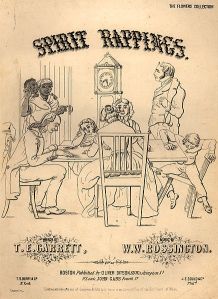
A few weekends back I watched the new Ghostbusters in the theater. Since tuition bills loom larger than life, it takes a powerful draw to get me to spend the money to see a movie in its natural setting. As my regular readers know, I loved it. Critics have tended to, well, criticize the movie, largely for its main drawing feature—the female leads. A thoughtful piece in by Colin Dickey in New Republic points out some of the unusual dynamics at play here. Looking at the history of Spiritualism as the basis for the modern interest in ghosts, Dickey suggests that women have been involved in the long-term fascination with the dead from the beginning. Their motive, however, was generally communication. Women wanted to relate with ghosts to make a connection. The original Ghostbusters movie represented a male, rationalistic approach to ghosts. As Dickey points out, instead of communicating, the men hunt and trap rather than trance and rap.

436px-Spirit_rappings_coverpage_to_sheet_music_1853

Ghostbusters, in all three cinematic presentations, is for laughs. Sometimes classified as supernatural comedy, the film is meant as humor while, admittedly, leaving the door creaking open for some serious thought about the implications. In a reductionistic world there’s no room for ghosts. It’s not possible to say, scientifically, what they might be. From the perspective of traditional belief, however, ghosts are the lost spirits of the departed. Traditional Christian theology places the dead squarely in Heaven or Hell, and they shouldn’t be wandering around down here. That hasn’t stopped people from reporting ghosts. They’ve been recorded almost as long as there has been writing. Today “Ghosthunters,” arms defiantly crossed, use “science” to try to prove the entities exist. This is lightyears from the traditional seance. A ghost under a microscope isn’t very scary.

One of the reasons I found the new Ghostbusters so compelling is that it managed to tiptoe that line between science and spirit that is so rare in the real world. The women, downgraded though they are in the story, are academics. They know, and experience, the dangers of taking haunting seriously. The movie is seriously funny. Like most truly funny efforts, there is a great deal of truth hidden in the humor. Dan Aykroyd’s cameo is one of the scenes that plays on its own loop in my head. “I ain’t afraid of no ghosts,” he says before he drives off toward Downtown. Women, in the film, have a healthy respect for the departed. Not exactly afraid, but not exactly unafraid, they handle ghosts as persons. This may be one of the points Dickey is making in his article. To understand a human one must be human. Spiritualist or Ghostbuster, women have always been superior guides to what is truly important. If only men could learn to listen.


New World Witches

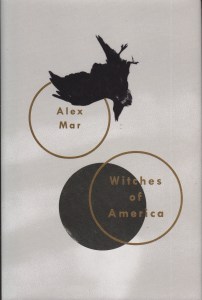
MarWitchOne of the most coveted phenomena in the publishing world is the bad review. Controversy sells a book like nothing else. It wasn’t because of the controversy, however, that I read Alex Mar’s Witches of America. Looking back, I wasn’t even sure of what to expect. Witches can mean many things and there is little one can do, beyond reading the blurbs and summaries (and who has time for that?) to know beforehand what a book’s really about. I like books about witches, so I just read it. I soon found myself engrossed in a spiritual memoir. Perhaps even more than books on witches, I’m drawn to women’s experience of religion. Many such accounts have haunted me over the years, but Mar’s story was different than most I’ve read. Women often write of escaping intolerant, priapic religions of a conservative stripe. Mar may be the first account I’ve read of a spiritual seeking becoming part of modern paganism.

The negative reviews largely focus on what they perceive as a false bill of goods. A woman passing herself off as an authentic seeker just to write a book that violates confidences. As a writer, and as someone who knows authors, I was a little taken aback at this. Those who know writers know they’re disruptive personalities. They look at things differently than most other people do. More than that, their experiences are subjective and must be explained in that vein. Some reviewers claim Mar was just wanting to write a book. Writers know that books write the authors. Spiritual experience is notoriously difficult to capture in words. I’ve read plenty of books about modern witchcraft, including the balanced, academic titles everyone commends. Mar was able, however, to explain the lure far better by taking a personal approach.

There are inherent dangers to sharing your innermost experiences. Other people are involved and honest perceptions will sometimes hurt. A writer finds it difficult to hold back. Spiritual experiences are something complex, multilayered, and scandalous. Often I was told, as an undergraduate at a conservative Christian college, that mystical experiences were to be avoided. They are powerful, frightening, and addictive. I can’t say if Mar violated any confidences, but it seems to me that the portraits she paints of witches are complimentary, and generally feel heartfelt. Then again, Christianity has been analyzed seven ways to Sunday, so it may feel like violation if a religion is still largely secretive. Were it not for the negative reviews, I would’ve never guessed that I’d read anything more shocking than the spiritual memoir that offers other ways of looking at what we think we already know. Oh, and did I mention the book was about witches?


High Castle Blade Runner

DivineMadnessGrowing up evangelical, one of the popular topics of conversation was crypto-christians. (My spellcheck insists that this is a lowercase expression.) Crypto-christians are people, generally famous people, who might be secretly “Christian.” You see, despite stereotypes most evangelicals really do want people to go to heaven. In fact, they tend to be obsessed with it. And besides, it can’t hurt to have a celeb backing your claims. One name that never came up in my circles was Philip K. Dick. I grew up reading science fiction. My reading patterns (which haven’t changed much) involved reading what I could find among used books at Goodwill. We were poor, and besides, there were no bookstores in our town. Like many people, I’m sure, I learned of Dick by watching Blade Runner. I occasionally heard others discussing the movie, but I hadn’t seen it myself and thus continued blithely unaware until I began teaching. I then read how Blade Runner is a possible Christian analogy, and curious, I read Do Androids Dream of Electric Sheep?

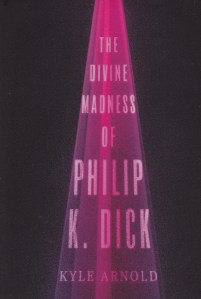
Since then Dick, who never made it big in his lifetime, has become a staple of the sci-fi diet. In The Divine Madness of Philip K. Dick Kyle Arnold explores the now famous 2-3-74 episode. Dick, in addition to being over-medicated, had mystical experiences. The “big one” took place beginning on the date implied in its title. This vision, while not orthodox by any standard, is clearly religious. Critics tend to think that Dick may have either faked it or that he underwent some kind of schizophrenic episode. Arnold, a clinical psychologist, has the chops to demonstrate that these latter explanations are off base. Dick had a legitimate visionary experience—something even neuroscientists can’t access because the experience is subjective and personal. It had a large impact on his life, but it did not make him mentally ill.

Arnold is not, as far as I can tell, a crypto-christian hunter. He is a psychologist attempting to understand a most complex and tormented writer of superior science fiction. What becomes clear, however, is that Dick was well-informed about Christianity. He imagined himself a secretive first-century Christian in an oppressive Roman Empire. This aspect of his life tends not to emerge in pop culture discussions—how Christian can you be and still be cool? Certainly Dick was not a conventional believer, but religious imagery and even actions became some of the most important moments of his life, according to his own recollections. Philip K. Dick was clearly a haunted man. And one of the specters haunting him was an often undiagnosed religion.


Strange Chemistry

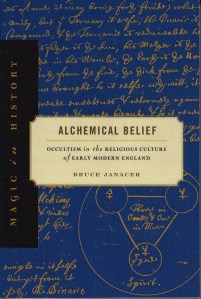
AlchemicalBeliefOne of the many antiquated beliefs that have been left behind over the centuries is alchemy. Today we tend to think that anyone who supposed natural substances could have been transmuted into others must have been naïve at best, or credulous at least. Bruce Janacek’s Alchemical Belief: Occultism in the Religious Culture of Early Modern England sheds light on the wider worldview of the alchemists. Some of them, anyway. Firstly, it is quite clear that many adepts of alchemy were very intelligent people. We easily forget that in addition to rewriting the laws of physics, Sir Isaac Newton practiced alchemy throughout his adult life. There’s something incredibly beguiling about the idea of an underlying unity of materials. Today atomic theory has answered that unity, perhaps a little too well. And that bring up the second important insight in Jancek’s book: alchemists often had an ulterior motive.

Early modern alchemists (think of those emerging from the wake of the Reformation, and you won’t be far wrong) often had a religious motivation for their work. Alchemy isn’t just turning base metals into gold—that’s just its most spectacular claim. Janacek points out that several alchemists were also attempting to prove the legitimacy of Christian theology through their explorations. Concepts as strange as the Trinity, or even the divisions of Christianity itself that were happening in the shadow of Luther, indicated to ordered minds that theological truth must be a unity. That unity, once found in alchemy, would naturally apply to the world of the church. The church, after all, can’t defy the very laws of the universe, can it? These early scientists accepted that there might also be a mystical element involved. Some rejected that aspect, but felt that the basic ideas of alchemy itself were sound.

Like dinosaurs, alchemy pretty much went extinct with the onset of the empirical method. Also like dinosaurs, it survived into the new age, transmuted in form. Alchemy was one of the ancestors of that bane of college students everywhere: chemistry. We tend to forget that astrology laid the groundwork for astronomy and creation (not quite an “ism” in those days) led to the study of biology. Religious ideas underlie much of what led to modern science. Religion, after all, indulges the curiosity of humankind. We are allowed (in the best instances) to let our minds range where they will. Later on theology, or some such device, will rein them in, but until such a time the psyche is free to explore. And build systems. And offer explanations. The alchemy comes when all of this is taken from the hands of natural philosophers and put into the laboratory only. And the rest of us await pronouncements from above of what might be real, or not.


Holy Haunted Book

Religion is one of those words that defies easy definition. As I’ve suggested before, you know it when you see it, but trying to pin the idea down is a different matter. Consequently, religion is closely related to a number of other areas of interest: philosophy, ethics, monsters, and the paranormal, to name a few. I was interested, therefore to see a blog post recently concerning a “haunted Bible.” Call me naive, but the thought had never occurred to me before: could a holy book be haunted? Churches are notorious for housing ghosts, of course. As someone who’s spent overnight retreats in churches I can vouch for the fact that a sanctuary after dark is a naturally eerie place. I’ve never seen a ghost in a church, however, and I’m not entirely convinced they exist, and if they do, what they might be. In any case, a haunted Bible is a different story.

David Weatherly is a fairly well-known paranormal writer. My web search brought up his blog where he explains that the haunted Bible was for sale on eBay with an asking price of $180,000. The owner, who remains anonymous, claimed to take no responsibility for any damage the supernatural scripture might cause. Instead of thinking that we have here a genuine haunted leather scripture, I know it can be nothing other than a genuine hoax (not on Weatherly’s part). Realtors know well that a haunting can, in today’s climate, counterintuitively drive the price of a house up. With people hungry for some element of the supernatural in their lives, and ghost hunters of all sorts on their televisions, they are willing to shell out a few more dollars to have a spirit around. And since ghosts can’t sign contracts, there’s no guarantee that they’ll be there once you move in. The supernatural can, it turns out, be the perfect scam.

If items can be haunted, I suppose a Bible might as well. When an owner, however, turns down an offer of 50,000 pounds that odor you’re smelling is that of a rat. I love old books. I have a few around that have more than a century’s weight on them. Looking at used bookstores longingly, I see first editions of Poe or Shakespeare that sell for far less than the asking price of the most printed book in the western world. Bibles, if you know where to look, can be had for free. I’ve got at least a dozen of them myself. Nothing makes fakery quite so clear as greed. No wonder the haunted Bible was such a disconnect. There’s nothing paranormal about love of money. That’s all too normal for anyone who tries to sell a Bible for implied spirituality.

IMG_1235


Holy Seer

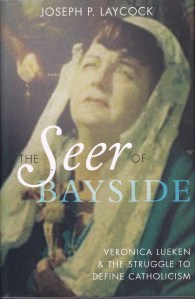
SeerOfBaysideHands up, all who’ve heard of Veronica Lueken. Maybe one of you in the back? I have to confess to having been in the “Veronica who?” crowd until reading Joseph P. Laycock’s The Seer of Bayside. The subtitle would have made the difference: Veronica Lueken and the Struggle to Define Catholicism. It’s a fascinating story. Lueken, a Catholic laywoman in Bayside, Queens, began to have visions of the Virgin Mary. This was in the days of Vatican II. Lueken was a traditionalist who felt the reforms were misguided, and found Mary to be on her side. She grew a large following during her outdoor vigils, eventually becoming so popular that people bussed down from Canada and in from other states to join her. The neighborhood association complained, and, some say, planned to assassinate the seer. The movement, known as Baysiders, eventually moved their vigils to Flushing Meadows Corona Park, where it—or they—continue to meet.

Critics of religion tend to claim believers credulous. The Catholic Church, however, has been notably reluctant to approve of Marian apparitions. Lueken’s visions and her movement were condemned by the authorities, but now, even two decades after her death, two groups of her followers continue to meet. I’ve read quite a bit about Marian apparitions over the past couple of years. As Laycock points out, Marian apparitions are frequently classed with the paranormal since anomalous events often accompany them. It is no different with Baysiders. They claim healings and other unexplained events associated with their devotions, including mysterious lights on Polaroid photographs taken during services.

How are rational people, especially non-Catholics to make sense of this? Obviously one can say that the thousands who’ve claimed to witness such miracles throughout history were simply mistaken. Or deceived. Or one could suggest that there may be more to this old world than we’re generally willing to admit. Laycock takes his book in a different direction by asking the salient question of who gets to decide who Catholicism is. Protestants have no single center like the Holy See, and fractions do what fractions do. They divide. Hierarchy hath its privileges, of course. Rome declares the Baysiders in error. Each side, as is to be expected with religions, claims that it is correct. It seems that only Mary knows the real answer.


Seekers

We live not far from an upscale mall. This mall, although over 30 miles from Manhattan, has its own bus line dedicated to it by New Jersey Transit. There is a route that runs throughout the day from the City to this mall and back. My readers know I’m hardly an uptown type. Nevertheless, an occasional trip to the mall can be a learning experience. On a cold weekend where outdoor activities felt unnecessarily ascetic we went to stroll around to see what was new. In the midst of the usual stores I never visit, there was one that had the temporary feel of an exploratory venture in high rent retail. It was, for lack of an appropriate adjective, a “New Age” store, featuring figurines from eastern religions, incense, dragons, and the aesthetic of the hippie mystique. Wandering about, I couldn’t help but notice how much of the merchandise, in one way or another, was religious in orientation.

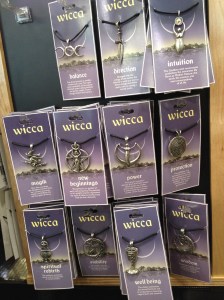
Those of us from the western hemisphere find the quotidian aspects of Hinduism and Buddhism exotic. Otherworldly, even. In our sterile offices, we dare not burn incense. Fabrics this colorful are not worn to work. It was as if the only place true color exists is in that mystical world that religions acknowledge, but businesses deny. Yes, it was a Saturday, but nevertheless the number of patrons surprised me. The town in which the mall sits is quite affluent. We live far enough from the City that some very serious money resides at no great distance. Patrons tend to have enough, and considerable surplus. And here they are, in a store selling that is undifferentiated spirituality. A stand of silver jewelry was explicitly marked Wicca. There were even Christian figurines among the crystals.

IMG_2672

People, even (or perhaps especially) the wealthy, desire more than the dollar can bring. We’re authoritatively told that we are meat computers. Mere automatons to the forces of physics. Our human experience tells us otherwise. We are meaning-seeking creatures. There are people who will willingly sit for three hours on a bus just to reach this mall. Whether it is a hippie-friendly shop, or the latest fashion trends that draw them here, they have this in common: they’re seeking something. I glance around and spy a mirror. I came here looking for a place out of the cold, but I have discovered an unexpected insight. If we make our own, or purchase it prefabricated, we venture to our secular cathedrals to find a kind of salvation.


To Nature, and Beyond

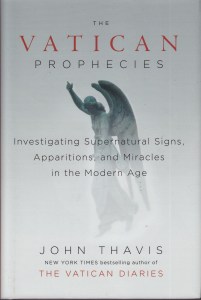
VaticanProphIt might seem odd to differentiate the supernatural from an established world religion like Roman Catholicism. After all, be premise of traditional Christianity is based on a miracle or two. Church officials, however, are not naive. It has been known from the early centuries of the church that although miracles are still from time-to-time proclaimed, they are a relative rarity. Few are claimed, like Jesus of Nazareth, to have the ability to summon the supernatural at will. When my wife gave me a copy of John Thavis’s The Vatican Prophecies, I wondered if this might be a sensationalist exploration of “the hidden Vatican” and its penchant for keeping things hushed. After all, the subtitle is Investigating Supernatural Signs, Apparitions, and Miracles in the Modern Age. Thavis, however, is one of the most even-handed writers on the topic I might imagine. Clearly respectful of the Catholic faith, he doesn’t go after any pet theories or conspiracies. He lets those in the church answer with their own words. And those words paint a fascinating picture.

Beginning with the concept of holiness, Thavis shows that the point of the spiritual life is not to seek signs. Nevertheless, signs are reported. Apparitions of Mary have a long history, as does the shroud of Turin. Those who write about such things often have a clear bias, but Thavis gives the facts, interviews those who know, and offers a narrative full of possibilities. The supernatural can take a darker turn, however, as his chapter on demons and angels demonstrates. Although demons have been cast into the outer darkness by science, it doesn’t prevent people from apparently being possessed. And of course miracles come under scrutiny, particularly in the context of making saints. Prophecy, in the sense of knowing the future, is the last major topic up for discussion.

The Vatican Prophecies is a curious book that seems neither credulous or overly skeptical. It’s more like reporting than it is declaring what is or isn’t possible. Yes, the Roman Catholic Church does still profess miracles, but a vast number of them that come up for testing fail. Scientists serve as expert witnesses and personal claims are not sufficient to win the day. Although there are a few characters in this account, the majority of those mentioned in the book are understated, thoughtful individuals who happen to know they can’t decide what really happens or not. Instead, they simply deal with it. For those of use who live in a world of uncertainty, this book is a most apt introduction to topics taken seriously by some very intelligent people.


Seeing Things

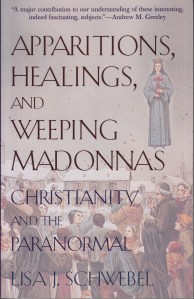
SchwebelWe have to learn to see the world. Traditionally religion and science both had roles to play, but as science grew better at explaining physical causes, many consigned religion to mere superstition. In such a paradigmatic world, Lisa J. Schwebel’s Apparitions, Healings, and Weeping Madonnas is something of an anomaly. Schwebel begins by noting that the Catholic Church has long accepted the reality of psi. As the branch of Christianity with the strongest commitment to furthering science, this itself might seem unusual. We are taught to see the world in a binary way: either this or that, not both. Books such as this challenge that convention, asking us to look at a world that doesn’t always conform to expectations. Parapsychology has made inroads from superstition to science because of testable hypotheses and statistically significant results. What it might mean is up for grabs.

Some claim that Catholicism is credulous. Actually, as Schwebel adequately demonstrates, criteria for declaring even spectacular events as miracles are amazingly high. Merely paranormal events seem common in comparison. In many ways, this is a disorienting book: the supernatural is assumed to exist, but miracles are treated as less common than the everyday supernatural. Those of us raised in a rationalist scholarly world might find the acceptance of that which we’ve learned is impossible just a bit unexpected. No doubt, visions of Mary are reported. Crowds often visit trees or highway underpasses where pareidolia impresses an image on the faithful. Schwebel, however, is discussing visions of another sort, and finds that they may involve the power of suggestion rather than the miraculous.

Faith healing, on the other hand, is something for which empirical evidence exists. Doctors still disagree about whether prayer speeds healing, but there have been many instances of unexpected healings that have occurred, apparently in relation to a person noted for bringing wellness about. Causality, of course, can’t be proven, but many people find themselves believing in a spiritual world after such an encounter. Perhaps that is what is so intriguing about books like this; they make readers uncomfortable in a world that is purely material. Finding a credentialed author who actually believes and has evidence to back her up is a rarity. Challenging conventions is part of the territory in most religions. Schwebel is simply straightforward about it.


Naming Evil

WetikoBooks don’t tell us what is true; books tell us what could be true. When I was growing up, under the influence of the Bible, I thought that non-fiction books were the truth. I came to understand that people disagreed about the truth, but it took a long time before I realized that books were merely the attempts of their writers to argue their version of the truth. If someone knew the actual truth that person would be a god. These thoughts came to me as I read the fascinating and mystical Dispelling Wetiko: Breaking the Curse of Evil, by Paul Levy. In many ways this is a mind-altering book. For one thing, Levy has made me reconsider how real evil is. Looking at what’s going on in the world it is increasingly difficult to deny the reality of objective evil. Levy’s book gives it a name and even attempts to analyze whence it comes. He calls it “wetiko.”

For several years now I have tried to find information on the monster known as the wendigo. Wetiko is a version of the same word, and it was this that drew me to Levy’s book. The wendigo is a shape-shifting creature that preys on humans. It is mentioned or featured in a few fictional books, and most recently featured in an episode of Sleepy Hollow. Since most academics don’t treat monsters seriously, it is difficult to find accounts of the beast. It is often discussed as a fictionalized version of cannibalism. It is a monster always hungry. The more it eats, the hungrier it becomes. It is this aspect that leads Levy to use it as his main metaphor for evil.

The evil that Dispelling Wetiko focuses on is the extreme selfishness our society has come to embrace. For example, our entire economic system is a fiction propagated by the ultra-wealthy. By defining a fiction as valuable and making it available to everyone else by a system of debt, the one-percenters keep everyone else, literally, in thrall to them. There is no gold to back up the fictional value they claim they have, and yet they consume others constantly in their evil greed. In a nuanced argument Levy suggests that this evil is real. Becoming conscious is the only way to combat it. There’s so much going on in this book that it has to be read several times, I’m sure, to get it all figured out. As I finished this one, however, I thought I had read a book that may actually be true.


Private Miracles

Despite rumors to the contrary, the Roman Catholic Church is skeptical of miracles. Quick to point out pareidolia where it occurs, looking like the Blessed Virgin in a tree stump or highway underpass, this is no credulous organization. Everyday miracles, doctrinal ones, of course are accepted. Transubstantiation is a quotidian miracle as the mass is no mere ritual. Flashier miracles—even some very impressive ones—are treated with suspicion and the rigor of Scotland Yard. When one of my regular readers pointed out the bleeding communion host in Kearns, Utah, I knew I had to check it out. As is to be expected in such cases, the Catholic Church does not disappoint. Some are calling it a miracle, but those who are do not speak for the Diocese.

Keeping in mind that my source for the story is Fox (Fox news seems more interested than most in this incident), apparently what happened is that a parishioner returned a host to the priest during communion. The priest put the host in a glass of water to dissolve it, but instead it began to “bleed.” Church officials were called in to investigate. There are several things odd here, although I’m no inquisitor, that make me wonder about the veracity of the story. First: Fox news. There are other outlets as well, so I’ll let that go at the moment. When a person was given a wafer at Nashotah House and for whatever reason turned it back in, the celebrant simply ate it. Priests, by definition believers in miracles, need not worry about germs. Protecting the host from desecration was the main thing. Putting it in a glass of water? I suppose that’s acceptable in some places, but even an Episcopalian would be shocked. And why was the host returned? Surely it wasn’t defective.

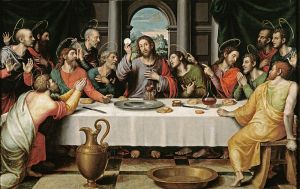
The Eucharist is the central rite of the liturgical churches, and it isn’t taken lightly. Although it is a miracle-laced event, it is expected that the transformation will follow the prescribed rite. I sometimes ponder what priests would do in the face of a genuine, unexplainable wonder. The side of the believer that yearns for validation would surely want to put it on Fox news for all the world to see. The private side would want to let it happen without any need to say anything about it. Keep it a private miracle. In a year when Starbucks red is a sign of an impending war, I wonder if a bleeding host is the most apt way to get the attention of the unfaithful when a simple cup of coffee will do.

800px-Última_Cena_-_Juan_de_Juanes