Holy Seer

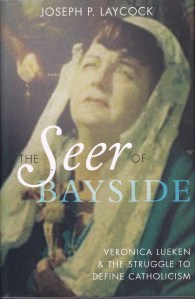
SeerOfBaysideHands up, all who’ve heard of Veronica Lueken. Maybe one of you in the back? I have to confess to having been in the “Veronica who?” crowd until reading Joseph P. Laycock’s The Seer of Bayside. The subtitle would have made the difference: Veronica Lueken and the Struggle to Define Catholicism. It’s a fascinating story. Lueken, a Catholic laywoman in Bayside, Queens, began to have visions of the Virgin Mary. This was in the days of Vatican II. Lueken was a traditionalist who felt the reforms were misguided, and found Mary to be on her side. She grew a large following during her outdoor vigils, eventually becoming so popular that people bussed down from Canada and in from other states to join her. The neighborhood association complained, and, some say, planned to assassinate the seer. The movement, known as Baysiders, eventually moved their vigils to Flushing Meadows Corona Park, where it—or they—continue to meet.

Critics of religion tend to claim believers credulous. The Catholic Church, however, has been notably reluctant to approve of Marian apparitions. Lueken’s visions and her movement were condemned by the authorities, but now, even two decades after her death, two groups of her followers continue to meet. I’ve read quite a bit about Marian apparitions over the past couple of years. As Laycock points out, Marian apparitions are frequently classed with the paranormal since anomalous events often accompany them. It is no different with Baysiders. They claim healings and other unexplained events associated with their devotions, including mysterious lights on Polaroid photographs taken during services.

How are rational people, especially non-Catholics to make sense of this? Obviously one can say that the thousands who’ve claimed to witness such miracles throughout history were simply mistaken. Or deceived. Or one could suggest that there may be more to this old world than we’re generally willing to admit. Laycock takes his book in a different direction by asking the salient question of who gets to decide who Catholicism is. Protestants have no single center like the Holy See, and fractions do what fractions do. They divide. Hierarchy hath its privileges, of course. Rome declares the Baysiders in error. Each side, as is to be expected with religions, claims that it is correct. It seems that only Mary knows the real answer.


Seekers

We live not far from an upscale mall. This mall, although over 30 miles from Manhattan, has its own bus line dedicated to it by New Jersey Transit. There is a route that runs throughout the day from the City to this mall and back. My readers know I’m hardly an uptown type. Nevertheless, an occasional trip to the mall can be a learning experience. On a cold weekend where outdoor activities felt unnecessarily ascetic we went to stroll around to see what was new. In the midst of the usual stores I never visit, there was one that had the temporary feel of an exploratory venture in high rent retail. It was, for lack of an appropriate adjective, a “New Age” store, featuring figurines from eastern religions, incense, dragons, and the aesthetic of the hippie mystique. Wandering about, I couldn’t help but notice how much of the merchandise, in one way or another, was religious in orientation.

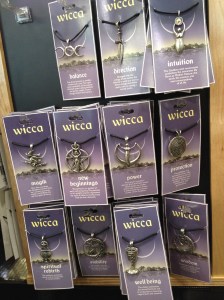
Those of us from the western hemisphere find the quotidian aspects of Hinduism and Buddhism exotic. Otherworldly, even. In our sterile offices, we dare not burn incense. Fabrics this colorful are not worn to work. It was as if the only place true color exists is in that mystical world that religions acknowledge, but businesses deny. Yes, it was a Saturday, but nevertheless the number of patrons surprised me. The town in which the mall sits is quite affluent. We live far enough from the City that some very serious money resides at no great distance. Patrons tend to have enough, and considerable surplus. And here they are, in a store selling that is undifferentiated spirituality. A stand of silver jewelry was explicitly marked Wicca. There were even Christian figurines among the crystals.

IMG_2672

People, even (or perhaps especially) the wealthy, desire more than the dollar can bring. We’re authoritatively told that we are meat computers. Mere automatons to the forces of physics. Our human experience tells us otherwise. We are meaning-seeking creatures. There are people who will willingly sit for three hours on a bus just to reach this mall. Whether it is a hippie-friendly shop, or the latest fashion trends that draw them here, they have this in common: they’re seeking something. I glance around and spy a mirror. I came here looking for a place out of the cold, but I have discovered an unexpected insight. If we make our own, or purchase it prefabricated, we venture to our secular cathedrals to find a kind of salvation.


To Nature, and Beyond

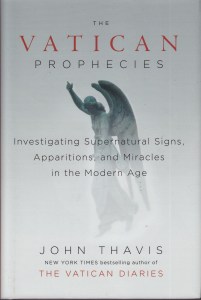
VaticanProphIt might seem odd to differentiate the supernatural from an established world religion like Roman Catholicism. After all, be premise of traditional Christianity is based on a miracle or two. Church officials, however, are not naive. It has been known from the early centuries of the church that although miracles are still from time-to-time proclaimed, they are a relative rarity. Few are claimed, like Jesus of Nazareth, to have the ability to summon the supernatural at will. When my wife gave me a copy of John Thavis’s The Vatican Prophecies, I wondered if this might be a sensationalist exploration of “the hidden Vatican” and its penchant for keeping things hushed. After all, the subtitle is Investigating Supernatural Signs, Apparitions, and Miracles in the Modern Age. Thavis, however, is one of the most even-handed writers on the topic I might imagine. Clearly respectful of the Catholic faith, he doesn’t go after any pet theories or conspiracies. He lets those in the church answer with their own words. And those words paint a fascinating picture.

Beginning with the concept of holiness, Thavis shows that the point of the spiritual life is not to seek signs. Nevertheless, signs are reported. Apparitions of Mary have a long history, as does the shroud of Turin. Those who write about such things often have a clear bias, but Thavis gives the facts, interviews those who know, and offers a narrative full of possibilities. The supernatural can take a darker turn, however, as his chapter on demons and angels demonstrates. Although demons have been cast into the outer darkness by science, it doesn’t prevent people from apparently being possessed. And of course miracles come under scrutiny, particularly in the context of making saints. Prophecy, in the sense of knowing the future, is the last major topic up for discussion.

The Vatican Prophecies is a curious book that seems neither credulous or overly skeptical. It’s more like reporting than it is declaring what is or isn’t possible. Yes, the Roman Catholic Church does still profess miracles, but a vast number of them that come up for testing fail. Scientists serve as expert witnesses and personal claims are not sufficient to win the day. Although there are a few characters in this account, the majority of those mentioned in the book are understated, thoughtful individuals who happen to know they can’t decide what really happens or not. Instead, they simply deal with it. For those of use who live in a world of uncertainty, this book is a most apt introduction to topics taken seriously by some very intelligent people.


Seeing Things

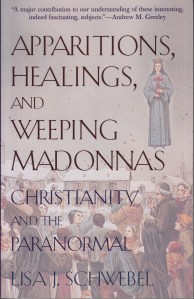
SchwebelWe have to learn to see the world. Traditionally religion and science both had roles to play, but as science grew better at explaining physical causes, many consigned religion to mere superstition. In such a paradigmatic world, Lisa J. Schwebel’s Apparitions, Healings, and Weeping Madonnas is something of an anomaly. Schwebel begins by noting that the Catholic Church has long accepted the reality of psi. As the branch of Christianity with the strongest commitment to furthering science, this itself might seem unusual. We are taught to see the world in a binary way: either this or that, not both. Books such as this challenge that convention, asking us to look at a world that doesn’t always conform to expectations. Parapsychology has made inroads from superstition to science because of testable hypotheses and statistically significant results. What it might mean is up for grabs.

Some claim that Catholicism is credulous. Actually, as Schwebel adequately demonstrates, criteria for declaring even spectacular events as miracles are amazingly high. Merely paranormal events seem common in comparison. In many ways, this is a disorienting book: the supernatural is assumed to exist, but miracles are treated as less common than the everyday supernatural. Those of us raised in a rationalist scholarly world might find the acceptance of that which we’ve learned is impossible just a bit unexpected. No doubt, visions of Mary are reported. Crowds often visit trees or highway underpasses where pareidolia impresses an image on the faithful. Schwebel, however, is discussing visions of another sort, and finds that they may involve the power of suggestion rather than the miraculous.

Faith healing, on the other hand, is something for which empirical evidence exists. Doctors still disagree about whether prayer speeds healing, but there have been many instances of unexpected healings that have occurred, apparently in relation to a person noted for bringing wellness about. Causality, of course, can’t be proven, but many people find themselves believing in a spiritual world after such an encounter. Perhaps that is what is so intriguing about books like this; they make readers uncomfortable in a world that is purely material. Finding a credentialed author who actually believes and has evidence to back her up is a rarity. Challenging conventions is part of the territory in most religions. Schwebel is simply straightforward about it.


Naming Evil

WetikoBooks don’t tell us what is true; books tell us what could be true. When I was growing up, under the influence of the Bible, I thought that non-fiction books were the truth. I came to understand that people disagreed about the truth, but it took a long time before I realized that books were merely the attempts of their writers to argue their version of the truth. If someone knew the actual truth that person would be a god. These thoughts came to me as I read the fascinating and mystical Dispelling Wetiko: Breaking the Curse of Evil, by Paul Levy. In many ways this is a mind-altering book. For one thing, Levy has made me reconsider how real evil is. Looking at what’s going on in the world it is increasingly difficult to deny the reality of objective evil. Levy’s book gives it a name and even attempts to analyze whence it comes. He calls it “wetiko.”

For several years now I have tried to find information on the monster known as the wendigo. Wetiko is a version of the same word, and it was this that drew me to Levy’s book. The wendigo is a shape-shifting creature that preys on humans. It is mentioned or featured in a few fictional books, and most recently featured in an episode of Sleepy Hollow. Since most academics don’t treat monsters seriously, it is difficult to find accounts of the beast. It is often discussed as a fictionalized version of cannibalism. It is a monster always hungry. The more it eats, the hungrier it becomes. It is this aspect that leads Levy to use it as his main metaphor for evil.

The evil that Dispelling Wetiko focuses on is the extreme selfishness our society has come to embrace. For example, our entire economic system is a fiction propagated by the ultra-wealthy. By defining a fiction as valuable and making it available to everyone else by a system of debt, the one-percenters keep everyone else, literally, in thrall to them. There is no gold to back up the fictional value they claim they have, and yet they consume others constantly in their evil greed. In a nuanced argument Levy suggests that this evil is real. Becoming conscious is the only way to combat it. There’s so much going on in this book that it has to be read several times, I’m sure, to get it all figured out. As I finished this one, however, I thought I had read a book that may actually be true.


Private Miracles

Despite rumors to the contrary, the Roman Catholic Church is skeptical of miracles. Quick to point out pareidolia where it occurs, looking like the Blessed Virgin in a tree stump or highway underpass, this is no credulous organization. Everyday miracles, doctrinal ones, of course are accepted. Transubstantiation is a quotidian miracle as the mass is no mere ritual. Flashier miracles—even some very impressive ones—are treated with suspicion and the rigor of Scotland Yard. When one of my regular readers pointed out the bleeding communion host in Kearns, Utah, I knew I had to check it out. As is to be expected in such cases, the Catholic Church does not disappoint. Some are calling it a miracle, but those who are do not speak for the Diocese.

Keeping in mind that my source for the story is Fox (Fox news seems more interested than most in this incident), apparently what happened is that a parishioner returned a host to the priest during communion. The priest put the host in a glass of water to dissolve it, but instead it began to “bleed.” Church officials were called in to investigate. There are several things odd here, although I’m no inquisitor, that make me wonder about the veracity of the story. First: Fox news. There are other outlets as well, so I’ll let that go at the moment. When a person was given a wafer at Nashotah House and for whatever reason turned it back in, the celebrant simply ate it. Priests, by definition believers in miracles, need not worry about germs. Protecting the host from desecration was the main thing. Putting it in a glass of water? I suppose that’s acceptable in some places, but even an Episcopalian would be shocked. And why was the host returned? Surely it wasn’t defective.

The Eucharist is the central rite of the liturgical churches, and it isn’t taken lightly. Although it is a miracle-laced event, it is expected that the transformation will follow the prescribed rite. I sometimes ponder what priests would do in the face of a genuine, unexplainable wonder. The side of the believer that yearns for validation would surely want to put it on Fox news for all the world to see. The private side would want to let it happen without any need to say anything about it. Keep it a private miracle. In a year when Starbucks red is a sign of an impending war, I wonder if a bleeding host is the most apt way to get the attention of the unfaithful when a simple cup of coffee will do.

800px-Última_Cena_-_Juan_de_Juanes


Supernatural Quest

SupernaturalTwo things we’re told about the supernatural: one, it doesn’t exist and two, it can’t be studied. Of course the vast majority of people in the world don’t buy into number one and hardly care about number two. Both, it seems to me, could be wrong. As Jeannie Banks Thomas says in her introduction to Putting the Supernatural in Its Place: Folklore, the Hypermodern, and the Ethereal, belief in the supernatural is not declining. In fact, the more we’re told by cocksure scientists that all of reality is quantifiable and material, the more we become aware of the many exceptions to the rules. Of course, “supernatural” may be a misnomer. It could be that anything sloughed off into that category is simply not understood well enough to be empirically studied. Thinking back over the history of science I find it ironic that the very system that had to convince people that something couldn’t be seen (many gases) could be deadly. Now if it can’t be seen it can’t exist. We certainly don’t want any deities hanging out around here.

But back to the book. Putting the Supernatural in Its Place is a folkloric study of place. The contributors to the volume look at popular beliefs, some serious, some not, that accrue around certain places. As I’ve often stated on this blog, we are aware as humans that some places are fraught with meaning. Scientifically we know this shouldn’t be true, but we feel it when we approach any space of significance. The contributors to Thomas’ book look to some very interesting places: New Orleans, Salem, St. Ann’s Retreat, Lily Dale, Japan, and even movies and the internet. If any of these places aren’t familiar to you, it’s worth picking up a copy of this accessible book to learn more. Supporting folklore is a very good thing. Folklore, after all, is the wisdom of the people.

The places in this book are rumored to be haunted by ghosts, witches, zombies, vampires, and even fairies. Folklorists, of course, don’t try to prove that beliefs are true. Like any academic they study and analyze. The main form of exploration for the non-academic is the legend quest. Many of us have gone legend questing from time to time. A place where something happened is said to have a certain feel or manifestation, so we go to see what it’s all about. If such trips are given religious sanction we call them pilgrimages. We want to see. But more than that, we want to experience something that the past has left behind. In the part of the year when each night grows longer than the last, my thoughts turn to what is usually termed “the supernatural.” And I, for one, am glad to have able guides along the way to make the simple voyage into a quest.


Pagan Religion

TriumphMoonFraming. Much of what we call “religion” has to do with framing. At one time it was standard practice to assume “pagan” was distasteful, if not downright evil. “Witch” was a pejorative term intended to humiliate and excoriate. Ronald Hutton is one of the few scholars who has taken the time to consider Wicca and related religions seriously. The Triumph of the Moon: a History of Modern Pagan Witchcraft has been on my reading list for quite some time. It is a big book, but this is a complex subject that can’t be dealt with briefly. Taking the time to get to know witches, with a historian’s patience, Hutton has given the world a valuable, balanced resource. Without prejudice, he traces how paganism, Wicca, and witchcraft are religions difficult to define or even categorize. There is little to frame them.

Rumor and hearsay make poor substitutes for understanding a religion. Most of what I grew up learning about witches was, in short, completely wrong. I wonder how much more pleasant the world might be if people assumed religions all to be similar in many ways. They are varied attempts to find ways of being moral in a world that gives little clear instruction on the matter. Witches and pagans are only evil in the uninformed opinions of more powerfully established religions. Religions of empire, whether real or only imagined. Those that had political backing and brute force to anathematize those who were different. Theirs is still a stigma that persists.

The Triumph of the Moon recounts the development, since the early part of the last century, of a somewhat organized experiment of religion as it grows organically. Without a leading figure or spokesperson, radically egalitarian, these groups, while sometimes in conflict, coalesce around the practice of finding something magical in the world. Theirs is an educated, literate world that does not judge other religions. It isn’t perfect, but then what religion is? The belief structure isn’t so different than many established religions except in the matter of degree. It is private and secretive in a way that we could only wish in many religions, if they could be counted on to behave themselves. I’m not likely to do a sky-clad spiral dance any time soon, but I would say that if we took religions at their word for being what they say they are, we might have a lot more resembling that of the noble pagan.


Detoxing God

There’s some pretty weird stuff in the Bible. Those who are only familiar with all the “thou shalt not”s are missing a great deal. Some of the material is strange enough to rival Alice’s tumble down the rabbit-hole (Charles Dodgson was, after all, a deacon). Anyone who’s read Ezekiel, or Daniel, or Revelation, knows the feeling of having been slipped into some kind of alternate state of consciousness. As students of the Bible have been saying for decades, “What was Ezekiel on?” I’ve always tried to put these unusual writings into context for my students. Nevertheless, some scholars still explore the possibilities that something more than revelation was going on in the desert. A friend of mine pointed out the website Time Wheel, which has a story about Moses and his experience of the burning bush. Time Wheel is an artistic collective, and the story about Moses is richly illustrated. The title, however, is the attention-grabber: “The Bible’s Moses Was On DMT Says Hebrew Professor.”

The article explores the thesis of Benny Shanon, who suggests Moses may have found DMT in the natural store of psychedelics available in nature. As the piece suggests, you have to accept a literal Moses for this to make any sense. Nevertheless, it does raise an interesting question: did ancient people use hallucinogens for religious purposes? We do know that cultures throughout the world have found alternate states of consciousness to be religious in nature. Before the days of controlled substances certain plants and fungi were known to distort reality. Alcohol was one of the earliest inventions of civilization, or perhaps even predating it. When other views of the world are available, it is possible to say that one is by default the true one? It’s a question we face every morning, to some degree. The dream, another biblical favorite for alternate realities, can be just as real as waking.

Controlled substances are dangerous in large groups of people. Not only have modern scientific techniques refined the active ingredients, but we live very close to one another and erratic behavior, perhaps fine isolated in the desert with a cognizant adult, can lead to problems when other people live right next door. Anthropologists assure us that the use of natural “drugs” is/was not uncommon among many peoples who don’t fall under the rubric of powerful centralized government. But was Moses among them? To me, the burning bush hardly seems fantastic enough to require a chemical explanation. In fact, detailed study of even such books as Ezekiel and Revelation often reveal a much more mundane reality behind the writing. Still, imagination is often the key to unveiling realities left hidden to more prosaic minds. So why not see what might happen when the religious are left to their own devices in the desert? The results could change the world.

278px-William_Blake_-_Moses_Receiving_the_Law_-_Google_Art_Project


Magic Tricks

Magia SexualisTo a scholar who has spent many years studying ancient religions, new religions hold a strange appeal.  After all, we are trained to look at obscure texts from forgotten cultures and to decipher the mute clues they have left behind.  New religions have the benefit of being (generally) documented in ways that ancient religions aren’t, and often exist in societies more literate than those of the remote past.  Finding out about them may be easier, but understanding them may be just as difficult.  In my research on magic, I was led to Hugh B. Urban’s Magia Sexualis: Sex, Magic, and Liberation in Modern Western Esotericism.  I’ve always found Urban’s work engaging, and since this book is one of the few academic studies to investigate magic seriously, I was eager to see what he had to say.  As usual, I wasn’t disappointed.
 
Sex magic is frequently at the heart of magical beliefs.  Urban shows that this has been the case from ancient times.  Those of us who’ve studied ancient Syrian, Egyptian, Mesopotamian, or Aramaean religions aren’t surprised by this.  Those cultures inhabited a world pummeled by magic, and it doesn’t take a genius to figure out that sex might have had something to do with it.  The majority of Urban’s book, however, concerns figures starting in the nineteenth century who introduced new religious forms of sexual magic into the occult circles of their times.  Focusing on a specific practitioner in each chapter, he brings us up to the present with some familiar, or often less familiar, names.  Magic, by its very conception, is a religious idea.  Even if some of the more notorious modern magicians such as Aleister Crowley and Anton LaVey took religion in a darker direction, it was still religion.  The founding of Wicca by Gerald Gardner naturally receives some attention.
 
As Urban notes from the beginning, sex magic is not a topic for titillation.  It involves some transgressive, but also original thought about something that is so basically human that we all know about it even if we won’t discuss it.  And the dark practitioners have seemingly exhausted the vaults of extremism regarding sexuality that even a straight-laced, nay even Presbyterian, culture may find itself with no further options.  Where does one go when the foulest of profanities has been executed?  Certainly not back to the beginning, for we’ve come too far for that.  The postmodern world deconstructs itself leaving us to wonder if there can be any magic left at all.  It is no wonder, I should venture, that Harry Potter was gathering steam even as Urban wrote his book.  Magic will, by its nature, always find a way.


Forest of the Subconscious

The mind is not the brain. This isn’t mystical mumbo-jumbo (although there’s nothing wrong with mystical mumbo-jumbo either). We’ve been bombarded with the message that we are meat machines for many years now. Those who have studied physics and plumbed its depths often tell us that if we had all the bits of information involved, we could figure out anything. Our minds are our brains and it is merely electro-chemical signals that form a kind of operating system for this biological computer. The idea that we have a separate mind, we are told, is an illusion. Interestingly, studies of the subconscious mind raise significant questions regarding this interpretation. The subconscious, it is generally acknowledged, was discovered by Sigmund Freud. Prior to Freud many people did things and didn’t know why. Now we know, despite debates about the details, that we have to consider the subconscious mind as well as the more familiar conscious one.

I’ve been on a Through the Wormhole kick lately. Since we don’t have television, I have to watch the episodes after they air, but at least I have the option of doing this when I have some time. I recently watched the subconscious episode. The truly amazing takeaway from this was that our minds often, daily, in fact, operate on a level that we know nothing about. There are ways of tapping into the subconscious mind—meditating, as I mentioned earlier this week, is one way. Others are more scientific. Stimulating areas of the brain with small amounts of electricity can enhance abilities that we never knew we had. In fact, we might even be able to enact a Matrix-like download of information. I think I may have swallowed the blue pill after all.

DSCN2021

Call it a gut-level reaction, but I have always had a strong resistance to the idea that we are mere automatons. Consciousness, which, increasingly we’re discovering, involves a dose of subconsciousness, doesn’t feel at all like a we’re programmed. Theologically, I always objected to the strange notion of predestination. It made no sense, theologically, or experientially. One very wise professor once told our class, “If you want to test this, tell your spouse that you’ve got her or him completely figured out. They will do something you don’t expect.” Our minds are perhaps the most miraculous parts of human beings. The concept that we are merely following the pre-determined laws of physics makes no sense unless we believe in a literal Hell that we’ve made of this world. Are we programmed to self-destruct? I believe not. Whether in my conscious mind or in the true mind that lies underneath it.


Scientific Voices

BarmaidsBrainScience requires translation. Even very intelligent people in other fields of study have trouble understanding what scientists have been saying. That’s why science writers are so important. They can distill the heady knowledge that empirical method produces into a palatable tipple for the laity. Jay Ingram’s The Barmaid’s Brain is one such digestible report. As the subtitle (And Other Strange Tales from Science) indicates, this book is about the weird world of science’s often hidden charms. We all pretty much know that quantum mechanics has turned conventional wisdom on its head. We also know (courtesy of the media) that science and religion fight like cats and dogs. What we don’t see is that scientists often disagree on how to interpret data, particularly on the weird end of things. Ingram tells many such interesting tales from nature, psychology, and technology.

The essays in the book are loosely grouped into areas with some common theme. The psychology story that struck me as being particularly appropriate for this blog was the one about Joan of Arc. Joan, as most of us learned from history, was a prodigy. Illiterate, female, and poor, she nevertheless displayed a military genius that led her to the head of a French army trying to hold off the advances of the English. When turned over to the enemy she was treated as a witch, tried for heresy, and burned at the stake. Later she became a saint. The reason that she’s in a book of science essays is that Ingram wonders what exactly was going on when she heard voices and saw visions. Neuroscientists have devised ways of peering into the brain during religious experiences, and psychologists have constructed theories of why otherwise sane people hear voices. Joan doesn’t fit into the category that used to be called schizophrenia, nor does she appear to have been in any way insane. She was religious and her religion spoke to her.

When I was growing up, it wasn’t unusual for scientists to be believers. Nothing was wrong with believing in a god and studying the physical world. Indeed, the idea went back to Isaac Newton and other scientists of the first generation of the Enlightenment. Implications eventually led to the utter absence of deity from the world. People such as Joan were understood as sadly misled by a religion that could not be distinguished from magic. Yet Joan, as Ingram well knows, would hardly be a household name without her visions and her faith. At the end of the analysis, Joan rises from the couch still a mystery. An enigma to science, and suspect to many religious. She was, it seems to me, quintessentially human. We are all, it seems, whether saints or scientists, subject to what empirical evidence will allow us to believe. Most of the time, anyway.


Different Bites

SharkGodThe South Pacific brings to mind light-hearted musicals, uncomplicated lifestyles, and Gilligan’s Island. For those of us born in the eastern parts of North America it can seem pretty exotic. Especially since we can seldom afford to go there. Since my income has wavered around the subsistence level of a reluctant urbanite, I instead travel there in my mind. I came across Charles Montgomery’s The Shark God at a recent book sale. I generally scour the anthropology tables since I find the belief systems of others so fascinating. Montgomery, a journalist, traveled to Melanesia to trace the route his great-grandfather took as a missionary. A non-believer himself, Montgomery wanted to see the magic that a former generation believed in firsthand. Noting that missionaries often despoil the cultures they are trying to “convert,” his tale is full of insights and observations and disappointments. My kind of book.

Montgomery is remarkably open minded. Like many of our generation, he outgrew the religious fervor that seemed so strong just a few decades ago. Still, he is open to the possibilities in the lesser understood cultures of the South Pacific. He notes that E. E. Evans-Pritchard, the famous anthropologist, opined that non-believers made poor anthropologists. Even missionaries might make better, he suggested, since at least they know what it is to believe. And here is the driving tension of Montgomery’s narrative. Sometimes you simply have to be open in order to see. Not all evidence is empirical. He recounts little “miracles” that he later reflects may have been mere diversions. Nevertheless, the world opens up when it is seen through native eyes.

Missionaries, although they may be better equipped to understand foreign (or native) believers, nevertheless try to change them. What I found most fascinating is how even those who fully identify as Christians in the south seas have combined that belief with their indigenous religions. Christianity, even among the clergy, is an overlay for culture. In ways that shock and frustrate missionaries, those converted maintain elements of their culture that fit uncomfortably with doctrine. How do you convert the converted? Or maybe the word is more properly “pervert.” Belief systems grow in cultures and tend to introduce high moral standards, no matter the deities (or non-deities) known. The Shark God is a wonderful window open on the South Pacific, a place to which some of us will only ever be able to travel in our limited minds. We are, after all, products of our culture.


Out There…

Spring is a time of hope. As crocuses poke their heads through the slowly yielding soil, we’re reminded that the long months of darkness are only temporary after all. It was only appropriate, then, that my wife should point out to me the returning of the X-Files. Only a limited season of six episodes, but after hearing rumors for years that the third movie was in the works, we’ll gladly take six episodes to remind us that the truth is out there. I’ve not always been a fan or the X-Files, but there are reasons for that which have to do with living in the middle of the woods in Wisconsin in a seminary where the paranormal was, at times, just a little bit too readily at hand. And also because the very topics addressed are those of taboo. The anomalous is fodder for ridicule. Nobody could be so naive. Meanwhile the show was winning awards and creating enduring cultural memes.

Thexfiles

As I’ve suggested many times on this blog, the paranormal and religion are closely related categories. While not many X-Files episodes directly dealt with religion, the second movie made the connections explicit, blending Bible and spooky effects at a distance with abandon. The X-Files and religion share a fascination with wonder. It is all right not to know. Sometimes wanting to believe is enough. We can find information on nearly any topic instantaneously by pulling out our phones and tapping into the local wifi network. We access any bit of random information with ease. And we wonder at our lack of wonder. Where has it gone?

Thirteen years ago the haunting music died. We’ve been left with a reality that feels dull and devoid of possibility. We need some sign of hope. Ironically, it is Fox that offered a world of possibilities far beyond a Republican purview. This was a realm where humanity was no longer in control. Forces outside of and more powerful than us swept into our mundane setting to remind us that even government control is only an illusion. Human pride requires timely mementos that we are simply the dinosaurs of our age. The incomprehensible overshadows us as we spin away our time on a planet nowhere near the center of our galaxy, let alone our universe. And yet we tell ourselves we are capable of discovering the laws that lie behind it all without stepping foot on even the nearest of other planets. Welcome back, X-Files. Remind us where the truth may be found.


Material to Ponder

EndOfMaterialismFrom my youngest days I remember wanting to be a scientist. This desire was tempered with a real fear of Hell and wish to please. In my career, it seems, the latter won out. Well, mostly. I never planned on being an editor, but it was clear that I missed the hard-core science courses and would always lack scientific credibility. You see, I believed what scientists said, and that included science teachers in high school. To this day I still believe in the back of my mind that you can’t really see atoms with a microscope. One of my teachers had said it was impossible, and although electron microscopes were still a long way off, it was clear that atoms were just too small. The force of materialism first hit me in ninth grade physics. If what I was hearing was true, then if you had enough information, you could figure out the whole universe. But what of Hell?

I read Charles T. Tart’s The End of Materialism because of my need for reassurance. Materialism leaves me cold. To find a scientist who feels the same way is a bonus. Not all authorities agree that we’re just excited atoms that can be seen. Tart is willing to consider the spiritual as part of what the evidence reveals. He explores it in the context of psi rather than in the doomed attempt to test religions empirically, but he does make a case for more to this universe than Horatio’s philosophy ever dared dream. And some of that more is decidedly not physical. It’s what we know from our experience of the world. We don’t only reason, we also feel. I have to wonder if reason is really the friend of materialism after all.

You can’t walk across Manhattan without seeing an ambulance most days. Often they’re called out to collect some unfortunate homeless person who collapses from our collective neglect. If we are only matter, then why do we bother to assist those in distress? It’s just a little electricity and some chemicals in a biological organ, right? Consciousness is only an illusion, after all. Unless, of course, the person suffering is a prominent scientist. Then we should all make way for the ambulance lest we lose an asset of great value. Materialism is insidious in its take-no-captives mentality. Feel what you will, there’s nothing more to life than physical stuff. You can make a good living believing that. Why is it that I’m suddenly thinking of Hell again?