Religion in the Underworld

One of the unspoken truths of the study of religion is that it has an unacknowledged, problematic sibling in paranormal studies. There are many obvious differences: for one thing, religious study is respectable, if not really considered essential, whereas paranormal study is suspect and not generally acknowledged by established scientific or mainstream research institutes. Nevertheless, both religion and paranormal phenomena deal with unquantifiable experiences, aspects of human perception that cannot yet be measured. So it was with a large grain of salt that my wife signed me up for a year’s subscription to the TAPS Paramagazine. I’ve posted on this particular magazine before, but a new issue arrived just yesterday that contained so many references to the Bible and mainstream religion that I thought it worthy of reiteration.

In general I am skeptical about supernatural claims. At the same time, I am aware that we understand only a fraction of the universe and some aspects of theoretical physics are more bizarre than your average ghost story. When the magazine arrives I read through it with my salt-shaker within easy reach. Nevertheless, a feeling haunts me that at some deep level my specialization is connected with paranormal activity. The first article in the current issue concerns the Underworld. The author suggests that biblical and Mesopotamian references to the Underworld may be supported by the findings of ghost hunting investigators.

I’m all for a couple of working guys (plumbers Jason and Grant) daring to tread where scientists fear to go, but the problems of using ancient materials to bolster ghost-hunting claims are legion. Just a glance at the popularity of Zecharia Sitchin books warns against a simplistic reading of complex, ancient civilizations. We don’t need ghosts in the machine to explain the Sumerians or Babylonians. At the same time, we don’t have many academic options for uncovering the many, many ghost claims that have made throughout history. Mass neurosis is less believable than occasional hauntings. So although I have to disagree about the viability of a literal Underworld – a good understanding of ancient mythology helps to clarify that one – I do reserve some space for wondering if religious studies might not end up in the same final resting place as paranormal studies once science is able to penetrate the veil.

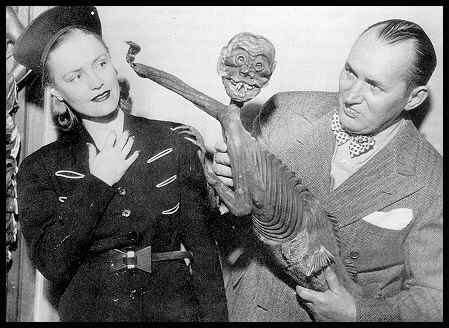
My all-time favorite ghost photo


What Hath AI Wrought?

Earlier this week an op-ed piece in the New York Times afforded the laity a rare glimpse into The First Church of Robotics, that is, Silicon Valley’s incredible and slightly disturbing vision of the future of technology. The writer of the piece, Jaron Lanier, an insider, expresses a concern that his area of specialization, a kind of artificial intelligence, is blurring the hard line between human and machine. Perhaps it is time we all watch Terminator again. Quoth Lanier, “It should go without saying that we can’t count on the appearance of a soul-detecting sensor that will verify a person’s consciousness has been virtualized and immortalized. There is certainly no such sensor with us today to confirm metaphysical ideas about people, or even to recognize the contents of the human brain. All thoughts about consciousness, souls and the like are bound up equally in faith, which suggests something remarkable: What we are seeing is a new religion, expressed through an engineering culture.” To put this in context, Lanier had been discussing the current concept that it might be possible to digitize human beings to incorporate all people in a Matrix-like universal brain.

I am woefully undereducated on the technology side of this issue to discuss whether or not such high-end digitization is possible. What interests me is the suggestion that this is a new religion. We haven’t even figured out the old ones yet. Defining what a religion is presents a nearly insurmountable barrier even to specialists in the field of religious studies, and some disgruntled conservatives claim that atheism and “sciencism” are religions. No matter how fast or how far you run, someone will always be able to label you as the adherent of one religion or another. Religion is an all-consuming category, a mental conundrum that cannot be contained by mere academic classification and circumscription. It is the universal solvent.

Meanwhile, universities and other learned bodies are reluctant to support the study of religion. In a world where the vast majority of individuals, university professors included, are motivated by religious guidelines and parameters, it is the elephant in the room we’d rather not discuss. From the sidelines I have watched reputable school after reputable school disembowel religion departments since they “don’t bring in money” and add nothing new to our understanding of the human condition. The sad truth is, religion indoctrinates much of the world. Deans and university presidents could learn a lot by reading op-ed pieces in the New York Times. Or at least have their avatars read them and store them away for future recall.


I Think, Therefore I Believe

This week in Time, an article by Jeffrey Kluger explores the intelligence of animals. Quite apart from many examples of how bonobos can string together relatively complex concepts using symbol cards (thus evidencing more intelligence than New Jersey’s current governor), the article demonstrates that many animal species display what we would recognize in other humans as intelligence. The article then develops the corollary that if animals think then perhaps they sense emotion as well. Having raised my daughter on Kratt’s Creatures and Zoboomafoo, none of this was new to me. I may be no scientist, but watching closely how animals behave, it has always been obvious to me that we are more like points on a continuum rather than a “special creation.”

Not to put too fine a point on it, this is what lies behind the human obsession with its non-animal status. As Kluger states, “For many people, the Bible offers the most powerful argument of all. Human being were granted ‘dominion over the beasts of the field,’ and there the discussion can more or less stop.” Unfortunately for our animal companions, the use of the Bible to repress others does not stop at human beings who don’t share your religious views. Many use the Bible as an excuse to do as they please to creatures who demonstrate similar emotional responses to people in similar situations and who, increasingly we realize, also think. Kluger’s article opens with an interview with Kanzi, a bonobo. One of the inevitable conclusions is that this great ape is able to think ahead and make plans. Evolution on this point has apparently skipped many Neo-Cons.

For years I have been telling my students that animals display behaviors that we label as “religious” in humans. The difference is that we are able to ask other humans what they are thinking and thereby gain somewhat direct access to their thought process (if they are telling the truth). Because we fail to share language with animals, we assume we are superior thinkers. To me this does not stand to reason. Animals are as fully members of this planet as humans are. Our desire to exploit them is more a reflection of human dominionist tendencies than a reflection of their lack of intelligence. We may even have animals to thank for the basic tenets of religious thought since religions are better described as evolved than revealed.

Maybe not the best sign of animal intelligence, but consider the Neo-Cons...


Lost Apocalypse

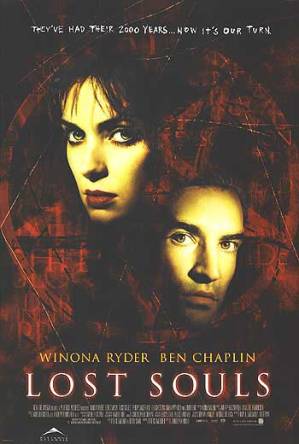
The Bible has many eminently quotable passages. I suspect that is one of the reasons it has the staying power that it does. Many critics of the theologies spun off by the Good Book have turned their vitriol toward the Bible itself, but I believe such hostility to be misplaced. Not everyone enjoys reading the Bible – that much is true for any book. The Bible, however, is foundational for not only our society, but the entire western literary tradition. Its influence on Shakespeare alone, who has, in turn, influenced just about every writer since the seventeenth century, underscores its literary importance. That’s why I’m always surprised with film-makers use concocted verses from the Bible when actual passages would produce the same effect. Granted, few Bible scholars comprise movie audiences and producers and directors seldom worry about writing the story for them. Last night I watched the “horror” film, Lost Souls, released in 2000. I’d read about the movie in Douglas Cowen’s Sacred Terror, so I wanted to see how it rated.

The movie begins with a false Bible quote: “… A man born of incest will become Satan and the world as we know it, will be no more. Deuteronomy Book 17.” Now granted, the movie failed to rock the critics, but the sheer weight of errors from pre-scene one should be the first warning to start from a better script. Beginning with an ellipsis for dramatic effect may be acceptable, but it serves no purpose – and what’s with the misplaced comma? A man born of incest in Deuteronomy is a non-starter because his potential parents could only be found dead, crushed together under a pile of hurled stones before the unfortunate could even be born. Satan as a devil is never mentioned in the Hebrew Bible, let alone Deuteronomy. Deuteronomy is almost never quoted by apocalypticists since it does not predict the end of the world, and Bible books are divided into chapters, not “books.” Well, the biblical illiteracy of Hollywood may be overlooked for a good story, but this is no such thing.

Lost Souls fails on the premise that a biblical “literalism” (and that is only if certain Evangelical interpretations are given unwarranted credence) about the coming of an Antichrist should be shored up by a fabricated quote from the Bible. I’m not trying to be a movie critic here, but a cultural one. The whole “end of the world” scenario held by many Evangelicals is a hodge-podge of biblical verses brought together by clever nineteenth-century clergy with little exegetical training. It is like trying to connect the dots while having to change pages constantly. The idea caught on amid the discarded lives left behind by advancing industrialism and the perceived threat of evolution. Apocalypticism has become its own industry as some otherwise unknown writers can attest. Movies like Lost Souls, or even The Omen, however, pale when compared to the antics of religiously motivated apocalypticists in the real world. Some of the rules in Deuteronomy itself are more frightening, if better written.


The Evil That Men Do

The graveyards of humankind are filled with the victims of religious violence. That fact does not seem to have lessened the impact of religion as a whole on humankind. One reason may be that religion has been a focal point of the good and humanitarian deeds of which people are capable, as well as a justification of the most heinous. The irony is that adherents of a religion claim that a just, true and righteous god is their motivation, for good or for ill. In the same church, mosque, or synagogue, there are widely differing views that live together. Sometime the truce is an uneasy one. Sometimes the adherents are united against a common enemy.

The furor over whether a mosque should be permitted near Ground Zero has become a major political whipping boy. Heavyweights like Newt Gingrich and featherweights like Sarah Palin are quick to fire off their half-cocked mouths about the impropriety of it. Michael Bloomberg, the mayor of New York City has been given the task that kindergarten teachers around the country – around the world – should incorporate in their curriculum, the task of teaching tolerance. In an excellent speech delivered yesterday, the mayor reminded citizens of what many appear to have forgotten: without religious freedom nobody is free.

Muslims are not to be blamed for 9/11 any more than Christians are to be blamed for the Inquisition. Every religion has members that misuse their sacred trust as a vehicle for hate and repression. By forbidding religious freedom to any religious group, America sets a precedent of a growing intolerance that can only lead to more, and greater suffering. Already the Gingriches and Palins of our nation tell us that there are indeed lesser citizens and greater citizens. Those like them deserve freedom of religious expression, of marriage recognition, of family size, of medical care, and those who believe differently and therefore deserve less. Speaking only for myself, I would rather have tolerant Muslims as my neighbors than supersessionist Christians.


Hoax Folks

The internet bores me sometimes. I can’t keep up with the pace of blogs that chug away like a neverending newsfeed. Information comes at me so fast I want to cower in a corner and start constructing my own printing press from scraps of lumber and bits of broken screws and bent nails. Slow things down a bit. Write something of substance. Of course, electronic information has its advantages – I frequent online dictionaries and thesauri where looking up words is much quicker than flipping countless pages. While hovering on the thesaurus.com page this morning, I noticed one of the blog entries entitled “Relax, Bill Cosby isn’t dead — it was a hoax. Is it true that the origin of ‘hoax’ mocks Christianity?” I’m glad for Bill Cosby’s sake, but what really caught my attention was the subtitle. We are all subjected to hoaxes almost as regularly as we are fed real news. Was this blurb suggesting that Christianity originated hoaxes or had given us the word “hoax”? Okay, too much information, but I had to find out.

The blog post states, in part, “The Eucharist, a central Christian prayer, contains the Latin ‘hoc est enim corpus meum,’ meaning ‘for this is my body.’ Jesus is said to have spoken these words at the Last Supper. The British clergy John Tillotson speculates in 1694 that hocus pocus is not only a corruption of this key Latin phrase, but a parody in keeping with the occasionally vulgar humor of prestidigitators.” Having taught for more than a decade at the avowed queen of “Anglo-Catholic” seminaries, I’d heard the gist of this before. For a blog on a website supporting grammar, however, I winced at “a central Christian prayer” and “The British clergy John…” phrasing. The Eucharist is not a prayer, but a sacrament, part of which is the Eucharistic prayer. Clergy is a collective, not an individual. Not to mention that if one was speculating in 1694 it ought to have been in the past tense.

In any case, the story as I received it was that Protestants coined the phrase “hocus pocus” to abjure the idea that anything “magical” was happening at the Eucharist. Protestants generally held communion to have been symbolic rather than a literal act of changing bread to flesh and wine to blood. So it seems that from a Protestant point of view the Eucharistic prayer was a hoax, but from a Catholic viewpoint it was salvation. As with most things religious, it is a matter of perspective. The word “hoax,” it turns out, likely derives from “hocus.” Having found this gem nestled in among so many grammatical errors, however, shakes my confidence a bit. That, however, is just my perspective.

A hoax or Dagon's sister?


Writing the Divine

The media has displayed considerable interest of late in the views of well-known writers towards the divine. Given the vast numbers of non-famous people daily consigned to Hell by the righteous, there are more tears shed for Anne Rice than for the thousands who’ve never written a vampire novel. Equally fascinating is a story from CNN yesterday on Ray Bradbury’s views on God. I cut my literary teeth on Ray Bradbury. I don’t even recall how I discovered him in the small town where I grew up. More likely than not I found used copies of his story collections at Goodwill. Already interested in science fiction, his tales of the future or fanciful past and alternate worlds captured my imagination. Living in a town where nothing ever seemed to happen, Bradbury was a doorway into someplace colorful.

According to John Blake and Bradbury biographer Sam Weller, the doyen of the sci-fi short story is an avid believer in something out there. Reluctant to accept any single religion, Bradbury embraces religious concepts as the wisdom of the sages. He believes, according to the article, that we have much to learn from religions. The views suggested in the interview may lack the rigor and sophistication of the professional theologian, but Bradbury’s emphasis on love comes close to the mark for several religions. People build superstructures around their religious founders and insist on orthodoxy and military adherence to human speculation about them. Often in the process, love becomes just another tenet left over, if you have time for it.

For many decades as I pursued formal degrees in religious studies, I was taught to put away childish things. I gave away my Ray Bradbury books and purchased hefty tomes of incomprehensible gibberish that passes for theological erudition. Then my daughter was assigned Fahrenheit 451 as high school reading. I picked up Bradbury again. His writing lacked the absolute wonder and fascination it held for my twelve-year-old eyes, but it was like greeting an old friend once again. My thinking had been partially shaped by this storyteller, and it is perhaps even possible, in a Bradburian sort of way, that I felt a “spiritual” connection as I read his books as a young boy. Reading his amateur views on religion was a quiet sort of homecoming.

An old friend


Toy Story 2.1

Summer is a season for movies. When the weather gets hot, sitting in an artificially cooled dark room for a couple hours, even if it is with strangers, seems like a good idea. Generally the movies I see in theaters are family movies – I’ve never been one to go to a theater alone and my personal taste in movies is unique in my family. The more interesting flicks usually have to wait until DVD release before I see them. Nevertheless, the movies are an experience that many of us remember fondly from childhood and children deserve good movie memories. Since the movie theater was invented it has become one of the signatures of culture in many parts of the world.

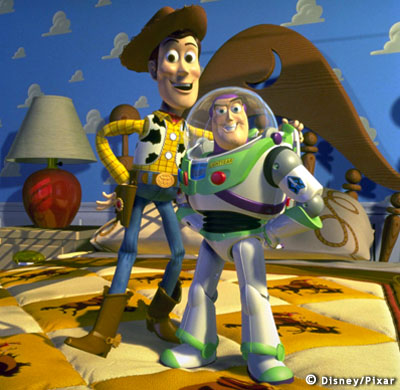
Last weekend, during the East Coast Heat Wave – a weather event so much talked about that it should have had its own theme music – we went to see Toy Story 3. In an unusual departure from my focus on religion, my comments here will focus on creativity. (Good religion is creative, after all.) Toy Story 3 opened to much critical acclaim, so my expectations ran a little high. A little too high. While I found the story to be interesting, it was a bit familiar. For those acquainted with the franchise, it felt like a remake of Toy Story 2. Both films open with the toys worried about their future because Andy is going away. In both 2 and 3 Woody is separated from his friends and has an epiphany that leads him back. Buzz gets returned to factory settings to reprise his humor in the first film. An evil toy in both movies holds the others captive against their wills. Meanwhile Woody makes new friends and with their assistance rescues the threatened toys. The evil toy ends up getting his just deserts and Andy’s toys successfully integrate.

The story line values friendship and commitment, and there is nothing to complain about there. Yet, after stepping out into the harsh sunlight, I felt like I’d just paid to see a movie I’d already seen before. Creativity – the factor that leads to truly new concepts – is not always valued in movies. This is particularly so in children’s movies. Our kids are being programmed to accept recycled stories as something new. It is not only Toy Story that has fallen into such rehashing: how many fresh ideas are shortly followed up by a 2, 3 or 4? Even if 1 wasn’t so good? I’ve even been told by publishers that publishing houses prefer to take few risks – they would rather have a product that is “like” one that has already proven a blockbuster. How many wizards and vampires have populated tween books over the last decade or so? It seems that the safe money is in the recycled story. In a society hooked on convenience, new ideas might seem just a little too dangerous. Once there was a cowboy blog…

Best friends forever and ever and ever


The Return of Christendom

Well, the Internet is shaking because Anne Rice has left Christianity. Not exactly, however. In her own words, according to her Facebook page, “I remain committed to Christ as always but not to being ‘Christian’ or to being part of Christianity. It’s simply impossible for me to ‘belong’ to this quarrelsome, hostile, disputatious, and deservedly infamous group.” For years I have observed decent people “quitting” Christianity because the name has been co-opted by intolerant, bigoted Neo-Cons who more often than not have political agendas in mind. I think the battle has been lost, the trademark name of Christianity must be surrendered to those who claim it most loudly. The meek have disinherited the earth. How many Catholic students have introduced their comments to me with “Christians say…” as if Catholics aren’t part of the club?

There was a perfectly good word for what Neo-Cons are calling themselves. It used to be “Christendom.” Harkening back to the imperial days when Orthodox Christianity ruled the East and Roman Christianity ruled the West, Christendom implied the power and the glory in its very name. Beyond a religion, it was a system of rule. The world was fine as long as everyone stepped in line to a magisterial faith that held the only set of keys to Heaven. Then Islam. Then Reformation. Then Enlightenment. The keys began to jangle amid many others on that divine keyring. Christendom seemed pretentious when there was no military might to back the strappado or red-hot iron. Christianity was but one belief system, deeply fragmented, among others.

Under the vision of James Dobson, Ronald Reagan, George W. Bush, and their minions, Christianity in its Neo-Con armor has once again become a forum for abuse and intolerance. Bearing little resemblance to the ethics and outlook of the carpenter of Nazareth, this religion would find an easy home in imperial Rome or medieval Aragon. As Ms. Rice notes, she is committed to Christ, but not a Christian. Although my impotent voice bears little weight in this overly loud and hyper-productive world-wide web, I would humbly suggest that Christendom be reinstated, instead of Christianity, to describe the Neo-Con religion. Christendom, after all, retains the imperial bearing and absolute authority the movement craves. Those, like Ms. Rice, who prefer to follow the teachings of Jesus might then have use of the traditional term of “Christian” once again.


Jesus’ Broken Dates

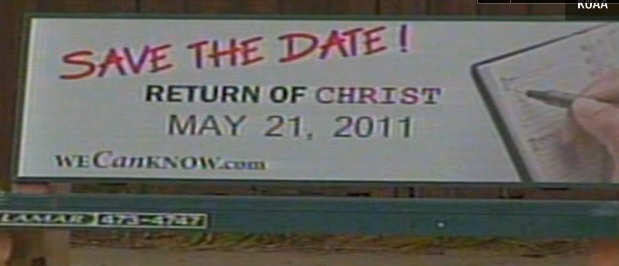
Jesus apparently has his calendar out. Again. This time it looks like May 21 is a red-letter day (he has a predilection for red-letters too). Well, at least it’s penciled in, like many other broken dates. An unemployed woman in Colorado Springs has decided to spend her dwindling reserves on bus bench advertisements reading “Save the Date / Return of Christ / May 21, 2011,” according to CNN. She states in the interview that she believes her job until judgment day is to get the world ready. She will find herself standing in the unemployment line on May 23 (the 22nd is a Sunday), more likely than not. Even more disturbing than the mostly harmless neurotic behavior of the unemployed (who am I to cast the first stone?) is the choice of Jerry Jenkins as an expert witness in the story.

Who questions a bus bench?

Jenkins and perennial Paleo-Con Timothy LaHaye wrote the “Left Behind” series that made more than a cottage industry out of repackaging Christian apocalyptic mythology into slick, science-fictionesque novels. They have more than a vested interest in promoting “and they lived horrifically ever after” scenarios. There is good money to be made by trolling the fears of the gullible. Very good money.

Our Colorado Springs prophet took her date from a billboard in Texas, a leading purveyor of rapture-mania. The thing that’s been left out of this – and many other apocalyptic episodes – is a serious consideration of the Bible. As most biblical scholars know, doomsday predictions generally derive from misinterpretations of ancient metaphors. Jesus, at least according to the canonical Gospels, was much more concerned about fair treatment of the poor and disadvantaged than he was about raining down brimstone on Babylon. Instead of spending money to warn the folks of Colorado Springs about yet another end of the world, why not donate the money to a local food bank and try to make the world a little bit better place?


True Colors

Over the past year several colleagues have urged me to join Facebook. To put this in context, I am one of those dinosaurs who made it through a Master’s program without having touched a computer – all theses and term papers were typed on a typewriter. It was only with the sheer volume of written material for my doctorate that I finally gave in to the technological revolution. Since then I’ve been sucked further and further into it, always a little bit reluctantly. When I read I like to have a book or magazine or newspaper in hand. When I communicate, I prefer a conversation to an electronic chat. Well, there are advantages to the technological world, but Facebook seemed a little too much. Caving to pressure, however, I eventually gave in and became a Facebooker.

One of the things I’ve learned from the daily updates of people – many of whom I’ve not seen since high school – is just how religiously conservative many of my friends are. I get daily, sometimes hourly, news updates about what the Lord is doing. He’s a pretty busy guy. Sometimes these friends look at my blog and wonder what has happened to me. When they ask, I have to wonder how deeply down the rabbit hole do they really want to go. I’ve been a professional religionist for nearly 20 years now – unfortunately several of those years have not included regular employment, but the work it took to get here can’t be undone – and prior to that I spent nearly 10 years in school studying religion. Anyone who makes it through an advanced degree in this field and comes out with the same viewpoint as when they entered it has had their mind firmly closed all along.

Religion is a phenomenon that can be studied, just like pottery or fashion history. Once a genuinely open mind is brought to it, perspectives begin to shift. Some of my friends who are less gracious about this respond by quoting the Bible at me, as if I’ve somehow learned how to forget the Bible while earning a Ph.D. in it. What they don’t realize is that if you want to learn about your religiousness in any serious way, there will be several Rubicons to cross and some pithy snippet from Paul is not going to change that. I don’t use Facebook to announce my religious thoughts to the diverse body of “friends” on my account. I use this blog for that. Those who are truly curious about religion might learn something from someone who’s been in the biz for nearly three decades. Others are content to announce to the world what the Lord is doing through Facebook.


Corporate Kindergarten

Ever since the Deepwater Horizon catastrophe, Tony Hayward, CEO of BP, has been under pressure not unlike the oil well itself. He has had to announce his resignation, having become the public face of the oil spill. Not an image anyone wants. Musing on the fact that he is being forced out as the head of one of the world’s largest corporations (which earns billions of dollars of profits each quarter) Hayward has stated that life is not fair. Welcome to Kindergarten, Mr. Hayward. Ask any of those millions of poor who’ve never been given a chance at a decent life and they will tell you. The lamentations of the rich are more annoying than jock itch. These guys have had it so good for so long that they’ve forgotten what it is to participate in the struggle for existence.

Not content to lament the fact that he still has an exorbitant salary within the company – being sent to Siberia is a great hardship, even if you have a mansion there – Hayward also stated that BP’s response to the tragedy is “a model of what corporate social responsibility is all about,” according to the New York Daily News. His words ring truer than he realizes. This is indeed a model of unbridled greed and utter disregard for either the planet or those who get in the way of corporate acquisitions. Yes, the response reveals what truly drives the corporate world. If the rich are left alone, they will allow life to remain just tolerable for those on the bottom.

Having learned very early that life is not fair, I have watched the response of the uncivilized wealthy to their various slings and arrows with a slurry of bemusement and rage. What separates those on top from others is their ruthlessness, not their intelligence, or, please!, their worthiness. Experience is the best teacher. I worked my way through three degree programs and earned exceptional teacher ratings for over a decade before being thrown in the unemployed slush pile. I routinely watch colleagues earn far more for doing far less while future prospects grow blacker and blacker. Oh, my heart goes out to Mr. Hayward. It is obvious he missed Kindergarten. Maybe the second-floor maid will be able to fill him in some day.

Soaring ever higher


Our Daily Bread

Over the weekend when my wife wanted to escape the East Coast heat wave and eat out in an inexpensive, but air-conditioned location, we ended up at the local Panera. While we were there, she mentioned that Time had just run an article about the chain because of its new, non-profit wing, the Bread Company. This store opened in Clayton, Missouri, and the store offers the option of paying what you can. Intended to help out the hungry but disadvantaged in an affluent St. Louis suburb, the customers are encouraged to pay more, if they able, to support those who can’t afford to pay. To the surprise of those on Wall Street, it seems to be working.

The article states that some wealthy take advantage of the system. No surprise there, we will always have the rich who feel the world owes them still more. Nevertheless, a successful company that offers to feed the hungry who can’t afford it – could this be a Gospel dream come true? It is easy to be cynical when the daily news feeds us a non-stop conveyor belt of corrupt politicians, CEOs greedy beyond the pale of human ambition, and the overall lack of concern among the privileged. Fat guys wearing cufflinks, jowls redolent with satisfaction, stare at the camera and inform us that they know what they are doing. Obviously.

In a nation as religiously inclined but as socially inert as the United States, it does me good to see a wealthy company offering something back to the community. The modest profits from the Bread Company are not channeled back into some executive’s already overstuffed wallet, but into community programs. I’m sure the cynical will say it’s a publicity stunt to win more customers. Perhaps so. Those who need help are nevertheless still able to access it. In a world where something as basic as bread is daily denied from many because those at the top can never have enough, it does my weary eyes a great deal of good to see any company with a modicum of social consciousness succeed.

A little bread shall lead them


Presbyterian Penance

Over the past week the Presbyterian Church (USA) has been in the news because of its overtures toward accepting gay clergy in committed relationships into ministry. While this is undoubtedly an honest approach to the issue, a disturbing subtext lies beneath the surface. That subtext, which may be practically impossible to escape completely, is that heterosexual clergy claim to have the right to “allow” homosexual clergy into “their” sanctioned leadership roles. The implied superiority is troubling. People have always found it easy to believe what suits them, the facts be damned.

Homosexual clergy is a picture-perfect example. Until society had evolved far enough to recognize that homosexuality is not a matter of choice, those who were homosexual existed in a kind of limbo. There was no lifestyle that could be displayed, just a secret predilection that could cost a person’s life if discovered. There were homosexual clergy, however, even in those days. They have very likely been part of Christianity from the first century on. In a society without the conceptual fortitude to realize that some people are born homosexual and others heterosexual – let alone the possibilities of evolution or stem-cell research – the lot of the homosexual clergy was one of pretense. There can be no doubt that homosexuality existed among the clergy, but the idea simply had no way to be delivered.

Many clergy, many of the best clergy, in my personal experience of the church, have been homosexual. Sexual orientation should make no difference in their ability to function as regular members of the clerical ranks. Only those with their eyes solidly closed can fail to recognize that Jesus never said anything about homosexuality, according to the Bible. What the early church taught was that all members should be equal. Somewhere along the past couple of millennia, however, the illusion slipped past actuality and the heterosexual (mostly male) clergy began to make all the rules. Perhaps we all have something to learn from the Presbyterians after all.


Truth in Fiction

In my more optimistic moods, I like to think of myself as a literary sort. Not constrained by the narrow confines of academia’s hallowed — and often hollow — halls, I have spent much of my life reading literature. I can’t say what started me on this track; my parents were not readers and the small-town school I attended encouraged little beyond subscribing to MAD Magazine. When I stumbled onto the literary giants, I was hooked. There are still great writers I have yet to explore, but one that I only really discovered at the prompting of my wife is Mark Twain. I’d of course known who he was. In my youth I never read any of his books. Then on a fateful, if carefully planned out, trip to Hannibal, Missouri to dig geodes during my geologist phase, we were rained out. The geode farm was closed. Sullen beyond shattered rock-hound dreams, I was at my wit’s end (not a long trip) when my wife suggested we not waste the miles we’d traveled, since Hannibal was also the boyhood home of Mark Twain. While there we bought souvenir quality volumes of Tom Sawyer and Huckleberry Finn. Upon returning home, I read them non-stop.

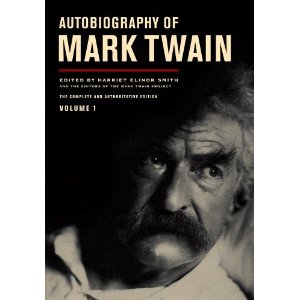
While on vacation last week my wife was discussing her literary pursuits with her family and it emerged that the full, uncensored, autobiography of Mark Twain will begin its public appearance in November of this year. One of the topics to receive his attention is religion. Twain was a Christian, insofar as any Presbyterian can make that claim, but he was critical of formal religion. A quote purporting to be from his autobiography runs: “There is one notable thing about our Christianity: bad, bloody, merciless, money-grabbing, and predatory. The invention of hell measured by our Christianity of today, bad as it is, hypocritical as it is, empty and hollow as it is, neither the deity nor his son is a Christian, nor qualified for that moderately high place. Ours is a terrible religion. The fleets of the world could swim in spacious comfort in the innocent blood it has spilled.” A bit caustic, but honest. When the books come out, I’ll be able to check it for veracity.

One of the things I value most about Mark Twain was his ability to hit his readers without giving away that they’d been hit. He accomplished this through a brutal honesty, often cloaked in fiction. When I explain myth to my students I tell them that it is an attempt to clarify the truth through story. Modern people tend to be fixated on historicity and sometimes miss the importance of a story because “it never happened.” If Huckleberry Finn never navigated a raft down the Mississippi, it would not affect the truth of the story or the insight of the author. It seems to me that with a writer so honest we would do well to consider what he had to say about his own religion before unsheathing our swords and rattling our sabers.