Sol Invictus

Perhaps for abject fear of paganism, western civilization has avoided holidays associated with the summer solstice. Being the lightest day of the year in a frequently dark northern hemisphere, it was naturally a time to celebrate the victory of light over darkness. While the winter solstice insinuated itself into the complex of Christmas holidays and Easter became intricately intertwined with the vernal equinox, the summer and autumn holidays were rejected.

This neglect of the powers of light coincides to some extent with the orthodox Christian rejection of Gnosticism. The Gnostics, able dualists like their Zoroastrian predecessors, celebrated the victory of light over darkness. Remnants of their theological outlook survived in the canonical Gospel of John and the always questionable Revelation. Ancient societies throughout the world recognized the summer solstice because, regardless of its name, the sun was acknowledged as a powerful deity. On this day the sun is at its height of strength, banishing darkness for longer than any other day of the year. It is a day not to waste.

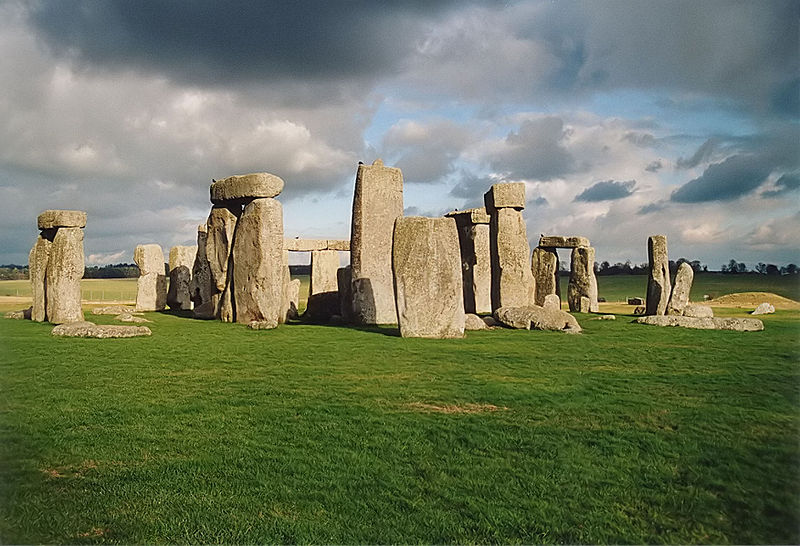
Christianity has preserved some minor holidays for the summer season, but with the advent of a leisure-based society where summer is a time to take it easy, if not cease work altogether, the solstice lost its grip. Perhaps because light is so abundant already in the longer days as winter wends its way into spring and summer and lingers pleasantly until the vernal equinox, summer itself is simply holiday enough. Those adhering to the ancient religions nevertheless gather at sites like Stonehenge and Maeshowe, or even Egypt’s famous pyramids to consider the unending influence that our special star holds for its most imaginative planet.
The stones of summer


Patriarchalism or Party?

Father’s Day is a “holiday” I treat with great ambivalence. Having barely known my own father, I applaud those dads who devote enough time and energy to their kids to earn a day of recognition. On the other hand, in a society that continues to foster privileges for men in the market and labor worlds, I wonder if men need their own holiday. I suppose one must separate “father” from “men,” since the day is the celebration of an ideal rather than a gender.

“A good man is hard to find,” so the old saying goes. Maybe that’s why there was never a father’s day in the ancient world. Anyone reading the ancient myths, the way that many fathers behaved, well, it’s no wonder they weren’t celebrated! Cronos, in some traditions Cybele’s husband, actually ate his own children. Not much of a motivation for celebration there. Were the gods made in the image of the metaphorical fathers?

In the United States the first Father’s Day was observed in Fairmont, West Virginia in July 1908. It has been suggested that a mine disaster that had killed over 350 men nearby was the inspiration for the day. About two years later in Creston, Washington, Sonora Smatt Dodd celebrated her father who’d raised six kids mostly by himself. President Woodrow Wilson was famously celebrated by his own family, and President Calvin Coolidge proposed the holiday in 1924. An early supporter of Father’s Day was the politician William Jennings Bryan, famous for his stand on what he understood as family values. President Lyndon Johnson set the day as the third Sunday in June. Father’s Day only became official in 1972, under President Richard Nixon. Still, it seems to be a day established by men for men, smacking a little too much of the self-congratulatory.

Back before cell phones were invented, Father’s Day was the biggest day of the year for collect phone calls. Perhaps that phenomenon is the essence of the holiday. From those to whom more is given, more should be expected.


iPriest

I don’t own an iPad or an iPhone. I even have to confess to being bored with the internet on occasion. Perhaps my interests are too antiquated for the electronic age. So when I saw that an Italian priest had developed an application to allow priests to celebrate Mass I knew that the brave, new world had attained a heretofore unfathomable high. Instead of laying a missal on the altar, priests can now “double click” to the appropriate rubric with an iPad next to the body and blood of Jesus Christ.

Of course, the temptation to surf the net during Mass must be overwhelming at times. When I look out over my university classes and see a sea of laptops, knowing that university wi-fi is everywhere, I am sure they are somewhere far, far away from Numbers or 2 Chronicles. Perhaps they are checking out what is going on in Mass? A couple years back iBreviary came out for those who need the daily offices on the fly. Convenience and worship, however, were never intended to go together.

I spent this morning in a used bookstore. Some of my favorite places are among old books. The knowledge they hold doesn’t freeze up on you or crash. And often it is easier to find since you don’t have to search for exact terms in an ocean of information so vast that even intellectual whales couldn’t navigate it. Upgrades on iMass are expected to be available soon. The content, however, will remain the same as that rolling off the press in hardcopy after Vatican II. How long will it be before virtual communion is available so that commuters can partake without ever taking their hands off the wheel?

In the name of the unix, linux, and holy mac


Casting the First Stone

I’m not overly nostalgic for a guy interested in ancient history. I tend to look at the more recent past as a via negativa for the young who might make a difference today. Very occasionally, however, aspects of society were handled better back in the 1960s and early 70s. One of the most obvious instances of a more sane society was the segregation of politics and religion. Prior to the rise of the “Religious Right” as a political machine the religious convictions, or lack thereof, of politicians played little role in their campaigns and American culture itself was much more open. A story from today’s MCT News Service illustrates this all too well.

In an article entitled “In S.C., religion colors gubernatorial race,” Gina Smith reports on the various religious slurs that now pass for political campaigning in that state. “Raghead” (for a former Sikh), Buddhist, Catholic, and “anti-Christian Jewish Democrats” are among the aspersions freely cast by those without the sin of a non-evangelical upbringing. As if only Fundamentalists are capable of making the right political decisions. As if Fundamentalists ever make the right political decisions. Fundamentalism is a blinding force on the human psyche, and those who are misled by religious leaders who claim unique access to the truth are to be seriously pitied. Conviction that those most like you are to be trusted most may be natural, but dogged belief that pristine morals accompany any religion is glaringly naïve.

The American capacity for belief in fantasy worlds is in the ascendant. No matter how many times Fundamentalists or Evangelical politicians are arrested or forced from office for the very sins they rant against, their overly forgiving constituencies come flocking back to them. Commit the sin of being born Sikh, Hindu, Buddhist, Muslim, Jewish, or Catholic and no quarter will ever be offered. No, I have no desire to go back to the 1960s, but I sure wish politics would.


Joltin’ Jesus

Jesus has been having a hard time lately. Just last month he was hit by a car, and on Monday night lightning struck a second time. Literal lightning. A touchdown-style Jesus in Monroe, Ohio, formerly six stories tall, received the paragon of divine punishments in a Midwest thunderstorm. Struck by lightning, the fiberglass and plastic foam savior melted leaving only an eerie, Lovecraftian idol of a steel frame behind. The statue had adorned the Solid Rock Church in Monroe since 2004. According to MSNBC many motorists said that America needs more symbols like this; God apparently disagrees.

Former Touchdown/Quicksand Jesus

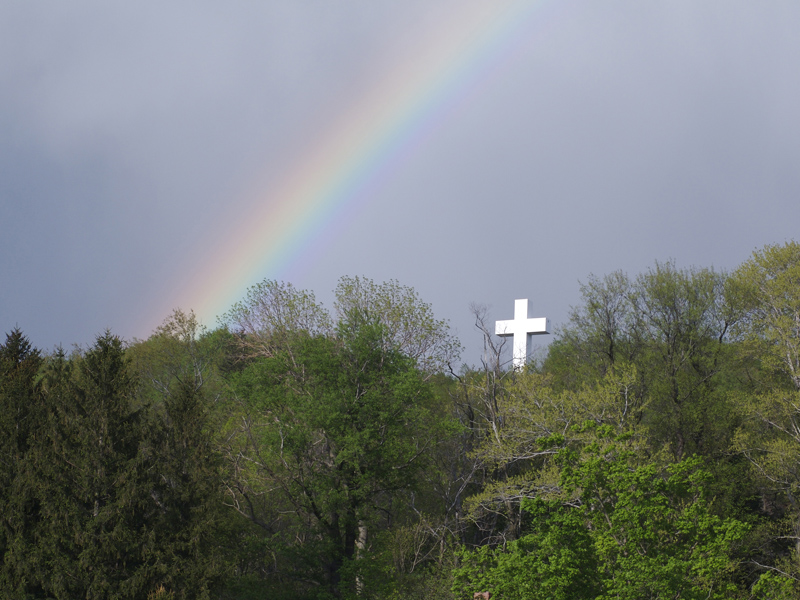
Obtrusive religious symbols dot many high hills and adorn many quotidian highways as signs of the donors’ faith. Lawrence Bishop, horse-trader-cum-pastor, and his wife Darlene made a substantial investment in this eviscerated Touchdown Jesus sculpture. As a camp counselor in my youth, I slept in the shadow of the great steel cross of Jumonville in southwestern Pennsylvania. The 60-foot tall cross is lit at night and is visible in three states. The monolithic cross always seemed incongruous with the blackened roasted weenies and gooey banana-boats we managed to choke down. Staring at its gleaming whiteness by night was an epiphany to many.

With the rainbow seal of approval

When my wife and I lived in Scotland some years ago, a terrific wind-storm blew through. In itself that was nothing uncommon, as any Scot will tell you. Wind gusts in this storm reached about 140 knots (160 mph), causing widespread damage. In an interview on the BBC, the sexton at one of Scotland’s cathedrals (time has robbed me of the details) recorded seeing the wind topple a statue of Jesus atop the building. He quipped, “I looked up, saw Jesus coming down, and ran for my life!” Although the exact location escapes me, the words have taken on an unexpected significance as icons crash down all around me. The demise of “Quicksand Jesus” is simply one further reason to avoid trusting in anything less than solid rock.


Tut-tut

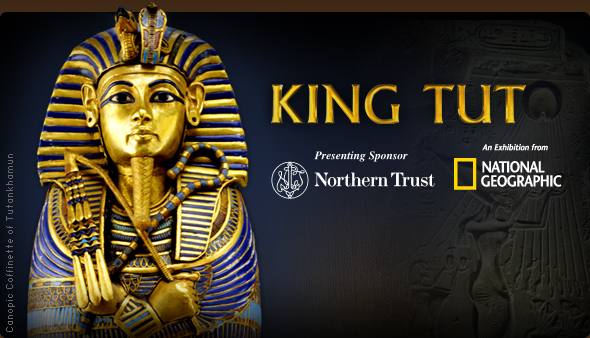
King Tutankhamen is on tour in New York City at the Discovery Times Square Exposition. It is difficult to assess how he feels about this tour, but I am certain the young king would have been astounded at Manhattan. The Egyptians were impressed by monumental architecture, and whatever one’s personal likes or dislikes may be, New York is full of monumental architecture. Tut’s famous golden death-mask will, however, be absent. That never leaves Cairo anymore.

As a sometime lecturer on the Ancient Near East, I can always count on students knowing King Tut. Many can’t name his father, Akhenaton, or even say what he was famous for (a rudimentary monotheism), but all know Tut. The reasons are transparent – all that gold! It is difficult not to be impressed with that shiny yellow metal we all would like to have in abundance. Apparently Tut did. His accomplishments as king were severely circumscribed and lackluster, yet he lives on as the most famous Egyptian pharaoh because we have his gold.

Our appreciation of the superficial in the ancient world is a condemnation of our own society. We continue to be impressed by wealth at the expense of substance. Seldom do we find anything resembling true wisdom surviving from the enormous estates of CEOs. Their wealth assures their place in society, regardless of their accomplishments in moving society forward (or, more likely, not). They are living King Tuts. When ancient historians of the future turn their gaze back to our era it is most certain that the modern day Tuts are the ones who will dazzle them with their worthless gold.


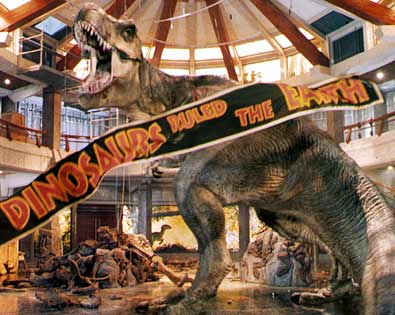
Jurassic Playground

Over the weekend I watched Jurassic Park for the first time in many months, perhaps even years. Despite the caricatures that substitute for believable characters, the dinosaurs are mostly believable and the warning tone appropriate. Throughout Dr. Malcolm cautions against “playing God” – an interesting perspective for a character who ascribes so fully to chaos theory. So when the television was off and the dinosaurs once again safely extinct, I continued to ponder this notion of “playing God.”

Quite often the phrase occurs in two main contexts: those of science and ethics. When humans have discovered the naturalistic explanation for a phenomenon and devise a human means of altering it, we are then in the realm of “playing God.” It seems to me that this is only a difference of degree from what people, and other creatures, have always done. Does not every action we take have endless ramifications? In our own little chaotic system, our decisions and activities impact others just as surely as a T-rex stomping through the park. It is only a matter of degree.

As human beings we may be the only animals that consciously “play God,” but the truth of the matter is that we are all pieces in an intricately interconnected system. Animals, even plants (behold the kudzu!), influence the activities of others, changing courses of rivers, degrading the environment, blocking the paths of ants, ant-eaters, or ant-eater eaters. What could be more natural than “playing God?” This, of course, doesn’t change the ethical angle, but throws it open much wider. Should we clone dinosaurs? Should we clone people? Don’t ask me – I’m too busy playing God in my own little corner of the world.

T-rex plays God


Dissing Mother T.

I pity the fool who challenges a powerful religion. Compelling religion. Tall towers. Tears of regret. The Empire State Building has a famous tower light show. Depending on the occasion, diverse wavelengths of light splash off the iconic skyscraper, and those who have the scorecard can see what’s important. In a city like New York there are countless occasions – holidays, Yankees and Mets games, significant birthdays. New York also houses a significant Catholic population. So it was not a popular decision on the part of the owner of the building to turn down a request to light up the town in honor of Mother Teresa’s centenary. I’m sure it was uttered with the purest of intentions, but the words of Bill Donohue, the president of the Catholic League, made me shiver just a little: “His [the owner’s] decision to double down at this juncture – in the face of massive support for our request – is something he will regret for the rest of his life” (according to the New York Daily News).

Mother Teresa, to many, is the epitome of Christian charity and selflessness. Devoted to helping the poorest members of a cruel world, she lived a life that many religious leaders could stand to emulate. On the front page of the same newspaper carrying this human interest story was the headline of how Seton Hall’s finalist for university president withdrew from the search after requesting a $300 K salary for the job. He is a priest, after all. Beg pardon, a Monsignor. And a professor of Christian ethics. I pity the fool who takes ethics seriously.

Somewhere between a 300,000 dollar salary and abject poverty, many religious believers are boggled by the mixed messages broadcast by their leaders. Most people in western religions are trying hard to avoid hell, complying with the traditions and new demands made by the spiritual CEOs. In a seminary setting someone once said to me that if Mother Teresa had advocated for responsible parenting (that great lumbering demon of birth control) perhaps the roots of the great poverty she daily redressed in Calcutta might have begun to dissipate. But the word from on high had been uttered and was immutable. She would not live to see her name up in lights. From what I’ve read about her, I have a strong feeling that Mother T. is just as happy to stay out of the limelight. I pity the fool who doesn’t understand.

A picture is worth $300,000


Long, Dark Tea Party of the Soul

I remember a time when it was considered bad taste for politicians to utilize their religion to garner votes. Crass and vulgar, it was considered an impropriety not unlike bribery – offering power in exchange for support. Two for tea, and tea for two. Elect me and I’ll make America a Christian nation again, i.e., in my own image. What perhaps bothers me the most about this culture is its deep-rooted arrogance in co-opting history, decorum, even the very imago dei itself. The lie in the service of the truth is a very powerful weapon. When a case is erected on a house of cards, architects must be careful indeed.

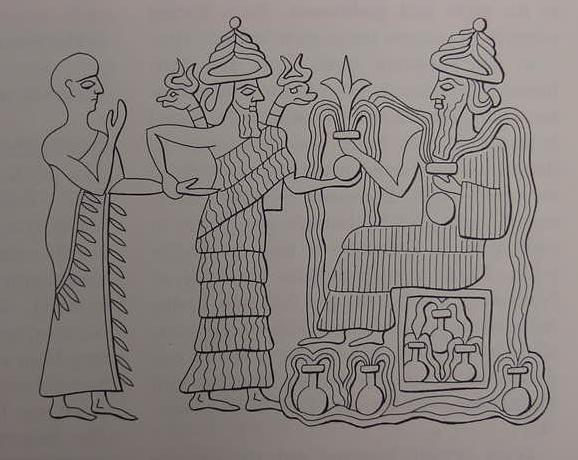
A very ancient image for the king was that of the shepherd. This is not surprising since the early kings were not afraid to confess to being gods, and characters like Dumuzi, originally a man, later became divine. And Dumuzi was a shepherd. Sheep are seldom classed among the most intelligent of mammals, being natural followers rather than leaders. When a sheep with the right stuff led the flock, he reserved the right to claim divinity.

The same dynamic is at work in Tea Party mentality. Although the leaders would be swift to deny – the truth is in the denials – that they are anything but humble servants, old ideas die hard. Civilization was built around the idea that leaders got their mojo from on high. Kings were only gods in disguise. Modern politicians are Joe the Plumber in aspect, but Belial under the skin.

Dumuzi leading a follower to a Tea Party?


Zombies, Golems, and Robots – Oh My!

A truly great metaphor is hard to kill. Despite detractors and naysayers, the zombie has clawed its way into the modern psyche as a denizen of the living death of a world we’ve created for ourselves. Joblessness, environmental disasters, tea parties – just when you thought it couldn’t get any worse, the dead refuse to stay dead. Elsewhere on this blog I’ve written about the origin of zombies in Voodoo, and I mentioned in passing the connection with the golem. The golem is a mythical Jewish creature that serves the role of protector of the oppressed (one can’t help but think of the Democratic Party). It is strong, dedicated to its task, brainless and soulless (one can’t help but think of the Religious Right). Like the zombie, the golem has no inherent ability to think for itself, and it must be animated by a magical word written on its forehead.

Golem around the corner

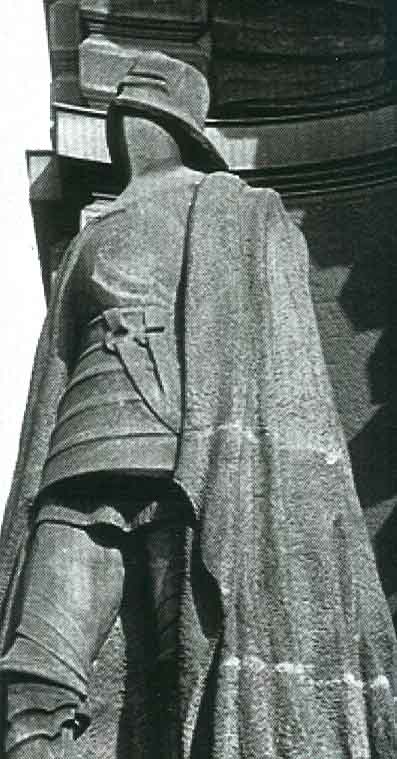
One of the most famous golem stories involves the Golem of Prague, defender of the oppressed Jews in that city in the Middle Ages. The Prague connection also forever ties the golem together with robots in Karel Capek’s 1921 play, R.U.R. (Rossum’s Universal Robots), the very origin of the word “robot.” Like the golem the robot putatively has no soul. It too is controlled by a code written precisely for it. Unfortunately on my one trip to Prague back in 1991, I didn’t know to look for the golem – I did find the statue of Jan Hus, however. Right around the corner the golem lurked, standing guard over the oppressed. It is a powerful image when the world is in such a state.

We need a hero

With the recent release of George Romero’s Survival of the Dead, the zombie has been given renewed life. Watching the Republican Party gearing up for a major thrust at the very soul of America, lining up the local BP station to support big oil, spouting false rhetoric about what the Bible says, I think I’d rather take my chances with the zombies. Does anyone out there happen to have a golem for sale, just in case?


Aye, Robot

Being a “biblical scholar,” having an interest in robots might seem counter-intuitive. I was intrigued by the topic as a youngster, but convinced that if what the Bible said was true it deserved nothing less than full attention, I let my formal study of science lapse (although I kept an active reading life on it). Now, through the interest of my daughter, I have found myself mentoring budding young engineers, mostly by helping put things away and correcting grammar. Yesterday we took our robots outside for the local street fair. Almost always the response we get from local people is “Robots? Our school has robots?” Well, partly correct. The schools house the robots, but our robotics club is largely self-funded, so the robots might be said to belong to the team rather than the school. In any case, yesterday the robots played soccer in the street for the amusement of festive fair-goers.

People often fear “soulless machines.” They run by predetermined rules, set down explicitly in computer code, and do only what they are programmed to do. Some fear artificial intelligence for this very reason: what if robots or computers are programmed to think? Does this make them something more than physical machines? The standard, religiously biased, answer is that the soul, or even mind, is a uniquely human possession. Animals may act on instinct, some may qualify as having a limited mind, but definitely not souls. That would simply cross too many boundaries. When asked to produce a human soul for scientific scrutiny all religions come up blank. We don’t actually know what a soul might be – an everliving component that God might throw into Hell or spoil in Heaven seems to be the general gist. And it makes our moral choices for us.

In the Bible if any animal (say a bull) gores a person to death, and that bull had a prior reputation, not only beast but master could be put to death. It seems that the bull has a bad moral intention. If robots hurt people, in violation of Asimov’s first law of robotics, they are treated as acting with moral intention. We project souls onto them for the convenience of condemnation. If an animal, such as a zoo gorilla, saves a human child, that animal receives the treatment of a souled being for a while, until the act is forgotten. It seems that souls are immaterial components of a closed system used to reward or punish an individual. How much of themselves do humans have to put into their robots before they can have souls as well?

Robots among the people


Cryptid Be Thy Name

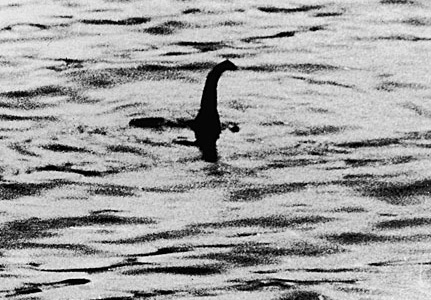
While poking around the internet last night to take my mind off the heat and humidity surrounding me, I stumbled across an article entitled “The Religious Struggle over Cryptozoology” on a site called Science and Religion Today. The piece was written by Joe Laycock, a doctoral candidate at one of my alma maters, Boston University. Having just finished Bruce Hood’s Supersense, there was a pleasing euphony in the coincidence. Cryptozoology is the study of unknown animals, and is not necessarily based on the supernatural (although it may fall within Hood’s definition of it). Laycock notes that two religious elements in society have latched onto this study: New Agers and Creationists. Creationists, it seems, see in certain cryptids, such as the Loch Ness Monster, hold-overs from the Mesolithic Era that prove the Mesolithic Era never existed. God can still make dinosaurs today, therefore the Bible (which doesn’t mention dinosaurs at all) must be true.

The draw of the unknown

One of the most welcome parts of Hood’s thesis was its consonance with Stephen Asma’s On Monsters, a book I’ve posted on before. Both authors explore how the human psyche reacts against what it perceives to be “strange mixes,” beings that cross-over between readily defined categories. Hood addresses this by tackling the concept of “essence” while Asma notes a dread accompanied by a sense of wonder. Hood demonstrates that from a scientific point of view, there is no such thing as the “essence” of a person, object, or living thing. Such ideas are the cling-ons from the era of souls and radically distinct species and genders. Closer observation has taught us that many such things are more of a continuum than a series of sharply defined types. Religions prefer to have fixed categories. Religious ethics often depend on them.

Laycock suggests that both New Ageism and Creationism “can be read as a religious response to the cultural authority of science.” Religions fear that which can be empirically demonstrated since it throws the god-of-the-gaps into the dryer and he comes out smaller each time. This is so, despite the fact that Creationists crave scientific respectability. While teaching my course on Myth and Mystery at the University of Wisconsin Oshkosh, I dwelt on cryptids for a few sessions. They are indeed often surrounded with a religious mystique. I wouldn’t necessarily dismiss the possibility of undiscovered species, many new ones are described by science every year. Nor would I say that they are supernatural. Nature has ways of surprising us still, and as Asma clearly demonstrates, we still have a need for monsters.


Bible Experts All

I seldom write follow-ups to my own blog posts – I’ve always found self-referential academics somewhat distasteful, and besides, what is creativity without some variety? Nevertheless, it seems that yesterday’s post has garnered a bit of interest in the disaffected outlook of a self-professed biblical scholar. (Actually, I have three “higher education” diplomas rolled up neatly in tubes in some untidy closet that show that some universities also accuse me with this charge.) Perhaps I need to clarify.

When reading a blog post, it is very difficult to determine the position of a writer’s tongue in relative proximity to his/her cheek. (Those with eyes to see, let them hear!) The subject might be funny if it weren’t so deadly serious. Despite my reservations with Christopher Hitchens, Sam Harris, and Bill Maher, they have all underscored a vital point – biblical literalism is very dangerous. This is even more so the case when, in their own minds, all people are Bible experts. We attend school and learn to read. Some learn to read more deeply than others, yet all “know what the book says.” There is no way to dispute that belief. Belief is belief, requiescant in pacem. Some commenters wondered why the opinion of “Bible experts” should matter at all.

When I’m feeling ill, I would prefer to ascertain the opinion of someone who has actually earned a proficiency in human physiology. When the car breaks down (again), I prefer to have someone who understands machines well as the repairer. When many, many people want to know what God doth require of thee, they turn to individuals who have not been thoroughly trained in Bible. I taught in a seminary for many years, and as an administrator, became quite familiar with the accrediting requirements of the Association of Theological Schools, the nation’s main seminary accrediting agency. I may unequivocally state that few seminarians emerge as full-fledged Bible scholars. Some “denominations” do not require any seminary training at all. So when your spiritual life breaks down, most folks head to an “expert” ill-equipped to handle the Bible, a homeopathic (no slur intended) literary diviner.

Purely from my own perspective, I would prefer to know what the Bible, in its own context, language, and words, is more likely to have meant. Delusions and all. Can’t buy that at your local church, with rare exceptions. That is the role of the humble Bible expert. As with any field of study, it is obvious when you have found a true expert. Such a one will readily admit that she or he has more questions than answers.


Pulp Bible

Everyone is an expert on the Bible. This is one of the factors that provides professional biblical scholars with generous ulcers. Everyone is an expert because they know what they believe about the Bible. The difficulty is very few people actually know much about the Bible. Belief and knowledge are very different features of the human psyche. In my introductory course on the Hebrew Bible last night, I showed the clip from Pulp Fiction where Jules exegetes Ezekiel 25.17 (which is a fictional verse concocted for the movie). This offers a springboard to discuss how the Bible is perceived in society at large. Many people believe that Ezekiel 25.17 actually reads as Jules quotes it. The writer/director of any movie may freely manipulate the Bible since they are as expert as anyone else on the subject. (Of course, Ezekiel is a safe bet for a false citation since few people have actually read the book.)

As an officially trained “expert” on the Bible who has learned the original languages and who has read far more books on the Bible than health or common sense would dictate, I often wonder about this. When the Jehovah’s Witnesses stop by, knowing that I have these credentials, they plow straight ahead and tell me what the Bible really means. They are experts as well. When my wife was pregnant and we visited the obstetrician for an initial interview, as soon as he discovered my vocation, the physician quoted Scripture for this nervous young couple before him. Would you not rather have a Bible expert deliver your first child? Where is there room for the bone fide Bible specialist?

Having read Hector Avalos’ The End of Biblical Studies some months ago, I found myself largely in agreement. In many quarters the Bible receives a privileged treatment that only creates problems. Politicians, rap artists, physicians, movie directors, and janitors are all experts on the Bible; why do we need those of us who’ve made it a life’s work? The answer, I believe, is that knowledge of the Bible is at an all-time low. Many venerate the Bible without understanding what it is. Until society gets a grasp on what it means to have so many experts on the Bible, everyone should ponder the meaning of the passage that reads, “The path of the righteous man is beset on all sides by the iniquities of the selfish and the tyranny of evil men. Blessed is he, who in the name of charity and good will, shepherds the weak through the valley of darkness, for he is truly his brother’s keeper and the finder of lost children. And I will strike down upon thee with great vengeance and furious anger those who would attempt to poison and destroy my brothers. And you will know my name is the Lord when I lay my vengeance upon thee.”


Mystical Aquariums

This is the dawning of the age of aquariums. With the Gulf oil spill still gushing out of control, there is a current awareness of the plight of the seas due to unnatural (i.e. human) interference. Perhaps that is why so many people flocked to the Mystic Aquarium yesterday. That, and the fact that it was a beautiful day on the northeast coast. Having grown up in land-locked western Pennsylvania, I have always appreciated the oceans and their microcosms, designed for human visitation. My first actual aquarium experience was the New England Aquarium in Boston, a facility that sets a very high standard for all others. Trips to the Seattle Aquarium, the Norwalk Aquarium, the Camden Aquarium, and a variety of smaller facilities (I unfortunately missed out when my family visited the San Francisco and Shedd (Chicago) Aquariums) always leave me with a sense of connectedness to our planet. Life emerged from the seas, and, as Rachel Carson observed, we always long to go back to our ancestral home.

It is easy to spend an entire day at the Mystic Aquarium. Beluga whales are impressive close-up, and the sea lions show more intelligence that your average Republican. Jellyfish, with no brain at all, are capable of doing tricks humans can’t – a tank of bioluminescent jellies was captivating. The penguins had a fascination all their own. It had been a few years since I’d been able to pet a shark or ray. In a separate exhibit on Deep Sea exploration, largely featuring Robert Ballard, the man who discovered the Titanic, the aquarium houses several robots used for entering regions uninhabitable by humans. Since my intense association with FIRST Robotics is never far from mind this was an unexpected bonus. The biblical aspect of the journey, however, came at the end.

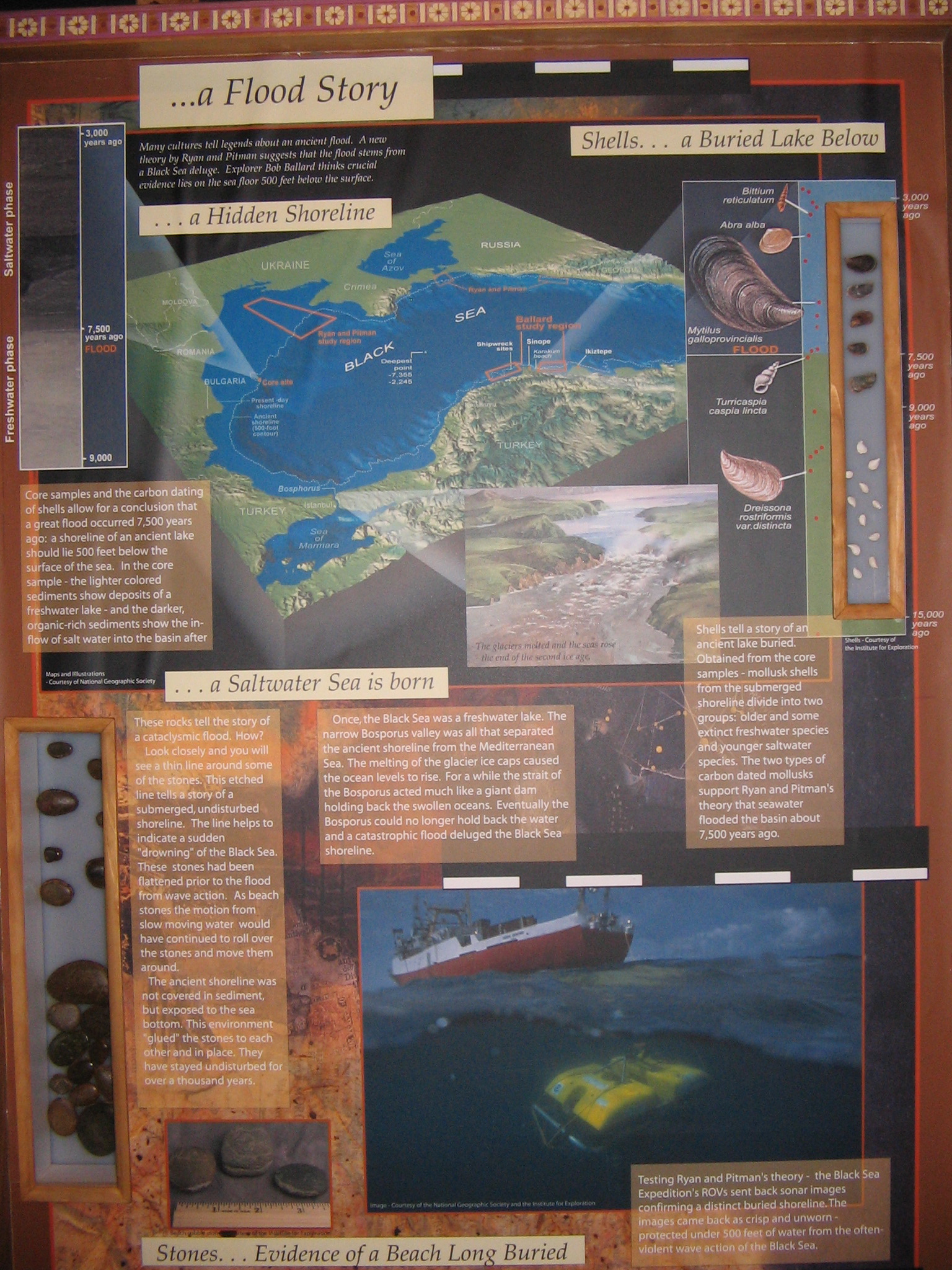
Exhausted from a day of wandering, hot and lethargic, we came across the final exhibit: Noah’s Ark! I had begun to wonder if I’d managed to spend a day in an entirely secular venue when the Bible showed up. The display was about the Black Sea. William Ryan and Walter Pittman’s theory of the origin of Noah’s flood in the Black Sea deluge was showcased, along with a video of Ballard, Ryan and Pittman discussing their ideas. As I tell my students, I don’t find this theory particularly convincing – the flood story first emerged, it seems, in southern Mesopotamia – but it is an excellent example of the hold the Bible has on the western imagination. The Black Sea did flood, shifting from fresh to salt water; that discovery is fascinating in itself. In the western world, however, it somehow just feels incomplete without giving old Noah his own Nantucket sleigh ride. To find the origin of the story of Noah, a trip to any vantage-point along the ocean where the power of the sea is evident is all that is required.