Zombies, Golems, and Robots – Oh My!

A truly great metaphor is hard to kill. Despite detractors and naysayers, the zombie has clawed its way into the modern psyche as a denizen of the living death of a world we’ve created for ourselves. Joblessness, environmental disasters, tea parties – just when you thought it couldn’t get any worse, the dead refuse to stay dead. Elsewhere on this blog I’ve written about the origin of zombies in Voodoo, and I mentioned in passing the connection with the golem. The golem is a mythical Jewish creature that serves the role of protector of the oppressed (one can’t help but think of the Democratic Party). It is strong, dedicated to its task, brainless and soulless (one can’t help but think of the Religious Right). Like the zombie, the golem has no inherent ability to think for itself, and it must be animated by a magical word written on its forehead.

Golem around the corner

One of the most famous golem stories involves the Golem of Prague, defender of the oppressed Jews in that city in the Middle Ages. The Prague connection also forever ties the golem together with robots in Karel Capek’s 1921 play, R.U.R. (Rossum’s Universal Robots), the very origin of the word “robot.” Like the golem the robot putatively has no soul. It too is controlled by a code written precisely for it. Unfortunately on my one trip to Prague back in 1991, I didn’t know to look for the golem – I did find the statue of Jan Hus, however. Right around the corner the golem lurked, standing guard over the oppressed. It is a powerful image when the world is in such a state.

We need a hero

With the recent release of George Romero’s Survival of the Dead, the zombie has been given renewed life. Watching the Republican Party gearing up for a major thrust at the very soul of America, lining up the local BP station to support big oil, spouting false rhetoric about what the Bible says, I think I’d rather take my chances with the zombies. Does anyone out there happen to have a golem for sale, just in case?


Aye, Robot

Being a “biblical scholar,” having an interest in robots might seem counter-intuitive. I was intrigued by the topic as a youngster, but convinced that if what the Bible said was true it deserved nothing less than full attention, I let my formal study of science lapse (although I kept an active reading life on it). Now, through the interest of my daughter, I have found myself mentoring budding young engineers, mostly by helping put things away and correcting grammar. Yesterday we took our robots outside for the local street fair. Almost always the response we get from local people is “Robots? Our school has robots?” Well, partly correct. The schools house the robots, but our robotics club is largely self-funded, so the robots might be said to belong to the team rather than the school. In any case, yesterday the robots played soccer in the street for the amusement of festive fair-goers.

People often fear “soulless machines.” They run by predetermined rules, set down explicitly in computer code, and do only what they are programmed to do. Some fear artificial intelligence for this very reason: what if robots or computers are programmed to think? Does this make them something more than physical machines? The standard, religiously biased, answer is that the soul, or even mind, is a uniquely human possession. Animals may act on instinct, some may qualify as having a limited mind, but definitely not souls. That would simply cross too many boundaries. When asked to produce a human soul for scientific scrutiny all religions come up blank. We don’t actually know what a soul might be – an everliving component that God might throw into Hell or spoil in Heaven seems to be the general gist. And it makes our moral choices for us.

In the Bible if any animal (say a bull) gores a person to death, and that bull had a prior reputation, not only beast but master could be put to death. It seems that the bull has a bad moral intention. If robots hurt people, in violation of Asimov’s first law of robotics, they are treated as acting with moral intention. We project souls onto them for the convenience of condemnation. If an animal, such as a zoo gorilla, saves a human child, that animal receives the treatment of a souled being for a while, until the act is forgotten. It seems that souls are immaterial components of a closed system used to reward or punish an individual. How much of themselves do humans have to put into their robots before they can have souls as well?

Robots among the people


Cryptid Be Thy Name

While poking around the internet last night to take my mind off the heat and humidity surrounding me, I stumbled across an article entitled “The Religious Struggle over Cryptozoology” on a site called Science and Religion Today. The piece was written by Joe Laycock, a doctoral candidate at one of my alma maters, Boston University. Having just finished Bruce Hood’s Supersense, there was a pleasing euphony in the coincidence. Cryptozoology is the study of unknown animals, and is not necessarily based on the supernatural (although it may fall within Hood’s definition of it). Laycock notes that two religious elements in society have latched onto this study: New Agers and Creationists. Creationists, it seems, see in certain cryptids, such as the Loch Ness Monster, hold-overs from the Mesolithic Era that prove the Mesolithic Era never existed. God can still make dinosaurs today, therefore the Bible (which doesn’t mention dinosaurs at all) must be true.

The draw of the unknown

One of the most welcome parts of Hood’s thesis was its consonance with Stephen Asma’s On Monsters, a book I’ve posted on before. Both authors explore how the human psyche reacts against what it perceives to be “strange mixes,” beings that cross-over between readily defined categories. Hood addresses this by tackling the concept of “essence” while Asma notes a dread accompanied by a sense of wonder. Hood demonstrates that from a scientific point of view, there is no such thing as the “essence” of a person, object, or living thing. Such ideas are the cling-ons from the era of souls and radically distinct species and genders. Closer observation has taught us that many such things are more of a continuum than a series of sharply defined types. Religions prefer to have fixed categories. Religious ethics often depend on them.

Laycock suggests that both New Ageism and Creationism “can be read as a religious response to the cultural authority of science.” Religions fear that which can be empirically demonstrated since it throws the god-of-the-gaps into the dryer and he comes out smaller each time. This is so, despite the fact that Creationists crave scientific respectability. While teaching my course on Myth and Mystery at the University of Wisconsin Oshkosh, I dwelt on cryptids for a few sessions. They are indeed often surrounded with a religious mystique. I wouldn’t necessarily dismiss the possibility of undiscovered species, many new ones are described by science every year. Nor would I say that they are supernatural. Nature has ways of surprising us still, and as Asma clearly demonstrates, we still have a need for monsters.


Bible Experts All

I seldom write follow-ups to my own blog posts – I’ve always found self-referential academics somewhat distasteful, and besides, what is creativity without some variety? Nevertheless, it seems that yesterday’s post has garnered a bit of interest in the disaffected outlook of a self-professed biblical scholar. (Actually, I have three “higher education” diplomas rolled up neatly in tubes in some untidy closet that show that some universities also accuse me with this charge.) Perhaps I need to clarify.

When reading a blog post, it is very difficult to determine the position of a writer’s tongue in relative proximity to his/her cheek. (Those with eyes to see, let them hear!) The subject might be funny if it weren’t so deadly serious. Despite my reservations with Christopher Hitchens, Sam Harris, and Bill Maher, they have all underscored a vital point – biblical literalism is very dangerous. This is even more so the case when, in their own minds, all people are Bible experts. We attend school and learn to read. Some learn to read more deeply than others, yet all “know what the book says.” There is no way to dispute that belief. Belief is belief, requiescant in pacem. Some commenters wondered why the opinion of “Bible experts” should matter at all.

When I’m feeling ill, I would prefer to ascertain the opinion of someone who has actually earned a proficiency in human physiology. When the car breaks down (again), I prefer to have someone who understands machines well as the repairer. When many, many people want to know what God doth require of thee, they turn to individuals who have not been thoroughly trained in Bible. I taught in a seminary for many years, and as an administrator, became quite familiar with the accrediting requirements of the Association of Theological Schools, the nation’s main seminary accrediting agency. I may unequivocally state that few seminarians emerge as full-fledged Bible scholars. Some “denominations” do not require any seminary training at all. So when your spiritual life breaks down, most folks head to an “expert” ill-equipped to handle the Bible, a homeopathic (no slur intended) literary diviner.

Purely from my own perspective, I would prefer to know what the Bible, in its own context, language, and words, is more likely to have meant. Delusions and all. Can’t buy that at your local church, with rare exceptions. That is the role of the humble Bible expert. As with any field of study, it is obvious when you have found a true expert. Such a one will readily admit that she or he has more questions than answers.


Pulp Bible

Everyone is an expert on the Bible. This is one of the factors that provides professional biblical scholars with generous ulcers. Everyone is an expert because they know what they believe about the Bible. The difficulty is very few people actually know much about the Bible. Belief and knowledge are very different features of the human psyche. In my introductory course on the Hebrew Bible last night, I showed the clip from Pulp Fiction where Jules exegetes Ezekiel 25.17 (which is a fictional verse concocted for the movie). This offers a springboard to discuss how the Bible is perceived in society at large. Many people believe that Ezekiel 25.17 actually reads as Jules quotes it. The writer/director of any movie may freely manipulate the Bible since they are as expert as anyone else on the subject. (Of course, Ezekiel is a safe bet for a false citation since few people have actually read the book.)

As an officially trained “expert” on the Bible who has learned the original languages and who has read far more books on the Bible than health or common sense would dictate, I often wonder about this. When the Jehovah’s Witnesses stop by, knowing that I have these credentials, they plow straight ahead and tell me what the Bible really means. They are experts as well. When my wife was pregnant and we visited the obstetrician for an initial interview, as soon as he discovered my vocation, the physician quoted Scripture for this nervous young couple before him. Would you not rather have a Bible expert deliver your first child? Where is there room for the bone fide Bible specialist?

Having read Hector Avalos’ The End of Biblical Studies some months ago, I found myself largely in agreement. In many quarters the Bible receives a privileged treatment that only creates problems. Politicians, rap artists, physicians, movie directors, and janitors are all experts on the Bible; why do we need those of us who’ve made it a life’s work? The answer, I believe, is that knowledge of the Bible is at an all-time low. Many venerate the Bible without understanding what it is. Until society gets a grasp on what it means to have so many experts on the Bible, everyone should ponder the meaning of the passage that reads, “The path of the righteous man is beset on all sides by the iniquities of the selfish and the tyranny of evil men. Blessed is he, who in the name of charity and good will, shepherds the weak through the valley of darkness, for he is truly his brother’s keeper and the finder of lost children. And I will strike down upon thee with great vengeance and furious anger those who would attempt to poison and destroy my brothers. And you will know my name is the Lord when I lay my vengeance upon thee.”


Mystical Aquariums

This is the dawning of the age of aquariums. With the Gulf oil spill still gushing out of control, there is a current awareness of the plight of the seas due to unnatural (i.e. human) interference. Perhaps that is why so many people flocked to the Mystic Aquarium yesterday. That, and the fact that it was a beautiful day on the northeast coast. Having grown up in land-locked western Pennsylvania, I have always appreciated the oceans and their microcosms, designed for human visitation. My first actual aquarium experience was the New England Aquarium in Boston, a facility that sets a very high standard for all others. Trips to the Seattle Aquarium, the Norwalk Aquarium, the Camden Aquarium, and a variety of smaller facilities (I unfortunately missed out when my family visited the San Francisco and Shedd (Chicago) Aquariums) always leave me with a sense of connectedness to our planet. Life emerged from the seas, and, as Rachel Carson observed, we always long to go back to our ancestral home.

It is easy to spend an entire day at the Mystic Aquarium. Beluga whales are impressive close-up, and the sea lions show more intelligence that your average Republican. Jellyfish, with no brain at all, are capable of doing tricks humans can’t – a tank of bioluminescent jellies was captivating. The penguins had a fascination all their own. It had been a few years since I’d been able to pet a shark or ray. In a separate exhibit on Deep Sea exploration, largely featuring Robert Ballard, the man who discovered the Titanic, the aquarium houses several robots used for entering regions uninhabitable by humans. Since my intense association with FIRST Robotics is never far from mind this was an unexpected bonus. The biblical aspect of the journey, however, came at the end.

Exhausted from a day of wandering, hot and lethargic, we came across the final exhibit: Noah’s Ark! I had begun to wonder if I’d managed to spend a day in an entirely secular venue when the Bible showed up. The display was about the Black Sea. William Ryan and Walter Pittman’s theory of the origin of Noah’s flood in the Black Sea deluge was showcased, along with a video of Ballard, Ryan and Pittman discussing their ideas. As I tell my students, I don’t find this theory particularly convincing – the flood story first emerged, it seems, in southern Mesopotamia – but it is an excellent example of the hold the Bible has on the western imagination. The Black Sea did flood, shifting from fresh to salt water; that discovery is fascinating in itself. In the western world, however, it somehow just feels incomplete without giving old Noah his own Nantucket sleigh ride. To find the origin of the story of Noah, a trip to any vantage-point along the ocean where the power of the sea is evident is all that is required.


Seaport Mystic

While at Mystic Seaport yesterday epiphanies of America’s religious life lined up to be encountered. The museum owns the Charles W. Morgan, the last surviving American whaler from the nineteenth century. The connection between whaling and religion is, as I’ve posted about before, Herman Melville’s Moby Dick. Whaling was a barbaric, inhumane business – particularly for the whale – but it had all the justification that BP or Exxon still utilize in the destruction of our oceans: the product is in demand and pockets are very nicely lined indeed. Moby Dick is, however, the story of an inaccessible, at times angry god, who leads to death as easily as enlightenment. The Morgan is dry-docked undergoing extensive restoration, yet is still open to the public. Stooped over in the blubber room, imagining the horrors of the place, Melville was my only comfort that something akin to nobility might have come from whaling.

The Seaport also offers an exhibition called “Voyages” – a look at the way the sea has played and continues to play a role in the life of an America that most people associate with a large swath of dry land. The first display tells the story of a family of Cuban immigrants rescued from a tiny fishing boat while trying to get to the United States. A nearby display features Neustra Senora de la Caridad del Cobre. This mythological character is a goddess emerging from the conflation of the Virgin Mary and the African goddess (through the mediation of Santeria) Oshun. The story of the Cuban family associates the origin of this goddess’s concern with seafarers through the chance find of a statue of the Virgin floating at sea near Cuba in 1606. Our Lady of Charity, the Catholic version, is the patron saint of Cuba, and the syncretism of these goddesses has led to a new mythological character on view in Mystic.
Neustra Senora de la Caridad del Cobre

Further along in the same building, in the story of immigration, is the painting shown below. A Jewish family is shown disembarking before a Lady Liberty with “America” written on her crown in Hebrew. The inscription on the sand asks whether the new world has room for the righteous. It is a poignant reminder that acceptance in the United States religious world is often a difficult one. Even today non-Christian religions are viewed with suspicion by many in America. The sea has brought us all together, however, since historically immigration has meant crossing the great waters somehow. One of the gifts of the sea that we are still struggling to grasp is what it means truly to offer freedom of religion to those from far distant outlooks in a world that daily requires less of the gods.


Mystery of Mystic

Ever since my school days at Boston University, even before a movie made the town famous, I wanted to visit Mystic, Connecticut. Perhaps it was the draw of the name that evoked foggy harbors and suggested the possibility of some kind of enlightenment. Perhaps it was because Mystic is near the gray waters of the north Atlantic that so captivate me. Perhaps because I am innately attracted by the sense of place. Whatever the reason, since we needed a break from my perpetual quasi-unemployment and my wife’s demanding hours, we have come to Mystic at last. Since traffic was exceptionally heavy, we haven’t had a chance to explore much beyond Mystic Pizza, now an iconic stop for all visitors.

She wasn't there

Curious about the name with its quasi-religious overtones, I tried to find in the town’s literature some hint of its origin. Nobody knows for sure. Like many “American” toponyms, however, Mystic likely derives from native American roots. The suggestion has been made that it means “great river whose water is driven in waves” (missi tuk). To the colonial ear ever alert for religious significance, this may have become “Mystic.” The true origin of the name may never be known.

Religious enthusiasm among early European colonists and their scions further west often inspired quasi-spiritual toponyms. Devil’s Tower and Devil’s Lake (Wyoming and Wisconsin, respectively) had no associations with the dark lord, but rather were locations of spiritual significance for the native populations. Grasping for a way to express this, the best evangelical Christianity could come up with was “Devil.” At least Mystic sounds much less diabolical. As we explore this town I will, by dint of natural disposition, keep an eye open for the religious implications. If I, perchance, uncover the true origin of the name, my readers will be the first to know.


Life Without Dragons

Every now and again, the great cosmic spheres align in their eternal turning and something just right clicks into place on our little planet. Such a juxtaposition must have recently occurred, for just when my worry about dragons had been reaching a crescendo, I received an offer for “dragon bane,” a beautifully crafted double-axe in the Minoan tradition, for only $39.99. The double-axe, or labrys, actually predates the Minoans, probably originating in ancient Sumer. The dragon predates even that.

Labrys dragon style

I’ve posted on the origin of dragons before, but of all mythological creatures dragons are perhaps the most tenacious. In various guises they reappear when we thought that they were gone. They are among the most ancient of feared creatures. Representing the untamed, indeed untamable areas of life, the dragon is the perfect symbol of chaos. Dragons are the disorder against which gods always struggle. Metaphorical dragons are always more troublesome than physical ones.

Although the idea of being a sword-swinging hero out to vanquish the forces of evil is an appealing one, I know that I won’t be purchasing this collectable. I have too much respect for dragons to see them slain by gods or mortals. What would life be without our dragons?


Vegetarian Meat Loaf

I’ve never been a hero worshipper. Perhaps the delusion set in when I realized several years ago that nobody really has all the answers. The “experts” (I’m even sometimes shackled with that designation at times) are limited by the same mental capacity as all Homo sapiens. Our elected officials do their best to find solutions, but at the end of the day oil still gushes into the Gulf, priests still violate children, and unemployment continues to wreck lives. No, hero worship is counter-productive and leads only to disappointment. Not that there aren’t people I admire – there are many – but they have their shortcomings too.

One of my admired people that often surprises those who know me is Meat Loaf. I really don’t qualify as a head-banger, but my tastes in music vary widely. With Meat Loaf the attraction is the sincerity evident in his voice. He may not write his own material, but the man feels the songs he belts out. So it was that I made a rare music purchase when Hang Cool Teddy Bear was released earlier this month. On glancing through the liner notes I was pleasantly surprised to find Boris Vallejo’s Crucifixion among the art.

Boris Vallejo's Crucifixion

Anyone familiar with the fantasy-style artwork in most Meat Loaf albums will not be surprised at finding Vallejo’s work, but this particular piece, reminiscent of Salvador Dali’s “religious” paintings, presents a depth of feeling to the crucifixion that most theologians diminish in their desire for profundity. The Jesus in this piece is sealed within the cross, raging for release. Most devotional paintings show a placid Jesus accepting, with existentialist-type calm, his long-foretold fate. I find Vallejo’s work compelling for the same reason I enjoy Meat Loaf’s performances – there is real emotion here.

Religion has little to offer the world in the way of rationality. Theologians have generally accepted the fact that religion runs counter to reason and therefore its value lies elsewhere. What is left when reason is gone is emotion. When reason tells me there are no heroes left, emotion sometimes convinces me otherwise.


Voices from the Third Estate

Discussions over the past week in that great wasteland we call state government have included talk of actually having millionaires taxed to shoulder a little of the state’s fiscal burden. Naturally there has been a strong backlash in this nation of deeply embedded plutocracy. Those who have their millions certainly feel little social responsibility, since the prosperity Gospel (or its analogs) comforts them with whispers that wealth is a sign of blessing. One of the most evil ironies of all is that many such folk have the chutzpah to cite the Bible as their backer. God loves the beautiful people.

Such virulent misreading of religion shrugs off millions of gallons of crude oil gushing into the Gulf. Petroleum companies breed some of the wealthiest individuals around, and if we wipe out the marine life of the southern coast, well, that’s a small price to pay for individual privilege. Somewhere along the line an unholy matrimony between religion and greed produced the great plague that will lead to the fall of western civilization. This may be seen clearly among the apes.

Frans de Waal, an author whom I’ve quoted before, notes that in ape society when an individual (or individuals) takes advantage of the system, the group eventually brings an end to his (or rarely her) reign. Primate society can only tolerate abuses that damage a community for so long before a collapse is immanent. Consider Rome, “the eternal empire.” Every day politicians posture in the media about how they have the best interests of society at heart. As members of the privileged classes, they have lost sight of what it feels like to live in the constant umbra of the supercilious wealthy while millions have no jobs, no health care, no future. Millionaires owe nothing to the society that allowed them to become rich, for the Bible tells them so. Nature, however, begs to differ.


Religious Democracy

An op-ed piece in yesterday’s paper raised some important issues concerning religion and the unfortunate fall of Mark Souder. The article, by E. J. Dionne, pointed out that Souder once said, “To ask me to check my Christian beliefs at the public door is to ask me to expel the Holy Spirit from my life when I serve as a congressman, and that I will not do.” This pointed affirmation of faith is precisely the dilemma of a democratic system that allows for freedom of religion. All religions (those that are serious attempts to deal with the supernatural, in any case) are defined by the conviction that their practices, their beliefs, their ethics, are correct. When a religious individual is elected, or even converted after election, in a democratic system their religion is given power. With their faith they vote on issues that cut across religious boundaries, binding those who do not agree to their personal faith stance by law.

Europe in the Middle Ages is perhaps the most obvious example of what might happen when one religious body (in that case, the Roman Catholic Church) gains excessive political power. Problem is, these days folks don’t agree on which is the right religion. America was not founded as a Christian nation, let alone an evangelical Neo-Con one. It has become, perhaps because of this fact, one of the most actively religious nations in the developed world. As befits a consumer mentality, religions are offered in a marketplace. Within Christianity alone there are aisles and aisles of churches from which to choose. When a public servant is elected and her or his religion dictates their votes, have we not just lost freedom of religion?

Teaching for many years in a seminary is a sure way of becoming aware of the limited training that religious leaders generally receive (if any). The short time they spend being educated does not equip them to think through all the implications of their convictions. They attain the pulpit and the congressional leaders who happen to be in their congregations receive an inchoate theology confused by their three years earning a “Master of Divinity” degree. Not all are equal to the task. Those religious leaders with promise, often because of internal church politics, end up in smaller venues, their voices effectively silenced. Those with the most strident voices reach larger congregations, often without the humility of admitting that the more you learn about theology they less you know. Their congregants, armed with faulty perceptions of their own religion, burst into their congressional chambers full of conviction based on problematic conceptions. It is a very serious dilemma.

Perhaps what is needed is an oath of office for politicians rather like the Hippocratic Oath for physicians. Perhaps they should swear to put their own religious outlooks in check while considering social issues on which their constituents vary widely. Perhaps their integrity in truly representing the population they govern would lessen the impact of their inevitable personal foibles. And naturally, this oath would not be superstitiously sworn with a hand on the Bible.


Robots and Religion

One of the constant duties I have as a “Robot Dad” (Soccer Mom just doesn’t apply here) is seeking funding for my daughter’s high school FIRST Robotics team. Always a supportive layman in the scientific venture to understand our world, I have encouraged this interest although I am pretty hopeless when it comes to understanding how it all works. So last night I found myself at a fund-raising, public-awareness event at the local minor league stadium. The Somerset Patriots stadium is just down the road, but I’d never been to a game before. I really don’t feel comfortable participating in crowd dynamics; I’d rather sit back and analyze than participate. And I have no real interest in sports. I wondered how I was going to survive being in such a foreign environment for several hours. Then my wife pointed out a, as it were, godsend.

Last night was “Faith Night” at the Somerset County Ballpark. The event was sponsored by Somerset Christian College, “the ONLY licensed and accredited Christ-centered, evangelical, undergraduate college in New Jersey.” Located in the appropriately denominated Zarephath, New Jersey, the small, extremely doctrinal college bought the privilege of a pre-game sermonette. Not too often does a public sporting event begin with references to “our Lord Jesus Christ;” I looked around for him but then remembered he’d been hit by a car just under two weeks ago. One of the administrators addressed the crowd and, trying to capture the elated, anticipatory feel of the moment, compared his college to a baseball game. I was busy handing out fliers and missed the early stages of his rhetoric, but when I heard him say, “third base is love,” my mind shifted to a more familiar baseball analogy I’d learned in high school. I imagined the prospective students’ interest when he went on to declare, “home base is Heaven!”

As two Christian motorcycle clubs solemnly rode their hogs around the field and local Catholic schools hawked their own fliers in competition, the sound system belted out any pop songs that had the word “faith” in them, no matter what the context. It was a circus-like atmosphere. I was surrounded by techies deeply immersed in science and human learning. We, in turn, were surrounded by an aggressive Christianity eager to claim as much territory as possible. Above it all wafted scents of searing flesh and deep-fried snacks. It seemed to me that a microcosm of American life was indeed evident at the stadium last night. Perhaps there is nothing as American as baseball after all.

Lead us not...


Suddenly the Bible

Universities are generally reluctant to hire Bible faculty (except in the case of “Christian” colleges where Bible faculty must be a particular brand of “scholar” who has already decided the case before the evidence is presented). The stock reason given to department heads and deans is that religion just doesn’t make money. Universities thrive on the income from science grants and wealthy business and finance donors who want buildings named after them. Religion, it is claimed, doesn’t bring in money. The real problem is that universities don’t know how to market religion.

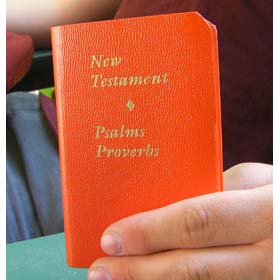
The other day I visited the local craft store to pick up supplies for a project my wife is working on. While in line I spotted this novelty item:

God in a box?

The shelf was full of them. When I returned later in the week, the supply was severely diminished. Someone had reasoned, correctly, that by putting a cheap length of paper-roll with “biblical” designs printed on it in a kit for making a throw-away mug, it would sell. Obviously universities and colleges couldn’t stoop to such a level, could they? Isn’t it far more respectable to draw your finest students into a mega-stadium to watch guys in tights throw around a fake pig-bladder and emerge drunk enough to vomit up all the costly snack foods they purchased? This is, after all, where the leaders of tomorrow are formed!

While looking up a troublesome word I can’t spell in an online dictionary, I was intrigued by this promotional inset (click to see). All I had done was type in a word on the Merriam-Webster site (it was not a biblical word), and when the answer popped up, so did this self promotional add for “Kiss of Death, Feet of Clay: Words From the Bible.” I don’t pretend to know how online advertising works, but it was clear that Merriam-Webster wanted the cyber-visitor to linger on their site, and the Bible was an effective way to achieve this.

The Bible is all around us. It would be difficult to nominate any other icon that would better illustrate American social self-consciousness. So immediately the sophisticated academic shuns it. Those of us who’ve put our lives into trying to understand the Bible phenomenon are deemed useless as money-makers while our counterparts in marketing and sales laugh biblically all the way to the bank.


Awaiting the Evolution

My daughter’s taking the mandatory New Jersey high school biology tests this week. Probably designed to ensure that basic health risks are factored and understood, it is one of the few bulwarks of the correct teaching of evolution in the United States. As anyone who follows my college Michael Zimmerman’s blog in the Huffington Post realizes, Creationism is a constant menace to our country. Although many simplistically assume that the threat is gone, it is, alas, sleeping but not dead. Perhaps quiescent under the administration of a moderate president, the Creationists have not gone away. I fear an imminent backlash along with popular apocalyptic hype for the year 2012. The Creationists are out there, just beyond the perimeter fence. I can feel it.

Having grown up under the umbra cast by the Creationists, I know their resiliency well. In a high school current events class, I participated in a Creationist-Evolution debate that classmates still remember some three decades later. It would be a situation laughable if it weren’t such a serious threat. While society has continued to evolve since Scopes, most Americans are still convinced that there is something insidiously evil about evolution, as if the devil generated the first simple cells and set the entire process running. In a society where Creationists daily benefit from the advances of science – as any search for evolution on the internet will demonstrate – they hold their feet firmly on the brakes nevertheless, awaiting a snow-white stallion at the parting of the literal clouds overhead.

I am not alone in foreseeing this whiplash that’s about to come. Many analysts who know the radical Evangelical camp share my fits of nerves and jitters. The educated elite suppose they’ve been eliminated, but those of us who know the world of the uneducated faithful tremble with a fear not inspired by the Maya. Sarah Palin is one of the most popular people in this country right now, and the Creationists, I assure you, are already staring at their watches and counting each passing tick.

Neo-Cons marching straight to the polls