Ichabod’s Body

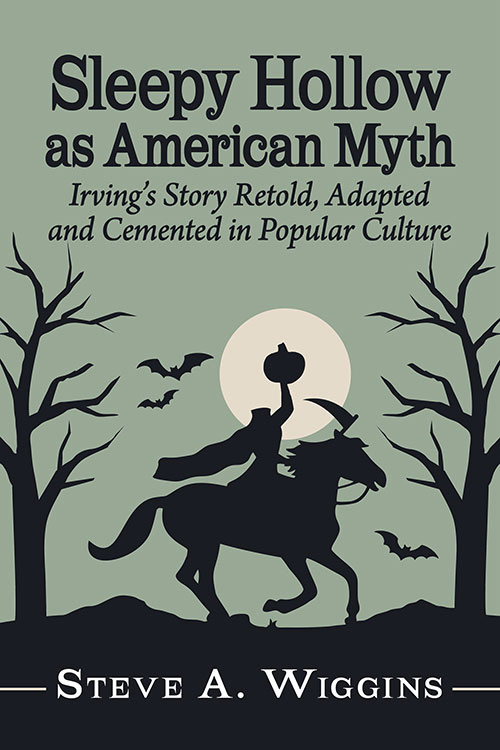
Maybe you’ve noticed this.  When Halloween comes around, the Headless Horseman and the Legend of Sleepy Hollow reemerge.  There’s a reason for that, and I discuss it quite a bit in Sleepy Hollow as American Myth.  Right now there seems to be quite an interest, or maybe I’m just noticing it more.  For example, a local theater where we saw a Poe performance last year is offering a Headless Horseman show this year.  Articles have recently been appearing on Tim Burton’s Sleepy Hollow movie, given that it was released 25 years ago—online discussion, however, is often eclipsed by the Fox television show by the same name.  And before it switched over to Christmas decorations, Michaels had its share of Sleepy Hollow merchandise.  Halloween and the Headless Horseman go together.  (Read the book to find out why!)

One of the tchotchkes I picked up at Michaels was Ichabod Crane’s tombstone.  In the many renditions of Washington Irving’s legend, Ichabod is treated as the protagonist of the story.  Although Tim Burton’s movie wasn’t the first to have Crane survive, besting the Horseman, the old wives’ tales, according to Irving, had him spirited away by the Horseman.  That’s why I found his gravestone so interesting.  The dates on it (1787–1857) indicate, at least according to this recension, that he died at seventy, surely not the victim of the attack that took place around the turn of the century.  If you’re not familiar with the original story, Irving set it “some thirty years since” the 1820 in which the tale was published, putting the events around 1790.  Burton shifted this to 1799, partially, I suspect, because that was two centuries before the release of his movie.

I do wonder where the maker of the Michaels tombstone got their information.  According to their reckoning, Crane would’ve been but three years old in 1790.  Of course, the story never tells us his age.  Since it is intimated that he relocated and became a judge after dabbling in politics, all of which would seem to indicate that he was a somewhat young man at the time of the tale.  To make Sleepy Hollow scary, though, having Crane cut off in his youth would seem to be more in keeping with the spirit of the season.  Of course, Sleepy Hollow is a legend that has become mythic through its many retellings.  Enough of them that someone could write a book about it all (ahem).  And this is the time of year to ponder it.  


Why, Cathy?

Learning to appreciate bad movies is a skill like any other.  It takes practice.  “Why?” I hear you ask?  Why climb a mountain?  Actually, there is a motive for seeing bad movies, apart from the good feeling they can leave you with.  (I might’ve actually done it better!)  That’s because they’re often free streaming.  If I had an endless budget I might well be able to avoid bad movies, but what’s the fun in that?  I found out about Cathy’s Curse because I was looking for a movie about a cursed doll.  (Don’t ask.)  I’ve seen many, of course.  Child’s Play and the whole Annabelle series.  But I felt I was missing something.  Wikipedia actually has a page on haunted doll movies, and Cathy’s Curse stood out to me.  Yes, I was forewarned, but I was also curious.

A Canadian horror film from 1977, Cathy’s Curse has become a cult classic.  The story line decidedly makes no sense.  Cathy, a young girl, moves into her grandparents’ house with her father and mother.  Her father’s father had died in a car crash with his daughter Laura, about Cathy’s age, some 30 years earlier.  Cathy’s parents are troubled, her mother having recently had a nervous breakdown.  Laura’s vengeful spirit possesses Cathy through a doll the latter finds in the attic.  For some reason, Cathy kills the housekeepers and attacks other children.  She tries to drown herself.  She kills the handyman’s dog.  The dog, which is clearly male, is explicitly said to be female in the movie, perhaps because one of the favorite words of the writer is “bitch.”  After about an hour and a half of running around screaming, the opening of the cursed doll’s eyes suddenly brings normalcy to the house.

There are some genuinely good things about the movie.  The late fall-early winter mood is nicely framed.  Why people hang out outdoors without coats in freezing weather is never really explained, though.  Neither the writing nor the acting are stellar.  And have I pointed out that the story makes no sense?  But still, there’s something there.  The idea of possession, a young girl under threat, the scary old mansion—these are classic tropes.  It’s unclear why, when Cathy’s father is fixing breakfast, he immediately sends her to bed and it’s suddenly night.  Or why the detective calls him by the wrong name.  Or why nobody can take a doll away from a little girl.  Ah, but that’s it, you see.  The haunted doll.  You have to learn how to appreciate these things, you know.


May I?

The thing about horror is that it’s an intensely personal preference.  Some people really like a movie while others find it, well, meh.  When the nights begin to lengthen you get lots of curated lists (I’ve never been asked to do any, but I’m working on one anyway) suggesting October viewing.  One such list that a friend sent me appealed to me because it was for movies on Netflix.  Since that’s one of the few streaming services to which I have access, it makes the movies seem free.  This particular list recommended May the Devil Take You, a 2018 movie from Indonesia.  The almost polite title suggests it wasn’t named in English.  In any case, I didn’t really find this one particularly scary and in part that was because of the apparent incongruity of the culture and the monster.  I knew that Indonesia was a highly Muslim majority country, and I know Islam also recognizes the Devil.  Still, Satanism feels kind of out of place here.

The story isn’t terribly deep: a man makes a deal with the Devil, through one of his dark concubines, to become rich, in exchange for the souls of his family.  His wife is the first to go, but he remarries a retired actress who has three children, two young adult.  His only biological child, from his first marriage, Alfie, feels herself estranged.  (It’s unclear to me whether the youngest daughter of the second wife was also biologically his, but it seems so.)  When the father falls into a serious, undiagnosed illness, the children, and actress, all converge on the house where the pact was made.  Of course they open the basement door—locked and with warnings posted—where the Devil’s concubine waits.  The actress becomes possessed and the two older daughters, Alfie and her stepsister, try to fight it off, only to have the stepsister become possessed.  She kills her brother and intends to kill Alfie and her own young sister as well, but the latter two manage to overcome her.

The plot is a bit convoluted but the basic story is maybe too familiar—make a deal with the Devil and all Hell will break loose.  I also wonder if some of the lack of real impact here comes from the subscript translation.  I don’t know how this is done, but I suspect it’s not dissimilar from Google translate.  That may be fine for academic purposes, but it does seem to lead to stilted dialogue among a group of twenty-somethings trying to fight the Devil in Indonesia.  My personal October list is more moody.  Seasonal.  And by no means complete.  The only way to find the movies, it seems, is trial and error via curated lists.


How Many Zombies?

The first thing to note about Zombi 2 is that there’s no Zombi 1.  Except that in Italy George Romero’s Dawn of the Dead was released under the title Zombi.  And Zombi 2 is also called Zombie.  It’s kind of a 1970s classic, but instead of a spaghetti western, it’s an Italian movie filmed in America.  This is one of those movies that has grown in reputation over the years and when revisited by critics is considered better than it was initially assessed.  All that discussion of the title clued you in that it’s about zombies, but what, specifically?  Well, it does take the concept back to its Caribbean roots.  A woman accompanied by a reporter, is trying to learn what happened to her father on the mysterious island of Matul.  Another couple who own a yacht reluctantly agree to take them to the island.

Meanwhile Matul is increasingly facing reanimated dead (one of whom escaped to New York City).  The local doctor can’t accept that voodoo is actually involved and has stubbornly remained to try to find the “actual” cause.  The two couples from the yacht learn from the doctor that the woman’s father had become a zombie.  The doctor knows to shoot zombies in the head, but the new-comers haven’t quite figured that out yet.  The zombie infection is passed on by a bite, but anyone who has died can come back.  And return they do.  They storm the hospital where doctor is trying to hold out.  In the end, everyone but the original couple has been bitten or killed, and the zombies have taken over the streets in New York City.

This isn’t bad for a zombie movie, but it’s not up to Romero standards.  Of course, few are.  I had only recently learned about it from a friend, and it was old enough to be free on a commercial streaming platform.  Zombies have some inherent contradictions, of course, and unless they’re handled well they can look a little silly.  That’s my overall assessment, not bad but a little silly.  Part of the draw of zombie movies is that they deal with inherent contradictions.  Bodies that lack the intricate biological structures required for walking, digesting, indeed, for doing what living people do, simply can’t walk around eating people.  And yet here we are.  George Romero gave the cinematic world the modern zombie, and his superior efforts have led to many attempts at bringing believable undead back to life.  If, like me, you overlooked this one, it’s worth catching, especially for free.


Them Apples

Although I’ve had this book as long as I can remember, I’d never read it.  Not the whole way through, until now.  As I kid I read Ray Bradbury when I could.  I’m sure I read a story or two in Golden Apples of the Sun, but I didn’t approach the entire collection.  I was drawn in at this late age by “The Fog Horn.”  This is the story that lay behind The Beast from 20,000 Fathoms, that classic of Harryhausen, the other Ray.  It’s been years since I’ve seen the movie, but the story was on my mind and I kept going.  Some of Bradbury ages well, while other stories, not so much.  The designation of his tales also changes over time.  As Stephen King says in Danse Macabre, Bradbury didn’t so much write science fiction (as the cover of this edition declares), even if the people occasionally get into rockets.

I realized as I read just how much my early writing style was influenced by Bradbury.  My stories were vignettes like these, not as accomplished, of course, but without lots of violence.  And with horror elements.  But it kept coming back to me how Bradbury’s characters, even the time-traveling ones, are stuck in the button-down forties and fifties.  I naturally overlooked this as a child but all these decades later and the strict binaries of, for example, men’s and women’s worlds, comes through on every page.  When women are the main characters, they’re usually not very flatteringly drawn.  The same goes for caricatures of races, although Bradbury is sympathetic he also uses stereotypes.  And many of the stories in this collection are just about everyday events, not a speculative element in sight.  Maybe I did try to read it through as a kid, but lost interest.

Writers struggle against irrelevance.  Those who look to the future sometimes get it right but often don’t.  And some reflect a present that we’d rather not acknowledge.  Of course, when I’m writing fiction I tend not to think in these terms.  The story simply takes you over and you can’t help being a refugee from the year in which you were born.  This is especially evident when Bradbury casts a rosy lens back toward childhood years.  As a child myself I had no idea that Bradbury was a time traveler from the twenties and thirties.  His childhood was nearly over by the time my mother was born.  It was a different world.  Some of his stories managed to transcend time and its for those that I keep reading him.


Another Ghost Story

Quiet horror films are sometimes thoughtful little gems.  I’d completely missed Lake Mungo when it came out.  An Australian indie, it’s a mostly gentle ghost story that leaves you with an eerie feeling, and perhaps a little sad.  Ghosts can be so resonant.  Yet the Poe-esque death of a beautiful woman—a teen, in this case—makes it kind of poetic.  The Palmer family is having a Christmas picnic (remember, southern hemisphere) at Ararat, where there’s a dam that allows for swimming.  The two teens, Mathew and Alice, go into the water but only Mathew comes out.  It takes some time for search and rescue divers to locate the body.  Filmed as a mockumentary, the movie slowly adds details that make it all seem much more complex than an accidental drowning.

Alice, it turns out, has a life that her family knew nothing about.  As various family members see her ghost, and even try to document it with cameras, their own motivations emerge.  Mathew, wanting to help his parents cope, fakes a couple of photos and films suggesting his sister is still at the house.  Everyone in the family experiences ghostly noises and a presence and they even consult a psychic, but nothing definitive comes to light.  They do learn that Alice was more troubled than she ever let on.  It was while at camp at the eponymous Lake Mungo that her own ghost came to her in a premonition of her death.  Finally, the Palmers decide to move but in their final photograph of the house, a shadowy Alice can be seen remaining inside.

Ghosts are, by their very nature, religious.  The deal with that universal that all religions address—what happens after death.  The Palmer family is traumatized, but as the closing credit scenes make clear, Alice has really been there.  The one church scene has some of their religious friends say that they don’t know how to comfort a family that doesn’t attend church.  There’s a lot going on here.  Even the name Ararat and the dam have meaning.  This quiet, haunting film is not dissimilar from A Ghost Story, in some respects.  Both reflect on the loss that a death has on loved ones, making them quite poignant because this is so very true of being human.  Horror films can be a source of wonder rather than the slashers they’re generally assumed to be.  I learned about Lake Mungo by word of mouth and I’m glad to have learned of it since, although fiction, it has something true to say.


Waking Poe

It’s personal and it’s deep.  My appreciation for Edgar Allan Poe, that is.  I’ve read a few biographies of him over the years, but my engagement with him feels more like that of a boon companion.  Still, I learn a lot from looking at him from different angles.  (And yes, he will be in my forthcoming book.)  Jonathan Elmer’s In Poe’s Wake: Travels in the Graphic and Atmospheric caught my attention but I can’t remember exactly how I heard about it.  This was a case where the back-cover copy won me over, noting as it does, that Poe’s image is everywhere.  Still, I approach things as an historian.  How did this lead to that?  And I must confess that I’m not a great fan of heavily theoretical work (I see plenty of it).  As soon as I see Deleuze, my eyes begin to glaze over.  Do we have to go there again?

All of which is to say Elmer’s book is erudite and, at times, quite academic.  I learned a lot from it, particularly the first two chapters.  Much of the rest of it was a bit too theoretical for my plebeian tastes, but I was still learning as I went.  I hope.  I guess I was thinking it would be more of a history of how Poe ended up, for example, on the cover of Sgt. Pepper’s Lonely Hearts Club Band.  Or how the Baltimore Ravens got their name.  Or even how the Ultima Thule daguerreotype became so ubiquitous.  These may well be impossible questions to answer, even as some of us are fool enough to rush in and try.  In academia, the theoretical is a much safer approach.  It impresses Deans and others in the department.

I occasionally listen to famous people talking about fame.  How it destroys some people and obliterates aspects of others’ lives.  Poe was reasonably well known during his lifetime, but not famous on the level that, say, the internet can instantly make you.  Or even TikTok.  Even back within my lifetime (which, I gather, is about the same as Elmer’s) Poe’s influence has grown dramatically.  His was a household name in my childhood, at least among a certain type of reader.  It wasn’t unusual to find people who’d never heard of him.  I suspect that is also true today, but Poe looms large over October and even the New York Times nods in his direction when the days grow shorter.  Like most writers, Poe isn’t who we think he is.  Elmer’s book does indeed explore his wake, and it is one that continues to cause waves over the centuries.


Like Twilight

The weird thing about watching The Similars is that I’d convinced myself that the movie was from the late sixties.  It’s set in 1968, and the use of desaturated colors gave it an antique feel.  The movie is actually from 2015, a fact that jarred me when it was over.  As I watched it my first thought was, “this is like The Twilight Zone.”  It is, very much so.  It begins with a voiceover and it follows a group of eight people in a bus station during a preternatural hurricane.  By the way, there will be spoilers here.  It’s pretty difficult to discuss the movie without them.  Please be warned.  Also, the film is in Spanish, so you may need subtitles.

Ulises, a youngish man, is trying to get to Mexico City where his pregnant wife is giving birth in the hospital.  A native woman, a shaman, avoids Ulises, while Martin, the ticket seller, doesn’t trust him.  The bus isn’t coming because of the hurricane which, the radio announces, covers the entire world.  Another pregnant woman, Irene, is fleeing her abusive boyfriend, but odd things have begun to happen.  A bathroom attendant and the shaman have seizures.  A mother and her ill son arrive.  Martin insists Ulises is a witch, and Martin has covered his face with bandages.  What soon becomes clear is that everyone is taking on Ulises’ face.  They assume he’s either a government agent and they are being experimented upon, or he’s somehow a supernatural being.  Then the Twilight Zone twist comes: it’s the ill boy who’s the one with special powers.  He is following the plot of a horror comic book he read, where everyone is transformed to look alike and they lose their identities.  That part was borrowed directly from the Zone.  The shaman reveals that aliens gave the boy his powers and this is an extraterrestrial plot.

There’s a lot going on in this movie.  Isaac Ezban, the director, apparently wanted it to be a character-driven drama, like Twilight Zone.  Indeed, the film nods to more than one episode of Rod Serling’s series.  Although it’s derivative, it’s artfully done.  The retro feel to it adds to the effect.  And when Irene’s baby is born it’s pretty clear that we’re firmly in the world of horror.  There’s a certain amount of humor here, but the parts are played straight.  The idea of a child with unlimited power is terrifying, as even ancient stories of Jesus as a boy show.  It does seem to be, however, an alien plot while the camera stays firmly focused down here.


Who’s Pretty?

Movies come at you from all angles these days.  People love stories and streaming companies make enough money to create their own content.  I Am the Pretty Thing That Lives in the House is a notable effort for a Gothic film, financed by Netflix.  The pace is fairly slow and there’s little in the way of jump startles or bloodshed.  The story isn’t fully explained, but then it revolves around a horror writer, so that’s not unexpected, I suppose.  Lily is called in as a hospice nurse for Iris, although what Iris is dying from isn’t specified.  The estate manager supposes the stay won’t be long, but Lily remains in the house for eleven months, not leaving at all.  A few creepy things happen, but nothing terribly threatening.  Meanwhile, Lily, who admits to being too scared to read horror, decides to investigate Iris’ best-known book because Iris keeps calling her by the name of one of the characters (Polly).

After several months of this, Lily comes to believe that Polly was a real person and that she was murdered in the house.  Up front the movie announces itself as a ghost story and lets us know that Lily won’t survive the year.  That’s technically not a spoiler, since it says so at the very beginning.  The question becomes, what has happened to Lily?  Iris remains pretty firmly in the background, but she is the one who initiated the story.  The movie strongly implies, without outright stating it, that Polly was a real person who somehow channeled her story to Iris.  Iris, however, when she talks about Polly, seems to take the point of view of her murdering husband.  I won’t say how Lily fails to survive the year because that might actually be a spoiler.

This is one of those movies that relies on mood more than plot.  In that it manages to approach Gothic sensibilities with the very premise being, from the start, that ghosts own a house.  I live in an old house.  Apart from the previous owners, who both left alive, I have no idea who might’ve lived here since about 1890.  I haven’t seen any ghosts but I often do wonder what has happened in this place.  There are those who prefer modern houses with shiny surfaces (and generally no books),  but some of us prefer to take our chances with history.  We may never unpack that history but living among it makes us feel connected.  That’s kind of like the experience of watching I Am the Pretty Thing That Lives in the House.  Only we hope that are good guests in what may be somebody else’s dwelling.


Virtual Head Sickness

I think quite a lot about the nature of reality.  Our brains—no, our minds—create reality for us.  I’m reminded of this when I get motion sickness from watching a movie.  I am not actually moving, and I even look away from the screen frequently, but if I don’t realize it soon enough, I become quite ill.  There really should be an advisory warning for people with my condition since I have occasionally lost an entire day recovering from such an experience.  Most recently it happened with V/H/S Viral.  I had not watched any of the V/H/S franchise; indeed, I didn’t realize it was a franchise.  I was watching it under the false impression that it was a Justin Benson and Aaron Moorhead movie.  Well, it partially is.  They were responsible for one of the segments—it’s an anthology film.

I made it through an hour and ten minutes, with only eleven minutes to go, when I realized, “I’m going to throw up if I don’t shut this off.”  So I did.  Now, if you have the condition I do, there’s little that you can actually do when the process starts.  You can’t move your eyes much, and even moving your physical body has to be done slowly.  (My sister-in-law, who is a physician, once tried a “tough love” cure when I got motion-sick from a small plane ride.  It didn’t work.  I ended up laying in the dirt by the side of a camp road in Idaho for about half an hour before I could open my eyes and walk, very slowly, back to the cabin.  Once there I slept the rest of the day.)  You might understand why I resent when a movie does this to me.  After maybe an hour, I tried to read.  I was actually reading “Hans Phaal” by Edgar Allan Poe at the time, the part where Hans is hanging upside down outside the balloon.  I had to put the book down.

Although I’d almost gone too far, after a couple of hours I could stand to scroll a bit.  (That often makes me mildly ill, so I need to be careful.)  Then I realized that V/H/S is an anthology series and that various filmmakers are invited to contribute.  Thus the mention of Benson and Moorhead that drew me in in the first place.  I had been trying to complete my viewing of their films.  They aren’t a franchise, but I realized, post-nausea, that I had already seen all of their feature-length collaborations.  They’re philosophical movies, and leave me questioning reality.  The fact that my mind makes my body motion-sick when it’s not moving also does the same thing.


Keep Them Open

“To be is to be perceived.”  That was the summary of Berkeleyian philosophy we were taught in college.  In other words, not to be perceived is not to exist.  So, Don’t Blink kind of runs with that idea.  Before getting started, a spoiler: close your eyes if you don’t want to know something important.  Okay, so no explanation is given.  Ten friends (a lot of names to remember) drive to a resort that is so remote that you arrive with the fuel tank on empty.  The friends explore the resort but there’s nobody there.  Clearly people were there, just shortly before, but they’re all gone.  And then the friends start disappearing, but only when nobody sees them.  That’s the Berkeleyian angle.  The last survivor never does figure out what is going on, although the authorities seem to be aware that something’s up.  For those of us easily ignored, this is a scary movie.

It’s also another potential film for Holy Sequel.  After her boyfriend vanishes, one of the girls finds a Bible and begins claiming that God is punishing their sins.  Given that these are all millennials, this kind of thinking starts to get on the others’ nerves.  It’s not a major event in the film but it reinforces, as so many factors do, that religion and horror aren’t ever very far apart.  And in case you’re wondering, no, she’s not the survivor.  Neither does she suggest this might be the “rapture.”  During said event, the righteous disappear, not twenty-somethings with a weekend of sex on their minds.  The director, Travis Oates, is apparently a Hitchcock fan, so some elements fit into that sensibility.

I only found out about the movie because a friend suggested that it might be good beginner horror.  There are a couple of pretty intense scenes, but overall there’s not a ton of blood and guts.  There aren’t any jump startles, just a dread that continues to grow throughout.  I’m pondering how the Bible is being presented here.  It’s used as an apotropaic device—as protective magic.  Because the Bible is divine, it has, so the belief goes, the power to prevent harm.  Ultimately, in the world of this movie, nothing has that ability.  Although the Bible’s there, the message is pretty nihilistic.  Kind of like thinking about the heat death of the universe.  Still, the acting is good and the premise, although Vanishing on 7th Street also covered the idea of people just disappearing, is engaging.  Even though it doesn’t answer the question of why, or how, it is a movie that underscores the philosophy of George Berkeley as having perhaps been onto something.


Something Somewhere

A friend suggested I might like Justin Benson and Aaron Moorhead films.  An unusually intellectual type of horror, these movies challenge perceptions of reality and are tied together with one or two thematic elements.  Something in the Dirt is their most recent offering and as far as existential horror goes, it’s a winner.  The storyline, as with their other films, plays with alternative realities bleeding over into what we think of as everyday life.  There’s a lot going on in this one that will keep you guessing until the end, and even after that.  Levi, a ne’er-do-well, awakes in his cheap apartment in LA and meets his neighbor, John, just outside.  Even this initial meeting has a sense of the surreal about it, but the two strike up a conversation, each trying to weigh the other’s truthfulness.

Levi’s apartment begins to show elements of paranormal happenings.  Neither he nor John have professional careers, so they figure they can use their off times to make a documentary about the phenomena to sell to maybe Netflix, setting them for life.  They each start coming up with theories about what is happening from ghosts to extraterrestrials to Pythagoreans building Los Angeles on an occult geometric pattern.  Ultimately they seem to settle on two basic forces of nature: electromagnetism and gravity.  Both are distorted in this apartment.  Meanwhile, each learns that the other isn’t quite what he seems to be.  Levi has a history of arrests that he downplays.  John is the member of an evangelical, apocalyptic group, but he’s also gay and claims to have made a ton of money that he donated to the church.  (Religion and horror, folks!)  Neither really trusts the other but synchronicities keep occurring, preventing either one from just ending the project.

They bring in occasional experts who have varying degrees of skepticism regarding whether the two are faking what they capture on camera.  After all, they include reenactments along with their actual footage.  I won’t spoil the ending here, but it is pretty much what a seasoned viewer of Benson and Moorhead might appreciate.  These movies are so unusual and so full of hard thinking that it seems odd that they aren’t discussed more often.  If I understand correctly, there is only one remaining film where they appear as writer, director, producer, editor, and director of photography that I haven’t seen.  They are the kinds of movies that if you binge on you’ll either end up enrolling in a graduate program in philosophy or spending the rest of the day blowing dandelion seeds into the wind.  Or maybe there’s something in all this.


Seasonal Poe

The more I read of and about Edgar Allan Poe, the more convinced I become that he wasn’t as associated with horror in his own mind as he has become.  As one of the earliest American writers, he has become the icon of those who wrote on the dark side.  His contemporaries—Washington Irving, Nathaniel Hawthorne, and Herman Melville—did as well, but it was Poe who became iconic.  On a recent trip to Michaels to take in the seasonal ambiance, Poe’s presence was difficult to ignore.  I wasn’t prepared to shoot a photo-essay (I’m not sure how they feel about such things in a store, in any case) so I didn’t photograph all the pieces.  “The Raven” is frequently referenced, with typewriters with the poem emerging and large, ominous black birds about, but Poe himself also appears.  There are, of course, painted busts of Poe.

But Halloween has grown more whimsical over the years.  Arguably for my entire life it has been primarily a children’s holiday, but many have noticed that those of us who grew up with Halloween have retained adult interest in it.  Part of this is no doubt commercial since the captains of industry have learned people will spend more on Halloween than any other holiday except Christmas (I do discuss this in my forthcoming book).  And indeed, the Headless Horseman appears quite a lot as well.  Irving, however, isn’t there on the ground.  Poe is.  The whimsical part comes through in showing the humor of the season.  For example, although Poe is shown in the noble bust format, he’s also portrayed (fully clothed) on the toilet.

Finally, there were figurines of a fanciful tombstone of Poe.  They even got the dates correct.  Now, there’s more to be said regarding the comparison with Irving.  You can find the Headless Horseman on the toilet as well (along with Dracula).  You can find the Horseman in bust format as well.  When it comes to tombstones, however, the fictional Ichabod Crane shows up alongside the nonfictional Poe.  That casts a certain light on Irving’s most famous story.  I’ll save that for another post, however, since authors are expected to repeatedly plug their books.  I left Michaels strangely reflective.  Poe-themed merchandise is fairly typical any given year, but since we’re having our first Halloween party in some years, and since I’ve been exploring Poe’s range as a writer, this clear abundance of Poe as an icon gave me pause.  As if I were coming within view of the melancholy house of Usher. 


Haunted Space

A haunted house film set in space.  That’s what I thought and then read the same words in a published description of what the writer and director were going for.  In that way it was a clear success, but in others it struggles.  The premise is good, if jarring.  Space travel, which is the most scientific of scientific enterprises (there’s a reason the rest of us say, “I’m not a rocket scientist”) collides with the traditional supernatural.  The results are worth pondering.  Event Horizon has become a cult classic, and like many older films, has been more positively reevaluated in recent years.  So the crew of Lewis and Clark is on a rescue mission to the ship Event Horizon, in a decaying orbit around Neptune.  Neptune’s atmosphere provides lightning for this haunted house.  The crew learns that Event Horizon has been through a black hole and has returned sentient.  Its crew has no survivors and it won’t allow Lewis and Clark to either escape or to destroy it.

Those of us who watch horror looking for religion—and even general viewers—can’t help but notice that Event Horizon ended up in Hell and returned.  It plagues the rescue crew with hallucinations of their regrets and failures.  Weir, the scientist who designed Event Horizon, is more or less possessed and stops at nothing to save the ship, which has brought Hell back to this dimension.  Again, it’s a bit jarring, like vampires in space.  (Yes, I know it’s been done.)  There’s even a point where Weir informs one of the crew that the crewman doesn’t believe in Hell.  Heck, they’re in outer space on a ship technology built.  But what if there is a spiritual reality—“dimension,” in the film’s lingo—out there?  What if some traditional religions are right?

The movie’s not apologetic, but it’s offering a reminder that to be human is to be spiritual.  No matter how much science “proves,” there’s always potentially more “outside.”  Hell in Event Horizon is beyond the bounds of the universe.  It is another place but a place it is.  It costs some of the crew their lives, but does it claim their souls?  Event Horizon is one of those movies that the studio ordered severely edited, and for which the edited footage was lost.  Movies ever only show us what directors, producers, and studio execs want us to see.  People crave stories.  And when a movie, like Event Horizon, raises more questions than it answers, viewers want to know—what really does happen in a haunted house in space?


Must Be Autumn

As it often goes, a friend pointed out to me a book on Sleepy Hollow that published just this week.  I preordered a copy that arrived on Tuesday and buzzed through it.  It’s what I describe to family as “one of those books”—you know, the local history, heavily illustrated quick reads from The History Press.  (I would note that I submitted what was then The Myth of Sleepy Hollow to The History Press, but they never even responded to the submission.)  In any case, Sam BaltrusisGhosts of Sleepy Hollow: Haunts of the Headless Horseman is really quite different from what I do in my forthcoming Sleepy Hollow as American Myth.  The History Press isn’t really regarded as such by historians.  I like their books nonetheless.  I was castigated by an academic journal editor early in my career for using one such book to illustrate local folklore.  (That was, by far, the snootiest rejection letter I’ve ever received.)

Aloft noses aside, there is a legitimacy in listening to what the folk say.  The tales in a book like this won’t convince skeptics, of course, but if you read them in the dark you’ll nevertheless find yourself glancing into the corner now and again, wondering if you saw something.  The book does cover the “Legend of Sleepy Hollow” and Irving’s life in a few pages—Irving was a complex man and the first truly famous American writer—before moving on to local haunts.  The thing that kept nagging at me was the easy shifting from fiction to fact.  Folklore does have a way of becoming reality (and who can definitively even say what that is?) for people.  No doubt, Sleepy Hollow has latched onto tourism in a big way.  Even more so than on my last visit there. And folklore draws on that shifting borderland between fact and fict.

One of my motivations in writing Sleepy Hollow as American Myth was that the story is largely ignored by academics and “sophisticated” readers.  It nevertheless remains important in popular culture.  Academics tend to be slow in picking up what general readers find fascinating.  I found a few academic articles on the subject, but my book was written for general readers as well.  I hesitate to say too much, otherwise, why buy it?  I have a handful of History Press (and similar) books on the region on my shelf.  I learn from them.  And I’m glad to see Sleepy Hollow getting more attention.  My only real regret about my book is that I’ll have to wait a couple of years before the price comes down.  In the meantime, those really curious about Sleepy Hollow will have this Haunted America version to read.