He’s Dead, Jim

So there’s this thing called Spotify.  Like most modern contraptions, I approach it warily.  I’m not sure how it works.  Do the artists get paid?  What’s the catch?  Is it only having to listen to a commercial for Amazon every three or four songs, like the radio?  I don’t have a lot of time to listen to music, but when I do have time I like to discover something new.  Then there’s the oldies.  And I can’t help but feel a deep sense of loss at the death of Jim Steinman.  I discovered Steinman earlier than I realized it when “Total Eclipse of the Heart” came out the year my first romantic relationship ended.  That song can still reduce me to a quivering lump of emotion.  All I knew at the time was that it was a Bonnie Tyler song.
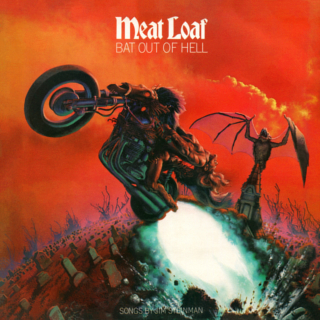
Growing up fundamentalist, even album titles like Bat out of Hell, Meatloaf’s Steinman breakthrough, were enough to scare said toponym right out of me.  I never knowingly listened to any of the songs on that album until after earning my doctorate.  When I did I was hooked.  My research skills had grown by that time to include finding out who the writer of a song was.  I discovered that “Wagnerian rock” really spoke to me.  And the only guy who seemed to know how to write it was Jim Steinman.  Most kids, I suppose, settle into their music tastes much younger, but in my thirties and forties I found Steinman a most compelling artist.  I listened to his older stuff, and his newer stuff.  I found out some surprising things, such as that even Air Supply’s “Making Love out of Nothing at All” was a Steinman song.

I seem to be hopeless at playing musical instruments.  I’ve studied piano and taken guitar lessons, leaving bewildered teachers in my wake.  My wife tried to teach me the recorder.  Despite my failure as a player, music means a lot to me.  I don’t listen to it unless I can pay attention to it.  For me it’s not background noise.  When I learned to identify operatic rock, I soon came to realize that it was the work of a singular genius who was covered by a wide variety of artists.  No one else, it seems, could capture the feeling of being young like Steinman could.  Now he’s gone.  In my noodling around with this thing called Spotify, I wonder if I can discover any more of his songs.  Meanwhile, I’m thankful that I found him when I did.

Leap Night

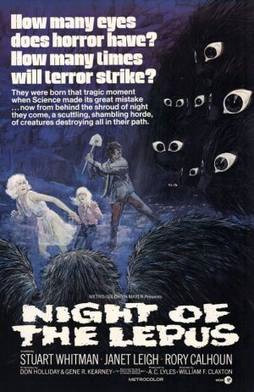
I was quite young when I saw Night of the Lepus for the first time.  Well, I had to have been at least ten, but when I recently sat down to watch it only one or two scenes looked familiar.  Like most poorly done horror films, Night of the Lepus has gained a cult following.  The story is loosely based on Russell Braddon’s comedic novel Year of the Angry Rabbit.  Without the comedy.  Or at least without intentionally being funny.  In an effort to control rabbit overpopulation in Arizona, a new virus is released into the population.  Instead of killing off the bunnies, it makes them grow as large as wolves and become carnivorous.  They go around attacking people with big, nasty, pointy teeth (to be fair, Monty Python and the Holy Grail wouldn’t be out for three more years).

Night of the Lepus was criticized for not being scary at all—a cardinal sin for a horror film.  I was kind of embarrassed when my wife walked in and found me watching it.  Nostalgia can do funny things to a person.  It is almost painful to watch the public officials make such obvious missteps each time they start to get an idea of what’s happening.  They’re almost as imbecilic as the Trump administration was.  Meanwhile rabbits are hard to make scary.  Perhaps William Claxton should’ve read Watership Down.  Ah, but Richard Adams’ classic was only published in 1972, the year the movie was released.  What was it about the mid-seventies and rabbits?  

Part of the problem is that Night of the Lepus takes itself seriously without the gravitas required to do so.  Who can believe actual rabbits are vicious when, to make them monstrous, the movie simply shows rabbits against miniature scenery?  Their human handlers occasionally smear their mouths with red, but a rabbit doesn’t appear cunning and vicious.  And to get them to attack people they had to use human actors in rabbit suits.  I’m a fan of nature going rampant as a vehicle for horror.  Hitchcock’s The Birds did it effectively.  So, I’m told, did Willard (which is remarkably difficult to access with HBO never having released it onto DVD).  The seventies were when ecology began to be recognized as perhaps the most important of global issues.  Half a century later we’re still struggling to reconcile ourselves with it.  Meanwhile the rabbits have begun to appear in our back yard.  They may nibble our perennials, but I’m not afraid.  At least as long as they don’t watch Night of the Lepus and start to get some ideas.


Scary Thoughts

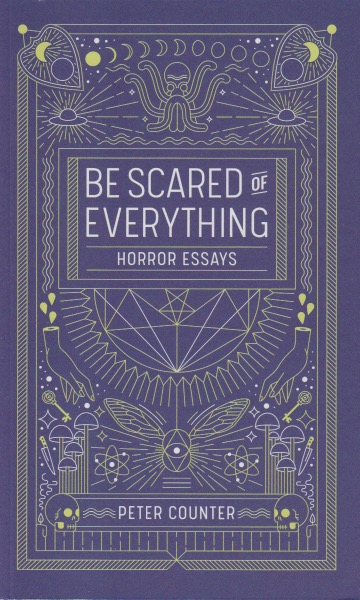
The kinds of places I hang out, online, dictate my reading.  It’s not that I like to be scared, it’s just that I’m honest.  Besides, even when hanging out in person was possible I didn’t do much of it.  So I became aware of Peter Counter’s Be Scared of Everything: Horror Essays.  Like me, Counter’s a blogger (among other things), but unlike me his blog is themed horror.  (This blog has an element of horror but is very roughly themed religion.)  Counter’s book is a fascinating collection of thoughts.  Some of the essays are funny, some are sad, and a few are downright profound.  It’s clear that what gave Counter his crisis was watching his father get shot.  Even those of us who grew up not knowing our dads can see how that experience would traumatize a life.  My own traumas were less focused than this, but we learned the same lesson—it pays to be afraid.

When I was young I never met a phobia I didn’t like.  As I grew older and left home, I came to bring them under control.  You can only get so far in life hiding under your blanket, secretly afraid you might suffocate.  I learned that if I wanted to be a minister—something that never happened—I had to overcome my fears.  Being a parent did it even more.  In order to try to teach your child not to be afraid, you find yourself doing things like scooping up bugs in your bare hands to show that they won’t hurt you.  Like putting a brave face on a truly scary situation.  Like carrying on when everything you’ve built crumbles around you.  Counter’s essays don’t shy away from the difficult things in life.  He’s right: there are many.

I was a monster boomer, but I only really came back to horror after losing my long-term teaching post and longed for career.  Horror helps you cope with trauma.  It gets a bad rap, but mostly from people who don’t understand its therapeutic value.  I don’t like being scared.  Horror, however, reminds me of that cozy childhood feeling of watching monster movies and knowing when it was over the threat would be gone.  Only it never was.  Not really.  Sleepless nights and their febrile dreams may’ve been triggered by the movies, but the realities happening behind the scenes were their real source.  I couldn’t know that at the time, and most of the time I’m not conscious of it now.  Still, I read books like Be Scared of Everything and I think maybe I’m on the right track.


Who’s Upstairs?

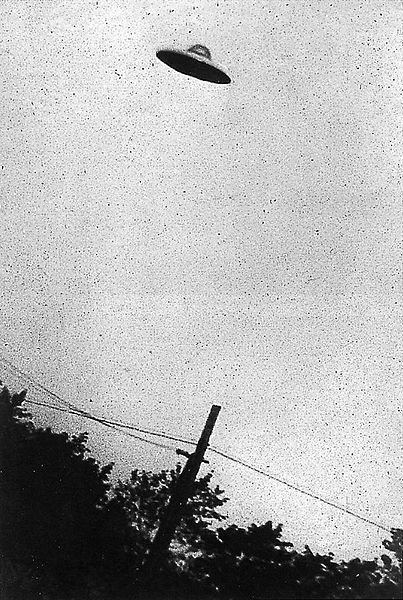
The other day the New York Times ran yet another article on UFOs.  This topic, which has been maligned since the 1940s, is now being discussed without mockery in the mainstream media.  Perhaps following the Trump presidency nothing’s impossible to believe.  There are, interestingly enough, many writers who connect UFOs with religion.  And these aren’t all writing about UFO religions, of which there are many.  Exploring the Outer Edges of Society and Mind ran a piece on biblical UFOs earlier this month.  The topic was taboo, of course, when I was teaching (I remember a colleague laughing when I told him I covered it in a course called Myth and Mystery) but it too is now becoming mainstream.  I don’t need to summarize the Outer Edges piece here since it’s easy enough to follow the link and read, but I would point out that a longstanding connection exists between UFOs and religion.

A spate of books on UFOs came out in the seventies and eighties.  Some of those more or less overlooked by the media focused on religion—often the Bible—and how UFOs play into it.  Quite often the biblicist writers identified these unknown objects in the skies as either angels or demons.  This continues to this day with some congressional leaders (many of whom are too religious for the good of the nation) averring that UFOs are “demonic.”  Frankly, if demons are incorporeal, I wonder why they need to fly around in saucers.  Perhaps they too grew up eating too much Quisp for breakfast.  In any case, the connection was made early and it remains.  When we see something in the sky we used to give it a religious explanation.  Now we chant “drones.”

In his article David Metcalfe begins by noting the forthcoming publication of Alan Steinfeld’s Making Contact: Preparing for the New Realities of Extraterrestrial Contact with the mainstream publisher St. Martin’s Press.  The difference between yesteryear with its Quisp and its flying saucer houses, and today is that people are starting to be serious about the topic.  This, I expect, is one of the benefits of increasing technology.  People are seldom without a camera in their pocket these days and although there are plenty of drones and other strange things flying around, the classic UFO hasn’t gone away.  A generation of people endured ridicule and scorn for being gullible.  Now the gray lady herself is asking questions with nary a smile.  Perhaps we’re becoming more tolerant and perhaps we’re more willing to believe we’re not alone in the universe.  Some would claim that even the Bible got in on the act millennia ago.

Image credit: George Stock, via Wikimedia Commons

Helpful Horror

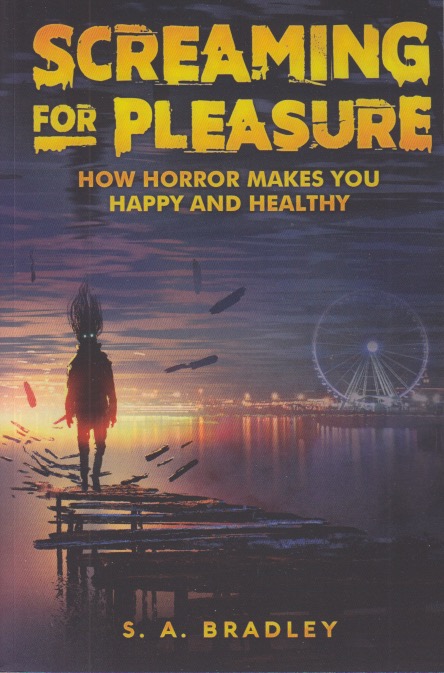
It’s pretty obvious when you meet one.  A horror fan, that is.  For one thing, they’re mostly decent people who often feel like outcasts for their tastes.  They also tend to have a well-developed critical sense for films.  While I’ve never actually met S. A. Bradley, I feel like I know him after reading Screaming with Pleasure: How Horror Makes You Happy and Healthy.  This is a must-read for horror fans and it comes with enticing descriptions of movies you’ll want to see afterward.  Bradley’s range is truly exceptional.  Not only that, but his taste in films leads to an inherent trust that he won’t steer you wrong.  The movies he recommends—the ones that I’ve seen—wholly bear him out.  The man’s a connoisseur.

Perhaps it was because I, like Bradley, was raised in a very religious household, but his recognition that horror and religion are closely related really spoke to me.  With a similar radar toward the religious impact of horror, he notes at several points how the two interact. His discussion includes horror in music and literature as well as cinema.  The benefits of the genre are unapologetically discussed, including the relatively high proportion of women who direct horror compared to other genres.  Unlike other movie genres, horror suffers from a perennial bad image.  Bradley confronts why this is so and also why it is misguided.  The bias is deep and undeserved.  Ironically, many of the same kinds of criticisms are now being leveled at religions as well.

Bradley’s book isn’t about religion and horror.  As someone raised in a religious household and who used horror to cope, however, he understands how the two are related.  Horror can heal.  When those of us in similar settings come to realize that horror is offering a means of getting along in a cruel world, it answers questions in a way that theodicy can’t.  Horror can be an intellectual experience.  It can be thoughtful.  But what comes through here is that it is also honest.  Life is complex and difficult.  Horror doesn’t shy away from that, but brings it out into the open.  I’ve read many books that analyze horror, and there are many more yet to read.  Bradley does something a bit different from many of them—he writes from a broad experience both in life and in the genre and comes up with an eloquent statement about a genre often dismissed.  And those willing to read it come away the better for it.


Movie Demons

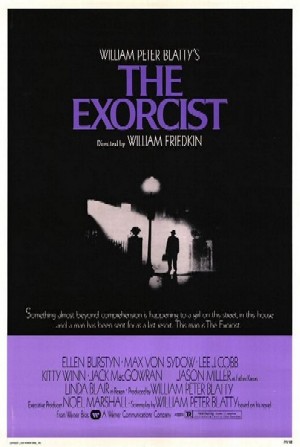
There’s an old tradition regarding demons that even discussing them is dangerous.  This was certainly in my mind as I wrote Nightmares with the Bible, as the topic is an uncomfortable one, at best.  A recent story by Paul Seaburn on Mysterious Universe references this danger in the title “Exorcist Claims ‘The Exorcist’ and Other Horror Movies are Sources for Actual Demons.”  Others have made similar suggestions that merely mentioning a demon is a form of summoning.  The post focuses on Fr. Ronnie Ablong, a Catholic priest in the Philippines, and an exorcist to boot.  Fr. Ablong claims that a number of recent cases involve fictitious demons from horror movies that possess those who watch them.  This is scary by implication and indeed is similar to what I learned growing up.

One of the things researching  Nightmares revealed was that demons in the ancient world come in many varieties.  There wasn’t one origin story behind them and ideas that make it seem that way had to evolve over time.  Of course, you can’t write a book like that without watching the movies and reading lots of books about demons.  It is a creepy thing until you start to reach the point where the material starts to break down.  In the case of Fr. Ablong, the demons come from movies, but often movie demons are based on ancient grimoires that name various entities.  The real question, and one which Seaburn raises, is whether such demons are real.  Given that we don’t know what demons are, and that some of the movies mentioned use made-up demons, such as Annabelle, it becomes suspect.

After finishing Nightmares with the Bible I was ready to put the subject aside for a while.  I’ve got other projects going and it’s important to have some balance, even in horror watching.  Still, the article caught my attention because it was one I’ve frequently heard—the danger of “opening doors.”  Often this is done unintentionally.  There’s no doubt that in the biblical world demons were frightening.  They still are.  Part of the reason is that they are so poorly defined.  In many more recent treatments they’ve become somewhat secularized, but they are, by their nature, religious monsters.  There is some truth to the Mysterious Universe story, however; our modern conception of demons goes back to the movie The Exorcist.  This is something I discuss at length in Nightmares and I don’t want to give too many spoilers here.  The topic, it seems, remains relevant even in our technological era.


Visualizing Twilight

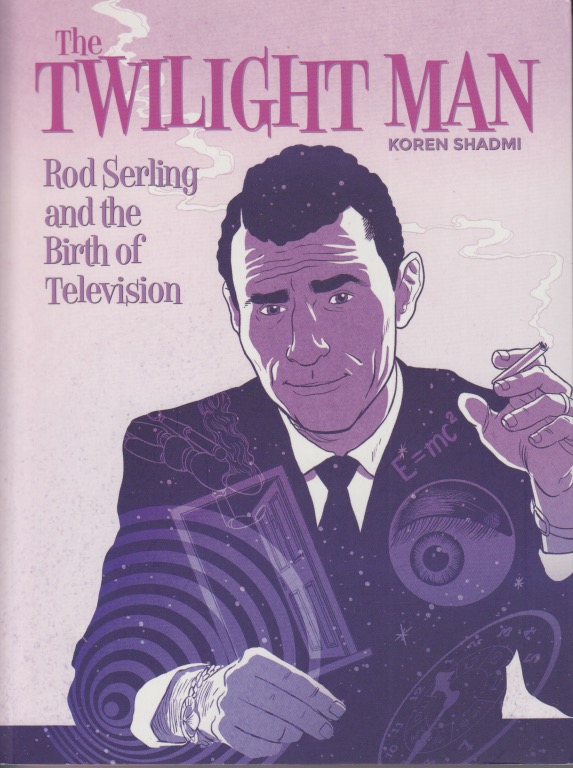
Graphic novels still feel like cheating.  That childhood message that comic books “aren’t really reading” has proven difficult to dislodge.  That, and the fear that we are entering a post-literary world, keep me from reading many of them.  Koren Shadmi’s The Twilight Man: Rod Serling and the Birth of Television, however, caught my attention right away.  Like many other people my age, my thinking was heavily influenced by The Twilight Zone.  As a kid, television had a kind of authority to it.  This is what adults were feeding us.  Although I was hardly intellectual then, I thought deeply about things and one of those things was The Twilight Zone.  The episodes were profound.  The twist endings certainly were among the best on the tube.  Shadmi’s graphic novel of Rod Serling’s life is a tribute to the influence the man had.

For a graphic treatment, The Twilight Man is strangely affective (yes, that’s spelled correctly).  I tend to shy away from hagiographies, and Shadmi’s treatment isn’t one.  It does illustrate, however, how Serling fought against a commercialism that would eventually win out.  Those who control the money control what we see.  Granted, the democratizing influence of the internet has let competition arise from unseen quarters—there are young people who watch YouTube to the exclusion of television altogether—but few shows manage the impact that The Twilight Zone had when there were only essentially three large networks.  Now we have so many choices that cultural reference points are rare.  Those who’ve never seen it, at least for the time being, know what The Twilight Zone is.

This book is biographical, based on published biographies.  There’s something about knowing, however, that the episodes actually happened.  Being in combat (as Serling was) puts some people into their own kind of limbo.  At least one person in my own family was irrevocably changed by fighting in a war.  The remarkable thing is that Serling came out of it wanting justice for all people. The book even points out that he became a Unitarian, although it doesn’t dwell on that point.  Some things, such as spiritual insights, are difficult to illustrate I suppose.  I can  see why Shadmi’s tribute receives good press.  Graphic novels are a means of telling a story that moves people.  I re-learn this each time I read one, which is something I rarely do.  Now that I’m starting to explore this genre I’m perhaps learning to address my own prejudices.  As long as there are still words to read.


Story Over

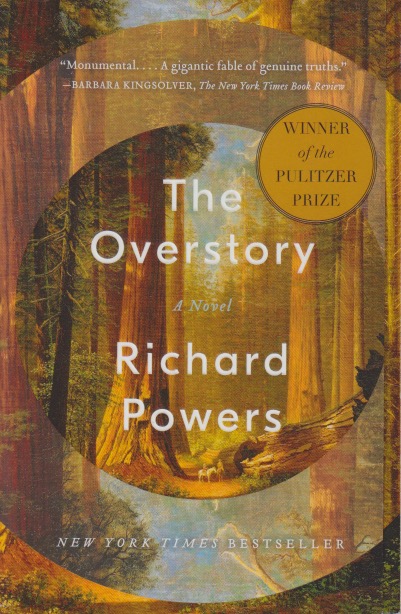
Despite my penchant for speculative fiction I tend to read a lot of what’s usually categorized as literary fiction.  These tales don’t fit into any genre and are often colored with realism.  More than one person had recommend Richard Powers’ The Overstory, not least the Pulitzer Prize committee.  In the style of novels these days it’s pretty long and that meant I had to build up the courage (and time) to get to it.  I support the environment.  I have a great respect for trees and try to support conservation any way I can.  The Overstory is, however, a bleak vision of what we’re doing to the planet and to other living beings.  It certainly helps to have read Peter Wohlleben’s The Hidden Life of Trees first.  It helps to know the main premise of the novel is based on non-fiction.  There may be spoilers below.

The first part of the book, Roots, introduces us to the various characters—most of whom will interact in the remaining pages.  Most of them are marked by tragedy in their lives and come to realize the longevity of trees has a perspective that can make sense of what, to our lifespans, seems inexplicable.  Several, but not all, of them end up in a conservation group trying to defend old growth redwoods from the insatiable greed of lumber companies and politicians.  The novel ends happily for none of them.  Trees, however, have the ability to outlive us.  While we cause real damage, they have the ability to regenerate, but in ways that none of us will live to see.  Trees see beyond the short, tragic lives we lead, into what may be a more hopeful future.

The other sections of the book, Trunk, Crown, and Seeds, follow events chronologically as the people age.  Some notable deaths among the group have a great impact on the small coterie of those protecting trees.  An unfeeling state and the corporate nature of laws are clearly on display.  They serve the will of those who can’t, or won’t, think differently about the world and our place in it.  Although the novel doesn’t ever cite the source, one of the eco-heroes finds a verse from Job to be of tremendous consolation: “For there is hope of a tree, if it be cut down, that it will sprout again, and that the tender branch thereof will not cease.”  I was glad to see the connection made, but the book left me emotionally exhausted.  With speculative fiction at least you can escape the real problems of this world for awhile.


Holy or un?

It’s either brave or stupid.  Maybe both.  Writing about a movie you haven’t watched, I mean.  Multiple people (do I have a reputation, or what?) have pointed out to me that Good Friday (for some) is the release date for The Unholy.  Since Good Friday’s a week away I guess we’re getting an early start this year.  The Unholy is a new horror movie and although I try not to watch trailers before seeing a movie—too many of them show too much in advance—I already have a sense of what it’s about.  This post isn’t really about the movie, however.  It’s about the bigger issue.  The concern many have is that it’s being released on Good Friday.  One thing I’ve learned is that to get attention you have to shock people, no, Donald?  Getting noticed is difficult and outrage generally works.

Friday, for many, is movie night.  Good Friday is, for some Christians, a day for church.  I’ve yet to have an employer (other than Nashotah House) that recognized it as a special day at all.  Easter always falls on Sunday so there’s no need to give time off work, at least in this capitalist, Christian culture.  But if you try to release a horror movie that day, people notice.  Mel Gibson knew that crucifixion could make the basis of a horror film, and people noticed.  Sitting over here in the backwaters just outside academe, I took to horror as a means of keeping my book writing active.  One reason was that horror gets people’s attention.  (It also helps if your books are reasonably priced.)

As a young man I used to spend a good deal of Good Friday in church.  Since I was serious about school I’m thinking we probably had the day off in my district.  Attending a Christian college, followed by seminary, I suspect these also paid attention to the liturgical year.  Then in the real world I learned the truth—it’s just another day.  A day for going to work and increasing the profits for whatever company may have hired you.  When the day’s over you’ll be inclined to relax, and perhaps watch a movie.  Right now going to a theater opens the possibility for horror itself so I won’t be there on opening night for The Unholy, but I think there was some savvy thinking going on, in any case.  And it may just be that the movie was titled specifically to fit the occasion.


Horror Story

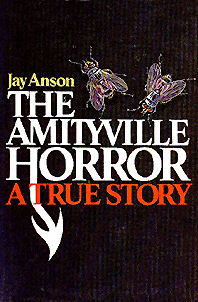
Last week, according to an article a friend sent, Ronald DeFeo died in prison.  DeFeo was made infamous by the Amityville murders in 1974 that led to the Amityville Horror franchise, a series that I covered in Nightmares with the Bible.  Many of the other individuals in that famous haunting/possession have also passed away, including both George and Kathy Lutz, the owners who bought the house and brought it to the public notice.  Controversy still surrounds the story with some claiming it was all a hoax and others suggesting that the hoax doesn’t add up to the sum of what happened there.  DeFeo and the Lutzes were all considered unreliable narrators—DeFeo because he was mentally unstable and the Lutzes because they made money out of their misfortune.  If anything can complicate truth, it’s money.

Academics, of course, won’t touch the story.  Claims and counterclaims, all swirling around lucre, fog one’s vision.  The story illustrates just how difficult it can be to get at the truth.  Even allowing for exaggeration, it seems something happened there.  A worldview that dismisses any possibility of spiritual entities—however defined—will necessarily come up negative.  No doubt, considerable money changed hands.  The franchise is still going with no less than four movies being released last year with Amityville in their titles.  Getting at the truth involves decided which human beings you trust.  The one Lutz child that has been willing to talk, Daniel, has continued the claims.  How can we ever know?

I object to those who claim that such inquiry is a waste of time.  If such things as claimed in Jay Anson’s book do happen (even if exaggerated), it may be that they’re exceptionally rare.  Rarity of objects in the physical world is seldom in doubt.  Ask any auctioneer.  Getting into the accounts around the events, however, betrays a list of money-seeking individuals.  Just about anyone making a counter-claim had a book deal in mind, and given the phenomenal success of Anson’s original the possibility of getting to the truth after that would always involve wading through greed.  No wonder politicians so easily become crooked!  Money makes people do strange things.  Not surprisingly, those left with questions regarding the truth of the matter are left hungry.  It’s clear that Ronald DeFeo killed his family.  It’s a matter of record that the Lutz family moved into the house just over a year later and moved out without their belongings less than a month after that.  Beyond this what happened is less and less likely ever to be known.


Old Wolves

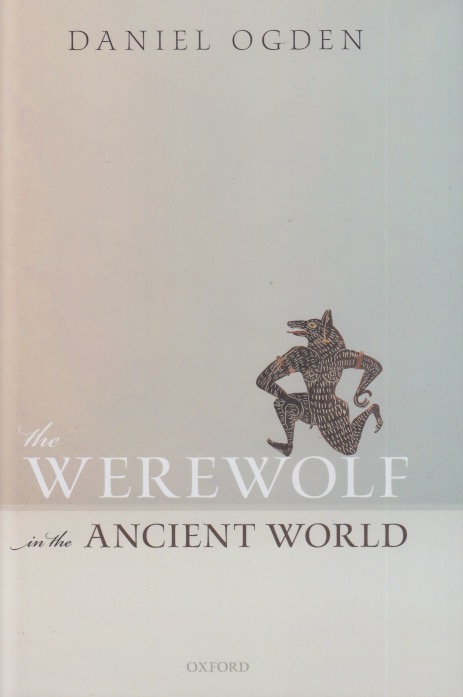
Among the classic monsters, the werewolf seems to suffer from lack of a foundational novel.  Yes, vampires are older than Bram Stoker’s Dracula, and antecedents can be suggested for Mary Shelley’s Frankenstein, but there isn’t a werewolf novel of similar stature.  Daniel Ogden, however, does us a service by providing an extended discussion of, as his title states, The Werewolf in the Ancient World.  His survey is intriguing and informative, and also insightful.  The werewolf is not always what it might seem.  Ogden is an able guide through sources from antiquity through some medieval tales, focusing mainly on the ancient ones.  He extensively explores their associations—witches, sorcerers, ghosts, and the like.  And related tales of human transformation.  He even suggests what some of those transformations may have been seeking.

The werewolf is perhaps the most obvious monster that expresses repressed desire for transformation—a kind of salvation.  Civilization comes with a cost and the werewolf is symbolic of the individual driven by animal desire, unrestrained by human convention.  It’s also an idea of great antiquity.  Although Ogden doesn’t go into it, stories of humans turned into wolves goes back at least to the Epic of Gilgamesh, one of the earliest pieces of literature we have in fairly complete form.  The idea is attested in writers such as Plato and Augustine, if only to refute it.  In other words, it is clearly something people have thought possible from very early times.  Our long association with the wolf, and its domesticated version—the dog—certainly plays a psychological role in such tales.

As Ogden points out, Guy Endore’s novel The Werewolf of Paris, published in 1933, is perhaps as close as we come to a foundational novel.  In the Universal monsters series that developed a canon for monster boomers, The Wolf Man was a somewhat late entry, appearing in 1941—a decade later than Dracula and Frankenstein.  Despite these tardy cultural appearances, the werewolf has been part of our collective psyche far longer.  Ogden shows that clearly.  When you stop to rethink stories like Little Red Riding Hood, the talking, humanized wolf appears so naturally that we don’t often stop to consider the implications.  I certainly hadn’t made the connection explicitly until reading it here.  Ogden’s work is readable but academic, so be prepared for citations and some technical talk.  Nevertheless, this is the clearest guide to lycanthropy and the magical ideas behind it from ancient times to have appeared in recent years.  


Space and Time

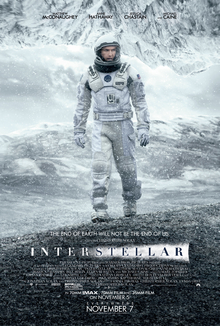
Keeping up with movies could be a regular vocation.  Until it is, however, I will always be running behind.  Seven years ago I planned to see Interstellar in the theater.   Seven years ago we had not dreamed of Covid-19 or a planetary pandemic.  I can’t see now how I would’ve possibly been too busy to have missed it.  If any movie, however, forgives the time-challenged, it’d be this one.  Apart from perhaps being the ultimate father-daughter movie, it plays with time like Inception plays with space.  Or space like it plays with time.  Einstein gave us the laws of relativity, and if they hold up when we finally get to interstellar travel (which has already happened on the space-time continuum somewhere), this is perhaps not at all unlikely.

Back in my teaching days I used to tell students that if they didn’t read at least one book during the summer or winter break that didn’t challenge their worldview then they’d wasted that break.  It was something I did my best to live up to.  Informing yourself—challenging your views—is a feature of education at which we seem to have failed.  Movies like Interstellar are examples of such challenges, albeit in the guise of fiction.  I’ve come to trust Christopher Nolan over the years.  His movies are cerebral yet moving, making us look at things from angles we didn’t know had existed.  I grew up watching not just horror, but also science fiction.  While I gravitated toward the former, I never lost my appreciation for the latter.  Especially when the latter made me think.

Much of Interstellar is, like the best of movies, is informed by previous films.  The influence of 2001: A Space Odyssey is pretty clear, as is that of Contact.  The idea at the center of Interstellar is that love drives the five dimensions in which Cooper finally ends up.  The love of a father for the daughter he had to leave behind and her love for the father that had to abandon her to save the world drives the entire plot.  To me this seems the right balance between science and spirituality.  Love is humanity at its best while science is some of our most advanced thinking at its best.  To recognize the strength of the former is important in a world increasingly driven by technology.  It took me, it seems, a full hour on the water planet to find the time to watch Interstellar.  It is time I won’t get back and I could have used some of it wisely by watching this movie sooner.


Your Viewing Pleasure

I watch a lot of movies.  Well, I used to before the pandemic stole much of my free time.  We have a closet full of DVDs.  At least they’re not VHS tapes.  The problem with VHS tapes was that they wore out with continued playing.  I’ve read that magnetic tape is still the most stable storage medium, but the DVD, with no moving parts, seemed like an improvement.  Lately we’ve had several DVDs go bad.  I’m not sure that I wanted to know there were such things as disc rot and laser rot, but there are.  And some of these were discs that weren’t cheap.  The alternative these days is streaming.  The problem is streaming services go out of business and you’re left without money and without the movie.  There’s a reason vinyl’s coming back, I guess.

Remember when you had to wait to see a movie?  When you had to either see it in a theater or wait years until it was broadcast on television on a certain channel at a specific time?  You lived your life normally, and the movie was a rare treat for those who had specific fare in mind.  Now we get movies “on demand.”  It’s death by a thousand cuts, though, since if you’re really in the mood for a film that’s not on Netflix you’ll pay to see it on Amazon Prime.  Used to be you can buy a disc—a one time expense—or was it?  Chances are in the early days you were replacing a VHS tape you’d already bought.  You may’ve sighed in relief when UltraViolet came along.  But you’d have sighed too soon.

These things bring eastern and southern Asian religions to mind.  (Consider the source.)  While I’m not an expert on the religions of east and south Asia, I’m familiar enough to know that their basic concept is that the only thing permanent is change.  Western societies are built on the demonstrably false concept that a steady state is permanent and that change comes once in a while.  In fact, our entire worldview is based on things remaining the same.  Perhaps that’s why conservatism is such a strong force in western thinking.  It is, however, an illusion.  The pandemic has given the lie to our steady-state thinking.  And if you cope, as many do, by watching movies you’ve probably signed up for a subscription service or two.  It will serve you well, for the moment.  You certainly can’t run to Blockbuster to pick up your favorite flick any more.  If only I had more time, a movie might have the answer.


J-Horror

J-Horror better move over.  There’s a new kid on the block.

For many years those of us strange fans of horror have used “J-Horror” as shorthand for Japanese Horror.  With two highly successful films (eventually series) of the mid-nineties (Ju-On and Ringu) the Japanese contribution stormed back into American consciousness.  Those of us who grew up on Godzilla knew that J-Horror had been around for decades already, but these new movies were distinctly creepy.  So much so that English-language versions were remade for both original films (The Grudge and The Ring, respectively—rather like Let the Right One In and Let Me In).  So far, so good.  So why does J-Horror need to move over?

At least three separate friends have pointed me to another emerging J-Horror trend: Jewish horror movies.  These used to be rare.  With cases of early antisemitic themes in horror, and the real life horror of the Holocaust, this is certainly understandable.  “Christian” producers or directors delving into Jewish themes would seem to be in bad taste.  Still, some notable Jewish-themed horror has begun to emerge.  (I addressed one such film in my recent Horror Homeroom piece.)  The Possession (discussed in both of my most recent books) centers around the need for a Jewish exorcist in the case of a dybbuk problem.  For more information, you know where to look!  It seemed to me that the dybbuk box contents were reminiscent of the Holocaust, but that may not have been intentional.

I recently wrote a post about The Golem.  This is a recent Israeli movie that builds on the traditional Jewish monster.  Although set before the Holocaust, the fact that there’s a pogrom in the film shows that the concept is not far off.  The movie that people have recently been pointing me toward is The Vigil.  I’ve not had an opportunity to see it yet, but the press it’s received suggests it too will be another classic based on lived experience in Judaism.  I’m not sure if Jewish horror will eventually rival the numbers of Japanese horror films, but the offerings thus far have been noteworthy.  Horror often addresses the problem of human suffering.  With all the oppressions in “white” society, it’s no wonder that, along with Black horror, Jewish horror is beginning to garner attention.  Although it’s clearly not to everyone’s taste, horror is often a genre with a conscience.  It becomes a screen on which we can see our worst behaviors projected.  And if we’re wise, we’ll take steps to make such suffering become merely an unfortunate memory.


Tomorrow’s Brainchild

The voice of one person is very small.  Even a guy like Donald Trump wouldn’t be the terrible threat to this nation that he is if nobody would pass on the nonsense he says.  I often think of this because internet personalities are always have to remind their fans to share their posts.  It’s a simple thing—click “share” and more people find out about something.  What if that something were free?  Isn’t something free worth sharing?  So tomorrow I’ll be participating in Virtual Voices Author Fair: A Day of Nonfiction Books, a small Zoom conference from one to five, to talk about Holy Horror.  Various readers over the years have asked if they can get a discounted copy—like most conferences this one will have a discount associated with it.  Stop by if you have the chance!

The variety of the books being discussed is pretty wide.  Topics will cover many of the areas for which the publisher McFarland is known: television, film, music, politics, the outdoors, and more.  A schedule may be found here.  For those of us who have been (or the lucky who still are) academics, the conference is a sacred cow that has largely been sacrificed to the pandemic.  Getting together with others to discuss ideas is important—the funny thing about ideas is that they often arise from talking with others.  For three years, for instance, the American Academy of Religion offered a session on monsters and monster theory.  That would never have happened if I hadn’t had a discussion with a friend and colleague who shared that interest.  If it’d been only me, it never would’ve transpired.  Sharing is important.

One of the things about generations is that mine (no longer the younger one), is still trying to wrap its collective head around this internet thing.  Now we feel like a bunch of avatars with no onboarding.  We don’t think in terms of clicking a share button.  We still feel like browsing is an individual thing.  They young people I know tend to think of the internet as a place for community.  It’s easier to find like-minded people there.  Unlike school (and often work) where you’re thrown together with people who may or may not share your interests, the web offers places where you can find others who share your interest.  If you’re interested in the kinds of things that you’ll find in the media, and if you have a few minutes tomorrow afternoon, feel free to stop by the Virtual Voices Author Fair.  If you land on their Facebook page, it’d be great if you’d click the share button.