Ghost Stories

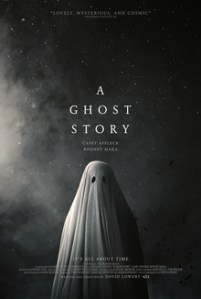
Those of us who confess to watching horror are fond of noting that the Christmas season has long been associated with ghost stories.  Charles Dickens wasn’t the first to make use of the trope and certainly won’t be the last.  After reading about elevated horror movies, I decided to watch A Ghost Story (David Lowery, 2017).  Many wouldn’t classify the film as horror at all.  It is quiet, slow paced, and has no gore.  It is nevertheless a haunting film.  I suspect its poignancy comes from a situation we can all imagine and which many people face in life—being left alone after the death of a loved one.  The idea that the dead never really leave us can be both comforting and unnerving at the same time.  The film plays to those strengths.

The premise of the film is simple: the ghost of one of a couple finds his way home and tries to reconnect with his widow.  He ends up staying there until, many owners later, the house is demolished and a high-rise is built in its place.  It’s essentially a story from the point-of-view of the ghost.  There isn’t too much dialogue included, but one significant monologue comes when a party is being held.  One of the party goers, or perhaps the current owner of the house, explains that because of what we know of physics everything on our planet will eventually be destroyed.  His beer-fueled lament is that whatever we do is therefore in vain.  He brings God into the discussion.  The ghost listens intently, but seems to disagree with his conclusions.  For someone like me the introduction of religion into the story is a Venus fly-trap, since religion and horror can’t seem to keep away from each other.

Death is a dilemma, a point that I made in a recent Horror Homeroom article on Pet Sematary.  Horror, like religion demands that we confront it.  Science can only offer cold comfort regarding the cessation of life.  Religion (and horror) open the dialog into the unknown, the realm into which mere human instruments cannot reach.  Sad and reflective, A Ghost Story hits on an essential question in the nexus of religion and science.  If a spiritual world exists, there may be some survival even of the earth’s eventual heat death.  As time passes, the titular ghost continues to learn.  Life is a learning experience, and although many modern forms of religion join in the cultural denial of death, horror is always ready to remind us that confronting it may be the wisest course of action.  Ask the ghost.  He knows.

Religion Prof

Back in 2009, when Sects and Violence in the Ancient World started out, there was a fair bit of interest.  At one point I was listed among the top fifty “biblioblogs.”  Back in those days I got to know James McGrath, the curator of Religion Prof, a great blog now hosted on Patheos.  If you want a finger on the pulse of what’s happening in religious studies, you should read him.  With an energy I can’t conceive, he posts interesting stuff every day, even while being a professor.  And like me, he’s fascinated by religion and pop culture.  He also understands something—links and likes and shares are important.  People in my generation and beyond often don’t think that clicking that little thumbs up will do anything.  It does.  More so, that share button.

I was really pleased when James agreed to do a virtual interview with me about Holy Horror and Nightmares with the Bible.  You can find the interview here—and be sure to recommend and share it.  James has several interesting books of his own.  You should check them out.  The world of religious studies (and dare I claim it, biblical studies) is hardly moribund.  Underfunded, yes.  Socially devalued, certainly.  But alive nonetheless.  James’ blog is proof of that.  My regular readers will know my usual jeremiad about how higher education has been treating religious studies.  You see, I’m an historical thinker.  Where we come from is important.  Higher education began because of religion.  Its origins lie in monastic communities preserving learning—some of it secular—for the good of the world.  Now administrators looking for a department to cut know just where to turn. Shouldn’t we treat our ancestors with a little more respect?

I’m forcefully reminded of the many times analysts have declared that religion would fade away.  The claim has been made multiple times over the centuries.  At the same time scientists studying humankind conclude that religion is good for us, and that we’re naturally inclined to it.  Of course we should cease studying it!  Well, Sects and Violence in the Ancient World has also evolved over the years.  Not all of my posts are about religion anymore.  Most of them touch on it, however, because I’ve studied it my entire life.  Not only did religion make Homo sapiens what they are, it also formed some of us individually in ways so profound that we’ll never escape it.  Some of us even wear it proudly.  Great job with the blog, James, and thanks for the shout out!

Remember the early days?


Monster Guides

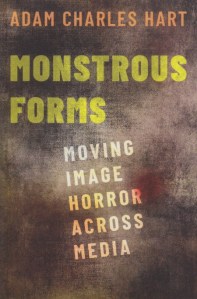
Reluctantly, almost begrudgingly, society seems to be accepting horror as a genre of more than cheap thrills, blood, and gore.  From childhood I was drawn to the gateway figure of vampires, but I’ve never been a fan of blood and gore, and not even cheap thrills.  You see, I saw something profound in horror.  A longing.  Experts might call it abjection, but to me there was a spiritual component to it, and I watch these kinds of movies to capture those moments of transcendence.  Adam Charles Hart seems to be aware of the draw horror has.  Monstrous Forms: Moving Image Horror across Media still shows its origins as a dissertation, but it has an appreciation for horror that doesn’t feel the need to make excuses for it.  Exploring the body-focus of horror, it delves into television, gaming, and other applications of the genre.

I have to admit that I don’t understand the cultural fascination with what we used to call video games.  I know they’re tremendously popular and the rights for gaming bring in even more royalties than sold movie rights do.  I just don’t get it.  Still, Hart explores how horror has become a very popular element in the gaming community.  Not only that but on the internet many young people like watching videos of other people playing games.  I’m sorry, but I’m just not that meta.  If I want to get lost in other worlds I read a book.  Or watch a movie.  And this is where Hart’s book shines.  His read on horror films is fresh and compelling.

Recently I had a conversation (virtual, of course) with some colleagues about the horror genre.  The topic of horror games came up.  I had to sit that part out.  I commended Hart’s book though.  For me time is too valuable to immerse myself into worlds where options are limited by some programmer’s imagination.  Movies will take a couple hours of your time.  If well done they’ll remain in your head for hours or days, interacting with other thoughts and experiences, and perhaps even inspiring the viewer.  If horror isn’t your thing, I get that.  I do have to say that the genre as grown up, and as Hart points out toward the end of his study, academy recognition of a couple of horror films in 2017 bodes well for the future of a genre that seems more and more applicable every day.  And when horror comes to town we’re going to need some able guides.


Time for Golem

I don’t claim to understand how the film industry works.  My two books on horror and religion deal with interpreting the movies, not their native cinematic environment.  I say this because I limited my treatments in them to films with a theatrical release.  Mainly this was so that readers would have had easy access to them.  Some films, of course, never go to theaters and it seems that happened, in the United States, to the Israeli movie The Golem.  I saw a trailer for it last year and patiently waited for it to arrive.  I recently found it on an online streaming service and finally had a chance to watch it.  Golems, as original Jewish monsters, have shown up in a variety of popular media including The X-Files and Sleepy Hollow.  Film treatments have been rare, and this one makes for a fascinating monster movie.

What makes the golem so compelling is that it is an explicitly religious monster.  To create a golem (according to the film) the maker must use Kabbalah, Jewish mystical texts, to learn how to bring it to life.  Hanna (Hani Furstenberg), the female protagonist, is the only one in her seventeenth-century village willing to try.  The real hook, for me, is that the golem she creates is a little boy.  The role must’ve been fun to play.  Golems cannot speak, so there are no lines to learn.  Kirill Cernyakov nails the part with an ability to portray emotionless menace.  The problem with a golem, you see, is that it goes on rampages, killing even those it’s conjured to protect.  Since the movie is intended to be a retelling of the classic story (involving the golem of Prague), it doesn’t have too many surprises.  It is, however, a thoughtful movie.

Write-ups on it call it “the Jewish Frankenstein,” but scholars who research Frankenstein often go the other way, seeing Frankenstein’s monster as a form of golem.  The basic idea is taking something inert and bringing it to life.  Afterward the creator is unable to control it.  It’s too bad that The Golem didn’t get a wide theatrical release.  I’ve seen far worse horror films that did.  Perhaps the focus on religion was too blatant?  One of the points I make in Holy Horror and Nightmares with the Bible is that religion and horror belong together.  Some Jewish viewers will undoubtedly spot inaccuracies (even this goy did) but the movie isn’t a religious text.  It is an appropriate rebuff to Trumpian “politics” and even features a plague.  It is a movie for our time.


Believing Beyond

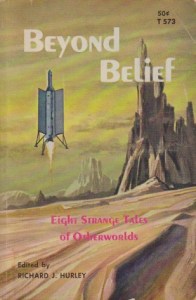
The closing line “I’ll come back to you—in the sunlight” is all I remembered from this little book.  Perhaps I hadn’t read it all the way through, but likely I did.  An unapologetic fan of science fiction as a kid, I must’ve picked up Beyond Belief at a fairly young age.  Although it’s a Scholastic book, it is appropriate for older readers as well.  I picked it up again because I start to get anxious when I can’t post about a book for a while.  My current reading projects are either very long or somewhat technical, meaning they take time to finish.  I’m running out of my ready stock of shorter books (mostly collections of stories from the time before book prices were hiked up and publishers felt the need to make them thicker so consumers wouldn’t feel so cheated.

I had put off reading this collection edited by Richard J. Hurley because of that one story I remembered.  As a kid I recognized the name of Isaac Asimov, but probably not that of Theodore Sturgeon, Richard Willey, or Richard Matheson.  These stories were masterpieces of sci-fi in its golden era.  Although they seem antiquated—perhaps even quaint—now, they are the kinds of stories that inspired young pioneers of space travel and may have contributed in some measure to this strange world in which we live.”Phoenix” by Clark Ashton Smith, has stayed with me for decades.  This tiny tome is old enough that I’m not going to worry about spoilers.  I’m only grasping for an emotional thread with childhood.

The sun has gone out.  Two young lovers talk on the eve of the earth mission to reignite the sun by a series of thermonuclear reactions.  The male, of course, is on the mission, but he assures his love that he will return to her in the sunshine.  Something goes wrong, of course.  The ship crashes into the sun, reigniting it, but annihilating the ship and crew.  As the future lady looks out on the newly illuminated world, she knows her love cannot have survived, yet he has returned to her in the sunlight.  That powerful story of self-sacrifice and love left unfulfilled stung my young psyche.  So much so that reading the other seven stories in this book was like reading tales I’d never heard before.  Beyond Belief was a quick read interjected in much more  complicated literary endeavors.  Like childhood, it didn’t fail to bring a warm glow after far too many years.


No Dolls Required

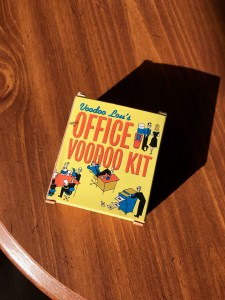
Moving is a never-ending process.  We’ve had some new neighbors move in next door over the past couple of weeks.  Seeing their boxes reminded me that we have many we still haven’t unpacked and sorted after over two years.  (That’s what attics are for.)  One of the novelties I found while doing so recently was one of those bookstore impulse buys at the checkout counter, “Voodoo Lou’s Office Voodoo Kit.”  This was actually a joke gift given to my wife some years ago.  In all probability it was me that insisted we not throw it out.  Perhaps I was saving it as an object lesson.  One of the religions I very briefly discuss in Nightmares with the Bible is Vodun.  This African diasporan religion is frequently demonized as “voodoo” because of its supernatural beliefs.

Many religions, of course, harbor supernatural beliefs.  The ballots are still being counted on whether such things exist because we can never wrestle them into the laboratory to measure them with instruments designed for physical applications only.  Vodun isn’t the source of evil perpetrated by the cheap (and often exploited by horror) “voodoo doll” narratives.  It is a complex blend of traditional African religions brought into forceful contact with Roman Catholicism.  We shouldn’t treat it as exotic, nor should it be a codeword for evil.  Like most religions vodun is an attempt to navigate the world of the gods and spirits that people everywhere believe in, even if they can’t be quantified.  The religion was mysterious when first noticed by travelers from the United States and it quickly became fodder for horror films.

We tend to judge religions just because they’re different.  One of the more insidious aspects of global religions is that they create the illusion among their believers that they are the “only true religion.”  Those who study religion professionally know that all religions are “syncretistic.”  There is no such thing as a “pure” form of any religion.  Just try getting a Calvinist and Catholic to come to a common understanding of what Christianity is.  Both want to claim their version as the true one.  Religions, however, have developed as ways for people to cope with the world as they’ve experienced it.  Just because fewer people believe one way we can’t assume their religion is inferior.  Vodun, in which I’m no expert, is far more complex and sophisticated as might be suggested by and impulse buy for frustrated office workers.  Still, it works as an object lesson.


New Twilight

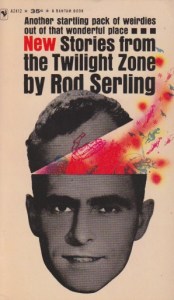
The strange thing about The Twilight Zone is its ability to endure in the minds of those exposed to it at an early age.  Often it’s more the image of it, that feeling of awe and wonder, that remains with me.  Rod Serling cut a sophisticated figure with what, for the time, was an unbounded imagination.  New Stories from the Twilight Zone was the last of the three standard collections of his tales.  Another book of stories published the same year, From the Twilight Zone, is a little difficult to pin down from online descriptions.  It’ll probably be the subject of a future nostalgia-laden post.  Reading the current collection is like déjà vu; some of the stories I remember from seeing on television, and others I’d probably read before.

In some ways these stories are time machines.  A slice of the early sixties.  The cover of my edition emphasizes that dramatically with Serling’s head hinged open and colorful ideas (“weirdies” in the copy) flying out.  Over half a century later the Zone continues to fascinate, despite the obvious context in which Serling originally wrote.  The enduring nature of his contribution somehow validates me, and probably many other kids of the sixties too.  The stories all suggest that the world isn’t quite what it seems.  It relates to what I posted on a couple days back, the weird, the eerie.  In other words, these are good stories.  Timeless in their own way.  Reaching back toward childhood, they help with the aging process.  

Weird tales have become a popular genre, and I suspect the popularity is due largely to the internet.  Those of us who liked stories such as these were an earlier generation of nerds (of the non-technical variety), those who didn’t find sports or girls or controlled substances—the more mainstream forms of diversion—to our liking.  We were perhaps misfits, but we knew we could well find a place in The Twilight Zone.  This may have been its great, subliminal draw; anyone could find her or himself in the Zone.  Some of the narratives were scary, some were funny.  Others were just odd (“weirdies”).  But they could sell books and Serling was able to make himself a household name through his imagination.  The internet has, in turn, made it more difficult to get noticed in its democracy of expression.  Indeed, it has become a twilight zone of its own.  At least it’s one where it’s a simple matter to still find the books that made us who we are.


Timely Terror

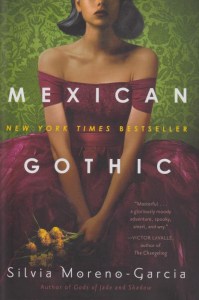
Fear comes in many colors.  Silvia Moreno-Garcia’s Mexican Gothic was getting such positive press that I didn’t wait for the paperback.  At first the title threw me a bit, but creepy old houses can be found in many places around the world, and the gothic often lurks in such structures.  The story builds slowly until the supernatural begins to seep in steadily and the reader realizes they’ve been hooked along the way.  In some ways it reminded me of Jeff VanderMeer’s Annihilation, but the setting in Mexico gives Moreno-Garcia’s tale its own kind of zest.  Having a strong hispanic, female protagonist is a nice corrective to the political rhetoric we’ve been fed for the past four years.  As I said, fear comes in many colors.

Perhaps I’m not as afraid as I used to be when I read fiction.  Gothic, however, is all about setting the right mood.  It’s a creepy sensation that boundaries are being crossed and such things often take place in isolated locations.  The house owned by the Doyles—not exactly colonialists, but symbols are seldom exact matches—is marked by greed and power.  A kind of rot is everywhere evident, but the family must keep power within its own circle.  The parallels to a Trumpian outlook were perhaps not intentional, but national trauma can make you see things in a different way.  As Noemí attempts to rescue her cousin from the house, High Place itself participates in thwarting their escape.

Reflection after reading draws out some further insights.  Not only is the white Doyle family the  oppressive element here, they do so by religion.  Secret rituals and practices have made the patriarch a god—and here let the reader ponder—who builds his power on the oppression of others.  I have no idea if Moreno-Garcia was influenced by the nepotistic White House we’ve just experienced—eager to use political office for overt personal gain, and yes, worship—but she’s laid bare the ugly truths of white power.  I dislike racializing people, but race was invented by Europeans as a mean of oppression and keeping wealth within the grasp of a few individuals who would be surrounded by an empowered “white” race.  It worked in Nazi Germany and it came close to working officially in the United States that fought to vanquish it just seventy years ago.  Mexican Gothic is a moody book indeed.  It’s also a book, whether intentionally or not, that is an object lesson for our times.


Aging Music

Poignant is the word that comes to mind.  Perhaps in stark contrast to my listening to My Chemical Romance, I’ve also been listening to the latest albums by artists such as Bruce Springsteen (Letter to You) and Meat Loaf (Braver Than We Are).  And Leonard Cohen (Thanks for the Dance).  In the last case the album was so late as to be posthumous.  Before that I spend quite a bit of time with David Bowie’s Blackstar.  These albums are, at least in part, about growing older and dying.  Now death is nothing new to rock-n-roll, but it seems as if as some of my favorites age they’re sending a message out from the autumn of their careers.  We may still be here, but we won’t be forever.


I’ve never really been afraid of dying.  In fact, as a kid I often imagined myself as an older man with some anticipation.  Now that I’m approaching that threshold of elderhood the view is just a touch different than it was to a small boy with a lifetime in front of him.  Leonard Cohen, at least, was dealing with aging as early as Various Positions, the album where he gave the world “Hallelujah.”  And Springsteen has toyed with it in various places, such as Devils & Dust.  What I’m hearing in these songs, however, is a kind of acceptance that isn’t really fearful at all.  It’s as if rock suddenly matured.  So many of the original pioneers died young and tragically, and those who survived have been calling to us like ghosts to let us spend our worn-out days in peace.

Perhaps it’s just that it’s November.  Light is becoming a rare commodity, and it will remain in short supply until around the middle of March or so.  Music helps us through the transitions.  There are albums that convince me I’m immortal.  If I weren’t so tired at the end of the day I might continue to believe that.  On a weekend when I had a few free moments I went to a local CD store.  Wearing mask and gloves, I could see that only people about my age were there to buy actual discs.  We’re not the streaming generation.  It gave me some comfort to see the names of bands I’d almost forgotten.  These artists, of course, will continue to live on after they’re gone.  They’ve left us a legacy.  We’d be wise to consider their advice from time to time.  And take a moment or two to reflect on the coming of December.


Demonic Monsters

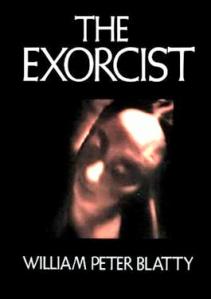
One of the perils of writing books is that you often realize something after the book has gone to the printer.  Book production is a lengthy process.  I submitted the manuscript for Nightmares with the Bible in January.  The procedure of getting it ready has stretched eleven months.  In that time, as any writer knows, you keep thinking about what you wrote.  That’s where blogging comes in handy.  In any case, as I was pondering demons the other day I realized that they really only became the objects of horror with The Exorcist.  Now I’m not alone in noting the importance of The Exorcist in kicking off the modern interest in demons.  But what I’m now thinking is that in making them the subject of a horror film—intended to be realistic—The Exorcist made demons monstrous.  Let me explain.

Demons have generally, in Judaism, Christianity, and Islam, been evil.  They cause suffering and misfortune.  They also, however, have a mischievous nature.  In other words, they can be playful.  So can grizzly bear cubs, did I hear you say?  That’s precisely my point.  Grizzly bears aren’t evil.  Powerful, yes.  Dangerous, certainly.  Evil, no.  One of the threads I take up but don’t spend too much time weaving into my book is the idea of the playful demon, or sometimes, the playful Devil.  In the Middle Ages such ideas weren’t rare.  Think about imps.  Do people really fear them?  Not so much.  And the often scatological behavior of demons in that time period made them a little less than serious.

I’m not suggesting that possession and exorcism are to be taken lightly.  I know they existed before William Peter Blatty ever decided to write a novel about them.  It was that novel, however, and the subsequent film, that made demons into monsters.  They joined the unholy pantheon of creatures like vampires, ghosts, and zombies.  They had the added frisson of being accepted as real by many religious traditions.  They continued to evolve in popular culture until they proliferated around the cinematic and television worlds.  Now we pretty much instantly recognize demons as monsters when we spot them.  I suspect they would not have been seen in a similar way in the Middle Ages.  Troublesome and evil they could be, but would they have been thought of in that mental category that we call monsters?  I have my doubts.  Perhaps it is good I didn’t think of this before sending my book off.  I doubt the publisher would’ve been happy if I’d added an extra chapter at the last minute.


Back to Tarrytown

The very name “Hollow” takes me there.  It’s a resonant geonym.  Near Franklin, Pennsylvania, my early hometown, runs a route called Deep Hollow Road.  For me, with its lush, thick trees and shadowed valley, it always exemplified what the term “Hollow” intended.  And of course, there was Sleepy Hollow.  Now that my article on various movies based on the Irving story has appeared in Horror Homeroom (it’s free), I’m again thinking about my dance with that particular story.  In fact, after I submitted the article I watched yet another version of the tale, Pierre Gang’s 1999 The Legend of Sleepy Hollow.  This film on Sci Fi (before it became SyFy) purports to follow the original closely.  It nevertheless has to pad out the story and does so with religion.

Religion—specifically the Bible—and the tale as represented in Fox’s four-season series Sleepy Hollow is what started me on the current leg of my journey.  I sent an article to the Journal of Religion and Popular Culture on the topic and when it was accepted I expanded the idea into the book Holy Horror.  So it is that I’ve tried to watch as many versions of the story as I can.  There have been many made-for-television renditions.  Some are available for free on the various services that draw from my pocket monthly.  Others cause me to debate whether I want to pay for seeing a sub-par effort for the sake of completeness.  The scholar’s heart still beats within me, I guess.  The Gang version expands the story with a church scene, not in the original tale.  To inculcate the Bible, however, Tim Burton’s film of the same year was necessary.

For me no story better encapsulates October.  Perhaps it’s the crucial role of the pumpkin.  Perhaps it’s the ambiguity of the headless horseman himself—is he a hoax or something more?  These kinds of questions are answered by various filmmakers but since the viewer ultimately decides the question is left up to us.  If I were still an academic my next book project would be clear.  Instead I’m trying to bask in the wonder that is October—the season of transition from bright blue skies and colorful leaves to long, chill nights and bare trees.  Our time outdoors becomes more focused so that we might get back to the warmth inside.  And if we’re looking for a tale to read that’s not really that scary, but which captures the ghosts of the American imagination, “The Legend of Sleepy Hollow” beckons.


Gothic Tales

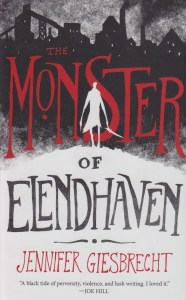
Each year when autumn worms its way into my consciousness, I begin looking for the ideal gothic book.  I can test this by looking at the Goodreads lists of best gothic novels and noting how many of them I’ve already read. The thing now, since I’ve already covered much of the canon, is to discover modern writers who can still evoke that feeling I seek.  This is all complicated by the subjective nature of what readers term “gothic.”  Many of the books on the lists don’t fit my own working connotation, so I keep looking.  One recommended title was Jennifer Giebrecht’s debut novel The Monster of Elendhaven.  I’m still trying to decide whether it is gothic or not.

It’s a little hard to classify, actually.  It certainly has some gothic elements, as well as some horror.  There are secrets and plagues and gruesome murders.  There is a monster from a polluted sea, but not quite your grandfather’s monster.  A human monster.  Or at least partially.  The tale is written with some tongue in some cheek.  There are funny elements and there are many serious moments.  There’s magic and mayhem.  If I were to try to characterize it the closest I might come would be a Tim Burton treatment of horror.  Like Burton, Giesbrecht creates a Halloween mood, but sometimes the humor undercuts it.  This makes it difficult to pin down the work as a whole and figure out if this is the gothic I’ve been seeking.

Set in a time difficult to define and in a fictional nation, it is the kind of novel that can be read without much consequence.  The references to the Allfather make comparison with Nordic regions natural, and there is perhaps a touch of Beowulf here.  In crafting the monster Giesbrecht has made a pretty unlikeable character.  He is a monster, after all.  But not a sympathetic one.  As in other modern treatments he is a stand-in for chaos.  There’s also an environmental sensitivity here.  The monster arises from a polluted sea that derives from, of all things, human greed.  So maybe there’s a parable here.  A short book, it doesn’t take too much of a time investment, but it may leave you wondering what exactly it is that you just read.  It is dark, and gritty, and fun.  A nice combination for an October night.  Is it gothic?  That one’s a little harder to answer.  It depends on how I’m defining it on any particular day.


Just Joking

I’m not sure when I’ll ever get back into a movie theater, given that our government plans to do nothing about Covid-19.  Still, I recently watched Joker for the first time.  In an eerily prescient move, Todd Phillips envisions the character as tapping into public dissatisfaction with the exploitative and unfeeling power of the rich, who often lead, through their greed, to outbreaks of public unrest.  The character of the vigilante clown coalesces the oppressed of Gotham and leads to riots in the streets.  I wasn’t quite sure what to expect of the film since I’d only briefly heard of it secondhand.  It is one of the most uninterrupted stretches of darkness that I can recall seeing in a movie, which, in some respects, makes it believable.

Comic book character films have taken on a life of their own.  Joker explore the backstory of mental illness in a culture that is bent on cutting care for those in need.  Not only that, the movie doesn’t let you think anyone is good.  All the heroes are flawed, and most of them fatally so.  Joaquin Phoenix’s acting, of course, solidifies the story and make the Joker sympathetic.  And there’s a fair amount of truth to the way that a capitalistic society is driven to hold down the many who need to be exploited for the system to work.  Although it is dark and gritty there’s a strong social commentary here.  It doesn’t surprise me that it was the highest grossing film of last year.  You don’t have to be a comic book fan to be drawn in.

Not too many other major films since One Flew over the Cuckoo’s Nest have attempted to stare unwaveringly at mental illness.  It is an extremely common condition, especially if we consider the number of people who require antidepressant, anti-psychotic and anti-anxiety drugs.  The culture we’ve created isn’t healthy for our mental development.  It’s often cruel and uncaring.  It never helps when people lie to us.  Joker addresses these  realities, exploring the “perfect storm” of factors that might lead to a psychopathic crime lord.  Of course, living through the Trump administration, led by an unfeeling, money-driven “president,” it’s obvious that we’ve set up a system that refuses to confront those who have no business making important decisions.  A system that could conceivably set up such pathological “leaders.”  None of the privileged people in the film cares for anyone beyond themselves.  And they wonder why violence erupts in the streets.  I think I have some recommended viewing to suggest to them.


Not Sleepy Yet

Over a recent weekend I watched four versions of “The Legend of Sleepy Hollow.”  (I have two excuses.  One is that it’s October, and the second is that I have an article on Sleepy Hollow coming out on Horror Homeroom.  For the second, read on.)  The story is one that made an impact on me as a child, probably because of Disney’s Adventures of Ichabod and Mr. Toad.  The cartoon version, which was one of the four I watched, is silly and scary both.  It leaves it to the imagination whether the headless horseman is real or not.  Before that I watched the silent 1922 Headless Horseman staring Will Rogers.  Clearly in that film the headless horseman is what we’d now call a liberal hoax.  It was Brom Bones scaring Ichabod Crane away from Katrina Van Tassel.

The canon of characters grows with Tim Burton’s 1999 film Sleepy Hollow.  Although Burton is hit or miss for me, this strikes me as one of the best October movies I’ve seen.  The headless horseman is quite real and the spiritual world intersects with the rational, crime and punishment world in the haunted western wood.  I didn’t have time for the 1980 television movie this time around, but I decided to watch the 2007 television movie Headless Horseman.  A rather puerile splatter film set in Missouri, it posits that this is the real headless horseman behind Washington Irving’s story.  It has a lot of religious imagery, which is often what I’m looking for in horror.  The writing is poor and the characters shallow, but it isn’t a total waste of time.

What all of these films demonstrate is that Washington Irving’s story, as simple as it is, really resonated with Americans.  How can you reason or plead mercy from a headless man?  Look closely, for there is a parable here.  The headless are merciless and they have the ability to frighten.  The story is generally set in the harvest season.  The 2007 movie makes the horseman’s appearance as a crucified scarecrow.  Although the original story had no such religious elements, they’ve become a standard part of its accrued cultural heritage.  The headless horseman has gone from secular to religious, for it is an American story.  Originally set in the period after the Revolutionary War, it was part of an unsettled nation’s frustrated attempt at normalcy.  This, I believe, remains.  When we can’t make sense of our surroundings, we look back to those stories that seem to have some insight into who we are.  Headless horsemen are quite useful in that regard.


Ghosts, of a Sort

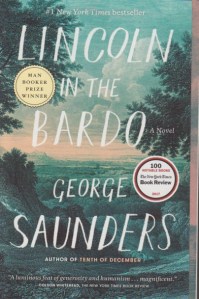
What happens when we die?  That question is perhaps THE question that drives just about everything we do.  Evangelicalism, masked behind love of Jesus, is really the desperate attempt to avoid Hell.  That idea is powerful and insidious.  The question of what happens, however, has also inspired a tremendous amount of literature.  Lincoln in the Bardo, by George Saunders, is a recent example of how diverse such views may be.  Written mostly epitaphicly, it is a conversation among the spirits in the cemetery the night Willie Lincoln arrives among them.  Fearing what is beyond, these ghosts don’t admit they’re dead, but rather think themselves sick, awaiting recovery.  When the profoundly bereft Abraham Lincoln arrives to mourn his son, things begin to change.  

All through my reading of this book I found myself wondering about the many ways we conscious creatures reassure ourselves about death.  Materialists say it’s like the turning off of a lightbulb.  All goes dark and there is no soul to remember anything.  Many of them claim science for proof, although science has no way to measure the non-physical.  Various religious sentiments of the eastern hemisphere posit reincarnation until one’s soul reaches the point of no longer having to cycle through all of this again.  Here in the western world, influenced by a Zoroastrian-inspired Christianity, we posit a Heaven and Hell.  Some include various shades of Purgatory, which, to the classic Greek, would’ve sounded familiar.  Those who’ve undergone Near Death Experiences often suggest a more dream-like reality of acceptance.

There are many more shades and nuances, of course.  We’ve entered the shadowy half of the year.  Those of us in temperate regions spend half of our lives with nights longer than the days.  Death, however, is generally a shunned topic.  We try to avoid talking about it since we really don’t know what comes after.  We have beliefs.  We have hopes.  We really just don’t know.  We often look to literature to help us explore these topics.  Lincoln in the Bardo does so with some humor, some sadness, and some soul-searching.  Those of us drawn to ghost stories naturally think about them as we wait later for the morning sky to lighten, and find it dark before we turn in for the night.  A great many options await us, some with a kind of historical anchor, and others that are completely made up for our edification.  The one thing they all have in common is they force us to think of that which we really don’t know.