Sinning

The other day I was searching through the CDs we have and came across the Pet Shop Boys’ album, Actually.  Curious, I googled them and was surprised to learn that they are considered the most successful British pop duo ever, by some metrics.  Who knew?  I lost track of them after 1987.  As I played the album—and synth-pop really isn’t my style—I began to wonder why I’d bought it.  Then “It’s a Sin” played.  The Pet Shop Boys’ second number one hit from ’87, that song was part of my personal history that has led, indirectly, to my last two books.  Let me set the scene:

In 1987 I graduated from seminary.  I was just a small town boy, having grown up in rural northwest Pennsylvania.  My exposure to big cities was limited, and that was one reason I’d chosen Boston for said seminary.  It was there that I began to realize just how much popular culture referenced religion.  “It’s a Sin” is emblematic in that regard.  Everything the boys want to say or do is a sin.  Sounds like Calvinism to me. Still, the song was heard by millions.  I bought the album because of it.

As I recall, there were several pop artists singing about religion at the time.  Joan Osborne’s “One of Us” was still eight years away, but it was becoming obvious to me that people took religious cues from pop media.  I once described the ability to find references to the Good Book as “Bible radar.”  If you’re raised in that culture you learn to spot religion in the most unlikely places.  The concept of sin is a purely religious one.  We all have consciences (I hope) but to make an act Hell-worthy requires religion.  And according to some forms of Christianity just about everything is a sin.

That idea lay dormant for decades.  I read novels and found religion embedded in them, often in biblical form.  I saw it on television.  And in movies.  Even horror movies.  While I sometimes elected to expose myself to intentionally religious media, these references often came from secular sources.  As I began to research this, I came to realize that religion is intricately woven into the fabric of society.  Try to tease it out to isolate it and the cloth starts to come undone.  We like to think of ourselves as more sophisticated than that, but the truth is at some level we still believe it’s a  sin.


Too Close?

What with the US Navy admitting that UFOs are real and all, it seemed like a good idea to watch Close Encounters of the Third Kind over the holiday weekend.  Like many of my generation I saw it in a theater—itself kind of a distant memory—back in 1977.  I’m not sure why it’s been on my mind lately, but since it’s a long movie it takes a long weekend to accomodate it.  As we settled down to classic Spielberg scenes—lots of khaki and crowds and desert locations—it was a reminder of how silly we all looked in the seventies.  (What were we thinking?)  Other than that the film has aged pretty well.  The plot, although not action-packed, is probing and has several moments that seem to have inspired Poltergeist.  What made the film blog-worthy at this time, however, was the wearing of masks.

When Roy Neary and Jillian Guiler arrive at Devil’s Tower the governmental cover-up is in full play.  A nerve-gas leak—and who can check out whether such a thing really happened?—has a mask-wearing restriction in place.  I wondered where one could get a gas mask today when the crowd scenes of the pandemic won’t even leave a roll of toilet paper behind.  Checking for rubbing alcohol to make homemade hand sanitizer I found it selling for $300 per gallon on Amazon.  Where are we going to get a gas mask in circumstances such as these?  That particular scenario never really stood out to me before although I’ve seen the movie many times over the years.  Back when I was a student at Boston University the school tee-shirt worn by Barry Guiler was the interesting cultural context.

Films that survive the years take on different aspects over time.  Some suggest that a branch of the military admitting to the reality of UFOs during a pandemic was intended to underplay the event.  Others have argued that a similar release of information many months ago received similar lackluster interest.  If there are aliens out there, I have trouble imagining that they’d travel all this way for a synthesizer concert at a national monument that received a major uptick in visitors due to the movie’s release.  Maybe we love our fictional aliens more than the possibility of meeting those that seem to be vexing our navy?  The movie was the right choice for the circumstances, it seems to me.  Some things about the seventies are worth revisiting from time to time.  Strangely, in retrospect, life seemed simpler then.


Still Evolving

Evolution, the 2001 movie, I mean, is good escapism.  Thinking back on 2001, instead of a space oddessy, another piece of news—another national crisis, in fact, dominated.  The film kind of slumbered in the background until we could sort out what it meant to live in, ironically, an unsafe world.  That’s precisely what the movie was about.  I wasn’t thinking that when I recently pulled it off the shelf.  I was simply wanting some fantasy to relieve the daily pressure of living in stress mode.  Besides, it has some of the best alien monsters you could hope for in a comedic setting.  Soon, however, the parallels began to appear.  A source of contamination from outside.  A growing threat.  A government that doesn’t know what to do and that can’t admit its mistakes.  It all seemed eerily familiar.  Dr. Allison Reed is even from the CDC.

Life isn’t constant crisis.  Funnily enough, when Democrats are in office there seem to be far fewer of these large-scale troubles.  “There will be signs,” I guess, “in the sun, moon, and stars.”  The thing about signs is that we’ve left the reading of them up to Fundamentalists.  And Fundamentalists don’t believe in evolution.  Or science.  Or modernity.  Idealizing medieval thinking does come with a price tag.  So I reach for the remote.  While the government has lots of money that it spends on its own volition, the crisis grows.  The alien menace is set to spread across the country.  Although beginning in a different geographical location, all that red on the map sure looked familiar to me.  How little has changed in the last two decades.  Evolution came out before smartphones even evolved.

Meanwhile, practically unnoticed, the U.S. Navy has been saying UFOs are real.  The story, muted and subdued—we’ve got more immediate concerns, such as getting reelected—has been on major reputable media.  When they land on the White House lawn we’ll ask the aliens if they have respirators and masks aboard.  Preferably the kind with face-shields.  In the movie the monsters are aliens.  They’re like an infection, and even hazmat suits can’t keep you safe.  The solution, of course, isn’t fire-power, but a good shampooing.  Now I know you still can’t go to the salon in lots of places, but washing up at home seems to be pretty good advice.  We put the movie on for simple escapism, but there’s no escaping the fact that we now live in an alien environment.


Straining Andromeda

As corona-life settles into just the way things are, I pulled out my copy of Michael Crichton’s The Andromeda Strain.  I read this in high school, and, judging from the state of my copy I originally found it in the book bin at Goodwill.  I actually didn’t remember how the book ended, but some of the scenes—particularly the bizarre suicides that the virus first initiates—stayed with me.  I really felt no compunction to read it again until our daily reality was one of infection, protection, and fear.  In other words, the time was right.  I can say that I found Crichton’s confident prose a bit overblown at times, especially given the resolution of the crisis, which I will not give away here.  Some of the rest of you may want pandemic-themed reading, after all.

Something I had forgotten, and since this is near the beginning I don’t mind giving it away, is that the Andromeda Strain was brought to earth by military intentions to develop new biological weapons.  Although the death toll is nowhere near what that of COVID-19 has been, the potential lethality of the strain is what keeps the compressed five-day story tense.  That tension makes for quick reading, and it seems pretty clear that some of the ideas here have been used for other pandemic story-lines.  I’ll write about one of them later this week.  The extraterrestrial life form of Andromeda is cause for discussion in the novel, but the explanation is never clarified.  Crichton’s later novels improve on this score.

A clear point in the novel is that the government, although aware of and complicit in the experiment, lacked the foresight to successfully see it through.  Governments are only human, after all, and can function effectively only when those with superior abilities are in charge.  Looking out for oneself and exploiting others are not superior abilities.  We can see the result of this with our own, nonfictional pandemic.  Still, the novel does raise the specter of dabbling in things we don’t fully understand and can’t, in any real sense, control.  The thread of the plan being military in origin isn’t fully seen through, but it does raise the larger question of morals.  Some of us go through ethical training for our jobs.  Some of us have it often.  It’s obvious, however, that the real deficiency of governments tends to be their lack of ethics.  In this current day and age that qualifies you for the sobriquet of evangelical Christian.  And now we have our own strain to deal with.


More than Sand

My sci-fi roots may be showing, but when John W. Morehouse posted a story on TheoFantastique’s Facebook page about Dune, I had to follow up.  The story was from Wired magazine, and the title asks “Should There Be a Religion Based on ‘Dune’?  Although I grew up on Poe, science fiction was my favorite genre as a kid.  Frank Herbert’s classic was published when I was only three, but it was experiencing a resurgence before the movie came out.  Dune was  complex world building.  It was immersive, and compelling.  The movie, I felt, didn’t do it justice.  I’m not surprised that people are now wondering if it shouldn’t become a religion.  Other sci-fi-based religions do exist.  Star Wars and Avatar have both developed fan bases that consider the films their religion.

Movies have a way of becoming part of our reality.  The other day I was reflecting on how much my frame of reference for life is based on movies.  I quote from them frequently.  I draw wisdom, and sometimes just plain inanity from them.  But I remember them.  I spend a lot more time reading than I do watching movies.  If a book is engaging I’ll remember it well, but it isn’t unusual to forget—although I hope it’s still there somewhere in deep storage—a book that failed to make much of an impact.  I suppose that’s true of movies too, but I recall my first viewing of The Jungle Book in theaters.  How those hypnotic snake eyes scared me!  And there was a film whose title I can’t recall, but I remember it was vignettes of Hans Christian Andersen stories, I believe.  One was called “The Tinderbox.”  I still remember it well although I was probably about five when I saw it and I never watched it again.

This staying power of movies suggests their religious potential.  People today, I suspect, are less concerned with the antiquity or bona fides of a religion than they are with the practical issue of whether or not it works for them.  Does it bring them near some sense of transcendence?  While the Wired article doesn’t seriously suggest a religion based on Dune, I sometimes ponder how the wisdom of ancient religions is often entombed in forms and structures that “true believers” mistake for the actual essence of the religion itself.  Sci-fi based religions reach for the newly created realms of transcendence.  They are filled with wonder.  But it will only be a matter of time before that awe fades into arguments about which canonical version is literally true.  It’s happened before.


Divided by Eight

Analogies are useful, but never precise.  When Midsommar came out last year, people were saying “It’s like Wicker Man.”  It’s a good analogy, but not precise.  The plots have quite a bit in common and both are part of the genre that we might call intellectual horror.  Midsommar is a slow burn where you know from the beginning that something’s not right, and you can’t quite figure out what.  I’ll try not to give away too much, in case, like me, you’re late in seeing it.  It involves a group in Sweden, the Hårga, who celebrate a Midsummer ritual every 90 years.  A group of five graduate students—and the writers of the movie actually do know what grad school is like—go to study the ritual.  In central Sweden, far enough north that it’s never really night, they discover a pleasant group of white-garbed believers who use a combination of drugs, sleep deprivation, and folk magic to get the pawns into place.

What fascinates here is just how a fictional religion, with some basis in reality, becomes the vehicle for horror.  The deaths of three of the students are all in the service of a belief system that involves runes, fertility rites, scriptures, and ritual suicide.  It’s self-aware enough that one of the students compares it to Waco early on.  If there were no exotic religion here, there would be no horror.  Tragedy, yes, but horror, no.  The entire energy of the genre draws from four of the students (the fifth is from the community in Sweden) not knowing what is going on.  The village of the Hårga is isolated, and there is no law to keep them within the bounds of secular behavior.  By the end of the film you feel that secular is much safer than religious.

Midsommar foreshadows much of the horror in the illustrations that the community readily supplies.  Paintings show what is coming although the viewers, like the students, don’t know what they’re seeing at the time.  Some of the horror is based on shock, but the director doesn’t stoop to startle scares.  Well, maybe once.  This is horror that you can see coming and you’re fully aware that it’s because the white-robed ones truly believe.  The ending is similar to Wicker Man and the message is much the same.  Religion, when taken too seriously, leads to the sacrifice of those deemed outsiders.  And you don’t have to go to Sweden to find it.


Misreading Melville

I make it a practice not to discuss books I’m still reading on this blog.  There’s no reason I shouldn’t, I suppose, but it just feels like cheating getting more than one post for a book.  Besides, there’s so much other stuff to blog about!  I’ll make an exception this time, because it involves an unusual typo.  Well, it’s not so much unusual as it is apt.  In chapter 82 of Melville’s classic, Moby Dick, “The Honor and glory of Whaling,” he discusses the mythical history of whaling.  In typical Melvillian style, he takes mythical stories to support his contention of how honorable whaling is.  After Perseus and St. George and the dragon, he mentions the curious biblical episode of Dagon and the ark of the covenant, found in 1 Samuel 5.  It’s here that my edition has a typo.  Melville writes “this whole story will fare like that fish, flesh, and fowl idol of the Philistines, Dagon by name” but my edition reads “Dragon by name.”

Image credit: Vignette by Loutherbourg for the Macklin Bible 12 of 134, via Wikimedia Commons

My very first academic publication was on this story about Dagon (I had intended to write my dissertation on that deity).  I had no idea of H. P. Lovecraft’s appropriation of Dagon at that point.  The interest was purely based on the fact that you couldn’t find much information on this curious god.  It was clear that he was well known among ancient cultures of West Asia.  He was attested at Ugarit, specifically as the father of Baal.  (Both would later be assumed to be demons.)  Further east, he was apparently a fairly major deity in Mesopotamian religions, although we are still awaiting a readable synthesis of that massive corpus of texts and the religions toward which it points.  In other words, Dagon is mysterious.  Lovecraft likely picked him up from the biblical story.

The tale in 1 Samuel is provocative.  After defeating Israel, the Philistines (who would eventually give Palestine its name) took the ark to the temple of Dagon as spoils.  The image of their god fell face-down before the ark overnight.  Disturbing as this was, the next morning after they’d replaced him, Dagon was again tumbled but also decapitated and with his hands broken off.  That meant his body was all that was left.  Somewhere along the line the name Dagon (close to the Hebrew word for “fish”) was interpreted as a maritime entity.  This seems unlikely, given what we know of his origins, but the idea stuck, leading to some compelling horror fiction.  Dagon does indeed become a kind of dragon in that realm.  My edition of Moby Dick has a typo that we today would blame on autocorrect, but in reality was likely the result of a copyeditor not knowing his or her Bible as well as Melville did.


White Rabbit

There are books that make you feel as if everything you know is uncertain.  D. W. Pasulka’s American Cosmic is such a book.  Its subtitle, UFOs, Religion, Technology, only pauses at the brink of the rabbit hole down which this study will take you.  Over the years I admit to having been jealous of colleagues who’ve been able to make an academic career stick.  The credentials of a university post open doors for you, even if you’re a professor of religion.  Pasulka has opened some doors here that I suspect many would prefer to have kept closed.  This is a compelling book, threading together many themes tied to religious studies.  There are things we might see, if only we’ll open our eyes.

Although immediately and automatically subjected to the ridicule response, UFOs are a fascinating subject.  This book isn’t about UFO religions—of which there are many—but rather it connects this phenomenon to the study of religion itself.  In Pasulka’s related field of Catholic studies, there are those anomalous accounts of saints who did the impossible.  Like UFOs, they are subjected to the ridicule response, making serious discussion of them difficult.  Might the two be related?  As you feel yourself spinning deeper and deeper down that hole, technology comes into the picture and complicates it even further.  Pasulka was a consultant on The Conjuring.  I’ve written about the movie myself, but what I hadn’t realized is how media connects with perceptions of reality.  Yes, it has a religious freight too.

Every once in a while I reflect that my decision—if it was a decision; sometimes I feel certain my field chose me—to study religion might not have been misplaced.  Perhaps all of this does tie together in some way.  American Cosmic is a mind-expanding book that assures me all those years and dollars learning about religion weren’t wasted after all.  I had a discussion recently with another doctoral holder who’s been relegated to the role of editor.  We both lamented that our training was in some sense being wasted on a job that hardly requires this level of training.  Still, if it weren’t for my day job I probably wouldn’t have known about this book, and that is perhaps a synchronicity as well.  Life is a puzzle with many thousands—millions—of pieces.  Some books are like finding a match, but others are like informing you that you’ve got the wrong box top in hand as you try to construct the puzzle with the pieces you have.  If you read this book be prepared to come close to finding the white rabbit.


Connecting Connecticut

One of the many lessons of the current pandemic has been that my appreciation of horror is not misplaced.  Horror Homeroom has just published my piece “Demons or Ghosts?  Hauntings in Connecticut,” available here.  I’ve noticed that Horror Homeroom has had a surge of pieces since all of this began, which seems tacit evidence that horror is a coping mechanism.  It’s no wonder, really.  Horror often deals with “worst case scenarios” and specializes in isolating victims.  Now that we’re all practicing social distancing we’ve entered into one of the main framing plots of the horror movie.  Contagion isn’t an unusual trope either.  My article is about neither of these, but I still maintain that watching horror is therapeutic.  As with most therapy there’s good and bad varieties.

The films I write about in this instance aren’t good movies.  The Haunting in Connecticut franchise misses on so many levels that it doesn’t seem bound for classic status.  Yes, there are classics in the genre.  When the outbreak started many people referred to The Shining as how they felt being cooped up all the time.  There are those who vehemently deny that The Shining is horror, but given the association with Stephen King it seems difficult to deny.  Horror doesn’t have to involve slashers or bug-eyed monsters.  It isolates.  It imagines worst case scenarios.  All Jack Torrence needed was an inept national administration to put us all in the Overlook, one at a time.  

The pandemic has slowed down the release of new movies, of course.  The much anticipated A Quiet Place Part II has been pushed out to September.   Sitting here in isolation I wonder if that’s long enough.  Politicians with money in mind over their human constituents are chomping at the bit to get us mingling again.  Exposing one another.  Horror, however, knows all about aftershocks.  I don’t like jump startles.  I prefer my movies to built thoughtful, moody situations.  Despite their many sins, the Connecticut haunting movies do that correctly.  While they have other problems, they do throw us into a world where things aren’t quite right and we know it.  Elaborate plots really aren’t necessary, though.  The mind is pretty adept at filling in the story.  Like children asking to have the same book read over and over, we know how it goes.  We just like someone else to show us exactly how.  Isolation should continue for some time.  And horror provides a reasonable narrative to help.


Reading Connections

It’s flattering to have someone notice your work.  The other day I had the very first email from someone who’d read Holy Horror and wanted to discuss it.  It was from an undergraduate, no less, who was doing a report on religion and horror.  She’d read my book (and yes, it’s undergrad friendly) and wondered if I’d be willing to talk about it.  I can’t express how surprised I was (and still am).  You see, I have emailed authors after reading their books.  Many of them show no interest in carrying on a conversation with someone they’ve “met” through email.  I’ve had so many single-sentence responses with no enthusiasm whatsoever that I’ve begun to think of those employed in academia as hopelessly stuck in tunnel vision.  If you write a book you’re wanting conversation with those who read it, I should think.  At least I am.

Those of us outside academe don’t have tenure committees to please or effectiveness committees to placate.  We write books to try to engage readers.  Unfortunately Holy Horror is priced for the library market.  During our phone interview, my interlocutor asked about the cover.  She said something publishers should hear: when walking around with Holy Horror her friends asked what the book was about because the cover is intriguing.  (It’s actually based on Chloë Grace Moretz from the reboot of Carrie, discussed in the book.)  In the midst of a pandemic, this first show of interest made my day, like seeing the first crocuses after a long, hard winter.  I do welcome conversation about my book.  I don’t have a classroom of students to force to buy and read it.  It’s out there for discussion.

Nightmares with the Bible is nearly finished.  Of course, publishers have hit a bit of a slow patch with many of their business partners shutting down.  Some publishers have gone into hibernation during the pandemic.  Books, though, will get us through.  A colleague of mine said the industry reports are showing that novels continue to sell while nonfiction is suffering.  Well, I’m no expert, but I do wonder if nonfiction might do better if authors would be willing to respond to this who express an interest in their work.  I know it’s a radical idea.  I also know that my books reach nowhere near what most publishers consider a viable readership.  What people are looking for during enforced isolation is a sense of connection.  Reaching out to find someone reaching back.  Books can do this, even if we never physically meet.


Haunted States

I’ve been going through a spate of watching “The Haunting” movies.  Just to be clear, I don’t mean The Haunting, by Robert Wise (1963), which is excellent.  Instead I mean movies spun off of the Discovery Channel’s series A Haunting.  Several years ago, between jobs and too near an FYE store, I picked up a cheap two-fer.  This set contained the television movies A Haunting in Connecticut and A Haunting in Georgia.  I watched them once and then traded them in to get something else.  The first one really bothered me.  The Connecticut story deals with a childhood cancer victim, and that alone is scary enough.  It had the limitations of a television movie and left me thinking it wasn’t too satisfying.  The Georgia haunting was more of a documentary, but it was also open-ended.

Then someone got the idea to make a movie out of the two.  The Haunting in Connecticut blows the plot over the top.  I kept thinking as I watched it, isn’t it in bad taste to make a horror movie based on the true life horror of tragic disease?  The protagonist of the story, Philip Snedecker, died about three years after the movie came out.  Although the plot generally followed the first movie an entire subplot was added to pad it out.  A nineteenth-century funeral director has enslaved a young man to be his medium.  The undertaker steals and marks dead bodies to enhance the boy’s powers.  These completely fictional characters intermingle with the real life tragic Snedeckers.  As you might expect, chaos ensues.

The oddly named The Haunting in Connecticut 2: Ghosts of Georgia also had to add an entire fabricated story to the troubles of the Wyrick family.  In real life the Wyricks moved into a house where their daughter started seeing things, including a kindly ghost named Mr. Gordy.  She also saw some sinister spirits.  So much so that her family invited a parapsychologist to investigate.  The theatrical version adds in a stationmaster on the underground railroad who was also a taxidermist.  Instead of helping all the slaves to freedom, he saved some for stuffing later.  No real motivation is given, beyond his enjoyment of sawdust and thread and death.  

While these two movies really didn’t help much, I generally find watching horror during a pandemic therapeutic.  Horror films sometimes help viewers envision worst-case scenarios and figure out how they might deal with them, learning from the victims’ mistakes.  I suspect that’s why, a few years back, the CDC posted instructions on what to do in case of a zombie apocalypse.  It was all about disaster preparedness.  Of course, in those days we had no idea what was really coming to Connecticut, and Georgia, and to every state of the union.


A-changin’

The other day, while engaged in a mindless task, I had Bob Dylan playing in the background.  When I say Bob Dylan I mean the Bob Dylan of the 1960s.  I was an infant when he was singing songs like “The Times They Are a-Changin’” and “Blowin’ in the Wind.”  As much as I cast the 1960s in a rosy glow, I was in fact a naive child through my portion of them.  I knew about the Vietnam War, but I couldn’t point to the country on a map.  Likewise, I knew about the assassinations of John and Robert Kennedy and Martin Luther King, Jr.  I also knew that we had walked on the moon.  My family at this stage didn’t listen to popular music.  I grew up with hymns in my ears and the culture in which I was swimming slowing becoming absorbed through my pores.  Dylan was part of the latter.

One of the reasons I don’t often listen to music is that I really listen to it.  It is so significant to me that I don’t like to relegate it to the background.  While I work from home, for example, I don’t put music on.  I find it difficult to concentrate because, truth be told, I’d rather listen to the music.  As I had Bob Dylan on, I was doing a task where I could listen as the rest of my body went into autopilot.  The angry white men who are running things now, it struck me, were alive in the sixties as well.  As much as they seem like aliens who were beamed down after the expansion of human consciousness, they were lurking in the shadows all along.  If they sing along to Bob Dylan they’re hypocrites.  We need another Dylan.

Photo credit: Rowland Scherman, public domain, via Wikimedia Commons

That’s putting quite a burden on an artist, I know.  But Dylan captured the spirit of the times.  Even as scientism was growing the reality of the Zeitgeist was obvious.  I grew up in the chaotic seventies.  The eighties were bland with the Reaganism reaction—angry white men wanted to get rich at others’ expense, and we let them.  Not enough time has passed for history to decide on the spirit of the fin de siècle, I don’t think.  You see, we seem stuck in a feedback loop.  Dylan’s lyrics are as necessary now as they were more than half a century ago.  I’m growing weary of angry white men and their petty concerns.  Maybe I need to listen to music more often. 


Green Dilemma

It’s a dilemma.  I face it every year.  I don’t have green to wear and it’s St. Patrick’s Day.  For your average run-of-the-mill citizen, this might not be an issue—but I do have an Irish heritage (in part), and so it’s a heartfelt concern.  The reason I don’t have green has less to do with fashion (consider the source!) than with my clothing purchasing practices.  First of all, I like to make my clothes last.  Fabrics can be quite durable.  They aren’t mechanical and therefore don’t break down often.  I don’t live a rough-and-tumble life, so tears aren’t really a problem.  The end result is that I keep my clothes as long as they’re functional.  When they begin to wear out I go to the store and examine the clearance racks until I find something in my size.  That means color selection is often a matter of very limited options.

Once in a great while I have landed something green.  I still remember a green shirt I had in college.  It served me well for more than four St. Patrick’s Days.  It long ago succumbed to overuse, however, because I wore it on other days as well.  And let’s face it, when I make one of those infrequent trips to the clothiers’ shops, this particular holiday’s not on my mind.  Unless, of course, I go shopping in March.  Back when I lived in Boston it was easy to get your Irish on.  I bought a bright green silky (I don’t know if it was real silk) tie with white shamrocks on it.  It was probably down at Faneuil Hall.  It had been a bit outlandish to wear to work in New York City, though.  Indeed, at work staid dress was by far the most common code.  Consequently it hung unused in my closet for years.

When we moved a couple summers back, I noticed my green tie had faded to bronze.  I thought it went the other way around.  In any case, my last truly green clothing article was no longer green.  Yes, it still has shamrocks, but I’d feel even more ridiculous trying to rock a bronze tie and pass myself off as Irish.  It won’t even pass for gold.  Of course, I work from home.  I’ve practiced social distancing long before it was a trend or a government mandate, whichever it is.  The only people to see my lack of green would be my wife and daughter, and perhaps a Jehovah’s Witnesses that might stop by.  But still, even minor celebrations are anticipated at times such as this.  Although I won’t be going out today I’ll probably be spending some time in my closet and reflecting on the true heritage of my Irish forebears.

Perhaps St. Pat shops like I do?


Coincidentally

I hope I never become too sensible not to pay attention to coincidences.  With the death of Max von Sydow falling the same week as the time change, the full moon, and Friday the thirteenth, I’m left feeling a little vulnerable.  I mean, what do we do now that the Exorcist is gone?  A couple days ago, when the moon was full—the last full moon before the vernal equinox—I awoke before 3:00 a.m.  Thinking Daylight Saving Time would have me groping for a few extra minutes abed, instead I found myself wide awake at the hour when monsters are thought to be afoot.  As I put my feet to the floor I saw the brilliant lunar light beating through the blinds like midday.  It was remarkable how very light it was.

A bipartisan bill has been introduced in congress to make Daylight Saving Time permanent.  Of course, getting any law passed without numerous riders and bickering is unlikely, but I do wish they’d get on with it.  That having been written, the time shift has been remarkably easy on me so far this year.  Perhaps those of us regularly awake in the dead of night adjust a little more quickly.  Keeping out of New York with the coronavirus lurking, I’d rather deal with my own monsters anyway.  I remember my amazement at seeing Max von Sydow unchanged from Fr. Merrin to Dr. Naehring.  Then I looked up just how much makeup the Exorcist had to have to age himself several decades.  He was a young man when The Exorcist was filmed.  At this time of day anything is believable.

Friday the thirteenth is a bit of lore grown from Christianity.  Friday was inauspicious because of Good Friday and the thirteenth lot fell on Judas, who, along with the others, made thirteen.  It was as if some demon were afoot on such Fridays.  These bits of Christian lore made their way into popular culture and then crept into horror films.  A good deal of Nightmares with the Bible revolves around The Exorcist.  So I sit here before sunrise with a bit of just-past full moon shining in, not too tired from losing an hour on Sunday.  It’s not difficult to think of scary things at this time of night.  Of course, demons traditionally come out around 3:00 a.m.  This week has been like that.  And without Max von Sydow, we want to be very cautious around demons.


Classic Monsters

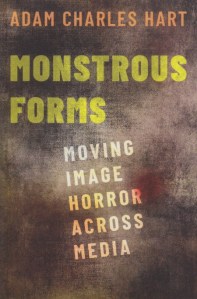
Convergent evolution is a term that’s used for when two unrelated species, separated by some gulf, develop a smilier trait independently.  I began studying monsters in biblical reception history before I really knew others were doing so.  After I’d written Holy Horror I discovered an article by another scholar who was doing similar things, even looking at some of the same movies.  Liz Gloyn, it turns out, was also doing something quite similar with classical monsters.  Her Tracking Classical Monsters in Popular Culture just came out a couple months ago.  Having taught classical mythology for a few semesters at Montclair State University, I have retained an interest in the subject and I was delighted to find a scholar who suggested that to get at the real substance you sometimes have to look beyond the heroes to the monsters they fight.  It’s the monsters who often prove more human.

Covering both cinema and television, Gloyn considers how classical monsters are represented in modern reception.  She looks at their appearance in literary forms as well.  Obviously not all of these reception avenues can be examined, but those she chooses are entertaining and informative.  In the case of biblical studies, I long ago came to the conclusion that biblical scholars pretty much just speak to each other.  The average person doesn’t read their books and the average pastor doesn’t either.  Laity, for the most part, get their interpretation of the Good Book from pop culture.  There’s a very good case to be made that, shy of sitting down and reading through a very big book, people would have little access to the Bible, or classics, if it weren’t for media representations.

Concurrent with my teaching classical mythology, the release of the reboot of Clash of the Titans transpired. (Gloyn covers both the original and the remake in her book.)  Students were really excited, anticipating the film.  It was one of the rare times (The Book of Eli was another) when I felt compelled to watch a movie as an adjunct professor, simply to share the experience with my pupils.  Clash of the Titans had made an impact on me in high school but the reboot failed to take me to the same place.  Still, here be monsters.  Those who’d never read Hesiod, Ovid, Pseudo-Apollodorus, or Homer, may have thought they were getting the straight dope from the silver screen.  That’s what reception history is all about.  Gloyn’s treatment kept me riveted, and I used to teach the subject.  Monsters have a way of doing that to you.