Mostly Clear

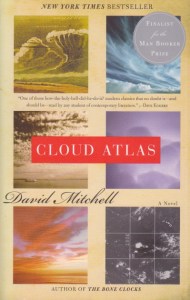
“Chiasm” is a literary technique based on the name of the Greek letter chi, shaped like a latinate X.  The idea is fairly simple and generally resembles a sideways V more often than an actual X.  It goes like this: a poem, or story, begin at a large, or wide premise, narrows down in steps to a center, and then, by corresponding steps, again out toward a larger, or wider resolution.  Another way to think of it is a set of Matryoshka dolls; first you take them apart, and then you put them back together.  David Mitchell’s Cloud Atlas is a chiastic story.  Starting on a cross-ocean voyage at an indeterminate time in the recent past centuries, it moves on to a Briton on the continent in about the turn of the last century, then a mid-twentieth-century American investigative journalist, a late twentieth-century or present-day rogue publisher in Britain, a clone in future Korea, and finally, to a planet of the apes-like Hawaii of the distant future.  Not really finally, though, since after the center of the X, it moves back outward through the nesting stories to bring us back to the beginning.

I’m not going to attempt to retell the story here, so don’t worry—it doesn’t get any more complicated.  There are, however, a couple of remarkable things about the tale.  In the brutish, nasty, post-collapse future that marks the center of the narrative, religion is central.  Some of the Hawaiians have come to believe the protagonist of the nesting story, the clone mentioned above, was a god.  To find her story, however, you’ll need to read the book.  Suffice it to say, that origin myth is part of the overall complex structure.  The second of the remarkable features, and one that makes this book very salient, is that in all the ages the issue of accepting those who are different is central.

In the outside framing story, the initial and terminal points of the chi, one of the characters is a missionary.  He’s trying to “improve” he life of Polynesians by making them into slaves, whereby they benefit from the largess of Christianity.  Quite a bit of the narrative draws its energy from the eventually faltering sense of superiority of the AngloSaxon “race.”  In that sense it’s definitely a parable for our time.  A story that deserves to be read.  Defying easy genre identification, Cloud Atlas is a thought-provoking novel that doesn’t fear religion and its larger implications.  A couple of the nesting stories have exquisite twist endings worthy of the Twilight Zone.  This book will make some demands on your time, but its message makes it a sound investment in a world rapidly heading toward a future that reveals just how troubled our species is.

Long Journey

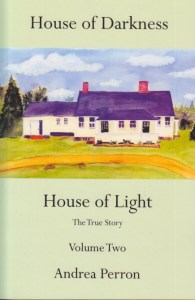
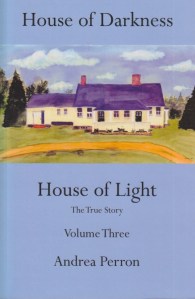
Although it may be only a venial sin, overwriting is nevertheless an offense.  As a professor I read many papers from students who had great difficulty clarifying what they were thinking only to disguise it with too many words.  I have finally finished Andrea Perron’s House of Darkness, House of Light.  Because academics too often dismiss personal testimony, I feel compelled to consider it.  Now over 1,300 pages later, I have discharged my duty.  Ed and Lorraine Warren, despite being famous, are difficult to assess in book form.  Yes, they (ghost-)wrote ten books, but they never had permission to include the Perron story that stands behind The Conjuring.  The eldest daughter took on the task herself and even seems to be aware of (in the acknowledgements) a dubious talent for overwriting.  What the Warrens saw as demons, she sees as ghosts.  Who has the right to decide?

I wish the author well in her writing career—those of us who write tend to be natural boosters of others—but it would’ve been nice to have had a more condensed version focusing on the events in the Harrisville house.  One interesting thing caught my attention here: according to Perron the Warrens called by phone after the Perrons moved from the offending house and tried to talk Carolyn, the mother, into a book deal.  Offering a healthy income from the proposition, they gave a hint of what other writers have claimed—they had the business angle firmly in mind.  I’ve read enough from people who actually knew the Warrens to believe they sincerely believed they were helping people.  They also had to make a living, and ghost stories tend to sell well.  Some use that as evidence that they were only trying to make money.  I’d remove the only, without dismissing the financial incentive.

It’s nearly impossible to read a very long book and feel that you haven’t come to know the author.  Also, it’s difficult to dismiss material written, even if overwritten, so sincerely.  We live in a world that we don’t understand nearly as well as we think we do.  Call it old school on my part, but I believe in extending the benefit of the doubt to eyewitnesses, particularly when there are several of them and they have a decade to observe closely what many others never get a chance to see.  This set of three books is a window into a realm over which the drapes are usually drawn.  For those willing to do some hard mining, there’s something of value here.


Frankly

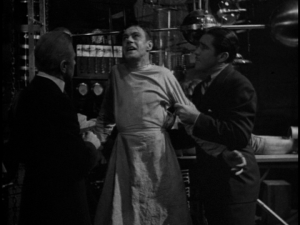
Even in the 1960s, if I recall, Dracula and Frankenstein really weren’t that scary.  I mean this in the sense of the 1931 Universal movies that began the entire trend of “horror” films.  They were, nevertheless, monarchs among those of us who claim the sobriquet “monster boomers.”  (I’ve never considered myself as part of any generation, but there’s so many people that you’ve got to sort us somehow.)  Recently I talked my wife into watching/re-watching these two films with me.   The pacing makes it seem like everything in the 1930s was stuck in slow motion.  The frights are difficult to feel, given what we’ve seen in movies since then.  And they are both, it occurs upon reflection, movies in which religion is the norm against which we measure monsters.  God is assumed.

Dracula, of course, fears the crucifix.  His chosen home in England is a ruined abbey.  Although the source of his monstrosity is never discussed, he is intended to be an embodiment of evil, draining the life of innocents.  Renfield craves flies and spiders in order to ingest their life.  Christianity can’t tolerate such evil and Dracula must be staked (off screen).  Frankenstein’s monster is much more obviously theological.  Opening with a warning to the audience that the film may shock due not only to its frights, but also because of Henry’s desire to create life, the film has philosophical discussions between Henry and his associates, and ends with the moral dilemma of what to do with an evil created by human hands, yet clearly alive like other people.

Metaphorically speaking, these first two horror films set the stage for later developments in the genre.  It isn’t so much fear and startles that define the genre as it is a deep dread of offending the powers that be.  Childhood was so long ago that I can no longer recall just which movies I saw on Saturday afternoons, but these two were among them.  Even as I was beginning the spiritual journey that would assure my job was never far from the Bible, I recalled with fondness the frissons of watching Dracula and Frankenstein—and then the host of other Universal monsters such as The Wolf-Man, The Invisible Man, and The Creature from the Black Lagoon (the last being scary in the classical sense).  The world in which they operated was deeply religious, for even the gill-man was an implicit condemnation of evolution.  These monsters were informing a religious outlook that would last a lifetime.  Going back to Dracula and Frankenstein is like turning back to the first page of Genesis and beginning again.


Strange Ending

Perhaps it’s from growing up as a biblical literalist, but I’ll probably always have problems with post-modernism.  You see, when you’re taught as a kid that there is one absolute right and you already know it (it’s Genesis to Revelation, no Apocrypha, please), you kind of get the idea that things are just what they seem.  Po-mo teaches, among other things, that there’s no true objectivity—reality is subjective and there is no neutral ground upon which to stand.  I’m down with that, but the old ways of looking at things remain.  This is a long-winded way of saying I finished Kohta Hirano’s ten-volume manga, Hellsing.  Over the past year I’ve been reading for a friend of mine, but manga has never really been my thing.  I read The Watchmen as a graphic novel, but looking at pictures somehow feels like cheating.  It’s that literalist thing again.

I might be dropping some spoilers here, so if you’re even slower than me be warned.  There’s quite a bit of shape-shifting here and it’s not always easy to tell who’s who.  In a kind of homage to my childhood monsters there’s vampires, werewolves, and even a Frankenstein’s monster in the series.  All of them are engaged in a constant state of combat against which the Protestant Hellsing organization stands for a stable civilization.  The Catholics are associated with Nazis along the way.  It’s a fascinating look at how an eastern culture might view the religious wars of those in the west who all go by the name “Christian.”  I think this is the genius of the series.  The friend who lent me the volumes has no declared faith, but he finds the dynamic fascinating.  Real religious fighting has made it easy for him.

The story, however, falls clearly into the generation of those without absolutes.  For someone my age a plot clearly laid out is a thing of beauty.  In college we used to argue about how absolutes might exist.  Where did they come from, and which is the strongest?  Did God make them or does God have to conform to them?  Even without the answers, the fact that absolutes existed was assumed.  Argument-driven science tells us that a theory is never proven.  Science is the best explanation we have at the moment, based on the evidence amassed.  In its own way, it has become post-modern.  Hellsing is a kind of mind-blowing work.  It will likely be a long time before I attempt another manga series.  Although I accept the po-mo premise, I still find old-fashioned fiction my favorite.


Stranger and Stranger

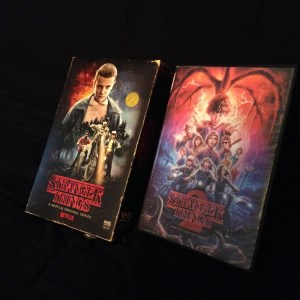
Like many fans of the X-Files and the early years of Sleepy Hollow, I’ve fallen into the Stranger Things orbit.  While I don’t have a Netflix account, I have friends who do and they got me hooked.  If you’ve watched it you’ll know why, and if you haven’t I’ll try not to give too many spoilers away.  The reason I raise it now, when we’ve gone such a long time without a new season, is that Stranger Things 2 took on shades of The Exorcist, but without any of the attendant religion.  Secular exorcists do exist, and possession is a feature of cultures with all different kinds of belief systems.  Exorcism works based on the belief system of the possessed, it seems, and if there’s no religion there’s no problem—call a secularcist!

Spoiler alert: Will is possessed by the mind flayer.  As the authorities flail around and get eaten by demidogs, his mother figures out how the exorcism has to work.  The thing about possession is that nobody really knows what demons are.  Dungeons and Dragons, which I confess I’ve never played—my life is too complicated already, thank you—gives the analogy for the possessing entity.    No matter what the demon, however, the only way to get it out is through exorcism.  Quite apart from sci-fi and fantasy, this is also the case in real life.  Part of the appeal to Stranger Things, I suspect, is that it indulges in the mysterious without the burden of religion.  While religion makes for good horror, good horror may exist without it.  Or can it?

Contrast this with Sleepy Hollow, now defunct.  Possession was a trope there as well, but the story had obvious elements of religion embedded in it.  As I point out in Holy Horror, religion often drives the fear.  That doesn’t mean it’s the only driver.  People fear being taken over by something else.  Stranger Things knows that if nobody can really figure out what that something else is, it can be scarier still.  We know it comes from the upside down.  We know it can possess people.  And we learn that it can be exorcised.  Although the setting is completely secular, there are elements of religious thinking even here.  It’s simply part of the human psyche.  We can deny it exists.  We can try to describe it only by analogy.  We can try to exorcise it.  It is there nevertheless, even as we eagerly await the advent of the third season.


Sixes and Sevens

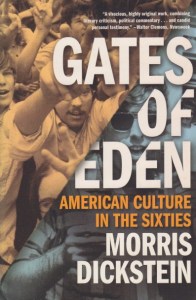
Few eras conjure mental images as readily as the sixties.  As the first decade of my life, I idealize them a bit, I suppose.  I wasn’t old enough to appreciate the truly wonderful and troubling things going on around me, and being raised in a Fundamentalist family I probably couldn’t have enjoyed many of them in any case.  Morris Dickstein’s Gates of Eden: American Culture in the Sixties was written in the seventies.  Since he’s a literary scholar much of the culture he analyzes is print culture, emphasizing the works of Jewish novelists and African-American writers.  That fits the sixties image pretty well.  He also looks at the music, but not as much as I had anticipated he might.  For me the music of the decade conveys what it really was about.

At one point Dickstein describes the political situation in the fifties that led to this incredible decade.  I had to remind myself that this was written forty years ago, for he seemed to be describing, with eerie prescience, the world of Trump and his followers.  Repressive conformity and the superiority complex of that era led to a breaking point where individual expression tumbled long-held rules and regulations that had tried to repress women and those that didn’t fit the WASP mold.  Most of us thought those controlling, catatonic days were over for good.  It seems we underestimated the will of those who lack imagination of where things might go if freedom were allowed to be free.  Some people, it seems, believed the sixties were a disease to be cured.

Historians who have a wider grasp than I do say that time has to pass before accurate pictures can emerge.  Instant potted histories tend to miss much of what becomes clear only with the slow passing of further decades.  To me the music defines them.  I only started to become culturally aware in the seventies, and that was in a small town.  When I learned to look back, largely in the eighties, I could see, and hear, that I’d lived through an extraordinary time.  The nineties, largely spent at Nashotah House, were again isolated from culture.  Who knows how this new millennium will be assessed?  Has a new music emerged that will help define us?  Or will it be, as Dickstein unwittingly projects, a new era of acceptance, love, and peace?  Or did the world really end at the millennium?   It could be, we might dare to dream, that a new decade as remarkable as the sixties is waiting to usher in Eden again.


Friends with the Devil

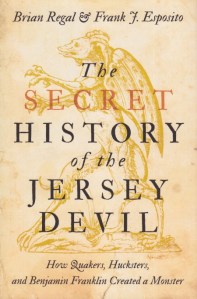
The Pine Barrens of New Jersey strike the first-time visitor as eerily odd, even today.  Stunted trees grow from sandy soil, crowded close together and growing hard up to the edge of the road.  You can see the sky above, but dwarf trees of uniform height block your lateral views over any distance.  It feels claustrophobic.  Add to this tales of inhospitable residents and an actual profusion of tree-climbing lizards, and you’ve got the grounds for wondering what else might lurk in the deciduous woods.  Brian Regal and Frank J. Esposito aren’t so easily frightened.  Their fascinating book, The Secret History of the Jersey Devil: How Quakers, Hucksters, and Benjamin Franklin Created a Monster is a bit of a chimera on its own.  The subtitle gives a pretty good idea of what you’ll find in the book.  For someone who had lived in Jersey for a dozen years, and who loves monsters, it was a must-read.

Not to provide too many spoilers, Regal and Esposito spend some time in colonial New Jersey sketching the little that can be known of the rather prominent Daniel Leeds.  Anyone from Jersey knows that its eponymous state demon is also known as the Leeds Devil.  This particular family had good connections despite being Quakers—a capital crime in some parts of the British Empire.  Daniel, however, had a falling out from the Friends and made his name by publishing an almanac.  This almanac and the proximity of Philadelphia to the Barrens brings Benjamin Franklin into the story.  Franklin competed with the Leeds almanac, and Poor Richard eventually won out in this war of the words.  Demonized by their former Friends and gently satirized by Franklin, the Leeds family was eventually all but forgotten.  Then stories began to emerge of a dragon-like monster in southern Jersey.

To get the details you’ll need to read the book.  Particularly interesting for this blog is the way religion and monsters interplay.  There’s a good bit of history of monsters in the story, including Quakers and early attempts among scientists to understand birth defects.  The very word “monster” is, in its “word cloud,” related to ideas such as revelation and portents.  Early scientists resorted to divine anger when they couldn’t explain what nature had wrought.  And of course folklore is a very potent lubricant.  There are some gaps in the story here, but this is an enchanting exploration of whence monsters might come.  The Jersey Devil has international fame now, and its birth may have begun with insults flashed back and forth among religious believers that eventually were taken literally.  The devil’s in these details.  Or at least in the spooky topography of the Barrens.


Remembrance

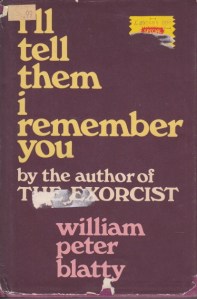
When reading C. S. Lewis’ Surprised by Joy, a number of things stood out in high relief.  One of them was his statement that the early years of autobiographies are often the most interesting.  Now, many people may have difficulty drawing a straight line between Lewis and William Peter Blatty, but the overlaps are there.  I’ll Tell Them I Remember You is a young man’s autobiography, so mostly it deals with early years.  Even more than that, it deals with Blatty’s mother.  Those of us who write often find a kind of inspiration in the life stories of other writers.  To hear Blatty tell it, or rather, to read him tell it, it was his mother who made him the man he became.  It’s a nice tribute.

Blatty is probably best remembered as the author of The Exorcist, but his background as a comic screenwriter comes through in his account.  (He also wrote, for example, the Pink Panther screenplay A Shot in the Dark.)  But more to the point currently, with a spoiled child wanting to try to force a wall that America doesn’t want on it, Blatty’s parents were immigrants.  From Lebanon.  It may be that since I’m writing a book about demons in movies that The Exorcist seems like an important national achievement to me, but it also seems an apt parable for the situation in which we find ourselves.  It worth thinking about—the invasion of evil and how to expel it.  Metaphorical writing is often the best.

Perhaps writers are naturally obstreperous people.  If my novels ever get published you’ll see that characters don’t do what you want them to.  And yet we like what happens when they don’t.  I would have found a bit more information about Blatty’s life an asset.  His mother certainly makes an impression, even if its third-hand.  Writers, if my own experience is anything to go by, often feel they are conduits.  Receivers.  It’s like listening to the radio when driving a car through the mountains.  Suddenly a station comes in clear, but just for a moment.  Ideas for stories are like that—they often arrive when you can’t do anything about them.  Writers carry notebooks for a reason.  I used to have a waterproof one in our shower.  You never know when the signal’s going to come in loud and clear.  And you never know when the people you’re trying to block out might be adding more value than you’d ever imagined.  You might be surprised.


Weaponized Scripture

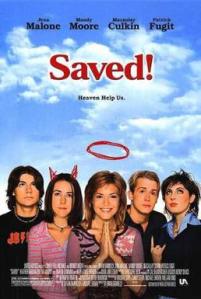
One of the many questions that haunt evangelical Christians is whether it is okay to watch horror films or not.  The same applies to whether it’s okay to listen to rock-n-roll (even as it’s reaching its senior years).  Cultural accommodation is often seen as evil and evangelicalism, as a movement, is frequently offered as a culture all its own.  I recently rewatched Brian Dannelly’s Saved!, a coming-of-age comedy about a group of teenagers at American Eagle Christian High School.  Gently satirical, it portrays well how evangelicals try to redefine “cool” in a Christian mode.  Taking tropes from pop culture and “baptizing” them, Pastor Skip—the principal—assures the young people that they’re every bit as cool as secular culture icons, only the Christians are going to heaven.

The film came out when I was teaching at Nashotah House.  That seminary also had problems with secular culture, but in a completely different way.  Its method was basically to ignore that culture.  Isolated, Anglo-Catholic, one might even say “Medieval” but for the sanitation, it was likely not a safe place for a professor to be watching such films.  Evangelicalism and right-wing Catholicism were beginning to find each other.  Once the cats and dogs of the theological world, they were becoming more like goldfish in their bowl, watching a strange and unnerving world just outside the glass.  A world in which they couldn’t survive.  Now, Saved! is only a cinematic version of this, but it has a few profound moments.  Mary, the protagonist, comes to see the hypocrisy of both the school and her former friends when she supports a boyfriend who is gay.

At one point her friends attempt an intervention.  They try to exorcize Mary, and when that fails one of them throws a Bible at her.  Picking it up, Mary says “This is not a weapon.”  Since this movie isn’t by any stretch of the imagination horror, I didn’t address it in Holy Horror.  As I rewatched it in the light of that book, however, I recognized a motif I did discuss in it.  The use of the Bible in movies is extremely common.  That applies to films that don’t have an overt Christian setting such as this one does.  The iconic Bible is a protean book.  Despite what Mary says it can indeed be a weapon.  It often is.  Many of us have been harmed by it.  Christian separatist culture has its own dark side, even if it’s carefully hidden, its adherents think, from the secular world outside the fishbowl.


Servants and Such

At Nashotah House I met my first real-life servant.  This was a student—a candidate for the priesthood—who’d formally been a “domestic.”  Now, being Episcopalian one doesn’t bat an eyelash at that sort of thing but I was secretly in shock that servants still existed.  I’m woefully uninformed about aristocracy.  Having grown up poor I resent the idea of a person being placed in the role of fulfilling the whims of someone just because they have money.  My wife has more of a fascination about this than I do, and she was recently reading a book about servants.  This post isn’t about domestics, however.  It’s about foreign gods.  In the book she was reading my wife noticed one of the servants writing that old-fashioned stoves were like Moloch.  Were it not for Sleepy Hollow, I suspect, many modern people wouldn’t know the name at all.  Who was Moloch?

Moloch, according to the Bible, was a “Canaanite” deity.  Specifically, he was a god that demanded child sacrifice.  The phrase the Good Book uses is that his worshippers made their children “pass through the fire” for Moloch.  Very little is known about this deity, and the question of human sacrifice is endlessly debated.  Theologically it makes sense, but practically it doesn’t.  Deities want servants and living bodies do that better than dead ones.  Although it’s been suggested that “passing through” could be a symbolic offering, by far the majority of scholars have taken this act as an actual sacrifice.  The ultimate servant is a dead servant.  Moloch, you see, comes from the same root as the word “king.”  And kings are fond of having many servants.

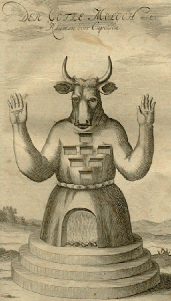
Image credit: Johann Lund, Wikimedia Commons

So how is a stove like Moloch?  The classic image of the god, which looks like a scene from The Wicker Man, holds the answer.  Well circulated since the early eighteenth century, this engraving has captured the imagination of modern people.  A massive, multi-chambered statue intended to consume by the raging fire in its belly.  This is the way in which a stove might resemble a Canaanite deity.  The servant who described cookware thus knew whereof she spoke.  Archaeological evidence for the “cult of Moloch” is slim.  It is almost certain that nothing like this fanciful image ever existed.  Moloch, in other words, lives in the imagination.  One aspect, however, rings true.  Like most tyrannical rulers the deity wants unquestioning obedience on the part of servants.  And this is a viewpoint not limited to deities.


Terror Text

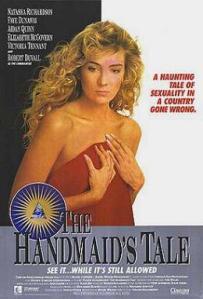
Dystopia reading and/or watching may be more practical than it seems.  History often reveals authors who may be accused of pessimism more as prophets than mere anxious antagonists.  Two books, according to the media, took off after November 2016.  One was George Orwell’s 1984,  and the other was Margaret Atwood’s The Handmaid’s Tale.  I’d read both long before I started this blog, but I recently asked my wife if she’d be interested in seeing the movie of the latter.  While teaching at Rutgers, I had a 4-hour intensive course and to give students a break from my lecturing I’d have us discuss Bible scenes from secular movies.  The Handmaid’s Tale was one of them.  Watching it again last night, I realized the problematic nature of Holy Writ.

The Handmaid’s Tale is a movie (and novel) that involves what I call “Bible abuse” in Holy Horror.  That is to say, the Bible can be used to oppress rather than to liberate.  To cause human suffering instead of eliminating it.  Sure, to make Atwood’s dystopia work a future catastrophe of fertility has to occur, but the military state, the assumed superiority, and the will to control on the part of men are all too real.  We’ve witnessed this in the United States government over the past two years.  A lot more has been revealed than personal greed—that side of human nature that quotes the Good Book while doing the bad thing.  In the movie it’s literally so, while our “leaders” are only a metaphoric step away from it.  Although it’s not horror, it’s a terrifying movie.  I still have trouble watching The Stepford Wives.  Why is equality so easy in the abstract, but so difficult when it comes to actual life?

Aggression is not a social value.  This is perhaps the most ironic aspect of using Scripture to enforce oppressive regimes.  The whole point of the New Testament is self-denial for the sake of others.  That may be why the only Bible reading in the movie comes from the Hebrew Bible, the story of Jacob and Rachel.  Although this isn’t one of the traditional “texts of terror,” to borrow Phyllis Trible’s phrase, it nevertheless illustrates the point well.  A culture that values women only for their reproductive capacities is dystopian to its very core.  When a book, no matter how holy, is divorced from its context it becomes a deadly weapon of blunt force.  Atwood moves beyond Orwell here—the government that sees itself as biblical can be far more insidious that one that only weighs evil on the secular scale.  Not only the Bible ends up being abused.


Troubled Trilogy

The quest for the truth is never-ending.  New information keeps emerging and our poor brains have evolved to survive the perils of weather and wild animals, not to receive all available information.  It’s the fear that I might’ve missed something that has me going back to a place I’d rather not go.  Andrea Perron’s account of what happened in Harrisville, Rhode Island is the only real published source by eyewitnesses that’s readily available.  Her three-book account, however, is a deeply personal ramble that isn’t easy for the fact-finder to follow.  A couple of months ago I posted on volume one, intimating that I would probably have to go back and read two and three.  There’s a compunction about completion that humans have.  An economist once told me not to measure a venture by sunk funds.  The same applies to books, I guess.

In my ongoing research into demons, and particularly the work of Ed and Lorraine Warren, I felt I had to continue with the troubled trilogy.  Volume one barely mentioned the Warrens.  Volume two finally revealed some of the story.  It took 260 pages to get there, but finally, an eyewitness account!  It has plenty of gaps, of course, but it is, as they say, different from the movie.  You have to understand that a certain sector of the internet was buzzing like flies in January over The Conjuring.  Based on a true story, it was a sympathetic treatment of the Warrens’ work that it was hoped would give credibility to the demon-hunting duo.

House of Darkness, House of Light in total is well over a thousand pages long.  I know, I know—“caveat emptor.”  Nevertheless, I’ve always felt that long books owe it to their readers to deliver on the promises.  I want my haunted house books to be scary.  Or at least moody with a gothic sensibility.  I do understand the desire—the compunction—to approach life philosophically.  Were I ever to put my life out there on display, beyond the occasional forays on this blog, I would hope to do it in a way that left readers wanting more, not less.  Biography is a dicey subject.  Autobiography even more so.  The traditional publisher steps in with an editor firmly in hand.  I know because I’ve been doing this for about a decade now.  The writer and the editor, like the farmer and the cowman, should be friends.  It’s tough, painful even, when someone takes a pen to what you’ve carefully crafted.  The results, when they work, give the reader what s/he wants.  The quest may indeed be never-ending.  At least trilogies have only three parts.


Ground, Candle, and February

The world’s hairiest prophet?

Relying on the prophetic ability of a rodent may seem like a fool’s errand, but to understand Groundhog Day you have to go back to Candlemas.  Apart from when I lived at Nashotah House, I’ve never been anywhere that people knew what Candlemas was.  It’s also known as the Feast of the Presentation, and it in itself is built on an archaic ritual based on a creative understanding of biology.  In ancient Israel, a woman was considered impure for seven days.  The eighth day, if the child was a boy, he was circumcised.  Thirty-three days later the woman, finally considered pure enough to approach the temple precincts, was to take a sacrifice for her purification.  And oh, if she bore a girl the impurity lasted sixty-six days.  It’s all there in Leviticus.

What does any of this have to do with Groundhog Day?  Well, according to the much later tradition that Jesus was born of a virgin on December 25, if you do the math you’ll find Mary’s purification falls on February 2.  And if Jesus had been a girl Candlemas would be a moveable feat since February sometimes has 29 days.  Since it’s still dark out for most of the time in February a couple of traditions developed: one was a way of finding out when winter would be over and the other was the blessing of candles since you’d still be needing them for awhile.  That gave the feast its common name.  The tradition grew that clear weather on Candlemas meant that winter was to last for a good long time yet.  Since Germanic peoples love their Christmas traditions, a badger was used for the long-range forecast part of the celebration.

In Pennsylvania Dutch territory, badgers are rare.  Woodchucks, or groundhogs, are just about everywhere and they live in burrows like badgers do.  In a carryover from Candlemas’s clear weather foretelling the future,  the belief was that a badger or groundhog seeing its shadow—because it’s clear, get it?—meant six more weeks of winter.  Of course nobody knew about global warming in those days.  Candlemas, it turns out, was one of the earliest Christian celebrations and it was part of the Christmas complex of holidays.  It’s still winter out there.  It’s also Saturday which means I already have a list of chores as long as a badger’s shadow.  Now I’ve got to remember to get my candles blessed as well.   Winter, it seems, never ends.


McChristianity

Christianity isn’t known for its sense of humor.  The same can be said of other religions as well, of course.  What else should we expect concerning belief systems that claim eternal consequences?  A story by Colin Dwyer on NPR explains that the Haifa Museum of Art had to remove a sculpture titled “McJesus” due to public violence.  The sculpture depicts a crucified Ronald McDonald, and a number of althoughs follow: although Haifa is in Israel a large number of Christians protested.  Although the practice of crucifixion was uncomfortably common in ancient days it has come to be associated with one particular case.  Although the message might be interpreted as a condemnation of commercialism, protestors took it to be aimed at their faith.  Perhaps it was.  Artists can be notoriously ambiguous in that way.

Ronald McDonald is a liminal, if ubiquitous figure.  Instantly recognizable, he has been challenged before as a threat to christendom.  I once heard a priest lament that children recognized the golden arches more than the cross.  Well, that’s not surprising—we don’t go around telling our kids about crucifixion daily.  (Or shouldn’t.)  A massive Ronnie, on the other hand, floats down Manhattan every Thanksgiving Day.  He’s on posters, commercials, and 42nd Street.  He’s the patron saint of branding.  With his garish clashing color palette, his red and yellow never mix to orange and they linger in our minds to ensure us that no matter where we might be there’s always cheap, if unhealthy, food nearby.  Mr. McDonald has become a religious symbol of capitalism.

Even as a child I noticed the great deal of excitement that accompanied the opening of the local McDonald’s.  In a small, corroded corner of the rust belt, families piled into cars to drive to Oil City to see this wonder.  It was like an epiphany.  Eating out that the poor could afford.  Just about everything in downtown Oil City is now closed, but the last time I was there that McDonald’s still stood.  Back in Haifa an ironic depiction led to real violence.  Angry Christians carrying stones couldn’t see the statue as a condemnation of consumer culture.  Their beleaguered religion was at risk.  Blood flowed and the art piece was removed and packed off to Finland.  Although the point of the display was to question religious appropriation in the support of consumerism, and although that message could ultimately support the teachings of the religion it evokes, the branding came across all wrong.  Church is your kind of place…


Prejudices of the Time

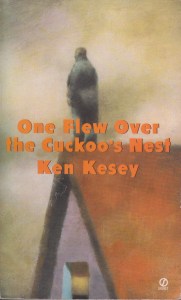
When my daughter was in middle and high school, I made an effort to read every book she was assigned for her English classes.  This gave us something to talk about during the years when many teens grow laconic and uncommunicative.  Some of the books I’d read before, but one frightened me off.  Ken Kesey’s One Flew Over the Cuckoo’s Nest pressed the wrong buttons.  You have to understand that I saw the movie for a class in college.  It disturbed me.  Even before encountering H. P. Lovecraft, one of my deepest phobias was insanity.  Children of alcoholics sometimes fear those who are out of control, and mental patients had become, in my head, associated with the non-rational behavior of my father that frightened me so.  During a clown ministry event we visited the local state hospital for mental patients.  I trembled for about a week after we left.

One Flew Over the Cuckoo’s Nest is in many ways a sixties novel.  One reflection of that is the fact that the religious imagery in the novel is presented in the form of punishment.  Everyone knows the narrative of R. P. McMurphy’s battle of the wills against Nurse Ratched.  The latter uses electroshock therapy as punishment and she tries to wear McMurphy down by using it repeatedly after the fight in the shower.  The electroshock table is described as a cross.  The metal headset is a crown of thorns.  Indeed, one of the patients is described as being crucified to the wall of the ward where he hangs throughout the novel.  The sixties frequently saw religion—especially the staid, conservative evangelicalism of the 1950s—as a form of punishment.  That’s pretty clear here.

Although the novel celebrates the freedom of the sixties, it also reflects the prejudices of the times.  The African-American attendees on the ward aren’t portrayed sympathetically.  The women—nurses and prostitutes alike—are there for the pleasure of the male patients’ gaze, exemplified in the leering laugh of McMurphy.  Still, there’s a kind of catharsis to this tale.  The Chief, from whose point-of-view the story’s told, is arguably cured by the antics and special attention McMurphy shows him.  Beneath the callous, self-serving conman there is a human decency that “the system” fails to find.  Indeed, McMurphy is a kind of Christ figure.  A fallen savior, no doubt, but a liberator nonetheless.  This was a difficult novel to read.  I couldn’t make myself pick it up half-a-decade ago, but I suspect somewhere beneath the surface I’m glad I’ve finally read it.  It didn’t cure any of my phobias but it made me think.