We Are an Island

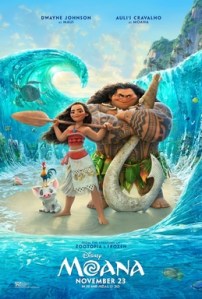
moana_teaser_posterApropos of both building your own deity and Disney, my family went to see Moana. Now, I have to admit up front to being a bit behind on my Polynesian mythology. Scholars of the history of religions feel terribly insecure if they don’t read the languages or haven’t spent time with the culture first-hand. I’ve seen the Pacific Ocean a few times, but never from the point-of-view of an islander. In fact, one of the areas of growing interest in biblical studies is the interpretation of Holy Writ by islanders. Their perspective, it seems clear, is different from others in more populated land masses. So Moana, which delves into Pacific islander mythology, was a brand new world for me. More than hearing about the demigod Maui, it was a chance to consider what destruction of our ecosystem looks like to those who have more limited resources at hand. Those who, when global warming really kicks in, will be the first to become homeless.

One of the strange things about living in the post-truth world (defined as the world after 11/9) is that many movies, novels, and other creative explorations I encounter seem to underscore the demon we’ve invited in. Moana is about a girl who saves her people, but she only does so by defying the man in power. Had she not journeyed beyond the reef, her people would’ve starved on their island. Meanwhile the big white man prepares to assault the White House and all that our founders held dear: an educated leadership. Progress. Fair treatment for all. Someone needs to remind these short-sighted individuals that every landmass is an island.

As we approach the end of 2016 it’s time to think of where we’ve been. At the theater, an ad by Google showed the newsworthy events of the year. There could not have been a better rendering of the high hopes with which we began and the sorrow with which we’ve come to an end. Our scorn of education has caught up with us and we’ve asked “the man” to please destroy our world and enslave our women and deport anyone who’s different. We need a lesson in how to build better deities. We need to be willing to admit that a girl might know more than her father. We need to learn the wisdom of the islanders.

Lions and Lambs

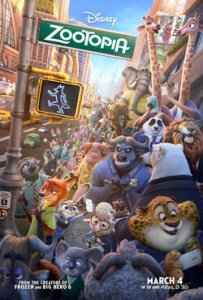
This brief break between Christmas and New Year’s Day, taking into account the vacation days expended to enjoy it, is a time filled with movies, reading, writing, and sufficient sleep. In short, it’s like a dream. I’ll get around to addressing the movies eventually, but right now one in particular is on my mind: Zootopia. Disney movies weren’t a big part of my childhood. We did watch the Wonderful World of Disney on Sunday nights, but movies were an expensive treat. I remember seeing The Jungle Book, Bedknobs and Broomsticks, and Herbie the Lovebug. When we could afford a movie, it was frequently at a drive-in where a carload was cheaper than individual seats. I missed several of the childhood western canon—I never saw Mary Poppins until I was in college. Becoming a parent in the 1990s meant becoming conversant with Disney.

zootopia

Oh, I’ve heard the conspiracy theories: Disney is “the evil empire,” part of the Bilderberg Group, the Illuminati, and any number of other collectives that want to run the world. They have access, we are told, to the young and a reach that excludes few before the age of ten. I know little of Disney’s business practices, but Zootopia suggests to me that they are telling our children the right message. The movie follows the ambitions of Judy Hopps, a bunny that want to be a police officer in Zootopia, the largest city in the animal world. Threatened and bullied because she’s a girl, and small—traditionally prey—she nevertheless overcomes the obstacles necessary to meet her dreams. Once she meets success, however, she finds herself engaging in prejudice against predators. Species profiling takes over and the white sheep (literally) take over.

The message of not assuming someone is a slave to their “biology” is a powerful one. Nick Wilde, the fox that assists Judy to her goal, becomes a victim. The only way forward for Zootopia is to recognize that profiling—gender or species—is wrong. Since the story isn’t preachy, it’s all the better. Watching unchecked prejudice surging through our political machinery today, it was difficult to believe that this movie was released all the way back in March. The prey animals are the majority, and they feel threatened and so follow the leadership that controls, deports the predators who’ve been law-abiding citizens all along. Only when we once again see shrews living peacefully next to elephants, rabbits, lions, and polar bears, do we get the sense that everything’s as it should be. I know nothing of Disney’s business practices, but with messages as important as this, I have but few worries.


Prejudicial Monsters

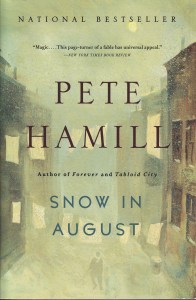
snowinaugustWitnessing injustice is traumatic. Especially when you’ve been conditioned to believe there is nothing you can do about it. That helpless feeling crushes you as you see the guilty, the powerful, the cruel getting away with whatever they want to do. This is the perspective of young Michael Devlin in Snow in August. Pete Hamill’s novel is full of observations about prejudice and ignorant blustering about those who are different in 1940’s New York City. Michael accidentally observes a robbery that may also be a murder. The perpetrator, an older boy who leads a gang in Brooklyn, hates Jews. Michael, however, has become the shabbos goy for a synagogue that has seen better days. Although a Catholic, he is curious about this strange rabbi he comes to know and what this other religion teaches. At the same time, Jackie Robinson is being called up to the Brooklyn Dodgers and prejudice about an African American playing in the major leagues sets up a parallel to the story of understanding the Jews.

It is an engrossing novel. I have to confess, however, that I read it because of the golem. A traditional Jewish monster, the golem is an animated being of mud that protects oppressed Jews. In the novel this begins as a legend Rabbi Hirsch tells the boy as they teach each other their native languages. Michael learns Yiddish as the rabbi learns English, and the story of the golem is part of the rabbi’s own sad history as a Jew during Nazi days. Then as Michael, his mother, and the rabbi are all beaten or molested by the gang, it is time for the golem to make his appearance.

Not exactly a monster story—as often in such cases the monster is someone recognized as fully human but without sympathy for those who are different—Snow in August is a thoughtful, almost nostalgic tale of “a simpler time.” What we learn, however, is that it wasn’t really simpler at all. Prejudice could be worn openly and proudly. What many of us may have forgotten, until recent elections forced us to remember, is that such hateful intolerance is still very common. We live in a world where hatred can be currency and bigotry has more power than we’d like to admit. Reading stories, such as Snow in August, will become increasingly important in days ahead. We will need to remind each other that even if only as metaphors golems do indeed exist. All we have to do is believe.


Charlie Grinch

There were probably about half-a-dozen animated Christmas specials I recall watching as a child. The two that became fixtures, and remain part of my present holiday ritual, are It’s Christmas Charlie Brown and How the Grinch Stole Christmas. I remember watching them from early days—of course you had to wait until their respective channels announced their advent in TV Guide (just writing that makes me feel older than the Grinch). Commuting wasn’t an issue then, so watching television was as common as candy canes and hopeful stockings. As an adult, though, you see things you overlooked, or simply accepted, as a child. I guess that’s what “believing in Christmas” is all about. The willful suspension of disbelief.

I’ve commented on these Christmas specials before. Charlie Brown has so many inconsistencies that an old biblical scholar can’t help but think of J, E, D, and P. What does the signage on Lucy’s Psychiatric Help booth really say? How many branches are on Charlie Brown’s Christmas tree? How does Sally get to the school before her big brother? The animation is clearly a little off—Lucy appears to emerge from the center of her booth’s wooden top as she gives advice to the woeful Charlie Brown with his Trump’s-been-elected-type depression. Still, Linus’ rendition of Luke’s Christmas story brings it home every time. Compare that with the Grinch.

Those who see a war on Christmas (there’s not) seldom cite the Grinch. How the Grinch Stole Christmas is entirely secular. No mention of a special birth. No angels or shepherds. Just a mean old man and his dog. The Grinch shares with Charlie Brown its message of looking beyond the commercialization of Christmas. In the case of the much better animated Grinch (although I still can’t figure out why that one Who’s hat repeatedly flashes from white to blue and back) it would seem that religion matters less than spirit. The Who’s Christmas song with its strange, non-English words, is a celebration of difference. Diversity. Even that angry old man who would steal Christmas itself is welcome in the end. The only war on Christmas is one that has been spawned in the imagination of those who fit the Grinch’s description in Thurl Ravenscroft’s rendering of Dr. Seuss’s lyric. Those my age will understand, and unless you were born yesterday, I suspect that you’ll get my meaning.


Engendering Fear

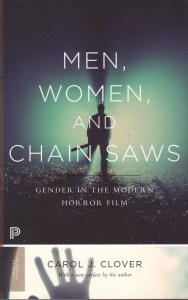
menwomenchainsawWe live in fear. At this point in history, it seems, with good reason. Horror films, apart from being considered low art, teach us to deal with some of these fears. I hadn’t been reading about the genre for very long before I began to notice the repeated references to Men, Women, and Chainsaws: Gender in the Modern Horror Film. This is Carol J. Clover’s seminal study of gender theory and horror. Probably best known for first identifying the trope of “the final girl,” Clover gives much more than that to the conscientious reader. Her chapter on possession movies is among the most insightful that I’ve read. And yes, she does make a very good case for the final girl.

Using theories of gender, she explores why both boys and girls (the former numerically more obvious) flock to such disturbing movies. Although she suggests masochism has something to do with it, is isn’t simply that boys enjoy seeing girls suffer. Quite the opposite. Boys often see themselves in the place of female victims. As with most things associated with gender, it’s far more complicated than it seems. In that sense, this is a book for our time. We live in what George Banks calls “the age of men,” and while Mary Poppins can hardly be called horror, the underlying narrative bears some warning tones. Men, left to their own devices, will seize what power they can grasp. We’ve spent the last five decades teaching men that this is no longer appropriate, only to have that message wiped away with the final trump. Horror can be remarkably pro-feminine. Business, as we’ve seen over and over, is less so.

Not having ever formally studied gender theory, some of the intricacies of Clover’s argumentation were no doubt lost on me. I was, however, able to gather a remarkable amount of appreciation for the subtexts in many of the movies I’ve watched. Gender, you see, touches everything we do. It behooves us to be aware that careless, or thoughtless support of misogyny does not lead to the results that many men suppose. Some horror movies are truly difficult to watch. Not all conform to the standard expectations. What Clover has shown, however, is that often the women are able to draw from a depth of strength to which the male characters lack access. They don’t do so willingly. In fact, they are often reluctant. When the horror is at its end, however, the final girl emerges triumphant.


What You Eat

The future of Sleepy Hollow is uncertain. The successful FOX television program has suffered the slings and arrows of outrageous scheduling over the past year and speculation abounds that the current fourth season may be its last. It has been, in my experience anyway, one of the most literate supernatural horror shows ever. Books and reading abound and an interracial team fights evil week after week. Having done some research on the first season of the program, I continue to be surprised just how detailed the homework of the writers is. My wife sent me a story from Atlas Obscura on the “sin eater.” This is a term, I readily confess, that I never heard before the introduction of Henry Parrish to Sleepy Hollow. Ichabod Crane, guilty over the death of a freed African American freedom fighter, ingests poison to kill himself and severe his connection to the Headless Horseman. Abbie Mills, believing there is another way, locates the sin eater.

The idea is fairly simple, if unorthodox. A sin eater can literally devour the sins of another. In Sleepy Hollow this comes at a considerable cost, but the article by Natalie Zarrelli demonstrates that this too reflects research on the subject. There were, it turns out, sin eaters in the early modern British Isles. Often a poor person with no other options, a sin eater would consume bread placed on the chest of the deceased, incorporating, in an almost Christ-like way, the sins of the recently passed. The dead could then be safely buried, forgiven, while for a pittance a poor soul could walk around with someone else’s sins in his or her body. Sounds like capitalism writ large, to me.

Watching Sleepy Hollow I had assumed this idea was invented for the show. Like so many details, however, it turns out that some digging had brought an obscure historical practice to the surface. Sin eating, as the article makes clear, was never sanctioned by the church. People have often worried that official religion might not deliver the salvation it so readily promised, bound up with rules and rites as it was. Here was a sacrament of the people. Bread could be visibly consumed and symbolically, or literally, sin with it. The sin eater was paid, making this a legal transaction. Although sin eating is thought to have died out, it seems that with the recent, high-level resurgence of evil-doing, perhaps it is a practice that should be recalled. In many ways Sleepy Hollow has been ahead of the times since the beginning.

IMG_1960_2


Monsters and Men

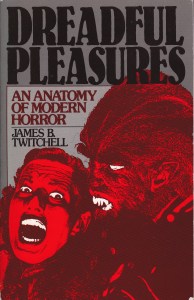
dreadful-pleasuresHorror films are something you either “get” or you don’t. I have no empirical evidence for that, but then again, “getting” is hardly a precise verb. In my recent desire to find some explanation for my own fascination with the genre, I turned to James B. Twitchell’s Dreadful Pleasures: An Anatomy of Modern Horror. This is a smart book. Twitchell, an English professor, knows to include Gothic novels in his accounting for this strange addiction. He has several insightful things to say about the differences between terror and horror. He gives a fairly complete analysis of the “big three”—vampires, Frankenstein monsters, and werewolves/wolf men/Jekyll and Hydes. Still, at the end, I have to wonder if he really “gets” the monsters he explores. Part of this is his early admission that he didn’t grow up with monsters, but that he was introduced to them academically. Another part of it is his sometimes dismissive style when talking about movies that meant a great deal to us monster boomers when they came out. Either you get it or you don’t.

Still, I recommend this book for those who want to make sense of some of the hidden dynamics of classic monsters. That the analysis is sexual should come as no surprise. Twitchell finds evidence for a sublimated incest in many of his creatures, but the true fan knows there is more to them than that. The monster does indeed cross boundaries—that’s what monsters do, after all—but that’s only scratching the surface with their claws. Of course, the book suffers from having been written perhaps a little too early. Although there is protest to the contrary, horror films have grown up considerably since the 1980s. Not all of them, of course. The same thing could be said of the kids I knew in high school.

Having a single theory to approach a phenomenon is respectable. So respectable that it’s called Occam’s Razor and everyone is expected to shave with it. I’ve never liked shaving. The more I reflect on reality, the more it seems to me that answers are more complex than single causation. Sometimes the simplest answer isn’t the most parsimonious. Sometimes there is far more going on than meets the cyclops’ eye. In my experience, limited though it may be, the horror movie has unexplored dimensions. One of them is the coping ability that they offer when evens such as 11/9 occur. There’s no simple way to understand monsters, but if we see them around enough, we might just be able to survive them.


The Wicked Man

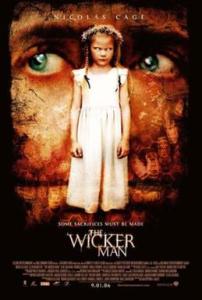
I confess, it was a moment of weakness. Or I could say that it was dedication to research. In either case, I subjected myself to watching the remake of the 1973 classic, The Wicker Man. The reviews that I’ve read over the past decade since its release had warned me not to subject myself to it. Not only did I, but I had my wife gamely watch it with me. If you plan to watch the flick but haven’t, I’ll first of all beg you to save your time and secondly warn you of spoiler alerts. So here goes.

By Source, Fair use, Link

By Source, Fair use, Link

In a movie that may be either pro-feminist or misogynistic, depending on which way you look at it, this version of The Wicker Man takes place in the United States. We’ve got all kinds of New Religious Movements in this country, so that much is believable. The film has a group of women who mute, deafen, and enslave their males moving from Salem, Massachusetts, across the country to Puget Sound where they can find an island to be left alone with their rituals. Superfluously adding an “s” to the original’s Summerisle, they come up with the sloppy-sounding Summersisle where they can raise bees. They worship the great mother-goddess, which is cool enough, but their religion appears to be cobbled together in a way that suggests those responsible for the movie didn’t do their homework. Although Sister Summersisle (five “s”es—count ‘em!) claims this to be a Celtic religion there are merely the weakest echoes of such.

To make matters worse, Edward Malus goes around beating up women when they get in his way. Yes, he is the unwitting victim—we’ve seen the original and know how this plays out—but it makes the viewer uncomfortable watching this unsympathetic protagonist punching, kicking, and even bicycle-jacking with a gun, the women of the island. A man comes ashore and the first thing he does is try to take over. Were there evidence of a deeper plot here it might suggest that this was intentionally written into it. As it turns out, however, as we enter a fearful era of the rich white man’s revenge, such scenes only suggest that Mr. Malus had it coming. Perhaps the movie is prophetic after all.

I really don’t recommend spending your time on the remake of what has become a horror classic. If you’ve seen the excellent original, you already know how it ends. And despite his brusque manner Neil Howie didn’t shout invectives at women or punch them in the face. In short, he took his fate in what might be a way that is also prophetic.


Fear of the Artificial

As someone who dedicated four years—particularly long winter nights—to the cause of high school robotics, I found myself knowing quite a bit before I walked into the room. Now let me post a disclaimer here: I’m no techie. I’ve studied the humanities throughout my education and although I’ve been able to engineer a bookshelf or two, and even the occasional project with moving parts, the technical eludes me. I claim absolutely no expertise in it. So where was I going that robotics came to mind? A lecture on Artificial Intelligence. AI. You see, I’ve been a bit concerned about it for some time because I’ve seen what robots can do. A friend recently showed me some episodes of Battle Bots on YouTube (the relative who started this blog for me was doing quite well in the competition last season), and from my own experience watching hours of FIRST robotics competitions, I know enough to be afraid.

What could possibly go wrong? (DARPA photo)

What could possibly go wrong? (DARPA photo)

The lecturer assured us that we had nothing—or next to nothing—to fear. Artificial Intelligence, he assured us, is a misnomer. Machines have no will. No mind. There’s nothing they want. They do as they’re told. You write a program and feed it to your bot and your mechanical friend can do only what it’s told to do. This sounds uncomfortably like slavery to me and although I know I’m projecting, I have to wonder if robots think the same way about it too. No, the lecturer assured us, they do only the tasks assigned. They don’t think at all. Then he said something that made me shiver. That wasn’t his intent. He said something like, “We don’t even know what consciousness is, so how can we replicate it?” That was meant to be reassuring.

I took this idea and flipped it over in my head. Rotated it. Ran it through my own programming. If we don’t know what consciousness is, how can we be sure we haven’t accidentally created it? Herein lies the heart of fear. Scientists have been trying for decades to define, to explain empirically, what consciousness is. We simply don’t know. We all recognize it when we see it in other humans. We’re finally starting to recognize it in animals (long overdue). How do we know that it isn’t a function of complexity? And when does something become complex enough to qualify? I don’t know about you, but videos of swarm robots send me hiding under the bed. Not that it will do me much good. They’ll know where I’m hiding. Maybe I could use some intelligence right now. Even something artificial might help to stop me from shivering.


Mark of the Beast

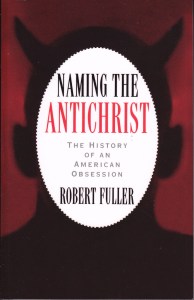
namingantichristI grew up believing in “the Antichrist.” As I came to realize that much of the New Testament pointed to contemporary problems (for them) with the Roman Empire and that what appeared to be predictions were actually safe ways to discuss forbidden topics, I began to worry less. It was about the past, not the future. Recent political events have ratcheted up my anxiety level again—maybe there is such an evil after all. Robert Fuller’s Naming the Antichrist: The History of an American Obsession is an important book in this regard. Although end-time worries have diminished among some now that we’re safely into a new millennium, for the true believer none of that matters. The Antichrist is a great motivator. I hadn’t realized until reading this book just how much of contemporary culture has grown from this fabricated fear.

Let’s get this straight from the beginning. In the Bible there is no figure known as “the Antichrist.” The generalized word antichrist is used only twice and in neither instance is the book in question Revelation. Early Christians speculated that the beast of Revelation might be “the Antichrist” but that identification wasn’t solidified until the beginnings of the Fundamentalist movement in the late 1800s. By the time Fundamentalism was a fully developed system, by about the 1920s, believing in the Antichrist and trying to identify him had become a cottage industry. I grew up in the shadow of Hal Lindsey and the pressing concern that “the Antichrist” was alive in the world today. Face it, The Omen loses something if he isn’t. This strange, non-biblical belief has come to define a large number of true believers.

Fuller’s book is important for the insight he brings into why some “Christians” are avowed enemies of peace, toleration, and the improvement of human conditions. Those who believe their tribe is the only correct one hold the double standard of ethical treatment of those inside and scorn and hatred of those without. This view believes that the world is to be condemned, natural resources used up, wars started, and civil rights suppressed, in the name of Christ. Perhaps you may begin to see why a chill ran down my spine as I was reading this book. We need to try to understand this perverted way of looking at the world in order to understand the forces that would rather see a dictatorial billionaire run the country than an eminently qualified woman. Reason’s got nothing to do with it. It’s all about conviction. Failure to understand that is perhaps the surest way to bring about the end of the world. We ignore religious thought to our own peril.


Hollow Bible

Sleepy_Hollow_-_Title_Card

The proofs for my article on the Bible in Sleepy Hollow are now here. It will be appearing shortly in the Journal of Religion and Popular Culture. For those who know my previous academic work—hi, both of you!—this represents a departure from the familiar for me. Some years back, floundering for a teaching position like a fish that’d flipped out of the acadarium, I talked to a colleague who confirmed what I’d long suspected: study of the biblical text is dying. Face it, nobody cares about J, E, D, and P, or even Q, anymore. We’ve made our point. The Bible is a composite document with many sources that people can still tuck under their arms on the way to the polls. It’s so easy to forget that this text is the basis for so many lives and eternal plans. While we scholars have been arguing with one another, culture has moved on. That’s why I looked at the Bible in “Sleepy Hollow.”

If the Bible isn’t relevant, why bother studying it? If the main character—dare we call him protagonist?—of the New Testament says to turn the other cheek and his “followers” advocate for gun ownership it’s time to ask what went wrong. Scholars know the Bible, but do we know the Bible? Long ago meaning slipped away from academics. Consider science. We can question global warming because the science has become a topic of conversation among specialists that the rest of us can’t hope to understand. Instead of trusting that they know what they’re talking about, we politicize it. Scientific research, even in major universities, is funded by interested third parties. You know, some scholars don’t think there really was even an E after all.

The Bible no longer means what the specialists say it does. I may have spent years of my life and thousands of dollars to speak as an expert, but I soon learned nobody was listening. Meanwhile, culture marches on, somehow supposing if two Corinthians walk into a bar the rich man in his tower makes the best sense, according to the Good Book. Indeed, if you want to find out what the Bible says, all you need to do is head up the Hudson Valley for a season. Or listen to those who hand out tracts and purchase firearms. What could possibly go wrong there? My article will be out in a few weeks. If you’re one of the two who read it keep in mind that there’s more to it than meets the eye.


Found in Translation

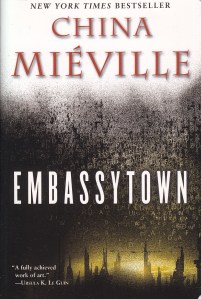
embassytownTraduttore, traditore—“translators are traitors”—is an Italian saying invested with a great deal of truth. Anyone who’s worked with the proliferation of languages in the world knows the truth of the adage. What is said in one language can’t be stated precisely in another language with all the depth and texture of the original. China Miéville’s Embassytown is a sprawling novel that addresses the question of how cultures evolved on widely separated world can ever understand one another. I can’t possibly go into a detailed summary of the story—it took me about 30 pages to begin to understand what was going on—but the book drew me in nevertheless and left me happy to have expanded my conceptual world.

The reason that I’m bringing this novel up in a forum where religion lurks in the background is that Miéville explicitly brings religion into his story. It may be impossible to explain precisely how he does this without the detailed summary that I’ve already begged off giving, but it is nevertheless noteworthy that in any sufficiently complex world religion emerges. We tend to think that religion is something that evolved from the slime and now that we’ve bathed in the light of pure reason it will eventually be washed into the gutter of discarded concepts. History demonstrates repeatedly that such is not the case. Religion is resilient and, dare I say it, inevitable. Human beings—perhaps also other conscious beings—know that there is something outside ourselves. That’s the foot in the door for higher beings or forces or worlds. In a word, religions.

Fiction writers frequently appeal to religions for verisimilitude. Are imaginary worlds believable without religions? It’s a long stretch. Star Wars has characters calling belief in the force a religion. Star Trek, in any number of episodes, dealt with gods. Anathem was based on the monastic ideal. Science fiction has trouble when it leaves religion completely out of the picture. A non-deistic universe is nearly incomprehensible to the human mind. Even great scientists and other rationalists occasionally lapse into thoughts about luck, fate, or fortune. Embassytown doesn’t focus on religion throughout, of course. It may be a minor subplot. But translating an alien world with a language that can’t be understood into a fiction of English is facilitated by putting a religion into the general mix. This is a smart and complex world, but when you read it you’ll find it believable because a religion naturally emerges. And that, I say, is realism.


Cinematic Reality

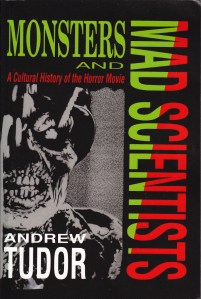
monstersmadEven without the results of the recent presidential election, I would be reading about horror movies. One of the reasons is that I wonder what the appeal might be—why do I put myself in a dark room with an uncertain future? Until recently academics had thought this was something only unreflective, uneducated people did. As is often the case, such as with the electoral college, the numbers tell a different story. Andrew Tudor’s Monsters and Mad Scientists: A Cultural History of the Horror Movie is an example of what happens when a sociologically oriented film critic explores the genre. Although not overwhelming, there are plenty of tables and charts, showing the various trends of horror films from the 1930s up through the mid 1980s. Tudor analyzes what makes us afraid and the main sources of that fear: science, supernatural, and psyche. Since these are all day-to-day things it seems that movies express the basic human condition.

Reading a book published in the ‘80s, however, makes you wonder what might have been missed. We’ve had more than three decades of further horror movies and although categories may be useful, and perhaps even stable, recent events unlock further fears. I suspect there will be a comeback of Nazis in scary movies over the next few years. Horror is, after all, a reflection of those who are willing to be honest about what scares them. There’s plenty of subject matter lying about the headlines of the past weeks.

What I found especially interesting is, at least in the 1980s, statistically the great majority of films featured a supernatural threat. Of these, Tudor notes, the vampire is by far the most popular. We’ve had a dalliance with zombies since then. And I’ve seen plenty of examples where extraterrestrials form the threat. Even ghosts have staged a somewhat unexpected comeback. And movies of demons have proliferated. The supernatural does indeed scare us. I’m not sure that we can quantify it as easily as we used to. Unlike earlier generations of scholars, I’m beginning to see the horror inherent in much of society. We’ve created a scary world with even more scary possibilities. The thing about monsters is they have no sympathy. They are cold, calculating, and all about meeting their own unnatural needs. All the rest of us are just, not to put too fine a point on it, their food. I have a feeling that we’ll be seeing much more of this in days to come.


So Long, Marianne

fullsizeoutput_122f“It’s a cold and it’s a broken Hallelujah.” Leonard Cohen has died. But can you blame him? This seems to be a week for losses. I came to appreciate Cohen’s work long after his best-known songs had been and gone. The interviews with and news stories about him that I’ve read convince me that he was an extraordinary man. Spiritual and sensual, he was a true contemplative. He strove to experience what it means to be human. I sometimes fear we’ve lost that as a goal. I see headlines proclaiming that we can now have chips implanted in our brains—we can become part computer. “You held on to me like I was a crucifix,” he once sang. Who believes in crucifixes anymore? Salvation doesn’t come from above. It comes from self-interest. From business and bank accounts. And that chip in my head.

My wife taught me the value of music therapy. When the forces of darkness gather, listening to music can help you through. Many artists have covered Leonard Cohen’s songs. So much so that some have forgotten who it was that wrote them. A true artist, I suspect, doesn’t mind. Those of us who delve in creativity know that we are more like receivers than gods. It takes worshipers to make a deity. The songs that Cohen wrote were messages to the world. Poetic and deeply personal, they are reminders that being human is okay. In fact, it’s what we’ve evolved to be. I have a feeling we’re going to be needing more poets in the days to come. Someone has to shine the shoes of those who work in Trump Tower. My mind is singing “Chelsea Hotel.” Everybody knows.

Cohen was a reminder that sacred and secular are not so far apart. In fact, they are often difficult to distinguish. There may be a problem when you discover that in seminary, but if you can put it into a song perhaps people will listen. Eras, it seems to me, ought to have anthems. F.D.R., one of the truly great Presidents of the century past, proposed “Happy Days Are Here Again.” I wonder what songs we’ll be associating with the presidency over the next four long years. Will there be any music at all? Far be it from me to proclaim any man a prophet, but can you listen to “First We Take Manhattan” and come to any other conclusion? Go to iTunes, or that chip in your head, and listen. You might just end up singing “Who by Fire” as well.


At the Crossroads

flood_album_cover

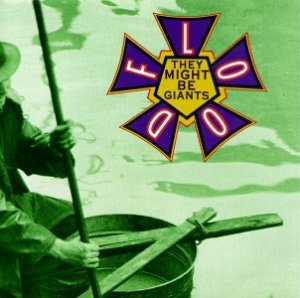
Back before there was iTunes—before Napster was even a thing—I heard a song on the radio. It was by a relatively new band, They Might Be Giants. We lived in Illinois at the time and I was being paid so poorly that we couldn’t afford luxuries like CDs. When I called the local radio station to ask them to play the song (“Birdhouse in Your Soul”) they apologized—they didn’t have the album. “We really should,” the receptionist told me. Although I was only earning a part-time salary—the fate of many a doctorate holder—and my wife was still in school, we eventually bought Flood. It quickly became one of our favorites. One of the songs that immediately struck us both was “Your Racist Friend.” It’s been going through my head lately, for some reason. “I know politics bore you, but I feel like a hypocrite talking to you and your racist friend,” the duo sings. I could quote the entire song, but let me highlight one of my favorite lines: “Can’t shake the devil’s hand and say you’re only kidding.”

I’ve been reading online that some people are saying, “Just get over it. You lost. Deal with it.” Auf Deutsch, “Komm damit klar.” After so many rounds of Kübler-Ross that Elisabeth is getting dizzy in her grave, I’ve begun to realize something. This was no ordinary loss. I’ve been alive long enough to be disappointed with election results several times. The psychological trauma from Tuesday rates somewhere between 9/11 and the Challenger explosion. To put this is perspective, when Reagan won I was depressed for a while, about as much as when the Steelers lost Super Bowl XL, and I’m not a sports fan. I’ve never spent the hours after an election glancing at the faces of others to see if they looked as damaged as I felt. “Just get over it” people?—it’s called shock. “Can’t shake the devil’s hand and say you’re only kidding.”

This was no ordinary election. Yes, I was born in the Kennedy administration. I was too young to understand Camelot, but I’m now old enough to read the writing on the wall. I saw our nation put a man on the moon. I felt the unending frustration of Vietnam. I watched Nixon resign after Watergate. God help us, I even survived two terms of W. I’ve never felt that we were bargaining our soul before. I was at the crossroads at midnight. I know what I saw. Can a man who has openly treated women as objects, insulted people for their race, and advocated thug violence to win lead a unified country? I don’t know. “If anything was broken I’m sure it could be mended,” the song says. Let’s hope so, but let me contemplate the ghost of democracy past. It’s my right.